Deceit at the Hospital of Truth: Surendra Panchal

Guest Post by Surendra Panchal

Sanitation Hospital Workers Strike at a Delhi Hospital over Non-Payment of Minimum Wages

Sanitation workers of the Satyavadi Raja Harishchandra Hospital (The Truthful King Harishchandra Hospital), Narela in Outer Delhi have started an indefinite dharna today, to protest their unjust dismissal when they asked to be paid the statutory minimum wage for unskilled work declared by the Delhi Government, Rs 7254 per month.

Continue reading Deceit at the Hospital of Truth: Surendra Panchal

Good Muslim, Bad Muslim – A Response to Ashish Khetan on the ‘IM’: Warisha Farasat

Guest Post by Warisha Farasat

The recent opinion piece by Ashish Khetan in the Hindu has yet again reiterated the false and malicious stereotype: that Muslims somehow have something or the other to do with terror, either when they are directly involved or when they are silent about others of the community being involved. It is disappointing that the debate is framed in the stereotypical, “good Muslim”, “bad Muslim” tenor rather than a real engagement with issues of shoddy investigation and communal bias that marks terror investigations in the country. Perhaps the greatest disservice that has been done to idea of justice has been linking an entire community to terrorism.

Continue reading Good Muslim, Bad Muslim – A Response to Ashish Khetan on the ‘IM’: Warisha Farasat

A Guantanamo of the Intellect


Close on the heels of the axing by Calicut Uniersity of a poem from an English textbook, for the alleged ‘terrorist links’ of the poet, comes the news of cancellation of a scheduled lecture of Dr. Amina Wadud , a US based Islamic scholar by the authorities of the Madras University.

Calicut University succumbed  to the demand of the ‘Shiksha Bachao Andolan’ , one of the many outfits of the RSS pariva,r that the poem ‘ Ode to the Sea’ be removed from the textbook ‘ Literature and Contemporary Issues’ as its author Ibrahim al- Rubaish was a ‘terrorist’. It was also demanded that the persons responsible for the selection of the poem be identified to ‘uncover’ the network of the ‘sympathizers’ of terrorists in the board of studies and academic council of the university. Continue reading A Guantanamo of the Intellect

Can Happiness and Resistance Go Together? Gowhar Fazili

Guest Post by Gowhar Fazili

Does resistance necessarily have a direct relationship with suffering and inverse relationship with pleasure and happiness? This is a question that is particularly significant for long drawn resistance movements facing a formidable enemy insensitive to and largely unruffled by the exertions of resistance.  The engagement with occupation often involves violent and non-violent struggle.  Both demand sacrifices that warrant shunning of such mundane pleasures and opportunities taken for granted by the populations reconciled with power.  If the struggle extends over multiple decades, it is bound to generate fatigue and disillusionment especially among those who have not voluntarily committed themselves to the life of endless self abnegation even while they may desire freedom from occupation.   While all people want to be free from the indignity of living under occupation and dominance, human nature puts limits on how far individuals and populations may be willing to stretch themselves in their denial of bodily desires and material pleasures that life has to offer.

Continue reading Can Happiness and Resistance Go Together? Gowhar Fazili

Interim report of the Kathikudam Fact Finding Commission THRISSUR, 30 and 31 July 2013

The news of police action against those agitating against the Nitta Gelatine India Ltd.,(NGIL) formally known as Kerala Chemicals and Proteins Ltd.)plant on 21 July 2013 in Kathikudam,Kerala, shocked the members of the civil society of the country. Various organizations across the country have come together in the form of this Commission to look into the matter. The team visited the site of the agitation of the NGIL Action Committee and some of the spots which are affected by the pollution of NGIL. The team also interacted with the affected residents and the members of Kadukutty Gram Panchayat to get a better insight into the pollution that the villagers have been alleging and the event that transpired on 21 July 2013. Continue reading Interim report of the Kathikudam Fact Finding Commission THRISSUR, 30 and 31 July 2013

Terror and the Indian Mujahideen – A Response to Ashish Khetan: Sharib Ali

Guest Post by Sharib Ali

There is something disquieting in what Ashish Khetan has written and said recently on terror in India (in The Hindu and on Tehelka.tv), and centrally within it, the Indian Mujahideen. More so, because it comes from one of the most credible journalist’s today, who has done some commendable work over the years. A journalist I personally respect. But there are several reasons which compel this response. And yet, this is not just a response, but also an attempt to elucidate the many complex processes within which ‘terror’ is located today, and the way the discourse has transformed, and has implications for a people’s negotiated relationship with their state.

Continue reading Terror and the Indian Mujahideen – A Response to Ashish Khetan: Sharib Ali

Minority Report – Deaths followed by Executions : Ramray Bhat

This is a guest post by RAMRAY BHAT

The collective conscience of our prominent democracies works in very strange ways. India is yet to come to terms with the killing of a nineteen-year-old Mumbaiite student Ishrat Jahan in an encounter by officers of the Gujarat Police in collaboration with the Intelligence Bureau. Along with three other individuals, Javed Sheikh (for whom Ishrat worked as a secretary), Amjad Ali Rana and Zeeshan Johar, Ishrat was first announced to have died in police firing and the alleged plan hatched by these four individuals to assassinate prominent politicians of India, thereby thwarted. Inquiries at the level of the Ahmedabad metropolitan magistrate court as well as by the Central Bureau of Investigation (CBI) as directed by the Gujarat High Court confirmed what had been suspected all along, that Ishrat had been murdered in cold blood while she was in police custody. Continue reading Minority Report – Deaths followed by Executions : Ramray Bhat

Gendered Violence and the Hall of Mirrors: Parnal Chirmuley

Guest Post by Parnal Chirmuley

A very young man, who should have been cheerfully devouring the world of ideas over samosas and tea from the canteen, tries instead to hack an equally young woman, his classmate, to death. With an axe, some say. Tries to shoot her too, but the pistol is too stubborn, they say. Then turns the blade and the poison on himself. There he sees success. Succumbs to both.

This leaves behind rivers of blood in the classroom and gashes in the minds of those who witnessed this, bravely intervened, or ran away from it. It leaves everybody entangled in a sea of Gordian knots that are just questions.

Continue reading Gendered Violence and the Hall of Mirrors: Parnal Chirmuley

The Affective Claims of Violence – Reflections on the JNU Campus Tragedy: Pratiksha Baxi

Guest Post by Pratiksha Baxi

Many competing frameworks have given expression to shock, disbelief, rage, grief, guilt and fear after the violence witnessed as the new semester kicked in, with a monumental tragedy, on the JNU campus. Everyone is stunned by the tragic turn of events that has resulted in a young woman battling for her life in a neuro–ICU in Safadarjung hospital. Confusion gripped the campus as the classroom became a scene of crime, a classmate became a bloodied body and the familiar transformed into the incomprehensible. It was devastating that the assailant, who succeeded in extinguishing his own life, aimed to unite in death the object of his obsession through a planned and highly performative act of violence in the routine setting of a classroom.

Continue reading The Affective Claims of Violence – Reflections on the JNU Campus Tragedy: Pratiksha Baxi

People’s Victory Against Chutka (Madhya Pradesh) Nuclear Power Plant: Lokesh Malti Prakash

Guest Post by Lokesh Malti Prakash

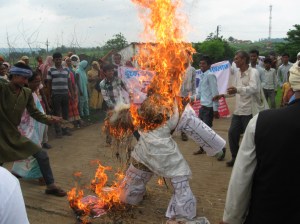
The People of Chutka and adjoining villages in Mandla district of Madhya Pradesh won another victory against the Chutka (Madhya Pradesh) Nuclear Power Plant (being imposed on them by Congress-led Central government in active collusion with BJP-led state government) as the government was forced for the second time to postpone its farcical public-hearing on the project that was scheduled on 31st July. After a sustained protest by people of the region that was actively supported by almost every section of left-democratic forces in the state and beyond, the district administration called off the public-hearing on 29th July.

Burning the Effigy of Nuclear Power at Chutka

Continue reading People’s Victory Against Chutka (Madhya Pradesh) Nuclear Power Plant: Lokesh Malti Prakash

आत्ममुग्ध क्रांतिकारिता और वरवर राव : अपूर्वानंद

हर वर्ष इकतीस जुलाई को दिल्ली में ‘हंस’ पत्रिका की ओर से किसी एक विषय पर एक विचार-गोष्ठी का आयोजन किया जाता रहा है. बातचीत का स्तर जो हो, यह एक मौक़ा होता है तरह-तरह के लेखकों, पाठकों और साहित्यप्रेमियों के एक-दूसरे से मिलने का. कई लोग तो वहीं सालाना मुलाकातें करतें है. मेरी शिकायत हंस के इस कार्यक्रम से वही रही है जो दिल्ली में आमतौर पर होने वाले हिंदी साहित्य से जुड़े अन्य कार्यक्रमों से है: इंतजाम के हर स्तर पर लापरवाही और लद्धड़पन जो निमंत्रण पत्र में अशुद्धियों और असावधानी से लेकर कार्यक्रम स्थल पर  अव्यवस्था, मंच संचालन में अक्षम्य बेतकल्लुफी तक फैल जाता है.प्रायः वक्ता भी बिना तैयारी के आते हैं और जैसे नुक्कड़ भाषण देकर तालियाँ बटोरना चाहते हैं.ऐसे हर कार्यक्रम से एक कसैला स्वाद लेकर आप लौटते हैं. श्रोताओं के समय, उनकी बुद्धि के प्रति यह अनादर परिष्कार के विचार का मानो शत्रु है. मैं हमेशा अपने युवा  छात्र मित्रों को ऐसी जगहों पर देख कर निराशा से भर उठता हूँ : ये सब यहाँ से हमारे बारे में क्या ख्याल लेकर लौटेंगे?

यह भी हिंदी के कार्यक्रमों की विशेषता है कि जितना वे अपने विषय के कारण नहीं उतना आयोजन , आयोजक और प्रतिभागियों के चयन से सम्बद्ध इतर प्रसंगों के कारण चर्चा में बने रहते हैं. चटखारे लायक मसाला अगर उसमें नहीं है तो शायद ही मंच पर हुई ‘उबाऊ’ चर्चा को कोई याद रखे. अक्सर सुना जाता है कि फलां को तो बुलाया ही इसलिए गया था कि  विवाद पैदा हो सके. विवाद अपने आप में उतनी भी नकारात्मक चीज़ नहीं अगर उससे कुछ विचार पैदा हो. लेकिन प्रायः विवाद और कुत्सा में अंतर करना हम भूल जाते हैं. विवाद में फिर  भी मानसिक श्रम लगता है, कुत्सा में मस्तिष्क को  हरकत में आने की जहमत नहीं मोल लेनी पड़ती. Continue reading आत्ममुग्ध क्रांतिकारिता और वरवर राव : अपूर्वानंद

Unrequited love or simply ‘self love’? – Reflections in the wake of a Campus Tragedy at JNU: Shivani Nag

Guest Post by Shivani Nag

In the days following the brutal rape and murder of a young woman in December last year, I remember waking up each day and being out on the streets raising slogans on women’s freedom and liberation. For months after that, there were a series of mobilizations, vigils, parades and protests, and my strongest recollection of those events is the resounding reverberation of ‘mahilaayein maangi azaadi… khaap se bhi azaadi aur baap se bhi azaadi, shaadi karne ki azaadi aur na karne ki azaadi…’. It WAS about justice for that one woman, but it wasn’t ONLY about that… it was also about many other such women – some forgotten, some not, some dead and some still around… it was also about all women, demanding not just justice but their right to life as equal citizens. We did not come out on the streets to be told how to be safe, but to convey it loud and clear that we cannot spend our entire lives trying to be safe without actually getting to live it. We came out to demand and defend our right to choice!! Continue reading Unrequited love or simply ‘self love’? – Reflections in the wake of a Campus Tragedy at JNU: Shivani Nag

The Changed Face of the Newsroom: Monobina Gupta

 Guest post by MONOBINA GUPTA. DelhiUniversity teachers are fighting back to hold on to the fast vanishing autonomy of academics and academia. For me, this is a significant moment. Not just because the teachers are setting an example in their refusal to submit to the destructive moves disguised as ‘reform’, slammed through by well-connected and powerful authorities at the top. I must confess to my own selfish reasons for celebrating this moment. As a journalist, I can’t but think of all that we too could have held on to had only we walked this path of resistance, stalled the first assault on the newsroom, resisted the first strike, shrinking what I would describe as our ‘journalistic territory.’

Had we moved in that difficult yet honourable direction, we too might have guarded our space, not allowed non-journalists to take it over, bit by bit. Is it too late to recover and reclaim what was once an autonomous, if not a radical newsroom? Maybe. Maybe not.

For journalists like me who entered the newsroom in the 1980s, it’s the transformation of that space that I find both fascinating as well as frightening, in equal measure. Tune out the deafening noise of  24×7 news – cut the frills – journalism emerges in all its bare bones as the craft it really is or should be: an incisive tool for chronicling and analysing events. Ring side spectators or distant observers, members of the media, under all circumstances, are supposed to have their ear to the ground. In an ideal world, these couriers of news – mostly nasty and brutish these days – shouldn’t be attuned to corporate boardroom culture or its fiat.  Continue reading The Changed Face of the Newsroom: Monobina Gupta

Beyond Reasonable Doubt? The Conviction of Shahzad Ahmad: JTSA

Guest Post by Jamia Teachers’ Solidarity Association ( JTSA ), Delhi.

Beyond Reasonable Doubt? The Conviction of Shahzad Ahmad is a detailed analysis and critique by the Jamia Teachers’ Solidarity Association of the judgment awarded on the 25th of July by the 2nd Additional Session Judge, Delhi-South East (Saket) Court in the ‘State vs. Shahzad Ahmad@Pappu’ case, also known as the ‘Batla House Encounter’ case. Yesterday, on the 30th of July, the judge confirmed his verdict of ‘guilty’ and awarded Shahzad Ahmad the punishment of imprisonment for life and a fine of Rs. 95,000/-. The JTSA, which has been following the Batla House Encounter since 2008 presents its findings on the trial in this booklet, and disputes the guilty verdict awarded to Shahzad Ahmad. Kafila is carrying this publication (as part of a series of posts on the Batla House Encounter) as a downloadable pdf format file.

The Batla House Judgement and the Impossibility of Closure

The word ‘closure’ has a reassuring, comforting resonance, particularly when it comes to matters of death. One achieves closure. It is granted.  Those who are fortunate receive it as recompense for the necessary tasks of grief and mourning. We move on.

On the 25th of July, last week, after Rajender Kumar Shastri, 2nd Addiitional Sessions Judge of the South East (Saket) Court in New Delhi announced in open court that a young man named Shahzad Ahmad of Khalispur village in Uttar Pradesh’s Azamgarh Disttrict was guilty of causing the death of Inspector Mohan Chand Sharma of the Special Cell of the Delhi Police in Flat No. 108, L-18, Batla House, in South Delhi’s Jamia Nagar on the 19th of September, 2008, the word ‘closure’ began to ring out on prime time television.  We were given to believe that the infamous ‘Batla House Encounter’ case had finally achieved closure. That the ‘martyrdom’ and sacrifice of Inspector Mohan Chand Sharma had now been vindicated. That all unseemly controversy could now be put to rest. We were told that it was time to move on.

Continue reading The Batla House Judgement and the Impossibility of Closure

आतंकवादी कविता के विरुद्ध युद्ध: अपूर्वानंद

‘शिक्षा बचाओ आन्दोलन’ ने आतंकवाद के खिलाफ अंतर्राष्ट्रीय युद्ध में नई जीत हासिल की है. वह कालीकट विश्वविद्यालय के स्नातक स्तर की  अंग्रेज़ी की पाठ्यपुस्तक –‘लिटरेचर एंड कंटेम्पररी इश्यूज’ से ‘अल कायदा से जुड़े एक आतंकवादी’ इब्राहिम अल रुबाईश की कविता ‘ओड टू द सी’ को निकलवा देने में सफल रहा है.  आन्दोलन की केरल इकाई के सचिव ने इस कविता को पाठ्यपुस्तक में शामिल करने को ‘गंभीर मामला’ बताते हुए कहा था कि किताब को वापस लेने और विश्वविद्यालय द्वारा माफी माँगने के बाद इसकी जांच होनी चाहिए कि ‘बोर्ड ऑव स्ट्डीज़’ और अकेडमिक काउन्सिल’ में आतंकवादियों के समर्थक कौन हैं जिससे इस तरह की सामग्री के चुनाव के पीछे की साजिश का पर्दाफ़ाश हो सके.

कुलपति ने फौरन अपने डीन प्रोफ़ेसर एम.एम. बशीर को मामले की जांच करने को कहा. उन्होंने कहा कि ऊपर से निर्दोष लगने वाली इस  कविता में रुबाइश ने अत्यंत अर्थगर्भी प्रतीकों का इस्तेमाल किया है जो खतरनाक भी हो सकते हैं.मसलन, उसने ‘फेथलेस’ शब्द का प्रयोग किया है जो अरबी शब्द ‘काफिर’ का अंग्रेज़ी अनुवाद है. फिर जैसा आज का अकादमिक रिवाज है, वे इंटरनेट पर गए और पता किया कि इस कवि  ने अमरीका के खिलाफ जंग का आह्वान भी किया था. भला इसके बाद और सोचने की ज़रूरत ही क्या रह जाती है?पाठ्यपुस्तक के संपादकद्वय में से एक ने लगभग माफी माँगते हुए कहा कि डेढ़ साल पहले इसे संपादित करते वक्त रुबाइश के बारे में ज़्यादा सामग्री ‘ऑनलाइन’ मौजूद न थी. अगर उन्हें कवि के  राजनीतिक रुझान  का जरा भी अंदाज होता तो वे इसे कतई न चुनते. Continue reading आतंकवादी कविता के विरुद्ध युद्ध: अपूर्वानंद

GUANTANAMO II : K Satchidanandan

This is a guest post by K SATCHIDANANDAN

A poem by Ibrahim al-Rubaish, a Guantanamo Bay prisoner written in the tragic circumstances of illegal incarceration  has given rise to a baseless controversy in Kerala as it was included in a section titled ‘Literature and Contemporary Issues’ of the English  text book for the third semester undergraduates in the University of Calicut. The poem was recommended for inclusion by the Board of Studies chaired by Dr K. Rajagopalan, and rightly so as the section dealt with creative writing based on contemporary issues including the issue of human rights. The poem goes like this: Continue reading GUANTANAMO II : K Satchidanandan

The BJP’s very own Stalin

Yashwant  Sinha is a worried man these days. He is apprehensive of his leader Narendra Modi being taken for a ride by the Congress party. He says that the Congress party is laying a trap for him, a trap of the binary of Communalism and Secularism and  fears that his upward looking Narendra Modi might fall in it. So, well  wisher that he is of Narendra Bhai, he wants to alert him: do not get  entangled in the conspiracy of the wily Congress. He appeals to Narendra Modi to stick to people’s issues and not let the political discourse  shift to the terrain of the Secularism  versus Communalism debate. Continue reading The BJP’s very own Stalin

Lok Sabha elections, software imperialism and the Urdu language: Anant Maringanti

Guest post by ANANT MARINGANTI. Kapil Sibal may have unwittingly erased a whole historical geography of pre-windows software development in India. If the Times of India report on the release of Urdu fonts developed by National Council for Promotion of Urdu Language ( NCPUL) last week is accurate,  Sibal said that India developed Urdu Software and fonts and thereby ended a longstanding dependency on Pakistan. This, according to him is beneficial to the 15 crore Urdu language users. There is a  ‘pre-election Muslim wooing’ feel to the story which nicely blends with the  ‘massaging of Indian (read Hindu) nationalist pride’ feel.  The sense of triumph and pride at this historic achievement by Indian programmers would have been justified even if it could be read as symptomatic of the postcolonial condition that Amitav Ghosh captures in his recounting of the breakdown of conversation between himself and the Imam of Lataifa and Nashawy.  Unfortunately however, Urdu language users in India were never dependent on Pakistan for software and fonts.  This can be said in two different senses: first that Indian Urdu language computing originated in Hyderabad almost 25 years ago and has contributed significantly to local cultural economy. Second, to the extent that there has been exchange between India and Pakistan in Urdu language computing, the participants in that exchange have seen it primarily in terms of exchange. Afterall, people cannot help making language tools even if nation states do not pay them much attention.    Continue reading Lok Sabha elections, software imperialism and the Urdu language: Anant Maringanti

मुकदमा क्या सिर्फ मीना कुमारी पर चले ?: अपूर्वानंद

मीना कुमारी पुलिस हिरासत में हैं.उन पर भारतीय दंड संहिता की धारा 302 और 120 के तहत मामला दर्ज किया गया है. यानी उन पर छपरा के गंडामन गाँव के नवसृजित प्राथमिक विद्यालय में पढने वाले तेईस बच्चों की ,जो स्कूल का मध्याह्न भोजन खाने के बाद मारे गए, इरादतन ह्त्या और उनकी ह्त्या के लिए आपराधिक षड्यंत्र का आरोप है.उन पर मुकदमा चलने और साक्ष्यों के स्थापित होने के  पहले ही बिहार के मुख्यमंत्री ने अपने दल के कार्यकर्ताओं के समक्ष शिक्षा मंत्री के षड्यंत्र के सिद्धांत को दुहराया है. आज , जब मैं जनसत्ता में छपी अपनी टिप्पणी को देख रहा हूँ, मुख्यमंत्री ने इसे दुर्घटना मानने से इनकार किया है. लेकिन वे इसे बाहरी साजिश का नतीजा मानते हैं. पहले ही इशारे किए जा चुके हैं. मीना कुमारी के पति के राष्ट्रीय जनता दल से सम्बन्ध की बात बार-बार कही जा रही है. कहा जा रहा है कि दुर्घटना वाले दिन वह स्कूल आया था और यह भी कि भोजन सामग्री की खरीदारी वही किया करता था. पहले यह खबर लगातार चलाई गई कि भोजन-सामग्री उसकी दुकान से खरीदी जाती थी. सच यह है कि उसकी कोई दुकान नहीं है. यह भी कोई  नहीं पूछ रहा कि आखिर मीना कुमारी का पति  सामान न खरीदता तो और कौन था यह काम करने वाला? क्या यह काम भी मीना कुमारी को ही करना चाहिए था?

मीना कुमारी की तस्वीर खलनायिका की बन चुकी है: रसोई बनाने वाली के संदेह के बावजूद  खाना उसी तेल में बनाने और फिर बच्चों की हिचक के बाद भी उन्हें खाने को मजबूर करने वाली औरत हत्यारी नहीं तो और क्या हो सकती है! Continue reading मुकदमा क्या सिर्फ मीना कुमारी पर चले ?: अपूर्वानंद

The media monster of the juvenile offender: Enakshi Ganguly and Anant Asthana

This is a guest post by ENAKSHI GANGULY and ANANT ASTHANA

July 17 was an important day. Supreme Court announced its judgment refusing to interfere with the Juvenile Justice Act. This was with respect to the eight petitions that were filed in the wake of the alleged involvement of a juvenile in the rape and murder of a 23 year young girl on December 16, 2012. The boy, who was found to be below 18 years, was described by the media as the most heinous of the rapists, a monster and a beast, and even the main accused—and this even before the police had filed the charge –sheets based on statements of the witnesses and evidence gathered. Should there be a fair judicial process that decides the case based on scrutiny of relevant facts or should we let media undertake a trial? Continue reading The media monster of the juvenile offender: Enakshi Ganguly and Anant Asthana

DISSENT, DEBATE, CREATE