
Some of the stronger protests and forceful political debates in Sri Lanka are taking place in relation to student rights, university teachers pay, allocation of government expenditure on education and inequalities relating to the Government’s private university bill. University students have been on the boil over issues from militarisation of the universities, including compulsory military training for entering university students last year, to attempts to ban student unions. University teachers carried out strike action for months last year extracting promises of higher pay and input into educational policy which were not carried forward with the Budget, leading to a token strike on January 17th. I wrote an article on the neoliberalisation of university education in the Sunday Island on Jan 15th discussing the larger project at work with the backing of the World Bank and IMF. Kumar David has written an article in the Jan 22nd issue of the Sunday Island explaining the z-scores scandal – about the Advanced Level exam results which are used for university entrance – and its relationship to the protests against the private university bill. The Young Asia Television in their episode of Connections today has documented the recent protests including some interviews with student leaders and university teachers. The uteachers blog is an excellent resource to find more articles and presentations by academics involved in the recent protests and actions. Historically, the universities have been a hot bed of protest as well as social and political change in Sri Lanka, and those in solidarity with progressive forces struggling for social justice in Sri Lanka may want to follow the protest movement gaining ground in the universities.
The Gandhi Chawl Incident: Meena Menon
This guest post by MEENA MENON is an extract from her recently published book, Riots and after in Mumbai- Chronicles of Truth and Reconciliation
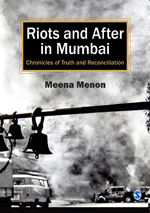
It was all in the eyes. Beneath the finely drawn brows, they were haunted and distant. For Naina Bane, the night of 8 January 1993 will remain a night of absolute terror. Her escape was miraculous as was her recovery. It took me several months and wrong leads before I met her finally at a family reunion in the suburbs. Dressed in a long mustard coloured ‘maxi’, her hair was drawn back tightly. I found it hard to recognize the same girl who was almost burnt alive on that fateful night in Gandhi chawl. Now 40, there is a faraway look about her and her eyes widen when I ask to speak to her. She got married in 1996 and lives outside Mumbai. Her 6-year-old son keeps her busy. Her husband worked for a mill which closed down, a typical story in Mumbai. He was a badli (temporary worker) and he lost his job. He now works as a watchman. Continue reading The Gandhi Chawl Incident: Meena Menon
The Book of Mothers: P K Medini
“P K MEDINI still recollects the day when she first sang for the election campaign of the Communist party. Now, six decades later, the spirit isn’t one bit lost for the veteran singer. Medini, 78, says she sang first for Communist leader T V Thomas. Since then, she had been a regular presence at the election campaigns of the Communist party.” From expressbuzz April 1, 2011
Delhi-based journalist JACOB SEBASTIAN sent us his translation of a piece by PK Medini in Malayalam (published in the journal Mathrubhumi earlier this month ), along with a background note that he wrote for our readers.
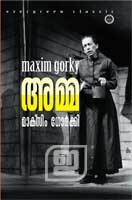 The following piece was written by P.K. Medini, the one-time ‘singing sensation’ of the Communist Party in Kerala. It originally appeared in the Matrubhumi Weekly, as part of a series where people talk about their favourite books. It offers a glimpse of a time and place where literature and books and the whole culture of reading, mattered in an urgent and vital way.
She gives us an intimate snapshot of the new reading culture at the time when it was putting down its first tentative roots. For someone who readily admits that her own reading was ‘impoverished’, she shows a keen awareness of the power of ideas – and of books as objects of an almost talismanic power – andreveals their absolute centrality to the social and political transformations of the time.
If such a thing is unimaginable to us today, even more unexpected are the ways in which it actually played out – the many tortuous routes the word had to take before it could become flesh (she calls it ‘social reading’). She also has a sharp eye for how political propaganda actually works ‘on the ground’. Along with other movements, Medini’s party too can take some credit for the fact that life in Kerala isn’t so desperate today that a society could catch fire from a book.
Jaipur Literature Festival – Requiescat in Pacem
Did you know that the law had four corners? I didn’t, but whosoever writes press releases for the Jaipur Literature Festival does. Did you know that the ‘ideas can be exchanged and literature loved‘, ‘strictly‘ within these four corners? I didn’t, but whosoever writes press releases for the Jaipur Literature Festival does.
PRESS RELEASE SENT OUT BY THE JAIPUR LITERATURE FESTIVAL, January 20th, 2012
This press release is being issued on behalf of the organizers of the Jaipur Literature Festival. It has come to their attention that certain delegates acted in a manner during their sessions today which were without the prior knowledge or consent of the organizers. Any views expressed or actions taken by these delegates are in no manner endorsed by the Jaipur Literature Festival. Any comments made by the delegates reflect their personal, individual views and are not endorsed by the Festival or attributable to its organizers or anyone acting on their behalf. The Festival organizers are fully committed to ensuring compliance of all prevailing laws and will continue to offer their fullest cooperation to prevent any legal violation of any kind. Any action by any delegate or anyone else involved with the Festival that in any manner falls foul of the law will not be tolerated and all necessary, consequential action will be taken. Our endeavor has always been to provide a platform to foster an exchange of ideas and the love of literature, strictly within the four corners of the law. We remain committed to this objective. [via FirstPost]
Continue reading Jaipur Literature Festival – Requiescat in Pacem
‘सलमान रूश्दी के कार्यक्रम रद्द होने पर निराशा’; PUCL regrets cancellation of Salman Rushdie’s visit to Jaipur
Given below is the text of a press statement issued today by the PEOPLE’S UNION FOR CIVIL LIBERTIES, Rajasthan. The Hindi original is followed by an English translation.
प्रेस विज्ञप्ति
सलमान रूश्दी के कार्यक्रम रद्द होने पर निराशा
दिनांक: 20.01.2012
सलमान रूष्दी के जयपुर आने के कार्यक्रम के सम्बन्ध में जब कंछ मुस्लिम संगठनों ने हिंसक विरोध की चेतावनी दी थी तभी पी.यू.सी.एल. ने तुरन्त उसके विरोध में अपना वक्तव्य दिया था और कुछ प्रभावषाली मुस्लिम संगठनो तथा उस समाज के प्रबुद्ध नागरिकों से सम्पर्क कर उनसे विस्तृत चर्चायें की थीं। उन्होने भी हमारे दृष्टिकोण को समझा था और किसी प्रकार के हिंसक विरोध के सम्बन्ध में अपनी असहमति भी प्रकट की थी। परन्तु वह सलमान रूष्दी का जयपुर आगमन पर अपने विरोध के स्वरो को मुखरित करने के अधिकार को सुरक्षित रखना चाहते थे। इसमें कोई आपत्ति भी नहीं हो सकती थी परन्तु ऐसे विरोध की सीमायें कहॉं तक हांेगी इस पर चर्चा जारी थी। इसी बीच सरकार की ओर से यह वक्तव्य दिया गया कि सलमान रूष्दी के आने से कानून और व्यवस्था की स्थिति बिगड़ सकती है। इसलिए उनके आने पर पाबंदी लगाने पर विचार किया जा रहा है। पी.यू.सी.एल. ने सरकार के इस रवैये का जमकर विरोध किया था और इस पर एक प्रदर्षन भी आयोजित किया था। मुस्लिम संगठनों से इसके बाद विस्तृत चर्चा हुई और उन्होने भी यह स्वीकार किया कि कानून और व्यवस्था की स्थिति नहीं बिगड़ने देगें। लेकिन लगता है कि सरकारों को यह प्रयास रूचिकर नहीं लगे और आज सलमान रूष्दी ने ई-मेल सन्देष भेेजकर अपना कार्यक्रम रद्द करते हुए यह कहा है कि उन्हें राज्य सरकार से सन्देष प्राप्त हुआ है कि कुछ उग्रवादी तत्व किसी अन्य प्रदेष से आकर उनकी जान लेने की कोषिष कर सकते हैं। हंालाकि उन्होने स्वयं इस प्रकार की खबर को सन्देहात्मक बताया है परन्तु अपना कार्यक्रम रद्द करने का यही कारण बताया है। Continue reading ‘सलमान रूश्दी के कार्यक्रम रद्द होने पर निराशा’; PUCL regrets cancellation of Salman Rushdie’s visit to Jaipur
The BSF as Pornographer: Bravehearts with Bluetooth
So, this is how the borders of the Republic of India are also defended. With sticks, ropes and bluetooth enabled mobile phones. Eight soldiers of the Border Security Force, hold down a young Bangladeshi man accused of cattle smuggling. He is stripped naked, hogtied and then thrashed. He screams in agony and humiliation. The soldiers act as if they are out on a picnic. They discuss whether or not to give him some tea. Where to hurt him, on which body parts. How big a stick to use on him. Someone says “cut his ear off”. They stroll casually around him as he is humiliated. They laugh. He cries, as people usually do in these circumstances, and seems to call for his mother. Someone, probably one of the soldiers, records it all on video, on the 9th of December, 2010, somewhere along the Indo-Bangladesh border in Murshidabad, West Bengal
Continue reading The BSF as Pornographer: Bravehearts with Bluetooth
Le Grande Triptych Humanism: Brinda Bose and Prasanta Chakravarty
Guest post by BRINDA BOSE and PRASANTA CHAKRAVARTY
Haruki Murakami’s much-hyped IQ84 that released worldwide in translation a couple of months ago is (Our) Big Fat Japanese Novel, three volumes in one. Closer home, Amitav Ghosh is in the process of completing the definitive South Asian Maritime Novel in trilogy. Young, prize-winning, promising writers from around the world – New Zealand, Malaysia, Bangladesh – are pledged to regale us with long large narratives that will tell us everything we ever wanted to know about their cultures, societies, lives – in trilogies and quartets. Intriguing? Indeed. Coincidental? Perhaps not.
Even as new literary canons are continually in consolidation, interrogation and re-formation, Franco Moretti – acclaimed, revered, preeminent theorist of the Novel and World Literature (which enjoy an odd synecdochic relationship) – has systematically constructed a blueprint for ways to appreciate the worth of such a grand, if loose, canon as World Literature by a particular reading technique he calls ‘distance-reading’.
Continue reading Le Grande Triptych Humanism: Brinda Bose and Prasanta Chakravarty
Open Letter to Haryana CM on Forced Land Acquisition for Gorakhpur Nuclear Power Plant, Fatehabad

Farmers of Gorakhpur village hold a protest in Fatehabad against acquisition of their agricultural land by the Haryana government for a nuclear power plant in the area, August 2010. (The Tribune on-line)
January 16, 2012
Bhupinder Singh Hooda,
Chief Minister, Haryana
Chandigarh
Dear Mr. Chief Minister,
It was with gravest concern and misgivings that we heard of Section 9 of the Land Acquisition Act, 1894, being issued in Fatehabad, Haryana, to forcibly acquire land for the proposed Gorakhpur Nuclear Power Plant Project. This action by the Harayana State Govt. is completely unacceptable on the following two counts:
Farmers of Gorakhpur and nearby villages have been sitting in continuous opposition to the proposed nuclear power plant from August 2010. They are fighting for their right to life, livelihood and to safeguarding their fertile and irrigated, three-crop land, all of which will be severely threatened if the project were passed. The fact that a community is in such a long drawn and strong opposition to this project, is of crucial concern and cannot be ignored arbitrarily or repressed in democracy. Continue reading Open Letter to Haryana CM on Forced Land Acquisition for Gorakhpur Nuclear Power Plant, Fatehabad
Satanic Versus Moronic: How Salman Rushdie Lost the UP Election
Oh, It’s silly season again. (Has it ever not been silly season? Silly me for making a silly rhetorical opening to this post). Anyway folks, aam aur khas janta, baba log and bibi log, it’s time, once monotonously again, for quarantines and piety, for bans and shoe-throwing contests, for frothing at the mouth and froth on the telly. Its Rushdie-Nasreen-Husain Time, again! Ta-Raa! And like a ‘sanjog’ made by a pretend-god in a made up marquee heaven, the stars of ‘Rushdie Time’ are crossed with the suddenly brightly shining stars of what would have otherwise been a lackluster, effigy-tarpaulined, mid-winter provincial election. Ta-Rant-Ta-Raa! Not even a Saleem Sinai or a Gibreel Farishta, let alone a jeeta-jagtaa Salman Rushdie in his weirdest magic-realist moment could have imagined himself mixed up in a plot as diabolical as this one. If this was a court case we could call it Satanic versus Moronic. Whatever it is, there is no denying that it is a P2C2E – a ‘Process Too Complicated To Explain’. But explain we must. Process we can. Pyaar kiya to darna kya?
Continue reading Satanic Versus Moronic: How Salman Rushdie Lost the UP Election
PUCL condemns those opposing Salman Rushdie’s visit to Jaipur
This release comes from the PEOPLE’ S UNION FOR CIVIL LIBERTIES, RAJASTHAN
16 January 2012, Jaipur: PUCL strongly condemns Muslim organisations, the Congress and the BJP for opposing Salman Rushdie’s proposed visit to Jaipur
Some Muslim organisations have opposed Salman Rusdie’s participation in the Jaipur Literature Festival. Leaders of the Congress and the Bhartiya Janta Party have also come out strongly in opposition to Rushdie’s visit. Some newspaper reports have carried announcements that Rushdie could be forcibly prevented from coming and attending the literary event.
The opposition is not merely ideological but is also by threatening to disturb law and order. The Rajasthan unit of the PUCL expresses deep concern at such announcements. Such regressive threats are not only an attack on the individual’s right to freedom of speech and expression and a violation of rights granted by the Constitution of India. Such threats also promote communal disharmony, if not deliberately seek to widen communal rifts. Continue reading PUCL condemns those opposing Salman Rushdie’s visit to Jaipur
Paramakudi – Six Poems: Ravikumar
In September last year, the Tamil Nadu police killed six Dalits in a firing incident in Paramakudi town of Ramanathapuram district. This guest post by RAVIKUMAR is a set of six poems on the Paramakudi killings. The English translation by RAVISHANKER is followed by the Tamil original. For more on the incident, see articles in Kafila archives by V. Geetha and Bobby Kunhu and over at Atrocity News, a fact finding report (.pdf).
Tribute to Homai Vyarawalla, India’s first woman photojournalist
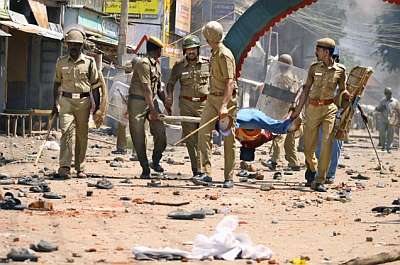
Homai Vyarawalla passed away at the age of 98 yesterday. We reproduce here the curator’s note written by cinematographer SABEENA GADIHOKE, biographer and friend of the legend, on the occasion of her staging a retrospective of Vyarawalla’s work at the National Gallery of Modern Art in 2011.
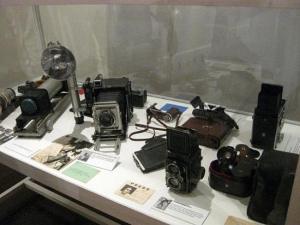
Having worked for thirty three years of her life Homai Vyarawalla gave it all up one day. Why did she give up photography?
Often meant for a fleeting glimpse in the newspaper, press photographs become visual archives of the future. Homai Vyarawalla’s photographs chronicling the defining moments of India’s Independence have acquired an iconic status and are now integral to a Nationalist version of history. According to this version, some people led and others followed. As important people dominated photographs, ordinary citizens or `the masses’ frequently found themselves relegated to the margins. Sometimes, they would be `cropped’ from the frame to accommodate more prominent figures.
Continue reading Tribute to Homai Vyarawalla, India’s first woman photojournalist
Engaging Lankans in Black Politics on MLK Day
In approaching Martin Luther King Jr., Day, I inevitably think about the politics of figures and the generation of King and Malcolm X. That generation and the Black politics they engendered had a lasting impact on the US and the World more broadly. Coming with decolonisation in Africa and elsewhere, King, Malcolm X, the radical youth they inspired and their contemporaries such as Frantz Fanon and C.L.R. James transformed our conceptions of race and class, advancing anti-imperialist and anti-colonial visions to engage formidable questions of Black politics in the West. In a piece written with Jinee Lokaneeta as part of the monthly column ‘Beyond Boundaries’ of the South Asia Solidarity Initiative (SASI), in the South Asian Magazine for Action and Reflection (SAMAR), we began with Manning Marable and C.L.R. James, and the importance of a turn towards critical solidarity engaging questions of race and class.
Here, I want to think about the contributions of South Asian intellectuals, or more specifically Lankan intellectuals in the context of Black and Third World politics. In fact, there are two major Lankan intellectuals belonging to that generation of King and Malcolm X, who are increasingly not known to the younger generations of Lankans. A. Sivanandan, the editor of Race and Class and Director of the Institute of Race Relations in London and the late Archie W. Singham, long-time intellectual and professor based in New York are two such figures who have made a major mark in Black politics. Indeed, they can give us a sense of the possibilities of political struggle and the historical and philosophical potential of Black politics. It is my contention that engaging the politics of Sivanandan and Singham is all the more important at the current moment, as South Asians in the Diaspora are increasingly becoming agents of Western power despite the shifting terrain of politics in the West with the global economic crisis. Continue reading Engaging Lankans in Black Politics on MLK Day
Fear, Safety and Livelihood: The Biopolitics of Mullaperiyar: T. T. Sreekumar
Guest post by T. T. SREEKUMAR
The Mullaperiyar Dam controversy embodies a concrete and complex example of the imperial matrix of biopolitical legacy that post-colonial societies continually encounter even after decades of political independence. More than a century ago, the British colonial Government administering Madras Presidency, which included parts of Tamil Nadu State, directed the erstwhile princely state of Travancore (which forms the southern districts of Kerala) to sign an agreement to divert water from the Periyar river in Travancore to the relatively arid zones adjoining the Western Ghats within the presidency, and to lease out a large tract of its territory for the construction of a Dam for a time span of 999 years. In the post-independence period, two supplemental agreements to the original Lease Deed of 1886 have been signed between the Madras government and the Government of Kerala regarding fishing rights and generation of hydroelectric power, the former in favour of Kerala and latter favouring Tamil Nadu. The supplementary agreements negotiated and enhanced the annual lease rent and the rate of pay for the electrical energy generated.
Continue reading Fear, Safety and Livelihood: The Biopolitics of Mullaperiyar: T. T. Sreekumar
Partition Revisited: 2 October 2011, Rudrapur
This is a film by RAJEEV YADAV and SHAHNAWAZ ALAM of the Uttar Pradesh unit of the PEOPLE’S UNION FOR CIVIL LIBERTIES
This is to introduce our documentary film ‘PARTITION REVISITED’ on the Rudrapur riot of 2nd October 2011, where four persons were killed. Policemen and mobs led by leaders of the Bhartiya Janta Party, the Congress and the Bahujan Samaj Party had ransacked shops and settlements of Muslims in their third successful attempt within two years to stoke communal violence. The riot, which took place on Gandhi Jayanti, led to a massive outmigration of the victimised community, reminding one of the days of the 1947 Partition. This film focuses on precisely this yet unnoticed phenomenon that we could trace out in this first-ever state-sponsored communal riot since the formation of the hill state of Uttarakhand, engineered by the Rashtriya Swayamsewak Sangh, which has been working for a long time in this area to arouse anti-Muslim sentiments in the Bengalis, Sikhs & Panjabi Hindus who settled in Rudrapur after the Partition to India. At a time when the state is going to polls this riot assumes an electoral importance.
Women’s groups stopped from meeting Soni Sori in Raipur
Press statement from Saheli, Delhi; Women Against Sexual Violence and State Repression (WSS), Delhi; WSS Orissa and Madhya Pradesh Mahila Manch, Bhopal.
A team of women representing various women’s groups from across the country were in Raipur on 12-13th January to meet Ms. Soni Sori, currently lodged in Raipur Central Jail. Ms Sori is a tribal school teacher who has been hounded by the Chhattisgarh Police as a Maoist conduit. She was arrested in October 2011 and was brutally assaulted sexually in police custody on the night of 8-9th October.
Even after applying for permission as per procedure and repeated requests to various concerned officials on 12th, the women were denied permission to meet her, despite already having an assurance from the Principal Secretary, Mr. Baijendra Kumar, during his visit to Delhi in October.For two whole days the team was shuttled from one authority to the other and back, with each and every official avoiding taking a decision or give in writing any denial or reasons for it. Finally, permission was denied on 13th citing `security’ concerns.
JTSA lists some more ‘genuine’ encounters in Delhi for the Home Minister
This release comes from the JAMIA TEACHERS’ SOLIDARITY ASSOCIATION
Mr. Chidambram,
You say there shall be no re-visit of the Batla House encounter. You are of course absolutely right. All those agencies who conducted the encounter have already given themselves a clean chit. What further proof could be required of the genuineness of the encounter than the fact that no less than Karnail Singh, Joint Commissioner of Police, Special Cell, Delhi, (who by the by, was also trying to derail the probe into Ishrat Jahan encounter) wrote to the Lt Governor and the NHRC vouching for the innocence of their gallant heroes. Speaking of gallant heroes, we are sure it has been brought to your notice—or maybe it hasn’t—that some of the brave hearts of the Delhi Police Special Cell have been indicted by the courts in the past couple of years for scripting and executing fake encounters. These are the very men whom you have been felicitating with gallantry awards and Presidents’ medals. But Sir, rest assured, we are not asking what sort of democracies fete and glorify killers. Our kind, of course. Continue reading JTSA lists some more ‘genuine’ encounters in Delhi for the Home Minister
On the Srinagar Sharia court’s statement against Christian pastors: AICC
This release comes from ALL INDIA CHRISTIAN COUNCIL comes to us via John Dayal
All India Christian Council concern at Srinagar Sharia court statement against Christian pastors
New Delhi, 13 January 2012
The All India Christian Council is deeply disturbed at the Srinagar based Sharia Court issuing a statement against Christian pastors Jim Borst and C M Khanna Srinagar, Jan 11: Supreme Court of Islamic Sharia Wednesday indicted Christian Pastor C M Khanna and Dutch national, Jim Borst for their involvement in luring people to convert their religion. The Sharia court has threatened it will issue a sentence shortly. Such statements can encourage extremist elements to indulge in violence, the Council fears. Continue reading On the Srinagar Sharia court’s statement against Christian pastors: AICC
Jaypee and Mahyco as Indian Express sponsors: There is conflict of Interest here, Sir
[The following is a statement issued by concerned individuals regarding the sponsorship of the ‘Excellence in Journalism’ awards organized by the Indian Express.]
On January 10 and 11, 2012, half page advertisements in the Indian Express (IE) newspaper (at least in the Delhi edition) announced that on Jan 16, 2012 the IE Excellence in Journalism Awards will be given. The advertisement also said that the main sponsor is Jaypee Group and among other sponsors include the Mahyco Monsanto.
One may recall that Indian Express has been on a campaign mode advocating big dams in general. It has been specifically campaigning against the movements like the Narmada Bachao Andolan. In March April 2006 the paper specifically ran a campaign against NBA and also against the then Union Minister Prof Saifuddin Soz[1]. In Oct 2010 the paper ran a campaign for large hydro projects in the North East India when the then Environment Minister Jairam Ramesh held an open public hearing on these projects in Guwahati and then wrote to the Prime Minister, raising concerns about so many hydro projects being taken up in NE India and the impacts thereof.
Demanding a ban on visit of Salman Rushdie to India is outrageous: PUCL
This release comes from the PEOPLE”S UNION FOR CIVIL LIBERTIES
The People’s Union for Civil Liberties (PUCL) views it with deep concern that some organizations have demanded ban on entry of Salman Rushdie in the country. The present call is illogical, preposterous and untenable as the writer has visited the country for several times after the Satanic Verses book controversy. Continue reading Demanding a ban on visit of Salman Rushdie to India is outrageous: PUCL
Nepal – The Nostalgia for 1990
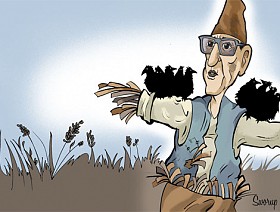 Kanak Mani Dixit’s efforts to portray 1990s as blissful, and Maoists to solely blame for all of Nepal’s ills, is revisionist history, facts be damned. Dixit’s rejoinder (‘The perils of executive presidency’, Jan 5) to my column (‘A question of form’, Jan 4) reveals fundamental differences in how we see recent Nepali history. The gist of Dixit’s rather simplistic world view is that the 1990s were wonderful and the Maoists destroyed it and are all evil. Let us examine this in more detail.
The 1990s
The 1990 constitution opened up Nepali society; it guaranteed fundamental freedoms and allowed groups to organise themselves at all levels; and economic policies pursued then led to the creation of a bigger middle class.
But there were two fundamental drawbacks of that period, which is what led to its eventual breakdown. Continue reading Nepal – The Nostalgia for 1990
 KAFILA - COLLECTIVE EXPLORATIONS SINCE 2006