Out of Development’s Waiting Room, Out of Democracy: The Continuing Agony of the DHRM

[with inputs from Baiju John]

Faced with the never-ending agony to which the members of the Dalit Human Rights Movement (DHRM) in Kerala seem to be subject to, it appears that that the more familiar ways of marginalizing of dalit people in Malayalee people do not work anymore. The past few days have seen horrendous attacks on these people near the town of Varkala in Thiruvanathapuram district. The DHRM has accused the Siva Sena and the BJP of violence, but it appears that both the authorities and the press are equally and irremediably deaf. Continue reading Out of Development’s Waiting Room, Out of Democracy: The Continuing Agony of the DHRM

Urgent Help Needed in Koodamkulam

As you all might be aware around 15000+ people are gathering everyday for more than 4 days from 3 south Tamil Nadu districts as part of an indefinite hunger strike to stop the Koodamkulam Nuclear Plant.

More than 100 people are on indefinite fast and some people’s health are turing bad as well. They are more or less in a isolated situation within the village of Idinthakari near Koodamakulam. There is a huge battalion of Police waiting outside the village venue. The police is trying to block the free passage of people into the village. The state administration and central administration has neglected the protest till now. The non-violent protest needs to be sustained, but people are losing their patience. The leaders who are very few in number though exhausted after 4 days of sleepless nights are trying their level best. Continue reading Urgent Help Needed in Koodamkulam

Lessons from Malegaon: JTSA

This is a statement put out by the JAMIA TEACHERS’ SOLIDARITY ASSOCIATION

Punish those guilty of misleading probes
Compensate the victims NOW!

13 September 2011: The NIA has finally put the official seal on what many activists, the families of the accused and the people of Malegaon had been saying for long: that the arrest of nine Muslim men for the 2008 Malegaon blast was a result of a communal witch-hunt, which passes for investigations into terror charges. As a consequence of the investigating agencies’ hubris and prejudice, nine innocent men had to spend five long years in jail, while their families suffered and they were stigmatized.  Continue reading Lessons from Malegaon: JTSA

In Allahpur, a Moment of Truth

(First published in Untold Stories)

Imam Shamsuddin calls for prayer. Photo credit: Shivam Vij

Like nearly every village in South Asia, Allahpur, in the east Indian state of Bihar, is geographically divided on the lines of caste. On one side of a dirt track live the upper-caste Muslims (Syeds, Sheikhs and Pathans) and on the other side live the lower-caste Muslims (Ansaris, Dhunias and Raains). There are only four Hindu families in Allahpur, and they are all lower castes, their houses amid the low-caste Muslim houses.

For five years now, the low caste Muslims have been praying at a ramshackle mosque they built, boycotting the mosque in the upper-caste Muslim area, a stone’s throw away.

Continue reading In Allahpur, a Moment of Truth

Where have the pilgrims gone?

The Journey is an integral part of any pilgrimage, the manner in which it is conducted is crucial to the successful conclusion of the endeavour. An edited version of this article first appeared in the travel and culture magazine Terrascape, published from Delhi. Photos: Himanshu Joshi/Curun Singh

Pilgrims at Puri, outside Jagannath Temple

There is a scene in Mughal-e-Azam, the early 1960s blockbuster of a movie by K Asif, where Akbar and his queen, the mother of his first son Jahangir (wrongly identified by K Asif and also by Ashutosh Gowarikar as Jodha Bai) stumble through the hot sands of Rajasthan under the mid-summer day sun that seemed intent on drying up and burning everything in sight. The two are on a pilgrimage. The pilgrimage was to fulfill a vow that Akbar had taken.

What I have to say in this piece can best be prefaced by narrating the story of that vow. Continue reading Where have the pilgrims gone?

Growing up with PTV in Poonch: Saqib Mumtaz

Guest post by SAQIB MUMTAZ

Away from the revolution of direct to home (DTH) and cable TV networks, the nineties were the time of one channel, when Doordarshan was synonymous with Television for most Indians, especially in rural areas. There was not much on television for a kid growing up except the occasional cartoon clips and Shaktimaan. I was fond of Meena and her parrot Mithu. They were loveable unthreatening characters. The duo imparted important lessons on a variety of social issues. Movies were a strict no-no and the news was other things adults were interested in. Every evening my grandfather would tune in to the Hindi news which was followed by another news broadcast in English. Even as a kid I could sense the repetition but never the reason of watching the same news twice.

In my memory of those days, it’s not Doordarshan that I associate myself with. Luckily for many of us near the border there was PTV.

Continue reading Growing up with PTV in Poonch: Saqib Mumtaz

A Critical Primer on India’s UID: Simi Chacko and Pratiksha Khanduri

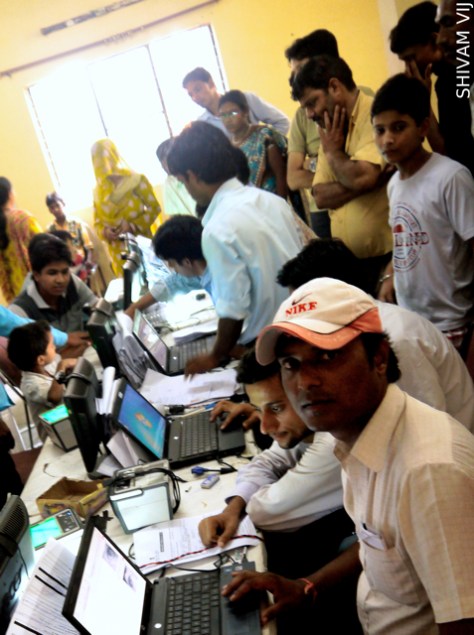
This guest post by SIMI CHACKO and PRATIKSHA KHANDURI is the full text of a booklet released in August 2011. A .pdf version of the booklet (41 pages, 304 KB) can be downloaded here.

A citizen gets her iris scanned for a UID 'Aadhar' card in Delhi.

Introduction

A. UID: The Basics

B. The Enrolment Process

C. Benefits of UID

D. Concerns: Biometrics, Privacy, Data security, Surveillance

Continue reading A Critical Primer on India’s UID: Simi Chacko and Pratiksha Khanduri

Prominent Indian journalist beaten up by Jammu and Kashmir Police

Is the Jammu and Kashmir Police a private, leaderless, unaccountable militia force that can go about beating up anyone they like in the name of saving Kashmir for India?

Well known Indian author and journalist David Devadas, a fellow with the Nehru Memorial Museum and Library in Delhi and author of a book on Kashmir, was beaten up by personnel of the Jammu and Kashmir Police in Srinagar on September 5. Sheela Bhatt reports on Rediff.com:

In a letter written to Jammu and Kashmir Chief Minister Omar Abdullah, Devadas said that on September 5, when he was crossing the Rambagh bridge in his car in evening in heavy traffic, he heard a loud bang at the back of his car. His car was hit by another car. Continue reading Prominent Indian journalist beaten up by Jammu and Kashmir Police

On a Lit Note: Hilal Mir

Guest post by HILAL MIR

I woke up this morning in an utterly confused state of mind. During the night I dreamt about having the tour of the Harud Literary Festival. My first astonishment came while in a queue outside the venue. Like the French streaming Parisian streets in teary-eyed joy at the sight of American liberators after having secreted themselves in root cellars for months from the sniffing gaze of Nazi jackboots, I felt similar joy at observing Indian soldiers not hurling ritual abuses from vehicle rooftops while asserting the right to overtake from any side and any crevice on the busy Panthachowk intersection.

The venue, Delhi Public School, is stone’s throw away from the intersection and within the earshot of any moist abuse hurled from those ubiquitous army trucks. Kashmiris finally had a dry day. Continue reading On a Lit Note: Hilal Mir

Which populism?: Saroj Giri

Guest post by SAROJ GIRI

As I read it, neither Aditya, nor Partha nor Gyan seems to deny that the Anna Hazare movement is populist. The debate here seems to be about: what kind of populism is it? Aditya is saying that this populism can lead to progressive political consequences, ‘by the presence of an anti-institutional dimension, of a certain challenge to political normalization’, while Partha (and Gyan too if I read him correctly) seem to be arguing that this populism is not progressive even if sometimes anti-institutional. And here Aditya reads Laclau contra Partha: that populism may indeed be the royal road to the constitution of the political. Partha and Gyan maintain that this populism works with a notion of ‘we the people’ who are free from corruption defined against ‘they the corrupt enemy’ (the government and netas). This ‘we the people’ can very well gloss over all internal contradictions, social divides and heterogeneities – hence Gyan points out that Dalits and minorities will not be counted or simply assumed away.

Continue reading Which populism?: Saroj Giri

The Sublime Object of Anti-Corruption: Sumandro

 Guest post by SUMANDRO

Recent discussion around the issue of corruption in Kafila has generated several references to and logical possibilities of understanding anti-corruption as an ideology, however, without finally drawing that conclusion. In this post I argue that the specific ideological functioning of this idea of anti-corruption is central for understanding the nature of the movement.

Partha Chatterjee writes: “The word [‘corruption’] creates an illusion – a fundamentally false image – of equivalence between two very different practices.” But for Chatterjee, this illusory character of ‘corruption’ is not comparable to the kind of illusion involved in the ‘mystical character of commodities.’ He argues: “But it is this illusion of equivalence that has been achieved, for the moment at least, by the rhetorical and performative adroitness of the Anna campaign and the spectacular bungling of the Congress leadership.” The multivalent illusion of ‘corruption,’ for Chatterjee, is shaped by the skilful performance from the activists’ side and lack of the same from that of the government. I would later argue that on the contrary, the skilful performance by the activists and the lack of the same from not only the government’s side but also that of different left positions are actually made possible by the essentially multivalent nature of the ideology of anti-corruption.

Continue reading The Sublime Object of Anti-Corruption: Sumandro

Harud Literary Festival: The Misrepresentation Continues

In a post on the Wall Street Journal’s India Realtime blog, journalist Tom Wright says at one point:

In the open letter, the signatories said it was impossible to have a literary festival in Kashmir [Link]

I asked him on Twitter as to where the open letter says that. He replied:

the opening graph says you can’t hold a literary festival in the context of kashmir [Link]

Given that he was being specific about the location of the “impossible to hold” claim in the open letter, I wondered for a moment if I was wrong. I checked the first two paragraphs of the open letter I had posted but found no such claim: Continue reading Harud Literary Festival: The Misrepresentation Continues

Haappy Onam, [Kallu] Shaappy Onam!

So Onam is in full-swing in Kerala.  I am writing this so that Kafila does not remain an ‘onamkeraamoola’, which in Malayalam literally means a place into which Onam does not enter — a place cut off from civilization, that is, populated by country bumpkins. Onam in Kerala now means many things to many people and I’m listing some of these below:

Continue reading Haappy Onam, [Kallu] Shaappy Onam!

Killing poetry and other possibilities of life

The news of the ‘postponement’ of Harud, a literary festival scheduled to be held in Kashmir in September, should be read with concern by those who believe in, and fight for, the right to express themselves freely. How the self-righteousness of some fighters for democracy actually forecloses any possibility of democracy can be seen from this incident.

In a statement last week, the organizers of Harud explained that they were forced to put off their festival as there was a concerted campaign by some people on the Internet, on  Facebook and some other sites attacking the festival. According to these critics, “We fear, therefore, that holding such a festival would, willy-nilly, dovetail with the state’s concerted attempt to portray that all is normal in Kashmir. Even as the reality on the ground is one of utter abnormality and a state of acute militarisation and suppression of dissent, rights and freedoms.” Continue reading Killing poetry and other possibilities of life

POSCO and the People: Ayush Ranka and Arati Choksi

This is a guest post by ARATI CHOKSI with photographs by AYUSH RANKA

01. Odisha is scarcely known to most people as the state of rich agriculture. It is more famous for it's floods and droughts which occur once in a while. However, the entire state, barring a few small regions, is rich with fertile soil and apart from betel leaves and cashew, food grains like rice, wheat, jowar and pulses are also grown

POSCO catapulted out of nowhere into the periphery of my imagination last year. On May 15, 2010, in a brutal show of aggression and violence, armed police battalions attacked unarmed protesters at Balitutha opposing a forceful takeover of their lands by the state for a POSCO steel plant. Members of police force set fire to shops, eateries and thatched homes, including the dharna site of people’s peaceful protest. Police fired upon unarmed protesters with rubber bullets. One person died, and hundreds were severely injured in this firing, many of these were women and the elderly. Continue reading POSCO and the People: Ayush Ranka and Arati Choksi

The Utopian Instinct – Aflatoon, Kiran Bedi and Nandan Nilekani: Taha Mehmood

Guest post by TAHA MEHMOOD

A pilgrimage to the cave

One day Cleinias, a Cretan invites Athenian and Megillos, a Spartan for a religious pilgrimage. Cleinias proposes to visit the cave of Zeus, just as Minos used to do. Minos was the legendary Cretan king. Every nine years Minos would walk along a path to the cave where he will hear revelations on the laws from Zeus. Perhaps the act of a man going to the cave to seek revelations from God was part of an ancient Cretian tradition. In the islandof Crete Minos played the role of a Lawgiver, in Athens– Zeus, while in Megillos’s state Sparta this role was played by Apollo.

Magnesia: The last idolum of Plato

This was the setting of the last dialog of Plato. He called it The Laws. In this dialog Plato tries to define the legal framework of an imaginary state named Magnesia. Throughout his life Plato was preoccupied with the question of how to name and define things. He believed one could even name abstract entities like numbers and define it as even or odd. In this dialog Plato makes an attempt to name various types of laws and define it.

Continue reading The Utopian Instinct – Aflatoon, Kiran Bedi and Nandan Nilekani: Taha Mehmood

Bring Dr Chishty home – alive

An elderly, bed-ridden man sentenced to life imprisonment in an ‘enemy’ country for a murder he didn’t commit awaits the signature on his clemency petition. By Beena Sarwar and Shivam Vij

Human rights activists in India are renewing their efforts for the release of the elderly Pakistani prisoner Dr Khalil Chishty lodged in Ajmer prison hospital, whose mercy petition awaits just one signature from the Rajasthan Governor Shivraj Patil. The mercy petition had earlier been approved by the state government and had reached Patil in June this year. At that point, it was expected that Dr Chishty, 78, a renowned virologist bed-ridden with various illnesses in jail, would soon be released.

Instead, Governor Patil raised a set of questions for the state government to answer. The Rajasthan government has answered all the queries, but has not submitted the file to the Governor again – perhaps because, according to sources, the Governor has already indicated that he will not sign the petition. Continue reading Bring Dr Chishty home – alive

Let us break the ‘silence’on Telengana movement: Sridhar Modugu

Guest post by SRIDHAR MODUGU

It is no exaggeration to say today that Telangana is burning. Nor will we be far off the mark if we suspect that a paralyzing fear has encased its ‘intellectuals”. Everyone is lost in providing testimonies to prove themselves to be pro-Telangana and everybody is a self-accomplished activist.  In fact, the intellectuals have lost themselves as spectators. They have become immune to understand what is happening before them.

The demand for statehood for Telangana is undoubtedly a democratic and judicious demand. It has been held back since 1950s and suppressed time and again.  No doubt Mr. Kalvakuntla Chandra Sekhar Rao (KCR), the President of Telangana Rastra Samithi (TRS) did maintain the public talk with occasional tactical moves and has been considered an icon of “Telangana vaadam” as last ten years of Telangana politics are referred to.  Since 2009 November the movement could attract large mass of diversified sections of people from all walks of life and engage the attention of the people with hopes of achieving the state any day thanks to the enthusiastic role play of the media and political parties – in power or opposition. It is indeed noteworthy that since November 2009 the movement has been able to attract a large number of diverse sections of people from all walks of life in thousands. They have mobilized voluntarily and have conducted meetings in the most democratic way. That there has been considerable restraint among the people who have been dishonored, alienated and humiliated under the Andhra Pradesh rulers is without dispute. These people have mobilized democratically despite the war-like surveillance and suppression of both the para-military and the state police force.  Historical injustice – political, economic and cultural of the people of this region is well highlighted.

Continue reading Let us break the ‘silence’on Telengana movement: Sridhar Modugu

In the Courtyard of the Beloved

*

In the Courtyard of the Beloved is a visual and aural portrait of Nizamuddin Auliya Dargah, a Sufi shrine in New Delhi, India. Made from over 18,000 still images and ambient sounds recorded on-site, rapid-fire bursts of kaleidoscopic imagery assemble into fractured collages.

Each day, hundreds of pilgrims travel by airplane, train, car, rickshaw and foot to reach this shrine, which honors a 12th century Sufi mystic who believed in drawing close to God through renunciation of the world and service to humanity. Beginning with imagery from these journeys, the film then enters the physical space of the shrine; a unique nexus of marketplace, social space and spiritual haven, where devotees come to offer their prayers and find a moment of reflection away from the din of Delhi traffic. As the sun sets behind the dome, musicians begin the qawwali, a style of Sufi devotional music that ranges from contemplative religious elegy to raucous crescendo.

Executive Producer Samina Quraeshi
Original tabla score by Suphala
Audio post-production by Paul Bercovitch
Produced by Sadia Shepard
Photographed and edited by Andreas Burgess

[via]

Speed and Control at Manesar: Why is the Maruti-Suzuki Management Keeping Workers Out of Its Factory

Protest Meeting at Maruti-Suzuki Factory, Manesar, September 01, 2011

Manesar is an emerging industrial hub roughly fifty kilometers from Delhi. Factories rise along the co-ordinates of a neat grid, overshadowed by the rocky Aravallis. The world is made here – cars, bikes, semiconductors, automotive parts, electronics, telecommunications equipment. Manesar has a little bit of everything. Even a bomb data analysis centre and a brain research lab and a military school and a heritage hotel. On a Maruti Swift, speeding down National Highway 8 towards Jaipur, you could make it to Manesar from Delhi, through Gurgaon, in less than an hour. Maruti’s ads are all about speed and control. Speed and control will cruise you to Manesar.

Continue reading Speed and Control at Manesar: Why is the Maruti-Suzuki Management Keeping Workers Out of Its Factory

CPI(M)’s Rectification Campaign and a Bit of History: Sankar Ray

Guest post by SANKAR RAY

The Rectification campaign (RC) in CPI(M) is in practice a PR exercise, vying with top corporate communicators. Take the judgment of killings on 27 July 2000 at Suchpur under Nanoor PS of Birbhum district of West Bengal. Forty-four members and sympathisers, including district committee member Ramprasad Ghosh and zonal committee members Nityanarayan Chattopadhyay, Golam Saror, Golam Mustafa and Badiujjaman were convicted for involvement in the ghastly killings of 11 landless agricultural labourers. None of them has even been suspended, let alone expelling them from the party. Party biggies from the general secretary Prakash Karat to the WB state secretary and polit bureau member Biman Bose often say they have reverence towards the judiciary, although their perception that in a class-divided society, justice is to be ‘class justice’ is judicious. But why should proven criminals be on the party roll, when the mandarins of A K Gopalan Bhavan, party’s national headquarters, boastfully talk of a continuous RC. WB party leaders assured months before the last Assembly polls in WB that hundreds of ‘corrupt’ members be thrown out out of the party. All this is remains on paper.

Continue reading CPI(M)’s Rectification Campaign and a Bit of History: Sankar Ray

DISSENT, DEBATE, CREATE