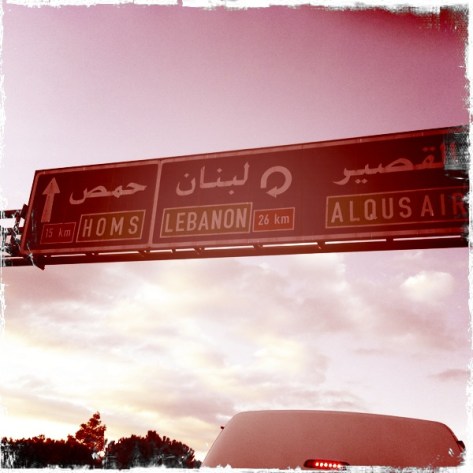
This guest post byALIA ALLANA is a despatch for Kafila from Homs, Syria. All photos by Alia Allana
He was found shot in the chest, bleeding on the streets, alone.
He has no name. He’s just another struggling body in the hospital in Homs — only he’s much younger than most. He’s only four. He doesn’t move, his small frail body is gobbled by wires. The doctors say he hasn’t opened his eyes, hasn’t made a sound, nor has he called out for anyone. Saliva runs down his mouth but there is no one to wipe it off his face. This isn’t the first case and the doctors fear it won’t be the last. There will be other children who will take his place, there will be more victims of random shooting, more deaths and no one knows by whose gun. Continue reading A Despatch from Homs: Alia Allana→
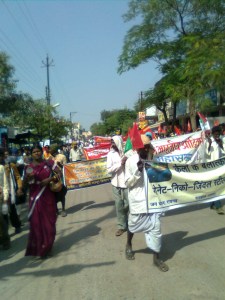
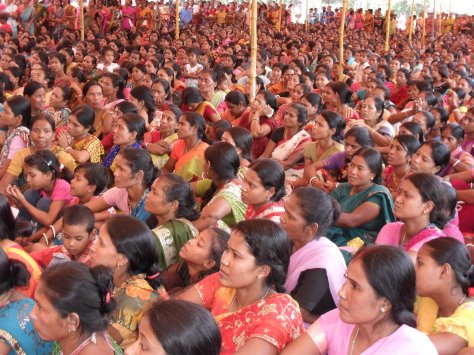
Last weekend, I attended a wonderful rally by the Adivasi Mahasabha in Raipur – some 10-15 busloads of people came from Dantewada and Bastar alone, while large numbers came from other parts of Chhattisgarh and even other states like Maharashtra, Orissa and West Bengal. The procession was flagged off by Dhurwa dancers while the rear end was brought up by Marias with their large dhols and bison horns. In between were thousands of militant marchers shouting slogans against militarization, demanding peace talks, the release of their arrested leaders, the implementation of the Supreme Court judgement on Salwa Judum, and all their constitutional rights with respect to land, forest and water. These were men and women who had lost everything to arson and loot by Salwa Judum, who had been interned in camps but managed to return home and pick up their ploughs again, who face the daily threat of arrests, beatings and encounters by the security forces, who have to negotiate with the Maoists everytime they wanted to access panchayat funds, who live a life on the razor edge of survival. And yet here they were, laughing, cheering and vowing to fight till the last breath, fight for their constitutional rights and in a constitutional way.
This remarkable struggle has been waged, not just over one weekend, but over years. Indeed, the Salwa Judum leaders themselves credit the CPI with the destruction of their movement – both through mass actions and through legal means.
It was this day five years ago that Kafila published its first post.
The number of people who have joined this caravan in five years has been way more than we expected. Our less than 1,500 posts have been read nearly 1.8 million times, and have received more than 13 thousand comments.
Here are two short articles, taken from the excellent Sanhati and Ludhiana Workers’ News by Saurav Banerjee and Amritpal (so after Faridabad and Gurgaon, yet another city gets its own workers’ newspaper !) Both point to spreading turbulence in Industrial areas in Ludhiana. The striking textile workers in Ludhiana explicitly invoke their solidarity with their comrades in Manesar in Haryana, and with female multipurpose health workers elsewhere in Punjab. Are we witnessing the beginning of a new reality? New solidarities? -Shuddha Continue reading After Maruti-Suzuki at Manesar, its Ludhiana: Sourav Banerjee and Amrit Pal→
I wish I could start with the ritual “I love you” which the Occupy Movement is supposed to inspire. To be honest, it has been a space of turmoil. But also, virulent optimism.
What I outline below are not criticisms of the Occupy movement. I am inspired that the dynamic of the movement thus far has been organic, so that all those who choose to participate are collectively responsible for its evolution and development. To all those participating — I offer my deepest gratitude and respect. I am writing today with Grace Lee Boggs on the forefront of my mind: “The coming struggle is a political struggle to take political power out of the hands of the few and put it into the hands of the many. But in order to get this power into the hands of the many, it will be necessary for the many not only to fight the powerful few but to fight and clash among themselves as well.” This may sound dramatic and counter-productive, but I find it a poignant reminder that, in our state of elation, we cannot underestimate the difficult terrain ahead and I look forward to the processes that will further these conversations.
Pakistanis love Bollywood. There is no question about that. Amidst the love-hate perceptions, Indian cinema has for decades fed public imagination. Before the 1965 war that took place when Ayub Khan, Pakistan’s first military ruler, was in power, Indian films were released in Pakistan regularly. They competed with the local cinema. The healthy contest enriched filmmaking and gave choice to Pakistani cinema-goers. The war and competing imaginary nationalism halted this process and for decades, Indian films stayed away from cinemas until another military ruler, Parvez Musharraf, allowed limited releases. Such is the power of Bollywood and its commercial viability that for the past few years, Bollywood flicks have revived cinema in Pakistan. Continue reading Through the screen, not so darkly: Raza Rumi→
A big red river streamed out of the gates of Kamla Nehru Park in Gurgaon last evening (17th October, 2011). Several thousands of workers (according to one estimate – one hundred thousand workers), from many factories in the Gurgaon-Manesar belt had occupied the park from 4:00 pm onwards to stand in solidarity with the struggle of the Maruti-Suzuki, Suzuki Powertrain and Suzuki Motorcycle India Limited workers. In an unprecedented demonstration of solidarity, permanent workers are on strike to demand justice and re-instatement of their contract worker colleagues. The atmosphere at the meeting was of celebration, workers who had been occupying three different factories for more than a week had been evicted by an administration that had brought out all the police and coercive power at its disposal. But yesterday’s gathering was like a reunion, the workers of the three ex-occupied factories, and their comrades in other plants throughout the Gurgaon-Manesar belt were meeting, like old and new friends, to taste the heady experience of peacable solidarity. Continue reading A Big Red River: Solidarity Meeting with Maruti-Suzuki Workers→
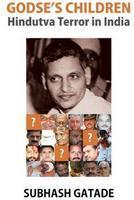
Rahul Gandhi’s answer to that question, given to American diplomats who seem to have his ear more than the people of India, was unequivocal: it’s the Hindu right whose violence he fears more. But fellow-Kafila-ite Subhash Gatade makes the point in an interview to Rediff.com that such violence is difficult to quantify and compare because it takes only a few from a community to perpetrate it:
…one sincerely feels that it is difficult to quantify the relative threats. Remember the period when India witnessed Khalistani terrorism, which involved a fraction of the misguided youth of the Sikh community and the danger it posed to peace and tranquility in the country then. [Link]
Appeal from the MSEU (Maruti Suzuki Employees Union) to All Trade Unions, Organisations and Individuals, by SHIV KUMAR, general secretary, MSEU, via Rakhi Sehgal of the New Trade Union Initiative (NTUI)
We, the Maruti Suzuki Employees Union (MSEU), Suzuki Powertrain India Employees Union (SPIEU) and Suzuki Motorcycle India Employees Union (SMIEU), have been on strike in our respective plants in Gurgaon-Manesar from the 7th of October, 2011, demanding our right to respectable and non-precarious employment and unionization. Our movement stands at a crucial juncture today, we therefore send this appeal to all the labouring people of the country and beyond, the trade unions and all other sections of society which have stood with us in solidarity to come forward with renewed vigour to take this movement forward. Our struggle is not a struggle for a mere wage-hike of any one section of workers, but is a struggle for our dignity and right to organise. We struggle also more importantly for the contract workers among us, whose insecurity and precarious condition of existence is a burning issue before the entire labouring people of the country today, which puts the very framing of the available labour laws into question.
It is not yet dawn, and I am wondering what is happening inside the Maruti Suzuki Factories in Manesar. How exactly is the Haryana Police, armed, along with its usual ordnance, with a High Court order, and the Haryana Labour Department’s ‘go ahead’, going about its stated business of ‘escorting’ a few thousand unwilling workers out of their factories under cover of darkness? Apparently, the factory fence has been layered with tent cloth. No light gets in, no light gets out. The Maruti Factories in Manesar have become black holes.They are producing more darkness than cars in Manesar tonight.
There is no way of knowing just what is going on inside. And yet, a few hundred surveillance cameras must be recording what the management, police, administration and ‘security personnel’ are doing to ‘convince’ the workers to leave. Someday, this archive, every inch of video footage, should be played and rewound repeatedly, in order to arrive at a clearer understanding of the evolution of class relations in the industrial belt around the National Capital Region in the second decade of the twenty first century in India. Unfortunately, I have a strong feeling that tonight’s footage is going to go where all inconvenient truths go – to the limbo of unsolicited erasure.
This is a fun radio show of various songs that queer spaces in Delhi and Bombay have reclaimed as our own. It is also a a coming together of songs that lend itself to queering almost effortlessly. A fun listening experience with snippets of information and laughs mixed in.
Guest post by Indu Vashist
Soundtrack of the Indian Queer Movementoriginally aired on Sunday October 9, 2011, 6-7pm EST. Hosts, Indu Vashist and Srinath Baba had special guests Ponni Arasu and Gautam Bhan in studio for commentary, history and a whole lot of laughs. Listen to full broadcast here.
Montreal-based Indu Vashist and Srinath Baba are the hosts of Desi Dhamaka, a South Asian music show with a political and social twist. It airs on CKUT, a non-profit, campus-community radio station based at McGill University. CKUT provides alternative music, news and spoken word programming to the city of Montreal and surrounding areas, 24 hours a day, 365 days a year. Hear us at 90.3 MHz on the FM dial, 91.7 by cable, or listen on-line.
The Delhi University academic council’s decision to drop A.K. Ramanujan’s essay, ‘Three Hundred Ramayanas’, from the prescribed readings for BA (honours) history and BA (programme) students, brings back memories of Bombay University’s move to remove Rohinton Mistry’s novel Such a Long Journey from the syllabus. The victimisation of art-historian Shivaji Pannikkar by Baroda’s Maharaja Sayajirao University is another long and painful story. The many, many cases of books and plays being proscribed by various governments form the general climate in which our universities operate. Continue reading An act of Academic Compromise→
Update: A Day after the publication of this post, Tehelka changed the status of Essar from “Principal Sponsor” to merely one of several “patrons” on the Goa ThinkFest website.
Guest post byBOBBY KUNHU
Tehelka: Free, Fair, Fearless?
Without doubt, one of the most important documents to make its appearance after the arrest of Soni Sori by the Chattisgarh Government in Delhi on 4th October 2011 was the cover story titled, “The inconvenient truth of Soni Sori” that appeared in Tehelka, written by Shoma Chaudhary. It tells the story of Soni Sori and her nephew Linga Kodopi as narrated to Tehelka and the sequence of events that led to their persecution.
Nonetheless there is an intriguing twist to how this story was framed. The introduction of the story goes: “Why were two tribals and the Essar group framed by the Chhattisgarh police? Why are Soni Sori and Linga Kodopi being systematically silenced? This chilling story of one family reveals more about India’s Naxal crisis than any official document can.”
In other words, Tehelka is arguing that Essar is also being framed in this narrative along with Soni Sori and Linga Kodopi.
Threatening people whose views you don’t like with violence is a sure-shot way of letting the world know who is right and whose argument is morally superior. To those who attacked Prashant Bhushan today for the comments he made in this video below, thank you for bringing more attention to them!
This is how “integral” a part of India Kashmir is – so integral that voices that doubt it must be silenced with vigilante force!
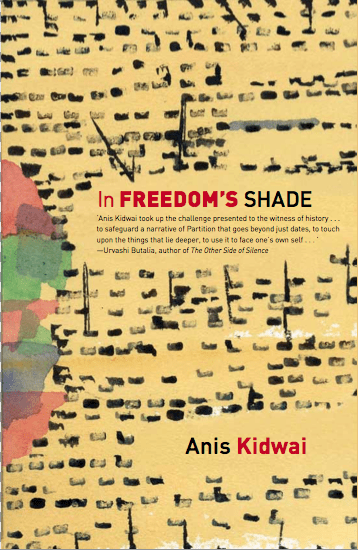
In Freedom’s Shade, by Anis Kidwai; translated from Urdu by Ayesha Kidwai; Penguin Books India 2011, Pp 382, price Rs. 450
Anis Kidwai belonged to the illustrious Kidwai family of Barabanki. The family has made more than a signal contribution to the making of India. Not only in politics and governance but also in diverse fields of creative endeavour. This short piece, though, is not about her or about her family but her most remarkable record of the unfolding tragedy in the Capital of India and in its surroundings in the aftermath of independence and partition.
Anis Kidwai, though extremely politically aware with sharp and clear views on what she saw happening, was not a political activist and would have probably continued to lead a well settled, almost sedentary life in Mussoorie, had the unthinkable not happened. Her husband, Shafi Ahmad Kidwai, the administrator of the Municipality, who had almost single handedly tried to keep peace in Mussoorie when everyone else had either given up or joined the rioters, was murdered.
I could have met Sebald.
I went to Britain in September 2001,
And he died in December.
East Anglia wasn’t all that far way
From London, nothing, really,
Is all that far away in Britain.
I could have met him, if I had known him
Then.
What I would have wanted to say, I think Continue reading Untitled: Najeeb Mubarki→
Justice Markandey Katju, who has upon retirement just been appointed head of the Press Council of India, today addressed the media at his residence in Delhi. Towards the end of his speech, he said:
Before I conclude, I once again repeat my appeal to the Indian Government through the Prime Minister to release Dr Khaleel Chishty who is in Ajmer Jail. He is 80 years old and has not very long to live. He was an eminent virologist in Karachi Medical College and was a PhD from Edinburgh University. He is a heart patient and has many other ailments also. He is unable to walk. In the name of humanity I appeal to the Indian Government to release him and allow him to get back to home in Karachi to his wife and daughter who live there. The Pakistan Government honoured my appeal and released Gopal Das from a Pakistani jail. I am sad that the Indian Government has not yet honoured my appeal made several months ago to the Hon’ble Prime Minister, the Hon’ble Home Minister, and His Excellency the Governor of Rajasthan. In my opinion, the prestige of our country will be invreased if Dr. Chishty is released, whereas if he dies in jail, we will be disgraced. Continue reading Gopal Das is free, Khaleel Chishty is not→
More than 3000 Domestic Workers Take to the Jaipur Streets
SHARE THEIR WOES AND DEMAND RIGHTS
PUBLIC HEARING PANEL:
• Aditi Mehta (Principal Secretary Social Justice and Empowerment),
• Anuradha Talwar. Trade Union Activist, Paschim Banga Khet Mazdoor Sangathan, Kolkata
• Jose Mohan, DCP, Jaipur Police Commissionerate
• Bhagwan Sahai Sharma, member Secretary, State Social Welfare Board,
Domestic worker women power made history today in Jaipur when they took to the streets of Jaipur and demanded their rights from the State and society. We are not “naukranis” they said. We are workers in free India and want the dignity of being a worker. We run two homes, yours and ours, can any of you in society do without our labour, they asked boldly. Ninety percent were Bengally with abotu ten percent from who had come from different parts of Rajasthan. Continue reading Bengal Power in Jaipur: Kavita Srivastava→
(On behalf of Krantikari Naujawan Sabha, part of the solidarity effort with struggling workers of Maruti Suzuki.)
The struggle of the workers in Maruti Suzuki India Ltd, IMT Manesar refuses to die, and just when quietening under settlement truce, has stood up again, gathering political edge and crucial concrete support among workers in the area. In a significant development this morning, 7th October 2011, the workers in seven nearby factories along with workers of MARUTI SUZUKI INDIA LTD, IMT MANESAR have gone on strike. These are workers in the nearby plants of SUZUKI POWERTRAIN INDIA LTD. and SUZUKI CASTINGS (Plot 1, Phase 3A), and SUZUKI MOTORCYCLE INDIA PVT. LTD (in the Gurgaon-Manesar road), along with the workers of LUMAX AUTO TECHNOLOGIES LTD (165, Sector-5), SATYAM AUTO COMPONENTS LIMITED (26 C, Sector – 3), ENDURANCE TECHNOLOGIES LTD ( Plot no. 400, Sector 8), HI-LEX INDIA PVT LTD, (Plot No.55 Sector-3) completely halting production. Continue reading Strike in Maruti-Suzuki and Seven Other Factories in Manesar: The Struggle Continues: Nayanjyoti→