Students In Solidarity With Professor Nivedita Menon and Rajshree Ranawat – A Statement – UPDATED SIGNATORIES.

We, the undersigned, condemn the repeated attacks on Professor Nivedita Menon, the most recent of which being the police complaint lodged against her on the 3rd of February, 2017 (as also against Professor Rajshree Ranawat) for allegedly making ‘anti-national’ remarks during a seminar organised by the Department of English, Jai Narain Vyas University. This incident, we believe, is continuous with the spate of attacks that Professor Menon has had to face for taking an astute stand against the RashtriyaSwayamsevakSangh (RSS), its student-wing the Akhil Bharatiya Vidyarthi Parishad (ABVP), and the nefarious politics of Hindutva in general. We refuse the rationale of dissent against Hindutva as dissent against the nation, because our idea of the nation is not of the Hindu Rashtra but of secularism, democracy, and social justice. Both as a voice of dissent and a formidable scholar of politics, Professor Nivedita Menon is an inspirational figure. She is a consistent articulation of conscience and an abiding commitment to the ideals that our freedom fighters envisioned for our nation. It is our conviction that patriotism is not only love for the abstract entity of the nation but also for its people, regardless of class, caste, religion, gender, sexual orientation, ability, or any other marker that is used to advantage or disadvantage groups. The ‘patriotism’ that the RSS and its henchmen claim to champion is hateful, divisive, and truly anti-national.

It is our concern as students, therefore, that the ABVP claims to speak for the student community. This petition is a rejection of that assertion, and a statement in solidarity with Professor Nivedita Menon. We hope for and demand the cessation of attacks on Professor Nivedita Menon and the protection of her inalienable freedom and right to oppose the politics of division and communalism. Continue reading Students In Solidarity With Professor Nivedita Menon and Rajshree Ranawat – A Statement – UPDATED SIGNATORIES.
Stop criminalizing academic freedom in Rajasthan: People’s Union for Civil Liberties

PEOPLE’S UNION FOR CIVIL LIBERTIES, RAJASTHAN

 PUCL demands an end to the Harassment of Dr. Nivedita Menon(JNU), Dr Rajshree Ranawat and Dr Vinu George (of JNVU, Jodhpur)

and the

Criminalizing and throttling of Academic Freedom in Rajasthan

 The PUCL is shocked at the harassment of Dr Rajshree Ranawat and Dr Vinu George of the English Department of Jai Narain Vyas University, Jodhpur, by University authorities, Jodhpur police and the BJP/ABVP outifts along with their fellow vigilante groups. The harassment and relentless persecution is for organizing  an academic conference titled “History Reconstrued through Literature: Nation, Identity, Culture”, in which one of the speakers was Prof Nivedita Menon of JNU, whose lecture was mis-reported sensationally in some local Hindi papers on the basis of the claims of one person. Following on this, the university authorities as well as private persons have filed police complaints against all three, and the university authorities have issued show cause notices to Dr Ranawat and Dr George. We condemn this effort of criminalizing and throttling academic freedom. Continue reading Stop criminalizing academic freedom in Rajasthan: People’s Union for Civil Liberties

Meanwhile, in India, Islamophobia proceeds apace

DARSHANA MITRA in The Wire

While many in India have recoiled at the manner in which the Trump administration has made religious discrimination a key ingredient of its refugee and  immigration policy, we should also turn to look at similar legislative provisions being proposed in our own country.

The Citizenship (Amendment) Bill of 2016 is a short, three-page document that seeks to amend Section 2(b) of the Citizenship Act. The Citizenship Act deals with the acquisition and termination of Indian citizenship. Section 2(b) of the Citizenship Act defines the term “illegal immigrant”. The Citizenship (Amendment) Bill proposes to amend the definition of this term by adding this proviso:

“Provided that persons belonging to minority communities, namely, Hindus, Sikhs, Buddhists, Jains, Parsis and Christians from Afghanistan, Bangladesh and Pakistan, who have been exempted by the Central Government by or under clause (c) of sub-section (2) of section 3 of the Passport (Entry into India) Act, 1920 or from the application of the provisions of the Foreigners Act, 1946 or any order made thereunder, shall not be treated as illegal migrants for the purposes of this Act.”.

This effectively means that persons from minority religious communities from our neighbouring Muslim majority countries shall not be considered as illegal migrants and subjected to prosecution. Further, the Bill also proposes an amendment to the Third Schedule of the Act, which would allow minority communities, namely Hindus, Sikhs, Buddhists, Jains, Parsis and Christians from Afghanistan, Bangladesh and Pakistan to qualify for naturalisation as a citizen of India if they are resident in India or in service to the Government of India for an aggregate period of not less than six years, as opposed to eleven years for everyone else.

Read the full article here.

In solidarity with all who see the map upside down: Shukla Sawant

Sent by Shukla Sawant, Professor, School of Arts and Aesthetics, JNU.

Joaquín Torres-García,  Upside-down Map (1943). 


88d5504f366713693474d35db3e1b9596f4033a3-1

Read more about this image and about “the essentially fictional status of maps and the power they possess for construing and constructing worlds.”

In Solidarity with People Affected by the ‘Muslim Ban’: Call for an Academic Boycott of International Conferences held in the US

If you would like to endorse this statement, as I have, please go to the link given below. As of 4 February 2017, 13.00 GMT the letter has 6000+ signatures.

On 27 January 2017, President Donald Trump signed an Executive Order putting in place a 90-day ban that denies US entry to citizens from seven Muslim majority countries: Iran, Iraq, Syria, Yemen, Sudan, Libya and Somalia. So far, the ban includes dual nationals, current visa, and green card holders, and is affecting those born in these countries while not holding citizenship of them. The Order also suspends the admittance of all refugees to the US for a period of 120 days and terminates indefinitely all refugee admissions from Syria. There are indications that the Order could be extended to include other Muslim majority countries.

The Order has affected people with residence rights in the US, as well as those with rights of entry and stay. Some of those affected are fleeing violence and persecution, and have been waiting for years for resettlement in the US as refugees. Others are effectively trapped in the US, having cancelled planned travel for fear that they will be barred from returning. The order institutionalises racism, and fosters an environment in which people racialised as Muslim are vulnerable to ongoing and intensifying acts of violence and hatred.

Among those affected by the Order are academics and students who are unable to participate in conferences and the free communication of ideas. We the undersigned take action in solidarity with those affected by Trump’s Executive Order by pledging not to attend international conferences in the US while the ban persists. We question the intellectual integrity of these spaces and the dialogues they are designed to encourage while Muslim colleagues are explicitly excluded from them.

Continue reading In Solidarity with People Affected by the ‘Muslim Ban’: Call for an Academic Boycott of International Conferences held in the US

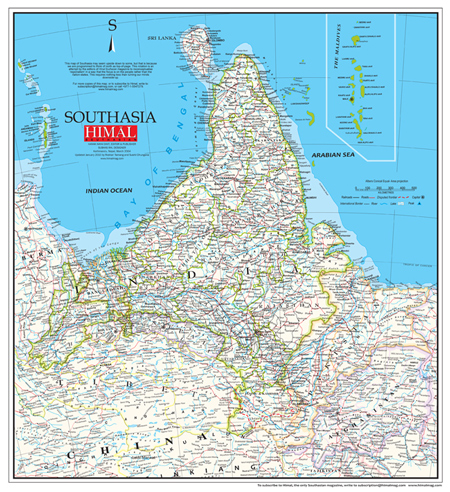
On RSS ignorance, the “upside down map” of India, and on being “anti-national”

himal_map_4501Himal Southasian’s ‘right-side-up’ map. In their words: “This map of Southasia may seem upside down to some, but that is because we are programmed to think of north as top of page. This rotation is an attempt by the editors of Himal to reconceptualise ‘regionalism’ in a way that the focus is on the people rather than the nation-states. This requires nothing less than turning our minds downside-up.

Turn your eyes away, gentle reader. You have already become anti-national by viewing this image.

More on this in a minute. First some background.

On the 3rd of February, ABVP called a bandh in Jai Narain Vyas University (JNVU), Jodhpur, forcibly stopping classes and demanding suspension of the organizers of a conference and police action against them, as well as against myself. Police complaints have now been lodged, and perhaps FIRs, we hear.

The charge? The conference, and my lecture in particular, was anti-national. Not one of these ABVP students attended the event, nor is there yet a video recording available to my knowledge, largely because the ABVP also gathered in intimidatingly large numbers outside the shop that had conducted the recording, and the owner shut up the shop and fled. The entire drama and some sensationalist and outright false stories in the local Hindi press, is based entirely on the testimony of one person, NK Chaturvedi, retired professor from the History department at JNVU, who attended just one session, mine.

Continue reading On RSS ignorance, the “upside down map” of India, and on being “anti-national”

City as a Site of Trade-Offs

To be truly radical, said Raymond Williams, is to make hope possible rather than despair convincing. Today, his words are both a diagnosis of all that ails the contemporary Indian city as well as the clearest articulation of what we must strive to be in the years to come. Amidst the smart, the inclusive, the global, the world-class, and the sustainable: how does one find the radical city?

This is no easy task. By their nature, cities concentrate both opportunity and risk, hope and despair. If growth rises, so does inequality. If diversity rises, then so does segregation. If infrastructure and built form expand, so do ecological risks. Historically, if cities have held innovation, mobility, and democracy, they have been equally adept at violence, poverty, and inequality. This is then where we must start: to acknowledge the city as a site of trade-offs, not the convenient listing of aspirations where the smart, inclusive or sustainable city can be created at no cost, no price, or without crowding out other visions and alternative futures. As India urbanizes, the only certainty we have is that these trade-offs will become more stark, with the stakes becoming higher for more and more people.

Continue reading City as a Site of Trade-Offs

Taming the Brat? Thoughts on the Kerala Law Academy Imbroglio


Reports of exploitation, humiliation, violence, and rampant nepotism are still flowing out of the private-sector law college popularly known as the Law Academy, in Thiruvananthapuram twenty whole days after the commencement of the students’ struggle there. At the centre of the controversy is the principal, Lekshmi Nair, who seems to have ‘inherited’ that position in the institution owned by her family: clearly, the students are determined to teach her a good lesson. Rarely have we seen all student organizations, from the far-right to the far-left, rally against one person with equal determination; but from the complaints of students – subsequently confirmed by the University of Kerala to which this college is affiliated – it appears that there is no reason to be surprised.

But the irony of  utter lawlessness and blatantly feudal despotism perpetuated in an institution devoted to legal education  in a democratic nation itself seems lost, for the authorities’ commonsense about liberal education in Kerala has been that it should be neither liberal nor education nor anything to do even remotely with the practice of democracy. I have been saying this over and over again, and really, feel utterly breathless at this. Continue reading Taming the Brat? Thoughts on the Kerala Law Academy Imbroglio

In Solidarity with Adivasis in Bastar, Human Rights Defenders and Bela Bhatia in Bastar: Concerned Students in TISS, Mumbai

Guest Post by CONCERNED STUDENTS OF TATA INSTITUTE OF SOCIAL SCIENCES, MUMBAI

We, the concerned students of Tata Institute of Social Sciences (TISS), Mumbai condemn the continuing state repression of adivasis and recent attack on human rights activist Bela Bhatia in Bastar, Chhattisgarh.

On the 23rd of January, 2017, a group of 30-odd men attacked Bela where they barged into her house in Parpa, near Jagdalpur violently and threatened to burn the building down if she did not leave immediately. The mob also attacked her landlords and their children, threatening them with dire consequences if Bela was not evicted immediately. Despite Bela’s assurances that she would leave, the mob continued to be belligerent, in the presence of the police, and the Sarpanch. The mob has been identified with the right-wing vigilante group Action Group for National Integrity (AGNI). Continue reading In Solidarity with Adivasis in Bastar, Human Rights Defenders and Bela Bhatia in Bastar: Concerned Students in TISS, Mumbai

भक्तों दा जवाब नहीं! गांधीजी का ‘विलोपन’- तीन ‘आसान’ किश्तों में

.जो शख्स तुम से पहले यहाँ तख़्त नशीन था….
उसको भी खुदा होने पे इतना ही यकीन था

– हबीब जालिब

Modi Bhakt

भक्तगणों का – अर्थात वही बिरादरी जो ढ़ाई साल से लगातार सुर्खियों में रहती आयी है –  जवाब नहीं !

अपने आराध्य को इस कदर नवाज़ते रहते हैं गोया आनेवाली पीढ़ियों को लगने लगे कि ऐसा शख्स कभी हुआ न हो। वैसे टेक्नोलोजी की तरक्की ने उनके लिए यह बेहद आसान भी हो गया है कि वह फोटोशॉप के सहारे दिखाए कि कथित 56 इंची सीने के बलबूते वह कुछ भी कर सकते हैं।

मिसाल के तौर पर वह बाढ़ के हवाई सर्वेक्षण के लिए निकलें और धुआंधार बरसते पानी में उनकी आंखों के सामने समूचा शहर नमूदार हो जाए। यह अलग बात है कि उनकी इस कवायद में कई बार उनके इस हीरो की हालत हिन्दुओं के एक पवित्रा कहे जाने वाले एक ग्रंथ में नमूदार होते नारद जैसी हो बना दी जाती है, जिसे इस बात का गुमान ही न हो कि उसने कैसा रूप धारण किया है और उनका यह आराध्य दुनिया भर में अपने आप को मज़ाक का निशाना बना दे।

हम याद कर सकते हैं अमेरिका के तत्कालीन राष्ट्रपति ओबामा की अगवानी का प्रसंग जब दिन में तीन तीन बार ड्रेस बदलने या अपना खुद का नाम अंकित किया दस लाख या करोड़ रूपए का सूट पहनने की उनके आराध्य की कवायद विश्व मीडिया में सूर्खियांे में रही, उसका जबरदस्त मज़ाक उड़ा और इसी दौरान मीडिया ने इस तथ्य को उजागर किया था कि इसके पहले ऐसी आत्ममुग्धता भरी हरकत मिस्त्र के अपदस्थ तानाशाह होसनी मुबारक ने की थी।

( For full text of the article click here :https://sabrangindia.in/article/modi-bhakt-and-mahatma-gandhi-subhash-gathade)

How do the new UGC regulations affect prospective students applying to JNU? Ayesha Kidwai

This is the first of a five part series in which AYESHA KIDWAI will explain how the UGC Gazette Notification of 2016, especially as interpreted by the VC of JNU, will affect different categories of students, faculty, and the general public.

Ayesha Kidwai is Professor, Centre for Lingustics, School of Language, Literature and Culture Studies, JNU.


poster1-ugc

Revisiting the demonetization survey: Juhi Tyagi

Guest Post by JUHI TYAGI

In light of the recent book, I Am A Troll: Inside the Secret World of the BJP’s Digital Diary authored by journalist Swati Chaturvedi which describes the working of the BJP’s media’s cell to systematically undermine dissenting opinions, we need to revisit other, seemingly innocuous, government media campaigns such as the demonetization survey and its use as a tool in bending into shape public opinion.

The demonetization survey was officially launched on 22nd November 2016 on the NM app by the government. Its purpose was to receive feedback from the people themselves on the validity of withdrawing 86 percent of the currency in circulation to address two problems: that of black money and counterfeit currency. The survey consisted of nine questions, with the tenth providing space for sharing suggestions. The questions dealt with people’s beliefs about the existence of black money in India and on its need to be eliminated. On their opinions of the government’s efforts against corruption, and more particularly, on the effectiveness of demonetization in ridding society of black money, all corruption and terrorism while creating opportunities for higher education, health care and affordable housing for all.

Continue reading Revisiting the demonetization survey: Juhi Tyagi

The Indian Newspaper Industry – Response to Times of India Editorial: JAC for Implementation of Majithia Wage Board

The following is a response by M J Pandey on behalf of the JOINT ACTION COMMITTEE FOR IMPLEMENTATION OF MAJITHIA WAGE BOARD, to a Times of India editorial calling for “reasonable tax and labour policies”.

With reference to the unsigned editorial ‘Indian Newspaper industry: Red Ink splashed across the bottom line’ (Times of India, Jan 19, 2017), a case is being made out for concessions to the newspaper industry on the grounds that it is in the doldrums and is beleaguered by various burdens, including that of wage board wages, GST, DAVP, etc.

Without mentioning the recent illegal closure of six editions of The Hindustan Times as the obvious peg for this, the editorial seeks a range of concessions – from a part-discontinuance of the wage board for newspaper employees, to subsidies on advertising and tax.

Clearly, what the newspaper industry has lost in judicial review, it is now seeking to stealthily recoup through administrative fiat.

Under the fig leaf of “freedom of speech”, the editorial makes a number of indefensible propositions. However, we will confine ourselves to the empiricial terrain of the Wage Boards and wish to make the following points:

That a three-judge bench of the Supreme Court headed by the then Chief Justice of India P Sathasivam had on Feb 7, 2014 (ABP Pvt Ltd and Anr vs Union of India and Ors), upheld ‘the constitutional validity of the Act and the Amendment Act, 1974’ (referring to the Working Journalists Act, 1955) and rejected the contention of improper constitution of the Wage Boards, irregularity in the procedure adopted by the Majithia Wage Board and that Majithia Wage Boards had overlooked the relevant aspects and considered extraneous factors while drafting the recommendations.

Continue reading The Indian Newspaper Industry – Response to Times of India Editorial: JAC for Implementation of Majithia Wage Board

Dining With The Cultured Hate Mongers

Should we criticise the organisers of the Jaipur Literature Festival for inviting two functionaries of the Rashtriya Swayamsevak Sangh to this year’s edition of the annual festival? Murmurs in the literary circles seem to suggest that the organisers of JLF succumbed to pressure from the right wing. A mere look at the list of speakers and programmes makes it clear that there are a fair number of liberal and left-leaning individuals among the speakers. Why, even the general secretary of the Communist Party of India (Marxist), Sita Ram Yechuri, is in that list. So a balance appears to have been struck. Continue reading Dining With The Cultured Hate Mongers

EFLU Defamation Case Against Students – Statement by Concerned Academics and Public Intellectuals

Statement by Concerned Academics and Public Intellectuals Following the Court Sentence on the EFLU Defamation Case

We the undersigned wish to express our grave concern over the fact that five senior students of the English and Foreign Languages University (EFLU), who were raising the issue of discrimination against SC and ST students in the EFLU’s Department of German, have on 13/12/2016 been charged with defamation of a professor and sentenced to six months’ imprisonment.  Their protests concerned Sreeramulu M, a ST student enrolled in the BA programme of EFLU’s German Department. Sreermulu had not been allowed to continue in the programme ostensibly for his failure to maintain grades.  The others who have been sentenced are office bearers of associations representing such marginalized students; they were speaking at a Press Meet held on 24/12/2012 after Sreeramulu, who had been trying for several months to be allowed to continue his course and avail remedial classes, went on fast.  The defamation case was filed in March 2013.  Two SC/ST atrocities complaints filed by Sreeramulu M and again by another student, Ranjan Kumar, in January 2013 are pending with the Police and are yet to be investigated.

The countrywide discussion raised through the struggles following Rohith Vemula’s death in January 2016 drew public attention to the extent of caste discrimination in our universities.  SC, ST, OBC and minority students figure disproportionately in the statistics for failure, drop out, expulsion, rustication and even suicide. Educational institutions and those who run them (teachers and administrators) have been forced to acknowledge that they are implicated in this terrible attrition of young citizens and know they must initiate reforms. Yet, far too little is being done to discuss this evidence, rethink rules, temper teachers’ attitudes, reform syllabi or challenge ideas of merit that discriminate against the marginalized.  A teacher’s job is to help the actual students in the classroom to learn; not to uphold abstract standards of merit.  From the courts, the underprivileged expect humane recognition of the inequities of their predicament and wise support for their cause. But what they have received is a demoralizing and intimidating signal. Continue reading EFLU Defamation Case Against Students – Statement by Concerned Academics and Public Intellectuals

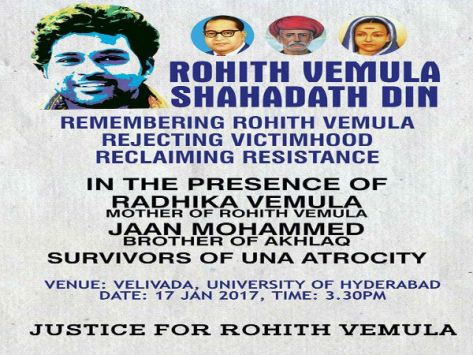
Never forget, never forgive: Justice for Rohith

xrohith1-16-1484552927-jpg-pagespeed-ic-5axp0tr5hh

The Dwijitalisation of India: Satya Sagar

GUEST POST by Satya Sagar

For over a millennium one of the recurring debates among Indian philosophers was whether this world was real or a mere dream[1]. Paradoxically, those who preached most passionately that our senses mislead us and everything around was Maya or an illusion, went on to corner the largest chunk of material reality.

Behind the smokescreen of clever mythology, it was they, who grabbed the lion’s share of everything tangible over the centuries – from land, water, natural resources to hard political and social power. Worse still, using a mix of brute force and religious mumbo-jumbo, they consolidated the exploitation of those who work by those who merely cook up tall stories, through the nightmare of the caste system.

Today the politics of Maya is well and truly back in play with Narendra Modi’s ‘Mahayagna’ a.k.a. demonetisation promising a digital Moksha through the tapasya of a ‘war on black money’. Once again, as in India’s sordid past, the biggest losers of this devious push for a cashless economy are going to be those right at the bottom of the Indian caste hierarchy. Continue reading The Dwijitalisation of India: Satya Sagar

NHRC indicts Chhattisgarh police: WSS statement

STATEMENT BY WOMEN AGAINST SEXUAL VIOLENCE AND STATE REPRESSION

WSS welcomes the decisive intervention of the National Human Rights Commission in  cases of sexual violence against Adivasi women by police and security forces engaged in anti-Maoist operations in Chhattisgarh. Validating our assertion that sexual violence is being used as a weapon of war in Bastar,  the Commission has held the State government “vicariously liable” for gross violations of human rights.

Continue reading NHRC indicts Chhattisgarh police: WSS statement

Hindutva Fascists Ransack Janchetna Book Shop in Ludhiana

We are publishing below a statement issued by Anand Singh on behalf of Janchetna, Ludhiana

A group of Hindutva goons ransacked Janchetna — an institution dedicated to promote and propagate progressive literature — in Ludhiana on 2 January 2017. They also abused and misbehaved with the book shop manager Binny and manhandled other activists who came to her rescue. They even threatened to put the books on fire. More disturbing, however, was the fact that all this happened in the presence of police which remained a mute spectator to this fascist attack which lasted for two hours. Later, instead of arresting the goons, the police took the activists present there — Binny, Janchetna book shop manager, Lakhwinder , President of Textiles Hosiery Kamgar Union, Gurjeet (Samar), an activist of karkhana Mazdoor Union and Satbir Naujawan Bharat Sabha activists — into custody and sealed the shop. However, due to people’s pressure the activists were soon released and a demonstration of various mass organisations and trade unions compelled the police to let the book shop reopen.

Continue reading Hindutva Fascists Ransack Janchetna Book Shop in Ludhiana

Maternity Entitlements were Legal Rights 3 years ago, not a New Year Gift: Statement of the Right to Food Campaign


On New Year’s Eve, the Prime Minister in his much-anticipated speech amongst other commitments made a vague announcement of a “nation-wide” scheme for maternity entitlements for pregnant women.

But the PM has not spelled out any specifics – neither the timeframe;budget nor its universal coverage as obligated in the National Food Security Act (NFSA) since2013. Clause 4B of the law already promises all pregnant and lactating women maternity entitlements of atleastRs 6000 for each child. But for three years, the central government didn’t honour this legal obligation. Though better late than never, re-packaging this legal right as the PM’s New Year gift is disingenuous.

Further media reports, from December indicate that the Finance Ministry may hike the budget by a mere 20 percent (instead of the sevenfold increase necessary for universalisation) and that too restrict the benefit to only women Below the Poverty Line (BPL). This would be in complete violation of the NFSA.

But there seems to bearecurring trend to subvert the law. For the last three years, this government continued with the pilot Indira Gandhi MatritvaSahyogYojana (IGMSY) in just 53 districts of the country despite repeated demands by civil society activists and women from across the country. This year, Right to Food Campaign activists from across India even sent postcards to the PM to remind him of the state’s obligation.

In September 2015, even the Supreme Court issued notices to the Centre on the non-implementation of maternity entitlements under the NFSA.

While the government did initially enhance the IGMSY allocations from Rs 4000 to Rs. 6000 to be in tune with the NFSA, neither the coverage nor the budget was enhanced which languishes at Rs. 400 crores. Instead to ensure that all eligible women are covered as per the NFSA, Rs 16,000 crores is necessary. A real test of the Prime Minister’s announcement will be in the fine print of the allocations in next month’s budget.

[Watch] Marching with the Bhim Army!


This October, a colleague and I tracked a group of young Dalits fighting caste atrocities in Uttar Pradesh. The documentary posted above is one part of an extended multimedia project. See the entire project here: https://www.thequint.com/quintlab/ambedkar-dalit-army-fights-caste-atrocities-in-uttar-pradesh/

DISSENT, DEBATE, CREATE