In Solidarity with Adivasis in Bastar, Human Rights Defenders and Bela Bhatia in Bastar: Concerned Students in TISS, Mumbai

Guest Post by CONCERNED STUDENTS OF TATA INSTITUTE OF SOCIAL SCIENCES, MUMBAI

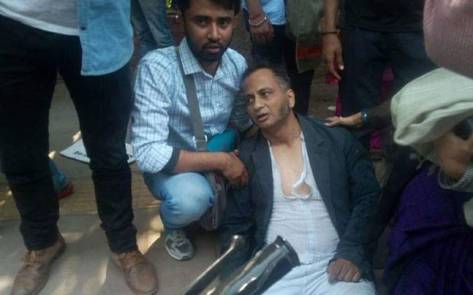
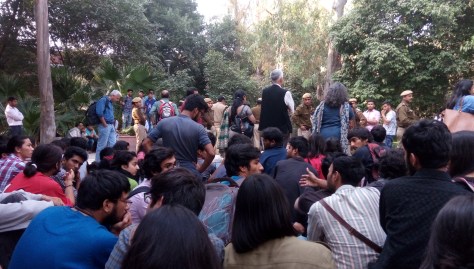
We, the concerned students of Tata Institute of Social Sciences (TISS), Mumbai condemn the continuing state repression of adivasis and recent attack on human rights activist Bela Bhatia in Bastar, Chhattisgarh.

On the 23rd of January, 2017, a group of 30-odd men attacked Bela where they barged into her house in Parpa, near Jagdalpur violently and threatened to burn the building down if she did not leave immediately. The mob also attacked her landlords and their children, threatening them with dire consequences if Bela was not evicted immediately. Despite Bela’s assurances that she would leave, the mob continued to be belligerent, in the presence of the police, and the Sarpanch. The mob has been identified with the right-wing vigilante group Action Group for National Integrity (AGNI). Continue reading In Solidarity with Adivasis in Bastar, Human Rights Defenders and Bela Bhatia in Bastar: Concerned Students in TISS, Mumbai

भक्तों दा जवाब नहीं! गांधीजी का ‘विलोपन’- तीन ‘आसान’ किश्तों में

.जो शख्स तुम से पहले यहाँ तख़्त नशीन था….
उसको भी खुदा होने पे इतना ही यकीन था

– हबीब जालिब

Modi Bhakt

भक्तगणों का – अर्थात वही बिरादरी जो ढ़ाई साल से लगातार सुर्खियों में रहती आयी है –  जवाब नहीं !

अपने आराध्य को इस कदर नवाज़ते रहते हैं गोया आनेवाली पीढ़ियों को लगने लगे कि ऐसा शख्स कभी हुआ न हो। वैसे टेक्नोलोजी की तरक्की ने उनके लिए यह बेहद आसान भी हो गया है कि वह फोटोशॉप के सहारे दिखाए कि कथित 56 इंची सीने के बलबूते वह कुछ भी कर सकते हैं।

मिसाल के तौर पर वह बाढ़ के हवाई सर्वेक्षण के लिए निकलें और धुआंधार बरसते पानी में उनकी आंखों के सामने समूचा शहर नमूदार हो जाए। यह अलग बात है कि उनकी इस कवायद में कई बार उनके इस हीरो की हालत हिन्दुओं के एक पवित्रा कहे जाने वाले एक ग्रंथ में नमूदार होते नारद जैसी हो बना दी जाती है, जिसे इस बात का गुमान ही न हो कि उसने कैसा रूप धारण किया है और उनका यह आराध्य दुनिया भर में अपने आप को मज़ाक का निशाना बना दे।

हम याद कर सकते हैं अमेरिका के तत्कालीन राष्ट्रपति ओबामा की अगवानी का प्रसंग जब दिन में तीन तीन बार ड्रेस बदलने या अपना खुद का नाम अंकित किया दस लाख या करोड़ रूपए का सूट पहनने की उनके आराध्य की कवायद विश्व मीडिया में सूर्खियांे में रही, उसका जबरदस्त मज़ाक उड़ा और इसी दौरान मीडिया ने इस तथ्य को उजागर किया था कि इसके पहले ऐसी आत्ममुग्धता भरी हरकत मिस्त्र के अपदस्थ तानाशाह होसनी मुबारक ने की थी।

( For full text of the article click here :https://sabrangindia.in/article/modi-bhakt-and-mahatma-gandhi-subhash-gathade)

How do the new UGC regulations affect prospective students applying to JNU? Ayesha Kidwai

This is the first of a five part series in which AYESHA KIDWAI will explain how the UGC Gazette Notification of 2016, especially as interpreted by the VC of JNU, will affect different categories of students, faculty, and the general public.

Ayesha Kidwai is Professor, Centre for Lingustics, School of Language, Literature and Culture Studies, JNU.


poster1-ugc

Revisiting the demonetization survey: Juhi Tyagi

Guest Post by JUHI TYAGI

In light of the recent book, I Am A Troll: Inside the Secret World of the BJP’s Digital Diary authored by journalist Swati Chaturvedi which describes the working of the BJP’s media’s cell to systematically undermine dissenting opinions, we need to revisit other, seemingly innocuous, government media campaigns such as the demonetization survey and its use as a tool in bending into shape public opinion.

The demonetization survey was officially launched on 22nd November 2016 on the NM app by the government. Its purpose was to receive feedback from the people themselves on the validity of withdrawing 86 percent of the currency in circulation to address two problems: that of black money and counterfeit currency. The survey consisted of nine questions, with the tenth providing space for sharing suggestions. The questions dealt with people’s beliefs about the existence of black money in India and on its need to be eliminated. On their opinions of the government’s efforts against corruption, and more particularly, on the effectiveness of demonetization in ridding society of black money, all corruption and terrorism while creating opportunities for higher education, health care and affordable housing for all.

Continue reading Revisiting the demonetization survey: Juhi Tyagi

The Indian Newspaper Industry – Response to Times of India Editorial: JAC for Implementation of Majithia Wage Board

The following is a response by M J Pandey on behalf of the JOINT ACTION COMMITTEE FOR IMPLEMENTATION OF MAJITHIA WAGE BOARD, to a Times of India editorial calling for “reasonable tax and labour policies”.

With reference to the unsigned editorial ‘Indian Newspaper industry: Red Ink splashed across the bottom line’ (Times of India, Jan 19, 2017), a case is being made out for concessions to the newspaper industry on the grounds that it is in the doldrums and is beleaguered by various burdens, including that of wage board wages, GST, DAVP, etc.

Without mentioning the recent illegal closure of six editions of The Hindustan Times as the obvious peg for this, the editorial seeks a range of concessions – from a part-discontinuance of the wage board for newspaper employees, to subsidies on advertising and tax.

Clearly, what the newspaper industry has lost in judicial review, it is now seeking to stealthily recoup through administrative fiat.

Under the fig leaf of “freedom of speech”, the editorial makes a number of indefensible propositions. However, we will confine ourselves to the empiricial terrain of the Wage Boards and wish to make the following points:

That a three-judge bench of the Supreme Court headed by the then Chief Justice of India P Sathasivam had on Feb 7, 2014 (ABP Pvt Ltd and Anr vs Union of India and Ors), upheld ‘the constitutional validity of the Act and the Amendment Act, 1974’ (referring to the Working Journalists Act, 1955) and rejected the contention of improper constitution of the Wage Boards, irregularity in the procedure adopted by the Majithia Wage Board and that Majithia Wage Boards had overlooked the relevant aspects and considered extraneous factors while drafting the recommendations.

Continue reading The Indian Newspaper Industry – Response to Times of India Editorial: JAC for Implementation of Majithia Wage Board

Dining With The Cultured Hate Mongers

Should we criticise the organisers of the Jaipur Literature Festival for inviting two functionaries of the Rashtriya Swayamsevak Sangh to this year’s edition of the annual festival? Murmurs in the literary circles seem to suggest that the organisers of JLF succumbed to pressure from the right wing. A mere look at the list of speakers and programmes makes it clear that there are a fair number of liberal and left-leaning individuals among the speakers. Why, even the general secretary of the Communist Party of India (Marxist), Sita Ram Yechuri, is in that list. So a balance appears to have been struck. Continue reading Dining With The Cultured Hate Mongers

EFLU Defamation Case Against Students – Statement by Concerned Academics and Public Intellectuals

Statement by Concerned Academics and Public Intellectuals Following the Court Sentence on the EFLU Defamation Case

We the undersigned wish to express our grave concern over the fact that five senior students of the English and Foreign Languages University (EFLU), who were raising the issue of discrimination against SC and ST students in the EFLU’s Department of German, have on 13/12/2016 been charged with defamation of a professor and sentenced to six months’ imprisonment.  Their protests concerned Sreeramulu M, a ST student enrolled in the BA programme of EFLU’s German Department. Sreermulu had not been allowed to continue in the programme ostensibly for his failure to maintain grades.  The others who have been sentenced are office bearers of associations representing such marginalized students; they were speaking at a Press Meet held on 24/12/2012 after Sreeramulu, who had been trying for several months to be allowed to continue his course and avail remedial classes, went on fast.  The defamation case was filed in March 2013.  Two SC/ST atrocities complaints filed by Sreeramulu M and again by another student, Ranjan Kumar, in January 2013 are pending with the Police and are yet to be investigated.

The countrywide discussion raised through the struggles following Rohith Vemula’s death in January 2016 drew public attention to the extent of caste discrimination in our universities.  SC, ST, OBC and minority students figure disproportionately in the statistics for failure, drop out, expulsion, rustication and even suicide. Educational institutions and those who run them (teachers and administrators) have been forced to acknowledge that they are implicated in this terrible attrition of young citizens and know they must initiate reforms. Yet, far too little is being done to discuss this evidence, rethink rules, temper teachers’ attitudes, reform syllabi or challenge ideas of merit that discriminate against the marginalized.  A teacher’s job is to help the actual students in the classroom to learn; not to uphold abstract standards of merit.  From the courts, the underprivileged expect humane recognition of the inequities of their predicament and wise support for their cause. But what they have received is a demoralizing and intimidating signal. Continue reading EFLU Defamation Case Against Students – Statement by Concerned Academics and Public Intellectuals

Never forget, never forgive: Justice for Rohith

xrohith1-16-1484552927-jpg-pagespeed-ic-5axp0tr5hh

The Dwijitalisation of India: Satya Sagar

GUEST POST by Satya Sagar

For over a millennium one of the recurring debates among Indian philosophers was whether this world was real or a mere dream[1]. Paradoxically, those who preached most passionately that our senses mislead us and everything around was Maya or an illusion, went on to corner the largest chunk of material reality.

Behind the smokescreen of clever mythology, it was they, who grabbed the lion’s share of everything tangible over the centuries – from land, water, natural resources to hard political and social power. Worse still, using a mix of brute force and religious mumbo-jumbo, they consolidated the exploitation of those who work by those who merely cook up tall stories, through the nightmare of the caste system.

Today the politics of Maya is well and truly back in play with Narendra Modi’s ‘Mahayagna’ a.k.a. demonetisation promising a digital Moksha through the tapasya of a ‘war on black money’. Once again, as in India’s sordid past, the biggest losers of this devious push for a cashless economy are going to be those right at the bottom of the Indian caste hierarchy. Continue reading The Dwijitalisation of India: Satya Sagar

NHRC indicts Chhattisgarh police: WSS statement

STATEMENT BY WOMEN AGAINST SEXUAL VIOLENCE AND STATE REPRESSION

WSS welcomes the decisive intervention of the National Human Rights Commission in  cases of sexual violence against Adivasi women by police and security forces engaged in anti-Maoist operations in Chhattisgarh. Validating our assertion that sexual violence is being used as a weapon of war in Bastar,  the Commission has held the State government “vicariously liable” for gross violations of human rights.

Continue reading NHRC indicts Chhattisgarh police: WSS statement

Hindutva Fascists Ransack Janchetna Book Shop in Ludhiana

We are publishing below a statement issued by Anand Singh on behalf of Janchetna, Ludhiana

A group of Hindutva goons ransacked Janchetna — an institution dedicated to promote and propagate progressive literature — in Ludhiana on 2 January 2017. They also abused and misbehaved with the book shop manager Binny and manhandled other activists who came to her rescue. They even threatened to put the books on fire. More disturbing, however, was the fact that all this happened in the presence of police which remained a mute spectator to this fascist attack which lasted for two hours. Later, instead of arresting the goons, the police took the activists present there — Binny, Janchetna book shop manager, Lakhwinder , President of Textiles Hosiery Kamgar Union, Gurjeet (Samar), an activist of karkhana Mazdoor Union and Satbir Naujawan Bharat Sabha activists — into custody and sealed the shop. However, due to people’s pressure the activists were soon released and a demonstration of various mass organisations and trade unions compelled the police to let the book shop reopen.

Continue reading Hindutva Fascists Ransack Janchetna Book Shop in Ludhiana

Maternity Entitlements were Legal Rights 3 years ago, not a New Year Gift: Statement of the Right to Food Campaign


On New Year’s Eve, the Prime Minister in his much-anticipated speech amongst other commitments made a vague announcement of a “nation-wide” scheme for maternity entitlements for pregnant women.

But the PM has not spelled out any specifics – neither the timeframe;budget nor its universal coverage as obligated in the National Food Security Act (NFSA) since2013. Clause 4B of the law already promises all pregnant and lactating women maternity entitlements of atleastRs 6000 for each child. But for three years, the central government didn’t honour this legal obligation. Though better late than never, re-packaging this legal right as the PM’s New Year gift is disingenuous.

Further media reports, from December indicate that the Finance Ministry may hike the budget by a mere 20 percent (instead of the sevenfold increase necessary for universalisation) and that too restrict the benefit to only women Below the Poverty Line (BPL). This would be in complete violation of the NFSA.

But there seems to bearecurring trend to subvert the law. For the last three years, this government continued with the pilot Indira Gandhi MatritvaSahyogYojana (IGMSY) in just 53 districts of the country despite repeated demands by civil society activists and women from across the country. This year, Right to Food Campaign activists from across India even sent postcards to the PM to remind him of the state’s obligation.

In September 2015, even the Supreme Court issued notices to the Centre on the non-implementation of maternity entitlements under the NFSA.

While the government did initially enhance the IGMSY allocations from Rs 4000 to Rs. 6000 to be in tune with the NFSA, neither the coverage nor the budget was enhanced which languishes at Rs. 400 crores. Instead to ensure that all eligible women are covered as per the NFSA, Rs 16,000 crores is necessary. A real test of the Prime Minister’s announcement will be in the fine print of the allocations in next month’s budget.

[Watch] Marching with the Bhim Army!


This October, a colleague and I tracked a group of young Dalits fighting caste atrocities in Uttar Pradesh. The documentary posted above is one part of an extended multimedia project. See the entire project here: https://www.thequint.com/quintlab/ambedkar-dalit-army-fights-caste-atrocities-in-uttar-pradesh/

Didi, I Want to Learn the Harmonium and Roam Around Freely: Samhita Barooah

Guest post by SAMHITA BAROOAH

During a visit to the Kishori Mandal at Apne Aap Women Worldwide’s Uttari Rampur Centre in Forbesganj I met some lovely girls. They stayed in the community near the red light area. They were eager to learn new things. They asked me my story of life, “Didi aapki kahani sunao? Aapne kaise yaha tak sangharsh kiya?” I was again very surprised to encounter the subversion of queries. I should have been the one to ask those questions to the girls, but they wanted to know more about me. Perceptual understanding is a perspective rooted in feminist standpoint theory which could apply to any context from the onlooker’s context. For the young girls from the Red Light Area in Forbesganj, I was trapped in some realities which connected me to them. That was why she asked me to share my story of struggle. When I said education enabled me to survive the world around me, they laughed and said that was not their story. They said, “For us we have to get married as soon as we are 18 years old but sometimes even earlier. We just want to enjoy our freedom now in this centre till we get married. After that we do not know what holds true for us.” As women whether we are in the Nat community of Bihar or we are in the liberated spaces of North East India, our identities get defined by our marriage, cultural practices and socialisation. Unbound freedom for women seems to be a misnomer which should be forbidden for women as the evolved souls say.

Continue reading Didi, I Want to Learn the Harmonium and Roam Around Freely: Samhita Barooah

Demonetization not a “war on black money” unless finances of political parties made accountable: Nishank Varshney

Guest Post by NISHANK VARSHNEY

While the common man is being subjected to infinite scrutiny and daily changing rules, the political parties enjoy to have a free-run at not disclosing a large part of their income, running into thousands of Crores. As long as the political parties continue to enjoy this exemption, the menace of black money cannot be said to have been tackled.

In one of the most unprecedented decisions in the Indian history that was taken on 8th November, 2016, the Prime Minister Shri Narendra Modi, suddenly announced the cancellation of Rs. 500 and Rs. 1000 notes with a view of “eliminating black money”. Over the last seven weeks, the PM has regularly reiterated this stand, and called Demonetization a “war on black money” through his speeches at various election rallies, the survey on his mobile app, and most recently in his “Mann ki Baat” program on Sunday. However, Mr. Nasim Zaidi, the Chief Election Commissioner of India, recently expressed that “many political parties are being used as conduits for siphoning off black money”.

As per the Representation of the People Act, 1951 (RP Act), political parties are not required to report the names of the individuals or organizations from whom they have received donations of amounts less than Rs. 20,000. A study by Association for Democratic Reforms (ADR) has shown that these ‘unaccounted donations’ form a large part of political parties’ income. In the year 2014-15 alone, BJP declared an income of 505.26 Crore from unknown sources, while Congress received a sum of 445.22 Crore from unknown sources during the same time-period. At present, there are over 1700 registered political parties in India, and many political parties may have been misusing this exemption to convert their black money, as voiced by the Chief Election Commissioner. Continue reading Demonetization not a “war on black money” unless finances of political parties made accountable: Nishank Varshney

Dangal and the Phogat Sisters – A Tale of Many Struggles: Praveen Verma

Guest post by PRAVEEN VERMA

1-phogats-and-film

Dangal literally means the Indian style wrestling competition for male pahalwans (wrestlers). Dangal has been an important form of entertainment for ages, especially in rural (north and west) India. Dangals act in many ways. It works to settle the personal score between different Akharas and pahalwans. It’s a place where honour, reputation and social status are on stakes and personal and political rivalries are fought out, or settled. For example, one of the most important dangals used to happen every Sunday at Eidgahi Maidan, Jama Masjid in Delhi, till very recently. Itwari dangal, as it was fondly called, was the place where pahalwan like Gama, Imam Baksh, Chandgiram used to come and show their talent in front of thousands of wrestling lovers. I remember whenever I used to come to Delhi, I always wanted to win the bout at Eidgahi Maidan, as it meant a lot to win at Eidgahi maidan rather than any other place!

Gama Pahalwan at Eidgahi

As it was strictly meant for male pahalwans, women were not even allowed to watch them fighting, let alone participating. Something similar to Khap Panchayats, where women still are not welcome. Women are the fairly latecomers in wrestling arena and yet not so welcome. In this context to make a film on the emergence and development of women wrestling in India itself is a fascinating idea.

Dangal, the movie is based on a true story of Mahavir and his firebrand daughters and their ‘quietly’ active mother. It is an important movie to watch for many reasons. Firstly, it portrays a father who wanted his daughters to pursue something (wrestling) which was un-imaginable in those days. It reveals what it took for the first generation of women wrestlers to break those masculine stereotypes and depicts the overall impression of wrestling in the realm of sports culture in India. There are so many moments in the film to cheer about, to get goosebumps (at least I got many). Writing review is an unknown territory for me but there is a personal reason to taking to this venture of writing.  The release of this film forced me to say something which, as a former wrestler for almost ten years, is still left with me. Continue reading Dangal and the Phogat Sisters – A Tale of Many Struggles: Praveen Verma

Do not let a university turn into a ‘shakha’ of a poisoned tree

Have the JNU students and faculty seriously considered taking legal action against the current Vice Chancellor? From every report that I have seen, all his actions in the recently concluded farcical Academic Council (AC) meeting seem to me to be instances of prima facie procedural violation. (Or am I incorrect in assuming this?)

From what I have heard, his conduct includes the deliberate misrepresentation of the minutes, pretending to consensual decisions where there were none, and disruptive and arrogant behavior towards Academic Council members. If this is indeed the case, could there not be strong legal grounds to ask for his removal on the grounds of his willful violation of institutional procedures and ethics? What do people with legal experience think of such a possibility? What do students and faculty think?

If recourse to legal action is not feasible or practical, what else can be done to remedy this situation? What kind of campaign can restore a semblance of sanity to JNU (and to universities, generally) that have been serially assaulted by university administrations acting at the behest of right-wing thugs.

It seems to me, that this man, Mamidala Jagadesh Kumar (the current JNU vice-chancellor) is acting like a criminal, and I think he should be treated as such from now on. Co-operating with his decisions, or even tacit acceptance of his manner of functioning, should now be seen as complicity with an agenda to destroy the university. Let us also not forget that this VC continues to protect those who assaulted Najeeb Ahmed before he disappeared from JNU. In the unfortunate possibility of anything untoward having happened to Najeeb Ahmed, this VC should be seen as being responsible. He creates the conditions of impunity that threaten the safety of each and every student. His decision to punish the students who protested yesterday with arbitrary and unjust suspension orders is exactly analogous to the authoritarian conduct of Podile Appa Rao, VC of HCU, that led to the tragic suicide of Rohith Vemula. The manner in which both Jagadesh Kumar and Appa Rao have acted suggests a pattern of the deliberate victimization of students on the basis of their caste identities. This only brings shame and disrepute to the institutions headed by them.

In my considered view, (and please view this only as a suggestion) the time has come for Faculty and Students of JNU to come together (irrespective of their political positions and postures) to demand the unconditional removal of Mamidala Jagadesh Kumar from the vice-chancellorship of JNU and from the university itself. I think that all limits have now been crossed by his conduct. His declarations about what the AC decided should be treated as null and void (also because they are violative of the principles of social justice and democratic education), and the suspension orders against the students who were targeted must be revoked. I hope that the present JNUSU and JNUTA will not fail in their responsibility to conduct a coherent and militant campaign to reverse this situation. If they vacillate, or, are unable to offer a coherent, well worked out strategy, they too will be seen as responsible for the mess that JNU is in today.

I hope that every student (and here I mean ‘common students’ as well as student activists within and outside organizations) and every teacher at JNU is able to rise above the temptation of negativism and needless point-scoring at this juncture. Just as the JNUSU crucially must not see itself as immune to criticism, or fail to act with militant resolve and clarity, and in resonance with the concerns of students, (including of those outside the union) so too, those outside the union could help matters by not falling to the temptation of adopting ‘holier than thou’ postures that impede practical unity. Let there be solidarity in struggle, and the kind of criticality that aids , rather than impedes, solidarity.

This time, this opportunity, this moment of necessity for thoughtful, militant, intelligent unity of all students, teachers and all friends of the idea or a free and open university is too precious to lose at the altar of either posturing or prevarication.

Restore freedom to freedom square! Do not let a university turn into a ‘shakha’ of a poisoned tree! Eject Mamidala Jagadesh Kumar! Reject Podile Appa Rao! Bring back life to our universities !

Corrupt Notes – the Black Comedy of Tragic Error: R Srivatsan

Guest post by R. SRIVATSAN

Reflections on the many paradoxes of the demonetization process: the schizophrenia of the BJP, the desire of the well to do, the baffling sacrifice of the have nots, the faults and fault lines that propagate through our society in crisis.

Narendra Modi and Arun Jaitley, in their brilliant strategy to kill black money through the withdrawal of currency, show no basic understanding of what the term ‘black money’ signifies.  Prabhat Patnaik has recently argued there is no such thing as black money – there is only a black economy.  However, one aspect of the black economy is the refusal to pay taxes and instead hoard wealth in the form of currency that is not recorded in bank deposits.  Another is the payment of bribes with untraceable currency to authorities and politicians who use their position of leverage as personal property on which they charge a rent for use. Both these uses of black money as corruption have a common lineage. In both cases, corruption is the failure of categories that were supposed to have been water-tight.  A) “All income is taxable” B) “Public servants are true servants of the people”

But first, here is an attempt to shake our convictions that the refusal to pay taxes is a moral evil.  To do so, let me take the example of a Hollywood film, Stranger than Fiction (2006).  The plot of this film, which has a quite complex fantasy storyline, baits the viewer’s desire through the emerging love interest between an IRS auditor Harold Crick and his investigative target Ana Pascal, who runs a bakery.  Ana is a conscientious objector against taxation. She argues that she openly defies taxation since she doesn’t support the hegemonic objectives of the USA which spends most of its revenue income on weapons of war and destruction.  Ana is thus the beautiful and charming face of morally upright conscientious objection which masks the libertarian hatred for a state that taxes more than minimally.  As Robert Nozick asserted long ago such taxation is seen as thievery, against the sacred right to private property.  Ana’s position thus also masks the refusal to redistribute wealth through welfare. As a viewer, I found it extremely difficult to think of Ana as an evil person.  She was the most charming free-spirit I had encountered on celluloid (well, on a TV screen) for a long time. The objective of this sub-plot of film criticism is to help the reader shed the ready moral judgement that not paying taxes is a universal crime and a sin against society, so that it becomes possible to examine exactly what the complex nature of the act that constitutes tax evasion is. Continue reading Corrupt Notes – the Black Comedy of Tragic Error: R Srivatsan

JNU VC sabotages democratic functioning of Academic Council to push through anti-social justice policies

First, here is the statement issued by 20 faculty members of the Academic Council today, about half the members present at the adjourned 142nd AC Meeting.

PRESS RELEASE BY MEMBERS OF THE JNU ACADEMIC COUNCIL

We, faculty members of the JNU Academic Council, are shocked and dismayed at the manner in which the Vice Chancellor has conducted the 142nd Academic Council meeting of December 23rd (adjourned to December 26th). This was a thinly attended meeting since it was held at short notice in the middle of the winter vacation, despite several requests for rescheduling.

The minutes of the previous (141st) Academic Council meeting that had been circulated contained many errors, misrepresentations, and falsities. Several of these had been pointed out by many members of the Academic Council, including in written representations to the Registrar.

Continue reading JNU VC sabotages democratic functioning of Academic Council to push through anti-social justice policies

On Barak Valley Bandh on 16th December, 2016 – Some Nascent Observations: Arunima Chakraborty

This is a Guest Post by ARUNIMA CHAKRABORTY

Let’s begin with the usual: by ruing over Indian mainstream media’s overlooking of what could have been treated as more newsworthy. Today, that is, 16th of December, 2016 witnessed a bandh in southern Assam’s Barak valley protesting against the statement by the union minister of state for railways, Rajen Gohain that ‘Bengali…should be withdrawn from Barak valley as official language’ since ‘there cannot be two official languages’.[1] And a simple, layman-like google-news search reveals that there are just three entries on the issue/event.

This piece is aimed not at joining the state Congress and the local SUCI(Socialist Unity Centre of India) cadres who are decrying comment by Gohain, the union minister and a senior BJP leader in Assam but rather at attempting a delineation of the ominous portents which it seems to have unleashed. And of course, to trace the genealogy of the statement.

First of all, a rather facile fact: Mr. Gohain’s observation that there cannot be two official languages clashes with article 345 of the Indian constitution which allows for the adoption of one or more official languages by any state of the Indian union. Article 347 also allows for respecting the desire of a significant section of a populace of a state for the usage of a language of their choice.[2] A couple of months ago, while visiting Assam, I watched, or rather listened, on an Assamese news channel, a shrill voice issuing a caveat to its viewers, “…barak upatyakat asomiya bhasha nokoya hoiche”. ‘Assamese is no longer spoken in the Barak valley’. Anybody remotely familiar with the history of the region could have retorted back with the question, when was Assamese ever spoken in the region?

Continue reading On Barak Valley Bandh on 16th December, 2016 – Some Nascent Observations: Arunima Chakraborty

The Laziest Blog Post Ever Written – Educational reform and Demonetization

Remember the FYUP debacle? Remember (as repeatedly written about on Kafila as elsewhere) that it was the latest in a long series of badly-conceived, mindlessly-borrowed and forcibly-implemented ‘educational reforms’ that practically crippled universities around the country? And remember a certain Rev. Valson Thampu, authoritarian, controversy-soaked Principal of St. Stephens College and eager soldier for the reforms? Well Thampu, now-retired, has thrown his weight against demonetisation these days in a set of articles on The Daily O. Now the thing is, almost everything Thampu finds objectionable about monetary reform, can be said about educational reform.

No, literally, every single thing.

So I simply took his post and replaced some key words, to produce a post about education. I know, I know, it’s not nice to do this, especially when you know, he speaketh the truth on demonetisation and all. But it is too wonderful an opportunity to pass up, to not use Thampu’s own eloquent words to say, yet again, what he has steadfastly refused to listen to in the past. Besides, as I say above, this is the laziest blog post I have ever had to write – that’s always an incentive.

His article in the original can be read here.

POLITICS HIGHER EDUCATION | 5-minute 7-minute read | 22-12-2016 23-12-2006 VALSON THAMPU SUNALINI KUMAR

Continue reading The Laziest Blog Post Ever Written – Educational reform and Demonetization

DISSENT, DEBATE, CREATE