Tag Archives: AAP

Sex Workers And Women’s Organisations Condemn DCW Chair Swati Maliwal’s Statement On Sex Work

[While in complete agreement with the statement posted below, I would like to add a personal note. I am a citizen of Delhi who believes that in its short stint in office so far, and despite every attempt by the central government to paralyze its functioning, the Aam Admi Party has taken decisive, creative and positive steps in several fields – education, health, and above all in its strong assertion that water is a natural resource that should not be treated as a commodity.

Nevertheless, it is unfortunately increasingly clear that on gender related issues, AAP’s functionaries exhibit the deepest conservatism – from Kejriwal’s speech on March 8th, which thanked his wife for keeping “his” home running, to Somnath Bharti on making Delhi safe enough for even “beautiful women” to be out at night, as if sexual violence is a tribute and compliment to the beauty of women, to Swati Maliwal’s aligning herself with the deeply conservative abolitionist position on sex work.

This conservatism is at odds not only with “elite activists”, as AAP may think, but with the views of the majority of ordinary people, who poured out into the streets after December 16th 2012, and sent scores of petitions to the Justice Verma Committee, expressing basically the belief in the rights of all women to public spaces at all times, and condemning victim blaming; sex workers are ordinary people too, and so are housewives, who even while they run homes with devotion and efficiency, are not unaware of the unfairness of the shared domestic space being considered to belong to the husband and “his” family. A March 8th message could have recognized women in their different roles, as housewives, domestic servants, CEOs, political activists. As a party that has learnt from other social movements, AAP needs to urgently start a conversation with women’s organizations of different kinds, including sex workers’ organizations.]

The statement follows:

The National Network of Sex Workers and women’s organisations in India strongly condemn the observations and statement of Delhi Commission for Women (DCW), Ms. Swati Maliwal calling sex work and prostitution akin to “rape” and calling for its “eradication”. We call on her to immediately withdraw her statement and tender an unconditional apology to the all women in sex work, whose dignity has been impacted by her observations.

The Honorable Supreme Court has recognized the need to ensure that sex workers are able to live a life of dignity. The Court set up a panel to discuss “Conditions conducive for sex workers to live with dignity in accordance with the provisions of Article 21 of the Constitution.” (Budhadev Karmaskar vs. Government of West Bengal).

 The Chairperson of DCW should do her homework before launching into a campaign that has not engaged with the ongoing debates and dialogues to recognize the rights of adult consenting workers to remain in sex work and ensure that their human rights and dignity are protected, such a short sighted and uninformed perspective demeans the office of a Commission set up to protect the rights and dignity of women. Continue reading Sex Workers And Women’s Organisations Condemn DCW Chair Swati Maliwal’s Statement On Sex Work

Delhi Police Blames AAP for Gajendra Suicide – Remember Constable Tomar’s Death?

Reports have it that Delhi Police has blamed the AAP for the death of Gajendra Singh at its rally recently – not surprisingly, as we had noted in our previous post on the suicide. We had suggested in that post there seemed to have been prior instructions to the Police from the Central government, under which it functions, not to act. And the reports today about Delhi Police reporting to their higher ups only confirm our suspicions.

Here is what one of the reports has to say:

In a letter to the Home Ministry, the Delhi Police has claimed that the mob including Aam Aadmi Party (AAP) workers incited Gajendra Singh to commit suicide at a party rally in Delhi. The letter also claims that untrained volunteers climbed the tree which led to Gajendra falling off.

The report states that AAP volunteers and leaders were clapping and raising slogans which incited him to engage in more dangerous acts. It also adds on to say that though police requested AAP volunteers to stop provoking him through clapping and solganeering, neither the volunteers nor the leaders present on the state acceded to the request info.

Another report in a channel known for its BJP connections, says:

As per the Delhi Police report, AAP leaders were making provocative speeches, and the crowd present at the rally venue instigated and provoked Gajendra to commit suicide. The report also alleged that AAP did not heed to the police’s request to change the rally’s venue to Ram Lila Maidan.

Continue reading Delhi Police Blames AAP for Gajendra Suicide – Remember Constable Tomar’s Death?

An inability to grieve

Sarcasm in the  moment of death? For this you need to be evil. For, the first human reaction to death is silence. Even in the case of a normal death. It suddenly reminds us of our own mortality. Impermanence of our existence. When death is not normal, when it is an accident, a suicide or a murder, it shocks us. Or, it should. A life cut short unnaturally creates a void in us. A sense of unfulfillment. And our gaze turns inwards. We tend to become reflective. Words do not come easily to you. On  most of the occasions they sound false, even obscene. Therefore, we console the grieving not though words but by touching them. It is not easy to make sense of death, in whichever form it strikes us. Continue reading An inability to grieve

The Sin and the Error : Ravi Sinha

Guest Post by RAVI SINHA

…it takes an error to father a sin. ─ J. Robert Oppenheimer[1]

Future historians of India may well describe the past year as a year of political sin. This was the year in which the man who had earlier presided over the Gujarat Carnage was awarded the ultimate prize. The year saw an election that touched a new low marked by shallowness, vulgarities and lies – in no small measure by the labors of the man himself. Equally appalling have been the exertions of a large class of literati and glitterati to portray philistinism and inanities spouted by the most powerful mouth as wisdom of a visionary leader.

An entire country seems to have gone blind – unable to see that the emperor has no clothes. In this age of incessant television it should be obvious to anyone that the supreme leader does not carry conviction even when enunciating relatively higher banalities. He is at his natural best only when he mocks someone as a shehzada or slanders and vilifies an entire community through phrases such as ame paanch, amara pachees. It is an irony of history that the republic which had Nehru as its first prime minister has one now for whom even common mythology is too cerebral. He must vulgarize Pushpak Viman and Ganesha and reduce them to quackeries of aviation and surgery.

Misfortune of the nation goes beyond the man. Forces of the diabolic housed in the hydra-headed Parivaar can now accomplish the impossible. They can now occupy the political center stage without leaving off the lunatic fringe. They can adopt Gandhi without renouncing Godse; erect world’s tallest statue of a leader who had punished their forefathers for assassinating Gandhi; even co-opt Bhagat Singh without batting an eyelid about what he stood for and what he had to say about ideologies like theirs. They can further refine the art of doublespeak. Their “statesmen” can pave the way for corporate plunder and call it sab ka vikas (development for all). Their “ideologues” can advocate sab ka saath (inclusion of all) by exhorting Hindu women to give birth to a minimum of four children each, lest Hindus are reduced to a minority “in their own country”. Continue reading The Sin and the Error : Ravi Sinha

Acche Din Are Here Again!

U Turn on Pictorial Warning on Tobacco Products

picture courtesy : WHO

 ..Government is set to defer indefinitely the implementation of notification for increasing the size of pictorial warning on tobacco products beyond April one, when it was to come into force. ..The notification regarding amendment to the Cigarettes and Other Tobacco Products (Packaging and Labelling) Rules, 2008 sought increase in the size of specified health warning from the current 40 per cent to 85 per cent of the principal display area of the package of tobacco products.

(http://zeenews.india.com/news/health/health-news/govt-set-to-defer-tobacco-pictorial-warning-notification_1568427.html)

The week gone by has brought back smiles on the face of Tobacco Corporates.

Thanks to the latest U turn by the Modi government, Acche Din would continue unabated for them. The non-transparent manner in which the decision was taken and the media was kept in the dark has raised further eyebrows. It was only on the evening of 24 th March that while talking to the media, the health minister J P Nadda had assured them that there is no rethink in the government on introducing pictorial warnings covering 85 per cent of packaging for tobacco products from April 1 and within few hours of this interaction he left for Beijing. Continue reading Acche Din Are Here Again!

Peace, bread and politics of AAP: Satya Sagar

Guest post by SATYA SAGAR

Among the epithets, most frequently hurled at Arvind Kejriwal by the BJP, in the run up to the Delhi assembly elections, were ‘anarchist’, closely followed by ‘urban naxal’. What is it about AAP that threatens the Sangh Parivar to a point of exhibiting such great hysteria and anxiety?

AAP, despite some novelties, is after all a very mainstream political formation, operating completely within the ambit of the Indian Constitution and no pretensions of turning the system upside down?Is there something deeper happening here?

One possibility is of course that, in its name-calling, the BJP presumed the average Delhi voter would run scared, straight into the waiting arms of Papa Modi[1]. In that case then, it was obviously a complete misreading of the public mood of anger and defiance against established national parties. Continue reading Peace, bread and politics of AAP: Satya Sagar

AAP Victory and Some Tools for Popular Self-Government: Sagar Dhara

Guest post by SAGAR DHARA

The Aam Admi Party (AAP) has won a spectacular victory in the Delhi assembly elections and will form a government shortly. The party’s manifesto 2015 (http://www.aamaadmiparty.org/AAP-Manifesto-2015.pdf) promises to do many things—some positive, e.g., passing a Swaraj Bill and some that are not so positive, e.g., setting up pithead power plants to supply power to Delhi. Here are a few practical suggestions that may help AAP and its supporters to strengthen people’s participation in grasroot self-governance.

Participatory budgeting

AAP’s proposed Swaraj Bill is aimed at strengthening grassroot self-governance in Delhi mohallas and community neighbourhoods. Mohalla committees are designed to deal with local issues. However, they can also be used as platforms for Delhi’s polity to participate in decisions that that affect all of Delhi through a process called participatory budgeting.

Participatory budgeting first began in 1990 in the Brazilian city of Porto Alegre.  In the first quarter of every year, communities hold open house meetings every week to discuss and vote on the city’s budget and spending priorities for their neighbourhood.  Later, city-wide public plenaries pass a budget that is binding on the city council.  The results speak for themselves.  Within seven years of starting participatory budgeting, household access to piped water and sewers doubled to touch 95%.  Roads, particularly in slums, increased five-fold.  Schools quadrupled, health and education budgets trebled.  Tax evasion fell as people saw their money at work.  People used computer kiosks to feed communicate suggestions to the city council’s website.

Participatory budgeting is now being done in 1,500 towns around the world—Europe, South America, Canada, India—Pune, Bengaluru, Mysore and Hiware Bazar in Maharashtra. Twenty five years ago, Hiware Bazar was like any other drought-prone village in Marathwada.  Today its income has increased twenty-fold and poverty has all but disappeared. Continue reading AAP Victory and Some Tools for Popular Self-Government: Sagar Dhara

AAP Victory and the Challenges of a New Politics

Let me say it once again, the AAP victory cannot be understood outside the post-ideological moment. I have argued earlier on Kafila (here and here), that one of the key features of AAP was its post-ideological character – one that moved relentlessly beyond many verities of 20th century ideologies and binaries like state versus market, or religious/communal versus secular and so forth. To reiterate, this formation represents the spirit of the moment that is itself post-ideological.

At Ramlila maidan, courtesy New Indian Express

But it is also time perhaps, to underline that post-ideological does not mean post-political. At least, not any longer. There is no doubt that a politics of AAP is gradually and clearly coming into view – but it is a politics whose edifice is being built from the bottom up. It does not derive from any settled ideological blueprint that comes ready-made – a blueprint around which a politics is then sought to be constructed. That was the project of all 20th century ideologies, which had already divided the world into neat camps and made the divisions into permanent battle lines. Ideologies became repositories of Truth – universal and unchanging, taking away from politics the very contingency and fluidity that defines it. Ideology, in other words, was fundamentally anti-political. In parenthesis, it may be relevant to point out that that is why, perhaps, Marx himself celebrated the Paris Commune by underlining that the workers “had no ideals to realize, no blueprints to which the world must conform”; they merely had to set free the new forces that were challenging the old order. Socialism in the 19th century was not yet an ideology in that sense. Continue reading AAP Victory and the Challenges of a New Politics

An Election of Hope Versus Fear

Yes it’s a simplistic dichotomy, but there is really no better way to describe the current Delhi elections. On the one hand, a little ragtag army of Davids behind “Mufflerman”, as his faithful supporters affectionately call him, a person in baggy sweater and sneakers, one you wouldn’t look at twice if you passed him on the road.

Mufflerman Business Standard

  Kejriwal

On the other hand, a massively funded, aggressively confident Goliath, openly backed by the corporate bodies and full-page ads, riding a  national “Wave” higher than most Tsunamis, topped by the 56-inch chest of “Modiman”, even if recently modestly covered by a 12-lakh rupee vest.

56-inch Modi78c0d4d3-be9e-4afb-b034-1247529df720wallpaper1

On the one hand, a fearful and awed media establishment donating PR for free to the seemingly invincible King of Gujarat, and on the other, an aam aadmi, a volunteer-cadre run campaign and a palpable vibe of trust and openness on the ground. I know I know, some will say it’s all ‘perception management’ and PR, but barring the googly of the 2 crores party donation thrown at the opportune moment, if Mufflerman’s party was any cleaner, it could have given Lalita ji’s Surf a run for its money. Whatever the result on the 10th (and there is reason to be hawk-eyed about the possibility of tampering as Nivedita Menon’s post has urged), how does anybody not get what a miracle this alone is, in a political economy with a black economy of a size that is higher than the GDPs of most smaller countries? Perhaps this is in fact about hope and fear after all, however clichéd that sounds.

Continue reading An Election of Hope Versus Fear

Beware BJP’s Filthy Campaign and Desperate Bid to Steal the Elections!

Avam characters

As the AVAM drama unfolds and much more detective work remains to be done, some other disturbing news has also started trickling in. A journalist friend got a mail from an official yesterday, who confided to this journalist:

Dear Sir,
We would like to bring to your notice that our volunteer Mr. XYZ (name withheld for obvious reasons) has attended the preparation of Electronic Voting Machine on 31st January & 1st February and he noticed some discripencies in the EVMs of Booth No. 26, 47A, 75 & 87.
Whichever button he was pushing the vote was being casted in favour of BJP only.
However, after his objection the EVM machines were replaced.

We of course, do not know how many such machines there are.

Meanwhile, another friend – an academic – sent this mail, which tells us something of the sense he got from a tour around Delhi areas – along with his deep suspicion that once again, through some machinations, the elections may be stolen:

This is just to tell you that I accompanied two journalist friends to go on an election tour of Delhi (targetting trader bases with BJP support) and most of the people that we talked to openly supported AAP. Attitudes to Modi ranged from indifference to criticism for blabbering away and not doing anything to plain abuse. Many have started identifying the BJP as a “syndicate” party i.e. as a party of rich businessmen. Above all people think that the 49 day government was a period they felt empowered – and they compare it to the lack of any improvements under Modi for the last 8 months!

This still does not let me lose my belief in the worst: But it gives me a warm feeling when I keep my fingers crossed!

Continue reading Beware BJP’s Filthy Campaign and Desperate Bid to Steal the Elections!

नचैया,गवैया और पढ़वैया

‘कहीं रिहर्सल के लिए जगह दिला दो,’आफ़ताब ने कहा. हमारी मुलाकात लंबे अरसे बाद हो रही थी. मैं जानता था कि आफ़ताब इप्टा के साथ व्यस्त है. इधर कोई नाटक तैयार हो रहा है, यह खबर भी थी. लेकिन मालूम यह भी था कि इप्टा का अभ्यास पार्टी दफ़्तर  में चलता रहा है.कई महीने पहले अजय भवन की सबसे ऊपरी मंजिल पर नगीन तनवीर के साथ एक बातचीत में हिस्सा लेने भी गया था.इसलिए मैंने पूछा,‘अजय भवन तो है ही!’ ‘निकाल दिया,’ आफ़ताब ने मुस्कराते हुए कहा, ‘….. का कहना है कि पार्टी का दफ्तर राजनीति जैसे गंभीर काम के लिए है, नाच-गाने की प्रैक्टिस के लिए नहीं.’ ‘औरों ने क्या कहा?’मेरी जिज्ञासा अबोध बालक जैसी थी क्योंकि उत्तर मुझे भी पता था.बहुत शोर होता है, तरह-तरह के लड़के-लड़कियाँ आते हैं जो देखने में ही भरोसे लायक नहीं जान पड़ते.वे नाचते-गाते हैं, एक ही संवाद को बार-बार बोलते जाते हैं. इससे दसियों बरस से पार्टी दफतर में बने मार्क्सवाद के इत्मीनान के माहौल में खलल पड़ता है. दूसरे कॉमरेड ने थोड़ी तसल्ली देने को कहा कि अभी वहाँ पार्टी क्लास चल रहा है. हो सकता है, उसमें डिस्टर्बेंस के चलते ही मना किया हो. मालूम हुआ कि पार्टी क्लास के सामने इप्टा को वह नाटक पेश करना है जो अभी वह तैयार कर रही है.हफ़्तों तक जो विचारधारात्मक बौद्धिक श्रम वे करेंगे, उसके बाद उन्हें विश्राम देने के लिए और उनका मनोरंजन करने के लिए शायद इप्टा के नाटक का इंतजाम किया गया हो!

अक्सर राजनीतिक दल अपने सम्मेलनों के अंत में गीत-संगीत या नाटक का आयोजन चाहते हैं. उनकी समझ है कि मुख्य काम तो वे कर चुके ,अब आनंद या विनोद की बारी है. शुभा मुद्गल ने इसी प्रवृत्ति से खीजकर मुझसे कहा था कि जब तक उनके संगीत की राजनीति को ‘एक्टिविस्ट’नहीं समझेंगे,वे उनके बुलावे पर आना पसंद नहीं करेंगी. Continue reading नचैया,गवैया और पढ़वैया

Shazia Ilmi – Why Her Exit is Such a Blow: Jyoti Punwani

Guest post by JYOTI PUNWANI

Shazia Ilmi’s exit marks a real blow for AAP supporters. Her frequent TV appearances as AAP spokesperson made her out to be an articulate, confident woman who didn’t need to assert her religious identity to prove a point, which is a rare thing in today’s politics. Her participation in the Anna andolan was as much a pointer to its inclusive nature as it was to the emergence of a new kind of Muslim in public life: one who had no hesitation plunging into a mass movement which had strong nationalist overtones, was avowedly against the political system and had little to do with minority concerns.

When Shazia almost won from Delhi’s R K Puram constituency, it suddenly came home – for the first time in years, a Muslim candidate had been fielded from a Hindu-dominated constituency, and the Hindus had voted for her. In Mumbai, a Muslim political activist who’s friendly with every political party, has for long told Shiv Sena leaders that the moment they field a Muslim from any of their strongholds, he would join them. “The ability to take the other community along, that’s the test of a secular politician,’’   a senior Congress Muslim in Nanded  told me, rueing the fact that Muslims who could do this were ignored by his leader Ashok Chavan (one of the two Congressmen to win in the state this time). Continue reading Shazia Ilmi – Why Her Exit is Such a Blow: Jyoti Punwani

Lessons for the Saner Segments of the Margins: Ravi Sinha

Guest Post by RAVI SINHA

The margins just got bigger. Many among those who customarily inhabit the centre have been pushed to the periphery. They are not my concern. There are analyses galore about why and how this has happened. I am not going to add one more to those. Margins exist on all sides. They encircle the political mainland from left and from right. Some might say there are no margins on the right. Everything on that side is mainstream. In any case, I will have little to say about the margins on the right.

My concern is with the left-side margins that now harbour the entire Left, although it is perhaps too soon for much of the traditional Left to acknowledge that. They are not likely, in any case, to listen to those of us who have spent a lifetime on the margins – partly because of our own follies and frailties but also because we have refused to succumb to the unsavory demands of the times. It is, after all, not our fault that we are born in a valley of historical time where the descent on the slopes of past glories has already come to an end and the ascent to the future ones is yet to begin. Continue reading Lessons for the Saner Segments of the Margins: Ravi Sinha

So Who Has Won the Election?

The sweep is certainly breathtaking. Way beyond what most surveys and exit polls predicted. To be sure, our commitment to the democratic spirit demands that we recognize the mandate for what it is – at least on the face of it. And on the face of it, it is a triumph of the Modi-led BJP. Behind it, of course, lies the organizational machinery of the RSS and its familial organizations.

However, it will be a mistake to think that the election was fought and won by any of these outfits. From 1998 onward, the BJP, backed by the same RSS parivar, has continuously registered a decline in vote share, irrespective of whether it was in power or out of it. From 25.6 percent in 1998, it declined to 22.2 percent in 2004 and further to 18.8 percent in 2009. The presence of younger people in RSS shakhas too has been significantly on the decline in this period and in particular, after 2004. In period of the run-up to the elections, the BJP was a ramshackle and directionless party – its top leaders like LK Advani and Jaswant Singh disgraced and then brought back; Atal Behari Vajpayee knocked out of action for quite some time by then and practically all state units riven with internal dissension. As a consequence, it was also a party therefore, with completely demoralized ranks.

How then did the change come about? As long as our eyes remain fixed on the supposedly ‘political’ domain, we are unlikely to be able to see what exactly has been going on. The fact of the matter is that Narendra Modi was neither BJP’s candidate of choice nor that of the RSS. This election was fought by the corporate sector directly, along with the Big Media – the surrogates of the corporate sector. The plan to set up Modi was put in place by these players. And in this process, the emergence of the Big Media as a full-fledged propaganda machine of Modi’s constitutes a significant moment. It is a moment that actually awaits a more detailed study of how exactly the game plan was put into operation but one thing can be said right away. What brought about this result was not just the machinery of the Sangh parivar but the mobilization of a whole range of opinion makers to serve what was to be a clearly Hindutva framed political formation. Most of these intellectuals and opinion-makers are economically right-wing (neoliberal fundamentalists) although not Hindu-communal, but while they do not seriously believe that Modi has shed his Hindutva skin, they are prepared to join the propagation of lies, lies and lies in the service of corporate capital, disguised as the ‘greater good of humanity’. Continue reading So Who Has Won the Election?

On Religion and Politics: Ravi Sinha

Guest Post by Ravi Sinha

This note is inspired by Subhash Gatade and Aditya Nigam. Subhash wrote a piece, “AK versus NaMo” that appeared on Kafila a few days ago and Aditya made a fairly detailed comment on it underlining the need to have “a proper debate on this issue”. It is foolhardy for me to rush where angels fear to tread. There have been celebrated debates on this in the scholarly circles and, just as phenomena “debate” theories about themselves in their own ways, Indian polity debates this issue all the time. How to make sense of such a tangled issue that fills libraries and unleashes periodic havocs in real life, and that too in a short note? Why even try?

My excuse comes, perhaps, from my ignorance. Many of the axioms of such a debate – e.g. church-state separation was specific to the west and even there it hasn’t worked; religion can never be separated from politics; such a separation, if it were to happen, would exclude the believers from the polity; in a multi-religious society only the maxim of “Sarva Dharma Samabhav” can be the desirable policy of the state; etc – do not appear obvious or acceptable to me. I hope to dispel the notion that my incredulity towards such maxims, and towards the Gandhian-communitarian-postcolonialist-postmodern attitudes in general, originate in my being a run-of-the-mill leftist belonging to the “now defunct Left” who refuses to see that the “communist model” to deal with such issues “has virtually no takers”. I do not share with Aditya an approach towards the Left, but that does not mean that I do not have issues with the latter. It seems to me that it manages an awkward feat of limping on both the legs – one leg is afflicted with dogma and the other with populism. But the other side – the Gandhian-communitarian-postcolonialist-postmodern side – appears even more challenged. Despite its erudition on the one hand and a practical-realist approach on the other, when it comes to actual walking in the political arena, it chooses to walk on one leg only – that of populism. Continue reading On Religion and Politics: Ravi Sinha

AK versus NaMo

Neelanjan Mukhopadhyay, author of a much discussed book on Modi, made few interesting observations about AAP’s (Aam Aadmi Party ) foray into the electoral politics of Gujarat. Underlining the fact that Kejriwal’s entry into the state – wherein he tried to put the government on the mat for its acts of omission and commission – did raise expectations, he maintains that the momentum did peter away slowly.

What is more important to note that when the electoral battle started the party did not field a single candidate from the minority community despite the fact that population of Muslims in Gujarat is more than nine percent. According to the state leadership of the party it did not ‘find any suitable candidate from the community’ to contest elections. Questioning this explanation Neelanjan says that it thus did not challenge the prevalent norm that ‘Muslims are not to be given tickets’ by the mainstream parties. (Modi ki Raah Chale Kejriwal, Deshbandhu, 30 April 2014).

Any neutral observer of the whole situation – who is familiar with the fact that there are places where AAP did field ‘outsiders’ to fight elections – would also be of the opinion that this explanation seems insufficient and perhaps there are deeper reasons involved in this decision. If at the political level it could bracket BJP as well as Congress at the same level by portraying their alleged proximity to the Adanis’ and Ambanis’ why did not it try to make another strong political point by giving ticket(s) to candidate(s) belonging to the minority community. (To put it on record, the BJP did not field a single Muslim candidate and Congress could muster courage to do it in only one constituency). Continue reading AK versus NaMo

BJP’s Campaign of Intimidation – A Report from Banaras: Monobina Gupta

Guest post by MONOBINA GUPTA

The narrow streets of Goduliya Chowk were bursting at the seams yesterday. It was the time of the famous Varanasi aarti at the ghats of the Ganga, a time when the crowd multiplies by several hundreds of people. Narendra Modi was preparing to head out on his triumphant road show through this area, choc-a-bloc full. The BJP’s activists were in a frenzied trance – waving saffron flags, flaunting Modi caps (a tawdry imitation of the original AAP trademark), dancing and chanting: Modi, Modi. As a person with no love lost for Modi, I responded to the exultant mood with some apprehension. My thoughts were straying to the nukkad sabha of the AAP that I attended last evening when a group of 20 young and old AAP volunteers had gone around campaigning for Medha Patkar’s meeting. I found myself thinking about the evening a couple of days ago when I stood with Anand Patwardhan and some activists who were distributing leaflets right there at Goduliya Chowk, and a group of BJP men came surrounded us. I thought about another night spent at Kabir Math Chowk after watching the Dastangoi performance – when a group of young men from Bangalore and Maharashtra were confronted by BJP supporters. I was worried about their safety standing amidst a crowd which appeared dangerous in its swaggering triumph. Yesterday, with Modi’s cavalcade approaching, frictions were reaching fever pitch – encounters one could not possibly see on the images on TV at home.

Standing there amidst the crowd, I spotted an elderly Sikh gentleman walking through the throng of people wearing his AAP topi. Suddenly a roar went up, as Modi sympathisers lunged after him shouting ‘pagal, pagal’ (mad/mad). A little distance ahead I saw another man wearing the AAP cap. The crowd spotted him too, and ran after them both, gesticulating, heckling. As I start walking quickly towards the men I saw them, seemingly unperturbed, walk right through the charging hoard, not a sign of nervousness about their gait. They were walking the confident walk of men who know no fear. Continue reading BJP’s Campaign of Intimidation – A Report from Banaras: Monobina Gupta

बर्धन, ममता और मोदी

चुनाव के अनंतिम चरण के ठीक पहले भारतीय कम्युनिस्ट पार्टी के नेता ए. बी. बर्धन का बयान आया कि उनकी पार्टी नरेंद्र मोदी को सत्तासीन होने से रोकने के लिए ममता बनर्जी का साथ भी दे सकती है.बाद में इसकी कुछ सफाई भी दी गई लेकिन यह बयान अपने आप में बहुत महत्वपूर्ण है.उसके कुछ पहले कांग्रेस पार्टी की ओर से यह इशारा आया था कि चुनाव के बाद,ज़रूरी हुआ तो वह तीसरे मोर्चे की सरकार को समर्थन दे सकती है. बाद में उसके नेता राहुल गांधी ने इसका खंडन कर दिया. इन दोनों ही वक्तव्यों पर कुछ बात करने की आवश्यकता है.उसके पहले बनारस की कुछ बात कर ली जाए. Continue reading बर्धन, ममता और मोदी

Modi Thugs on the Rampage – Where is the EC?

UPDATE on yesterday’s news

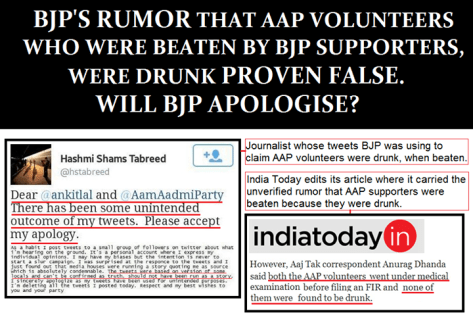
BJP's lie exposed

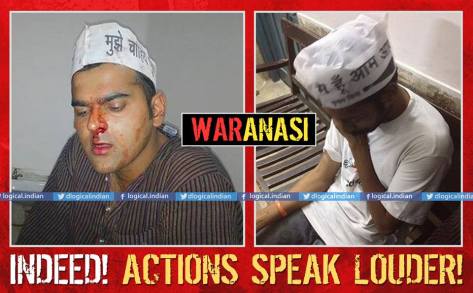
Reports of Modi Thugs on the rampage in Benaras: Over the last few days, as the days of the election appraoch, Modi supporters have become more and more desperate and violent. This is just one in a long series of disruptions of meetings and attacks that has been meted out by the goon squad to AAP volunteers.

जिन्हें नाज़ है हिन्द पर वो कहाँ हैं? उन्हें  ये गलियाँ, ये कूचे, ये मंज़र दिखाओ…

AAp activists attacked by Modi Thugs

Continue reading Modi Thugs on the Rampage – Where is the EC?

Modi-Fascism and the Rise of the Propaganda Machine

Almost every day, Modi takes off from Ahmedabad airport in an EMB-135BJ, an Embraer aircraft, for his rallies. The jet is owned by Karnavati Aviation, a group company of the Adani Group. “We record two movements of Modi’s aircraft daily. No matter where he goes to address rallies, he always comes back home,” said an air traffic control official.

Recently, Modi’s aircraft was denied permission to fly by DGCA in Delhi for over two hours, following which he lashed out at the central government for stalling his movement. Ever since, Modi has increased the use of choppers to cover smaller distances. “Mostly, politicians use chopper to reach places where bigger aircraft can’t reach,” said an ATC official.

Over the past few days, Modi flew in an Augusta AW-139 chopper, owned by the DLF Group, for his rallies in north India, especially in Uttar Pradesh and Bihar. ‘Fleet of 3 aircrafts ensures Modi is home every night after day’s campaigning’, Times of India, April 22, 2014

The Political Culture of Fascism

In an earlier post, I had joined issue with a section of liberal intellectuals, whose ‘liberalism’ was either rendering them too gullible or simply complicit in the formation of the Narendra Modi phenomenon – which I have no hesitation in referring to as the Indian edition of fascism. The gullibility or complicity of many of these intellectuals also manifests itself in the myopia that grips them when the talk about the impending challenge before democratic politics in India – a brief glimpse of which is provided in the quote above, that indicates the alliance, the power bloc that will rule, were Modi to come to power.

The Modi-formation is ‘fascism’, in the sense that it takes direct inspiration from the particular history that goes by that name, especially its Nazi episode and knows that even though it cannot replicate the conditions of its existence in India, it can nevertheless use its cardinal ideas. The exaltation of the Nation/ nation-state, the manic obsession with ‘national security’ to the extent of the destruction of democratic rights, identification and suppression of scapegoats – the Other (the Jew, the Muslim, the homosexual, and all kinds of ‘wayward’ sexualities – often, all rolled into one) and of course, the intellectuals, artistes and human rights activists. A key aspect of this political culture is the combination of violence with mass frenzy that is sought to be continuously whipped up and directed against the imagined enemies of the ‘Nation’. Continue reading Modi-Fascism and the Rise of the Propaganda Machine

Elections, Propaganda and Education

The Aam Aadmi Party was reluctant to include the issue of the rights of the LGBT people in its Delhi manifesto due to strategic reasons. Explaining the absence, the party officials said that conservative voters might turn away from the party if they find it supporting the LGBT cause. The LGBTs also seem to ‘understand’ the constraints of the poor party. The election meetings could have served as a wonderful platform had the party decided to talk to the people about this issue, telling them why it is important for us to ensure liberty to individuals to decide about their bodies. It would have been an educational exercise. Given the fact that people are ready to listen to this new party and its ideas, this reluctance on its part to take up this role says a lot not only about it, but also about the health of our polity.

The AAP candidate challenging Rahul Gandhi is harping on the bad condition of the roads of Amethi and lack of electricity there. One wonders whether Rahul Gandhi, in his response, would have the courage of a now-forgotten former Congressman. Abdul Ghafoor, once Chief Minister of Bihar, was campaigning in Siwan in a Parliamentary election. At a meeting, voters started complaining about the bad condition of roads and sanitation. He told them bluntly that he was there to seek their approval for his candidature for the membership of the Parliament and they should not waste their votes on him if they expected him to fix these problems. The problems they cited were something a municipal councilor was supposed to look after. It is a different story that he lost the election. Continue reading Elections, Propaganda and Education