All posts by Aditya Nigam

Statement in Solidarity with Students, Against Police Excesses from Alumni of National Law University, Jodhpur

The following is a statement from the alumni of NLU Jodhpur, in solidarity with the students at the receving end of police brutalities in Delhi, Aligarh, Assam and other universities.

We, the undersigned alumni of National Law University, Jodhpur unequivocally condemn the police excesses in response to student protests at Jamia Milia Islamia University, Delhi University, Aligarh Muslim University, Dibrugarh University, Gauhati University, Cotton University, Assam and other universities across India. As persons with training in constitutional laws and values, we recognize the significance of dissenting speech and assembly, and the need to preserve academic spaces as free from State coercion and militarization and to uphold the values of secularism.

Continue reading Statement in Solidarity with Students, Against Police Excesses from Alumni of National Law University, Jodhpur

Still Life, Aflutter – Harold Bloom and an Old Incantation: Prasanta Chakravarty

Guest post by PRASANTA CHAKRAVARTY

Harold Bloom had made it clear many times that his investment in the Greek literary critic Dionysius Longinus, writing in the first century AD, was a way to address and revisit the fundamental encounter of the sublime in our living. Commentators have noticed a remarkable ‘agon’ being played out in Bloom’s career: between his idealizing enthusiasm in romantic-messianic visions and his equal investment in gnostic wisdom and stoic classicism. This agon, or contestation, was his way of addressing a certain space of the uncanny in dealing with art and literature, in contrast to the modernizers and tropologists who, he believed, rejected subjectivity itself as a fallacy. Not Bloom—who had always claimed that the ‘strong critic’ is a kind of poet. As he saw it, literary criticism is an ongoing tussle between the pathos of the heroic will and the ‘literalizers’ who deal in tropes and textual juggleries. But has he been successful in strictly distinguishing the daemonic from the analytic? Are the uncanny and surpassing moments entirely separable from the sensory and the figurative? 

Here is a singular song, penned and sung by Suman Chattopadhyay (now Kabir Suman) decades ago. Continue reading Still Life, Aflutter – Harold Bloom and an Old Incantation: Prasanta Chakravarty

एन आर सी और उससे जुड़े चंद सवाल : सबीहा फ़रहत

Guest post by SABIHA FARHAT

[भारतीय-हिन्दू मिथकों और परम्परा पर लंबे समय से लिखते आ रहे  बुद्धिजीवी श्री देवदत्त  पट्टनायक  अपनी एक ट्वीट में  एक लाजवाब  बात  कही . उनहोंने कहा कि जहाँ हिन्दू धर्मं  का मतलब  वसुधैव  कुटुम्बकम है , उसके  लिए  अगर  समूची वसुधा , सारी एक कुनबा  है , वहीँ  हिंदुत्व  का मतलब  सिर्फ़  एन आर सी  (यानी नागरिकों की राष्हैट्रीय फेहरिश्त ) है. बिलकुल दो शब्दों में  , बड़ी खूबसूरती  से पट्टनायक साहब ने इन दोनों  फलसफों के बीच का फर्क़ खोल कर सामने रख दिया  है. इस  संक्षिप्त लेख में   डाक्यूमेंट्री  फ़िल्मकार  और पत्रकार  सबीहा फ़रहत  उसी एन आर सी  से पैदा हुए  चंद सवाल उठा रही हैं.]

आजकल अमित शाह केवल एनआरसी पर स्टेटमेंट दे रहे हैं। “घुसपैठियों ” को बाहर फेंक देंगे और हिन्दू, सिख, बौद्ध, जैन, ईसाई, पारसी को नागरिकता दे देंगें। फिर चाहे उसके लिये संविधान को तक पर रख  कर सिटीज़नशिप ऐक्ट ही क्यों ना बदलना पड़े!

उनकी इस बात से साफ़ ज़ाहिर है कि देश के 16 करोड़ मुसलमान ही “घुसपैठिये” हैं। “दीमक” हैं और उन्हें देश से बाहर खदेड़ने की ज़रूरत है। लेकिन सिर्फ़ मुसलमान से इतनी नफ़रत क्यों? मुसलमान ने इस देश का क्या बिगाड़ा है? क्या उसने किसी की रोटी छीनी, किसी की नौकरी छीनी, किसी का बिज़नेस हड़प लिया। नहीं! क्योंकि अगर वो ऐसा करता तो आर्थिक तौर पर सबसे ज़्यादा कमज़ोर नहीं होता।

Continue reading एन आर सी और उससे जुड़े चंद सवाल : सबीहा फ़रहत

Education on Education – Reclamation, and Other Mediations: Sasheej Hegde

Guest Post by SASHEEJ HEGDE

A thought is a tremendous form of excitement. [Alfred N. Whitehead]

We are concerned with the imagination, and the vaguely functionalist remarks we noticed before are not the sketch of an explanation, but an aid to the imagination, to make a different practice a more familiar idea to us, and hence to make us more conscious of the practice we have.  Seen in this light, … [t]he imagined alternatives are not alternatives to us; they are alternatives for us, markers of how far we might go and still remain, within our world – a world leaving which would not mean that we saw something different, but just that we ceased to see. [Bernard Williams]

This is an extended essay working off two official documents, and public ones at that: one, the voluminous draft of the National Education Policy 2019 (henceforth Draft NEP) authored by the K. Kasturirangan-led Committee appointed by the Ministry of Human Resource Development, (MHRD) Government of India and, second, the brief report on ‘Promoting and Improving the Quality of Research in Indian Universities/Colleges’ headed by P. Balaram under the auspices of the University Grants Commission (UGC) [accordingly, UGC-Balaram report].  My interest is as much with the former as with the latter; and, although they can be commented upon independent of each other, it is the combined resonance of these two policy suggestions that I am interested to examine (especially as they bear on the higher education [HE] space in India).

Continue reading Education on Education – Reclamation, and Other Mediations: Sasheej Hegde

Statement by Teachers and Academics in Support of Dr. Hany Babu

The following is a statement issues by teachers and academics in support of Dr Hany Babu, whose residence was raided early morning non 10 September by Pune Police

We, teachers and members of the academic community from across universities, are shocked to know of the illegal raid at the residence of Dr. Hany Babu, Associate Professor in the Department of English, University of Delhi on the morning of 10 September 2019. While the horrifying overreach of a search conducted without a warrant has become routine harassment for dissenting citizens, the attempt made by the Pune Police to forcefully detain Babu’s family for six hours and deprive them of any communication with lawyers or friends amounts to extreme duress. Finally, forcing Babu to change passwords and forfeit access to his email account and other personal online media clearly makes way for a possible planting of evidence, to concoct a case against an assumed ‘suspect’

Continue reading Statement by Teachers and Academics in Support of Dr. Hany Babu

Protest Prime Minister Modi’s visit to the United Nations: Coalition Against Fascism in India

Statement by the US-based COALITION AGAINST FASCISM IN INDIA

cafiusa2019@gmail.com Twitter @Hum_CAFI_hai)

Protest on Friday, September 27th at 10:30 am

United Nations Plaza, New York City

India’s Prime Minister Narendra Modi will visit the United States at the end of September. He will attend the United Nations General Assembly Session on September 28.  Please join us to protest Modi’s visit. Modi’s government has been orchestrating a pogrom of hate and violence against Muslims and Dalits in India. His government has been cracking down on all forms of dissent and all those who question its politics of hate. Its economic policies have resulted in escalating poverty and thehighest unemployment rate in half a century. We call upon all anti-fascist, anti-racist,secular, and environmentalist groups in the United States to join us in protesting his visit and exposing the retrograde, near-fascist politics of Modi’s government.

Continue reading Protest Prime Minister Modi’s visit to the United Nations: Coalition Against Fascism in India

Exclusion of 19 Lakh People Shows the Irrationality of #NRC Exercise: Joint Forum Against NRC

The Final NRC published today has excluded a whopping 19.06 lakh persons in Assam. The NRC process had shifted the burden of proof of citizenship on to the entire population of Assam, with people undergoing deep travails over the past four years to get their names included. In a poor country like ours and in a state which witnesses frequent floods, it is not unnatural that lakhs of people were unable to produce documents to prove that they or their ancestors were inhabitants of Assam before 24th March 1971. To rob people of their citizenship and rendering them stateless on the basis of this flawed process would be a gross violation of the fundamental rights guaranteed by the Indian Constitution.

Continue reading Exclusion of 19 Lakh People Shows the Irrationality of #NRC Exercise: Joint Forum Against NRC

Nationalism and Politics – An Open Letter to Arvind Kejriwal

I write this open letter to you as a well wisher, and someone who has been seriously supportive of the Aam Aadmi Party (AAP) through all the ups and downs in the years since its formation.  Perhaps like many others, I too have high expectations of the experiment that AAP is and the new ground it has tried to break in terms of providing a government that has steadfastly kept the interests of the common person in mind while taking decisions.

But I also write this letter because I, like many others, have been perturbed by some developments which do not augur well for the future either of your party or of the country. The latter in any case, is set on a disastrous course, thanks to the current dispensation at the Centre. Let me also make it clear right away that I am not one of those who criticize AAP for ‘lacking a clear ideology’ and I in fact value the fact that on many critical issues, AAP has been able to resist the pressure to step into well trodden, familiar responses to specific situations and issues – especially well trodden among Leftists. But I do think that AAP needs to think a bit more seriously  about politics – which is not the same thing as ideology.

Continue reading Nationalism and Politics – An Open Letter to Arvind Kejriwal

Kashmir Caged – A Report from the Ground

Economist Jean Dreze, Kavita Krishnan of the CPI(ML) and the All India Progressive Women’s Association, Maimoona Mollah of the All India Democratic Women’s Association and Vimal Bhai of the National Alliance of People’s Movements released the following report to the press today, 14 August 2019, after spending five days in Kashmir, meeting and talking to people.

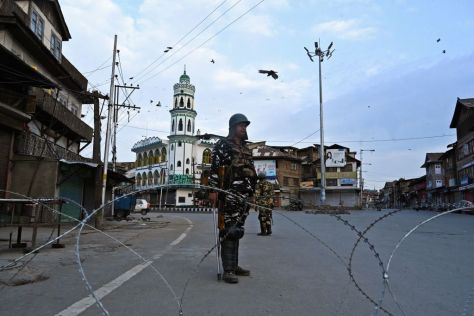
Security personnel stand guard on a street during a lockdown in Srinagar on August 12, 2019. (Photo credit: TAUSEEF MUSTAFA /AFP/Getty Images)

We spent five days (9-13 August 2019) traveling extensively in Kashmir. Our visit began on 9 August 2019 – four days after the Indian government abrogated Articles 370 and 35A, dissolved the state of Jammu and Kashmir, and bifurcated it into two Union Territories.

When we arrived in Srinagar on 9 August, we found the city silenced and desolated by curfew, and bristling with Indian military and paramilitary presence. The curfew was total, as it had been since 5th August. The streets of Srinagar were empty and all institutions and establishments were closed (shops, schools, libraries, petrol pumps, government offices, banks). Only some ATMs and chemists’ shops – and all police stations – were open. People were moving about in ones and twos here and there, but not in groups.

Continue reading Kashmir Caged – A Report from the Ground

83 Delhi University English Teachers’ Statement against Politically Motivated Attacks on Syllabus

The following is the full text of the statement issued by 83 English teachers of Delhi University against the attack on the syllabus:

We, the teachers of English across Delhi University are shocked and appalled at the unacademic, politically motivated attack on our syllabus. This is a democratically drafted syllabus, which involved faculty participation from around 40 colleges; over 2 years, and more than 3000 working hours have been spent on it. It is a matter of sorrow and deep academic concern that the syllabus is now being maligned, and is sought to be scuttled, by certain political groups at the University.

Continue reading 83 Delhi University English Teachers’ Statement against Politically Motivated Attacks on Syllabus

Effects of Climate Change are not Contained within Nations – The Impact on India: Nagraj Adve

Guest post by NAGRAJ ADVE

This post is the second part, excerpted and slightly adapted, from the booklet by Nagraj Adve, Global Warming in the Indian Context: An Introductory Overview (Ecologise Hyderabad 2019). The first part appeared in Kafila on 1 July 2019

While the earlier post covered the basic science of global warming, the roots of the problem, and how inequality relates to climate change, this part focuses on key impacts of climate change in India, on humans and other species, and the reasons for urgency in tackling the problem. 

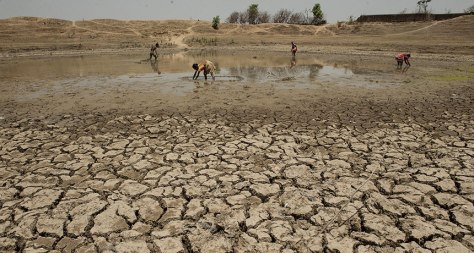
Villagers try to catch fish in drying pond in West Bengal, image courtesy Science News

Before we consider impacts in India and elsewhere, a few things are useful to keep in mind:

– Unlike most other forms of pollution, the source of carbon dioxide and where its effects are felt can be very far apart. Carbon dioxide generated in the United States affects people on the Orissa coast.

– A significant portion of carbon dioxide emitted today will remain in the atmosphere for centuries, influencing future climates.

– Even after the world ceases to emit carbon, higher average temperatures are “largely irreversible for a thousand years” because the gains of lesser radiation being trapped gets offset by the reduced loss of heat to the oceans. Hence, climate change is the new ‘normal’.

– Impacts will worsen because of the time lag between emissions and warming. Some of it is unavoidable. Our urgent intervention is needed to make sure they do not get much worse, and that the situation does not spiral out of our control. Continue reading Effects of Climate Change are not Contained within Nations – The Impact on India: Nagraj Adve

Global Warming – The Disaster that has Long Been Brewing: Nagraj Adve

Guest post by NAGRAJ ADVE

This essay is the first of a two-part excerpt from the booklet by Nagraj Adve, Global Warming in the Indian Context: An Introductory Overview (Ecologise Hyderabad, 2019). This covers the basic science of global warming, the roots of the problem, and how inequality relates to climate change. The  second piece, to appear soon, will focus on impacts in India, both on humans and other species, and the reasons for urgency in tackling the problem. You can read the second part here.

 What they told us in Gujarat

A few years ago, a group of us went to northern and eastern Gujarat to find out how climate change was affecting small farmers there. In villages in eastern Gujarat, they told us that the wheat and maize crops had been getting hit for some years during winter. Wheat and maize are important sources of nutrition for poor households in these and nearby regions. But because winters have been getting warmer, the dew (os) had lessened, or stopped entirely for the last few years. For those without wells—most of them poor households—dew is the only source of moisture for their crop. With less or no dew falling, either their crop dried up, or they were being forced to leave their lands fallow.

When we asked them why the winters had been getting milder, the people’s response there was interesting: “Prakruti ki baat hai (it has to do with Nature).” They did not consider it imaginable that human beings had the power to alter Nature on this scale. We do.


Sick Earth
Sick Earth, image courtesy Epispastic clipart (UI-Ex.com)

Continue reading Global Warming – The Disaster that has Long Been Brewing: Nagraj Adve

Statement of Academics on Rabindra Bharati University Incident of Harassment

Dear Friends,

As some of you might be aware, our friend and colleague, Dr. Saraswati Kerketta (Assistant Professor in the Department of Geography, Rabindra Bharati University), has recently been a victim of caste-based attack in the university. We write this statement to unequivocally condemn the attack.

We, the concerned faculty members/research scholars across institutions in India and abroad, are deeply disturbed by this incident of caste-based attack on Dr. Kerketta. Dr. Kerketta is a young faculty member from a Scheduled Tribe background, and the sole faculty member appointed in a substantive position in her department, thereby taking on the tremendous task of running the department on her young shoulders. This brazen instance of caste-based harassment meted out to her by a group of students who claim to be affiliated to a political party has hurt and disturbed us immensely as citizens of India. The nature of attack meted out to her – for instance she has been followed by the students up till home after the incident – also showcases the gendered nature of her vulnerability. The incident has been followed by mass resignation on the part of other faculty members from various positions in the university, thereby showing indirect proof of the same.

Continue reading Statement of Academics on Rabindra Bharati University Incident of Harassment

A Case of Harassment of Dalit Student in Jadavpur University: Srijan Dutta

Guest post by SRIJAN DUTTA

The value of a man was reduced to his immediate identity and nearest possibility.

The line quoted above is from Dalit PhD scholar Rohith Vemula’s ‘last’ letter, discovered after he was found hanging in his hostel room in January 2016. The letter had exposed how caste-based discrimination is used as a medium of oppression against Dalits and other minorities. Casteism serves both as an ideology and as a means for exploitation by the upper castes and upper classes of the Indian society.

Recently, a complaint has been made by a second year Masters student of the Department of Library and Information Science in one of the hotbeds of Bengal student politics, Jadavpur University. Jadavpur Uiversity is also a premier institution of higher learning, with a well deserved reputation.  Raja Manna, a student belonging to the ‘Scheduled Caste’ category, has revealed that he has been facing a lot of harassment and discrimination at the hands of his dissertation guide, Prof. Udayan Bhattacharya, an upper caste Brahmin.

Continue reading A Case of Harassment of Dalit Student in Jadavpur University: Srijan Dutta

A Statement against Suppression of Dissent by IACLALS

We are publishing below a statement sent to us by the Indian Association of Commonwealth Literature and Language Studies against the suppression and criminalizing of dissent in India

The Indian Association of Commonwealth Literature and Language Studies (IACLALS) expresses its deep dismay over the continuing assault on civic freedoms and constitutional rights of writers, teachers, students, human rights activists and public intellectuals in the country. The current political climate of fear and intimidation – fuelled and vindicated by the state and the ruling party – has simultaneously targetted entire communities through a range of religious-ethnic violence, as much as it has sought to silence conscientious voices that have spoken up against such onslaughts. Vacuous rhetorical constructions like “anti-national” and “urban naxal” – with no basis in fact or in principles of democratic governance – have been repeatedly manufactured as the grounds for punitive-legal action and media trials, through the invoking of outdated colonial codes like the sedition laws. The latest of these forms of orchestrated witch-hunt has seen the attempted arrest or chargesheeting of Hiren Gohain, Anand Teltumbde and of several JNU students – in the cause of raking up an electoral consensus against the spirit of scientific inquiry and free-thinking.

The IACLALS’ academic investments have engaged with and gained from the works and ideas of these scholars, who now face the ire of the state. As a scholarly association, we believe in the need and power of a critical public sphere, as the only promise of a living democracy. We stand in firm solidarity with them, and strongly condemn every attempt being made at gagging forms of dissent and enforcing regimes of censorship.

Pondicherry University, Feb. 8, 2019.

GJV Prasad (Chariperson), Subhendu Mund and M. Asaduddin (Vice Chairpersons), Rina Ramdev (Secretary), Angelie Multani (Treasurer)


Celebrating Dalit Achievements: C. K. Raju

Guest post by C.K. RAJU

It was B. R. Ambedkar who first publicised the 22 Mahar names inscribed on the pillar commemorating the battle of Bhima-Koregaon.  Ambedkar, a Mahar himself, had experienced great indignities, and everyone appreciates his quest for a symbol of dalit achievement. Much has been written since on Bhima-Koregaon, but one question has not been asked:  is there really such a paucity of symbols of dalit achievement?

Not actually. There is no dearth of dalit and ‘lower caste’ achievers. Sages from such backgrounds range from Valmiki, author of the Ramayana, to Tukaram, Kabir, and Sri Narayana Guru. Dalit warriors and kings range from the Nanda dynasty, mere reports of whose mighty army so frightened Alexander’s troops (according to Plutarch), to the Chalukyas (who were dalits according to Bilhan), the Bhils, the Gonds, and to Udham Singh who avenged Jallianwallah Bagh.

Continue reading Celebrating Dalit Achievements: C. K. Raju

In Imagination, in Resistance, in Solidarity and Rage – People’s Literary Festival in Kolkata: Tamoghna Halder

Guest post by TAMOGHNA HALDER

“It was the unlikeliest setting for a ‘literature festival’. A run-down auditorium with rickety chairs secured with rope. Noisy ceiling and pedestal fans. Battle scarred tables covered with threadbare cloth. But the first edition of the People’s Lit Fest, held in Kolkata, was designed to be just that – a radically different interpretation of literature and its role in modern India”

These were the opening lines of a report by Scroll.in, on the 1st edition of People’s Literary Festival, 2018. In less than a couple of weeks, the 2nd edition of People’s Literary Festival (henceforth, PLF) will commence, once again at that run-down auditorium with rickety chairs, namely ‘Sukanta Mancha’ in Kolkata. The present article hopes to shed some light on the reasons why those rickety chairs or the noisy fans are related to PLF, but before that, as a member of Bastar Solidarity Network (Kolkata Chapter), I feel compelled to explain why we even organize PLF in the first place.

Continue reading In Imagination, in Resistance, in Solidarity and Rage – People’s Literary Festival in Kolkata: Tamoghna Halder

The Misplaced Celebration around Priyanka Gandhi: Bobby Kunhu

Guest post by BOBBY KUNHU

At this important political juncture in Indian polity, anything that seems to give hope of seeing the last of the absurd and nightmarish theatre that has been happening in the name of governance for the last four odd years, would definitely be welcome to any rational person with elementary notions of value and justice – across ideological spectrum. This is the reason why I believe that Priyanka Gandhi’s entry into politics is well timed and strategic – ensuring that she is discussed in all possible terms across the board. Everyone who hates, loves or is even indifferent is in a tizzy at her entry – and till now Priyanka seems to be taking the publicity, including the hate publicity with grace and equanimity! This does not however mean or show how the polity is going to react to Priyanka’s entry into politics, because despite the timing, even many of the usual Modi fans in the media have announced the end of the Modi era, at least for the time being.

Continue reading The Misplaced Celebration around Priyanka Gandhi: Bobby Kunhu

‘Beheading’ Marxism, Unleashing Desire: Ghya Chang Fou and the Marxist Unconscious

Ghya Chang Fou is not a Chinese or East Asian word – it is the name of this new dark Bengali satirical film that had its world premiere this September (2018), at the Transart Communication Festival, Nove Zamky, Slovakia.  Below is the official trailer of the film, followed by my take on it – better not read as a review.

The quirky world of Ghya Chang Fou (Joyraj Bhattacharjee, 2017) is best seen and understood as a dream. For, a dream never really adheres to the conventions of linear realistic narrative, and characteristically, scrambles up time and space. Everything makes perfect sense while you are seeing it but do try interpreting your dreams through realist conventions, especially if you are a believer in any form of realism.

Continue reading ‘Beheading’ Marxism, Unleashing Desire: Ghya Chang Fou and the Marxist Unconscious

The Kisan Charter – ‘Farmers are not just a residue from our past but integral to the future of India and the world’

Kisan Mukti March in Delhi, image courtesy New Indian Express
Till just the other day, they were committing suicide, while some of them were demonstrating in Jantar Mantar, Delhi, humiliating themselves by disrobing and eating rats, trying in vain to draw the attention of the political establishment to their plight.  And to pour salt on their wounds, BJP leaders were saying that committing suicide had become a fashion among farmers! Today they are out on the streets, demanding, among other things, that their own debts be written off, not of the powerful and predatory capitalists. (See the Charter of the All India Kisan Sangharsh Coordination Committee below). This is, in all probability, the sign of a decisive shift, for today the charter relseased by the Coordination Committee declares loud and clear that
Farmers are not just a residue from our past; farmers, agriculture and village India are integral to the future of India and the world.

Continue reading The Kisan Charter – ‘Farmers are not just a residue from our past but integral to the future of India and the world’

100th day of Shahidul Alam’s Detention – Eminent South Asians Write to Bangladesh Prime Minister

Today, it is 100 days of the detention of acclaimed photographer and cultural activist Shahidul Alam. On this occasion, Arundhati Roy, Aparna Sen, Vikram Seth, Romila Thapar, Amitav Ghosh, Shabhana Azmi, Buddhadeb Dasgupta, Nandita Das, Mohammad Hanif, Anish Kapoor among other eminent persons from across South Asia have written a letter to Bangladesh Prime Minister Sheikh Hasina Wazed demanding his immediate release.  on the 100th day of his detention.

Shahidul 3

H.E. Sheikh Hasina Wazed
Prime Minister of Bangladesh
Prime Minister’s Office
Dhaka, Bangladesh
13 November 2018

Subject: Appeal for release of Shahidul Alam on 100th day in custody

Your Excellency:
As well-wishers of Bangladesh and supporters of its 166 million citizens’ struggle for dignity, social justice and prosperity, we are distressed by the continued imprisonment of photographer and cultural activist Shahidul Alam. Since the founding of the nation in 1971, the people of Bangladesh have led by example, fighting poverty, ending social injustices and being standard-bearers of participatory development. This advance has been made possible by the democratic spirit of the people, who have challenged military rulers and autocrats alike. As well-wishers of Bangladesh, we fear that these gains are in danger due to the rising political intolerance and denial of fundamental freedoms.

Shahidul Alam is a Bangladeshi citizen, but the rest of us in South Asia are also proud to call him our own, for the values of truth, justice and social equality he promotes. His work and activism are respected all over our region and beyond, with innumerable friends who admire his concern for the voiceless and marginalised. One example is his latest work highlighting the tragedy of the Rohingya people, who have been given refuge in Bangladesh by your Government.

Since Shahidul Alam was forcefully taken from his home on the 5th of August, he was remanded first in Detective Branch custody for seven days and, then held at Dhaka Central Jail at Keraniganj. He is accused of ‘hurting the image of the nation’ while reporting on protests by young students demanding road safety.
It is clear to us that the case of Shahidul Alam is being used as a means to suppress criticism by others in civil society. His arrest and continued detention appear to be manifestation of an intolerant political atmosphere, an attempt to threaten and silence the voice of Bangladeshi citizens. With the country preparing for general elections, this is a time when there should be more space for debate and discussion, not less.

As believers in the rule of law, we are shocked to learn that government lawyers continue to oppose Shahidul Alam’s release on bail using various stratagems and delays intended to deprive him of his fundamental rights to liberty and due process. Across South Asia, politicians and citizens have fought for the right to speak, and to write, and it is astonishing to us that a government today, especially one which seeks to harness technology for progress, should choose to use a law to proscribe online speech to jail a citizen.

Prime Minister,

We the undersigned urge you to ensure the release of Shahidul Alam on this, the 100​th​ day of his detention. We look forward to Bangladesh retaining its place as an exemplar of
participatory democracy in South Asia.

Sincerely,
1. Akram Khan, London
2. Amar Kanwar, New Delhi
3. Amitav Ghosh, Goa
4. Anish Kapoor, London
5. Aparna Sen, Kolkata
6. Arundhati Roy, New Delhi
7. Ashok Vajpeyi, New Delhi
8. Buddhadeb Dasgupta, Kolkata
9. Dayanita Singh, New Delhi
10. Ina Puri, Kolkata
11. Jayadeva Uyangoda, Colombo
12. Kanak Mani Dixit, Kathmandu
13. Laila Tyabji, New Delhi;
14. Manjushree Thapa, Toronto
15. Mohammed Hanif, Karachi
16. Moushumi Bhowmik, Kolkata
17. Nandita Das, Kolkata
18. Nimalka Fernando, Colombo
19. Patricia Mukhim, Shillong
20. Pooja Sood, New Delhi
21. Rachana Singh, New Delhi
22. Raghu Rai, New Delhi
23. Rajdeep Sardesai, New Delhi
24. Ramchandra Guha, Bangalore
25. Romila Thapar, New Delhi
26. Salima Hashmi, Lahore
27. Sanjay Kak, New Delhi
28. Sanjoy Hazarika, Shillong
29. Sankha Ghosh, Kolkata
30. Shabana Azmi, Mumbai
31. Sushila Karki, Kathmandu
32. Vijay Prashad, New Delhi
33. Vikram Seth, New Delhi
34. Vrinda Grover, New Delhi