All posts by Aditya Nigam

Noida’s Domestic Workers’ Take on the ‘Madams’ – A Report from Ground Zero: Maya John, Sunita Toppo and Manju Mochhary

This guest post is an investigative report by MAYA JOHN, SUNITA TOPPO and MANJU MOCHHARY, who are associated with Gharelu Kamgar Union and actively involved in organizing domestic workers.

Recently, the otherwise docile workforce of domestic workers – most of whom are migrant labourers from the poorest states in the country – showed remarkable collective zeal against their wealthy employers in Noida (Uttar Pradesh). On the morning of 12th July 2017, a confrontation broke out between wealthy residents in a posh housing society, Mahagun Moderne in Noida Sector 78, and a gathering of agitated domestic workers and their families. The rampant exploitation of domestic workers, and the huge antagonism between their interests and those of their employers was directly exposed with the outbreak of this agitation.

The 12th July incident and subsequent developments have also revealed the sickening nexus between the police, employers, and right-wing politicians who have extended support to the wealthy residents. Within hours, an obvious labour issue, and the struggle of workers against the alleged illegal confinement of a female domestic worker was projected as a communal confrontation. With the accused employers and their sympathizers identifying the protesting workers and the missing domestic worker as ‘Bangladeshis’, the social media exploded with communal diatribe and messages of hate. Conditions for communal discord were consciously sown by Mahagun residents, putting at risk the lives of hundreds of workers living in neighbouring slums.

Continue reading Noida’s Domestic Workers’ Take on the ‘Madams’ – A Report from Ground Zero: Maya John, Sunita Toppo and Manju Mochhary

Armed Forces Veterans Speak Out – ‘Act Now to Uphold the Constitution’

In the midst of all the cacophony and shrill pseudo-nationalist rhetoric that is destroying the fabric of a plural India, often in the name of the Armed Forces, 114 veterans of the Indian Armed Forces have spoken out. They have spoken out in no uncertain terms against targeted attacks on Muslims and Dalits and against the attempts to destroy the Constitution –  upon which arose the new, independent India.

An Open Letter from Veterans of the Armed Forces

To: the Prime Minister of India, Chief Ministers of the States, and Lieutenant-Governors of the Union Territories.

30 July, 2017

We are a group of Veterans of the Indian Armed Forces who have spent our careers working for the security of our country. Collectively, our group holds no affiliation with any single political party, our only common commitment being to the Constitution of India.

It saddens us to write this letter, but current events in India have compelled us to register our dismay at the divisiveness that is gripping our country. We stand with the ‘Not in My Name’ campaign that mobilised thousands of citizens across the country to protest against the current climate of fear, intimidation, hate and suspicion.

The Armed Forces stand for “Unity in Diversity”. Differences in religion, language, caste, culture or any other marker of belonging have not mattered to the cohesion of the Armed Forces, and servicemen of different backgrounds have fought shoulder to shoulder in the defence of our nation, as they continue to do today. Throughout our service, a sense of openness, justice and fair play guided our actions. We are one family. Our heritage is like the multi-coloured quilt that is India, and we cherish this vibrant diversity. Continue reading Armed Forces Veterans Speak Out – ‘Act Now to Uphold the Constitution’

विश्वविद्यालय, अंध राष्ट्रवाद और देशभक्ति : वैभव सिंह

Guest post by VAIBHAV SINGH

भारत खुद को भले किसी महान प्राचीन ज्ञान-परंपरा का वारिस समझता हो पर उसके विश्वविद्यालयों की दशा चंद चमकदार अपवादों के बावजूद खस्ताहाल है। उच्चशिक्षा की हालत किसी मरणासन्न नदी जैसी है जिसपर पुल तो बहुत बड़ा बन गया है पर पानी सूखता जा रहा है। भारत अपने साथ ही यह झूठ बोल रहा है कि वह ज्ञान या ज्ञानियों का आदर करता है, जबकि सचाई इसके विपरीत है। आधुनिक युग में भारत ने जितना ज्ञान की अवहेलना और अनादर किया है, उतना शायद ही किसी देश ने किया होगा। हर तिमाही-छमाही आने वाली रिपोर्ट्स हमें शर्मिंदा करती हैं कि संसार के सर्वोच्च 100 विश्वविद्यालयों में भारत के किसी विश्वविद्यालय को नहीं रखा जा सका। पूरा शिक्षा-जगत डिग्रियों की खरीदफरोख्त में लगे विचित्र किस्म के अराजक और अपराधिक सौदेबाजियों से भरे बाजार में बदलता जा रहा है। यहां अपराधी, दलाल और कलंकित नेता अपने काले धन व डिजिटल मनी की समन्वित ताकत लेकर उतर पड़े हैं और हर तरह की कीमत की एवज में कागजी शिक्षा बेचने लगे हैं। इस बाजार में ‘नालेज’ और ‘डिग्री’ का संबंध छिन्नभिन्न हो चुका है। कमाल की बात यह है कि यह स्थिति हमें चिंतित नहीं करती।

दूसरी ओर, उच्चशिक्षा अभी भी समाज की नब्बे फीसदी आबादी के लिए सपने सरीखी है। उच्चशिक्षा में जीईआर यानी दाखिले के अनुपात की गणना 18-23 आयुवर्ग के छात्रों को ध्यान में रखकर की जाती है और अभी भी भारत में केवल दस फीसदी लोग उच्चशिक्षा के संस्थानों के दरवाजे तक पहुंच पाते हैं। इसमें भी दलित व गरीब मुस्लिमों की हालत बेहद खराब है। दलितों में दो फीसदी से भी कम लोग उच्चशिक्षा प्राप्त कर पाते हैं तो मुस्लिमों में यह आंकड़ा केवल 2.1 फीसदी का है। भारत की ग्रामीण आबादी में केवल दो फीसदी लोग ही उच्च माध्यमिक शिक्षा के पार जा पाते हैं। ये आंकड़े भारत में उच्चशिक्षा की आम लोगों तक पहुंच की भयावह तस्वीर को प्रस्तुत करते हैं और दिखाते हैं कि हम जिन संस्थानों, बड़े कालेजों-विश्वविद्यालयों आदि को भारत के विकास के प्रमाण के रूप में पेश करने की इच्छा रखते हैं, वे देश की नब्बे फीसदी आबादी से बहुत दूर रहे हैं। Continue reading विश्वविद्यालय, अंध राष्ट्रवाद और देशभक्ति : वैभव सिंह

JNUTA Statement on JNU VC’s ‘Tank’ Talk

Following the bizarre idea, earlier mooted by retired army officials, now taken up by the Vice Chancellor of JNU, to install a tank on university campus, ostensibly to instill nationalism in the university community, the JNUTA has issued the following statement:

The JNUTA is amused by the JNU VC’s earnest desire that a tank be rolled onto JNU campus. It is surprising that Prof. Jagadesh Kumar can only be inspired to patriotism upon beholding instruments of war. This seems to be only a personal affliction, since the rest of the JNU community does not need these visual aids to feel love and concern for this land, its environment and all its peoples, whether in the armed services or elsewhere.

The JNUTA also hopes that the JNU VC will understand that developing what he believes is the correct affective attachment towards the Indian Army is not part of his job description. JNU cannot be made into a theatre of war. His statutory role is one of “maintaining and promoting the efficiency and good order of the University” and of upholding the JNU Act and Statutes. The full statement can be read here.

Open Letter to the Board Members of the Sameeksha Trust


Following is the text of the open letter by members of the EPW Community addressed to Sameeksha Trust

As long-standing well-wishers and members of the intellectual community served by the EPW, we are appalled and dismayed by the recent events leading to the abrupt resignation of the Editor, Paranjoy Guha Thakurta.

We are distressed that the Board of the Sameeksha Trust has insisted that the Editor retract an article published in the journal, and is preparing to introduce new norms for the Board-Editor relationship and appoint a co-editor.  It is obvious that, taken together, these actions (mentioned by the Editor in interviews to the press and not denied in the statement issued by the Trust) would force any self-respecting editor to resign.  By failing to distinguish between internal issues of procedural propriety in Board-Editor relationship from the much larger question of the EPW’s public reputation for integrity, the Board of the Sameeksha Trust has dealt a strong blow to the journal’s credibility. Continue reading Open Letter to the Board Members of the Sameeksha Trust

The Death of a Historian – A Tribute to Biswamoy Pati: Saurabh Mishra

Guest post by SAURABH MISHRA

Historian Biswamoy Pati

These days, when lynch mobs, cow-killings, and aggressive patriotism dominate the headlines, what does the passing away of a mere historian mean? Not much, it seems. Yet, for those who knew Dr Biswamoy Pati, or had the good fortune of being taught by him, this has caused nothing short of a major storm in their lives.

I got to know Dr Pati in the summer of 1996, when he was a young and energetic lecturer in Delhi. I waited eagerly for his lectures (as did everyone else), which were really my first introduction into new ways of thinking about the world.

Continue reading The Death of a Historian – A Tribute to Biswamoy Pati: Saurabh Mishra

उना कांड की पहली बरसी पर राष्ट्रीय आह्वान, गुजरात में होगा ‘आज़ादी कूच’ : जिग्नेश मेवाणी

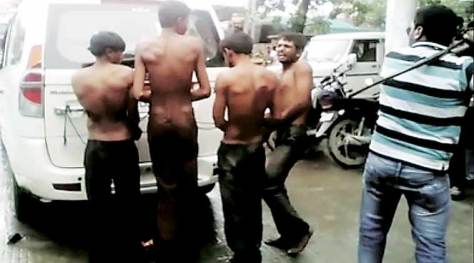
On the First Anniversary of the Una Floggings – Call from JIGNESH MEWANI and RASHTRIYA DALIT ADHIKAR MANCH

Continue reading उना कांड की पहली बरसी पर राष्ट्रीय आह्वान, गुजरात में होगा ‘आज़ादी कूच’ : जिग्नेश मेवाणी

Mathematics, Decolonization and Censorship: C. K. Raju

Guest post by C.K.RAJU
Did you find math difficult in school? Does your child? If so, what is the solution: change the teacher or change the child? Blaming the teacher or the child for math difficulties is a common but unsound explanation. Thus, problems with teachers or students should equally affect all subjects, not only math.The right solution is to change math. That seems impossible. People naively believe that math is universal. In fact, the math taught today, from middle school onward, is called formal math; it began only in the 20th c. with David Hilbert and Bertrand Russell. It differs from the normal math which people earlier did for thousands of years, across the world, and still do in kindergarten.Formal math adds enormously to the difficulty of math but nothing to its practical value. The practical value of math comes from efficient techniques of calculation, used in normal math, not prolix formal proofs. For example, the proof of 1+1=2 took Whitehead and Russell 368 pages of dense symbolism in their Principia. That proof is a liability in a grocer’s shop. In contrast, normal math is easy. One apple and one apple make two apples as most people learn in kindergarten. So should we switch back to normal math at all levels?

Russell

Continue reading Mathematics, Decolonization and Censorship: C. K. Raju

अरुंधति का निर्वासन: वैभव सिंह

Guest post by VAIBHAV SINGH

अरुंधति राय के खिलाफ अपशब्दों की, गाली-गलौच की, आरोपों की हिंसा ने हमें एक बार फिर यह प्रश्न पूछने के लिए विवश कर दिया है – क्या हमने सचमुच अपने देश में सभ्यता व सहिष्णुता के महान मूल्यों की रक्षा करने के दायित्व से छुटकारा पा लिया है? कहीं हम पूरे राष्ट्र को ‘डिसोसिएटिव आइडेंटिटी डिसआर्डर’ (खंडित व्यक्तित्व मनोरोग) का शिकार बनते तो नहीं देख रहे हैं जिसमें किसी व्यक्ति नहीं बल्कि पूरे राष्ट्र के चरित्र में परस्पर विरोधी मूल्य इस प्रकार विषैले कांटों की तरह उग आते हैं कि राष्ट्र का पूरा व्यक्तित्व चरमराने या दिग्भ्रमित होने लगता है! एक सभ्य-लोकतांत्रिक देश के रूप में आत्मछवि और हिंसक बाहरी आचरण में जितना गहरा भेद पैदा हो जाता है, वह राष्ट्र की आत्मा मार देता है। जिसने भी स्वयं में अनूठी लेखिका को जीप के बोनट से बांधने की कल्पना की, उसे संभवतः अंदाजा भी नहीं था कि वह केवल एक वक्तव्य नहीं दे रहा है, बल्कि मनुष्यता के सभी संभव परिकल्पनाओं के विरुद्ध अपराध कर रहा है। ऐसी कल्पना में बीमार विचारशून्यता ही नहीं बल्कि भयानक सड़ांध, विकृति और मनोरोग की झलक मिलती है। परेश रावल के अरुंधति के विरोध में लिखे ट्वीट से उल्लसित सोशल मीडिया के एक समूह ने तो अरुंधति राय की सामूहिक ढंग से हत्या कर उनके शव को पाकिस्तान में दफनाने की वकालत भी कर डाली।

Continue reading अरुंधति का निर्वासन: वैभव सिंह

1984 and Punjab’s Transformation to a Hindutva Laboratory: Gurpreet Singh

Guest post by GURPREET SINGH

It was summer of 1985 when we were visiting New Delhi, the national capital of India to attend a wedding in the family. I had a long hair back then and was aged 15. Both me and my uncle who were wearing turbans like other Sikh men were waiting at a bus stand for the next bus to go to our relatives. As soon as the bus arrived and we were about to climb in after other waiting passengers, the door was slammed on us.  When my uncle protested, the conductor shouted that there is no seat inside. Even as we pointed out at some empty seats, the answer was – “we have told you there is no seat.” Before we could argue the bus sped away.

The incident left me shocked but I wasn’t surprised.  Continue reading 1984 and Punjab’s Transformation to a Hindutva Laboratory: Gurpreet Singh

बहुजन राजनीति की नयी करवट की अलामत है भीम आर्मी : प्रवीण वर्मा

Guest post by PRAVEEN VERMA

यूँ तो अम्बेडकर जयंती हर साल आती हैं और दलित-पिछड़े समुदाय का एक बड़ा तबक़ा इसे बड़ी शिद्दत से मनाता आया है। लेकिन इस बार अम्बेडकर का 126वां जन्मदिन कुछ और ही नज़ारा ले कर आया। यू॰पी॰ का सहारनपुर ज़िला जहाँ अच्छी ख़ासी तादाद में दलित समुदाय के लोग रहते हैं और अन्य जिलों की बनिस्बत ज़्यादा संगठित हैं, वहाँ दो आयोजनों और उसकी अनुमति को लेकर दबंग जाति के लोगों ने जम कर उत्पात मचाया, जिसका दलित समुदाय के द्वारा ना केवल डट कर मुक़ाबला किया गया बल्कि एक वाजिब जवाब भी दिया गया। हालाँकि प्रशासनिक कार्यवाही हमेशा की तरह एकतरफ़ा रही जिसमें 40 दलित युवकों को जेल में ठूँस दिया गया और दबंगो को सस्ते में जाने दिया गया। शब्बीरपुर की ये घटना(एँ) कई दिनों तक चलती रही जिसमें दबंग जाति के लोगों के अहम को चोट तो लगी ही, साथ ही साथ एक और संदेश दे गयी : जिस तरह से दबंग जाति के लोगों ने हिंसा को अपनी बपौती समझ लिया था, अब वैसा नहीं हैं, लगभग देश के कुछ हिस्सों में तो। 

Continue reading बहुजन राजनीति की नयी करवट की अलामत है भीम आर्मी : प्रवीण वर्मा

Photo Story on Bhim Army Rally in Delhi: Debalin Roy

Guest post by DEBALIN ROY

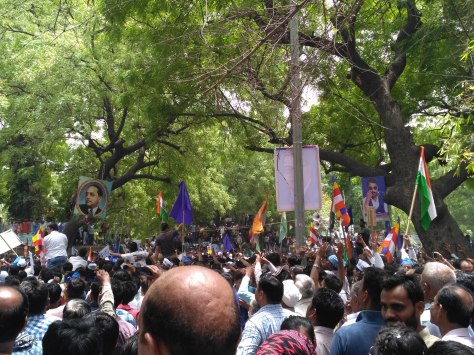
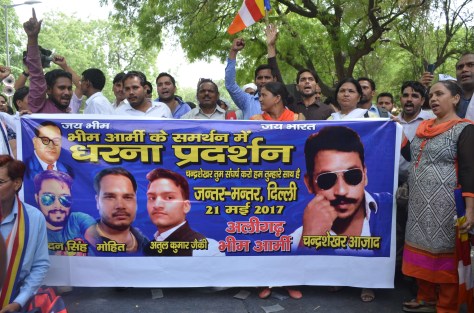
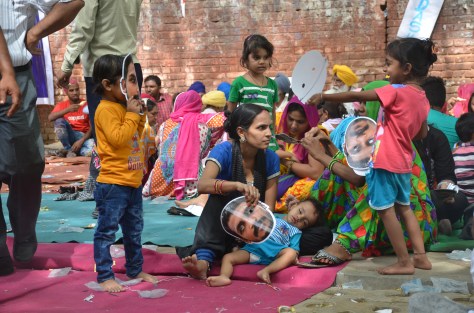
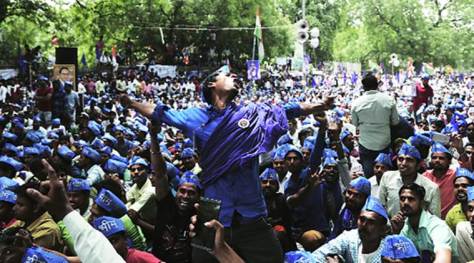
Debalin Roy takes us to some specific moments in the rally, aside from the bird’s eye view of the massive rally that we have already seen.

Dalits from all over northern India gathered at Jantar Mantar, Delhi on the 21st of May to protest the Saharanpur violence and increasing atrocities on Dalits across the country.

Although there were representatives from various states, especially from Haryana, U.P. and Rajasthan, Bhim Army took the center stage, with their blue flags waving like a giant dark blue field of tall grass, shaking and waving with every chant of Jai Bhim.

Continue reading Photo Story on Bhim Army Rally in Delhi: Debalin Roy

The Anti-Democratic ‘Republic’: Bobby Kunhu

Guest post by BOBBY KUNHU

English language television news in India nowadays is nothing more than exaggerated visual editorials. They pick two or three stories, sensationalize them, run them in a loop through the day, alongside panel discussions where the editorial ideology of the channel is forced down the throat of the panelists and the viewers. In short there is hardly little journalism left in these channels. Though they do have panel discussions, regional language channels – at least Malayalam and Tamil channels that I watch – have a wider and more diverse reportage than self-proclaimed national television.

It wasn’t always like this. When Prannoy Roy pioneered private television content for Murdoch – regardless of the ideological content – there was reportage. Editorial proselytizing and endless panel discussions were limited most often to when psephologists stepped in.

Continue reading The Anti-Democratic ‘Republic’: Bobby Kunhu

कट्टरता के खिलाफ अज्ञेय: वैभव सिंह

Guest post by VAIBHAV SINGH

सच्चिदानंद हीरानंद वात्स्यायन अज्ञेय हिंदी के ही नहीं वरन समूचे भारतीय साहित्य में निरंतर जिज्ञासा और पाठकीय आकर्षण पैदा करने वाले रचनाकार के रूप में देखे जाते हैं। विभिन्न किस्म की दासता-वृत्तियों, परजीवीपन और क्षुद्र खुशामद से भरे मुल्क में उनका स्वाधीनता बोध जितना गरिमावान लगता है, उतना ही चौंकाने वाला भी। इसी स्वाधीनता बोध ने अज्ञेय की दृष्टि को भारत के लोकतांत्रिक मिजाज के अनुसार ज्यादा खुला व अपने रचना संसार को स्वेच्छा से निर्मित करने लायक बनाया। उनके इस स्वाधीनता बोध का प्रभाव व्यापक रूप से सृजन के बहुत सारे आयामों पर पड़ा है।

अज्ञेय के साहित्य पर लिखने वाले कई आलोचकों ने इस प्रभाव के मूल्यांकन का प्रयास किया है। जैसे कि निर्मल वर्मा ने स्वाधीनता बोध से उत्पन्न उनकी इसी खुली, व्यापक दृष्टि को उनके संपादन कर्म से जोड़कर देखा था। अपने द्वारा संपादित पत्र प्रतीक व दिनमान  में उन्होंने मुक्तिबोध, शमशेर बहादुर सिंह व सज्जाद जहीर को जोड़ा तो तार सप्तक के विविध खंडों में अपने से पूर्णतया भिन्न दृष्टिकोण वाले कवियों को। स्वाधीनता के प्रति तीव्र संवेदनशीलता को व्यक्तिवाद के दायरे में रखकर समझने की सरल चिंतन-प्रक्रिया साहित्य में बहुतायत से मौजूद रही है। ऐसा मानने वालों की सीमा प्रकट करते हुए निर्मल वर्मा ने कहा है कि स्वाधीनता के प्रति अत्यंत सचेत अज्ञेय के प्रति लोगों को झुंझलाहट उस समाज में स्वाभाविक थी जहां लोगों को हर समय किसी ‘ऊपर वाले’ का मुंह जोहना पड़ता है। इन ऊपर वालों में परिवार, जाति, रूढ़ि, पार्टी, विचारधारा, संगठन आदि सभी कुछ शामिल रहा है। यहां तक कि गांव में जातिवाद-परिवार की गुलामी करने वाले लोग जब शहर आए तो उन्होंने विभिन्न पार्टियों, संगठनों व विचारधाराओं की गुलामी को बिना किसी आलोचना के स्वीकार कर लिया। जिन्होंने नहीं स्वीकारा उन्हें कुलद्रोही, जनविरोधी, परंपराद्वेषी, धर्मविरोधी, व्यक्तिवादी आदि आरोपों का सामना करना पड़ा।

Continue reading कट्टरता के खिलाफ अज्ञेय: वैभव सिंह

We are Baba Saheb’s Followers, We Believe in the Constitution – Vinay Ratan Singh, President of Bhim Army

The vicious and combined attack of the administration and the local media on Bhim Army continues. It is being villainized by them and they are threatened with impending arrests under the National Security Act. The  blatantly partisan attitude of the administration, backing in overt and covert ways, the attempts of the Thakurs and other upper castes, to provoke riots – are laid bare by VINAY RATAN SINGH in the interview below where he speaks to CHALCHITRA ABHIYAAN on what has been going on in Saharanpur and neighbouring areas. We unequivocally support the efforts of the Bhim Army to resist the vicious attacks of the upper castes, who are now emboldened by the presence of their own government in the state.

People’s Movements Demand Revocation of Suspension of Dalit Asst. Jail Superintendent, Varsha Dongre

The  NAPM (National Alliance of People’s Movements) has written the following letter, signed by many movements and orgnizations, to the Governor and the Chief Minister of Chhatisgarh

Date: 11th May, 2017

To,

Shri Balram Das Tandon, The Hon’ble Governor, Raj Bhawan, Raipur, Chhattisgarh,

To,

Shri Raman Singh, The Chief Minister, Civil Lines, Raipur, Chhattisgarh

Sub: Revocation of suspension orders of upright, Dalit woman officer, Ms. Varsha Dongre, Asst. Jail Superintendent, Raipur Central Jail and restoration of peace and good government in the V Schedule adivasis areas of Bastar – Reg.

Respected Balram Das Tandon ji and Shri Raman Singh ji,

We, the undersigned, representing a large number of people’s movements and organizations, across India, as the National Alliance People’s Movements (NAPM), are writing to you with a deep sense of anguish regarding the arbitrary suspension of a young and dynamic dalit woman officer of your state, since she publicly expressed concerns over the serious human rights abuses of young adivasis girls in the jails of Chhattisgarh.

Continue reading People’s Movements Demand Revocation of Suspension of Dalit Asst. Jail Superintendent, Varsha Dongre

‘India is Threatened by Brahminism, Not Muslims’ says Bhim Army Chief

Update: Reports coming in that the UP government plans to use NSA against Chandrashekhar. Should be condemned and opposed by all concerned.

Even as the embers of the recent fires continue to smolder in Saharanpur, ‘Dalit-Thakur’ clashes have been reported just now from Sardana. Ravi Das statues have apparently been desecrated in many places in Western UP, according to preliminary reports from senior journalist Radhika Ramaseshan. In that context, we are Chalchitra Abhiyaan the organization of Dalits that is in the eye of the storm, fighting back – the Bhim Army. Vilified by the local media for fighting back, Nakul Sigh Sawhney and the Abhiyaan have recirculated their video interview of Advocate Chandrashekhar, taken a few weeks back. Chandrashekhar is the founder of Bhim Army. Here is the video:

Bilkis Yakub Rasool’s Statement to the Press

All Accused in Bilkis Bano Case, Including Police Officers Finally Convicted

BOMBAY HIGH COURT REJECTS APPEALS OF THE 11 CONVICTED ACCUSED, UPHOLDS LIFE IMPRISONMENT

Sets Aside Acquittals of 7 Gujarat Cops & Doctors Convicts them of Evidence Tampering & Cover Up

 Mumbai, May 4, 2017

 Through all of you, friends in the media, I wish to say to all my fellow Indian citizens, my fellow Gujaratis, my fellow Muslims, and to women everywhere – I am grateful that this verdict delivered by the Honorable Judges, has, yet again, vindicated my truth, and upheld my faith in the judiciary.

 My rights, as a human being, as a citizen, woman, and mother were violated in the most brutal manner,  but I have trusted in the democratic institutions of our country. Now, my family and I feel we can begin to lead our lives again, free of fear.

 I am happy that the State and its officials who emboldened, encouraged, and protected the criminals who destroyed the life of an entire community, are no longer unblemished, but today stand convicted of tampering with evidence and cover up. For officers of the state, whose sworn duty it is to protect citizens and enable justice, this should be their great moral shame, to bear forever. Continue reading Bilkis Yakub Rasool’s Statement to the Press

Karl Marx in the Times of Climate Change

The Communist Manifesto had, as its object, the proclamation of the inevitable impending dissolution of modern bourgeois property. But in Russia we find, face-to-face with the rapidly flowering capitalist swindle and bourgeois property, just beginning to develop, more than half the land owned in common by the peasants. Now the question is: can the Russian obshchina, though greatly undermined, yet a form of primeval common ownership of land, pass directly to the higher form of Communist common ownership? Or, on the contrary, must it first pass through the same process of dissolution such as constitutes the historical evolution of the West?

The only answer to that possible today is this: If the Russian Revolution becomes the signal for a proletarian revolution in the West, so that both complement each other, the present Russian common ownership of land may serve as the starting point for a communist development. [Marx and Engels, ‘Preface’ to the 1882 Russian Edition of The Communist Manifesto; all emphasis added]

The above passage, jointly signed by Marx and Engels, appears at the end of the 1882 ‘Preface’ to the Russian edition of The Communist Manifesto. It also appears, towards the end of a decade-long engagement with the Russian social formation and the social formation of many Eastern societies like India’s. The detailed notes, excerpts and commentaries compiled by Marx, published later as The Ethnological Notebooks of Karl Marx, belong precisely to the end of this period, the years 1880-1882. Marx passed away the following year, in 1983. Continue reading Karl Marx in the Times of Climate Change

A Non-believing Muslim’s Experience of Islamophobia

Guest post by SARAH ATHER

My life has revolved around the concept of God. I have been a Muslim, a theist, an agnostic and an atheist in all types of phases of my life. I am sure, I am still just growing and my perceptions will mature as I grow. My Muslim identity slowly faded when I picked Dawkins and Ayaan Hirsi Ali in my late teens. To put it simply I was a perpetually angry Muslim. Angry at Islam, angry at Wahabism, angry at imposed patriarchy in Islam. I believed religion was so bad for the world, so unscientific. And so I wrote and I discussed with my fellow Hindu friends. They opened their hearts out. A lot of them told me how Muslims were always cruel and misogynistic. And they told me how I was different to see the truth. I felt a sense of moral superiority, I felt I was so unbiased and rational that I could see faults in my own religion. Continue reading A Non-believing Muslim’s Experience of Islamophobia

AUD Faculty Association Condemns Police Brutality in Panjab University

Ambedkar University Delhi Faculty Association condemns the police brutality on students of Panjab University earlier this month. Students were protesting against fee hikes which have been made primarily because one of the oldest universities in the country is under a financial crisis for the last one year. This has happened due to the distinctive status of the university, which is neither a Central university nor a full state university. The UGC since last year has stopped its grants to the University and as a result not being able to generate salaries for employees, the University hiked student fees in response. Lathi charge and tear gas shells were unleashed on the protesting students, students were arrested under various sections of the Indian Penal Code, including sedition charges. Although released, students are still under surveillance and victimized.

Continue reading AUD Faculty Association Condemns Police Brutality in Panjab University