
Away from the obscenity of a parade of tanks, nuclear missiles, and military might, the citizens of Delhi, once again (yesterday, the 26th of January, Republic Day) demonstrated that their re-definition of citizenship and the idea of a republic does not necessarily need an army, the AFSPA, restrictive laws like section 377, moral policing, censorship and assaults on workers, gay, lesbian and transgender people, women, the young, pensioners, minorities, Africans and other non-Indian inhabitants of Delhi, disabled people, or discrimination against people from the North East and Kashmir. Since last year, in the wake of the anti-rape protests, the 26th of January, which is nominally observed as the day when the Indian state performs its show of strength on New Delhi’s Rajpath has now been liberated by many of Delhi’s citizens groups as an occasion for us to turn away from the spectacle of the state and walk towards a liberated future. This is how the Republic gets Reclaimed on 26th January in Delhi.
All posts by Shuddhabrata Sengupta
AAP, Racism and Delhi – Perspective from a ‘North Eastern’ Citizen of Delhi: Anuraag Baruah
Guest Post by ANURAAG BARUAH
The recent ‘AAP’ state of affairs in the National Capital brought about by a dharna led by the Chief Minister Arvind Kejriwal has indeed shaken up the nation. Instead of judging and delivering a verdict on this so called ‘anarchism’, I stress upon something else here. The inherent racism prevalent in the mindset of our people actually found a shameless outlet through the antics of the new law minister of Delhi. The minister’s actions and words only reflect the mindset of the people of the concerned neighbourhood. His own words confirm that he was acting upon their complaints. This particular neighbourhood again reflects the mindset of any middle class neighbourhood in Delhi.
We The People, Reclaim the Republic: Various Citizens Groups
Call given by VARIOUS CITIZENS GROUPS
As we commemorate another Republic Day, We The People proclaim that the parade of the powerful at Rajpath does not represent us. We The People, Reclaim our Republic.
As members of the LGBT community, women, workers, sex workers, students, teachers, activists, persons with disabilities, health rights activists, Dalits, indigenous people, farmers, those affected by unconstitutional military rule, we are united not as “minorities” or “others,” but as the people. We invoke the promises of the Constitution of India in our name. Our struggle will continue until all arms of the state are unwavering in their constitutional promises towards the marginalized in our society, rather than only representing the powerful.
Continue reading We The People, Reclaim the Republic: Various Citizens Groups
Why AAP’s Stance on Somnath Bharti Is Disturbing, Whether He is Eventually Sacked or Not: Kavita Krishnan
Guest Post by KAVITA KRISHNAN
AAP’s official position is: we’ll sack Bharti IF judicial probe finds him guilty. But what AAP leaders are saying about Bharti’s ‘version’ on TV is as disturbing as Bharti’s own actions and words.
Open Letter to Delhi CM Demanding Action Against Racist Minister: Concerned Citizens
Guest Post by a group of Concerned Citizens
Open Letter by Citizens to Delhi CM Demanding Action Against Racist Minister
To Shri Arvind Kejriwal, Founder, Aam Aadmi Party and Chief Minister, Delhi
CC: Shri Yogendra Yadav, Shri Prashant Bhushan
Our Demands
1. Remove Somnath Bharti from his position as Law Minister immediately
2. Punish all those, including Somnath Bharti, guilty of instigating and perpetrating racist and sexual violence on African women
3. Delhi Police must come under Delhi Government, but Delhi Police must be accountable to Constitution and not to the bidding of Ministers and mobs
4. Meet and apologise to the Ugandan women who have complained of racist, sexual violence Continue reading Open Letter to Delhi CM Demanding Action Against Racist Minister: Concerned Citizens
Skin Deep – Narratives of Racism in Delhi University: Aashima Saberwal Bonojit Hussain Devika Narayan
Aashima Saberwal, Bonojit Hussain and Devika Narayan are activists associated with New Socialist Initiative (NSI). This article was published in the November 2010 issue of CRiTIQUE, an irregular magazine brought out by the New Socialist Initiative (NSI) – Delhi University Chapter.
Kevin is from Kenya. He studies at the faculty of Law. We ask him whether he likes India (he doesn’t) and about the kinds of challenges he faces. He shrugs and shakes his head “I have don’t face any discrimination” He often repeats this sentence at various points of the discussion. After he tells us about shopkeepers who refuse to sell him milk or before narrating how not a single shop at Patel Chest area was willing to type his assignment. “When you go to buy things from a shop they refuse to sell. If you ask for milk they say ‘no milk’ but you can see the Indians buying milk.” Later he tells us a similar story “My mobile phone was stolen. For one week I was thinking how to get a new one. The shops here don’t sell to Africans.” Kevin doesn’t think much of these experiences and dismisses them as insignificant, the ordinary trials of living in a foreign country. A woman on the road provokes a dog, provoking it to bite him, which it does. At Hans Charitable Trust Hospital they ask him for 10,000 rupees for the anti-rabbis injection. This is a service which is provided free of cost, however the small print reads ‘unless you are black’. Our interviews starkly shows that this particular subtext is present everywhere. We don’t realize that for the most mundane of daily activities (like buying milk) there are conditions that apply. The condition that you are not black.
These interviews give us a glimpse of how these students experience classrooms, hostels, streets, the metro and other public spaces. “What does kala bandar mean?” Boniface asks. They point. They laugh. They don’t like sitting next to you in the metro. What must it feel like to enter a strange foreign country where people across the board categorise you as sub-human? Strangers call you black monkey. “When I go back from college to hostel people on the streets keep laughing and staring. It is humiliating” Boniface says.
Somnath Bharti and the Terrible, Everyday Racism of a South Delhi Mohalla: Aastha Chauhan
This article by AASTHA CHAUHAN was originally published on the Yahoo! News India web site. It is being republished here so that it reaches a different audience because there is an urgent necessity to widen the discussion on racism in India.
In the decade that I’ve been working in Khirki Extension in south Delhi, I’ve known it as a neighborhood in a constant state of flux.
When I first began working at KHOJ, an international artists’ association located in Khirki Extension in 2004, the neighborhood was home to architects’ studios, a theatre studio and various offices, followed by a wave of musicians and artists. It was a locality comprised mainly of houses, some built by well-known architects such as Ramu Katakam and Ashok B Lall. Even Jaya Jaitly had a house there. Soon enough, these large plots were sold to builders, who put in apartments that could accommodate more people. But given the terrible infrastructure in the area, with its poor roads and drainage and its tendency to get flooded, many of its earlier residents moved out. Continue reading Somnath Bharti and the Terrible, Everyday Racism of a South Delhi Mohalla: Aastha Chauhan
The Savage Greed of The Civilized – AAP, Moral Posturing and Ordinary Racism
The savage greed of the civilized stripped naked its own unashamed inhumanity’
Africa, Rabindranath Tagore
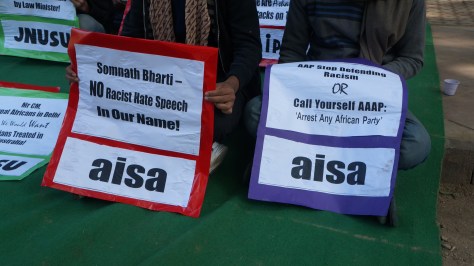
Delhi Law Minister and Aam Aadmi Party leader Somnath Bharti’s midnight raid in Khirki village, during which he ordered policemen to search and enter houses, arrest people without warrants, and allegedly said that “black people, who are not like you and me, break laws” – strips naked the unashamed inhumanity of the Aam Aadmi Party regime’s moral posturing. Underneath the holier-than-thou mask of that moral posture lies the unmistakably horrible sneer of the ordinary racist thug. This is the real face of Somnath Bharti. I hope it is a face that the Aam Aadmi Party can turn itself away from.
Continue reading The Savage Greed of The Civilized – AAP, Moral Posturing and Ordinary Racism
Protest Against Delhi Law Minister Somnath Bharti’s Racist Vigilantism in Delhi: Kavita Krishnan
Guest Post by KAVITA KRISHNAN
Many of us have felt disturbed by the implications of the incident involving the Delhi Law Minister’s attempted raid on African nationals in Khidki village.
The Minister, Somnath Bharti, (a member of the Aam Aadmii Party) insisted that the police conduct a raid minus a search warrant. Two African women have said, on record, that they were subjected to racist abuse (‘black people break laws’) and beaten by a mob of people (the Minister’s supporters), and that it was the Delhi police who protected them from the mob violence.
[ See Aditya Nigam’s post on the same issue in Kafila earlier ]
There are also reports that one of the women was forced to give a urine sample in public. The women were also subjected to cavity searches and tests – none of which yielded any sign of drugs. The violence against the women was defended in the name of anger against ‘prostitution’ and ‘drug peddling’, while no proof of the same has been presented as yet. In any case, the treatment meted out to the women cannot be justified even if they were indeed prostitutes! Continue reading Protest Against Delhi Law Minister Somnath Bharti’s Racist Vigilantism in Delhi: Kavita Krishnan
The Aam Aadmi Party and Animal Farm
The plot of George Orwell’s ‘Animal Farm’ can be summarized in a single sentence – “This novel demonstrates the consequences of the addition of four important words -‘but’, ‘some’, ‘more’, and ‘others’ to the phrase – <all animals are equal>”.
In other words, it describes the transition from the axiomatic statement <all animals are equal> to the qualified formula <all animals are equal, but some animals are more equal than others>.
Aam Aadmi Party founder and Delhi’s new chief minister Arvind Kejriwal’s ruling out the possibility of referendums in Kashmir about the presence of the armed forces in Jammu & Kashmir (in response to his party colleague Prashant Bhushan’s endorsement of the idea of such a referendum during a recent television appearance) could signify a shift within the Aam Aadmi Party’s evolving political doctrine that parallels the transition that the pigs in Animal Farm made while turning their revolution into a counter-revolution. Continue reading The Aam Aadmi Party and Animal Farm
Azadi in the Lexicon of the Aam Admi: Gowhar Fazili
Guest Post by GOWHAR FAZILI
During the swearing in speech at Ram Leela Maidan, the word Azadi found its place of pride on Arvind Kejriwal’s symbolic cap. ‘ Mujhe Chahiye Poori Azadi’ it said. The word Azadi has travelled from the freedom struggle in Kashmir, to the movement against gendered violence in Delhi and is now entering the lexicon of Aam Aadmi. The Aam Aadmi’s historic ascension to power through a referendum resonates well with the long standing demand in Kashmir seeking to let the people decide their political future directly.
Continue reading Azadi in the Lexicon of the Aam Admi: Gowhar Fazili
Magistrate Ganatra’s Dictionary and the Crime Scene of Language
Written in the wake of the dismissal of Zakia Jafri’s Petition by an Ahmedabad Metropolitan Magistrate’s Court
On 13th June, 1971, a courageous Pakistani journalist called Anthony Mascaranhas published an article in the Sunday Times, London, which was headlined ‘Genocide‘. The story of how this article got to be written and published is noteworthy in itself – and is an object lesson in how an ethical journalist takes and follows through a difficult decision. Forty two years later, Is it too late to wonder if a Gujarati magistrate could have taken an ethical leaf out of a Pakistani-Goan journalist’s lexicon?
Continue reading Magistrate Ganatra’s Dictionary and the Crime Scene of Language
In Tragic and Tough Times – Thoughts in the Wake of A Rape Charge and a Suicide: Sucheta De and Shivani Nag
Guest Post by SUCHETA DE and SHIVANI NAG
In Tragic and Tough Times, Let Us be True to Our Democratic and Gender-Just Principles.
We are confronted by a painful episode involving a rape charge and a suicide, that poses many tough and tangled questions to us – as the JNU community and also as individuals and activists committed to secularism, democracy and gender justice. Let us, for a moment, reiterate what one of the late Khurshid Anwar’s friends has said in his recent post on Kafila: the suicide does not prove him guilty of the charge of rape, and it does not prove his innocence either.
The suicide is a horrible, tragic occurrence – and it is a tragedy we should not compound with irresponsible utterances. A charge of rape does not necessarily turn the accused into a convicted rapist. True. And equally truly, it does not turn the woman making the charge, overnight, into a slut, a murderer, or a communal/political conspirator. Continue reading In Tragic and Tough Times – Thoughts in the Wake of A Rape Charge and a Suicide: Sucheta De and Shivani Nag
Hayaat-e-Azadi, The Life of Freedom: Suvaid Yaseen
Guest Post by SUVAID YASEEN
Ho Agar Khudnigar-o-Khudgar-o-Khudgeer Khudi
Ye Bhi Mumkin Hai Ke Tu Mout Se Bhi Mer Na Sake
[If the ‘ego’ is self‐preserving, self‐creating and self‐sustaining,
Then it is possible that even death may not kill you.]
— Allama Iqbal, Hayaat-e-Abadi, Zarb-e-Kaleem

The News
On the evening of 14th July 2013, I received a text message from a friend saying Hayaat had been hit by pellets in the eyes. Both his eyes were damaged. As I read the text, I became numb. I was at loss how to respond, trying to sink in what had just happened.
Continue reading Hayaat-e-Azadi, The Life of Freedom: Suvaid Yaseen
On the Death of Khurshid Anwar: Kalyani Menon Sen and Kavita Krishnan
Guest Post by KALYANI MENON SEN & KAVITA KRISHNAN
(Find Hindi translation below the English statement)
We are deeply shocked and saddened by the death of Khurshid Anwar.
As activists committed to ending violence against women, we have been trying to ensure the due process of law and justice in relation to the allegations against Khurshid Anwar. Continue reading On the Death of Khurshid Anwar: Kalyani Menon Sen and Kavita Krishnan
Khobragade’s Arrest – Labour Law Violation Issue, Not Foreign Policy Issue: Gharelu Kaamgaar Sangathan and NTUI
Guest Post by GHARELU KAAMGAAR SANGATHAN, (GKS) Haryana & New Trade Union Initiative (NTUI)
We express strong outrage at the Indian government’s reaction to the case of visa fraud and exploitation of her domestic worker against Deputy Consul General Devyani Khobragade in the United States. In its dealing of the case, the Indian government is only seeking to protect the dignity and honour of Ms. Khobragade, and has shown a complete lack of respect for the underlying issue – that of the abuse and exploitation of a domestic worker by a senior official. Ms. Khobragade’s father, Mr. Uttam Khobragade, is a politician and has a played a harmful role in suppressing the facts of the case and in diverting attention from it.
Section 377 and the Love with Odd Edges: Pallavi Paul
A Guest Post by PALLAVI PAUL
It is like watching an 80’s slasher film on an old VHS. The gruesomeness of mangled bodies, extra slimy trails of thick blood, intestines plastered against the screen. Parts of the image are eaten up by the glitch-ghosts that hang above them. The erased bits , however, intensify the onset of the apocalypse instead of putting it away. It is impossible to tell whether something is happening, happened or will happen. Time is put through a particle accelerator, and what follows is a journey through a dilapidated scene of crime, with pure tone for background score.
Continue reading Section 377 and the Love with Odd Edges: Pallavi Paul
Dear Supreme Court: Inder Salim
Guest Post by INDER SALIM
Dear Supreme Court,
I am personally glad that your recent verdict on Article 377 has sparked a debate on the nature of “SEX “in India.
Queering Christianity: Janice Lazarus
Guest Post by JANICE LAZARUS
While there have been several writings, posts and comments on the web and in the print about the connection between homosexuality and Hinduism, there has been almost nothing said about the outlook of Christianity on homosexuality. One of the petitioners in Kaushal vs. Naz case is the Utkal Christian Council represented by its Secretary; and so I feel that it is crucial to write about Christianity and the way in which in many parts of the world a Queer Theology is embracing those previously deemed sinful by the Church. While I am in no way a theologian, I do feel that the Bible is open to be read by all and can be interpreted differently by many (as do the different sects within Christianity).
An Incomplete Reunion – Ruining the Post-Partition Party: Archit Guha
Guest post by ARCHIT GUHA
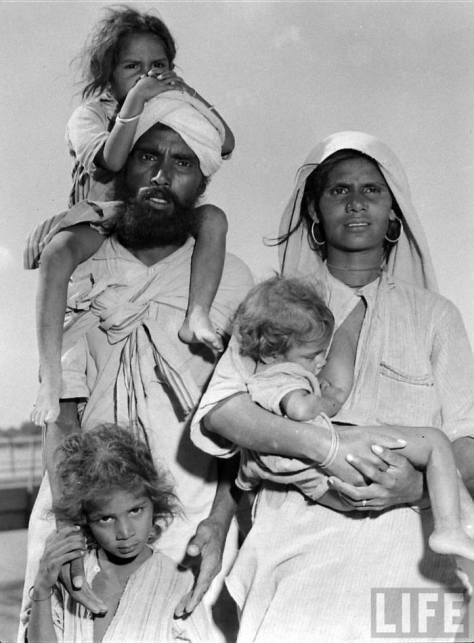
By this point, every Indian, Pakistani, and their grandfathers has watched the Google Partition ad, tears welled up in their eyes. For the uninitiated, Google’s recent advertisement tugs at heartstrings, telling the tale of two chaddi buddies, separated by Partition, and reunited by their grandchildren nearly seventy years later. When the ad went viral via Facebook, sitting thousands of miles away in America, I bawled as I watched the granddaughter listening to her grandfather’s nostalgic retelling of the idyllic life he led in Lahore, eating jhajhariya, with his buddy Yusuf, and his granddaughter’s instant Google fixes to reunite him with Yusuf in Delhi. Continue reading An Incomplete Reunion – Ruining the Post-Partition Party: Archit Guha
People’s Participation in Planning Mumbai?: Hussain Indorewala and Shweta Wagh
This is a guest post by Hussain Indorewala and Shweta Wagh
Since the past six months in Mumbai, there has been an unusual convergence between urban activists, community groups, rights groups, unions, Non-Governmental Organizations and academics, who have come together to provide a theoretical critique of the city’s neoliberal development model, to formulate a more diverse and hopeful vision for the city than the one proclaimed by its power elite, and to present practical alternatives to plans and projects promulgated by faceless state bureaucracies and unaccountable private consultants.
On 22nd October 2013, more than 1500 people gathered at Azad Maidan to formally present “The People’s Vision Document for Mumbai’s Development Plan (2014-2034)” to the Municipal Corporation of Greater Mumbai (MCGM).[1] The People’s Vision Document (PVD)[2] is a remarkable collective vision statement, an outcome of discussions focused around specific issues in the city with more than a hundred grassroots and community groups, along with activists, experts and academics who participated in them. With this movement, the less advantaged residents of the city have announced and forced themselves into an exclusionary and secretive Development Plan process; refusing to be silent spectators, in a striking example of initiative, organizational ability and creative agency, they have asserted their right to the city’s future, whose owners and managers have done much to keep them out. To use the language of other social urban movements around the world, some of the most marginalized groups of the city are fighting for spatial justice, urban democracy, and have claimed their ‘right to be equal in diversity.’[3] Continue reading People’s Participation in Planning Mumbai?: Hussain Indorewala and Shweta Wagh
 KAFILA - COLLECTIVE EXPLORATIONS SINCE 2006