[ This is a letter addressed to Raman Singh, the Chief Minister of Chhattisgarh by several concerned individuals and organizations regarding the impunity with which medical guidelines are put aside by professionals who enjoy the patronage and protection of the state government.]
We, the 138 undersigned individuals and organizations working across the country on health and women’s rights are shocked and dismayed that the case against surgeon Dr. R. K. Gupta has been dismissed by the Hon’ble High Court on grounds that “the alleged act committed by the petitioner was while acting in discharge of his official duty and admittedly no previous sanction was obtained before initiating prosecution case against him”.
The Anita Jha Judicial Enquiry Commission report has clearly pointed out that “It is evident from the facts that in the camps organized on 8.11.2014 and 10.11.2014 there was a breach in the important necessities hence the standard operating procedure were not followed. As a result of which the symptoms of infections were found in post operative female beneficiaries“. It further states that “On the background of deliberation of investigation point number 1 to 3, investigation committee has found following persons Guilty/responsible, functionary, during 08 and 10 November, 2014:- 4.1 For not following standard procedures and for medical negligence by immediate functionary Block Medical Officer, Takhatpur…………….and surgeon who conducted surgery in tubectomy camp at Sakri and Gaurella ( Surgeries were completed by the same surgeon in the both camps)”.
As a nature lover and then an ecologist, my tryst with the living world has been fascinating, exciting, scary and at time dangerous. The most recent of this interaction was with a jackfruit tree in my backyard that has the uncanny capacity to produce fruits all the year round…juicy, sweet and delicious fruits that one cannot even imagine throwing away. I developed a balance of sharing the fruits with the bats, squirrels, crows, tree pies, woodpeckers and koels that would inhabit my garden whenever the fruit ripens and spreads its fragrance around. Continue reading From Cucumber Juice to Mutton Soup, A Culinary Healing Journey: Anitha S→
Please find below a collation of statements of solidarity received by Kafila over the past fortnight since the shameful incidents of violence by the ABVP occurred on the 21st and 22nd of February 2017. These are from: Ramjas Alumna, Ambedkar University Delhi Faculty Association, O.P Jindal Teachers: Students and Durham University Politics and International Relations Society, U.S.A; and students and faculty at the University of Minnesota, U.S.A.
University of Minnesota Students and Faculty
The statements are preceded by a short write-up on what Ramjas College has meant to its alumna, by ANUBHAV PRADHAN.
Nostalgia is made of more than just happiness. It is sulphurous too.
To many who spent three or more years of their life in Ramjas College, visuals of violence in and around it on 21 and 22 February 2017 have been a source of deep, personal shock. The footpath and the areas adjoining the college gate were often sites of lingering conversations between friends, offering moments of respite from studies, tensions accruing from impending exams, or relief to those who had just accomplished a hectic ECA festival and were there catching up their breath or exhaling smoke.
The ABVP struck twice, once attacking the college Seminar Room and then coming back the second day to attack students. In the hundredth year of Ramjas’ establishment, a college founded at a time when protest was an active ideal for most Indians, this singular episode of planned, institutional violence against students and teachers is a grim reminder of the brute silencing of interrogation, peaceful protest, dialogue and dissent being normalised across our colleges and universities, and in our society at large. The audacity with which these perpetrators and their ideologues brand entire institutions and diverse communities of students and academics as anti-national—and therefore fit recipients for their brute censure—also gives the lie to the intellectual and affective bankruptcy of a rapidly emergent cultural orientation premised on simplistic binaries of good and bad, right and wrong, national and anti-national. In a society—and nation—whose ideals are peace, dialogue, and inclusion, these attacks on students and teachers point to the deep ideological rot in the perpetrators’ conception of nation, nationality and nationalism.
As an alumnus of Ramjas College, I cherish the right to self-determination and open debate. I feel outraged that the students’ and faculties’ right to decide what discussion to hold and whom to invite for it within college premises was usurped in this manner. It is disturbing that this violence rippled across the campus as it were, with students being followed, identified and harassed in their personal spaces for having asserted their right to listen to discussions on Bastar and for not bowing down to bodily attacks perpetrated through stones and fisticuffs by members of the ABVP and their affiliates.
Most alumni like me are invested in our respective professions, but the foundations of study and work were laid for us by Ramjas’ teachers and the college’s vibrant culture of extra-curricular instruction. This experience has proved fundamental to our engagement with our immediate workspaces, surroundings, power structures, and our nation. Denying current and future students their right to freely and openly debate issues of their choice in fora of their choice is tantamount to denial of a basic academic right. Threatening and manhandling academicians guided by the spirit of enquiry towards generation of dialogue will prove detrimental to the quality of collegiate education in our nation. We collectively issue the following statement of solidarity with Ramjas’ students and teachers in this moment of crisis:
As I see it, university spaces are being assaulted at least from two sides; though it seems as if the two sides are antagonistic to each other, in practice they come dangerously close to each other. How and why is this happening, and what can be done about it?
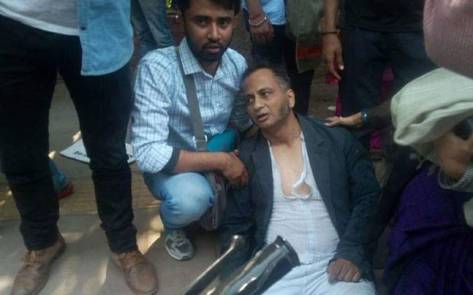
Prasanta Chakravarty, immediately after being assaulted on February 22nd. Image from the India Today Website.
Ramjas students and faculty held hostage inside campus by ABVP cadre
The violence that gripped Ramjas College on the 21st and 22nd of this month is now national news. We heard belligerent slogans by ABVP members of ‘chappal maro saalon ko’ (beat them with slippers), we saw students being chased on the campus, and we saw students being beaten up. All this culminated in a situation where students and teachers were held captive for over five hours within the campus premises. Let me emphasize that this violence was completely unprovoked.
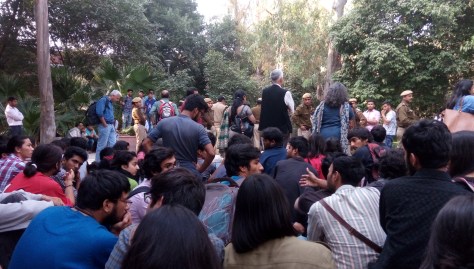
On the 22nd of February, some of the students who were simply sitting with their friends were attacked. The police came and formed a cordon around them. Others joined the students in a gesture of solidarity. Teachers joined them to ensure that the students were not assaulted. The police cordon became their prison for the next five hours. And even then they were not safe.
They were repeatedly assaulted, threatened, and abused. All of this happened in front of their teachers and, more importantly, in front of the police, who, as is well known by now, did not do anything substantial. They could have maintained the cordon around the protesters, arrested those who were repeatedly carrying out the assaults, or – at the very least – prevented the attackers from coming back in (they had left for some time to attack the protest going on outside). But they did not. Whether this was because they were under pressure or because they were complicit is besides the point. The point is that students and teachers remained at the mercy of their attackers for over five hours.
But on the same day something far more ominous was also going on.
We, the undersigned students and academics, gravely condemn the attack on the students and faculty of Delhi University on the 22nd of February, 2017. The students and faculty of Delhi University were expressing their democratic right to protest against the vandalism and hooliganism unleashed by the Akhil Bhartiya Vidyarthi Parishad (ABVP) at Ramjas College, Delhi University, on the 21st of February, 2017. We oppose ABVP’s systematic and deliberate attempts to humiliate, terrorize and bully the students and the faculty members.
We also condemn the brutal, unconstitutional, and illegal actions taken by the Delhi Police against the students and faculty members. Delhi Police’s refusal to lodge legal detention and parading of students in buses, and scapegoating of democratic student and faculty body threatens and undermines values of the Constitution, and has created an environment of fear and dismay.
We, the students, alumni and associates of the Department of English, Delhi University, unequivocally condemn the attack on the students and teachers at Ramjas College and on the university campus by violent protesters from the ABVP and/or other factions, outside and inside the college premises on the 21st and 22nd of February, 2017. We also condemn police inaction and the unprovoked assault on peaceful protesters, manhandling of women and students who were registering their dissent outside Maurice Nagar police station.
The attack on a faculty member of our Department has brought to light the glaring fact that none of us who uphold the right to a free exchange of ideas is safe in the university campus under the current circumstances. We assert that it is our most fundamental right as members of the university community to critically engage with ideas, discuss, debate and follow strands of thought to uncharted territories that remain under the cover of the protective gaze of social and political forces. We have been nurtured by the English Department, at the University of Delhi to question established readings of texts—both cultural and literary—to place them upside-down or to give new shape to them as the need be and we will not concede this ground to forces that wish to stagnate readings of literature, culture and the social at large. An attack on Dr. Prasanta Chakravarty is a blatant attack on each and every member of the English Department, as we have learned more than we can encompass in this statement from his lectures, ideas and discussions both inside and outside the classroom. He taught us to speak truth to power and this practice is most needed today when he was physically assaulted not more than five hundred meters away from the English Department.
Despite the controversies of demonetization, the central government has again succeeded in deftly hijacking the minds of Indian citizens through a riveting speech made by Finance Minister Arun Jaitley. The budget seemed to be especially important given third quarter statistics which are filled with drawbacks of the demonetization policy. Thus we had a budget speech completely focused on digitalization of a country where the ‘digital divide’ stubbornly persists. As the budget theme (Transform, Energize, and Clean) attempted to glorify existing conditions, there were unsurprisingly no transformations in the overall economic framework except the expected tax reduction. In the zeal for “energizing”, the budget had clean forgotten the needs of the informal sector including agricultural sector. Even though the government provocatively claimed that it had cleaned up black money, it revealed no data regarding the amount of black money actually mopped up from the market.
As is well known by now, a seminar organised by the English literary society of Ramjas College, Delhi University titled “Cultures of Protest” on Tuesday the 21st of February was disrupted by a huge mob of ABVP students. They threw stones/bricks into the seminar hall, shattering windows and injuring students, and in full view of Delhi Police, manhandled and beat up student participants. Delhi Police was barely able to control the situation and refused to offer protection to the invited speakers who were told by ABVP members,”We will disfigure your face in a way that you will be unrecognisable”. Mainstream news media has added little to our understanding of the harrowing day-long siege of a college campus space by bloodthirsty goons by presenting it as a “clash” that “broke out” (like a case of hives?!) between two student groups. Thereby implying that left hooligans and right hooligans engaged in their hoologanism while we as neutral public can sigh at the declining public behaviour of students and get back to our lives. Thankfully there are eyewitness accounts and videos that counter this ridiculous and dangerous false equivalence and drive home the point that once again, the opportunity to engage in speech, reason and words was violently cut short by those who wanted to hurt and maim.
I am writing to express my deep dismay at the recent incidents at the University College, and more importantly, at your near-total inexcusable and cowardly passivity that not only permitted the culture of violence to grow in this institution, but also allowed the situation to be such that the aggrieved young people continue to be ostracized and threatened by fellow-students. It escapes my reason why responsible authorities at University College cannot recognize a few basic facts about higher education in post-independence democratic India : (1) the fact that all students, irrespective of caste, class, gender, and other such considerations, have equal rights of access and equal mobility inside the campus, and of course, an equal right to justice, (2) that violence by any section of students against other students is not permissible and must invite prompt action by authorities, (3) that any section of students subjected to violence have full rights to complain and obtain redressal, (4) that the dignity of women students is protected by law and the institution is bound to take action against erring parties following the process laid down by the law. Continue reading An Open Letter to the Teachers and Parents of the Students of University College, Thiruvananthapuram→
संघ के सुप्रीमो जनाब मोहन भागवत की सूबा मध्य प्रदेश की बैतुल की यात्रा पिछले दिनों सूर्खियों में रही, जहां वह हिन्दू सम्मेलन को संबोधित करने पहुंचे थे। सूर्खियों की असली वजह रही बैतुल जेल की उनकी भेंट जहां वह उस बैरक में विशेष तौर पर गए, जहां संघ के सुप्रीमो गोलवलकर कुछ माह तक बन्द रहे। इस यात्रा की चन्द तस्वीरें भी शाया हुई हैं। इसमें वह दीवार पर टंगी गोलवलकर की तस्वीर का अभिवादन करते दिखे हैं। फोटो यह भी उजागर करता है कि भागवत के अगल बगल जेल के अधिकारी बैठै हैं।
विपक्षी पार्टियों ने – खासकर कांग्रेस ने – इस बात पर भी सवाल उठाया था कि आखिर किस हैसियत से उन्हें जेल के अन्दर जाने दिया गया। उनके मुताबिक यह उस गोलवलकर को महिमामंडित करने का प्रयास है, जिसे ‘एक प्रतिबंधित संगठन के सदस्य होने के नाते गिरफ्तार किया गया था। यह जेल मैनुअल का उल्लंघन भी है। केवल कैदी के ही परिजन एवं दोस्त ही जेल परिसर में जा सकते हैं और वह भी वहां जाने से पहले जेल प्रबंधन की अनुमति लेने जरूरी है।’
गौरतलब है कि संघ के तत्कालीन सुप्रीमो गोलवलकर की यह पहली तथा अंतिम गिरफतारी आज़ाद हिन्दोस्तां में गांधी हत्या के बाद हुई थी, जब संघ पर पाबन्दी लगायी गयी थी। प्रश्न उठता है कि आखिर गोलवलकर के इस कारावास प्रवास को महिमामंडित करके जनाब भागवत ने क्या संदेश देना चाहा।
This is my Malayalam opinion piece for iemalayalam, on something despite the outcry against the CPM in the mess around Kerala Law Academy. The public discussion has been, not unexpectedly, on the line of Kerala’s well-entrenched scandal journalism, which has a history of a hundred years, at least. This is a form of journalism that highlights the sexual lives – proper or improper – of powerful male politicians which accompanies the attack on their public failings directly or indirectly- a very highly successful tactic, hitherto, to undermine even the seemingly unassailable. When women began to figure in this kind of journalism as something more than just passive sexual objects, as active agents of corruption and manipulation – most markedly, in the controversy over the businesswoman Sarita Nair – scandal journalism worked by highlighting the huge contrast between their ‘feminine-respectable’ names, sartorial styles, behaviour, and so on, and the despicable manipulations they indulged in. This is the case also with much media discussion of the principal of the Kerala Law Academy, Lekshmi Nair.
However, this tactic is not only misogynist, it also lets the elite-femininity that she represents escape critique. This is a very contemporary form of respectable femininity that presents itself as essentially domestic, but wields delegated masculine power to vicious ends, and it is almost all-pervasive in disciplinary institutions in Kerala now. Not surprisingly perhaps, the CPM’s mishandling of the issue has not just shown how poorly committed the party is to women’s rights, but also how soft it is on this elite-feminine power.
Reports of exploitation, humiliation, violence, and rampant nepotism are still flowing out of the private-sector law college popularly known as the Law Academy, in Thiruvananthapuram twenty whole days after the commencement of the students’ struggle there. At the centre of the controversy is the principal, Lekshmi Nair, who seems to have ‘inherited’ that position in the institution owned by her family: clearly, the students are determined to teach her a good lesson. Rarely have we seen all student organizations, from the far-right to the far-left, rally against one person with equal determination; but from the complaints of students – subsequently confirmed by the University of Kerala to which this college is affiliated – it appears that there is no reason to be surprised.
But the irony of utter lawlessness and blatantly feudal despotism perpetuated in an institution devoted to legal education in a democratic nation itself seems lost, for the authorities’ commonsense about liberal education in Kerala has been that it should be neither liberal nor education nor anything to do even remotely with the practice of democracy. I have been saying this over and over again, and really, feel utterly breathless at this. Continue reading Taming the Brat? Thoughts on the Kerala Law Academy Imbroglio→
Guest Post by CONCERNED STUDENTS OF TATA INSTITUTE OF SOCIAL SCIENCES, MUMBAI
We, the concerned students of Tata Institute of Social Sciences (TISS), Mumbai condemn the continuing state repression of adivasis and recent attack on human rights activist Bela Bhatia in Bastar, Chhattisgarh.
On the 23rd of January, 2017, a group of 30-odd men attacked Bela where they barged into her house in Parpa, near Jagdalpur violently and threatened to burn the building down if she did not leave immediately. The mob also attacked her landlords and their children, threatening them with dire consequences if Bela was not evicted immediately. Despite Bela’s assurances that she would leave, the mob continued to be belligerent, in the presence of the police, and the Sarpanch. The mob has been identified with the right-wing vigilante group Action Group for National Integrity (AGNI). Continue reading In Solidarity with Adivasis in Bastar, Human Rights Defenders and Bela Bhatia in Bastar: Concerned Students in TISS, Mumbai→
.जो शख्स तुम से पहले यहाँ तख़्त नशीन था….
उसको भी खुदा होने पे इतना ही यकीन था
– हबीब जालिब
भक्तगणों का – अर्थात वही बिरादरी जो ढ़ाई साल से लगातार सुर्खियों में रहती आयी है – जवाब नहीं !
अपने आराध्य को इस कदर नवाज़ते रहते हैं गोया आनेवाली पीढ़ियों को लगने लगे कि ऐसा शख्स कभी हुआ न हो। वैसे टेक्नोलोजी की तरक्की ने उनके लिए यह बेहद आसान भी हो गया है कि वह फोटोशॉप के सहारे दिखाए कि कथित 56 इंची सीने के बलबूते वह कुछ भी कर सकते हैं।
मिसाल के तौर पर वह बाढ़ के हवाई सर्वेक्षण के लिए निकलें और धुआंधार बरसते पानी में उनकी आंखों के सामने समूचा शहर नमूदार हो जाए। यह अलग बात है कि उनकी इस कवायद में कई बार उनके इस हीरो की हालत हिन्दुओं के एक पवित्रा कहे जाने वाले एक ग्रंथ में नमूदार होते नारद जैसी हो बना दी जाती है, जिसे इस बात का गुमान ही न हो कि उसने कैसा रूप धारण किया है और उनका यह आराध्य दुनिया भर में अपने आप को मज़ाक का निशाना बना दे।
हम याद कर सकते हैं अमेरिका के तत्कालीन राष्ट्रपति ओबामा की अगवानी का प्रसंग जब दिन में तीन तीन बार ड्रेस बदलने या अपना खुद का नाम अंकित किया दस लाख या करोड़ रूपए का सूट पहनने की उनके आराध्य की कवायद विश्व मीडिया में सूर्खियांे में रही, उसका जबरदस्त मज़ाक उड़ा और इसी दौरान मीडिया ने इस तथ्य को उजागर किया था कि इसके पहले ऐसी आत्ममुग्धता भरी हरकत मिस्त्र के अपदस्थ तानाशाह होसनी मुबारक ने की थी।
Should we criticise the organisers of the Jaipur Literature Festival for inviting two functionaries of the Rashtriya Swayamsevak Sangh to this year’s edition of the annual festival? Murmurs in the literary circles seem to suggest that the organisers of JLF succumbed to pressure from the right wing. A mere look at the list of speakers and programmes makes it clear that there are a fair number of liberal and left-leaning individuals among the speakers. Why, even the general secretary of the Communist Party of India (Marxist), Sita Ram Yechuri, is in that list. So a balance appears to have been struck. Continue reading Dining With The Cultured Hate Mongers→
For over a millennium one of the recurring debates among Indian philosophers was whether this world was real or a mere dream[1]. Paradoxically, those who preached most passionately that our senses mislead us and everything around was Maya or an illusion, went on to corner the largest chunk of material reality.
Behind the smokescreen of clever mythology, it was they, who grabbed the lion’s share of everything tangible over the centuries – from land, water, natural resources to hard political and social power. Worse still, using a mix of brute force and religious mumbo-jumbo, they consolidated the exploitation of those who work by those who merely cook up tall stories, through the nightmare of the caste system.
Today the politics of Maya is well and truly back in play with Narendra Modi’s ‘Mahayagna’ a.k.a. demonetisation promising a digital Moksha through the tapasya of a ‘war on black money’. Once again, as in India’s sordid past, the biggest losers of this devious push for a cashless economy are going to be those right at the bottom of the Indian caste hierarchy. Continue reading The Dwijitalisation of India: Satya Sagar→
On New Year’s Eve, the Prime Minister in his much-anticipated speech amongst other commitments made a vague announcement of a “nation-wide” scheme for maternity entitlements for pregnant women.
But the PM has not spelled out any specifics – neither the timeframe;budget nor its universal coverage as obligated in the National Food Security Act (NFSA) since2013. Clause 4B of the law already promises all pregnant and lactating women maternity entitlements of atleastRs 6000 for each child. But for three years, the central government didn’t honour this legal obligation. Though better late than never, re-packaging this legal right as the PM’s New Year gift is disingenuous.
Further media reports, from December indicate that the Finance Ministry may hike the budget by a mere 20 percent (instead of the sevenfold increase necessary for universalisation) and that too restrict the benefit to only women Below the Poverty Line (BPL). This would be in complete violation of the NFSA.
But there seems to bearecurring trend to subvert the law. For the last three years, this government continued with the pilot Indira Gandhi MatritvaSahyogYojana (IGMSY) in just 53 districts of the country despite repeated demands by civil society activists and women from across the country. This year, Right to Food Campaign activists from across India even sent postcards to the PM to remind him of the state’s obligation.
In September 2015, even the Supreme Court issued notices to the Centre on the non-implementation of maternity entitlements under the NFSA.
While the government did initially enhance the IGMSY allocations from Rs 4000 to Rs. 6000 to be in tune with the NFSA, neither the coverage nor the budget was enhanced which languishes at Rs. 400 crores. Instead to ensure that all eligible women are covered as per the NFSA, Rs 16,000 crores is necessary. A real test of the Prime Minister’s announcement will be in the fine print of the allocations in next month’s budget.
During a visit to the Kishori Mandal at Apne Aap Women Worldwide’s Uttari Rampur Centre in Forbesganj I met some lovely girls. They stayed in the community near the red light area. They were eager to learn new things. They asked me my story of life, “Didi aapki kahani sunao? Aapne kaise yaha tak sangharsh kiya?” I was again very surprised to encounter the subversion of queries. I should have been the one to ask those questions to the girls, but they wanted to know more about me. Perceptual understanding is a perspective rooted in feminist standpoint theory which could apply to any context from the onlooker’s context. For the young girls from the Red Light Area in Forbesganj, I was trapped in some realities which connected me to them. That was why she asked me to share my story of struggle. When I said education enabled me to survive the world around me, they laughed and said that was not their story. They said, “For us we have to get married as soon as we are 18 years old but sometimes even earlier. We just want to enjoy our freedom now in this centre till we get married. After that we do not know what holds true for us.” As women whether we are in the Nat community of Bihar or we are in the liberated spaces of North East India, our identities get defined by our marriage, cultural practices and socialisation. Unbound freedom for women seems to be a misnomer which should be forbidden for women as the evolved souls say.