
Category Archives: Bad ideas

Statement on the Loksabha Elections, 2014: P.A.D.S.

Guest Post : P.A.D.S. (Peoples’s Alliance for Democracy and Secularism) Statement on Elections

The Loksabha election results of 2014 surprised everyone. They are beyond the wildest dreams of even the most ardent BJP and Modi supporters, and worse than the worst scenarios imagined by  BJP’s political opponents. Even though these elections results are singularly stunning, phenomena like these have diverse reasons. A comprehensive understanding and meaningful response require that all these reasons be dispassionately explored and evaluated.

First, the votes behind these results. BJP polled 31% of votes. Never before has a party with so few votes won a mjority in national elections. Clearly, the first past the post system has benefited it disproportionately, more than any other ruling party in the past. This electoral system has amplified the BJP victory and made it look so impressive.  However, BJP’s electoral achievements in other domains must not be discounted. For the first time it managed to dislodge the Congress as the main party to represent Assam in the Lok Sabha. Fighting alone, it garnered 17% of votes in West Bengal and made determined bids in Tamil Nadu and Kerala. In all states where it fought a straight battle with the Congress, its vote share was above or close to fity percent. It ran the most expensive and well organised campaign. Among all contestants, only it appeared determined to win and left no stone unturned to achieve its objective. It played the communal card astutely in UP and Bihar, with full paraphernalia of communal riots, started more than a year ago, and unabashed use of Hindu religious symbols. At other places it was the ‘development’.  The BJP victory is actually Mr Modi’s victory. For the first time since Mrs Indira Gandhi after  the 1971 and 1980 elections, a single person has come to acquire such a mandate at the national level.  These results show a significant shift of electoral politics to the right and marginalisation of non-communal forces. Continue reading Statement on the Loksabha Elections, 2014: P.A.D.S.

A Stolen Verdict: Nirmalangshu Mukherji

Guest Post by NIRMALANGSHU MUKHERJI

The Bharatiya Janata Party secured about 19% votes in the general elections of 2009 to win 116 seats in the Parliament. With this most impressive conversion ratio, they had more or less exhausted their possibilities in their ‘safe’ states like Gujarat, Madhya Pradesh, Chhattisgarh, Jharkhand, Karnataka, and the like. They were still 157 seats away from a simple majority in the Loksabha. Even assuming the impressive conversion ratio, they needed at least 26% more of the vote share, that is 45% in all, to form a government.

When the elections for 2014 were announced, it was hard to see where the BJP would get these additional votes from. Moreover, unlike the NDA of 1999-2004, they had rather modest support from other parties with most of the big parties like AIADMK, TMC, JDU, BJD, and the like staying away. Hence, even if we factor in some rise in number of seats in ‘safe’ states, plus handsome gains in Rajasthan, Maharashtra etc., their ability to reach anywhere near the 272+ mark looked rather dim.

Continue reading A Stolen Verdict: Nirmalangshu Mukherji

Lessons for the Saner Segments of the Margins: Ravi Sinha

Guest Post by RAVI SINHA

The margins just got bigger. Many among those who customarily inhabit the centre have been pushed to the periphery. They are not my concern. There are analyses galore about why and how this has happened. I am not going to add one more to those. Margins exist on all sides. They encircle the political mainland from left and from right. Some might say there are no margins on the right. Everything on that side is mainstream. In any case, I will have little to say about the margins on the right.

My concern is with the left-side margins that now harbour the entire Left, although it is perhaps too soon for much of the traditional Left to acknowledge that. They are not likely, in any case, to listen to those of us who have spent a lifetime on the margins – partly because of our own follies and frailties but also because we have refused to succumb to the unsavory demands of the times. It is, after all, not our fault that we are born in a valley of historical time where the descent on the slopes of past glories has already come to an end and the ascent to the future ones is yet to begin. Continue reading Lessons for the Saner Segments of the Margins: Ravi Sinha

Thinking About Adam Ajmeris in Saffron Times

“The past is a foreign country; they do things differently there.”

L.P. Hartley, The Go-Between

Sixteen year old Shahwan, from Ahmedabad, who is still waiting for his Class X results, was extremely happy that day, when India’s electorate gave its verdict. He hugged his Ammi and went out in his Mohalla along-with his brother Almas, yelling ‘we have won’, ‘we have won’. And not only Shahwan and his family members but one could witness similar joy in the houses of Mohammad Salim Hanif Sheikh, Abdul Qayyum Mansuri alias Mufti Baba and several others.

Interestingly Shahwan’s tremendous joy with tears flowing down the eyes of his Ammi Naseem (40) had nothing to do with the fact that Mr Narendra Damodardas Modi, had delivered a ‘historic victory’ to the BJP.

It was a strange coincidence that the day India’s electorate decided to give a mandate to the Modi led BJP to rule the country for coming five years also happened to be the day when Supreme Court of India in a historic judgment overturned a controversial decision take by him as home minister. It was related to the prosecution of those arrested for Akshardham attack under now lapsed Prevention of Terrorism Act (POTA). Continue reading Thinking About Adam Ajmeris in Saffron Times

The Triumph of the Will(ie): Prasannarajan Anoints Modi in the Open

The televised coronation (or should I say Rajyabhishek) of Narendrabhai Damodardas Modi has featured a supremely photogenic set (the Dasashwamedh Ghat in Benaras), a chorus line of calisthenic priests lining the riverfront of the Ganga with blazing torches, a script (being written, even as the epic is being canned, in every television studio and editorial office) talented producers and art directors, an army of happy-clappy extras, and even its own battalion of masked stunt doubles.

Modi at Dasashwamedh Ghat, Varanasi/Benaras on 17 May 2014. Courtesy, Amar Ujala website.
Amit Shah, Rajnath Singh and Narendra Modi,  at Dasashwamedh Ghat, Varanasi/Benaras on 17 May 2014. Courtesy, Amar Ujala website.

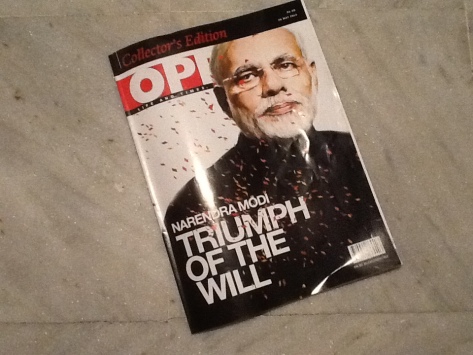
Like any good bollywood blockbuster, it cannot but be a homage to an extant cinematic classic. S. Prasannarajan, editor of the Open Magazine has even told us what that classic is. On the cover of Open, beneath a pensive, tight lipped and determined Narendrabhai looking out at the magazine’s reader through a shower of rose petals and rimless Bulgari glasses, four words spell out in bold capitals the film’s name – ‘TRIUMPH OF THE WILL’. Dejavu, anyone?

'Triumph Of the Will' Open Magazine, May 26, 2014
”Triumph Of the Will’ Open Magazine – ‘Collectors’ Issue’, May 2014

Continue reading The Triumph of the Will(ie): Prasannarajan Anoints Modi in the Open

Isn’t ‘Illegal Bangladeshi’ Racist Shorthand for Bengali Speaking Muslims in Assam? Bonojit Hussain

Guest post by Bonojit Hussain

The fragile and unstable peace in Bodoland Territorial Autonomous Districts (BTAD) of Assam has once again been ruptured. The recent massacre of Muslims of East Bengali descent in Kokrajhar and Baksa districts of BTAD on 1st and 2nd May has already taken toll on 46 lives; with many people still missing, the dead count might go up.

This is not the first time that targeted ethnic violence has occurred in what is today BTAD. Through out the 1990’s armed Bodo groups have indulged in pogroms against Nepalis, Adivasis and Muslims and Hindus of East Bengali descent. But since the creation of BTAD in 2003, increasingly only Muslims of East Bengali descent are being targeted. Worst among all was the so-called ‘riots’ of 2012 where 108 people died. According to sources in Assam government, 79 were Muslims of East Bengali descent, 22 were Bodos and 4 were from other communities.

A lot has been written about the underlying causes of these recurring targeted killings and we need not dwell upon that here. (for an overview see Sanjib Barua, “Assam: The Politics of ElectoralViolence”, Outlook Magazine, May 09, 2014). What should bother us all is how quickly discourse over the recurring massacres in BTAD is transformed into a debate on the question of illegal immigration from Bangladesh, wherein the victims are immediately labeled as ‘illegal Bangladeshis’. Even if the victims were ‘illegal Bangladeshis’, the barbaric act of killing 46 people in a span of 36 hours is a crime against humanity. Continue reading Isn’t ‘Illegal Bangladeshi’ Racist Shorthand for Bengali Speaking Muslims in Assam? Bonojit Hussain

On Religion and Politics: Ravi Sinha

Guest Post by Ravi Sinha

This note is inspired by Subhash Gatade and Aditya Nigam. Subhash wrote a piece, “AK versus NaMo” that appeared on Kafila a few days ago and Aditya made a fairly detailed comment on it underlining the need to have “a proper debate on this issue”. It is foolhardy for me to rush where angels fear to tread. There have been celebrated debates on this in the scholarly circles and, just as phenomena “debate” theories about themselves in their own ways, Indian polity debates this issue all the time. How to make sense of such a tangled issue that fills libraries and unleashes periodic havocs in real life, and that too in a short note? Why even try?

My excuse comes, perhaps, from my ignorance. Many of the axioms of such a debate – e.g. church-state separation was specific to the west and even there it hasn’t worked; religion can never be separated from politics; such a separation, if it were to happen, would exclude the believers from the polity; in a multi-religious society only the maxim of “Sarva Dharma Samabhav” can be the desirable policy of the state; etc – do not appear obvious or acceptable to me. I hope to dispel the notion that my incredulity towards such maxims, and towards the Gandhian-communitarian-postcolonialist-postmodern attitudes in general, originate in my being a run-of-the-mill leftist belonging to the “now defunct Left” who refuses to see that the “communist model” to deal with such issues “has virtually no takers”. I do not share with Aditya an approach towards the Left, but that does not mean that I do not have issues with the latter. It seems to me that it manages an awkward feat of limping on both the legs – one leg is afflicted with dogma and the other with populism. But the other side – the Gandhian-communitarian-postcolonialist-postmodern side – appears even more challenged. Despite its erudition on the one hand and a practical-realist approach on the other, when it comes to actual walking in the political arena, it chooses to walk on one leg only – that of populism. Continue reading On Religion and Politics: Ravi Sinha

मुकुल सिन्हा

यह विचित्र और विडम्बनापूर्ण संयोग है कि जब सारे टेलीविज़न चैनल नरेंद्र मोदी नीत राजनीति के भारतीय केंद्रीय सत्ता में आने की खबर दे रहे थे, उसी वक्त मुकुल सिन्हा के हम सबसे अलग होने समाचार नासिरुद्दीन ने फोन से दिया. मुकुल कैंसर से जीत न पाए. उनकी मौत की खबर से ज़्यादा सदमा इस बात से पहुँचा कि हमें उनके हस्पताल में होने की खबर ही न थी. हमें इसका इल्म न था कि नरेंद्र मोदी के मोहजाल को, जो करोड़ों,अरबों रुपयों और अखबारों और टेलीविज़न के विशालकाय तंत्र के ज़रिए बुना जा रहा था, छिन्न-भिन्न करने के लिए प्रेमचंद के सूरदास की तरह ही गुजरात का सच बताने का अभियान जो शख्स चला रहा था, उसे मालूम था कि वह अपनी ज़िंदगी के किनारे पर खड़ा था.

धर्मनिरपेक्ष कामकाजीपन का रिश्ता ही हम सबका एक दूसरे से है, मानवीय स्नेह की ऊष्मा से रिक्त!यह एक उपयोगितावादी सम्बन्ध है जिसमें हम एक दूसरे से धर्मनिरपेक्ष, राजनीतिक चिंताओं से ही मिलते-जुलते और बातचीत करते हैं.अपने मित्रों की जिंदगियों और उनकी जाती फिक्रों क साझेदारी हम शायद ही करते हैं.मुझे खुद पर शर्म आई कि मैं मुकुल के कैंसर के बारे में नहीं जानता था, गुस्सा उन दोस्तों पर आया जो इसे जानते थे पर इस दौरान कभी इसे बात करने लायक नहीं समझा. हम अपनी ही बिरादरी नहीं बना पाए हैं फिर हम एक बड़ी इंसानी बिरादरी बनाने का दावा क्योंकर करते हैं! Continue reading मुकुल सिन्हा

The UAPA in Madhya Pradesh – The JTSA Report in Perspective, and Beyond: Sharib Ali

Guest Post by SHARIB ALI

REPEAL UAPA: JTSA REPORT IN PERSPECTIVE, AND BEYOND

The state fabricates terror. There is enough evidence to take it to court on that count. Yet, how does one construe ‘fabrication’- what is implied by it? First, that the state has orchestrated elaborate attacks- violence to terrorize its people for certain legal, electoral and political ends. Second, that it has, through the use of laws like Unlawful Activities Prevention Act (UAPA)  against specific segments of its population has consciously manufactured a state of terror- a collectively imagined perception of threat that the nation faces from a particular people. The ends, always remain the same.

Though there is evidence of the agencies of the state, or actors within them, expressly participating in orchestrating large scale terror attacks (think col. Purohit), it is the latter- where terror within specific communities is manufactured in the eyes of the law and the people- that I deal with here, today. ‘Guilt by Association’The JTSA (Jamia Teachers Solidarity Association) report on UAPA cases in Madhya Pradesh, is a crucial case in point.

Continue reading The UAPA in Madhya Pradesh – The JTSA Report in Perspective, and Beyond: Sharib Ali

A Matter of Honour ? A Response to B. G Verghese’s views on the Kunan Poshpora Mass Rape: Shrimoyee Nandini Ghosh

Guest post by Shrimoyee Nandini Ghosh

 I have thought hard about why I want to write this piece at all, since so many others before me, have made robust critiques of Mr B.G Verghese’s well-known views on the Kunan Poshpora mass rape. Past criticism has focussed on questions of his obvious biases– both personal and professional, his misogyny and profound lack of empathy for the victims, his blinding nationalism, the tenor and language of his reportage. Most however accept his version of the facts, given his (often self proclaimed) claims to veracity bolstered by official hospitality, access to documents, and his reputation as an eminent journalist. ‘There was a delay in making an official complaint’ ‘medical evidence shows that the mass rapes did not take place’, ‘villager’s and early official accounts of that night are full of gaps and contradictions’, these have become the pervasive truths about the events of February 23-24, 1991, to the point where his decriers can often only counter him by explaining away the inconvenient and the inexplicable, within the narrative and factual scaffolding that he provides. Mr Verghese points to this when he writes, ‘Sadly, it [the Press Council of India Report] was and is widely criticised to this day, without critics having read it or controverted its substantive findings’. Mr Verghese fails to disclose that until recently no one has had access to the ‘substantive’ material that could allow such a critique, because the state had never disclosed that any other investigative material existed simply replying to RTIs seeking information on the status of the case, with the inscrutable ‘closed as untraced’. The unwieldy length of this piece (8000 words) will, I hope, serve to finally pursuade him that not only is his work read, it is read in painstaking detail.

Continue reading A Matter of Honour ? A Response to B. G Verghese’s views on the Kunan Poshpora Mass Rape: Shrimoyee Nandini Ghosh

AK versus NaMo

Neelanjan Mukhopadhyay, author of a much discussed book on Modi, made few interesting observations about AAP’s (Aam Aadmi Party ) foray into the electoral politics of Gujarat. Underlining the fact that Kejriwal’s entry into the state – wherein he tried to put the government on the mat for its acts of omission and commission – did raise expectations, he maintains that the momentum did peter away slowly.

What is more important to note that when the electoral battle started the party did not field a single candidate from the minority community despite the fact that population of Muslims in Gujarat is more than nine percent. According to the state leadership of the party it did not ‘find any suitable candidate from the community’ to contest elections. Questioning this explanation Neelanjan says that it thus did not challenge the prevalent norm that ‘Muslims are not to be given tickets’ by the mainstream parties. (Modi ki Raah Chale Kejriwal, Deshbandhu, 30 April 2014).

Any neutral observer of the whole situation – who is familiar with the fact that there are places where AAP did field ‘outsiders’ to fight elections – would also be of the opinion that this explanation seems insufficient and perhaps there are deeper reasons involved in this decision. If at the political level it could bracket BJP as well as Congress at the same level by portraying their alleged proximity to the Adanis’ and Ambanis’ why did not it try to make another strong political point by giving ticket(s) to candidate(s) belonging to the minority community. (To put it on record, the BJP did not field a single Muslim candidate and Congress could muster courage to do it in only one constituency). Continue reading AK versus NaMo

Notes on Velaveping Kerala : Inside a Brand-New Paradigm and Outside

Insiders: Velaveping Idukki

All I can say about the Supreme Court verdict striking down Kerala’s position on the Mullaperiyar Dam issue is that we are due for another round of the Hysterics vs. Imperialists media game. The managers of the Hysterics team, our local Malayali politicians, do have the advantage that their experience in fear-mongering has gone up considerably with the controversies over the Gadgil and Kasturirangan reports regarding ecological conservation of the Western Ghats. The Imperialists team out there in Tamil Nadu is also now more experienced, after their successful suppression of their own people’s fears for their lives at Koodankulam. So we are set for an interesting match!

However,please don’t underestimate us. The truth is that you north Indians (or others) never really got us — what we are today you will be –well — ten years later. There are of course simple souls, many ordinary folk in Idukki, who are scared for the land and their lives. But in any society, there are bound to be backward people who are always under old delusions? The sophisticated among us may be marginally scared of the dam break but our fear is not really that the land will disappear. Actually our issue is that the dam-break will make that happen too quickly. Please note that we intend to do it little by little, so that full economic advantage can be obtained! Ah, what is the use of letting everything get washed into the Arabian Sea? Our plan was simple and you will admit that no one can maximise advantage better than us. You have to realize that Kerala’s topography is too unfriendly towards profit-making ventures and we need to do something about it. Consider the following steps: Continue reading Notes on Velaveping Kerala : Inside a Brand-New Paradigm and Outside

Why the Law may still Catch Up with Amit Shah: Warisha Farasat

Guest Post by WARISHA FARASAT 

Amit Shah seems to be on a roll this election season. First, he escaped any punishment after delivering one of the most disturbing hate speeches made during the 2014 election campaign. After the Muzaffarnagar riots, attempts were made by political parties to capitalize on the suffering of the locals, and provoke certain communities to vote for them. And when Amit Shah was censured by the Election Commission for indulging in objectionable speeches during the election campaign in Uttar Pradesh, BJP Primeminsterial candidate Narendra Modi came to the defence of his most loyal lieutenant. Clearly, Amit Shah’s statement was made with the intention of polarizing the voters in a politically surcharged environment in Uttar Pradesh and amounted to hate speech. However, the Election Commission soon did a u-turn, diluted its own stand, withdrew the ban against Shah and allowed him to go ahead with his campaign. The withdrawal of ban against Amit Shah ignoring the drastic implications of his hate speech during the campaign was alarming.

And now, the CBI has not named Shah as an accused in the Ishrat Jehan fake encounter case stating that there is no ‘prosecutable evidence’ available against him. But Shah and his supporters should not think that this so-called ‘clean chit’ absolves him of all criminal responsibility for indulging in fake encounters in Gujarat. If we believe the CBI in the Ishrat Jehan case when they claim that there is no prosecutable evidence against Shah, consequently, we also need to trust their investigations in atleast two other fake encounters, namely the Sohrabuddin Shiekh and the Tulsiram Prajapati cases where the CBI have named Shah as an accused. Shah is presently being tried in these cases and is able to campaign during these elections only because he is out on bail.

Continue reading Why the Law may still Catch Up with Amit Shah: Warisha Farasat

The curious case of Reliance Industries Ltd’s gravity defying stock price – Or, how you should learn to stop worrying about gas prices and buy RIL stock now: Vineeth Sukrithan

This is a guest post by VINEETH SUKRITHAN

The stark contrast between RIL’s latest march quarter performance and the almost- three-year highs that its stock price is perched on top, merits a deeper analysis. On April 18th, 2014, RIL released its quarterly data showing disappointing results that were entirely in line with industry expectations. Petrochemical business revenues fell 3.7%, while oil and gas turnover dropped 18.2% q-o-q. Net profit growth in its January-March quarter (Q4FY14) was at Rs 5,631 crore – only 0.7 per cent higher than Rs 5,589 crore it earned a year ago. The petrochemicals business’s Ebit was lower than in the December quarter and the company’s outstanding debt over shot its cash and equivalents. (Rs 89,968 crore against cash, and equivalents of Rs 88,190 crore.)

Yet, for a company that has always been known to be reticent about taking on high levels of debt, RIL has gone on what can only be called a remarkable splurge in capital expenditure. Its capital expenditure during the year was the highest ever. The company reported net addition to fixed assets of Rs 35,210 crore in FY14. In FY09, when the company commissioned its second refinery and K-G basin gas production, its capex was only Rs 24,907 crore. So, on all accounts, RIL’s actions and stock price seem counter to the predicaments of its current financial health, which begs the question, where does Reliance derive this level of confidence in its future profitability to be willing to take on tremendous amounts of debt?

Continue reading The curious case of Reliance Industries Ltd’s gravity defying stock price – Or, how you should learn to stop worrying about gas prices and buy RIL stock now: Vineeth Sukrithan

Should only Minorities be Worried over Mr Modi? Sanjay Kumar

(Photo Courtesy : ibnlive.in.com)

Guest Post by SANJAY KUMAR

By stealth, wealth, and media barrage a phalanx of powerful interests is trying to create a public opinion favourable to Mr Narendra Modi. It appears the entire privilegenstia of the country, the super rich capitalists, professional elites, entrepreneurs of the religion, top bureaucracy, including retired army men and police, upper castes, media pundits, even NRI academics, are united in their enthusiasm for Mr Modi. From Ratan Tata to Ramdev, people have been told how the man is the only saviour of a country in crisis. What exactly do this bunch of rich and privileged, but discontented people hope from Mr Modi as PM is important for the future of the country. The moot point here is the difference between declared intentions and actual motives. Perhaps even more important is the response of Mr Modi’s political opponents, because that indicates the kind of resources the country can fall back upon when confronted with the reality of him in power. The moot point here is a lack of understanding of the significance of the usual, non-Modi type politics for ordinary Indians. The stakes are high indeed. Far from what the phalanx and its ideologues claim, it is actually this politics which is their target, and which they wish to change under Mr Modi.

The most prominent charge leveled by Mr Modi’s opponents is that he is communal and divisive, and will alienate minorities. From Mr Lalu Prasad to Prof Amartya Sen, that appears to be the chief misgiving. If the charge against Mr Modi is so framed, then by implication it also appears to be asserting that if there had been no Gujarat 2002, Mr Modi and the kind of politics his party represents will be as good or bad as any other party politics. Are minorities’ misgivings about Mr Modi’s the only fact that the rest of Indians should worry about? Is the hesitation of minorities about him the only legitimate concern that may stop the man from reaching the PMO? Continue reading Should only Minorities be Worried over Mr Modi? Sanjay Kumar

Condemn the Gruesome Massacre in Bodoland (Assam) : Statement by New Socialist Initiative (NSI)

Text of a statement issued by New Socialist Initiative

New Delhi; 07/05/2014

New Socialist Initiative (NSI) strongly condemns the gruesome massacre of Bengali speaking Muslims in the Bodoland Territorial Autonomous Districts (BTAD) in Assam, which has witnessed the resurgence of the ugly head of ethnic violence. As per latest official reports, 38 people have been killed, the majority being women and children, while several have been injured and many are missing.

On the evening of 1st May at 7.30 pm, 8 armed Bodo youths riding on 4 bicycles entered a house in Narasinghbari village in Baksa District and fired gunshots. The next day (2nd May), allegedly 40 Bodo militants surrounded 77 houses in Narayanguri village in the same district and fired indiscriminately. Until now 30 dead bodies have been found. According to district administration 15 people are still missing, among them 12 children and 3 women. Simultaneously, in Balapara village in Kokrajhar district at around 12.30 am on 2nd May, armed Bodo youths killed 8 people. The survivors in Baksa district told that the death toll will substantially increase as the militants killed and threw the dead bodies into the Beki River that flows through the area. Continue reading Condemn the Gruesome Massacre in Bodoland (Assam) : Statement by New Socialist Initiative (NSI)

EFLU Hyderabad Rusticates Students for Wanting to Keep Library Open: Sudha and Muhammad Afzal

Guest Post by Sudha K F and Muhammed Afzal P

The semester break seems to be the most active time for the English and Foreign Languages University (Hyderabad) administration. What are these activities that the administration invests so much of its energies in, when most students have left the campus for their vacation? It is sending memos, show cause notices and the latest: the RUSTICATION of two significant student leaders on the EFLU campus.

When the word ‘fascist’ has become an everyday term, to talk about the Modi nightmare and its anxieties, we have more to add to that list from EFLU, Hyderabad. Mohan Dharavath, President of Dalit Adivasi Bahujan Minority Students’ Association and Satish N, General Secretary of Telengana Students’ Association, have been rusticated from the University for two years, the latest in a series of draconian and undemocratic moves, on the part of the autocratic EFLU administration. The two students, along with another student, Subhash Kumar, were given show cause notices by the Proctor’s office on 24 March, to which they responded, denying the baseless charges levelled against them. The rustication is part of the disciplinary action against these students who were part of a massive protest that took place against the administration, called forth by the EFLU Students’ Union. This protest was against the absolute closure of the only 24-hour reading room, and library, on the small EFLU campus in the first week of March 2014.

Continue reading EFLU Hyderabad Rusticates Students for Wanting to Keep Library Open: Sudha and Muhammad Afzal

Tsundur Massacre – Normalising Injustice the Judicial Way

Tsundur, Guntur, A.P. which had made headlines way back in 1991 when eight dalits were lynched by a 400 strong armed mob of Reddys is again in the news. The recent judgment of the A.P high court has overturned the judgment of the Special courts and has acquitted all the accused involved in the case for ‘want of evidence’.

As rightly noted by Human Rights Forum (HRF) the judgment is ‘brazen injustice’ and is ‘reflective of upper caste anti-dalit bias’ and ‘betrays insensitivity in the judiciary to an inhuman caste atrocity.’ It is expected that the state does not waste time in moving the Supreme Court to get this retrograde judgment overturned and render justice to the families of dalits.

What is more disturbing and shocking is the fact that when the Special Court formed to deliberate on the case had finally given its verdict seven years back, it was considered a ‘historic’ in very many ways. The conviction of the perpetrators – twenty one of the accused were life imprisonment and 35 of the accused were asked to serve one year rigorous imprisonment – was considered a significant milestone in the ongoing dalit emancipation movement. Continue reading Tsundur Massacre – Normalising Injustice the Judicial Way

पार्टी विहीन गठबंधन का दिल्ली फतह ! संजीव कुमार

Guest post by SANJEEV KUMAR
अभी अभी सत्तरहवीं लोकसभा (2019) के चुनाव परिणाम आये है, देश की कोई भी पार्टी खाता भी नहीं खोल पाई है, जनता ने सभी सीटों पर निर्दलीय उम्मीदवार को चुनकर संसद का रास्ता दिखाया है। हमारे राष्ट्रपति महोदय सरकार बनाने के लिए आमंत्रित करें तो किसे करें? देश को इस संवैधानिक और क़ानूनी संकट से बाहर निकालने के लिए राष्ट्रपति ने सर्वोच्च न्यायलय के न्यायधीश को ख़त लिखा और दोनों ने मिलकर ये फैसला लिया कि सभी नव-निर्वाचित सांसदों को दिल्ली बुलाया जाय और उन्हें समग्र रूप से अगली सरकार बनाने का आग्रह किया जाय।

इधर हमारे सभी नव-निर्वाचित सांसदगन कन्फ्यूज्ड भी है पर दिल्ली के लिए अपना बोरिया बिस्तरा भी बाँध रहे है, आखिर महामहिम का आदेश जो है। दिल्ली पहुँचाने पर सभी सांसद जब राष्ट्रपति भवन में पहुंचे तो राष्ट्रपति ने सदन के दोनों सभाओ के संयुक्त बैठक को संबोधित कर सरकार बनाने की प्रक्रिया का ढांचा प्रस्तुत किया जिसमे सबसे पहले सभी नव-निर्वाचित सांसदों को एक एक कर देश की समस्याओं और उसके समाधान के उपाय पर बोलने की अनुमति दी जाएगी और उसके बाद उन सांसदों को प्रधान मंत्री बनाने का दावा पेश करने के लिए सामने आने को कहा जायेगा जिनको कम से कम 60 सांसदों का समर्थन प्राप्त हो। 60 सांसदों का समर्थन जुटाने के लिए उन्हें एक हफ्ते का समय दिया जायेगा और फिर उसके बाद संसद में प्रधानमंत्री पद के लिए अनुपातिक मतदान पद्धति से चुनाव होगा और हमारे प्रधान मंत्री को चुना जायेगा। उसके बाद ठीक इसी प्रकार से देश के अन्य मंत्रालयों के मंत्रियों का भी चुनाव होगा। सभी सांसदों को सभी मंत्रालयों को चलाने की क्षमता को संसद में सांसदों के सामने प्रकट करने का सामान अधिकार होगा। Continue reading पार्टी विहीन गठबंधन का दिल्ली फतह ! संजीव कुमार

Modi-Fascism and the Rise of the Propaganda Machine

Almost every day, Modi takes off from Ahmedabad airport in an EMB-135BJ, an Embraer aircraft, for his rallies. The jet is owned by Karnavati Aviation, a group company of the Adani Group. “We record two movements of Modi’s aircraft daily. No matter where he goes to address rallies, he always comes back home,” said an air traffic control official.

Recently, Modi’s aircraft was denied permission to fly by DGCA in Delhi for over two hours, following which he lashed out at the central government for stalling his movement. Ever since, Modi has increased the use of choppers to cover smaller distances. “Mostly, politicians use chopper to reach places where bigger aircraft can’t reach,” said an ATC official.

Over the past few days, Modi flew in an Augusta AW-139 chopper, owned by the DLF Group, for his rallies in north India, especially in Uttar Pradesh and Bihar. ‘Fleet of 3 aircrafts ensures Modi is home every night after day’s campaigning’, Times of India, April 22, 2014

The Political Culture of Fascism

In an earlier post, I had joined issue with a section of liberal intellectuals, whose ‘liberalism’ was either rendering them too gullible or simply complicit in the formation of the Narendra Modi phenomenon – which I have no hesitation in referring to as the Indian edition of fascism. The gullibility or complicity of many of these intellectuals also manifests itself in the myopia that grips them when the talk about the impending challenge before democratic politics in India – a brief glimpse of which is provided in the quote above, that indicates the alliance, the power bloc that will rule, were Modi to come to power.

The Modi-formation is ‘fascism’, in the sense that it takes direct inspiration from the particular history that goes by that name, especially its Nazi episode and knows that even though it cannot replicate the conditions of its existence in India, it can nevertheless use its cardinal ideas. The exaltation of the Nation/ nation-state, the manic obsession with ‘national security’ to the extent of the destruction of democratic rights, identification and suppression of scapegoats – the Other (the Jew, the Muslim, the homosexual, and all kinds of ‘wayward’ sexualities – often, all rolled into one) and of course, the intellectuals, artistes and human rights activists. A key aspect of this political culture is the combination of violence with mass frenzy that is sought to be continuously whipped up and directed against the imagined enemies of the ‘Nation’. Continue reading Modi-Fascism and the Rise of the Propaganda Machine

On Community Profiling

New York Police Department (NYPD) is in the news again for wrong reasons. It’s campaign to carry photos of citizens with its officers via Twitter backfired,as users flooded the hashtag with photos decrying alleged police brutality.

Not sometime ago it had to disband its Demographic Unit, which was engaged in spying on Muslim neighborhoods, infiltrating groups and eavesdropping on conversations across the northeastern United States, in the years following the Sept. 11 attacks. It had to finally admit that this secret Demographics Unit failed to yield a single terrorism investigation or even a single lead. Senior police officers of the department had to confess that the police gathered information on people even when there was no evidence of wrongdoing, simply because of their ethnicity and native language.

It may be added here that Adam Goldman, a journalist who with the help of his colleague Matt Apuzzo first broke this story about New York Police Department’s Muslim Spy Programme in a series of articles they wrote for Associated Press for which they were rewarded with Pulitzer Price.

Interestingly it was quite a coincidence that when the world at large was discussing how NYPD tried to stigmatise a community and terrorise a people, reports about the ‘informer-cop nexus behind Islamic Fundamentalism in Tamil Nadu’. Continue reading On Community Profiling