Category Archives: Capitalism

The Elite Criminal Man and the Self-Curated Criminal Man: Criminality and Misogyny in the Dileep Case

The verdict in the actor-assault case of 2017, delivered a few day back in the Ernakulam Principal Sessions Court, did not surprise anyone, except the extremely naive. Not just because of the difficulties in proving conspiracies, but also because the trial court seemed so unbelievably biased against the survivor all through and actually in favour of the accused. The man accused of conspiring against the female actor and hiring a gang of thugs to abduct and rape her in a moving vehicle, Dileep aka Gopalakrishnan, is an actor in the Malayalam industry. But he is also accused of being a notorious fixer in the Malayalam movie industry, the go-to person for people who want to get things done — someone who bends things to their will, cuts through all institutional procedure and safeguards using invisible chains of influence and violence. The verdict convicted the six men who actually committed the crime – and declared that the prosecution had not proven Dileep’s involvement in the crime. In other words, the man escaped for entirely technical reasons — or the blind spots of the law.

Continue reading The Elite Criminal Man and the Self-Curated Criminal Man: Criminality and Misogyny in the Dileep Case

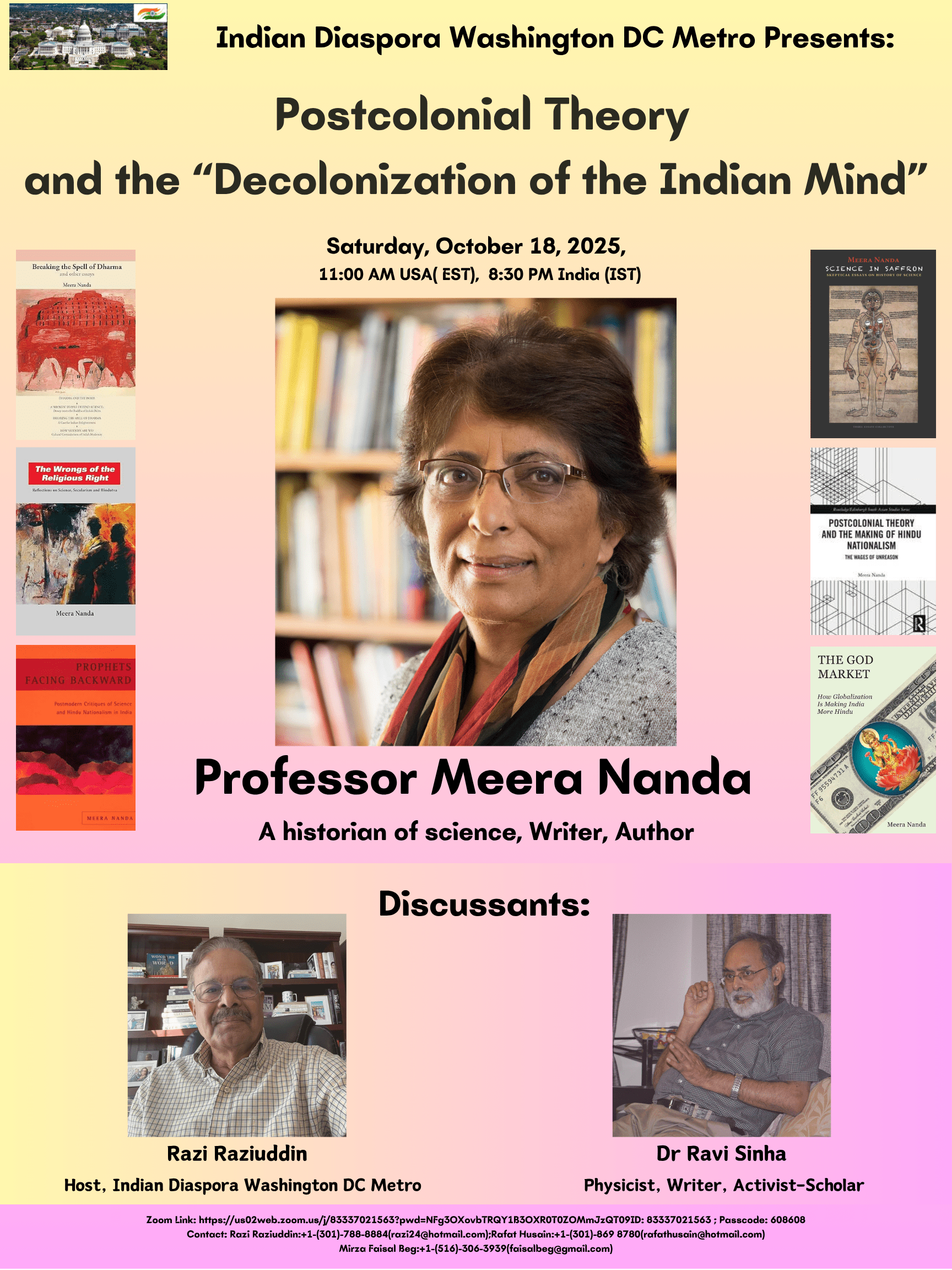
Postcolonial Theory and the “Decolonization of the Indian Mind” : Professor Meera Nanda

Indian Diaspora Washington DC lecture series

Topic: Postcolonial Theory and the “Decolonization of the Indian Mind”

Speaker: Professor Meera Nanda

Red Dreams, Saffron Marches – Longue Durée of India’s Struggles and Strategies of Power: S. M. Faizan Ahmed

Guest post by S.M. FAIZAN AHMED

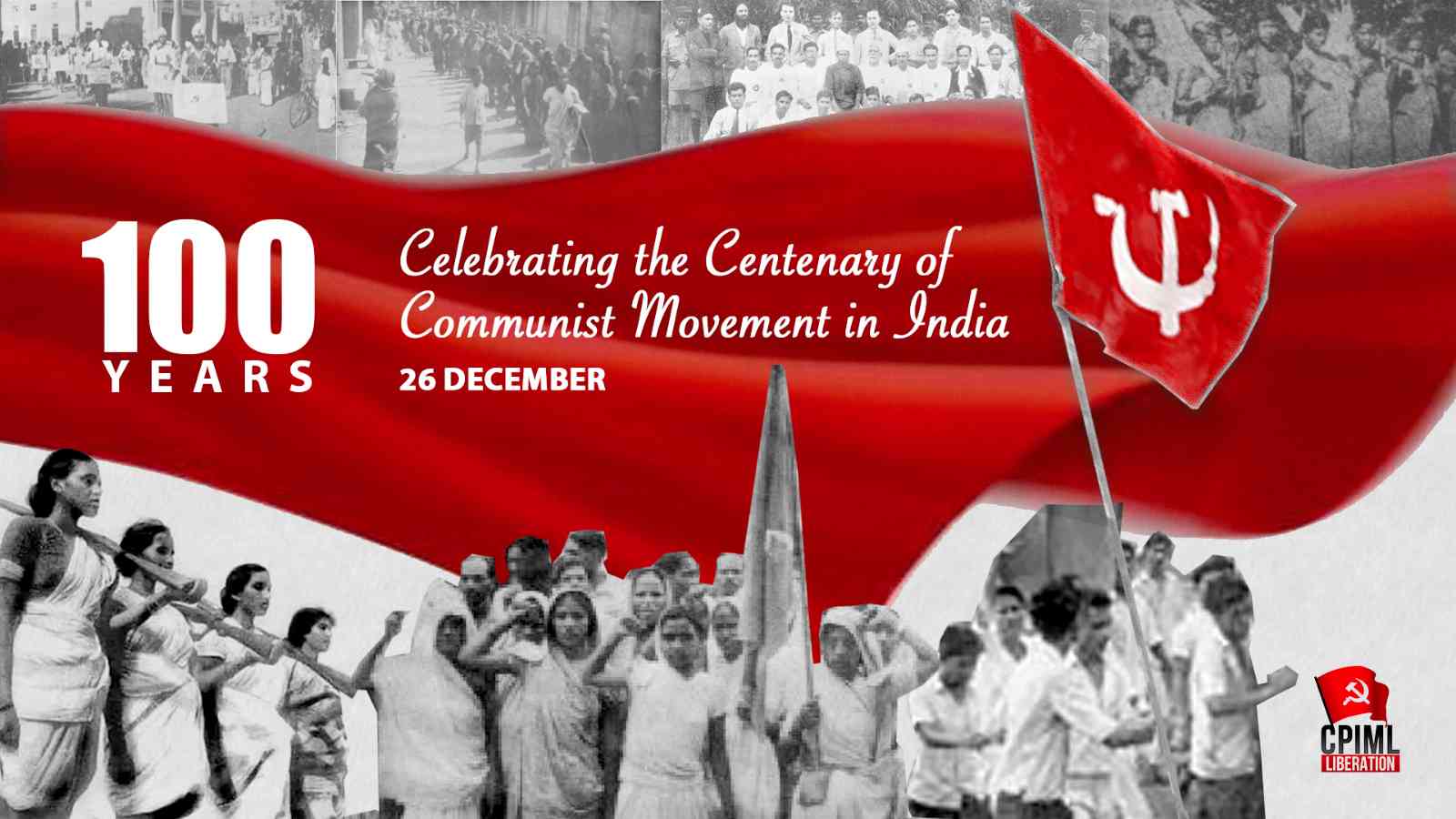
[The author writes about the current scenario, reflecting on the one hundred years of the communist movement as well as of the RSS. In these important reflections Ahmed recounts the great achievements of the communist Left, while at the same time speculating on where the RSS scored over it – leaving us with a number of questions to seriously ponder about. – AN]

Image courtesy Liberation

On October 1, 2025, a day before Gandhi’s birth anniversary, long revered and associated with ahimsa and moral conscience, the government unveiled a ₹100 coin at the Dr. Ambedkar International Centre, 15 Janpath, marking a century of the Rashtriya Swayamsevak Sangh. A day earlier, as if to turn ideology into spectacle,  a Shakha parade, named Path Sanchalan, traced its way through Jawaharlal Nehru University—once a fortress of dissent and the audacious poetry of thought. The rhythmic march of uniformed bodies through corridors once alive with debate did more than display ceremony; it signaled a shift in the republic’s moral conscience, where the choreography of discipline seeks to mute the dialectic of doubt, and the university—once a sanctuary of questioning minds—becomes a stage for the theatre of obedience. Continue reading Red Dreams, Saffron Marches – Longue Durée of India’s Struggles and Strategies of Power: S. M. Faizan Ahmed

Books as Crime ? – Whether J and K High-court Will End the ’Unprecedented Situation’ ?  

‘So you are the little woman who wrote the book that made this great (American) civil war’
— Abraham Lincoln to Harriet Beecher Stowe, author of Uncle Tom’s Cabin

The Writers’ Police !

Bruno Fulgini, a nondescript employee at the French Parliament, would not have imagined in his wildest dreams that his tedious and boring job at the Parliament library would lead him to a treasure hunt of another kind.

Nearly two decades back one witnessed him metamorphose into an author and editor, thanks to the sudden discovery of old files of the Paris police, which provided details of its surveillance work done way back in 18 th century. A report filed by AFP then, quotes Fulgini tell us that ’Beyond criminals and political figures, there are files on writers and artists. In some cases, they go far in their indiscretions.’….

It was clear to these protectors of internal security of a tottering regime that the renowned literati then viz. Victor Hugo, Balzac or Charles Dickens, might be writing fiction, but their sharp focus on the hypocrisy of the aristocrats or the livelihood issues of ordinary people is adding to the growing turmoil in the country. They knew very well that they might be writing fiction for the masses but it is turning out to be a sharp political edge that hit the right target and is becoming a catalyst for change.

The Parisian police was engaged in tracking down the daily movements of the writers, was more subtle in its actions; its present-day counterparts in the West do not seem to have such patience.

The strongest democracy in the world namely the US has of late become a site of an ’unprecedented’ ’Multi-level barrage of US book bans’ as per PEN America [1]….

And now there are indications that the biggest democracy in the World namely India is keen to follow the footsteps of the strongest democracy ?
Or it is too early to say that .[ Read the full article here : http://mainstreamweekly.net/article16227.html

The hopeless quest for a pure incorruptible knowledge – decoloniality and its discontents

[This post by Nivedita Menon is the fourth essay of the series in Kafila titled Decolonial Imaginations. Links to the previous essays are given at the end.

The terms ‘decolonization’ or ‘decolonial’ have become quite critical now, given that the impulse of justice lies at the core of these concepts. Neither postcolonial nor decolonial perspectives are compatible with right-wing ideologies but the fact that Hindutva ideologues in India and the rightwing globally are now trying to appropriate that language makes it seem to some that the very idea of the postcolonial or decolonial is suspect. We believe that this demonizing of decolonial theory from a position defensive of the European Enlightenment needs to be unpacked in the interests of a mutually productive debate. Kafila will be publishing a series of interventions on what the idea of the decolonial imagination involves, locating decolonial theory as speaking from the margins, drawing attention to identities which the orthodox Left subsumed under ‘class’ and which the rightwing in India seeks to assimilate into Brahminism. Additionally the orthodox left’s rejection of spiritual beliefs and inability to engage with them is also a factor that may have produced the space for right wing appropriations of a field marked “religion”. 

We hope that these interventions will clear the ground for productive conversations on the left rather than polarised and accusatory claims.]

Introduction

As Hindutva ideologues and the rightwing globally, appropriate the idea of “decolonising”, it seems to many opposed to these trends, that scholarship around decoloniality is itself the problem. Such arguments tie in with earlier ongoing attacks on postcolonial scholarship since the 1990s that virtually accuse it of directly contributing to the rise of the right. Decolonial scholarship is relatively a new arrival in the Anglophone world (since the 2000s), and ever since the rightwing started using that language, the same charges are laid at its door as well. Indeed, the implication (and sometimes outright allegation) is that decolonial/postcolonial scholars were secretly rightwing all along.

This charge I will address in a somewhat different way in the first section, by way of analogies with other bodies of knowledge.

The second section will address another related critique of decolonial thought, that it is “merely epistemic” and does not consider the materiality of structures of power

Finally we will ask the question – when Hindutva claims to be “decolonising”, what is it doing exactly? Continue reading The hopeless quest for a pure incorruptible knowledge – decoloniality and its discontents

Anti-colonial Thought and the Global Right – An untenable alliance: Ishan Fouzdar

Guest Post by ISHAN FOUZDAR

[This post is the third essay of the series in Kafila titled Decolonial Imaginations. Links to the previous essays are given at the end.

The terms ‘decolonization’ or ‘decolonial’ have become quite critical now, given that the impulse of justice lies at the core of these concepts. Neither postcolonial nor decolonial perspectives are compatible with right-wing ideologies but the fact that Hindutva ideologues in India and the rightwing globally are now trying to appropriate that language makes it seem to some that the very idea of the postcolonial or decolonial is suspect. We believe that this demonizing of decolonial theory from a position defensive of the European Enlightenment needs to be unpacked in the interests of a mutually productive debate. Kafila will be publishing a series of interventions on what the idea of the decolonial imagination involves, locating decolonial theory as speaking from the margins, drawing attention to identities which the orthodox Left subsumed under ‘class’ and which the rightwing in India seeks to assimilate into Brahminism. Additionally the orthodox left’s rejection of spiritual beliefs and inability to engage with them is also a factor that may have produced the space for right wing appropriations of a field marked “religion”. 

We hope that these interventions will clear the ground for productive conversations on the left rather than polarised and accusatory claims.]

Introduction

Anti-colonial thought is under attack. Some scholars have accused decolonial and postcolonial theories of nativism. Interestingly, the phenomenon that provoked this accusation is stranger than the accusation itself. The global North and the global South have witnessed an unlikely alliance of anti-colonial rhetoric and right-wing discourse. While the Hindu Right in India deems Muslims to be colonial invaders, the Right Wing in Europe constructs the influx of refugees as a colonial invasion, which will lead to a ‘great replacement’ of White Europeans by West Asian and African refugees. The solution – ‘decolonise’ by expelling the colonisers and reviving the ‘glorious’ ‘indigenous’ past. This invokes several questions: How do European right-wing groups lay claims on decolonisation? Are there common links between these right-wing ‘decolonisation’ projects? More importantly, does the presence of anti-colonial language in right-wing discourse automatically translate to the conclusion that postcolonial and decolonial theories are inherently nativist?

I undertake two broad tasks. First, I lay forth the ‘anti-colonial’ rhetoric of these right-wing projects. Secondly, I condense their similarities and use them to show why anti-colonial thought should not be seen to be irredeemably polluted by this misappropriation.

Before I trace the right-wing appropriation of anti-colonial language, a caveat about the usage of the terms anti-colonial, postcolonial and decolonial is in order. I use anti-colonial thought to broadly bundle postcolonial and decolonial theories. The reason being that both theoretical schools present varying critiques of the socio-cultural and intellectual legacies of colonialism. The difference in the kind of critique separates postcolonialism from decolonial theory. Continue reading Anti-colonial Thought and the Global Right – An untenable alliance: Ishan Fouzdar

Beyond Philosophical Gaslighting – Seven theses on Decolonization/ Decoloniality

[This post by Aditya Nigam is the second essay of the series in Kafila, titled Decolonial Imaginations. The first essay can be read here.

The terms ‘decolonization’ or ‘decolonial’ have become quite critical now, given that the impulse of justice lies at the core of these concepts. Neither postcolonial nor decolonial perspectives are compatible with right-wing ideologies but the fact that Hindutva ideologues in India and the rightwing globally are now trying to appropriate that language makes it seem to some that the very idea of the postcolonial or decolonial is suspect. We believe that this demonizing of decolonial theory from a position defensive of the European Enlightenment needs to be unpacked in the interests of a mutually productive debate. Kafila will be publishing a series of interventions on what the idea of the decolonial imagination involves, locating decolonial theory as speaking from the margins, drawing attention to identities which the orthodox Left subsumed under ‘class’ and which the rightwing in India seeks to assimilate into Brahminism. Additionally the orthodox left’s rejection of spiritual beliefs and inability to engage with them is also a factor that may have produced the space for right wing appropriations of a field marked “religion”. 

We hope that these interventions will clear the ground for productive conversations on the left rather than polarised and accusatory claims.]

The question of decolonization/ decoloniality keeps surfacing periodically in ill-informed writings and tracts. The target may be postcolonial studies or more recently, decolonial theory, but the attack is always launched in the name of “the Enlightenment” (notice the definite article). The idea behind making what was the European Enlightenment into “the Enlightenment” for the whole world is to claim – as has been done for a couple of centuries since – that the world was lying in “darkness” and “superstition” before the dazzling light of the Enlightenment rescued the inhabitants of the different continents. What were Latin Christendom’s (Europe) “dark middle ages” became the convenient and imagined dark ages of all societies in the world.

Continue reading Beyond Philosophical Gaslighting – Seven theses on Decolonization/ Decoloniality

Teachers, Straw, and the Combine Harvester – Peasant Household’s Ecological Ledger in Assam: Bonojit Hussain

Guest post by BONOJIT HUSSAIN

I did not come to the village to do research. I came to farm for the market—and to do it without breaking the village’s social and ecological ledger. I returned as a nephew and a neighbour. For six years I have lived inside this world of muddy fields, failed pumps, anxious harvests, and commonsense wisdom passed across haat stalls. Six years on, I am only now seeing a glimmer of hope for a workable path.

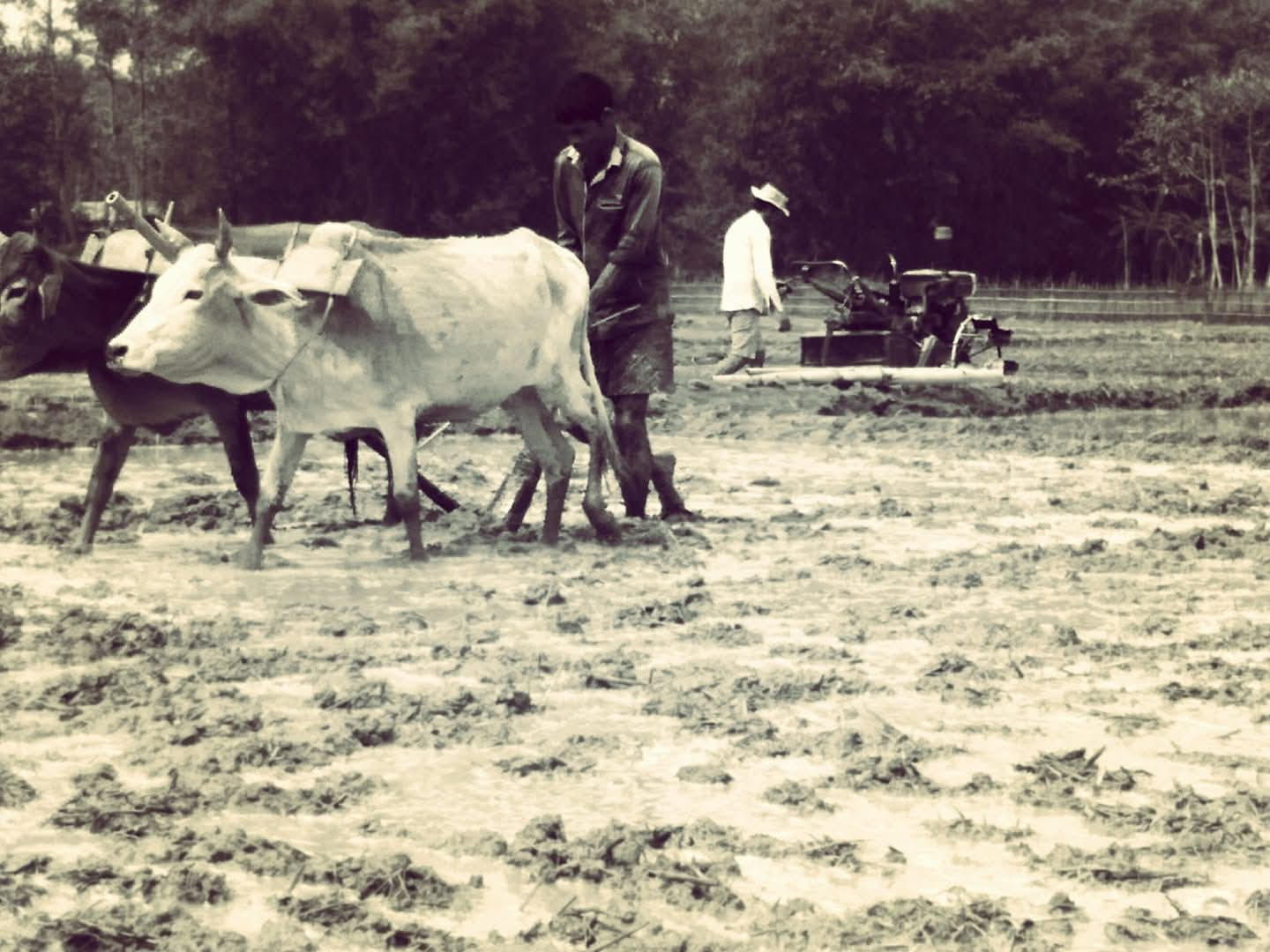
Photograph by Bonojit Hussain of his own farm

What I write here is not sociology in the professional sense, but a testimony from within the living contradictions. My focus is on the choices and constraints of the khilonjiya peasant household—native, often subsistence-oriented communities whose economic logic is deeply tied to ecological and social reproduction. This is a distinct reality from the highly commercialized production systems found in some other parts of the state.

Continue reading Teachers, Straw, and the Combine Harvester – Peasant Household’s Ecological Ledger in Assam: Bonojit Hussain

A Strategy for India’s Tryst with Its Destiny : Arun Maira

Democracy Dialogues Lecture 41

Organised by New Socialist Initiative

Title: A Strategy for India’s Tryst with Its Destiny

Speaker: Arun Maira, Author, Thinker, Former Member of the Planning Commission of India

Date and Time: August 31, 2025, 6 PM IST 

The lectures are also live streamed at facebook.com/newsocialistinitiative.nsi

Abstract:

I will share what I have learned about the process of transforming complex systems, the changes necessary in ideologies, and in the way in which public policies are being made, for India to progress towards its vision of poorna swaraj. The following points indicate an outline of the argument I plan to make in the talk:

• Global governance has broken down. The world is in disorder.

• India is strategically vulnerable. It is a long way off from its ‘tryst with destiny’ of poorna swaraj.

• India must become much more self-reliant, and less dependent on the US and China to protect its strategic autonomy. It must find its own democratic path to strengthen its society and economy. The US (and the West) cannot provide a blueprint. 

• Development and progress are processes of learning.

• Nations are complex ‘self-adaptive’ systems.

• Power and wealth in a system accumulate by a process of cumulative causation.

• The process of change must be democratic for new ideas to emerge.

I have explained such ideas in my book, Reimagining India’s Economy: The Road to a More Equitable Society, published this year, and in some previous books.

About the Speaker:

Arun Maira is an eminent author, a strategic thinker and a former member of the Planning Commission of India. He had joined the Commission at the invitation of then Prime Minister Dr Manmohan Singh himself. Mr. Maira has had a distinguished career as an enlightened business leader and management consultant. He worked as Executive Director on the Board of Tata Motors and later as the Chairman of Boston Consulting Group. He has authored many books including Transforming Systems: Why the World Needs an Ethical ToolkitTransforming Capitalism: Improving the World for EveryoneRedesigning the Aeroplane While Flying: Reforming InstitutionsShaping the Future: A Guide for Systems leaders; and most recently, Reimagining India’s Economy: The Road to a More Equitable Society, published in June 2025.

Genocide in Gaza – All the Perfumes of Arabia Will Not Sweeten These Hands…

As the ongoing livestreamed genocide in Gaza reaches its most despicable and horrendous phase of killing masses people through forced starvation, I am posting here a piece that I wrote for the art journal Art Deal last year. It was also delivered as a talk in a discussion organized by the All India Students’ Association (AISA) in JNU in September 2024. I am publishing it here with some minor additions/ changes.

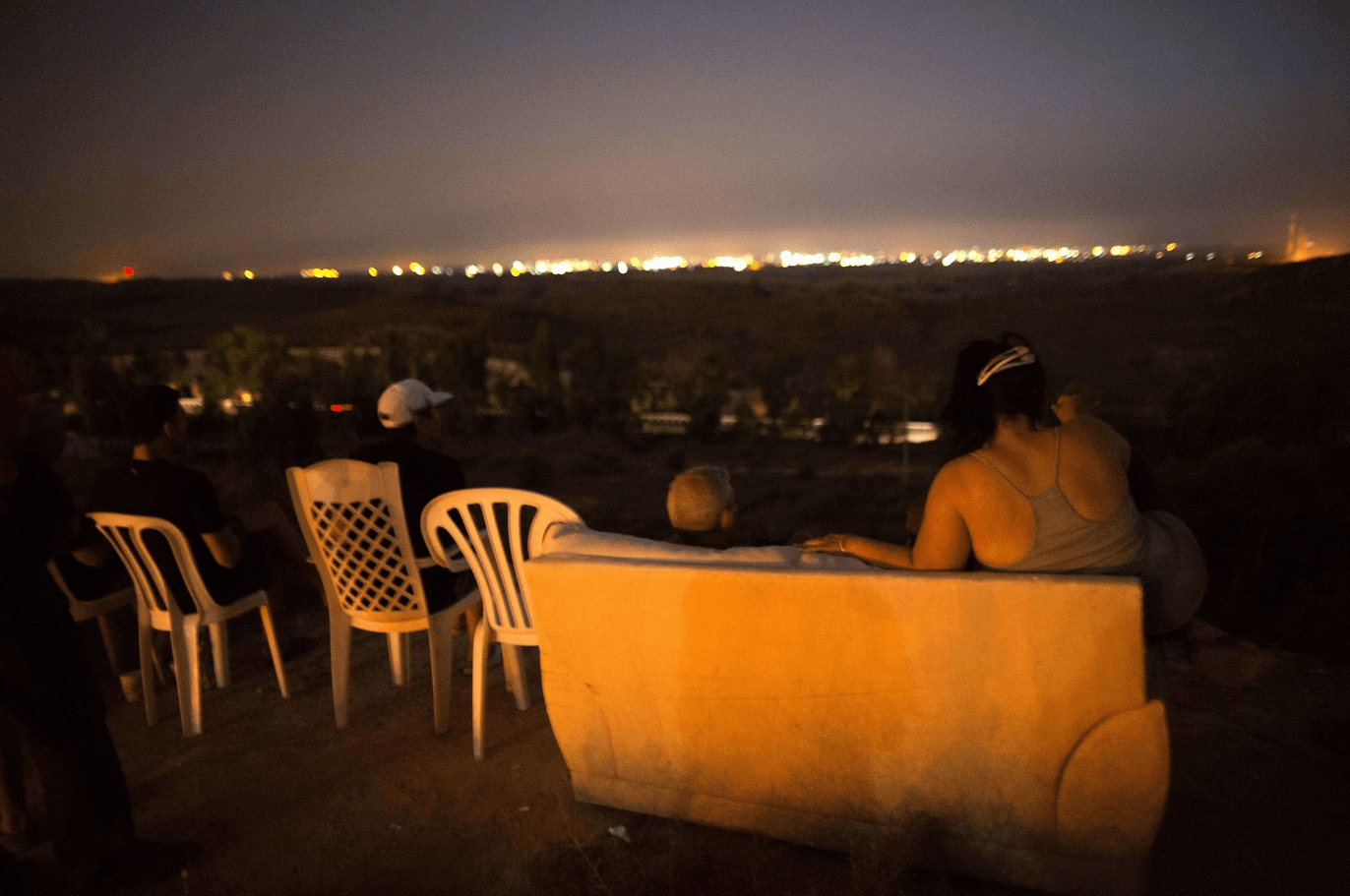
Israelis watch the bombing of Gaza in picnic mode outside a town called Sderot, in 2014, nine years before October 7, 2023. Image courtesy Menahem Kahana, Agence France-Presse.

‘Israel told U.S. officials in 2008 it would keep Gaza’s economy “on the brink of collapse” while avoiding a humanitarian crisis, according to U.S. diplomatic cables published by a Norwegian daily on Wednesday.

Three cables cited by the Aftenposten newspaper, which has said it has all 250,000 U.S. cables leaked to WikiLeaks, showed that Israel kept the U.S. Embassy in Tel Aviv briefed on its internationally criticized blockade of the Gaza Strip.’

 – Reuters, 5 January, 2011, Jerusalem.

I

No, it did not begin on 7 October 2023. Notwithstanding all the gaslighting by Israel and its guardians and arms-suppliers in the USA and Europe, the evidence says something else. The US cables leaked to Wikileaks show that not only had Israel been carrying out its genocidal activities for a very long time, its sponsors in the USA knew everything all along.

Continue reading Genocide in Gaza – All the Perfumes of Arabia Will Not Sweeten These Hands…

The Man Who Died at Gate Number Three: Avantika Tewari

This is a guest post by AVANTIKA TEWARI

It was night when the man died.

In the thick, humming night of a city that never truly sleeps — only flickers. Flickers between traffic signals and app pings, between delivery promises and the quiet violence of exhaustion.

He collapsed just beyond Gate Number Three in a residential colony in Delhi, somewhere between the parked dumpers and the weary under-construction site of the Metro.

He fell softly, without spectacle. The kind of death a city absorbs without noticing, like rain into dust.

In a few days, the Resident Welfare Association had drafted a statement — not out of grief, but out of inconvenience: “What if it had been one of us?”

The question hung in the air like a perfume of moral panic. A swift and bloodless message was delivered — the dumpers, it was agreed, would no longer be stationed near Gate Number Three. Continue reading The Man Who Died at Gate Number Three: Avantika Tewari

Oppose The Inhuman Eviction in Dhubri: Hiren Gohain et al

Following is a statement on the violent displacement and dispossession in Dhubri, Assam by some leading civil society members of the state who were also the conveners of the Assam United Citizens Convention.

We strongly condemn the  inhuman, brutal and cruel eviction of more than thousands of farmers and labourers from  Chap Revenue Circle of Dhubri district by the government of Assam. Such atrocities against innocent people are unusual and indicative of a perverted mind. We don’t know who could be the next victims of such atrocities.  The government says the people are ‘encroachers’. However, the attitude of the ruling classes  towards land has been exploitative since the colonial times. Although the direct use of land is for settlement, agriculture, and other productive livelihoods of citizens, but for the government it is primarily a means of generating revenue. Since the colonial era, the government has not focused on the leasing and resettlement of landless indigenous people and other legal residents. However, the preceding governments at least allowed the people residing on government land to live in peace with some degree of humanitarian sympathy. But the BJP government has evicted these citizens like heartless zamindars. They are planning to hand over the land of the indigenous  residents of Assam to the big capitalists at home and abroad. Thus, the poor tribals, backward castes and char people have been turned into s beggars on the streets within a day. It is supposed to be a step forward for  ‘development’ and ‘industrialisation’. The ‘development’ of the state by killing people has assumed a demonic form now. We have also seen an anti-Muslim propaganda campaign openly and sometimes subtly launched  day and night by the government-owned media to cover up this evil character. Therefore, we demand the government to stop such evictions and warn the people to be vigilant against this evil government conspiracy.

Hiren Gohain, Harekrishna Deka, Ajit Kumar Bhuyan, Paresh Malakar, Abdul Mannan, Santanu Borthakur
Conveners, Assam United Citizens Convention

Dark Shadows of Emergency! 

How they have become arsenal for the majoritarian Hindutva forces to convert the sovereign, independent, secular, socialist republic into a Hindu Rashtra.

25 th June 2025 happened to be the fiftieth year of the internal emergency imposed by the then Indira Gandhi regime. Much has changed during all these years but till date we are still far away from a balanced review of that period.

What really prompted Indira Gandhi to declare emergency , whether drive for personal power was the key factor, as has been reiterated multiple times…..

On the other hand, whether it could be said that she correctly perceived how sinister forces in the subcontinent were hell bent on sabotaging the democratic experiment at the behest of imperialist powers , who were even found to be provoking police and security forces to pursue their dubious agenda.

No doubt such a holistic review is a need of the hour but one thing cannot be denied that the biggest beneficiary of this whole exercise has been the Hindutva rightwing forces who are keen to transform India into a Hindu Rashtra

[ Read the full article here : https://www.mainstreamweekly.net/article15924.html]

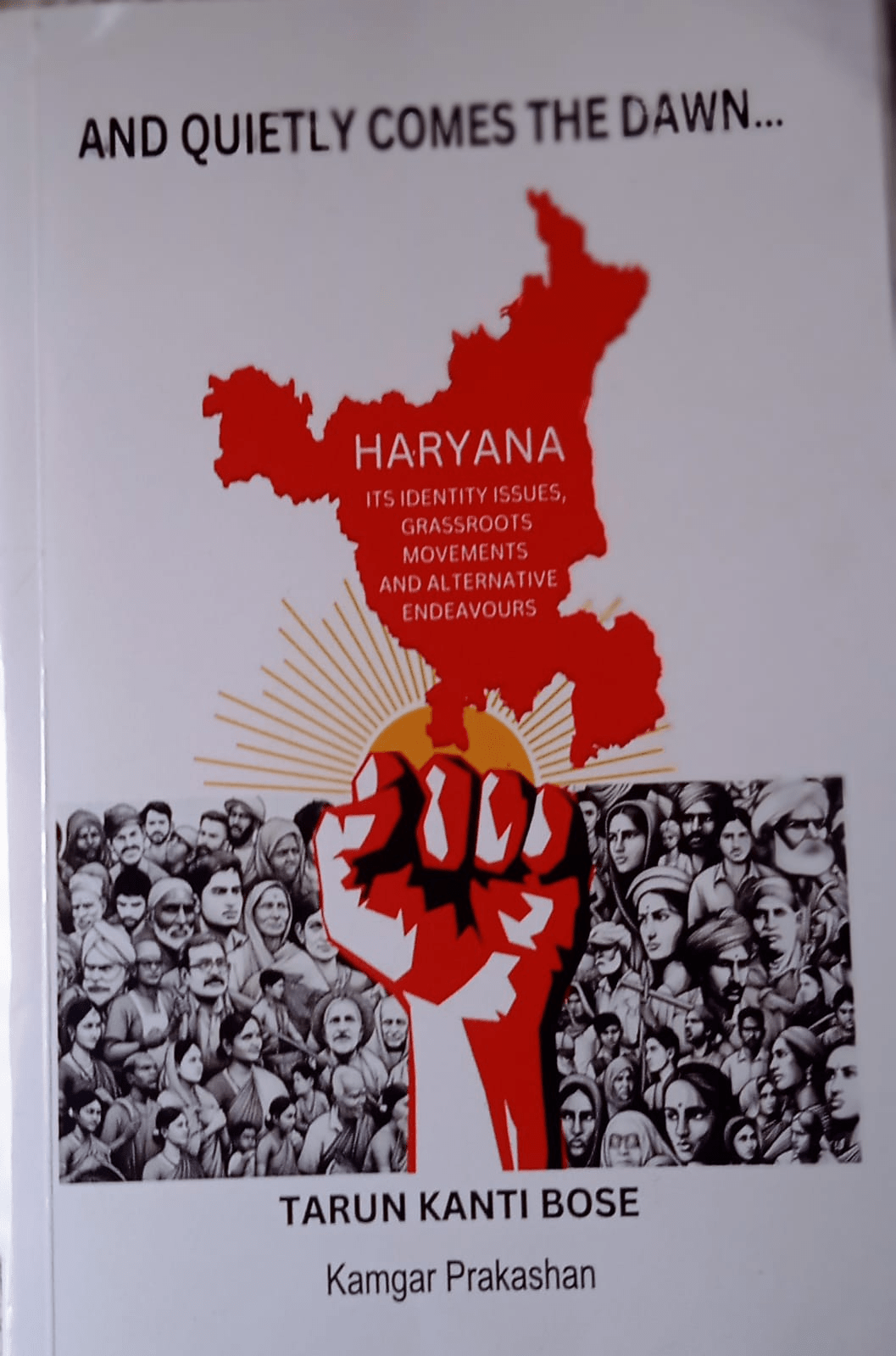
Review : ’And Quietly Comes the Dawn’

The ‘Other Haryana’ Which Rarely Gets Discussed

BOOK REVIEW

And Quietly Comes the Dawn:
Haryana —Its Identity Issues, Grassroots Movements and Alternative Endeavours
by Tarun Kanti Bose

Kamgar Prakashan | https://kamgarprakashan.com

What image does one conjure up when Haryana finds mention anywhere !
It is the image of the millenium city Gurgaon – with offices of leading MNCs or neighbouring Nuh – the Muslim majority district with one of the lowest literacy rates in India or the dominant Jat peasantry, the growing gender imbalance in the society which even gets reflected in the phenomenon of purchasing of brides from Bihar or other areas, etc

Various cases of dalit oppression add another gloomy layer to the not so bright picture.

Rarely does one find voices of the ’other Haryana’ getting reflected in the public discourse.

….Writer, journalist, left activist Tarun Kanti Bose’s new book, ’ And Quietly Flows the Dawn : Haryana— Its Identity Issues, Grassroots Movements and Alternative Endeavours breaks a new ground in this dominant discourse and brings before us many such unheard voices.

( Read the full review here : https://www.mainstreamweekly.net/article15848.html )

The Everyday Ecological Justice Struggles Across India to save Commons, Humans & All Species: NACEJ

[We are publishing below a report of a press conference by the NATIONAL ALLIANCE FOR CLIMATE AND ECOLOGICAL JUSTICE that details the status of struggles for ecological justice from across the country. Lifting the mask off ritualistic official observances of the World Environment Day, while the government continues to wreak havoc on the ecology and the commons, this report gives a sense of the struggles in different parts of the country. At the end of this report is the link to its full online recording.]

As the world marked yet another Environment Day on 5th June, the National Alliance for Climate and Ecological Justice (NACEJ), a pan Indian forum of NAPM, brought together voices from different parts of the country in an online press conference on 6th June, to share the current status of ecological justice struggles. Speakers from Kashmir, Sikkim, Tamil Nadu, Madhya Pradesh, Maharashtra, Telangana, Rajasthan, Chhattisgarh, Haryana, Odisha, and other states addressed the Press Conference. These voices reinforced the reality that both the Central Govt and different states governments are majorly complicit in environmental violations, enabling large profiteering, extractive agendas of mega-corporations, unleashing repression on democratic movements. Moderated by well-known environmental activist Soumya Dutta, the meeting saw good participation from both media and movements.

Continue reading The Everyday Ecological Justice Struggles Across India to save Commons, Humans & All Species: NACEJ

Marxist Coordination Committee and Lal Nishan Party Merge with CPI(ML) Liberation: Dipankar Bhattacharya

[In two very significant developments in the non-mainstream Left, the Marxist Coordination Committee (MCC) of the Dhanbad-Jharkhand region and the Lal Nishan Party (LNP) of Maharashtra merged with the CPI(ML) Liberation. While the merger with the took place in September 2024, the one with the LNP happened on 31 May 2025. What is really significant about these two developments is that both the MCC and the LNP, in different ways moved away from orthodox thinking from the beginning. It is not surprising then that they decided to merge with the CPI(ML) Liberation, which in my reckoning, has made some very significant departures from orthodoxy on a range of issues concerning the Indian social and political scene (as also on matters such as democracy and climate change). It is no wonder then that while the MCC, founded by the legendary AK Roy, had developed strong ties of the trade unions in the colliery with the larger adivasi Jharkhandi society, the LNP in its time, distinguished itself by standing by and campaigning for Ambedkar in the early 1950s.

Here we reproduce two pieces by CPI(ML) General Secretary DIPANKAR BHATTACHARYA published in their journal Liberation. The pieces separately discuss the two mergers. – AN]

Lal Nishan Party’s Unification with CPI(ML): Towards a Stronger Communist Movement to Defeat the Fascist Offensive

To defeat the growing fascist offensive, India today urgently needs a stronger presence and role of the Left. The merger of the Lal Nishan Party of Maharashtra with the Communist Party of India (Marxist-Leninist), announced at a unity conference in Shrirampur on 31 May, marks an encouraging step in this direction. This unification brings together two great legacies of India’s communist movement in a state which has historically been the cradle of the quest for social equality. Maharashtra also happens to be the ideological fountainhead of Indian fascism and every advance of the communist movement in Maharashtra today has great value. The unification of LNP and CPI(ML) therefore evokes a lot of hope in the centenary year of India’s organised communist movement.

Continue reading Marxist Coordination Committee and Lal Nishan Party Merge with CPI(ML) Liberation: Dipankar Bhattacharya

‘The Old is Dying’ – Notes on the Global Crisis of Democracy

Reflecting on what he called the “crisis of authority” or the “crisis of hegemony” from inside Mussolini’s prison, Antonio Gramsci had observed,

“The crisis consists precisely in the fact that the old is dying and the new cannot be born; in this interregnum a great variety of morbid symptoms appear.” (Selections from the Prison Notebooks, International Publishers, 1971, p. 276)

Reduced by Slavoj Zizek to a meaningless tweet that substitutes the last part with his own pop culture expression “now is the time of monsters”, it has become a kind of substitute for thinking what the crisis actually is all about.

Gramsci in fact, was hardly talking about pop culture “monsters”. He was thinking about a very new phenomenon of his time but which has become far more serious today – the crisis of the political party. The crisis of hegemony is tied in his above reflections, to the fact that “the great masses have become detached from their traditional ideologies and no longer believe in what they used to believe previously etc.” (SPN: 276)

Continue reading ‘The Old is Dying’ – Notes on the Global Crisis of Democracy

Class, Inequality, and the Current Political Moment in China and India : Prof Vamsi Vakulabharanam

Democracy Dialogues Series 39

Organised by New Socialist Initiative

Theme : Class, Inequality, and the Current Political Moment in China and India

Speaker : Prof Vamsi Vakulabharanam

Co-Director of the Asian Political Economy Program and Associate Professor of Economics at the University of Massachusetts, Amherst

Live streamed at Facebook ( facebook.com/newsocialistinitiative.nsi).
———————————-

Theme: Class, Inequality, and the Current Political Moment in China and India

This talk is based on a recently published book by the Oxford University Press – Class and Inequality in China and India, 1950-2010. China and India have seen a significant revival over the last three decades in terms of their place in the world economy. Two and a half centuries ago, they contributed 50 percent of the world output; after suffering a decline thereafter, their share fell to a paltry 9 percent in 1950 but has since resurged to over 25 percent today. Their growth and inequality experiences diverged for three decades following India’s independence (1947) and the Chinese revolution (1949). Thereafter, there are remarkable underlying similarities in the experiences of both countries, especially in terms of their rising inequality patterns analyzed through a class lens. Vamsi demonstrates that the mutual interconnectedness between Chinese and Indian growth and inequality dynamics and the transformation and evolution of global capitalism is key to understanding the within-country inequality dynamics in both countries over the 1950-2010 period. Based on this analysis of class-based inequalities, Vamsi reflects on the current political moment in both countries, from a political economy perspective.

Speaker : Prof Vamsi Vakulabharanam
Vamsi Vakulabharanam is Co-Director of the Asian Political Economy Program and Associate Professor of Economics at the University of Massachusetts, Amherst. He has previously taught at the University of Hyderabad (2008-14) and the City University of New York (2004-07). His recent research focuses on inequality in India and China and the political economy of Indian cities through the axes of gender, caste, class, and religion. In the past, he has also worked on agrarian change in developing economies, agrarian cooperatives, and the relationship between economic development and inequality. Vakulabharanam was awarded the Amartya Sen award in 2013 by the Indian Council of Social Science Research.

L’affaire UoH – How much land does a university want? Nithin Jacob Thomas

Guest post by NITHIN JACOB THOMAS

Recently, the students of the University of Hyderabad were protesting the Telangana state government’s bulldozing of 400 acres of ecologically vibrant, species-rich land within the university, undertaken as a preparatory step to auction it off. The state government sought to quell the protest by force, asserting that the land does not belong to the university and that it is within its rights to auction it. However, the Supreme Court has intervened and stayed the activities for the time being. Ego-bruised by the setback they have faced at the hands of the campus community, the Telangana government has now proposed that the entire 2300 acres of the university be turned into an eco-park, uprooting the campus in toto to a hundred-acre campus on the city’s outskirts.

Kancha Gachibowli forest, image courtesy The Hindu

Strangely, the university has not secured legal rights for the land it has occupied for several decades. However, the emphasis in the following note is on an aspect of the protest that lies beyond the legal dispute over ownership. It rather seeks to articulate the inarticulable—why the preservation of the ecology of these 400 or 2300 acres is not a standalone question but one that co-constitutes the very question of preserving the university itself.

Continue reading L’affaire UoH – How much land does a university want? Nithin Jacob Thomas

Can Extradition of Tahawwur Rana Bring Closure to 26/11 Terror Attack?

David Headley remains inaccessible in the US, and so do the masterminds in Pakistan.

The extradition of Tahawwur Rana to India to face trial for his role in the 26/11 terror attack is big news in the media. One can sincerely hope that with the arrest of only the second suspect to face trial for the 26/11 attacks – the first one was Ajmal Kasab – we can unearth other critical links in the conspiracy, role played by the terrorist groups and the support the whole operation received from the Pakistani establishment or its deep state.

Of course, it will be rather premature to assume that this arrest can bring a closure to the dastardly 26 /11 terror attacks. We are yet far away from the possibility of the mastermind of the attack – Hafeez Saeed and his accomplices – facing trial in Pakistan or being extradited to India.

There is no clue yet whether David Headley, a close friend of Tahawwur Rana, who is called the main conspirator of the operation would ever face trial in India. In fact, it is still a mystery how and why the US entered into a plea deal with him – promising him that he will not be extradited to India.

[ Read the full article here : https://www.newsclick.in/can-extradition-tahawwur-rana-bring-closure-2611-terror-attack]

Attacks on the Kancha Gachibowli Forest (KGF) – Capitalist Exploitation of the Human-Nature Relationship: Suddhabrata Deb Roy

Guest post by SUDDHABRATA DEB ROY

Land forms one of the most important planks of private property, because the appropriation of land (or ‘soil’ if one is to follow Karl Marx’s usage) forms the core of capitalist development, and since capitalism cannot sustain without the creation of class antagonisms and the appropriation of productive capacities of workers,[1] capital further uses the appropriation of land as a tool to exploit the non-capitalist classes. This results in the gradual separation of the worker from nature and thus eventually from the society itself, resulting in a state of alienation, which is used to create a ‘certain quantity of labour stocked and stored up’.[2] This stocked up/stored-up labour, as Marx explains, becomes capital. The relationship between manufacturing – the foundation of industrial capitalism – and nature – reflected in Marx’s usage of ‘soil’ – was an integral part of Marx’s definition of ‘capital’ under advanced capitalism. For example, in the discussion on ‘Bonds, or stock’, Marx had quite explicitly put up the relationship that capitalist development shares with the ecological world: ‘Bonds, or stock, is any accumulation of the products of the soil or of manufacture. [This] Stock is only called capital when it yields its owner a revenue or profit’.[3] The struggle for ecological justice thus constitutes an important aspect of the broader social justice movement because land relations constitute an integral part of the social relations, which in turn constitute the basis of not only capital but also the working class itself.[4] It is interesting to view the recent agitation against the auctioning of land within the campus of the University of Hyderabad (UOH), or the Hyderabad Central University (HCU), surrounding the proposed construction of IT parks by deforesting the Kancha Gachibowli Forest (KGF) in this context.

Continue reading Attacks on the Kancha Gachibowli Forest (KGF) – Capitalist Exploitation of the Human-Nature Relationship: Suddhabrata Deb Roy