This post originally appeared on social media and refers to the on-going Jan Shakti exhibition at National Gallery of Modern Art (NGMA), Delhi, which according to its description, displayed “works of India’s top artists on themes covered in Mann Ki Baat such as Swachhata, water conservation, agriculture, space, India’s northeast, Nari Shakti, Yoga, and Ayurveda.”
For some days now, certain videos and photos of PM Narendra Modi, the authoritarian Supreme Leader now ruling one-sixth of the world’s population, have been circulating on social media. He is seen visiting the new exhibition ‘Jan Shakti: A Collective Power’ at NGMA dedicated to his propagandist radio programme Mann Ki Baat.
About a week ago, an uproar, however scattered, erupted on social media when this exhibition, guest-curated by Alka Pande, was opened to the public since the occasion also witnessed the presence and participation of some of the celebrated personalities of the Indian artworld. To name some of them, since they would be recorded in history’s hall of shame – Atul Dodiya, Vibha Galhotra, Riyas Komu, Ashim Purkayastha, G.R. Iranna, Thukral and Tagra, Manjunath Kamath, Jagannath Panda and Kiran Nadar in her role as the “adviser” to the exhibition. Almost all of these luminaries and “top artists” (as it is reported in the media) again appeared when the PM visited the show, proudly posing for a photo with him.
New Delhi, May 14 (ANI): Prime Minister Narendra Modi poses for a photograph with a group while visiting Jana Shakti, an exhibition at the National Gallery of Modern Art in New Delhi on Sunday. (ANI Photo)
The list of people associated with Hindutva outfits caught in damning revelations keeps growing.
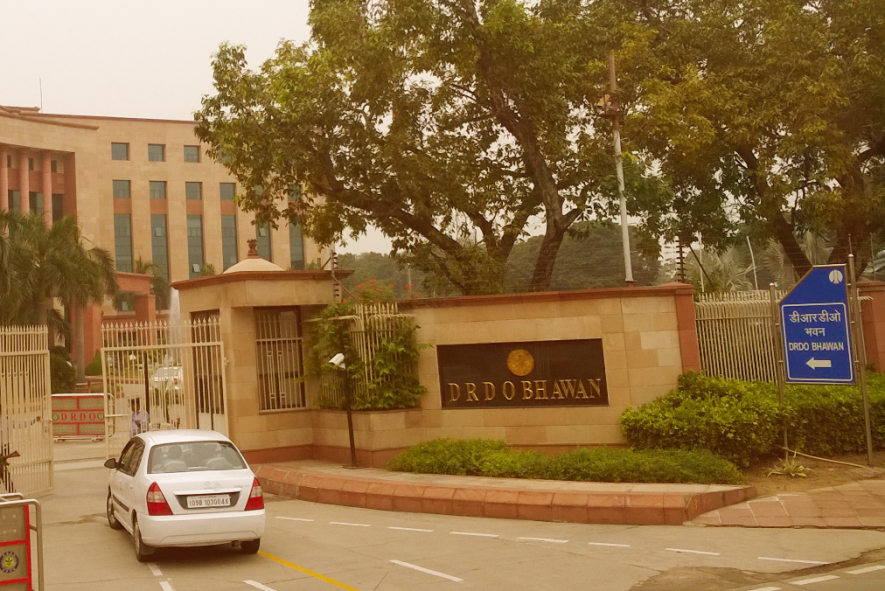
Recent revelations involving alleged espionage involving Prof Pradeep Kurulkar at the Defence Research and Development Organisation should have shaken up the establishment. After all, Kurulkar is said to have handled crucial projects related to India’s defence and reportedly was the lead designer or team leader for projects on missile launchers and subsonic cruise missiles.
Reports say Kurulkar was in contact, over WhatsApp, with a Pakistani Inter-Services Intelligence (ISI) agent late last year. His suspicious activities were reported to the police by DRDO, and in January, his laptop and two mobile phones were seized. The Maharashtra Anti-Terrorism Squad (ATS) is now handling the case. Kurulkar’s foreign trips are also under the scanner.
Such discoveries have long-term implications for India’s national security. Initial reports from ANI, a news agency known for its proximity to the ruling regime, did not mention Kurulkar’s name. The news agency did not initially mention his name in its tweets, though pictures of his face were circulating on social media and news outlets. The sequence of events left many wondering if the tweets deliberately concealed his name to create a doubt over his identity.
No doubt, Indian investigators will examine if the neighbouring country’s sleuths have penetrated India’s defence research sector and the extent to which Kurulkar has compromised India’s secrets. But it’s worth noting this case has not been handed over to the National Investigation Agency. Formed in the immediate aftermath of the 2008 Mumbai terrorist attack and supposedly more equipped and experienced to handle cases with cross-border ramifications, this agency has been busy filing plenty of cases—so, why not this one? ( Read the full article here)
यह लेख इंडियन एक्सप्रेस में मई दिवस 2023 पर लिखे गए लघु लेख का हिन्दी रूपान्तरण है।
वो दिन ज़रूर आएगा जब हमारी खामोशी उन आवाज़ों से ज्यादा ताकतवर होगी जिनको आज तुम दबा रहे हो।
अमर शहीद अगस्त स्पाइज़ का हेमार्केट शहीद स्मारक पर उद्धृत कथन, अनुवाद हमारा
हर दिन मैं खुद को यह याद दिलाता हूँ कि मेरा अंदरूनी और बाहरी जीवन मृत और जीवित लोगों के श्रम पर आधारित है, और जो मुझे मिला है और मिल रहा है उसको उसी मात्रा में देने के लिए मुझे पुरज़ोर मेहनत करनी होगी।
अल्बर्ट आइंस्टीन, द वर्ल्ड एज़ आई सी इट (दुनिया मेरी नज़र में), अनुवाद हमारा
मई दिवस 2023 के साथ भारत में मई दिवस मनाए जाने के 100 साल पूरे हुए हैं। सिंगारावेलु चेट्टियार, जो कि भारत के स्वतंत्रता आंदोलन की बड़ी शख़्सियतों और जाति-विरोधी आंदोलन से जुड़े शुरुआती कम्युनिस्ट नेताओं में से एक थे, उनको भारत में सबसे पहले मद्रास शहर में 1 मई, 1923 को मई दिवस मनाने का श्रेय दिया जाता है। सिंगारावेलु ने भारत में मई दिवस की शुरुआत कर कोशिश की कि भारतीय मजदूरों के संघर्षों को वैश्विक-स्तर के मज़दूरों के प्रतिरोध के साथ जोड़ा जाए। शिकागो में मई 1886 में मजदूरों की रैली से शुरू हुए मई दिवस की तीव्र तरंगें जो भारतीय तट तक 1923 में पहुँचीं, उस संवेग को आज भी दुनिया के विभिन्न हिस्सों में महसूस किया जा रहा है।
Despite frequent misgivings about universal claims of modern science and despite it being taken often as an accomplice of western imperialism, it is impossible for any culture or civilization to avoid science or to create a culturally distinct version of it. And yet, how does science seep into and reshape a culture would have as many answers as there are cultures. The example of the West is invariably taken as canonical wherein science appears as a key factor in triggering the Great Divergence catapulting Western Europe in pole position ahead of far advanced civilizations such as China or India. It is far more tractable to draw some approximately generalizable lessons from this example than to comprehensively answer the famous Needham Question about why the rest of the world missed out on the Scientific Revolution and the subsequent percolation, even if partial and fragmentary, of the cognitive values promoted by science into the layers of cultural values.
Yet, the fact remains that the cultures and the civilization on the Subcontinent are irreducibly distinct from the West and also from the rest of the world. It is not possible to draw out serviceable prescriptions just from the western example for cultivating science in the cultural soil of the Subcontinent. It will be necessary to cast a bird’s eye-view on the civilizational contours of this vast land to have some idea about what have been the obstacles in the past and what possible pathways to future are available in the present.
While the right-wing of the Hindutva kind seeks glory in ancient India and considers the arrival of Islam as the despoiler of a great civilization, the left-wing, both of the liberal and the leftist kinds, puts all the blame at the doors of colonialism. Both miss out, in their respective ways, a very large fact. The thickest layer of the mass cultural soil on the subcontinent was deposited during the millennium between the 7th and the 17th century and in this the Bhakti Movement played the most important role. If in Europe the theological debates and religious wars led to modern philosophy and modern science, in India the philosophical debates, such as in the Upanishads and between the Buddhists and the Sanatanis, led to devotional movements of mass religions and theologies.
After sketching out these broad contours I will conclude this talk by making some tentative suggestions about how to seek pathways to a future in which science can attain the status of a cultural ideal, which in turn may facilitate emergence of an Indian modernity worthy of a glorious civilization.
About the Speaker :
Ravi Sinha is an activist-scholar who has been associated with progressive movements for nearly four decades. Trained as a theoretical physicist, Dr. Ravi has a doctoral degree from MIT, Cambridge, USA. He worked as a physicist at University of Maryland, College Park, USA, at Physical Research Laboratory, Ahmedabad and at Gujarat University, Ahmedabad before resigning from the job to devote himself full time to organizing and theorizing. He is the principal author of the book, Globalization of Capital, published in 1997, co-founder of the Hindi journal, Sandhan, and one of the founders and a leading member of New Socialist Initiative.
If 2018 was a trial by water in Kerala, 2023 seems to be a trial by fire, judging by the horrendous waste-dump fires in the State’s commercial capital, Kochi which have been polluting the air this with the most dangerous mix of toxins (so say the scientific community which has been warning this bunch of callous, stupid, greedy, irresponsible bunch who we have elected to power).
New Socialist Initiative ( NSI) South, recently organised two lectures by one of its senior Comrades Dr Ravi Sinha in Hyderabad.
First lecture was on ‘Fascism and Democratic Polity : How Did India Land in This Crisis ?‘ and the second lecture was on ‘How Does Democracy Undermines Itself ?‘
Here is a YouTube Link of the first lecture.
Topic – Fascism and Democratic Polity : How Did India Land in This Crisis
[Names and publications of cited authors are listed at the end of the essay.]
The sophists taught, rather publicly, the view that the summit of happiness is to combine the appearance of justice with actual injustice: Gregory McBrayer (2015), p 44
To speak of justice has always been to plunge into a metaphysical abyss, especially as the issue has been intractable since (at least) Plato’s most famous work, The Republic was written some twenty-five centuries ago. Not least has been the permanently contentious issue – named the theological-political problem by Leo Strauss – of whether we should live according to divine or human guidance. But to speak of justice in India is confront our deeply divided souls; and in the most horrendous cases, to stare evil in the eye.
If Mrs Indira Gandhi dreamt of a ‘committed bureaucracy,’ our current rulers appear to be bent upon the complete domestication of civil society by their ideological enterprise. This requires a committed judiciary too, for which aspiration clues are ample, because they conspire in broad daylight. It was inevitable that some members of the judiciary were and continue to be complicit in this totalitarian project. We should be grateful that there are men and women of courage and conscience within. One of them was named Judge Loya.
Below, I share a write-up byJohnson Jament, an academic researcher from the coast of the Thiruvananthapuram district, where an intense struggle against the Adani Port Project has been unfolding. Arrayed on opposing sides are the fisher people who have inhabited the coast since the past 500 years (according to historical record) and more, whose livelihoods are at stake, and the Adani Port Project, supported by the combination of natural resource predators and the CPM-led government of Kerala. The leadership of the CPM (though not the ranks, or at least all of the ranks) can be quite fairly described as a ‘post-socialist oligarchy’, and hence their support of Adani Ports is pretty understandable. The battle has been equally one of wits too, with the Kerala government pulling out all their progressive aces, including the longtime literary-cultural acolytes of the CPM but also some of the (former) stars of Kerala’s oppositional civil society — notably, the poet and critic, K Satchidanandan! Questioned about his stance, this early teacher of Euro-Marxism of a whole generation claimed that the conflict was because of ‘binary thinking’ that supporters and opponents of the Port project both equally indulge in, forgetting notably, that something like ‘structural contradiction’ may be becoming evident in and through this struggle. Perceiving it, of course, is not indulging in binary thinking.
Following is the text of an open letter sent by the Bisthapan Birodhi Jana Andolon Mancha, a coalition of people’s organizations, activists, journalists and citizens to the Governor of the Odisha. It was released in Bhubaneswar yesterday the 3rd of December 2022.
Respected Sir,
We as concerned citizens, social activists, political and human rights activists, environmentalists and journalists and the leaders of twelve mass organizations on behalf of Bisthapan Birodhi Jana Andolon Mancha, Odisha appeal for the protection of natural resources and an immediate end to the continuous forceful displacement of people from their lands and dwelling places.
We express our protest and dissent against the Odisha government’s Make-in-Odisha Conclave in Bhubaneswar. Inviting more investments in the name of development will uproot the lives and livelihoods of people dependent on these land, forests and coasts. We appeal to your conscience to intervene and prevent the exploration and exploitation of natural resources through unmindful and unwanted mining of bauxite, iron ore, chromite, coal, river sand, china clay and other resources in the name of development. People are struggling against all odds and hardships to protect the same for future generations even as they remain deprived of access to basic needs like education, health and nutritional food security.
The struggle against the ecologically-fatal Adani seaport being built at the seaside village of Vizhinjam in south Kerala is probably the first large-scale instance of ‘accumulation by dispossession’ in the history of this state. The state — the ruling government, the police, and judiciary — hold hands now in their effort to dispossess the large population of fisher people whose home this coast has been since centuries, for the convenience of predatory capital. As usual, the port-building commenced after massive ‘opinion-building’ exercises by all the major political parties among their supporters in the port-affected villages, promising them golden futures (now that the resources of the sea, which they had depended on for centuries, were robbed, in the course of some seventy years since the 20th century, through the commercialization of fisheries). Doing fieldwork in those areas around 2013, I remember how hard it was to even broach the topic without provoking massive, sometimes, violent, disagreements — it has divided the people completely and left the major social force there, the Latin Catholic Church, quite confused. Now, after 2018, the ecological destruction wrought by this foolish act of greed is nakedly evident for all with eyes to see; and most residents of the sea coast are convinced that in just a few years, the sea will take everything, including the houses built with sweat and tears, labouring for years abroad, even.
The other day, the citizens of Kerala witnessed an extraordinary coming -together of CPM and BJP leaders in Thiruvananthapuram — in support of the Adani sea port, against the fisher community of the Thiruvananthapuram coast.
Did you even know this? That there have been no admissions this academic session so far, to any Central University, as the results of the new UGC mandated centralized Common Universities Entrance Test (CUET) are yet to be announced as late as September 2022, when the academic session was to have begun in July/August. The UGC Chairperson M Jagadesh Kumar (who ran JNU to the ground in his extended tenure) has tweeted that results for the Undergraduate courses will be announced latest by September 15th. The exams for Postgraduate courses were conducted only this month!
And I dare you to find a single news item that reports the CUET as the large scale massive failure it is. At best you get bland information such as that undergraduate admissions are about to begin in Deli University this month and that classes are expected to begin on October 20th. No questioning of why there has been a three month delay already and even now everything is only “expected”!
And again earlier this month, as late as September 2022, the National Testing Agency informed Central Universities it will be unable to conduct the Common Test for the Ph.D programme, and the universities will, at this point, START the process of conducting these exams themselves.
The first time in India admissions to universities were severely delayed was due to the Covid virus in 2020-21, but different universities had different processes and could accomplish admissions by the end of the year. In the last year too there was delay, but as universities were still holding different entrance text exams, universities differed in when they managed to complete admissions in 2021. This academic year, however, when there are no pandemic induced closure of any university, the situation is the worst ever, due entirely to a targeted human endeavour to destroy India’s public university system, by imposing an unmanageable, centralised examination that lakhs and lakhs of students all over the country must take for admission into universities.
That this disaster for public universities and for two generations of students is not making the news, let alone the headlines, says much about the state of the media in India today. That nobody will be held accountable for this national disaster is almost unbelievable except that we have had to to believe so many unbelievable developments in our unfortunate country since 2014, that perhaps the destruction of public universities seems minor in comparison?
Please take a look at the detailed critique provided by the JNUTA.
[This article is based on the discussions with activists of the Janatha Aragalaya and concerned Sri Lankan citizens. It is a humble contribution towards ongoing debates within the movement. As the French proverb goes: “De choc des opinions jaillit la vérité” – Truth arises from a conflict of opinions. – MJ]
With the deepening crisis of the world capitalist system, we see social upheavals erupting in one country after another. Most recently, Sri Lanka, a relatively small island country in South Asia that is enveloped by a staged debt crisis, has amply revealed circumstances which are infused with revolutionary possibilities. Resembling dark clouds that announce the gathering of a storm, Sri Lanka has shown how rapidly a revolutionary situation can develop.
Heading the floundering ruling establishment, and harbouring perpetual dismissiveness of the swelling discontent, the ruling family of Rajapaksas expectedly attracted massive public ire. Fighting hunger, spiralling inflation, long queues for fuel and rations, crumbling medical facilities, loss of employment, frequent and long power outages, angered citizens came to see the Rajapaksas as well as other mainstream politicians as creators and perpetuators of the grave crisis. Importantly, the distrust of the people has not been limited to individual politicians and ruling cliques whose moral right to govern is being openly challenged, but is a latent distrust for the system itself. At present, majority of the public rightfully views all established parties with deep suspicion and hostility. The majority perceives the rise to power of President Ranil Wickremesinghe as an epitome of the rot in the political system. They see his government as an illegitimate one.
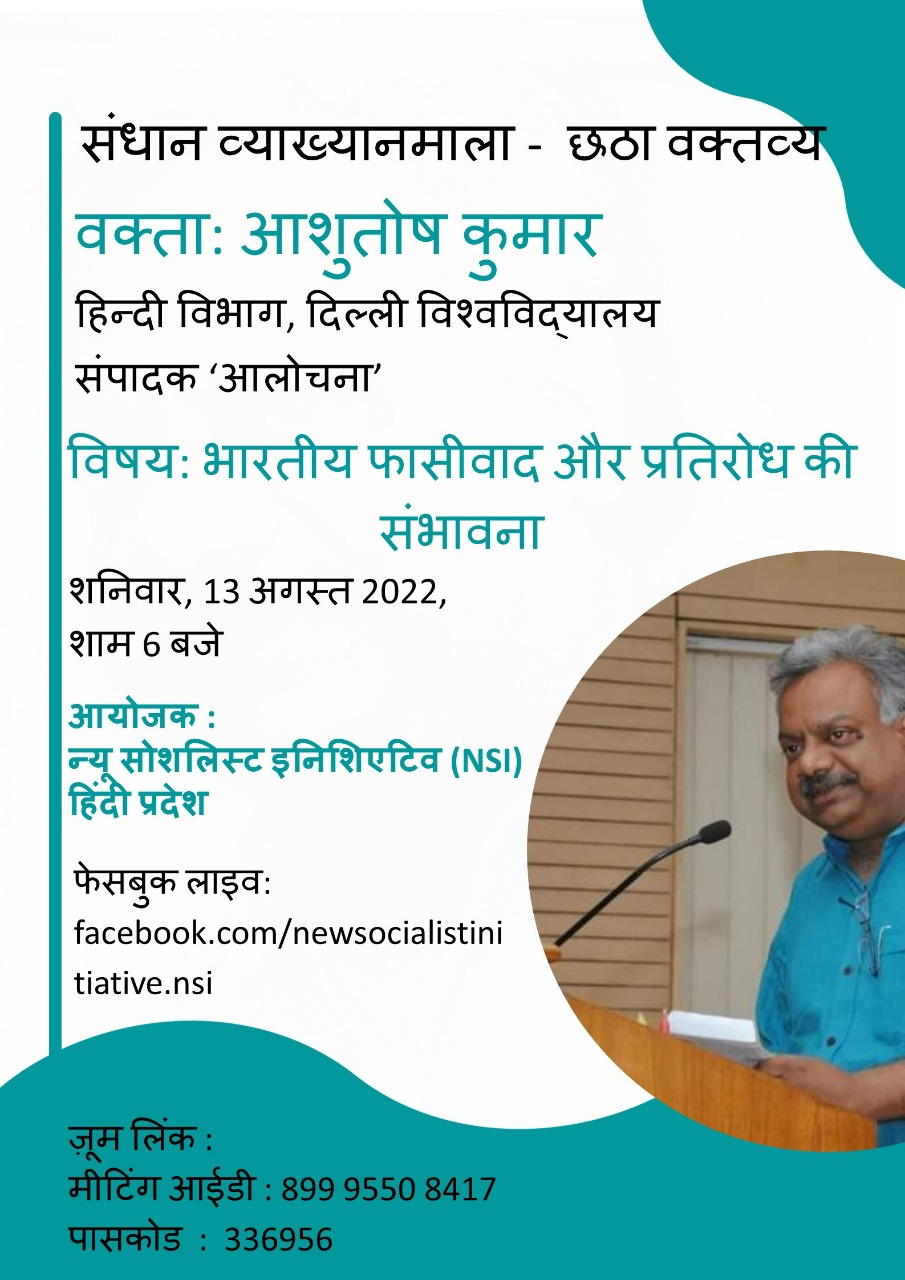
Leading Critic Ashutosh Kumar, Editor ‘Aalochana’ , who teaches at Department of Hindi, Delhi University will be delivering the sixth lecture in the ‘Sandhan Vyakhyanmala Series’ ( in Hindi) on Saturday,13 th August, 2022, at 6 PM (IST).
He will be speaking on ‘ भारतीय फ़ासीवाद और प्रतिरोध की संभावना’ ( Indian Fascism and Possibility of Resistance)
Organised by :NEW SOCIALIST INITIATIVE ( NSI) Hindi Pradesh
संधान व्याख्यानमाला : छठा वक्तव्य
विषय : भारतीय फ़ासीवाद : प्रतिरोध की संभावना
वक्ता : अग्रणी लेखक एवं संपादक ‘आलोचना’
आशुतोष कुमार
हिंदी विभाग, दिल्ली विश्वविद्यालय
शनिवार, 13 अगस्त, शाम 6 बजे
सारांश :
भारतीय फ़ासीवादऔर प्रतिरोध की संभावना
कुछ प्रश्न: क्या भारत की वर्तमान परिस्थिति को फासीवाद के रूप में चिन्हित किया जा सकता है? अथवा क्या इसे केवल सांप्रदायिक ध्रुवीकरण , धार्मिक कट्टरता और रूढ़िवाद की राजनीति के रूप में देखा जाना चाहिए? यह सवाल महत्वपूर्ण इसलिए है किस के जवाब पर इस परिस्थिति से मुकाबला करने की रणनीति निर्भर करती है।
अगर यह फासीवाद है तो इसके उद्भव और वर्तमान शक्ति-सम्पन्नता के आधारभूत कारण क्या हैं? क्या यह केवल वैश्विक वित्तीय पूंजीवाद के संकट की अभिव्यक्ति है, जैसा कि प्रभात पटनायक जैसे अर्थशास्त्री समझते हैं?
क्या भारतीय फ़ासीवाद जैसी किसी अवधारणा के बारे में सोचा जा सकता है? या यह सिर्फ एक वैश्विक प्रवृत्ति है ?
अगर यह फ़ासीवाद नहीं है तो क्या यह पश्चिम और पश्चिमपरस्त राजनेताओं और बौद्धिकों द्वारा अन्यायपूर्ण ढंग से दबाए गए हिन्दू राष्ट्रवाद का उभार है, जैसा कि के भट्टाचार्जी जैसे सावरकरी टिप्पणीकार दावा करते हैं?
क्या यह संघ के बढ़ते लोकतंत्रीकरण के चलते उसके नेतृत्व में वंचित- उत्पीड़ित जन समुदाय द्वारा किया गया सत्ता परिवर्तन है, जिसने कुलीन वर्गों की कीमत पर अकुलीनों को शक्तिशाली बनाया है? जैसा कि अभय कुमार दुबे और बद्री नारायण जैसे सामाजिक लेखक संकेत करते हैं?
क्या वर्तमान सत्ता संतुलन को बदला जा सकता है? इसे कौन कर सकता है और कैसे?
कुछ बातें—
फ़ासीवाद का सबसे बड़ा लक्षण कार्यपालिका,विधायिका और न्यायपालिका के एक गठबंधन के रूप में काम करने की प्रवृत्ति है। लोकतंत्र में इन तीनों के अलगाव और इनकी स्वायत्तता पर इसलिए जोर दिया जाता है कि कोई एक समूह राजसत्ता का दुरुपयोग न कर सके। तीनों निकाय एक दूसरे पर नजर रखने और एक दूसरे को नियंत्रित करने का कार्य करें। इस व्यवस्था के बिना एक व्यक्ति और एक गुट की निरंकुश तानाशाही से बचना नामुमकिन है।
अयोध्या-विवाद से लेकर गुलबर्ग सोसाइटी जनसंहार और छतीसगढ़ जनसंहार तक के मामलों में हमने सुप्रीम कोर्ट को संविधान-प्रदत्त नागरिक अधिकारों और न्याय की अवधारणा के विरूद्ध राज्य के बहुमतवादी फ़ैसलों के पक्ष में खड़े होते देखा है. हाल ही में सुप्रीम कोर्ट ने धन-शोधन निवारण अधिनियम के अन्यायपूर्ण प्रावधानों के खिलाफ दी गई याचिका पर राज्य के पक्ष में फैसला दिया है. सीएए और धारा 370 के निर्मूलीकरण जैसे मामलों में चुप्पी साधकर भी उसने नागरिक अधिकारों के विरुद्ध राजकीय निरंकुशता का समर्थन किया है.
नाज़ी जर्मनी में ग्लाइसेशतुंग या समेकन के नाजी कानूनों के जरिए इसी तरह राज्य के सभी निकायों को सकेन्द्रित और एकात्म बनाया था. हिटलर की तरह मुसोलिनी ने भी ‘राष्ट्र-राज्य सर्वोपरि’ के सिद्धांत के तहत न्यायपालिका को पालतू बनाने का काम किया था. भारत में भी हमने गृह मंत्री अमित शाह को सबरीमाला मामले में सुप्रीम कोर्ट को चेतावनी देते देखा है.
भारत में फ़ासीवाद के सभी जाने पहचाने लक्षण प्रबल रूप से दिखाई दे रहे हैं। एक व्यक्ति की तानाशाही और व्यक्ति पूजा का व्यापक प्रचार। मुख्य धार्मिक अल्पसंख्यक समूह के विरुद्ध नफरत, हिंसा और अपमान का अटूट सिलसिला। अल्पसंख्यकों के खिलाफ अधिकतम हिंसा के पक्ष में जनता के व्यापक हिस्सों का जुनून। विपक्ष की बढ़ती हुई असहायता। स्वतंत्र आवाजों का क्रूर दमन। दमन के कानूनी और ग़ैरकानूनी रूपों का विस्तार। मजदूरों और किसानों के अधिकारों में जबरदस्त कटौती। आदिवासियों, दलितों और स्त्रियों के सम्मान के संघर्षों का पीछे ढकेला जाना। शिक्षा पर भगवा नियंत्रण। छात्रों के लोकतांत्रिक अधिकारों का विलोपन। फ़ासीवादी प्रचार के लिए साहित्य, चित्रकला, मूर्तिकला, सिनेमा और दीगर कला-विधाओं के नियंत्रण और विरूपण को राज्य की ओर से दिया जा रहा संरक्षण और प्रोत्साहन।
अभी भी कुछ लोग भारत में फासीवादी निज़ाम से सिर्फ इसलिए इंकार करते हैं कि इस देश में गैस चैंबर स्थापित नहीं किए गए हैं। उन्हें समझना चाहिए कि भारतीय फ़ासीवाद ने फ़ासीवाद अतीत से बहुत कुछ सीखा है। उसने समझ लिया है कि भारत जैसे विशाल और विविधतापूर्ण देश में भौतिक गैस चैंबर से कहीं अधिक असरदार और स्थायी व्यवस्था है देश के भीतर सामाजिक और मनोवैज्ञानिक गैस चैम्बरों का विस्तार।
लगभग समूचे देश को एक ऐसे सांस्कृतिक गैस चेंबर में बदल दिया गया है, जिसमें एक व्यक्ति और एक विचारधारा की गुलामी से इनकार करने वाले स्वतंत्रचेता जन अपने जीवित होने का कोई मतलब ही ना निकाल सकें।
यूरोप की लोकतांत्रिक परम्पराओं के कारण फ़ासीवादी राज्य की स्थापना के लिए कानूनी बदलावों की जरूरत थी. भारत में ‘भक्ति-परम्परा‘ की जड़ें बहुत गहरी हैं. शर्तहीन-समर्पण का संस्कार प्रबल रहा है. क्या यह भी एक कारण है कि भारत में यूएपीए और अफ्स्पा जैसे कुछ विशेष कानूनों के अलावा व्यापक कानूनी बदलावों की जरूरत नहीं पड़ी है?
फ़ासीवाद की मुख्य जीवनी शक्ति नफ़रत की भावना है। हमारे देश में वर्ण व्यवस्था और जाति प्रथा के कारण अपने ही जैसे दूसरे मनुष्यों से तीव्र नफरत का संस्कार हजारों वर्षों से फलता फूलता रहा है। वोट तंत्र ने इस नफरत को उसकी चरम सीमा तक पहुंचा दिया है। क्या भारतीय फ़ासीवाद नफरत के इस चारों ओर फैले खौलते हुए समंदर से उपजे घन-घमंड के रूप में ख़ुद को जनमानस में स्थापित कर चुका है?
इस बातचीत में मैं ऐसे ही कुछ सवालों के जरिए यह देखने की कोशिश करूंगा कि क्या हम ‘भारतीय फासीवाद’ की कोई व्यवस्थित सैद्धांतिकी निर्मित करने के करीब पहुँच गए हैं. ऐसी किसी संभावित सैद्धांतिकी की रूपरेखा क्या होगी और इस उद्यम से हम अपने किन सवालों के जवाब हासिल करने की उम्मीद कर सकते हैं.
[This article is based on a talk delivered at the online session organised by International Solidarity with the People’s Movement in Sri Lanka on a 23.07.2022]
The people’s movement in Sri Lanka has entered into a deadlock with the ‘(s)election’ of Ranil Wickremesinghe as President. Within hours of him assuming office, a mid-night crackdown on the Galle Face protest camp was unleashed. Only cowards attack in the dead of the night as they have much to hide during the day. Despite brutal state repression, the people’s movement shows a resilient commitment to continue. This resilience stems from a simple fact: the people are fighting against Wickremesinghe for the same reason why they were fighting against his predecessor.
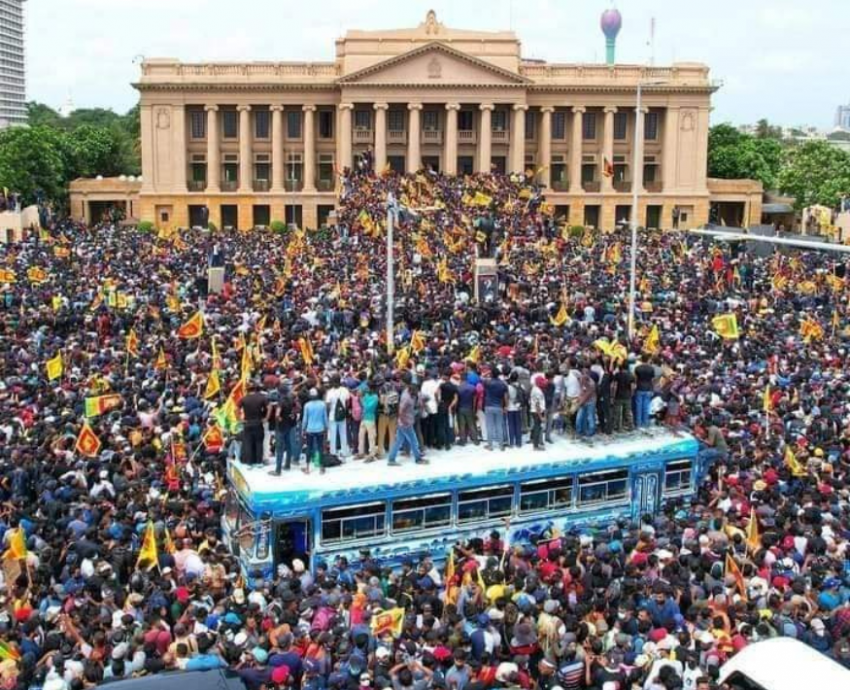
People converge at the Presidential building in Colombo, July 9, Photo: @UnionProtect/ Twitter, courtesy greenleft.org.au
A powerful Sri Lankan people’s movement, Janatha Aragalaya, has shattered the legitimacy of the ruling establishment of the country and has come to pose a serious challenge to the imperialist powers that have been backing the corrupt regime. Functioning from the Colombo’s Galle Face and numerous other centres which have surfaced across towns and villages, the movement amply reveals that the Sri Lankan people are questioning the misuse of the popular mandate by the country’s ruling elites. One can easily glean that the people’s aspirations go beyond the simply dethroning a few powerful politicians.
Eminent author and rights activist Aakar Patel will be delivering the 17 th lecture in the Democracy Dialogues Series, organised by New Socialist Initiative, at 6 PM (IST), Sunday, 3 rd July, 2022.
Aakar Patel is a syndicated columnist, author and rights activist and is Chair, Amnesty International India
He has edited English and Gujarati newspapers. His translation of Saadat Hasan Manto’s Why I Write was published in 2014 ( Tranquebar). His study of majoritarianism in India ‘ Our Hindu Rashtra : What It Is. How We Got There came out in 2020 ( Westland) and his next book which seeks to explain data and facts on India’s performance under Narendra Modi, titled ‘Price of ‘The Modi Years‘ was published in 2021 ( Westland). His forthcoming book is on protest and participation by citizens
Abstract :
The role of individuals in resisting the majoritarian state.
India is going through a transformational period when many feel constitutional values have been undermined, an oligopoly has been handed control over large parts of the economy and the secular and pluralist basis of the nation are being eroded.
What can the individual do in these circumstances? A talk on the ways of meaningful resistance
The Google episode shows the right-wing vision of unity is exclusionary. But this vision is increasingly being challenged in the United States and beyond.
On 9 May 1916, a young BR Ambedkar presented a paper at Colombia University in the United States titled Castes in India: Their Mechanism, Genesis and Development. He referred to caste as a “local problem, but one capable of much wider mischief”. He wrote, “…if Hindus migrate to other regions on earth, Indian caste would become a world problem.”
More than a century later, as one of the biggest corporations, Google, battles allegations of caste discrimination in the United States, the predictive value of Ambedkar’s words is evident. Recently, Google News cancelled a scheduled talk by Thenmozhi Soundararajan, the founder and executive director of Equality Labs, after many Google employees (of Indian origin or Indians) opposed it. The discussion was supposed to mark Dalit Equality Month, celebrated every April to mark the month Ambedkar, the first law minister of independent India and its leading anti-caste activist, was born. Equality Labs is a leading non-profit group in the United States that advocates Dalit rights. According to its 2016 survey, a third of Hindu students in the United States reported experiencing caste discrimination.
Thenmozhi was subjected to an organised campaign led by a section of Google employees, who called her “Hindu-phobic” and “anti-Hindu”. The name-calling went on in emails her opponents sent to company bosses and documents they posted on a mailing list that thousands of Indian employees access.
Letter of Deep Distress and Concern to THE LG OF DELHI, CM OF DELHI, COMMISSIONER, MUNICIPAL CORPORATION OF DELHI
Stop Unlawful Demolitions in Delhi;
Compensate, Rehabilitate, Restore Livelihoods
of the Affected Immediately
We, the undersigned, wish to express our deep concern at the bulldozer-led demolitions carried out by various municipal corporations in Delhi. As is well known, the first round of demolitions was carried out by the North Delhi Municipal Corporation in Jahangirpuri resettlement colony on April 20, 2022, soon after the communal violence in the area just four days prior to that. The recent visits to and subsequent statement by the SDMC Mayor regarding areas earmarked for future demolition points to the real and present danger that the actions in Jahangirpuri and Kalyanpuri over the past week will be repeated in these areas that have already been named – Shaheen Bagh, Jasola, Sarita Vihar, Jaitpur and Madanpur Khadar. It is deeply disturbing that demolitions in these areas have been put on hold only because the Delhi Police publicly asked for ten days’ notice in order to cooperate with the order. Massive presence of paramilitary forces in some of these areas as well as frequent processions of slogan shouting crowds led by BJP leaders are contributing to an overall climate of intimidation and terror.
It is appalling that the bulldozers hired by civic authorities are targeting temporary structures essential for livelihood such as handcarts and cycle carts, fruit stalls, gumtis, and wooden ‘shop’ tables. These structures are used all over the country by some of the poorest communities in the city – rickshaw pullers, fruit vendors, women running marginal and subsistence businesses, ragpickers, garbage sorters, vendors and hawkers. The brutality of the action to destroy the precious belongings of some of the poorest residents of the city is unprecedented in the history of Delhi. The affected are overwhelmingly unprotected informal economy workers who have already suffered sudden and severe destruction of their livelihoods during last two years of the coronavirus pandemic and lockdown. Continue reading STOP UNLAWFUL DEMOLITIONS IN DELHI: Women’s groups, other groups, and concerned citizens of Delhi→
Why the Corporate Czars are Silent over increasing attacks on Social Fabric and rising Communalism
Celebrity actors and players share an interesting commonality in this part of South Asia.
Their moral compass normally veers towards the ‘righteousness’ of the rich, powerful and the influential.
Lynching of innocent people on the streets for their faith, social and governmental hounding of lovers belonging to different communities, call for genocide of religious minorities from public forums and similar hate filled acts, nothing normally impinges on their conscience.
Corporate elites are qualitatively no different.
Occasionally, there are feeble voices of disagreements also.
What Kiran Mazumdar Shaw – founder of India’s largest biopharmaceutical company Biocon – did was exactly this only. She expressed her indignation about growing religious divide in the country and underlined how it would be detrimental to India’s global leadership in ITBT ( Information Technology and Bio Technology)
Definitely her statement which was couched in ‘economic terms’ was very mild, but it did not stop attacks by right-wing trolls.
This article by VISHWAS SATGAR was earlier published in the Daily Maverick, South Africa, Satgar has written for Kafila on earlier occasions.
Vladimir Putin’s regime, unlike Franco, Mussolini or Hitler, has a formidable nuclear arsenal. In this context, the contemporary world stands on the brink, facing extinction either through nuclear holocaust emanating from battle fields in Ukraine or worsening the climate crisis, while in our everyday lives prices for food and fossil fuels are skyrocketing.
Precariousness, uncertainty and complex risk have become the lived reality of deep globalisation in which markets for finance, energy, food and production have been integrated.
The fragility of this global economy was exposed in the “great financial crisis” (circa 2007-2009) from which the world economy has not recovered, by the ongoing Covid-19 pandemic, and now by the Russian invasion of Ukraine. These realities cannot be understood through simple memes, propagandistic binaries or abstract security concepts.





 KAFILA - COLLECTIVE EXPLORATIONS SINCE 2006