Category Archives: Culture

The Nation’s Orgiastic Fantasy and the Politics of ‘Nationalist’ Anger

The Mise en Scene

The Nationalist is angry. He wants to kill, maim and rape for his Mother’s honour. From the lawyer criminal who has a Rs 45 lakh fraud case against him to the extortionist television anchor – all are bellowing with rage. Another anchor, Mr Nation himself, whose publicly declared annual salary is Rs 5 crores, is suddenly choking with emotion at the death of the hapless army jawan, Hanumanthappa (who earned less than 120th of Mr Nation’s monthly salary and for whom the Nation never shed a tear till this collective arousal). Blood lust has taken over the land. In this scenario, the hysterical television anchor takes on the role of a lynch mob instigator and the cheer leader combined into one. He exhorts while the lynch-mob runs amok threatening, attacking and  demanding that all anti-nationals – students, teachers and intellectuals in general –  be shot, killed or sent to Pakistan. We have seen, as a consequence, all manner of angry nationalists offering prize money – Rs 5 lakhs for cutting Kanhaiya Kumar’s tongue and Rs 11 lakhs for killing him. More recently, he has been issued another death threat along with an ultimatum to leave Delhi by the end of March. Fellow Kafila-ite and feminist scholar Nivedita Menon has, for the last few weeks, been openly threatened with nationalist rape and more.

The Nation’s collective fantasy is orgiastic. And the current object of this collective fantasy is Jawaharlal Nehru University. Witness the BJP MLA who spends his free time (which is perhaps most of his time), not  only showering money on  dancing  girls, but even more, fantasizing about the orgy that he believes is JNU. According to The Indian Express:

In perhaps the most bizarre comments on the JNU controversy so far, BJP MLA from Ramgarh in Rajasthan’s Alwar district, Gyandev Ahuja, on Monday said that daily 50,000 pieces of bones, 3,000 used condoms, 500 used abortion injections, 10,000 cigarette “pieces”, among other things, are found at JNU, where girls and boys dance naked at cultural programmes.

Continue reading The Nation’s Orgiastic Fantasy and the Politics of ‘Nationalist’ Anger

Am I Doing Enough? Crisis, Activism and the Search for Meaning: Lata Mani

This is a guest post by LATA MANI

In the past fifteen years I have been developing what I describe as “contemplative cultural critique.” Such an effort at transcoding between secular and meditative understandings is not without difficulty and not without its limits. But it has led me to pose questions I might not otherwise have asked, and to think through them in ways that I would not have previously considered.

How might this approach contribute to reflecting on the political turmoil of the past eight weeks in India? This period has been marked by national focus on the penalization and criminalization of student dissent at Hyderabad Central University and Jawaharlal Nehru University. In the former case prolonged institutional harassment drove Rohith Vemula to take his life and in the latter it has led to the imprisonment of Kanhaiya Kumar, Umar Khalid and Anirbhan Bhattacharya on charges of sedition. In both instances a witch-hunt led by the media and the right-wing BJP government has created a hostile environment conducive neither to dialogue nor to a calm consideration of facts. These events, as P. Sainath has argued, extend to university campuses ideological, legal and political tactics long used against communities resisting “development” in rural India.[1] Continue reading Am I Doing Enough? Crisis, Activism and the Search for Meaning: Lata Mani

Of False Binaries and ‘Dirty’ Politics: Divya Kannan

This is a guest post by DIVYA KANNAN

Manu Joseph’s latest commentary regarding the ongoing crisis in Jawaharlal Nehru University (JNU) and the larger debate on Indian ‘nationalism’ smacks of crass elitism, as a journalist pithily pointed out online. If one were to use a ‘different term’, as Joseph himself keeps venturing to do in his writing, it is simply nauseating. This is for several reasons. To begin with, he harbours a convoluted understanding of what research in higher educational institutes entails, the nature of student politics, the lasting dangers of right wing assaults, and the pathetic misrepresentation carried out by the media, including himself, of the pressing issues in this country. Continue reading Of False Binaries and ‘Dirty’ Politics: Divya Kannan

Appreciating Diversity, Corporate Style – Guest Post by Anonymous

Guest Post by Anonymous

A senior leader of India’s leading IT Services Company took a moment on March 8th to send a note to his colleagues wishing them on International Women’s Day.  In the mailer, he also exhorted his colleagues, among other things, to strive towards building an environment that appreciates variety. The variety of Race, Ethnicity, Gender or Generation! He did not stop there, but went on to talk about drawing strength from these differences. Caste, quite evidently, is conspicuous by its absence in the corporate discourse on diversity (or variety as they also like to call it).

What is it that makes Corporate India, or a part of it, sensitive towards race issues/matters on one hand but allows them ignore caste on the other? Is it reflective of what a social activist friend once mentioned to me in a private conversation – Caste is only visible from “down below” and not “up above”? Continue reading Appreciating Diversity, Corporate Style – Guest Post by Anonymous

Long Nights of Revolution, Dancing, Music and Poetry are Ahead: Veer Vikram

[ Here are five joyous excerpts of recordings from a recent night on the JNU campus – after Kanhaiya Kumar came back –  recorded by a young person called Veer Vikram. We do not know who Veer Vikram is, but came across his Youtube Channel, and were struck by the raw freshness of the voices and of the footage. So we are sharing them with you, saluting the generosity of Veer Vikram, who recorded these and uploaded them on to Youtube for everyone to enjoy. May there be many long nights of joy, music, dancing and poetry – in campuses, factories and neighborhoods – everywhere  Think so what a beautiful sight a ‘vishaal jan jagaran’ (as distinct from a ‘bhagawati’ jagaran) can make in different corners of Delhi, and in every city and town where young people can no longer take the rubbish offered by TV channels and the Modi regime. The revolution will be danced, sang, dreamt, recorded, uploaded, downloaded, shared and enjoyed. No more words necessary ]

Sedition is a Shade of Grey or, Bharat Mata’s Smothering Embrace: Ankur Tamuliphukan and Gaurav Rajkhowa

The dominant narrative around the recent JNU incident has been that the unwarranted police action and the concerted acts of violence, incitement and misinformation that followed are all part of a determined push by the saffron brigade. After love jihad and beef, the story has it, it is “sedition” and “Pakistani agent” this time—we are living in a state of undeclared emergency. A sense of disbelief and apocalyptic doom seem to underpin these sentiments, along with a nostalgic optimism for a quick return to harmony and normalcy. But such things have happened far too many times, and far too often for us to harbour such illusions. For what we are going through is in effect a recalibration of that normalcy.

To read political slogans literally is an absurdity. But in the hands of the present government, it is a calculated absurdity that reads “Bharat ki barbadi…” as armed conspiracy against the state. The variables are many—arrests, fake tweets, rampaging lawyers, patriotic house-owners and now, open calls for murder. But the calculus resolves itself into the same formula every time: national/anti-national.

At the outset, the opposition to the attack on the university campus seems to have coalesced around two points—first, maintaining a safe distance from the “anti-India” slogans raised at the meeting; and second, showing themselves as the real nationalists, standing against the saffron thugs in patriot’s disguise. Partly in response to a vicious media campaign, videos of “real nationalist” speeches at the protest venue are being posted on social media everyday. We are told at length about the “real” Indian behind the deshdrohi, his credentials, and how he wants his India to be. Things reached a disturbing pitch when spokespersons of the traditional Left went on record to express their displeasure at the real culprits not being caught. Without doubt, the saffron brigade cannot be allowed the prerogative of deciding what “the nation” means. But why do so from the flimsy ramparts of sedition? Continue reading Sedition is a Shade of Grey or, Bharat Mata’s Smothering Embrace: Ankur Tamuliphukan and Gaurav Rajkhowa

क्या यही प्यार है? कहो, कहो ना…

chinnamastabharatmata


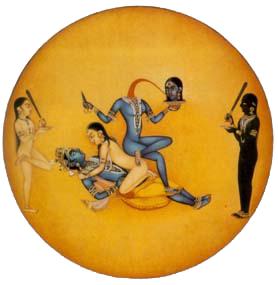
आजकल दर रोज़ हमें बताया जा रहा है कि हम देश से प्रेम करें, राष्ट्र से भक्ति. बड़े परेशान हैं आज के शासक हमं जैसों की करतूतों से. जोश में आ कर कुछ भी बड़बड़ा देते हैं : कभी आज़ादी की बात करते हैं, कभी काशमीर की. कभी जातिवाद से छुटकारा चाहीए, तो कभी पूँजीवाद से. ऐसा लगता है हम न भक्ति जानते हैं, ना प्रेम. तो चलीए, भक्ति ओर प्यार, राष्ट्र ओर देश: इन चारों संज्ञाओं का विश्लेषण कीया जाए.

पहला प्रस्ताव: भक्ति में मिला हुआ है डर; प्यार के साथ चलती है रज़ामंदी.

प्यार मासूम नहीं होता. बच्चे प्यार ज़रूर करते हैं, पर प्यार बड़ों का खेल है. प्यार करना जोखिम भरा काम है दोस्त. ख़तरे की खाई है प्यार. क्योंकि डर लगता है कि जिससे हम प्यार करते हैं, वह हम से फ़क़त दोस्ती जताना चाहता है. “Let’s just be friends.”है इस वाक्य से बड़कर कोई अनर्थ? किसी नौजवान से पूछिए जिसने काँपते हाँथों से Valentine’s card दीया, ओर वापस मिला,”Thanks.” हँसी तो फँसी नहीं, हँसी तो भंग आशाओं की शिखंडी कलेजी में घुसी. पर होता है दोस्त. होता है. क़बूल करना पड़ता है. रो कर, हस कर, दोस्तों के साथ मदहोश शाम में पुरानी फ़िल्मों के गाने बेसुरी आवाज़ में रेंक कर, सुन कर, सुना कर. जब बैंड बजती है तो गाना गाओ दोस्त. गोली मार कर प्यार तो करवाया नहीं जा सकता. Continue reading क्या यही प्यार है? कहो, कहो ना…

A Conversation about the Meaning of the word ‘Azadi’ (‘Freedom’) in the Wake of Events at JNU

Signal to Noise Ratio

There has been a lot of talk about what exactly ‘Azadi’ (freedom) means, especially in the wake of Kanhaiya Kumar’s post release midnight speech at JNU on the 4th of March. So lets talk some more. No harm talking. If there is noise, there must also be a signal, somewhere.

Kanhaiya Kumar clarified in his electrifying, riveting speech that his evocation of Azadi was a call for freedom ‘in’ India, not a demand, or even an endorsement of a demand for freedom ‘from’ India.

This may come as a sigh of relief to some, – Kanhaiya , the man of the moment, proves his ‘good’ patriotic credentials, leading to an airing of the by now familiar ‘good nationalist vs. bad nationalist’ trope. And everyone on television loves a nationalist, some love a good nationalist even more.

Perhaps this was a way of dealing with a bail order that was at the same time a gag order.

[ P.S. : Since writing this last night, a more careful reading of the bail order has suggested to me that the actual terms of bail are not so bad after all. Bail is in fact granted, as far as I can see, fairly unconditionally. Kanhaiya is not asked, for instance, to step down from his position in the students’ union, nor are restrictions placed on his movement and activity. So in technically legal sense, the bail provisions need not be interpreted in a tightly restricted manner. The egregious political hortations, the references to infection, antibiotics, amputation and gangrene, which are over and above the legal instructions, are indeed terrible, but operationally, they have no executive authority backing them.]

But to say just that the text of the bail order is what shaped Kanhaiya’s midnight speech would be ungenerous, and miserly, especially in response to the palpably real passion that someone like Kanhaiya has for a better world, and for a better future for the country he lives and believes in. I have no doubt about the fact that coming as he does from the most moderate section of the Indian Left (the CPI – well known for their long term affection for the ‘national bourgeoisie’ despite the national bourgeouisie’s long term indifference/indulgence towards them), Kanhaiya is a genuine populist nationalist patriot [I have corrected ‘nationalist’ to ‘patriot’ here in response to the criticism and suggestion held out by Virat Mehta’s comment – see below in the comments section] and a democrat moulded as he says, equally by Bhagat Singh and Dr. Ambedkar. There is a lot to admire in that vision, even in partial disagreement. And while some may not necessarily share his nationalism, this does not mean that one has to treat it with contempt either. I certainly don’t.

Continue reading A Conversation about the Meaning of the word ‘Azadi’ (‘Freedom’) in the Wake of Events at JNU

A historian’s response to the petition against Sheldon Pollock: Janaki Nair

Guest post by JANAKI NAIR

spine-details-vertical

A petition, signed by 132 “academics” asking Rohan Murty and Narayan Murthy to dismiss Prof Sheldon Pollock from his role as Editor of the Murty Classical Library Series, is receiving attention that the signatories did not anticipate.  I put the word “academics” in quotes because the commitment of the signatories to an academic evaluation of Sheldon Pollock’s intellectual leadership is nowhere in evidence, since a quotation from Pollock was changed mid-way through the signature campaign. Nor does it seem as if the signatories have ever held any one of the hot- pink,  beautifully produced volumes in their hands, where   as much attention has been paid to looks and fonts,  as to the quality of translations.

Had they done so, they too would have appreciated the significance of this effort, in bringing to the wider reading public the oceans of literary texts and traditions, in a mind-boggling array of languages,  from a period covering two and a half millenia.  The individual translators and editors are among the best in the field. Thanks to this series, so many more Indians and others will learn of the sheer beauty and anguish of Punna, a  Therigatha poet (translated from Pali, 3rd century BCE).  People of the south will hear the voice of Bulle Shah, translated from Punjabi, and those from other parts of India will read Allasani Peddanna, translated from Telugu.  True we will miss the mellifluous chanting, or the energetic sounds of performance: for now, we will have to make do with the books on hand. Continue reading A historian’s response to the petition against Sheldon Pollock: Janaki Nair

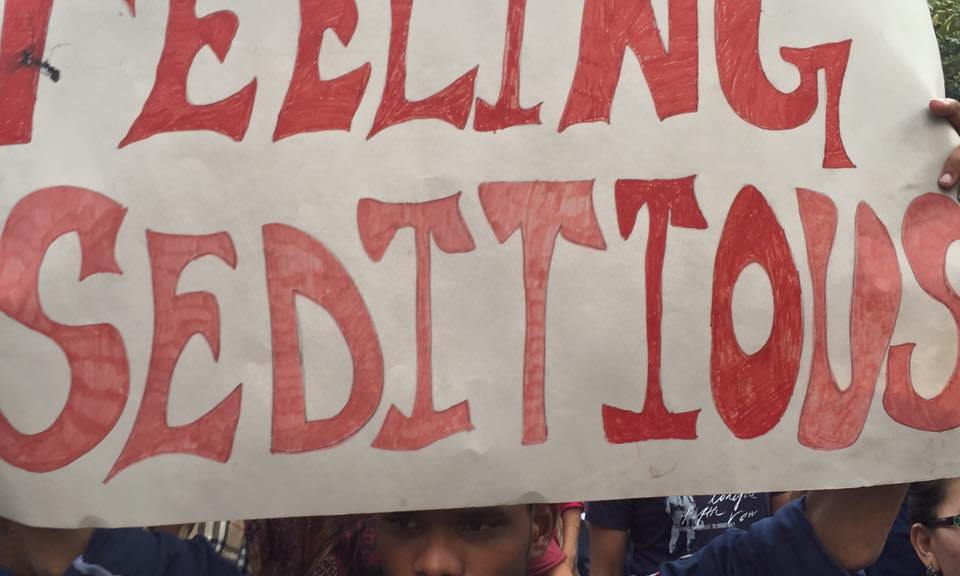
‘Feeling Seditious’: March on Parliament to #StandwithJNU

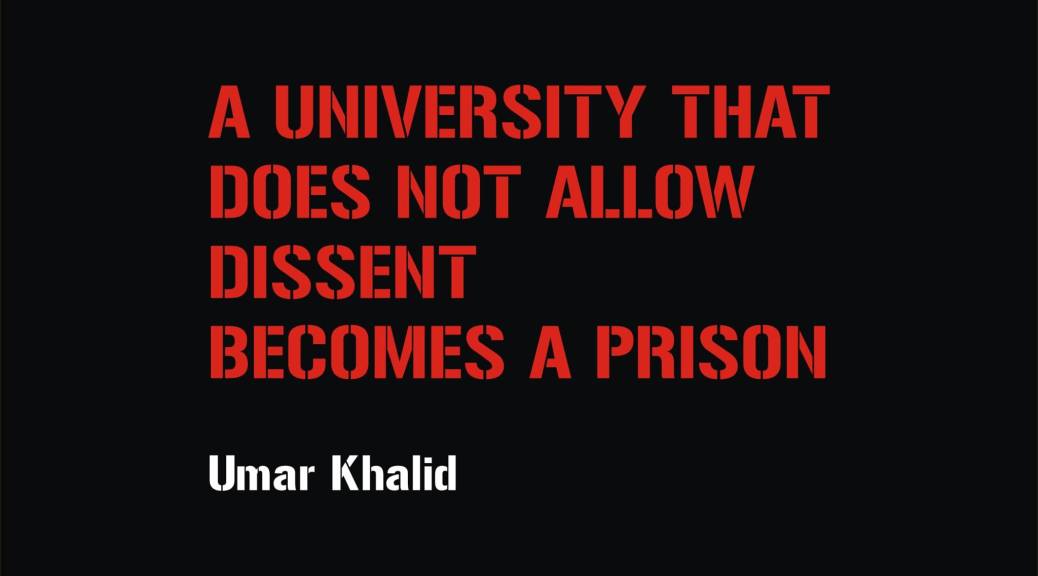
For the third time within a span of two weeks since the middle of February, thousands of people came out on the streets of Delhi to express their solidarity with the detained students of JNU (Kanhaiya Kumar, Umar Khalid and Anirban) and to voice their anger with the venal Modi regime.

Protest demonstrations (at least in northern India) tend to have something of the monotonous in them, the same cadence, the same rhythm and the same wailing, complaining tone. They tend to have an air of events staged by the defeated, for the defeated. But if we take the last three big protests in the city, and the many gatherings in JNU in the last two weeks or so,  as any indicator of what the pulse of our time is, we will have to agree that there has been a qualitative transformation in the language, vocabulary and  affect of protests. This afternoon, like the afternoon of the 18th (the first big JNU solidarity march), and of the 23rd of February (the Justice for Rohith Vemula March), was as much about the joy of togetherness and friendship as it was about rage and anger.

Continue reading ‘Feeling Seditious’: March on Parliament to #StandwithJNU

Submission Before Inquiry Commission by Concerned Teachers and Scientists, Univ of Hyderabad

Submission by Concerned Teachers and Academics before the Roopanwal Judicial Commission at Hyderabad

 (The Roopanwal Commission came to Hyderabad on 23-25th February to enquire into the facts and circumstances leading to the suicide of Dalit research scholar Rohith Vemula. The mandate of the Commission was to review the functioning of existing grievance redressal mechanisms in the university. Concerned with the absence of in-house redressal mechanisms for marginalized students, a joint submission was made by 88 concerned teachers drawn from the state and central universities in Hyderabad. The Submission sought for a rigorous implementation of the 2012 UGC Regulation as well as the setting up a Special Commission to review the major punishments passed by Universities in the case of marginalized students.) 

The suicide of Dalit research scholar Rohith Vemula in Hyderabad Central University has brought to the fore the issue of caste discrimination in higher educational institutions. We believe that the suicide is only the tip of the iceberg of many problems that students from Dalit and other marginalized groups are experiencing. University administrations have generally attributed these deaths to personal psychology instead of initiating broad systemic and attitudinal reforms to prevent such suicides.

In 2012, in the wake of series of suicides by marginalized students in higher educational institutions, the University Grants Commission formulated two Regulations to ensure social equity and set in place grievance redressal mechanisms.  In 2013, Andhra Pradesh High Court took suomoto notice of the student suicides in Andhra Pradesh in PIL No 106/2013 and issued several directives to the Universities to prevent the recurrence of suicides. However, neither the UGC Regulations of 2012 nor the Court directives have been implemented by the Universities.   Continue reading Submission Before Inquiry Commission by Concerned Teachers and Scientists, Univ of Hyderabad

Intolerance Tracker – A Community Curated Visual Storytelling Platform: Siddharth Peter de Souza and Saba Sharma

Guest post by SIDDHARTH PETER DE SOUZA and SABA SHARMA

In a world where breaking news cycles drive our imagination and interaction with events and incidents around us, it often becomes difficult to not to have a fragmented idea of trends because they evolve and develop so rapidly. Does this volume of information necessarily imply that we become unable to view similar types of stories because they are portrayed as isolated, anomalous and disconnected? Is this also because it is much more comfortable to forget, rather than remember and reflect on an accumulation of incidents that maybe unpleasant, inglorious and inconvenient. Amartya Sen recently stated that “The problem is not that Indians have turned intolerant. In fact to the contrary we have been much too tolerant of intolerance”. Is our numbness because we are overwhelmed by these incidents or because we perceive them to be isolated without an underlying systemic pattern?

Intolerance Tracker is a visual story telling and crowd-mapping platform that seeks to engage with some of these issues. The idea of using a map is because it provides a compelling medium through which information can be consolidated, and presented across temporal and spatial boundaries.

It aims to utilize the power of the community to identify, report and map instances of intolerance across South Asia, and organically create and curate a visual storytelling database. This initiative is primarily led by students at the University of Cambridge, and has been set up on an entirely voluntary basis by people who are passionate and committed to the cause of documenting intolerance across the region. Continue reading Intolerance Tracker – A Community Curated Visual Storytelling Platform: Siddharth Peter de Souza and Saba Sharma

Searching for Raja Debi – A Santhal poet tells the tale of Mahishasura

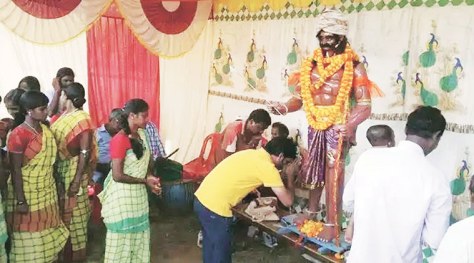
mahishasur-759

Mahishasur being worshipped in Purulia, Bengal 

In Parliament the other day, Minister for Education Smriti Irani emotionally prefaced her reluctant reading of an alleged JNU poster with “May my God forgive me for even reading this out”. I am mildly envious that she has a personalized god to take care of her doubtless more weighty requirements than an ordinary citizen (an anti-national at that) can claim.

Be that as it may, what she read out purported to be from a poster about an event in JNU organized by “SC, ST and minority students”, an event that celebrated Mahishasura:

“Durga Puja is the most controversial racial festival, where a fair-skinned beautiful goddess Durga is depicted brutally killing a dark-skinned native called Mahishasur. Mahishasur, a brave self-respecting leader, tricked into marriage by Aryans. They hired a sex worker called Durga, who enticed Mahishasur into marriage and killed him after nine nights of honeymooning during sleep,”

Now, she does not show us that poster. Does it really use the term “sex worker”? I have seen posters for Mahishasura Diwas on JNU campus and never noticed this phrase. However, if it has indeed been used, we could have a discussion around the gender politics of that term and of that poster. Moreover, reading (in translation) the tale of Mahishasura from Santhal poet Bajar Hembrom will also give us a sense of how and why that phrase could have been used, if it was.

Actually, the only place I have seen the words “sex worker” in conjunction with “Goddess Durga” was in an ABVP poster that accused All India Backward Students Forum (AIBSF) of describing Goddess Durga as “a sex worker, seducer and prostitute” in their account of Mahishasura Diwas. Just as I have heard the slogan Pakistan Zindabad only in the mouths of Hindutvaadis who accuse us of chanting it.

Continue reading Searching for Raja Debi – A Santhal poet tells the tale of Mahishasura

माँ भारती के वीर सपूतों की रेप फंतासियाँ

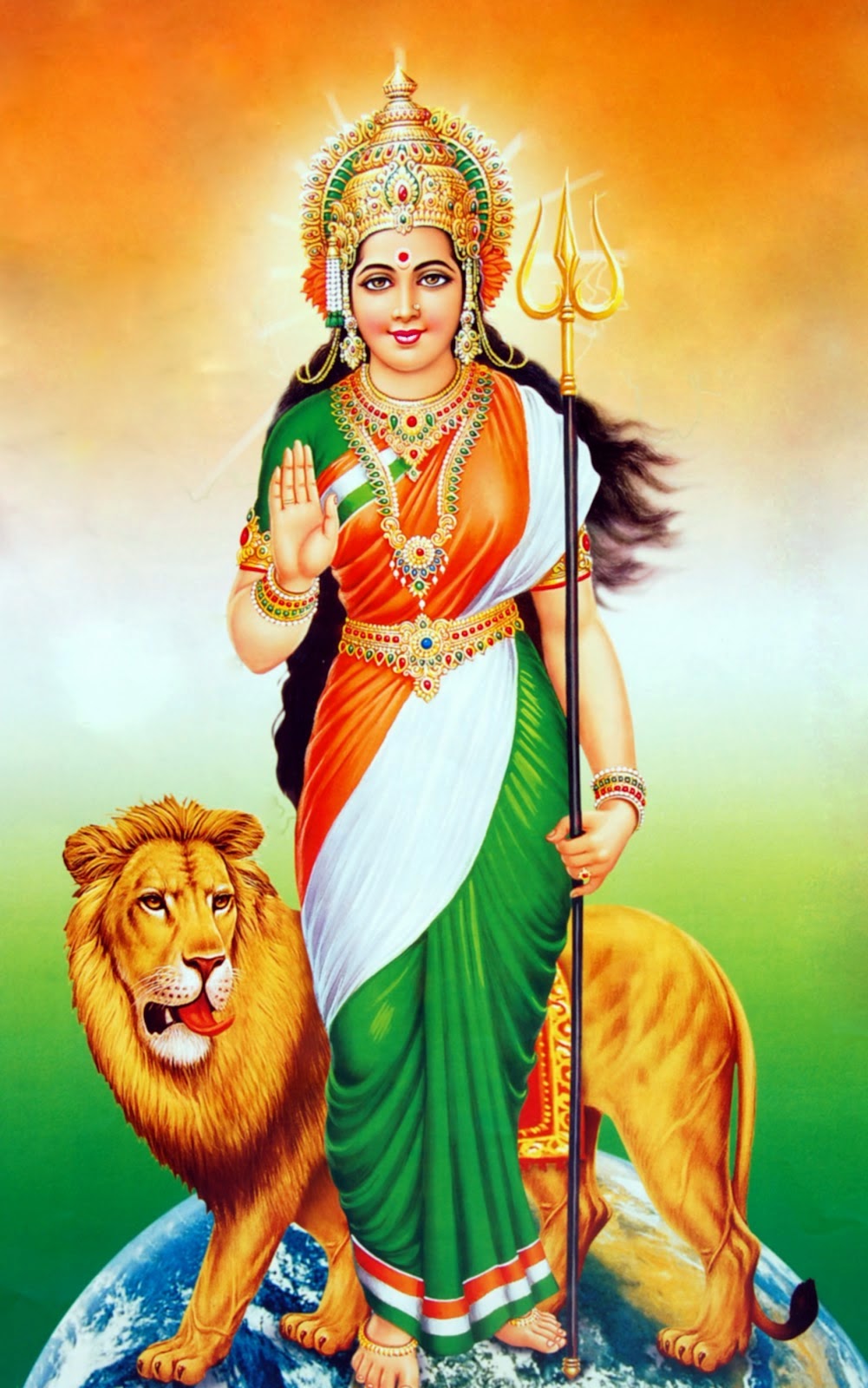
पेश हैं सोशल मीडिया से दो, फ़क़त दो, बानगियाँ उस नए संस्कारी राष्ट्रवादी नायक की जो  खुद को ‘माँ भारती’ का दीवाना सपूत बताता है. उसकी दीवानगी का आलम यह है कि वह अपनी माँ की खून की प्यास बुझाने के लिए किसी भी औरत से बलात्कार करने पर उतर आने को तैयार है. यह कौन माँ है इस पर तो हम थोड़ी देर में आयेंगे, पहले ज़रा इन सपूतों की करतूतों पर नज़र डाल लें.

Continue reading माँ भारती के वीर सपूतों की रेप फंतासियाँ

Come on man, be clear, what comes first—Nation, or Democracy? Bodhisattva Kar translated by Ahona Panda

Guest Post by Bodhisattva Kar and Ahona Panda

(Written by Bodhisattva Kar in Bengali, First published in on 18 February 2016 by the Ei Samay newspaper.Translated into English by Ahona Panda)

“To you I confess today—what you all call a patriot, I am not of that kind.” After this confession of sparkling clarity, should we not catch hold of that man as an anti-national? So what if he is dead? If the dead can be rewarded with the Bharat Ratna, why can’t we frame the dead with a few charges of sedition? For God’s sake, all you good people, how did you make a song written by this man the national anthem? The man who—without any obfuscation—speaks through the mouth of the protagonist of Char Adhyaya—“They who do not take cognizance of that which is greater than patriotism, their patriotism is like crossing on a crocodile’s back.” Where did he get the audacity to dream of something greater than patriotism? And, he did not even study at JNU. “By killing the very soul of the country, the country’s life can be resuscitated: this terrible untruth is being announced in beastly roars by nationalists around the world and it makes my heart revolt with intolerable intensity.” How can you not burn the books produced by such a treacherous son of Mother India, who said such terribly instigatory things? Why do you worship him instead? Can anyone put their hand on their hearts and say that he wasn’t a Pakistani spy, just because of the niggling detail that Pakistan did not exist at the time he was writing? Did we not shoot Dabholkar or Pansare for agonizing quite a bit less than he did? Continue reading Come on man, be clear, what comes first—Nation, or Democracy? Bodhisattva Kar translated by Ahona Panda

If there is dancing, there will be revolution : Three New Tracks to Groove to While Modi Quakes

No Text Necessary ! Make them your phone ringtone! Friends having tried this report electrifying effects on passersby.

https://youtu.be/6NJbxEgf3Uo

‘Azadi’, (‘Freedom’) featuring Kanhaiya and Friends, Courtesy DJ Dub Sharma

http://https://youtu.be/mNn2RuTPabU

‘Yeh Ladai’ (‘This Struggle), Courtesy DJ MojoJojo, featuring Umar

‘Bandh Bhengey Dao’ (‘Break Down the Barriers’), Courtesy Q, OST of ‘Tasher Desh’, with a nod to the great DJ Robin T


Statement of Solidarity with JNU: University of Exeter (UK)

We, the undersigned, stand in solidarity with the students, faculty and staff of Jawaharlal Nehru University in New Delhi, India in their ongoing struggle against the anti-democratic incursions of the Indian state. We appeal to the elected Prime Minister Narendra Modi to uphold the Indian constitution, cease the repression of democratic protest across university campuses in India, and withdraw the spurious charges of ‘sedition’ against JNU Students’ Union President Kanhaiya Kumar. Continue reading Statement of Solidarity with JNU: University of Exeter (UK)

Solidarity Statement from The International Institute of Social Studies (ISS) of Erasmus University Rotterdam in The Hague

We, the undersigned students, staff and faculty members at the International Institute of Social Studies (ISS) of Erasmus University Rotterdam in The Hague, support the right of students and teachers everywhere to a learning environment that is critical, engaging and respectful. In light of recent events and the slander campaign against the Jawaharlal Nehru University (JNU), we are disheartened and embarrassed that this is not the vision of the current Government of India, that they would rather create spaces of fear and control, by labelling all those that criticise their policies as anti-national and unpatriotic. Continue reading Solidarity Statement from The International Institute of Social Studies (ISS) of Erasmus University Rotterdam in The Hague

The India I Came Back To: Namrata Sharma

This is a guest post by NAMRATA SHARMA


I will start this piece with a painful but short flashback tirade about myself. I moved back to New Delhi in 2014, after six long years in New York and Singapore. My decision to move back to the motherland was predominantly attributed to issues that a twenty-something grapples with when he or she is away from home and family. However, familial ties and emotional reasons aside, there was one factor which deeply resonated with me and was the driving force behind my decision to move back. This factor was – the liberty to express my thoughts and views on a topic, any topic, in an indulgent and lenient space, which, by virtue of being an Indian citizen, was guaranteed to me in India and not in other places. In India, this liberty transcended predictable spaces like classrooms, newsrooms and sophisticated editorial pages of the morning newspaper and was very organically present in the form of arm-chair political banter amongst friends and political conversations with family over dinner. Continue reading The India I Came Back To: Namrata Sharma

Solidarity Statement of Students from Northeast India, TISS, Mumbai 20th February 2016


We, the undersigned, students and research students from various states of northeastern region of India studying in Tata Institute of Social Sciences, Mumbai would like to highlight on the unprecedented shrinkage of academic spaces across various universities in India. We condemn the politically motivated interferences of the state in Jawaharlal Nehru University and in Hyderabad Central University (HCU), and other universities. We also condemn the mob justice perpetrated by lawyers against students, journalist, activists etc in the Patiala House Courts, New Delhi, and media trial led by prominent journalists from New Delhi. Continue reading Solidarity Statement of Students from Northeast India, TISS, Mumbai 20th February 2016

An Appeal to the Academic Community of Delhi for February 23 Rohith Vemula March, “Chalo Dilli” by University of Hyderabad Alumni

Dear friends,
We, the alumni of the University of Hyderabad, are writing to the fellow teachers, researchers and students of Delhi to request all to participate in the Chalo Dilli March, “Delhi for Rohith Vemula”, organised for the ideals of social justice and constitutional rights on 23 February 2016 from Ambedkar Bhawan to Jantar Mantar.

Continue reading An Appeal to the Academic Community of Delhi for February 23 Rohith Vemula March, “Chalo Dilli” by University of Hyderabad Alumni