This is a guest post by Rina Ramdev and Debaditya Bhattacharya
Students of JNU have been on an indefinite hunger-strike for over 15 days now, and the administration’s only official response so far had been the Vice Chancellor’s May 4 statement invoking the vocabulary of the ‘lawful’ and the ‘constitutional’ — in ambivalences closer to threat than appeal. The subsequent May 10 Academic Council meeting has been historic, both for its 53 members’ overwhelming denunciation of the HLEC report, as also for the indelible image of a fleeing VC now forever etched in campus folklore. Further, the Delhi High Court’s stay on the fine imposed upon one of the students lends hope for similar stays with the remaining beleaguered students’ cases. The VC has consequently been referring to the enquiry mandate as being sub-judice, only to grant it an interim legitimacy that may symbolically defeat the stridency of student resistance. Letters have been sent out to the parents of striking students, in an attempt to re-route intimidation and pressure through other non-official means of paternalism. Given the conditions of duress being thus created, until the HLEC’s report is revoked in entirety, there is every reason to believe that the administration’s vindictive punitive designs will leech into the future of university freedoms and campus democracy irreversibly.
The JNU students have decided not to bow down. They have decided not to become just another brick in the wall. The JNU authorities have punished them with rustication, hostel eviction and steep fines for ‘raising objectionable slogans’, ‘taking part in unauthorised procession’ and ‘addressing the crowd’. Unable to frame charges, but desperate to act, RSS run VC has clearly started an ideological war on the students. And that is why, JNU students are saying we shall not accept your farman.
It is not difficult for them to collect the amount of money to be paid as fine. Workers, teachers, citizens have offered to collect money so that their studentship continues. Our comrades who faced media trial, lynch mob psyche came out from Tihar with stronger resolve to continue the struggle for justice and equality. They promised the nation that voice of the unheard will continue to be echoed through their slogans. One year of rustication and hostel eviction is nothing compared to what they have already faced. JNU students have not strated the idefinite hunger strike only to get punishments revoked. This struggle is to let the rulers know that their orders shall be resisted till the end.
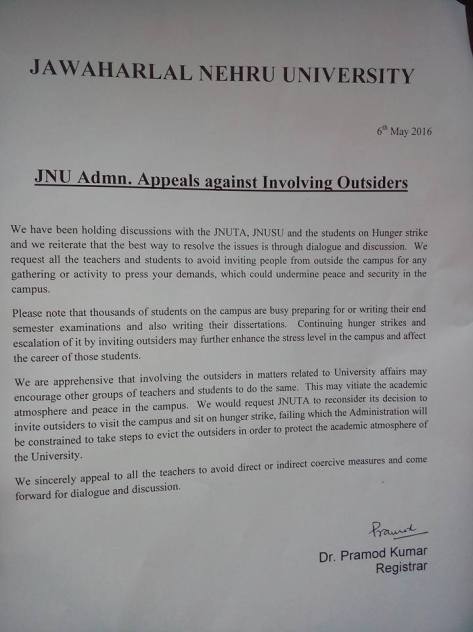
‘Appeal’ from JNU Registrar not to involve and invite ‘outsiders’ for protests in the University. The ‘appeal’ contains a veiled threat that this might provoke ‘other groups’ to invite ‘other outsiders’.
Several of us have been JNU students. Several of us who have been trained to think that central universities are not for us, actually made it to JNU, came to the national capital and experienced that another world is possible. Families in the lowest income groups sent their children to JNU. We women who for the first time were treated as equal human being by fellow students and teachers, became part of the struggle for liberty of workers, women, dalits and the marginalised. We denied to be reduced to our immediate identities here in JNU, we became much larger. Other comrades have fought tough battles in other universities and in several parts of the country. We met on the streets for Kashmir, for Manorama Devi, For Khairlanji, for Narmada Valley, for FTII/HCU/DU/ Jamia. And today when ManuSmrti Irani’s ministry wants to teach the JNU students a lesson for daring to raise voice against oppression, let us all again flood the streets to defend the idea of JNU.
Since 27th May, JNU students have started their indefinite hunger strike. In this scorching heat, none of are comrades in hunger strike are doing fine bodily. But they are high in spirit and resolve. The VC has sent them letter expressing his concern that the hunger strike is unlawful and it will have implication on their career.
Their hunger strike will reach its 10th Day on the 7th of May. JNU alumni students have called for relay hunger strike in solidarity with JNU students on the 7th May from 10am in the morning. This is an appeal to all old friends, class mates, hostel friends and comrades to join the relay hunger strike on the 7th. Also in the evening the JNUSU has called for a Human Chain from Ganga Dhaba at 5pm. Let us hold hands and fight back. Fight back for all students in the counry. Fight back so that every one can reach universities. Fight back so that the possibility of a better world is kept alive. Come friends, let us hold hands with JNU comrades on the 10th Day of their Indefinite hunger strike.
Sucheta De was a student in JNU from 2005 – 2014. She was president of the Jawaharlal Nehru University Students Union (JNUSU) in 2012. She is the current president of the All India Students Association.
जिशा, मेरी दोस्त मेरी यार, क्या कहूँ यार तुम्हारे साथ जो दंविये बर्बरता हुई उसके लिए मुझे शब्द नहीं मिल रहे हैं कुछ कहने को. ये देश ये समाज हर रोज़ ऐसे झटके देता रहता है और इतना देता है, इतना देता है, की हमारे लिए वीभत्स से वीभत्स घटना क्रूरतम से क्रूरतम घटना साधरण बन गई है और इन घटनाओं को पचाने की क्षमता में भी हम माहीर हो गए है. देखो न दोस्त, असाधारण कहाँ कुछ रह गया है. बचपन से आज तक तो यही सब देख- देख कर पले बढे हैं हम सब की, जो कुछ हो अपना हक़ मत मांगना, पढने लिखने की बात मत करना , बाप या भाई लात घूंसे मार- मार कर तुम्हे अधमरा कर दे लेकिन एक शब्द भी उनके खिलाफ बोलने की गुस्ताखी मत करना, गाँव के उच्च जाति वर्ग के सामंती तुम्हे अगर छेड़े तुम्हारा बलात्कार करे तो उसका बहिष्कार मत करना कियोंकि ये तो उनका जन्म सिद्ध अधिकार है.
तुम्हारे लिए जो लक्ष्मण रेखा खिंची गई है उससे बाहर जाने की कोशिश की तो तुम्हारी शामत आना पक्की है. और शादी? ये तो दूसरी जात में तो दूर की बात अपनी जाति में भी करने का अधिकार या आजादी की बात मत करना ये तय करना घर के बड़े पुरुषों के कंधे पर छोड़ो. सती सावित्री बनो, एक सद्गुणी बेटी, बहु और पत्नी बनो इसी में तुम्हारी भलाई है.
So, the High Level Enquiry Committee at JNU, set up under the watch of Jagadish Kumar, the recently appointed Vice Chancellor, has just delivered a low blow. A summary of its decisions (taken from the Facebook Wall of JNUSU Vice President, Shehla Rashid) meted out as the consequences of the events of February 9 and after is as follows :
Umar Khalid, rusticated for one semester + 20K fine.
Anirban, rusticated till 15 July & from 25 July, out of bounds for 5 years.
Another Kashmiri student rusticated for two semesters.
Ashutosh, former JNUSU President, removed from hostel for one year + fine.
Chintu, former JNUSU Gen Sec: 20K fine
Rama, current JNUSU Gen Sec: 20K fine
Anant, former JNUSU Vice-President: 20K fine
Aishwarya, current GSCASH representative: 20K fine.
Gargi, current JNUSU councillor: 20 K fine
Shveta Raj, current SL & CS Convener: 20 K fine
Kanhaiyya, current JNUSU President: 10K fine
Other organisers fined from 10K to 20K
Two ex students declared out of bounds from campus.
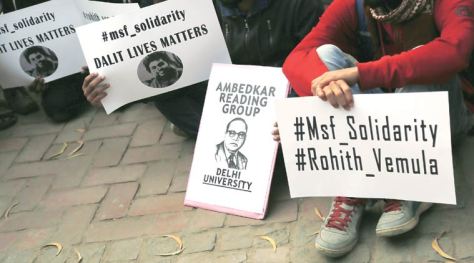
This is an administration, which, in obedience to its backers in the Ministry of Human Resource Development and the Government of India, that knows only one way of dealing with the students in its charge – and that is a replica of the vindictive path that eventually drove Rohith Vemula to his institutionally mandated death in Hyderabad University.
Guest Post by Shehla Rashid. Based on a Status Update on her Facebook Page.
They tell us that the military is meant for fighting the “terrorists”; But most of the time, it is the civilians who are killed.
They tell us that “special powers” for the army are necessary for national unity; But the army only teaches us how to hate India.
They say the University is anti-national because it wants to break India; But it’s the University that teaches us to love Indians.
Then, who is anti-national? Those who teach us how to hate India, or those who teach us how to love Indians?
Yes, we see the difference between India and Indians; India is at war with Indians throughout India.
I wish the Indian state could also see the difference between Kashmir, which it claims as its own, and Kashmiris who belong to no one; They claim to love Kashmir but hate and kill Kashmiris.
“His right to march where he likes, meet where he likes, enter where he likes, hoot where he likes, threaten who he likes, smash as he likes. All this I think tends to anarchy. (Mathew Arnold, Culture and Anarchy, 1866)
….It certainly does. Nothing is stranger, in Arnold’s often scrupulous, often self-consciously charming and delicate prose, than the escalation, the coarseness of these Hyde Park verbs…It is a point of view. Certainly it contrives to forget the start of the disorder: the defeat of the reform legislation, the locking of the gates against the reform meeting (for which, as it happens, there were no legal grounds). As so often, it picks up the story at a convenient point: at the point of response, sometimes violent, to repression; not at the repression itself. Even so, it is a point of view and a familiar one.”
The above excerpt is from an essay by the British Marxist thinker Raymond Williams “One Hundred Years of Culture and Anarchy”, which is part of his path-breaking collection of essays Culture and Materialism. The first paragraph is a quotation that Williams makes from Mathew Arnold’s essay Culture and Anarchy written in the 1860s in response to the workers’ demonstration at Hyde Park asking for voting rights for workers. Arnold’s argument and language is all too familiar to us now, as that is the language available to us through mainstream media and in general the middle class public sphere, while talking about the brutal deployment of force and violence on the students at the University of Hyderabad. Many seem to be in the business of picking up stories at convenient points. Continue reading Let us not be little Arnolds in these times : Sudha K F→
There has been a lot of talk about what exactly ‘Azadi’ (freedom) means, especially in the wake of Kanhaiya Kumar’s post release midnight speech at JNU on the 4th of March. So lets talk some more. No harm talking. If there is noise, there must also be a signal, somewhere.
Kanhaiya Kumar clarified in his electrifying, riveting speech that his evocation of Azadi was a call for freedom ‘in’ India, not a demand, or even an endorsement of a demand for freedom ‘from’ India.
This may come as a sigh of relief to some, – Kanhaiya , the man of the moment, proves his ‘good’ patriotic credentials, leading to an airing of the by now familiar ‘good nationalist vs. bad nationalist’ trope. And everyone on television loves a nationalist, some love a good nationalist even more.
[ P.S. : Since writing this last night, a more careful reading of the bail order has suggested to me that the actual terms of bail are not so bad after all. Bail is in fact granted, as far as I can see, fairly unconditionally. Kanhaiya is not asked, for instance, to step down from his position in the students’ union, nor are restrictions placed on his movement and activity. So in technically legal sense, the bail provisions need not be interpreted in a tightly restricted manner. The egregious political hortations, the references to infection, antibiotics, amputation and gangrene, which are over and above the legal instructions, are indeed terrible, but operationally, they have no executive authority backing them.]
But to say just that the text of the bail order is what shaped Kanhaiya’s midnight speech would be ungenerous, and miserly, especially in response to the palpably real passion that someone like Kanhaiya has for a better world, and for a better future for the country he lives and believes in. I have no doubt about the fact that coming as he does from the most moderate section of the Indian Left (the CPI – well known for their long term affection for the ‘national bourgeoisie’ despite the national bourgeouisie’s long term indifference/indulgence towards them), Kanhaiya is a genuine populist nationalist patriot [I have corrected ‘nationalist’ to ‘patriot’ here in response to the criticism and suggestion held out by Virat Mehta’s comment – see below in the comments section] and a democrat moulded as he says, equally by Bhagat Singh and Dr. Ambedkar. There is a lot to admire in that vision, even in partial disagreement. And while some may not necessarily share his nationalism, this does not mean that one has to treat it with contempt either. I certainly don’t.
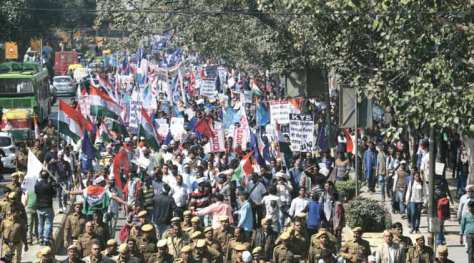
For the third time within a span of two weeks since the middle of February, thousands of people came out on the streets of Delhi to express their solidarity with the detained students of JNU (Kanhaiya Kumar, Umar Khalid and Anirban) and to voice their anger with the venal Modi regime.
Protest demonstrations (at least in northern India) tend to have something of the monotonous in them, the same cadence, the same rhythm and the same wailing, complaining tone. They tend to have an air of events staged by the defeated, for the defeated. But if we take the last three big protests in the city, and the many gatherings in JNU in the last two weeks or so, as any indicator of what the pulse of our time is, we will have to agree that there has been a qualitative transformation in the language, vocabulary and affect of protests. This afternoon, like the afternoon of the 18th (the first big JNU solidarity march), and of the 23rd of February (the Justice for Rohith Vemula March), was as much about the joy of togetherness and friendship as it was about rage and anger.
The call for a protest rally by the Joint Action Committee for Social Justice, constituted in the aftermath of Hyderabad Central University research student Rohith Vemula’s suicide galvanised large number of students and activists on 23rd February. On a bright sunny day, thousands descended on the streets of central Delhi marching from Ambedkar Bhawan to Jantar Mantar. The attendance was perhaps lower and the organization less cohesive than the JNU protest rally of 18th February. However, it trumped its predecessor in terms of attracting a far-wider political cross-section of the voices openly choosing to dissent against the current ruling establishment. The protestors proudly displayed anti-Brahmanism banners, flags, badges (featuring excerpts of Rohith’s suicide note) and even a radical inversion of Modi-style masks (featuring Rohith Vemula’s smiling face) thereby signaling that the same youth-brigade which was instrumental in BJP’s rise to political power in 2014 has started turning against it.
You, who shout your nationalism from the rooftops; you whose blood runs hot for “Mother India”; you who turn red with rage when contradicted; you who set agendas like patriarchs drunk on father-right; you who refuse to let another speak, you! who don a suit every night on television to disguise your cheap tricks; you who abuse your guests if they happen to be young, powerless and honest; you who bloat on adrenaline while your viewers turn to idiotic jelly; you who abuse the highest offices of this land; you who give a bad name to khaki; you who wear lawyers’ robes to beat students and teachers; you who are protected by your political masters; you who strike deals in the privacy of your offices, chambers and boardrooms; you who live by ratings and upvotes; you who tell lies so long you forget the truth; you who form bands of cowards hiding in plain sight; you who roam the streets showing your fist to all; you for whom a martyred soldier is more valuable than a living citizen; you who abuse the power that history gave you; you who mistake that accident of history for a moral right; you whose imagination of revenge always involves rape; you who have brought this country to the brink of civil war; you who speak in the name of the mythical motherland while the actual children of that land are hungry, thirsty and unemployed; you who claim this moment, this nation, this public, this history, this land. Apologise.
Apologise to those who work everyday to make this country decent; who work for too little, and for too long; those whose deaths become statistics in the great churning pots of state economists; those whose parents taught them to keep their heads down and quit an ugly fight; those who argue, debate, disagree without the urge to kill or maim their opponents; those who understand when an argument becomes too heated; those who pull back from the brink every time because they know that to be alive is not always to be right; those who reclaim the streets to protest when it’s hard, when it’s inconvenient, and when it’s dangerous, because it’s the only way to disagree; those who see that an eye for an eye makes the whole world blind; those who understand and accept this land in all its confounding conflict; those who risk death to expose the powerful and corrupt; those who have no choice but to join the army to feed their families; those who laugh when there is nothing left; those who write, think and reason, and take time over all three; those who appreciate the beauty of the stars on a still night; those who make love like it’s a gift and not a right; those whose parents live after they died because they were on the wrong side at the wrong time.
Above all, you deranged “nationalists”, apologise to three fellow citizens – one born in a caste that could only speak from the protection of death; another who is languishing in jail for no crime at all; and perhaps most of all, a third who is on the run from a police none of us ever trusted. Apologise. These young people are the future of this country, not you with your bloodlust. WE are the nation, and we demand an apology from you.
We, the undersigned faculty and students at Purdue University, strongly condemn the arrest of JNUSU President Kanhaiya Kumar. We oppose the systematic and deliberate attempts to humiliate, bully and terrorize the university’s community of scholars and political activists. It is unethical for a government to spread canards about students with the hope of distracting attention away from its over-zealous, slapdash interventions in academic institutions. We demand that this scapegoating and hounding of Umar Khalid, and all other students, cease immediately.
We salute the courageous JNU community that stands proud and resolute in the face of physical violence, media trials, and sectarian, antediluvian discourses that confuse students for enemies, and dissent – the cornerstone of democracy – for sedition.
More generally, we detect a pattern in this government’s deployment of the state machinery against young adults committed to addressing the inequities and discriminations so blatant in our country today. We insist, therefore, that the central government end its programmatic assault on public educational institutions and the spirit of free-thought. Institutions of higher education must be created and preserved as spaces where caste oppression, gender and minority-exclusion can be studied, and their resistance practiced. JNU exemplifies a dual commitment to combining academic rigor with a political-ethical conscience. We stand in solidarity with JNU’s vision of a diverse campus, charged with a robust polity, where no monolithic, auto-corrected version of the nation or patriotism dominates. We believe that university campuses, like society at large, can thrive only when celebrations of the myriad manifestations of the nation are accompanied by an honest and fearless capacity to criticize its inadequacies. Continue reading Purdue University Stands in Solidarity with JNU→
This is a resolution passed by the Doctoral Students’ Council, City University of New York (CUNY)
WHEREAS, on 12 February, the Delhi Police raided student hostels at the Jawaharlal Nehru University (JNU) and arrested the JNU Students’ Union President Kanhaiyya Kumar on the arbitrary and anti-democratic charge of sedition; and
WHEREAS, this application of a draconian, colonial law which criminalizes dissent stands in stark contradiction to the very democratic character of the nation that affirms an individual’s right to free speech, however radical and unpopular the opinion; and
WHEREAS, this arrest of an elected student representative and the subsequent militarization of the campus with an overwhelming police presence is sanctioned and sponsored by the Bharatiya Janata Party (BJP) led ruling regime, in conjunction with its affiliate organizations RSS and ABVP, its student wing; and
WHEREAS, this coercive presence of the police on the university premises and elsewhere is compounded by their complicity in the physical assaults by lawyers of the Hindu Right on JNU teachers and students at the courthouse before Kanhaiyya’s hearing; and
We are going into a dangerous situation now. It is that time when we all should come together to work against autocracy, state led atrocities, bullying, dictatorship and authoritarianism and any other form of injustice. We all know about JNU case, role of Lawyers & MLA O. P. Sharma in the shameful acts of abuse and warnings to people who take initiative to speak against atrocities and injustice all-over the country. Now Raman Singh’s model of development has also showed us two shameful cases in Chhattisgarh. One is attack on Tribal activist and AAP’s leader Soni Sori who has faced a lot of humiliation, atrocities and pain but always stood steadfast on her path and is still fighting. And one more case of state-led dictatorship is related to Jagdalpur Legal Aid Group, which is a legal aid group to support tribal people who are facing problems in that region in terms of false cases, fake encounters, etc. for details about its existence see this link of the Hindu’s article (http://www.thehindu.com/news/national/a-group-of-lawyers-trying-bring-law-to-lawless-bastar-region/article7735079.ece) They worked for people facing false charges of Naxalism, against controversial encounters and other issues where there is a need to work hard for giving support to the voice of justice among tribes.
This has become problematic for state and police. They first started annoying them, throwing false allegations against their degrees and eligibility to fight case. When they fought and won against those charges now some organizations (with the support of state officials & police) also warned them to leave that place and said that they are Maoist sympathizers. And now finally they left their landlord’s rented home in Jagdalpur when police pressurized their landlord who (according to one member of Jagdalpur Legal Aid Group (JAGLAG) in an interaction to a reporter) is very good for them and they don’t want to be a problem for him. For further details and mail of a member of JAGLAG see the article in this link.
We should think again, is it development where state itself making people speechless and generating more mistrust among people for government, where they do violence by their own way and more than that they are even silencing voices of resistance. These officers will get awards by government like Ankit Garg who shamelessly ordered humiliation and sexual abuse of Soni Sori. They want to silence voices like JAGLAG so that they will punish more innocents in the name of Naxalism as they did with Kartam Joga, who because of lot of efforts of Lawyers and activists found a new life after 3 years’ Jail and pain of brutality of Police. They don’t want any voices of resistance because they know their reality will emerge; so they beat people without any reason as they did with Lakhan Lal and broke his legs just for replying “Laal Salaam” in the dead of the night; their shameful act of humiliating Soni Sori in jail in the name of police inquiries is also for the same reasons. In the name of Anti-Naxalism/Maoism they are trying to silence all voices and justifying all their acts as their friends are trying to do in the name of nationalism in other parts of country. We should support now all members of Jagdalpur Legal Aid Group and raise this issue on all platforms.
The first thing you do is to forget that I’m black Second, you must never forget that I’m black
Pat Parker (1978)
In these opening lines of her poem, For the White Person Who Wants to Know How to be My Friend, Pat Parker names a paradox at the heart of challenging socially produced difference. Parker is speaking not to diversity in nature, nor to the diversity of nature. Not to the variations of appearance – size, shade, height, foliage, texture; or mode of expression – hoot, howl, accent, gesture, cultural practices. Her lines address a uniquely human phenomenon: prejudice. They speak to the poignant difficulty of challenging a spurious and malevolent construction of racial difference in a society still in the grip of its miasma.
I have recalled Parker’s lines many times in the days of sorrow, tumult and righteous rage that have followed Rohith Vemula’s suicide. “Rohith Vemula’s suicide.” I am holding off from saying “Dalit scholar Rohith Vemula’s suicide.” Or, as is now being said with good reason, “Dalit scholar Rohith Vemula’s institutional murder.” I defer by a couple of sentences a description of him that refers to the caste into which he was born; to honour if only symbolically his anguish that the contingent facts of his birth had indelibly defined his life.
Ever since the Hindutva right-wing attacks on the country’s youthful citizens intensified – from the Kiss of Love protests to the attacks on politicized dalit youth on the campuses of IIT Madras and HCU, and now, against JNU – we have come together several times as a group to defend our right to critical thinking, action, and speech and protest against atrocities in the name of national interest and culture. We have come out not to defend our petty interests but in defense of the Indian Nation as we imagine it – differently from the right-wing – as belonging to the communities of peasants, workers, students, artisans, dancers, singers, small traders, and thousands of other groups that contribute to the economy of this country, as the homeland of vast sections of underprivileged people denied humanity in the name of caste, class, culture, ethnicity and gender. Continue reading Fearless Minds and Heads Held High: To the CDS Student Community→
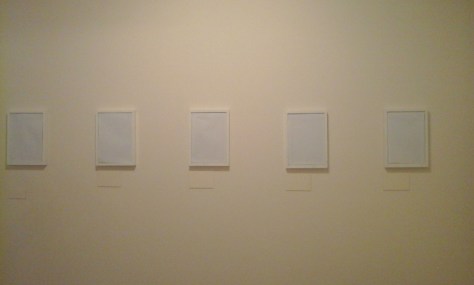
These pictures, which depict blank walls, are symbolic of the attack. Pictures of the original art cannot be shared due to copyright issues.
On the 7th of February, Tibetan artist Nortse and Indian artists Ritu Sarin and Tenzing Sonam had their photographs and art installations removed at the behest of the Chinese ambassador to Dhaka from the Dhaka Art Summit taking place in Shilpakala Academy in the capital of Bangladesh. The art project by Nortse was titled Prayer Wheel, Big Brother and Automan (2007) which showed the artist don traditional Tibetan clothes along with modern objects to show the surveillance that marks their lives. .Ritu Sarin and Tenzing Sonam produced a piece called “Last Words”, which consists of five facsmilies of five last messages written by the self-immolators in Tibet, along with their English translations. Ritu Sarin and Tenzing Sonam depicted Tibetan monks in the act of self-immolation as a way of political and religious protest against the occupation of Tibet by the Chinese government. At the end of the 6th of February, both artists were still depicted on the walls of the Art Summit. On the 7th, what greeted the visitors and patrons were blank stretches of white wall with white frames. It was as if the works had never existed. This is not the first time the Chinese government has tried to shut down political art work that aims to show the real face of Chinese occupation of Tibet. What is even more reprehensible is that it happened inside the walls of an institution that was proclaiming itself to be a haven of bold art and artistic expression. That the Chinese government could go to such lengths to silence an exhibition happening thousands of miles away shows the depth of their oppression over an entire country. Since February 2009, 142 Tibetans have self-immolated in their homeland, 120 dying from their actions.
(‘नवउदारवाद के दौर में हिन्दुत्व’ विषय पर अहमदाबाद में प्रस्तुत व्याख्यान का संशोधित एवं विस्तारित रूप)
‘आम लोग धर्म को सच मानते हैं, समझदार लोग झूठ मानते हैं और शासक लोग उपयोगी समझते हैं।’
– सेनेका / ईसापूर्व 4 वर्ष से ईसवी 65 तक/
..अपनों के बीच होने की एक सुविधा यह होती है कि आप इस बात से निश्चिंत रहते हैं कि किसी प्रतिकूल वातावरण का सामना नहीं करना पड़ेगा, जो सवाल भी पूछे जाएंगे या जो बातें भी कहीं जाएंगी वह भी अपने ही दायरे की होंगी। मगर फिलवक्त़ मैं अपने आप को एक अलग तरह की मुश्किल से घिरा पा रहा हूं।
मुश्किल यह है कि जिस मसले पर – ‘नवउदारवाद के दौर में हिन्दुत्व’ -बात करनी है उस मसले को सदन में बैठे हर व्यक्ति ने ‘सुना है, धुना है और गुना है’। और खासकर जो नौजवान बैठे हैं, – जिनकी पैदाइश सम्भवतः बाबरी मस्जिद विध्वंस और उसके पहले लागू किए जा रहे ‘नए आर्थिक सुधारों’ के दौर में हुई थी – उनको फोकस करें तो कह सकते हैं कि उनकी सियासी जिन्दगी की शुरूआत से ही यह दोनों लब्ज और उससे जुड़ी तमाम बातें महाभारत के अभिमन्यु की तरह उनके साथ रही हैं।
The so-called People Against Fascism (PAF), a meeting at Kochi last weekend, will be remembered perhaps as the first open enunciation of neocon anti-Muslim rhetoric in Kerala. This is important considering the fact that even the Hindutva rightwing here is yet to draw on this virulent discourse. The terrible – and sadly laughable- irony is that it is the self-styled social and political radicals who claim that it is a move against Hindutva politics. Continue reading Beyond Trumpism and Rumpism- Thoughts on People Against Fascism in Kerala→
Megan Garber’s article ‘#PrayForParis: When Empathy Becomes a Meme’, published in The Atlantic (November 16, 2015) has claimed that Paris hashtags and French flag filters on Facebook make for an “act of mass compassion” – a “compassion that has been converted, via the Internet’s alchemy, into political messaging”.
I have absolutely no problems with flag filters on Facebook. Or for that matter, profile-picture revolutions that happen all too often. I’m not, in the least bit indignant about such a competitive exhibitionism of feeling – indexed through a currency of memes and emoticons. In an age of such mass-production of violence (‘terroristic’ or ‘humanitarian’), it is no surprise that the event of mourning must become a symptom of the incompatibility between ‘act’ and ‘response’.
A funereal Facebook must therefore bleed profile pictures, because that seems the only charter of our most intimate emotions. We naturally do not care if Facebook is using the Paris tragedy as a marketing platform, as long as it helps us reclaim a deeply ‘personal’ angst in the face of more-than-a-hundred ‘spectacular’ deaths.
We women of occupied East Jerusalem call for immediate protection as we witness and suffer the widespread and serious violations of Palestinian human rights, including physical attacks and injuries, severe psychological threats, and persecution by the Israeli settler-colonial state and settler entities.
We urge the international community to act and defend the rights of Palestinian children, women, and men, including the right to a safe life amidst the constant attacks, excessive and indiscriminate use of force used by the Israeli oppressive apparatus, acts of violence and daily terror committed by Israeli Jewish civilians, including settlers. This brutality is intimidating our lives, provoking our youth, willfully causing death and bodily and psychological harm, and disabling and injuring of our community members.
We, a group of Palestinian women, mothers, sisters, daughters and youth—and in the name of the “Jerusalemite Women’s Coalition”—call upon the international community to protect our families, community, and children. We are calling for the protection of our bodily safety and security when in our homes, walking in our neighborhood, reaching schools, clinics, work places, and worships venues. Continue reading Palestinian Women from Occupied East Jerusalem Call for Protection: Jerusalemite Women ’s Coalition→
After seven tumultuous years following the overthrow of the more than two century old monarchy which led to elections to form a Constituent Assembly, and many governments failing to fulfill the task of finalizing a Constitution, at last on 20th September the President of Nepal has promulgated the new Constitution amidst support from overwhelming majority of the CA and people. The Constitution creates seven states in a secular, federal system. Continue reading Stop Interfering in Nepal : Statement in Protest Against India’s Interference→