
Text of a Statement by Artists, Curators and Critics in India against a Climate of Rising Intolerance in India
(Followed by Names of the 300 + Signatories, in Alphabetical Order)
The artist community of India stands in firm solidarity with the actions of our writers who have relinquished awards and positions, and spoken up in protest against the alarming rise of intolerance in the country. We condemn and mourn the murders of MM Kalburgi, Narendra Dabholkar and Govind Pansare, rationalists and free thinkers whose voices have been silenced by rightwing dogmatists but whose ‘presence’ must ignite our resistance to the conditions of hate being generated around us.
We will never forget the battle we fought for our pre-eminent artist M.F. Husain who was hounded out of the country and died in exile. We remember the rightwing invasion and dismantling of freedoms in one of the country’s best known art schools in Baroda. We witness the present government’s appointment of grossly unqualified persons to the FTII Society and its disregard of the ongoing strike by the students of this leading Institute. We see a writer like Perumal Murugan being intimidated into declaring his death as a writer, a matter of dire shame in any society.
While the Prime Minister of the country has been conspicuously reticent in his response to the recent events, the reactions of BJP ministers in his government reveal their ignorance and prejudice. Mahesh Sharma, Minister of State for Culture, has made abhorrent comments about mob lynching and murder. His remarks suggesting that writers should stop writing to prove their point are alarming – empowered as he is to take policy decisions in the domain of culture. Arun Jaitley, Minister of Finance, Information & Broadcasting, has mocked the actions of our respected writers as a manufactured ‘paper rebellion’. He asks for scrutiny of the political and ideological affiliations of those who are protesting.
To these and other such provocations there is a clear answer: while the actual affiliations of the protesting writers and artists, scholars and journalists may be many and varied, their individual and collective voices are gaining cumulative strength. It is this that the ruling party will have to reckon with: the protestors’ declared disaffiliation from a government that encourages marauding outfits to enforce a series of regressive commands in this culturally diverse country.
The scale of social violence and fatal assaults on ordinary citizens (as in Dadri, Uttar Pradesh; Udhampur, Jammu and Kashmir; Faridabad, Harayana) is escalating. The contemptuous comments about the religious minorities and Dalits made by those within the government confirm that there is little difference between the RSS-BJP mainstream and supposed ‘fringe’ elements. The perfunctory warnings and regrets issued by ruling party ideologues – to defend the agendas of ‘development’ and ‘governance’ advanced by Mr Narendra Modi – are merely expedient. The Sangh Parivar and its Hindutva forces operating through their goon brigades form the support base of this government; they are all complicit in the attempts to impose conformity of thought, belief and practice. Continue reading Statement by Artists, Curators and Critics Against Rising Intolerance in India

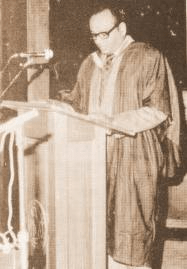 I first met Anandarajan when I was fourteen years old, a few weeks before I was to join St John’s. Anandarajan was introduced to me at a family function, as my would-be principal. The first thing I noticed about him was the total lack of aloofness. His response was ‘I say, I was a classmate of your mother at St John’s, and she was the only girl in the class whom I was scared of’ (which my mother vehemently denied!). In the years that followed I came to know Anandarajan more closely, first as a teacher, and then as a close family friend. In those days at St John’s the first year Advanced Level classes occupied the open sheds opposite the Vice-Principal’s house, and everyday from my classroom I would see Anandarajan walk purposefully across the school grounds from his residence to the principal’s office. If it was a Monday, I would see him again a few minutes later, wearing a black academic-gown walking up the stage of Peto Hall to chair the assembly. I used to enjoy those Monday morning assemblies, as they provided a welcome reprieve from the stress of cramming for exams. Anandarajan would invite interesting speakers to address us, from Hindu mystics to those who spoke on more earthy topics such as pollution and war in the Middle East. Ironically for many of us in those days, war was something that happened only in distant places. If there were no outside speakers Anandarajan would address the assembly himself. It was on one such occasions that I learnt a value that I have cherished ever since then. It is in Anandarajan’s own words: “Always defend yourself. Never let anyone accuse you falsely – not anyone – not even me. If you let that happen, part of the blame is yours”.


