Category Archives: Identities

Whatever Happened to Struggle Against Untouchability

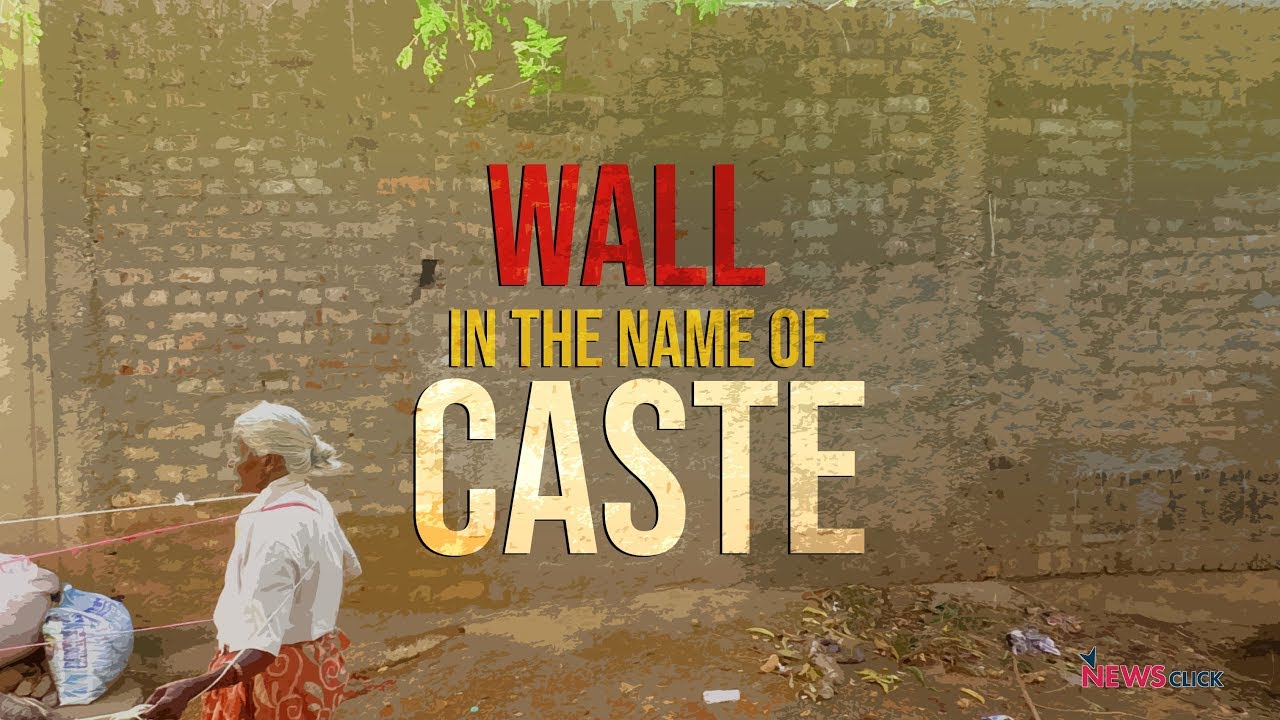
Untouchability Walls keep rising and falling in Tamil Nadu.

Whatever Happened to Struggle

BR Ambedkar wrote in Annihilation of Caste that “…the world owes much to rebels who would dare to argue in the face of the pontiff and insist that he is not infallible. I do not care about the credit which every progressive society must give to its rebels. I shall be satisfied if I make the Hindus realize that they are the sick men of India, and that their sickness is causing danger to the health and happiness of other Indians.”

In 2008, Uthapuram, a village in Madurai, Tamil Nadu, had made national headlines. It was the year when the Karunanidhi-led DMK state government had taken the initiative to demolish a portion of a thirty-metre wall that had been raised by the dominant Pillaimar community, an OBC caste which had wanted to keep residents of the Devandra Kula Vellalar community, which falls under the Scheduled Caste category, out of the Mariamman temple.

Built in 1989, this wall had become a symbol of segregation based on caste and organisations like Tamil Nadu Anti Untouchability Front, along with other groups and individuals had been conducting agitations to end this discrimination. Finally, the DMK government was forced to take action.

This was perhaps the first time that the rest of India came to know about the prevalence of this pernicious practice in Tamil Nadu. The demolition of the wall was projected as a significant step to move towards caste annihilation.

The recent death of 17 dalits in Mettupalayam wall collapse, in which members of the arunthathiyar dalit caste lost their lives is a reminder of how our celebrations were premature. And that when it comes to caste and its attendant exclusions and discriminations, India still has miles to go.

(Read the full article here https://www.newsclick.in/Whatever-Happened-Struggle-Against-Untouchability)

Against Aachaaram: Moorkothu Kumaran’s Dream of the Future

This is the fifth in a series titled Against Aachaaram: A Dossier from Malayalam on Kafila. The note below is by J Devika. The excerpt from the essay by Moorkothu Kumaran has been translated by K R GOPIKRISHNA.

Moorkothu Kumaran (1874- 1941) was one of Malayalam’s earliest short story writers, literary critics, and public intellectuals. Born in the avarna Thiyya community in north Malabar, he was educated at Thalassery and Madras and was closely associated with Sreenarayana Guru. He was active in the SNDP Yogam in its early years and highly influential through his pioneering journalism and contributions to modern Malayalam, as it was shaped in and through the new voices that were now heard in the emergent public sphere.

Below is an excerpt from an essay of his titled ‘Oru Pusrushasamajam’ (A Men’s Association), in which he indulges in a fantasy of a social event set in 2029. Written in the late nineteenth century, it imagines a world which women have taken over, and where the Manusmrithi is a long-lost and obscure text, while the writings of late-nineteenth century women authors, like Tottaikkattu Ikkavamma, are widely in circulation. In other words, a world in which the aachaaram of Manu has somewhat declined, though there are indications that it has not disappeared fully.

Reading this, one cannot help noticing the fallacy often shared, sadly enough, by reformers and conservatives, then and now: that empowered women will merely seize patriarchal-caste-heteronormative power and exercise it unchanged. And so their imagined utopias of gender equality inevitably look like the inverted version of patriarchal society. But perhaps Moorkoth Kumaran leaves us a clue about why this was so: as is evident from the extract below, caste seems alive and well despite the disappearance of Manusmrithi– the privileged sudra identity of Menon, Nair seem untouched, alongside upwardly mobile individuals born in lower castes aspiring to the new savarna status. It is not, however, clear that Moorkoth makes this gesture deliberately.

Sadly enough, this aspect of the emergent order of gender, in which the new empowered woman (irrespective of where she originates in the spectrum of castes sharing the renewed Brahmin-sudra social contract or among the avarna individuals who seek upward mobility into the savarna, partakes in the refurbished savarna power) was hardly ever discussed. In this fantasy, it is stretched to its maximum, and so the ‘oppressed’ men now complain of women inverting the order, in effect, behaving like upper caste men of the late19th century. Women have removed all portions of aachaaram that limit them and imposed those on men, but they have not delegitimised caste, one may suppose. In short,  women have managed to replace words like paativratyam with others like patnivratyam.

To avoid this  we have,  precisely, the insistence- still audible in left cultural circles as well  — that women are not interested in sameness,  only equality.  Sameness within  the new savarna order would mean that women may take caste power and that may even make them conspire to impose a cultural agenda in their favour, proscribing scriptural authority that sanctions make authority.  It is not merely the love of ‘Indian culture’, but also this fear that makes the Indian right wing  and the still-savarna reformers on the left embrace the infamous despoilation of women’s public voice – in two different ways-during last year’s  savarna mutiny against the Supreme Court’s verdict about  the entry of women of menstruating ages into Sabarimala.

Of course visions of feminist utopia  have been strikingly different in that they envisage the wholesale elimination of all forms of patriarchy, but then when both the really-existing left and the right both are interested only in demonising the feminists,  their protestations will be surely ignored.

_____________

A Men’s Association

A meeting that may be held a hundred years into the future
AD 2029 October 1, Tuesday, Kanni 15, 1205, the Kollam Era:  An important convention of Kerala Men’s Association is being held on the westside garden of Smt. VCR Amma M.A. M.L.C.’s house at Kozhikode (Calicut). Sri Narayanan Nambiar (husband of High Court judge L D Amma M.A. B.L.) was chosen to preside to over the meeting based on the suggestion of Smt. TKG Amma B.A. M.R.A.S.’s husband Sri Kannaran, which was seconded by Barrister Smt. B K Amma’s husband Sri. Gopala Menon. In his inaugural speech, the President spoke engagingly about men’s lack of freedom He essentially pondered how in the older times, men were free and were educated, and how they worked and earned when women engaged in domestic duties, serving their husbands, bearing and nurturing their children, and how peace prevailed in households and the society in those days. He spoke in detail, and with considerable poignancy, how, in contemporary times, women have attained education, entered into all government jobs, and become members of the governing bodies and legislatures t and how this has destroyed the freedom of men. Finally, he said, “Dear brothers, there are umpteen illustrations to prove that the brave men who were our ancestors enjoyed freedom in households and the country. I have found reasons to believe there existed a great scripture named Manu-Samhita. In it, it is stipulated that even education must be denied to women. Somewhere I have read that Manu-Samhita is the rule-book for the Hindus. I have been able to find documents proving that women were men’s slaves and women’s worlds were confined to the kitchen and bedroom only – cooking food and taking care of children. Women have destroyed Manu-Samhita completely, without sparing a single copy.
“Freedom is not for women
The Father will save her at adolescence
The Husband will save her at adulthood
The Son will save her at old-age.”

Thus states this scripture of antiquity. It appears that that this section has been redacted out from the edition of this scripture currently in publication. A drama written by a poetess who died 125 years ago is being circulated by the women of our times. Though it was an attempt to prove women were scholarly at those times, however, a sloka confirming that women didn’t have freedom at those times, was included in the print. Also, it can be understood that women wrote poetry rarely and men considered them incapable of it. This was that sloka:

“Didn’t Krishna’s beloved Bhama fight?
Didn’t Subhadra ride a chariot?
Isn’t all this world ruled by Victoria?
If the beauties can accomplish all these,
How will they be incapable to writing a poem?”

What can you decipher from this shloka? Does it not hint that women wrote poetry rarely? That they were considered inadequate to it? If these justifications were given for a woman writing a poem, doesn’t it mean that these were early attempts of women writing poetry? Now, we don’t blame women for being newspaper editors, poets or dramatists. We hinder do not them from being one. We don’t disapprove of them occupying any office, as much as they can. Our sole grievance is against reducing men to slaves capable of only doing domestic work. Is it fair that the burden of care and protection of children they bear is turned into a liability of ours?

They haven’t done enough to meet our educational needs. Despite our raising our need for exclusive schools and colleges many times, they have ignored us. Despite their decision that we are capable of only domestic work and after having forced us into it, they have not provided us with the necessary instruction in domestic work at school. We are being offered the same subjects and textbooks as them. Young women ill-treat youngsters who are forced to study in the same schools as them. Meanwhile, the infamous tale of how a young woman threw a letter at a high school-going youth and how he complained to the principal, and how she did not inquire into the matter at all against the offending woman has been in the news. Headmistresses also do not listen to the complaint that young women are spilling ink on the shirts of young men and bothering them thus! Though exclusive elementary schools have been established for us in a few places, it is a concern that it was all women who were appointed as teachers. Though a few amongst us has risen to become elementary level headmasters, they are harmed by transferring them off to faraway lands.

Apart from all this, women insult us claiming that our vows to our wives – our patnivratyam  – are insufficient and slander us in their newspapers. That few youngsters amongst us are living as ganikanmaar– prostitutes – in certain city houses that they have leased is indeed a great weakness on our side. But the responsibility to abolish it is on the women who rule and they have failed to act on it. A woman member has introduced a bill in the legislature to abolish the system of polyandry and it is deeply concerning that few other women members are opposing the bill. You all must be aware from the invitation that this today’s meeting is being heldwas convened to discuss this matter and send a joint-representation to the Lady Governor. As my time is limited, I conclude my address and request the subsequent proceedings to be held.

(Applause)
 (K R Gopikrishna is a Master’s student of Political Science at University of Hyderabad.)

Against Aachaaram : Kuttippuzha Krishna Pillai on the veneration of Parasurama

This is the fourth in a series titled Against Aachaaram: A Dossier from Malayalam on Kafila. The note below is by J Devika. The excerpt from the essay by Kuttippuzha Krishna Pillai is translated by UTHARA GEETHA.

The formation of the linguistic state of Kerala was the culmination of a long process of negotiation around Malayalam as a common cultural ethos for the new Malayali. It ultimately became a battle-ground on which the defenders and opponents of aachaaram clashed.  Aachaaram – and the brahmin-sudra nexus – had taken a sound beating when the avarna rose up against these in the late 19th and early 20th centuries. However, both these did not go under. Instead, they were transformed – aachaaram was put through the seive of Victorian values, and the part of it that survived this process was hailed as the ‘quintessence’ of Malayali Hindu culture. The brahmin-sudra social contract, long existent as the major axis of both exploitation and oppression in the Malayalam-speaking regions, was soon resurrected as ‘savarna Hindu’. This new elite defined itself in terms of the newly-recovered ‘ Malayali Hindu cultural essence’.

One important way this elite and this insidious cultural identity manoeuvred itself into public discourse was by depicting itself as the cultural core of the new United Kerala. However, the best of Malayali intellectuals of the time, especially the poets — Balamani Amma, Vailoppilly Sreedhara Menon, Edassery Govindan Nair, and even P Kunhiraman Nair – crafted a vision of Kerala that was still rooted in many ways in local culture, nature and ethos, but was removed from aachaaram and its despicable connotations. The degree to which they succeeded in this, and their level of commitment to the destruction of aachaaram varied, but there was a general effort to seek other cultural moorings for the New Kerala. The most prominent of the moves made in this direction was perhaps the resurrection of the myth of the Asura King Maveli and the reimagining of Onam around him, rather than Vamana.

In the excerpt below, Kuttippuzha Krishna Pillai (1900-1971), one of Malayalam’s finest modern intellectuals and champions of free thought and unfettered conscience, makes a scathing critique of the attempts to sneak aachaaram back into imagination of new Kerala during the discussion about it as a unified cultural entity. He takes unerring aim at an image of the father-figure of aachaaram in Kerala, Parasurama, which was mounted at the entrance to a major conference on United Kerala, held at Thrissur in 1947.

[Kuttippuzha Krishna Pillai, ‘Parasurama chithram’, Kuttippuzhayute Prabandhangal Vol.3, Thrissur: Kerala Sahitya Akademi, 1990, pp.85-88]

The Image of Parasuraman

The newspapers have reported that an image of axe-bearing Parasurama has been installed on the tower at the entrance to the Aikya Kerala Nagar. It would be useful if the organizers explained what they mean by this image. The myth of Parasuraman, in sum, is a tale about his act of gifting the land of Kerala which he created by throwing his axe into the sea to Brahmins, to atone for his sin of having murdered Kshetriyakings twenty-one times. Do the organizers assign any value to this grandmother’s tale? Does this picture or this story contain anything that could inspire the creation of United Kerala in the future? Whatever that may be, there may not be many in these times of the twentieth century who will passively suffer the sight of the coffin of such made-up stories carried out and put on display. This image will only be perceived as a black flag symbolizing superstition and slavery by those who desire freedom. If we confer significance to Parasuraman’s history today, that means accepting ideas that besmear the face of humanity, free conscience and modern science. Let us see what all makes up the story:

  1. A Brahmin with supernatural powers strong enough to create land by drying up the sea with just a throw of his axe lived in India.
  2. The whole of Kerala belongs to the Brahmins according to the heirship granted by the donor.
  3. Redemption from sin is possible through making offerings to Brahmins.
  4. You can be absolved of multiple murders through such offering to Brahmins.
  5. Brahmins are the highest and finest caste and their lives are most valuable.
  6. As the whole of the earth belongs to the Brahmins, other castes are their mere tenants.
  7. Due to the same reason, the ruling powers are also Brahmin.


How many of those celebrating the United Kerala celebrations today at Thrissur believe the notions listed above? We ought to introspect on how these kinds of superstitions have pushed Malayalis, especially Hindus, into utter degradation, and about the many ways in which they were reduced to mere menials of the Brahmins. So many are the aachaaram-procedures and blind beliefs well-established over centuries, that this disgusting servitude has permeated the blood of the Savarna and is now dried up into an ugly stain. The blind aacharam of making offerings to the brahmins has cost the savarna Hindus so many lakhs of rupees! [And yet] isn’t this idiotic practice still embraced by many? Brahmin landlordism has its roots in this story of Parasuraman. How many lakhs of Keralites were exploited by the economic system built upon this! Have they attained freedom from this economic exploitation even today?

Even today, it is upon the slogan Go brahminaibhya shubhamasthu nithyam that the Hindu kings wield their sceptre. Good things should befall the Brahmins and the cows which provide them with milk and butter; to hell with others! Look how deep the Brahminical roots have sunk! Can’t you see its dark shadows on all aspects of a Keralite’s life? This image of Parasurama is in actuality the very slavishness of the savarnas to brahmins sunk deep in their subconscious raising its head. It is a disgraceful self-espoused flag of slavery even to them. When that is the case of the savarna, not to speak of the avarna!  They cannot bear it even for a moment. It is the veritable caste-devil which has given rise of six or seven lakhs of abjected and oppressed people. And this is just about the Hindus. Think about another side. Does ‘Keralite’ only refer to Hindus? What worth does this image of Parasuraman hold for the people belonging to other religions? Do not Christians, Muslims, Jews and other communities have an equal status in United Kerala? The utter inappropriateness of an image of a Brahmin clutching his weapon belligerently, reiterating Brahmanical control over the whole world placed in front of a hall in which the United Kerala conference is held for all Keralites irrespective of religion and caste, is surely worth thinking about. Such images do not encourage friendship among different religious groups. Rather, they sow the seeds of disharmony and competition. Some might strain hard to reinterpret this picture and confer new meaning(s), attempting to connect it to modern ideas. They should understand that the common people would still comprehend it with reference to existing meaning conventions. It is impossible to uproot centuries-old deep-rooted meanings and channels of faith with a new interpretation. Is it not evident that Mahatma Gandhi is failing miserably in his attempts to reinterpret the Varna system and the chanting of Ram’s name as he strives to advocate the unity of all religions and to develop goodwill among Hindus and Muslims? Aren’t the bloodbaths of North India today a result of his journey through this dangerous path for well over twenty-five years? Religion, in its everyday meaning and tradition, would culminate in collective insanity. Gandhiji’s toils only helped to inflame it all the more.

We should particularly remember that people trying to dig up the Aryan culture under new names and forms are manuring religious fanaticisms dormant in humanity. The display of monsters from the past, like this image of Parasurama will result in such ugly outcomes. I think there are already disputes and clashes regarding the same in the newspapers. Only images that inspire brotherhood among over the one and a half crore of Keralites should be exhibited. This image of Parasuraman which proclaims Kerala’senslavementto brahmins and blind belief in religion should hereby be removed immediately. It would be amusing to know how the non-violent followers of Gandhi view this representation of a man who committed murder twenty-one times. As it is, they who are the chief trumpeters of United Kerala. It is also very amusing that the very first sight that will fall upon the Hallowed Eyes of the Rajah of Cochin, who will arrive in honour to inaugurate the conference, will be of a Kshatriya-slayer!!


Uthara Geetha is currently an Erasmus Mundus scholar at the Centre for Women Studies, University of York.

Women Of The World Stand With Kashmir

Statement issued on 27 September 2019.
NEW DELHI. NEW YORK
 

On 30 August 2019,the United Nations’ International Day of the Victims of Enforced Disappearances, Parveena Ahangar, mother of Javaid, a 16 year old who was ‘disappeared’by paramilitary forces in Kashmir in 1990 mourned again.

Every year, the families of APDP (Association of Parents of Disappeared Persons) come together on 30 August. This is our way of reassuring each other that we are not alone in our grief. Yet this year we have been strangled, and there was no coming together because through its siege, India has denied us even the right to mourn.

Kashmir under siege. Kashmir caged. Kashmir imprisoned. Analogies abound for of the Indian Government‘s actions of August 5, 2019 when it unilaterally terminated the semi-autonomous Constitutional status granted to the region as a condition of its accession to India, and bifurcated it into two directly ruled Union Territories. This action was preceded in the previous week by a military blockade, a state of undeclared emergency, and an unprecedented media and communications clampdown. An estimated 4,000 Kashmiris have been arbitrarily detained including politicians, business leaders, lawyers, human rights defenders, chartered accountants, journalists, teachers, and students. Some are being held without charges or trial, under administrative detention laws such as the Public Safety Act, 1978 while the grounds of detention and whereabouts of a large number, including children as young as ten, remain unknown. An unknown number of people have been moved to prisons outside the state of Jammu & Kashmir.The Indian government continues to declare that all is ‘normal’ in the face of credible and mounting evidence of a healthcare and humanitarian crisis, civilian deaths and blindings and other injuries in pellet gun attacks by Indian security forces, torture, molestations, and the severe curtailment of freedom of opinion, expression, and information; assembly and movement; and religious freedoms. Continue reading Women Of The World Stand With Kashmir

Against Aachaaram: When is Your Cloth Clean/Pure/ Both?

This is the third in the series titled Against Aachaaram: A Dossier from Malayalam on Kafila. Both excerpts have been chosen and translated by HARIKRISHNAN S. The prefatory note below is by J Devika. They are about the notions of purity of clothing harboured by the traditional caste elite in Kerala, which were revised by the neo-savarna of twentieth century Kerala.

The neo-savarna refers to a twentieth-century social formation that comprises of the upper-caste elite of traditional Kerala – the sudras (nair and ambalavasi), the samanthas and kshathriyas (the members of erstwhile ruling houses, minor and major), and the brahmins. The richer sections of the ex-untouchable Ezhava caste-community who have in effect abandoned the teachings of their chosen Guru, Sree Narayana, now actively seek membership in the neo-savarna, but are yet to be accepted fully.

Continue reading Against Aachaaram: When is Your Cloth Clean/Pure/ Both?

Exclusion of 19 Lakh People Shows the Irrationality of #NRC Exercise: Joint Forum Against NRC

The Final NRC published today has excluded a whopping 19.06 lakh persons in Assam. The NRC process had shifted the burden of proof of citizenship on to the entire population of Assam, with people undergoing deep travails over the past four years to get their names included. In a poor country like ours and in a state which witnesses frequent floods, it is not unnatural that lakhs of people were unable to produce documents to prove that they or their ancestors were inhabitants of Assam before 24th March 1971. To rob people of their citizenship and rendering them stateless on the basis of this flawed process would be a gross violation of the fundamental rights guaranteed by the Indian Constitution.

Continue reading Exclusion of 19 Lakh People Shows the Irrationality of #NRC Exercise: Joint Forum Against NRC

Against Aachaaram: Lalitambika Antharjanam

This is the second in a series titled Against Aachaaram: A Dossier from Malayalam on Kafila. The note on Lalithambika Antharjanam is by J Devika. The excerpt from her story Vidhibalam (The Power of Fate) is translated by GEORVIN JOSEPH.

Lalitambika Antharjanam (1909-1987) was the first Malayali woman to achieve prominence in the field of modern Malayalam literature, and also among the first thinkers to reflect critically on modern gender as a framework for social existence in Malayali society. Born in the notoriously-aachaaram-bound Malayala brahmin community, she grew up to become one of its strongest and most vocal opponents. Her powerful short stories exposed the horrors that women suffered in conservative Malayala brahmin households. They indicted aachaaram again and again of dehumanising women, through heartbreaking accounts of their emotional and physical suffering, all sanctioned by the cold and ruthless workings of aachaaram.

Continue reading Against Aachaaram: Lalitambika Antharjanam

Nationalism and Politics – An Open Letter to Arvind Kejriwal

I write this open letter to you as a well wisher, and someone who has been seriously supportive of the Aam Aadmi Party (AAP) through all the ups and downs in the years since its formation.  Perhaps like many others, I too have high expectations of the experiment that AAP is and the new ground it has tried to break in terms of providing a government that has steadfastly kept the interests of the common person in mind while taking decisions.

But I also write this letter because I, like many others, have been perturbed by some developments which do not augur well for the future either of your party or of the country. The latter in any case, is set on a disastrous course, thanks to the current dispensation at the Centre. Let me also make it clear right away that I am not one of those who criticize AAP for ‘lacking a clear ideology’ and I in fact value the fact that on many critical issues, AAP has been able to resist the pressure to step into well trodden, familiar responses to specific situations and issues – especially well trodden among Leftists. But I do think that AAP needs to think a bit more seriously  about politics – which is not the same thing as ideology.

Continue reading Nationalism and Politics – An Open Letter to Arvind Kejriwal

Kashmir Caged – A Report from the Ground

Economist Jean Dreze, Kavita Krishnan of the CPI(ML) and the All India Progressive Women’s Association, Maimoona Mollah of the All India Democratic Women’s Association and Vimal Bhai of the National Alliance of People’s Movements released the following report to the press today, 14 August 2019, after spending five days in Kashmir, meeting and talking to people.

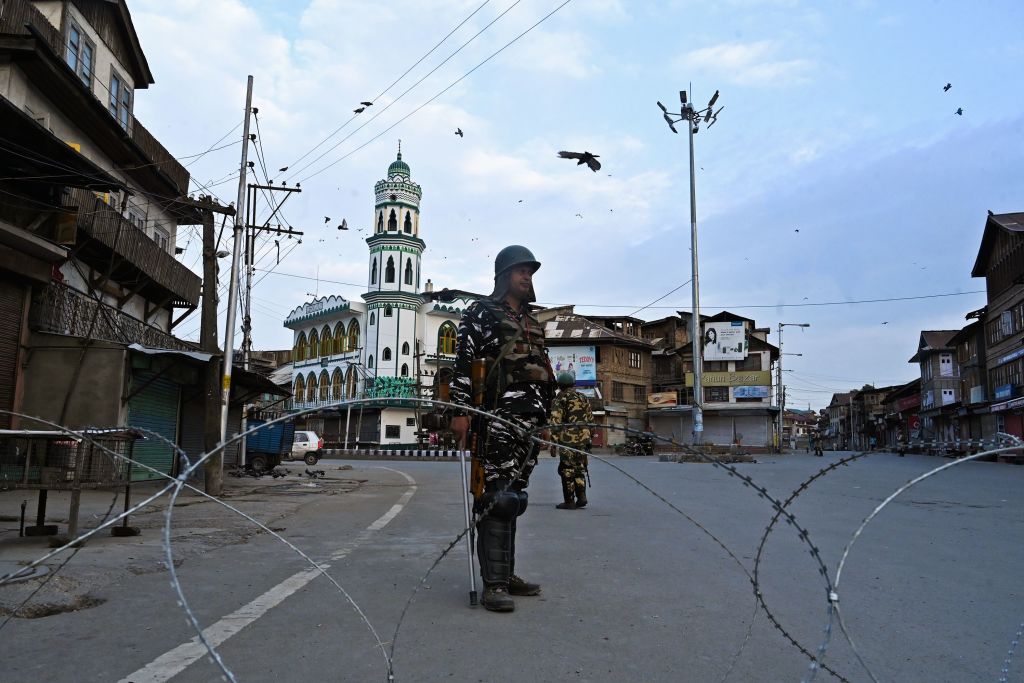
Security personnel stand guard on a street during a lockdown in Srinagar on August 12, 2019. (Photo credit: TAUSEEF MUSTAFA /AFP/Getty Images)

We spent five days (9-13 August 2019) traveling extensively in Kashmir. Our visit began on 9 August 2019 – four days after the Indian government abrogated Articles 370 and 35A, dissolved the state of Jammu and Kashmir, and bifurcated it into two Union Territories.

When we arrived in Srinagar on 9 August, we found the city silenced and desolated by curfew, and bristling with Indian military and paramilitary presence. The curfew was total, as it had been since 5th August. The streets of Srinagar were empty and all institutions and establishments were closed (shops, schools, libraries, petrol pumps, government offices, banks). Only some ATMs and chemists’ shops – and all police stations – were open. People were moving about in ones and twos here and there, but not in groups.

Continue reading Kashmir Caged – A Report from the Ground

Shyama Prasad Mukherjee’s Role: Official Myths on J&K Busted

Dear Prime Minister, nothing about Jammu & Kashmir is as your party sees it

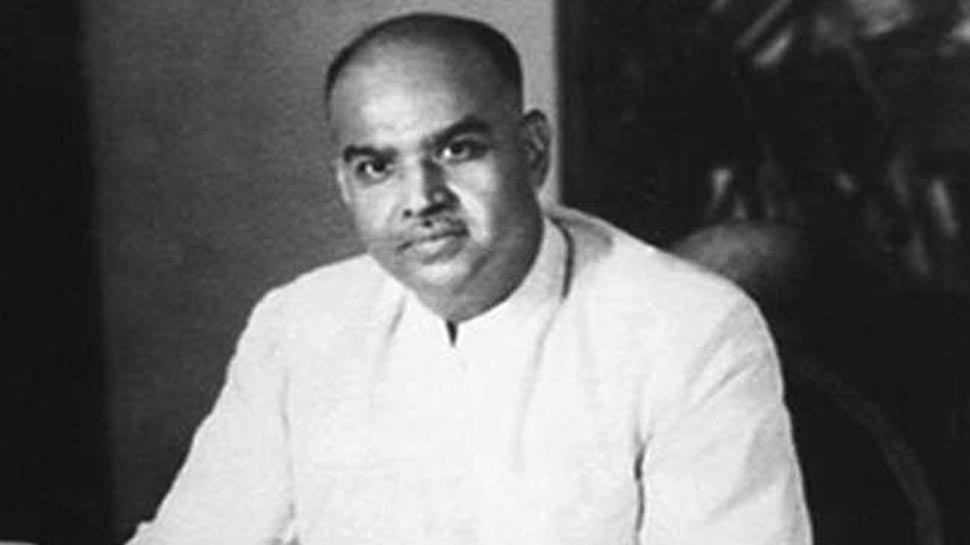
Syama Prasad

Economist and activist Jean Dreze, who has co-authored books with Nobel laureates, such as Amartya Sen and Angus Deaton, was in the headlines for a placard he carried to a protest rally in Delhi earlier this week. His placard challenged the government’s most critical justification for its controversial move to scrap Article 35A and read down Article 370 in Jammu and Kashmir (J&K). The placard displayed statistics that compare J&K with Gujarat, which is Prime Minister Narendra Modi and Home Minister Amit Shah’s home state. Dreze clearly showed how Gujarat lags behind J&K on a raft of development indices.

Although Dreze’s data beautifully punctures the government’s claim that J&K’s special status was a hindrance to its progress, Modi in his address to the nation on Wednesday night repeated the same argument, based on dubious claims. For instance, his claim that J&K lags behind other Indian states in matters of health services, education and so on, is patently incorrect.

Figures recorded in the National Family Health Survey (NFHS) has extended the debate further and shown that J&K already excels many other Indian states on several human development counts. Once again, this underlines that all talk about how “development” will reach J&K after Article 370 is made redundant is sheer humbug.

The propagation of false information brings home the fact that the government has gone very far to generate legitimacy for its decisions in J&K. In his address to the nation, Modi also said that his government had “fulfilled the dreams of [BR] Ambedkar as well as [the then Home Minister Vallabhbahi] Patel”.

( Read the full article here : https://www.newsclick.in/index.php/shyama-prasad-mukherjees-role-official-myths-jk-busted)

Return of Hindutva: A Challenge for Secularism

Guest Post by Gargi Chakravartty

BOOK REVIEW

Hindutva’s Second Coming by Subhash Gatade; published by Media House, Delhi; 2019; pages: 272; Rs 395 (US $ 18).

The return of Modi to power with a huge margin in this 2019 election is a clear verdict for the Hindutva plank. Why and how it happened leave us, the secular billions, to ponder about the reality and its aftermath. And at that juncture Subhas Gatade’s 272-page analysis titled ‘Hindutva’s Second Coming’ gives us something concrete to think over once again. This in-depth study with rich academic perception is a commendable work, bereft of jargons and convoluted expressions, often found in books written from a high pedestal which goes beyond the mental reach of lay readers. Precisely for this reason the author needs to be specially acclaimed for bringing out facts at one place based on notes and references which are so far scattered in divergent historical materials. It serves as a Reader for millions who are combating communalism and distortion of history at the grassroot level.

( Read the full text here : http://www.mainstreamweekly.net/article8847.html)

Against Aachaaram: Srinarayana Guru

The excerpt below is translated by DARSHAN SUBRAMANIAM. The note that follows is by J Devika.

Continue reading Against Aachaaram: Srinarayana Guru

Against Aachaaram: A Dossier from Malayalam – Announcement

This is to announce a new series of postings I will be doing, relating to aachaaram in Kerala.

Aachaaram is loosely translated as ‘customary practices’ or ‘customary rituals’, but in 19th century Malayali society, it referred to a massive, inter-connected, all-pervading web of practices, rituals, and ideas which bolstered the domination of the upper-castes — in Kerala’s context, this meant the Brahmin-sudra nexus — over the lower castes. It touched the most intimate and personal aspects of a person’s life; through it,  the allegiances and the labour of lower caste communities were extracted to benefit the upper castes. The lower-caste assertions of the late 19th and early 20th centuries here, through which modern democracy became a possibility at all, were directed against this web. Aachaaram, however, survived this phase through shrinking its spatial presence to savarna homes and temples; later, after the re-consolidation of brahmin-sudra power, towards the end of the 20th century, the rise of spiritual capitalism had led to aacharam’s resurrection as the vehicle of gendered savarna power — and as the provider of opening gambits for the Hindu fundamentalists — in Kerala .

In this series, I will post translations of selections/excerpts from the writings of the critics of aachaaram from early 20th century Kerala, with short reflections on each for the present. The many different readings of Hinduism that arose in that period when the Brahmin-sudra nexus was thrown into confusion, as well as the many different dreams of social liberation from different parts of the world that entered Malayali society then — from C Krishnan’s Buddhism to Marxism — produced powerful critical exposures that revealed aachaaram to be nothing but a vehicle and instrument of the power of certain groups over others. The effort made by these voices to point to the danger that it posed to a dream of a just society was largely ignored by the mainstream, especially the mainstream left.

The first of these is an excerpt from a conversation between the well-known social revolutionary, the avarna-born seer, spiritual leader, and philosopher, Srinarayana Guru and his disciples in which the annual pilgrimage to Sivagiri was planned, which I will post separately.


Statement of Academics on Rabindra Bharati University Incident of Harassment

Dear Friends,

As some of you might be aware, our friend and colleague, Dr. Saraswati Kerketta (Assistant Professor in the Department of Geography, Rabindra Bharati University), has recently been a victim of caste-based attack in the university. We write this statement to unequivocally condemn the attack.

We, the concerned faculty members/research scholars across institutions in India and abroad, are deeply disturbed by this incident of caste-based attack on Dr. Kerketta. Dr. Kerketta is a young faculty member from a Scheduled Tribe background, and the sole faculty member appointed in a substantive position in her department, thereby taking on the tremendous task of running the department on her young shoulders. This brazen instance of caste-based harassment meted out to her by a group of students who claim to be affiliated to a political party has hurt and disturbed us immensely as citizens of India. The nature of attack meted out to her – for instance she has been followed by the students up till home after the incident – also showcases the gendered nature of her vulnerability. The incident has been followed by mass resignation on the part of other faculty members from various positions in the university, thereby showing indirect proof of the same.

Continue reading Statement of Academics on Rabindra Bharati University Incident of Harassment

Celebrating Dalit Achievements: C. K. Raju

Guest post by C.K. RAJU

It was B. R. Ambedkar who first publicised the 22 Mahar names inscribed on the pillar commemorating the battle of Bhima-Koregaon.  Ambedkar, a Mahar himself, had experienced great indignities, and everyone appreciates his quest for a symbol of dalit achievement. Much has been written since on Bhima-Koregaon, but one question has not been asked:  is there really such a paucity of symbols of dalit achievement?

Not actually. There is no dearth of dalit and ‘lower caste’ achievers. Sages from such backgrounds range from Valmiki, author of the Ramayana, to Tukaram, Kabir, and Sri Narayana Guru. Dalit warriors and kings range from the Nanda dynasty, mere reports of whose mighty army so frightened Alexander’s troops (according to Plutarch), to the Chalukyas (who were dalits according to Bilhan), the Bhils, the Gonds, and to Udham Singh who avenged Jallianwallah Bagh.

Continue reading Celebrating Dalit Achievements: C. K. Raju

Statement on the People’s Resistance against the Citizenship Amendment Bill : New Socialist Initiative

This is a guest post by New Socialist Initiative

New Socialist Initiative stands in solidarity with the people of Assam, Tripura and the other North Eastern states in their heroic struggle against the communally motivated Citizenship Amendment Bill (CAB). It was only because of the resistance of the people that the government couldn’t table the Bill for voting in the Rajya Sabha after surreptitiously passing it in the Lok Sabha. This is in fact a victory for all the progressive and democratic forces of the country,who have been fighting to save and expand the secular character of the nation. While the danger still looms large and there is a strong possibility that the government may try to bring back the bill in the upcoming budget session, the mass resistance of the people has demonstrated very clearly that the evil designs of the fascists in power will not go unanswered and that the people will fight back with all their might. Continue reading Statement on the People’s Resistance against the Citizenship Amendment Bill : New Socialist Initiative

Thejus – The Death of a Daily Newspaper

[This is a GUEST POST by N P CHEKKUTTY]


It is rarely that a journalist writes about himself or herself, because they are supposed  to be detached observers of history-in-the-making. But this time I cannot help it because one of the things that happened in the Sabarimala-obsessed state of Kerala this week happens to be the demise of Thejas, a daily newspaper that I was associated with for almost 14 years. It was a death foretold over two and half months ago, but no one took notice and no one raised any serious concerns about the passing of a newspaper that existed in our civil society for over a decade. It is sad that the newspaper which was known for its fierce anti-Sangh Parivar positions leave the scene just a few months ahead of a general election that will decide the future course of this country. Continue reading Thejus – The Death of a Daily Newspaper

Hindutva Terror and Left Hegemony: After Women’s Entry into Sabarimala

Hours after the two women entered Sabarimala, the Hindu terrorists began their handiwork. Mad mobs, including women, began to roam the streets and attack by-passers, in their desperation to foment violence and provoke riots. In Karunagappally, Muslim establishments and shops were singled out for vandalism. The Sangh-backed Sabarimala Action Council called for a hartal today and they have spared no effort to make sure that people are terrorized. Continue reading Hindutva Terror and Left Hegemony: After Women’s Entry into Sabarimala

IIT-Madras, a Modern Day Agraharam ?

The institute’s recent order, now withdrawn, of separate entrance for non-vegetarians is just a part of the overall policing and push for vegetarianism after the Modi government’s ascent.
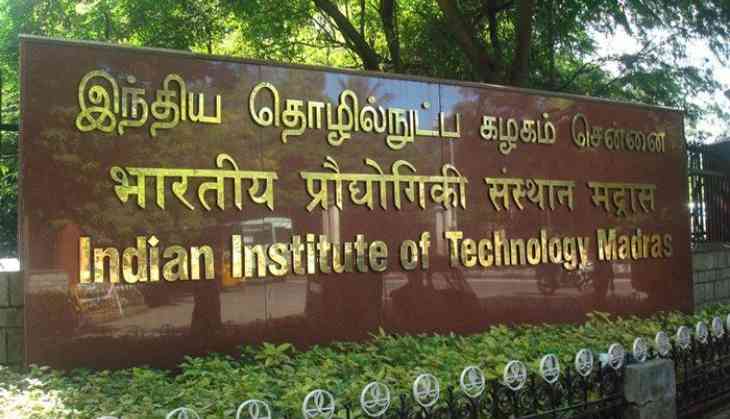
IIT Madras
Image Courtesy: Catch News


Nagesh (name changed), a bright student at the Indian Institute of Technology- Madras, who hails from a very poor economic background, had a shock of his life when he was entering the hostel mess. Someone literally stopped him at the gate and asked him to enter the mess from the other door if he is not a vegetarian.

A notice was duly pasted at the entrance of the mess, informing everyone of this ‘new order’. Even separate basins were demarcated for the students’ cuisine choices. Talking to a reporter with rage in his eyes, Nagesh questioned how the IIT-Madras management could issue such a discriminatory order without even consulting the students.

As of now, the notices have been removed after taking into consideration the uproar this ‘untouchability of a different kind’ caused at the national level. management is now trying to save itself by putting the blame on the caterer. Anybody can guess that a caterer, who is basically a contractor serving food for a fixed period, cannot suddenly disturb the existing arrangements, divide the mess into two separate sections, and have the courage ‘instructing’ his customers to use separate gates.

Commenting on this episode, the Ambedkar Periyar Study Circle – a student group within the institute- which brought this issue to national attention, says:

“Caste masquerades as something else in ‘modern’ society. In IIT Madras campus, it manifests itself as separate entrance, utensils, dining area and wash area in the mess for vegetarian and non-vegetarian students…:

( Read the rest of the article here : https://www.newsclick.in/iit-madras-modern-day-agraharam)

Continue reading IIT-Madras, a Modern Day Agraharam ?

पवित्र गाय, त्याज्य लोग !

..बुलंदशहर की घटनाएं इस बात की ताईद करती हैं कि  हिंदुत्व वर्चस्ववाद का यह नज़रिया जिसमें मानवीय जीवन के प्रति गहरी असम्वेदनशीलता और असम्पृक्तता  टपकती है और जो एक चतुष्पाद को पूजनीय बनाती है, आज उरूज पर है।..

( Photo Courtesy : indianculturalforum.in)

कभी कभी एक अदद वक्तव्य किसी नेता की एकमात्र निशानी बन कर रह जाती है। विश्व हिन्दू परिषद के नेता गिरिराज किशोर इसका क्लासिकीय उदाहरण कहे जा सकते हैं जिनका नाम लेने पर अक्सर उनका विवादित वक्तव्य ही लोगों की जुबां पर आ जाता है। याद है कि उन्होंने कहा था कि ‘‘पुराणों में गाय को मनुष्य से अधिक पवित्रा समझा गया है।’’

वह अवसर बेहद शोकाकुल करनेवाला था, जब उनका वह वक्तव्य आया था। दिल्ली से बमुश्किल पचास किलोमीटर दूर दुलीना नामक स्थान पर पांच दलितों की भीड़ द्वारा पीट पीट कर हत्या कर दी गयी थी Continue reading पवित्र गाय, त्याज्य लोग !

Remote Islands, Savage Tribes: Sajan Venniyoor

Guest post by SAJAN VENNIYOOR

If you key in “remote island” on Google, most of the news stories it throws up are about an unfortunate and very dead young man named John Allen Chau. If you type in “remote Indian island”, Google will take you immediately to North Sentinel Island.

We are all, by now, familiar with sad tale of John Allen Chau and his ill-fated voyage to Sentinel Island. A young evangelical from the United States, Chau was – apparently from a very tender age – fired with zeal to convert to Christianity the natives of a very specific island in the Bay of Bengal: viz., North Sentinel Island in the Andaman & Nicobar archipelago.

John Allen Chau

Continue reading Remote Islands, Savage Tribes: Sajan Venniyoor