Category Archives: Images

Hard Ways of Lucidity – Thinking About the Crisis in the University: Prasanta Chakravarty

Guest Post by Prasanta Chakravarty

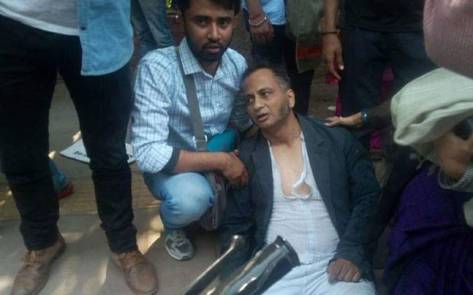
As I see it, university spaces are being assaulted at least from two sides; though it seems as if the two sides are antagonistic to each other, in practice they come dangerously close to each other. How and why is this happening, and what can be done about it?

Prasanta Chakravarty, immediately after being assaulted on February 22nd. Image from the India Today Website.

Continue reading Hard Ways of Lucidity – Thinking About the Crisis in the University: Prasanta Chakravarty

A Small Matter of Security – Holding the Guilty Accountable for What Happened in Ramjas College on the 22nd of February: Shafey Danish

This is a guest post by SHAFEY DANISH

imag0406
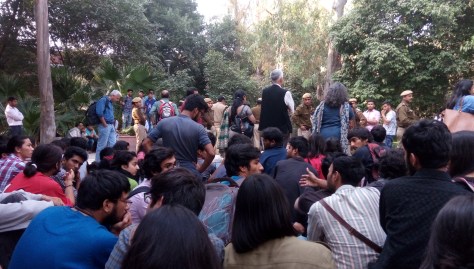
Ramjas students and faculty held hostage inside campus by ABVP cadre

The violence that gripped Ramjas College on the 21st and 22nd of this month is now national news. We heard belligerent slogans by ABVP members of ‘chappal maro saalon ko’ (beat them with slippers), we saw students being chased on the campus, and we saw students being beaten up. All this culminated in a situation where students and teachers were held captive for over five hours within the campus premises. Let me emphasize that this violence was completely unprovoked.

On the 22nd of February, some of the students who were simply sitting with their friends were attacked. The police came and formed a cordon around them. Others joined the students in a gesture of solidarity. Teachers joined them to ensure that the students were not assaulted. The police cordon became their prison for the next five hours. And even then they were not safe.

They were repeatedly assaulted, threatened, and abused. All of this happened in front of their teachers and, more importantly, in front of the police, who, as is well known by now, did not do anything substantial. They could have maintained the cordon around the protesters, arrested those who were repeatedly carrying out the assaults, or – at the very least – prevented the attackers from coming back in (they had left for some time to attack the protest going on outside). But they did not. Whether this was because they were under pressure or because they were complicit is besides the point. The point is that students and teachers remained at the mercy of their attackers for over five hours.

But on the same day something far more ominous was also going on.

Continue reading A Small Matter of Security – Holding the Guilty Accountable for What Happened in Ramjas College on the 22nd of February: Shafey Danish

ABVP Riots in Delhi University with Police Protection

For the second successive day, goons affiliated to the RSS-BJP backed right wing student mafia gang called ABVP (Akhil Bharatiya Vidyarthi Parishad) pelted stones and violently attacked peaceful assemblies of students and teachers in Delhi University. Journalists who were present were also beaten up. Phones and cameras and filming equipment were destroyed. An attempt was made to strangle a professor with his own scarf. He, and some other students who were injured had to be hospitalized. Luckily, they are shaken, but out of immediate danger. The incidents have been characterized as ‘clashes’ between right wing and left wing student groups by some sections of the media. Nothing can be further from the truth. These were not ‘clashes’. They were straight-forward one sided attacks by a mob intent on violence. A riot is not a clash. Continue reading ABVP Riots in Delhi University with Police Protection

Rain and Revulsion: Prasanta Chakravarty

This is a GUEST POST by Prasanta Chakravarty

“Slime is the agony of water.”

~ Jean Paul Sartre, Being and Nothingness


The Birth of Revulsion – Pranabendu Dasgupta

No certainty where each would go —
Suddenly the descent of a cloudburst, rain.
We stood, each where we were,
And stared at one another.
It is not good to be so close
“Revulsion is born” – someone had said

“Revulsion, revulsion, revulsion.”
Then, lighting a cigarette, some man
Muttered abuse at another next to him.
Like an abstract painting, spiralling like a gyre,
In a wee space
We slowly fragmented, dispersed.
Had it not rained, though,
We would have stepped out together.
Perhaps to the cinema, tasting a woman’s
Half-exposed breast with the eye,
Then laughing out loud,
We could head for the maidan!
Someone maybe would sing; someone
Would say, “I am alive”.

But it rained.

(Krittibas, Sharad Sankhya,  1386)

 ঘৃণার জন্ম

প্রনবেন্দু দাশগুপ্ত

কোথায় কে যাবে ঠিক নেই —
হঠাৎ দুদ্দাড় ক ‘রে বৃষ্টি নেমে এলো।
যেখানে ছিলাম, ঠিক সেইখানে থেকে
আমরা পরস্পরের দিকে তাকিয়ে রইলাম।

এত কাছাকাছি থাকা খুব ভালো নয়।
” ঘৃণার জন্ম হয় ” –কে যেন বললো
” ঘৃণা, ঘৃণা, ঘৃণা। ”
তারপর সিগ্রেট ধরিয়ে, আরো একজন
খুব ফিশফিশ ক ‘রে
পাশের লোককে গাল দিলো।
বিমূর্ত ছবির মতো তালগোল পাকিয়ে পাকিয়ে
ছোট্ট জায়গা জূড়ে
আমরা ক্রমশ ভেঙে, ছড়িয়ে পড়লাম।

বৃষ্টি না নামলে কিন্তু
আমরা একসঙ্গে বেরিয়ে পড়তাম।
হয়তো সিনেমা গিয়ে,রমণীর আধ -খোলা স্তন
চোখ দিয়ে চেখে
তারপর, হো হো ক ‘রে হেসে
ময়দানের দিক যাওয়া যেতো !
কেউ হয়তো গান গাইতো ; কেউ হয়তো
বলতো “বেঁচে আছি “।

কিন্তু বৃষ্টি নেমেছিলো।।

(কৃত্তিবাস, শারদ সংখ্যা ১৩৮৬)

Continue reading Rain and Revulsion: Prasanta Chakravarty

Longing for the World: A Memoir of Two Days at the Kochi Biennale

[Disclaimer: I am not an art critic, artist, or travelled in the world of art. This is just a memoir]

(I)

Fort Kochi, 9 Feb. 2017

Though I had already been to the biennale in January and had a roaring time, something kept urging me to go there again. That something, I believe, is my insatiable imagination – which has always had a life of its own as long as I can remember, needs to be fed all the time, and actually drives me crazy. But maybe I should be thankful: if I survive this loveless existence that is my life, it is because my imagination has always spirited me away even from the midst of the worst emotional violence and uproar. Social theorists who use trickster figures or such characters as Daedalus who give power the slip, or manipulate it to their own ends, are probably saying the same thing.

The only ‘Moral Science’ lesson I remember from school was from the fourth standard, about the invisible guardian angel who supposedly protected us from evil. What intrigued me was the suggestion that each of us had a special angel-companion of our own who was ever-present though invisible – quite a lovely idea to a lonely child who found it hard to blend and settle into her playmates’ world. For me that was the unseen power which transformed a boring class into a musical concert by playing music inside my head; wove words and images into tales there; scared me sometimes, but equally let me exorcise the fear; and led me to all sorts of nooks and corners in the house and the yard and showed me all sorts of things, almost a world that I, but no one else, could see.

I pulled myself out of the world of research that employed, that did not satisfy, my imagination, and went again to the biennale. Two golden days! No words exist to reveal how my heart sang at the prospect. And besides, I was going to stay with dear, beloved friends, people who lived steeped in imagination – unlike me, whose current existence involved the use of the imagination (though it can never be mastered fully for sure) in a self-conscious way. My friends who run a little homestay near Fort Kochi reach out to others with extraordinary warmth mainly because, I think, their world is so incredibly diverse – populated by not just all sorts of diverse human beings, (rich, poor, high, low, of different faiths and castes, related by marriage, friendship, acquaintance, country-cousinship, common humanity, vague feelings of familiarity and so on), but also by spirits, saints, gods, all of who are felt and reached. Continue reading Longing for the World: A Memoir of Two Days at the Kochi Biennale

Maternity Entitlements were Legal Rights 3 years ago, not a New Year Gift: Statement of the Right to Food Campaign


On New Year’s Eve, the Prime Minister in his much-anticipated speech amongst other commitments made a vague announcement of a “nation-wide” scheme for maternity entitlements for pregnant women.

But the PM has not spelled out any specifics – neither the timeframe;budget nor its universal coverage as obligated in the National Food Security Act (NFSA) since2013. Clause 4B of the law already promises all pregnant and lactating women maternity entitlements of atleastRs 6000 for each child. But for three years, the central government didn’t honour this legal obligation. Though better late than never, re-packaging this legal right as the PM’s New Year gift is disingenuous.

Further media reports, from December indicate that the Finance Ministry may hike the budget by a mere 20 percent (instead of the sevenfold increase necessary for universalisation) and that too restrict the benefit to only women Below the Poverty Line (BPL). This would be in complete violation of the NFSA.

But there seems to bearecurring trend to subvert the law. For the last three years, this government continued with the pilot Indira Gandhi MatritvaSahyogYojana (IGMSY) in just 53 districts of the country despite repeated demands by civil society activists and women from across the country. This year, Right to Food Campaign activists from across India even sent postcards to the PM to remind him of the state’s obligation.

In September 2015, even the Supreme Court issued notices to the Centre on the non-implementation of maternity entitlements under the NFSA.

While the government did initially enhance the IGMSY allocations from Rs 4000 to Rs. 6000 to be in tune with the NFSA, neither the coverage nor the budget was enhanced which languishes at Rs. 400 crores. Instead to ensure that all eligible women are covered as per the NFSA, Rs 16,000 crores is necessary. A real test of the Prime Minister’s announcement will be in the fine print of the allocations in next month’s budget.

On Barak Valley Bandh on 16th December, 2016 – Some Nascent Observations: Arunima Chakraborty

This is a Guest Post by ARUNIMA CHAKRABORTY

Let’s begin with the usual: by ruing over Indian mainstream media’s overlooking of what could have been treated as more newsworthy. Today, that is, 16th of December, 2016 witnessed a bandh in southern Assam’s Barak valley protesting against the statement by the union minister of state for railways, Rajen Gohain that ‘Bengali…should be withdrawn from Barak valley as official language’ since ‘there cannot be two official languages’.[1] And a simple, layman-like google-news search reveals that there are just three entries on the issue/event.

This piece is aimed not at joining the state Congress and the local SUCI(Socialist Unity Centre of India) cadres who are decrying comment by Gohain, the union minister and a senior BJP leader in Assam but rather at attempting a delineation of the ominous portents which it seems to have unleashed. And of course, to trace the genealogy of the statement.

First of all, a rather facile fact: Mr. Gohain’s observation that there cannot be two official languages clashes with article 345 of the Indian constitution which allows for the adoption of one or more official languages by any state of the Indian union. Article 347 also allows for respecting the desire of a significant section of a populace of a state for the usage of a language of their choice.[2] A couple of months ago, while visiting Assam, I watched, or rather listened, on an Assamese news channel, a shrill voice issuing a caveat to its viewers, “…barak upatyakat asomiya bhasha nokoya hoiche”. ‘Assamese is no longer spoken in the Barak valley’. Anybody remotely familiar with the history of the region could have retorted back with the question, when was Assamese ever spoken in the region?

Continue reading On Barak Valley Bandh on 16th December, 2016 – Some Nascent Observations: Arunima Chakraborty

On Indian Exceptionalism and Kashmir: Dia Da Costa

This is a guest post by Dia Da Costa

‘If Trump is elected, I will move to Canada,’ many Americans noted in passing, in jest, and then in all seriousness once the results were out.

If it has taken this election result to make people recognize the pervasive racism in the US, that is because of the success of US exceptionalism and its ability to deflect attention from its ongoing colonization of indigenous land, relentless imperialism, Islamophobia, and ongoing brutalities against black people in the aftermath of abolition and the civil rights movement. If it has taken this election result to make people really want to move to Canada, that too is because of the success of Canadian multicultural exceptionalism. Apparently, Canadian exceptionalism is still able to pass as not-as-racist by deflecting attention from its ongoing colonization of indigenous land, relentless participation in imperialism cloaked all too often as humanitarian development, growing Islamophobia, and its self-congratulatory representation of itself as having no history of slavery even as its anti-Black violence pervades cities and small towns alike.

For those of us who can recognize these forms of exceptionalism, I want to ask if we acknowledge Indian exceptionalism, and its specific relation to Kashmir? ‘If Trump is elected, I will move back to India’, I saw many Indians say on social media. If it has taken this US election result to make Indians really want to move back to India, that is not just because of the apparent success of US exceptionalism among Indians, who could see racism but could ultimately deal with, and even love life in the US. It is also because of Indian exceptionalism. To be sure, Indian exceptionalism is nurtured by the caste and class privilege that allows some Indians to declare that they will simply up and leave when the going gets tough (whether it is in India or in the US), or joke about the same.

But there is more to it. Indian exceptionalism is a state projected discourse turned commonsense perception of India as a complicated and diverse nation that is ultimately unified against all odds by the absolute commitment of its people to democracy. Whether we believe it at face value or we critique the many excesses of the Indian state, ultimately something draws us to this idea of India as the world’s largest democracy. Continue reading On Indian Exceptionalism and Kashmir: Dia Da Costa

Memories of a Machine, or the Machine of Memory?


Watching the much-debated ten-minute-film ‘Memories of a Machine’, which has been accused of justifying paedophilia, I remembered this woman:

I met her, a young woman professional working at Technopark, Thiruvananthapuram – where else, in these days, but in the queue in front of an ATM . In response to my grumbling, she told me that she had never experienced any kind of power in her whole life.  She had not even been affected by demonetisation much, she insisted. ‘True, I couldn’t pay the dhobi and the ironing-man, but those were minor inconveniences,’ she quipped cheerily, quite convinced, of course, that the predicament of these two people, definitely as much professionals’ as her, was none of her concern. Indeed, her constant effort was to cheer people in the queue with her don’t-worry-be-happy body-language with which she slipped and slid between acting and sounding like a grown woman and chirping and giggling like a teenager or child. She was attracted to the BJP, she said, because she needed some ‘philosophy’ in her life, to balance the heavy workload she carried in her workplace. As far I could see, her life was such that the philosophy-lesson she would find useful could have been obtained from something as commonplace as a treadmill – start slow, peak up, take regular dips, continue for a spell sufficiently long, stretch after the workout. In other words, her life seemed to be just one long workout, with no indication of when it would end or yield result. But just the feeling that she was on her way was enough to make her cheery to the point of being silly. Continue reading Memories of a Machine, or the Machine of Memory?

Alchemies of Art and Resistance in Kashmir

Bertolt Brecht, was to write

“In the dark times

Will there also be singing?

Yes, there will also be singing.

About the dark times.”

Violence, persistent and unending, creates an alternative reality, a festering, perverted, horrible, surreal reality. Violence, unending and unrelenting erases all memories of times past, Memories of times when another reality existed, It is this alternative reality that begins to redefine imagery, ideas, sensibilities and begins to creates a new grotesque discourse, a discourse in which the ugly face of fear and death becomes the normative. I’ll give you one example of how this works. Continue reading Alchemies of Art and Resistance in Kashmir

The Anatomy of a Disappearance: Shehla Rashid

Guest Post by Shehla Rashid. Videos by Haider Saif and Samim Asgor Ali

Students Gathering in a Vigil for Najeeb Ahmed at JNU


Think of the person closest to you, and the place that they hold in your daily life, the bittersweet memories that they create each day in your life, the daily fights and the moments of affection. At times, you fight and simply want to go away from one another, seeking a temporary calm from each other’s absence. You resolve never to call him/her again, or to speak to her/him anymore. However, by the time dusk falls, you realise the emptiness of your time without them, and you make a phone call, speaking reservedly, trying not to sound desperate or sappy. You tell them that you are coming home, and ask whether you need them to get anything- as if that were the reason for the phone call. This person could be you sister, your partner, or your best friend. Continue reading The Anatomy of a Disappearance: Shehla Rashid

The Cult of the Angry Pointed Finger, or How I learned to Stop Worrying and Love the Father

The recent order by the I&B Ministery to NDTV India to suspend broadcast for 24 hours drew a range of reactions from outrage to bewilderment. The supporters of the ruling party were of course triumphant – Subhash Chandra of Zoo, er sorry Zee News was so excited he wrote a whole article on this. But even outside the partisan responses, many well-meaning self-declared neutral janta declared that national security is not a matter to be trifled with, and that it was right for the government to admonish NDTV. Wait, ADMONISH?! Never mind that the government’s allegation of NDTV having compromised national security simply doesn’t survive a fact-check. Here is how the largest section of (English-speaking, online) popular opinion sees it.

This token punishment was good and important to show that someone is there who is monitoring the media who always thinks behind the mask of freedom of expression that they can do anything in the world. So it is important that the Government of the Day makes its presence felt otherwise there will more chaos and issues like the UPA government where everyone was going around like headless chicken and no one is bothered or cared if a Govt of Man Mohan Singh existed or NO. Even small timers like the Delhi CM AK and his Guru Anna were threatening and taking morcha in Ram leela Maidan every second day and doing expose every third day putting the Govt. of India on the back foot and in defensive mode running for shelter. Now Arvind Kejriwala and his team is running for shelter as every day a Delhi MLA is shown the door of the JAIL and Anna Hazare has been locked in a shell in his hometown watching the sunrise and the sunset. This means business, It is important that Govt of the India should show it exist otherwise human mentality is that then everyone shows that everyone exist and everyone is the BOSS. Cannot allow to happen like this MESS. PM Modi please keep it up and keep the heat on this reckless media, on AK and his gang, on others who are trying to show unnecessary activism and also the Judiciary, keep all the appointments on hold and let them slog day and night. Show who is the BOSS ! Show who is the BOSS !

Yes, Modi ji, show who is the BOSS!

joffrey_nskwqom3fi1tcgpa7o1_500-1

Continue reading The Cult of the Angry Pointed Finger, or How I learned to Stop Worrying and Love the Father

Anguish and Insurrection – Travelling with Shubha’s Poem: Prasanta Chakravarty

Guest post by PRASANTA CHAKRAVARTY

अतिमानवीय दुख

शुभा
________________

इतना दुख आंसुओं से नहीं उठाया जाता
वे हार गए कब के
चीख़ इसे और वीभत्स बनाती है
गुस्सा तो सिर्फ राख पैदा करता है

कुछ देर इसे ख़ामोशी ने उठाया
कभी उठाया कविता ने
विचार ने उठाया इसे
इसे उठाया दोस्तों ने
मिलकर गीत गाते हुए

कम्युनिस्ट पार्टियां बिखरीं
कितनी बार इसे उठाते हुए

इसे उठाने के लिए
कुछ और चाहिये
इन सबके साथ
उठाने का कोई नया ढब
इतिहास ने इसे उठाया कभी-कभी

अब इसकी चिन्दियां बिखरी हैं
इन्हें बच्चे उठा रहे हैं
यह पहुंच रहा है प्रकृति तक
तूफान और कन्दराएं
उठायेंगी इसका बोझ

अगर धरती इसे न उठा सकी
अन्तरिक्ष में नाचेंगी इसकी चिन्दियां

1.

SUPERHUMAN GRIEF

Shubha

Tears cannot bear such a burden of grief
They gave up a while ago
A scream makes it even more horrid
And anger gives birth only to ash

For a while silence bore it
Occasionally it was borne by poetry
Thought bore it
It was borne by friends
As they sang songs together

Communist parties scattered
so many times as they bore it

To be able to bear it
Something more is needed
along with all of these
a new way to bear it
History bore it on occasion

Now its scraps are scattered
Children are gathering them
It is now reaching nature
Storms and ravines
Will bear its weight
If the earth cannot bear it
Its scraps will dance in the cosmos

(Tr. Suvir Kaul)

* * *

2.

GRIEF WAY BEYOND HUMAN

Shubha

A grief that is way beyond human
Is too hard for tears to hold
Defeated, they dry up before long
Howling makes it only worse, more horrendous
Anger yields nothing but ash

Silence shouldered this grief for sometime
As did poetry
As did ideas now and then
As did comrades singing in unison
History has carried it too

Communist parties fell apart so often
Carrying this burden

Surely we need something different now
To carry it any farther

Grief is everywhere now
Little children are carrying its shredded pieces
It has overcome nature
Caves and storms will bear it

If the planet too fails to contain this grief
Its shreds will swirl and spread
Into empty space beyond

(Tr. Bhupinder Brar)

* * *

3.

SUPERHUMAN SORROW

Shubha

So much sorrow cannot be borne by tears
They gave up a while ago
A shriek makes it more grisly
And anger only births ash

For a while silence bore it
And sometimes poetry did
Thought carried it
And friends too
Singing along together

Communist parties disintegrated
so often while carrying it

Something more is needed
Some new bearing
with the rest to carry it
Now and then history lifted it

Now its bits lie scattered
Children are picking them up
Now it’s reaching into nature
Storms and caves will
bear its burden

If the earth is unable to bear it
The bits will dance in the cosmos

(Tr. Aishwarya Iyer)

* * *

4.

SUPERHUMAN GRIEF

Shubha

Tears can’t bear this much grief
They had been defeated long ago
A scream makes it more grotesque
Anger can only turn to ashes

For a time silence carried the burden
sometimes poetry tried it
Ideas bore it for a bit
And then the friends
singing together

Communist parties disintegrated
trying to carry it ahead

To bear it
one needs something else
A new way
Beyond the known ones
Occasionally history too tried its hand

Now it lies scattered
And children pick up the pieces

It now enters the nature itself
Storms & Caves
Shall lift its burden
If the earth can not bear it
Universe shall see the pieces dance

(Tr. Tarun Bharatiya )

5.

SUPERHUMAN GRIEF

Shubha

Tears cannot bear this burden
They have dried up long ago
A scream makes it bizarre
And anger can only produce so much ash

Silence bore it for some time
Sometimes poetry
Thought carried it
As did friends
singing in unison

Communist parties disintegrated
Umpteen times under its weight

Something else is needed
To lift it
A new way
Along with the familiar ones
History lifted it occasionally

It is scattered into tiny strips now
Kids are picking and carrying them
It is now reaching the nature itself
Storms and caves and ravines
Will bear it

If the earth couldn’t carry its weight
The strips will dance in outer space.

(Tr. Asad Zaidi)

––––

Five translations of a single poem, by five leading poets, activists, artists and/or literary scholars. A rare occasion in contemporary translation on the subcontinent. A special poem it is indeed. Every single one of these attentive readers seems to have been scorched by the primitive, enunciatory power of its pure voice. Every single translation extends the afterlife of the original and shows how Shubha has been able to successfully communicate the force of a guttural shriek into something coherent and universally felt. Continue reading Anguish and Insurrection – Travelling with Shubha’s Poem: Prasanta Chakravarty

It Is About Women: Debating the Violence of the Uniform Civil Code – Kartik Maini

This is a guest post by KARTIK MAINI

The performative art of choice, like most habitations of discourse, is deeply political. To oppose the mythical creature of the Uniform Civil Code (UCC), as heralded by the Bhartiya Janata Party (BJP) and its parent votaries, is to find oneself in the august company of the All India Muslim Personal Law Board (AIMLB); both part, or so I must argue, of the same physics of power. Once again, if one does indeed trace the history of debating the suttee in what is now called the ‘colonial’ period, the spectre of representation (or lack of) haunts us: women are merely the grounds of debate, and the female body a site of contestation in the name of faith. As creatures of active agency, the figure of the woman disappears – not into a pristine nothingness, as Gayatri Spivak cautioned us, but into a violent shuttling of displaced figuration. It is, therefore, time to ask of ourselves the fundamentality of thought. What is the politics of rendering unintelligible the variegated nature of religious traditions and their pronouncements unto ‘uniformity,’ particularly so through the rationale of national integrity in a time when supposed dangers to the same are declared seditious? Is it not our collective responsibility to be virulently against the employment of the expressed and expressive agony of women to insidious political ends? What, finally, of those who lie at the interstices of ‘men,’ ‘women,’ and the compulsory heterosexual matrix?

Even in precluding Shayara Bano’s infamous claim on the immediate necessity of all, especially Muslims, to say ‘Bharat Mata ki Jai,’ the communal in the demand for the Uniform Civil Code is an effortless inscription. For one, the Hindu Code, which seeks the creation of uniform laws governing all Hindus, is itself not so – embedded in its semblance of pervasive homogeneity is heterogeneous pliability to the customs and traditions of different communities, as also the restriction in its uniform applicability to social groups that are now designated as the Scheduled Tribes. While Article 44 of the Indian Constitution exhorts the nation state to create a ‘uniform civil code’ for all, the Constituent Assembly had no perspectival clarity on what it would look like; B.R. Ambedkar elucidates that such a code ‘need not necessarily be mandatory.’ In fact, beyond the obvious ambiguity of Article 44, the glorious prospect of the Uniform Civil Code only finds silence, and in not being addressed in specificity, is subsequently regaled with the obstructions of political autonomy, detailed as they are in the articles and schedules on Kashmir, Nagaland, Mizoram, Assam, Tripura, and Meghalaya. In other words, the binary between the Uniform Civil Code and communalism, between Hindutva and the mythical uniformity that must now be forged against this ‘problem’ of diversity is a fundamentally false one – there is no independent discursive existence of the Uniform Civil Code, if the circular ruins of its debate are to tell us anything, besides its violent deployment against the personal laws of the Muslim community, Muslims in particular, and as it may now be said, against the idea of India in general. The indivisibility of the undivided Hindu family, tangential, if not absent, as it has been to the contention on the Uniform Civil Code, is a loud, almost resounding declaration of its essential purpose; to collapse unto its exercise the subjective agency of the patriarchal paradigm of ‘women’ collapses its very structure.

In a strongly worded missive, Noorjehan Safia Niaz of the Bharatiya Muslim Mahila Andolan (BMMA) expounds, ‘We condemn the attempt to politicize the debate by mixing up of the abolition of triple talaq – the demand for whose abolition we strongly reiterate, with the move by the Law Commission seeking views from the public on the Uniform Civil Code. These are two separate issues, and should not be treated as similar.’ Of the many meanings that azaadi has now taken, this statement of the BMMA is instructive in the difficulty of politics: as Muslim women today stand at the altar of the supposedly emancipatory modern state, complete with its accompanying structures of governmentality, their courageous struggle against the maulana-headed jamaats has reached a befitting crescendo. ‘The court is our jamaat,’ they declare, in Jyoti Punwani’s eloquent piece. Truly, the progressive thrust of judgements as Shamim Ara v. State of U.P.(2002) has faltered in its promise of remedying the inscription of subordination in the Muslim personal law, and revolution, as we know it, is in the offing. It is not my case, or, for that matter, of progressive groups that are now in the line of fire for having ‘lost the plot,’ to stand against this calling, indeed, this making of history. But history is replete with its uncomfortable lessons. It tells us tales of progression hindered by violent appropriation, of causes obfuscated by the malevolent reasons of statecraft, and of representation that fails to present its subjects. To struggle against the patriarchy of laws, then, is a struggle of its own, and therein is the opposition to the Uniform Civil Code. Historians are forgiving. History, and we need not search too arduously, is not.

Yet, appreciating the struggle that asks of the state must not presuppose an unproblematic depiction of the state itself. Indeed, if the state legitimises, then it must also render illegitimate. Such has been the case of a people who are, in a very particular expression of otherness, called the queer. Even as the Indian state, in all its time of being a modern, independent republic, debates the realm of the personal, it is our collective ignominy that what is debated as the personal eludes the queer. It is a denial, not merely of recognition, but of personhood. As the queer have sought to enter state registers of legitimation, they have had to confront the always already heterosexual nature of kinship; the governmentality manifest in personal laws and cultural politics, a totalising pontification of the compulsory heterosexual matrix, the violent institution of marriage, and, invariably, of monogamy. To queer the question of personal laws, even of the infamous Uniform Civil Code, is thus to challenge their fundamental premise: the systematic, seamless reproduction of heterosexuality, patriarchal relations, and above all, of violence. Is not, then, the making of queerness a simultaneous unmaking of how we debate the personal?

[Kartik Maini is at St Stephen’s College, Delhi]

2 Weeks No #JusticeForNajeeb – A Few Thoughts on Yesterday’s March and the Way Forward: Shehla Rashid

Guest Post by Shehla Rashid.

Video and Photo Inputs from Naushad MK, Samim Asgor Ali and Amit Kumar

[ This post was written shortly after JNU students gathered in front of Vasant Vihar Police Station to articulate their concern and anger at the lax attitude taken so far by the Delhi Police and other concerned authorities in relation to the disappearance of Najeeb Ahmed almost two weeks ago. In this text, (originally uploaded as a note on Facebook and then sent to us to be posted at Kafila) Shehla Rashid, thinks aloud about what has happened so far and looks ahead at the possible way forward for the students of JNU and their supporters to focus on making sure that Najeeb Ahmed, wherever he is, returns safe and sound to the JNU campus. We hope that it will be widely read, and discussed to evolve strategies for the evolving future of the campaign to give justice to Najeeb. Kafila]

Shehla Rashid and Others Being Confronted by Delhi Police at the Vasant Vihar Chakka Jam on Oc. 26, 2016


First of all, I’d like to express my gratitude to all the students who joined the Chakka Jam at Vasant Vihar police station, where the ACP refused to even accept the paper with our demands and, instead, ordered a lathi-charge on us. Students marched as one and stayed together till the end, despite all differences, for one goal- justice for Najeeb, and his safe return to campus life. I salute this spirit of JNU students. Having said that, I must say that we need to do more. Students need to come out in even greater numbers, as the attack on us is of immense magnitude.

Continue reading 2 Weeks No #JusticeForNajeeb – A Few Thoughts on Yesterday’s March and the Way Forward: Shehla Rashid

Requiem for the Undead: On Kerala’s Sixtieth Birthday

[The title is a tribute to Johnny Miranda’s exquisite Malayalam novel, Requiem for the Living (Jeevichirikkunnavarkku Vendiyulla Opees in Malayalam)

As Kerala’s sixtieth birthday – a year which was inevitably one of celebration for many Malayalis as the culmination of life, until the increasing life expectancy here rendered it redundant – approaches, evaluations on the health and well-being of the region (and not just the people, or individual Malayalis) are being offered. They do not bode well. There is a sense in which we feel that the magic that has somehow protected the region, placed a shining cloak around its shoulders once, has departed. This magic is none other than that which is captured by the term ‘Kerala Model’ – which, in our popular imagination, always exceeded being just social science shorthand for the complex array of historical factors that led to high social indicators in a society characterized by low economic growth once associated with us. The idea of the Kerala Model somehow represented the fairy godmother who had transformed Kerala from being the Cinderella in India, to a shining princess fit to be raised to the heights of the UN’s international development-circles in the 1970s. Continue reading Requiem for the Undead: On Kerala’s Sixtieth Birthday

Ezhuka Tamil – A Conversation about Democracy :Dharsha Jegatheeswaran and Gajen Mahendra

This is a guest post by DHARSHA JEGATHEESWARAN AND GAJEN MAHENDRA


On Saturday September 24, 2016, Ezhuka Tamil, organized by the Tamil People’s Council, became the largest rally to happen since the end of the war in the North-East of Sri Lanka. Over 10,000 people took to the streets to demand an end to ongoing human rights violations, particularly militarization and Sinhala-Buddhisization of the North-East,reiterate their demand for genuine accountability and justice and voice their expectations regarding the ongoing political processes. The political elite in Colombo and their supporters elsewhere have however chosen to read Ezhuka Tamil as an expression of ‘Tamil extremism’. This response requires us to critically interrogate the nature of democratic spaces in post-war Sri Lanka available to the numerically smaller communities and more largely what our understanding of democracy is. This is very necessary if we believe in the need for public participation in the constitutional and transitional justice process currently underway. Continue reading Ezhuka Tamil – A Conversation about Democracy :Dharsha Jegatheeswaran and Gajen Mahendra

Adventures in Creepland: An Open Letter to the District Collector, Calicut, Kerala

This letter is jointly written by the signatories.


Dear Mr Prasanth Nair

We, the undersigned participants of the 7th Queer Pride March held on 12 August 2016 in Calicut, would like to bring to your attention the unforgivably irresponsible attitude of the Kozhikode police towards the rights of young people who identify themselves as queer, and their allies. In what should have been a completely joyous event, their attitude cast a dark shadow, for sure. Continue reading Adventures in Creepland: An Open Letter to the District Collector, Calicut, Kerala

Slow Rendering of an Ache & Mahesh Verma’s Translation : Prasanta Chakravarty

This is a guest post by PRASANTA CHAKRAVARTY


“If the translation of poetry is impossible, then the translation of poetry is a genuine art.”

~Nasos Vayenas, Eight Positions on the Translation of Poetry


Translation is an act in the wake of literature. Both the languages – source and target – are variations on literary themes, with neither having priority. But translation depends on an essential paradox: a collision between restlessness and poise, detachment and recreation. In the best translations of poetry this paradox turns into a synthesis that must remain unfinished. Continue reading Slow Rendering of an Ache & Mahesh Verma’s Translation : Prasanta Chakravarty

Not Pakistan, but Modi has pushed Kashmir on the Brink : Ashok Swain

This is a guest post by ASHOK SWAIN

Since the death of a young and charismatic separatist named Burhan Wani, Kashmir has erupted into violence and chaos. Weeks of violent protests in the Valley have resulted in the deaths of at least 50 people and over 5,000 injuries. Kashmir is not new to violent protests and civilian deaths, but this time the intensity of the protest and the passion of the protesters is unprecedented. Continue reading Not Pakistan, but Modi has pushed Kashmir on the Brink : Ashok Swain

A response to “Kashmir is Feminist Issue” by Sonam Mittal: Tupur Chatterjee

Guest Post by Tupur Chatterjee

Sonam Mittal’s recent piece in Kafila, “Kashmir is Feminist Issue” draws upon an oft-cited gendered analogy to describe the Kashmir’s relationship with India and Pakistan. Though it makes a few pertinent points about the nexus of power and patriarchy and the urgent need for Indian feminist solidarity with the Kashmiri resistance, I found the analogy deeply problematic and strongly feel that it needs further unpacking to underline its worrying implications.

Continue reading A response to “Kashmir is Feminist Issue” by Sonam Mittal: Tupur Chatterjee