Category Archives: Language

Statement about the attacks on Dalits in Bhima Koregaon & the Subsequent developments in Maharashtra : Umar Khalid

Guest Post by Umar Khalid

I went to Maharashtra as I along with other activists and intellectuals were invited to come there. I along with others was a guest there. And I would remember fondly the love and support that I received in Pune and Mumbai. I would remember the resilience and enthusiasm of the people I met and their resoluteness to fight Manuvaad and centuries old casteist tyranny. I would remember the immense inspiration that I felt, when we paid homage to Jyotiba Phule and Savitribai Phule in Phule-wada, Pune. And, No I will not let two days of media trials by a few TV anchors, who are more of professional howlers, spoil these wonderful memories. I will not let their criminal cacophony and mindless vilification of me, Jignesh & others shadow my beautiful memories of Maharashtra.

The state of Maharashtra as well as the rest of the country is at a critical juncture today. On the one hand are forces in power who want to push our country back to many centuries and on the other are people who are resisting this Neo-Peshwahi, the casteist-communal-fascist regime of BJP-RSS. In my speech at Elgar Parishaad on 31st December 2017, I had said that the year 2018 is going to be a very challenging one. The last 3 and half years of the Modi Sarkar has exposed the BJP’s jumlas of Ache Din and Vikas as hollow, bitter and brutal lies.

As the General Elections of 2019 approach, BJP/RSS will now resort to creating civil strife amongst the people, polarising them on the basis of caste and religion and unleashing attacks on muslims and Dalits. The developments over the last few days vindicate me, a little too soon. Several regions of Maharashtra are in the midst of an acute agrarian distress. Both Marathas and Dalits are victims of this agrarian crisis that has been precipitated by the policies of both Modi and Fadnavis. The BJP/RSS regime has no resolution to offer to the farmers of Maharashtra. Therefore, unleashing attacks on Dalits through their hoodlums and portraying it as a caste clash between Dalits & Marathas will remain their only strategy. Continue reading Statement about the attacks on Dalits in Bhima Koregaon & the Subsequent developments in Maharashtra : Umar Khalid

Jignesh Mevani, The Meltdown of Modi-Men and Dadhichi’s Bones

[ This post is based on updates posted by me on my Facebook wall ]

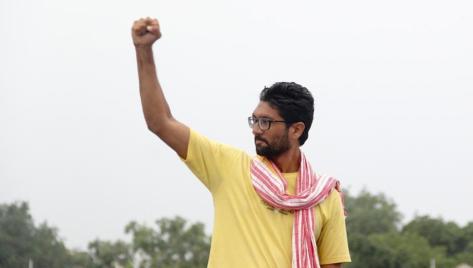
Jignesh Mevani. Photograph by Siddharaj Solanki, HT (Hindustan Times) File Photo, accessed from the HT website

A great kerfuffle has ensued ever since the recently elected independent MLA from Vadgam, Gujarat and Rashtriya Dalit Adhikar Manch activist Jignesh Mevani gave an interview in which he had some choice things to say about the Prime Minister and BJP leader Narendra Modi. Mr. Mevani made some positive and gentle suggestions, to the effect that because Mr. Modi has stopped being relevant, has not delivered on even one of the promises made by him, he should retire, proceed towards the Himalayas, and in the phrase that has caused the greatest commotion, ‘melt his bones’.

Predictably, Mr. Modi’s personal broadcasting service, known as Republic TV has kicked up the greatest fuss. Arnab Goswami has been especially indignant, and he was joined in his rage by BJP spokesperson, the orotund television commentator and historical photo-shop scam artist, Mr. Sambit Patra. Mr. Mevani offered a robust and dignified  refusal to apologize for what he said about Mr. Modi, when Republic TV demanded that he do so. Continue reading Jignesh Mevani, The Meltdown of Modi-Men and Dadhichi’s Bones

An open letter to Brinda Karat: why do female supporters of the Kerala CPIM spew such venom at Hadiya?

Dear Comrade

I can hardly describe the joy and relief I felt reading your piece on the Hadiya case in the Hindu yesterday. By now I am nearly deaf from the cacophony of misogyny, islamophobia, and sheer short-sighted rage that CPM supporters on Facebook are unleashing against this young woman.

Your voice of sanity, Comrade, is therefore a great restorative. If not for your writing, one could have well thought that the CPM was nothing more than a bunch of short sighted, power hungry, strategisers, whose total lack of ethics and values is covered up by a vapid, outdated rationalism and an equally problematic liberalism. You refuse to condemn Hadiya for choosing Islam. You acknowledge that she is brave. You unequivocally reject the father and other minions of patriarchy. You rightly criticise state patriarchy evident in the Supreme Court. Unlike many CPM supporters here, you have no illusions about the times we live in; you are clearly aware that the NIA is not something which will spare us if we stay good. Importantly, you put paid to the idea that the High Court judgement that sanctioned her illegal custody was justified — an idea assiduously nurtured by certain public figures allied with the CPM against religious Muslims. Comrade, thank you again for being so forthright and in the face of snarling islamophobes in your own ranks actually gunning for the voice you raised against her illegal custody long back.

Continue reading An open letter to Brinda Karat: why do female supporters of the Kerala CPIM spew such venom at Hadiya?

Thoughts on the Continuing Assault on Women’s Rights and Progressivist Gaslighting in Kerala

After the atrocious indifference and trivialisation of domestic violence displayed by the sneering alpha-male brigade of the CPM during the discussion of the Hadiya Case, nothing surprises me. However, it appears important to point out how such callousness is indeed becoming normalised here alarmingly. It seems that the gains of women’s movement which made violence against women at home something beyond an intimate private affair, a ‘family quarrel’, are being steadily depleted. Of course, we did see how so many smooth-talking liberal CPM-oriented or purportedly-rationalist young male intellectuals went ballistic at the mere suggestion that they are blind to the domestic violence in Hadiya’s imprisonment. Also intriguing was their persistent defense of the father’s right to keep an adult, mentally fit, educated daughter immobile and imprisoned because he feared for her safety. Continue reading Thoughts on the Continuing Assault on Women’s Rights and Progressivist Gaslighting in Kerala

Cutting the nose to spite the face?

It looks like the CPM’s enmity towards the Muslim organizations is such that they do not mind sacrificing women’s human rights and reinforcing the patriarchal family just to teach them a lesson. So they are happy to stick with the Sanghi understanding of conversion as necessarily forced in some way, ideological or physical. Media One broke news yesterday about a Sanghi torture camp for Hindu women who marry Christians or Muslims concealed as a yoga center. A woman incarcerated there for marrying a Christian managed to escape and complain to the police. Sixty-five women were reportedly incarcerated there when she was an inmate (a later report, after the place was shut down today on the order of the High Court, said 22 women and 23 men were allegedly for reconversion) . The reconversion therapy includes physical assault and threats. This 28-year-old woman married a Christian man without converting and her family seems to have initially accepted it. However, she was taken to this yoga cum counseling center by her own family without her consent and they left her there to the mercy of the criminals who ran the place.  She also confirms that a  young woman, Athira from Kasaragod, who had chosen to convert to Islam on her own who recently ‘returned’ to ‘Sanatana dharma’ with much fanfare, was in this place for twenty-two days and that she had continued to insist on her preference for Islam.

This place is in Tripunithura, in the heart of urban Kerala quite near the High Court at Ernakulam, which damned Hadiya’s right to choose her faith and a partner. Apparently, it is the Sanghi gang from this place who visited Hadiya at her father’s house. Here is the story:

https://youtu.be/ea-rJmuba8I

So it appears that the Sangh is clearly seeking to reverse what is an outcome of long-term social processes shaped by increasing access to higher education for most social groups in Kerala. Women entered higher education here in larger numbers in the 1980s and Muslims, men and women, since the 1990s till now. The expansion of the media and cellphones is such that young people are not influenced solely by their parents or community. In other words, there is a greater livelihood of women and men choosing partners actors communities. Even sensible people here whisper about how zealous Muslims are about conversion away from Islam but the discourse of Hindu tolerance is so pervasive that it lets concentration camp proliferate in secret. The response of the CPM participant is truly revealing — indeed, this is cutting the nose to spite the face. Whatever be their position about welfare and economic development, the CPM in Kerala seems appallingly on the side of the Hindutva security state. And the questions this raises for the fabled autonomy of women here that the CPM ideologues never ceases to claim credit for, are huge.

This is probably the calculation of utility that underlies the chilling indifference/ outright contempt of the CPM leadership towards the plight of the Muslims:  the average CPM and CPI supporter is the middle-caste ex-avarna middle-aged male of the middle or lower middle class. This gentleman’s  preferences are such that his utility is maximised by staying with the organized dominant left in matters related to securing public resources to private ends (because the mobilization for that, given Kerala’s demographics and history needs to be necessarily by a multi-community mix) and by sticking to community/caste organizations for family matters. This choice has always been detrimental to women’s personal rights, particularly personal choices. The community/caste organizations of the 20th century are becoming more of economic institutions than social — and they manage the vast community assets once secured from governments for public ends now securing mainly the interests of the community elite. The social, however, is undergoing rapid transformation, and indeed, sections of the young now even dare to define the social for themselves. Into this gap steps the Sangh, desperate to make an entry, now that their efforts to secure the ex-avarnas have failed (because of their own irremediable casteism). The above-mentioned gentleman finds it prudent to use their services in making sure that the young stay under his patriarchal thumb. Especially young women, for they have nobody to really defend their rights. Thus arise the thriving if silent business of reconversion, well-protected from public view by the pervasive Islamophobia of the Right and Left, believers and rationalists. Also remember that in a post-demographic society, children are few and they are more akin to trophies that future labour for the family. The dominant left sees that as long as they don’t disturb this gentleman’s efforts to secure his patriarchal authority through whatever means, however violent, crude, and abhorrent to democracy they may be, they retain influence. In other words, the tattered influence of the dominant left — no longer hegemonic — endures through, among other things, looking away from the social and the familial as hierarchical institutions and the abuses. This is why a sexual attack on a film actor elicits a huge response from the feminist supporters of the CPM, while the unlawful confinement of a far less privileged young woman is largely ignored or supported ‘personally’.  The dominant left leadership reasons this to be its best strategy, since it loses nothing by letting the Sanghis handle family affairs. The presence of the Sangh works well for it too, since very many Muslims and Christians, who are sizeable in demographic and economic terms, will turn to it for protection from the Sangh!!  This strategy has worked hitherto, and the sole risk lies in the gentleman ceasing to remain a Rational Agent and joining the ranks of the Indo-Gangetic barbarians, essentially irrational in the Kerala context (I keep urging them to leave for Haryana in pursuit of what must be their choices if they choose to become such barbarians). But this has been largely limited to the upper caste Hindus and some sections of elite Christians who regret the loss of traditional power and hope that the Sangh will restore it. They are not the growing power, demographically or economically. Meanwhile, the effete rationalists generate a ‘secularised’ Islamophobia that serves as a neutral-sounding justification for the government’s inactivity.

There are very few moments in which I have felt so lonely. Almost everyone I know seems to be a player, a rational agent, in this game, either participating or creating justifications for the strategy or participating by simply looking away and remaining silent. But this loneliness is so much more dignified — and indeed, more human. I stand with the six young women who braved the Sangh and the police trying to reach Hadiya; I condemn those who serve up her father’s sickening sentimental patriarchal shit in the public in a way that renders them vulnerable. Hadiya’s father who had not the slightest compunction in approaching the High Court and painting his own daughter a potential terrorist such that her entire life promises to be hell (even if she escapes his confinement), is showered with sympathy by our critical intellects for being a poor worried father. Meanwhile, a radical student who claims to be on Hadiya’s side flings abuse on me for wearing a sleeveless blouse, for leaving my hair untied – she does not even notice that her tirade is so like a Brahmanical patriarch’s diatribe against the well-known signs of Kali — immodest women with their hair open — such missiles seem convenient for all, radical Ambedkarites even, to use against those they dislike.  The only silver lining in this mess is that it reveals with unprecedented and astounding clarity,  the enormous risks, dangers, and material losses ahead of anyone who wants to remain human, and not what is substitutable with Artificial Intelligence. And that in order to be popular, you must swim with some tide or the other.  But I’d rather be human than popular, still.

Shame on all of you — AIDWA leaders, Brinda Karat, M S Josephine, C K Asha, Geeta Nazir, Sreemathi teacher, Shylaja teacher — all of you women adherents of the CPM and CPI. If Hadiya dies in that horrible hell, her blood is on your hands. Her rights are already dead and you have done precious little.


Literature and Silence: Prasanta Chakravarty

Guest post by PRASANTA CHAKRAVARTY

“Then is Now. The star you steer by is gone, its tremulous thread spun in the hurricane spider floss on my cheek.”
~ Basil Bunting, Briggflatts


“He who writes the work is set aside; he who has written it is dismissed. He who is dismissed, moreover, doesn’t know it. This ignorance preserves him.”
~Maurice Blanchot, The Space of Literature


“Blanchot is even greater waste of time than Proust,” Georges Poulet had famously remarked. Poulet was hinting at the grandeur of wasted time. A ruthless negativity, a rigorous retreat must take on all forms of reparation and facile optimism of human agency. Unconcern must be at the front and centre of our concern. The work of art is. Nothing more. The very idea of elucidation—to dwell upon the actual object that a writer has to offer us—is aesthetically vulgar and politically reactionary. A deep futility marks all perfection. A creation, like Eurydice when Orpheus looks at her, must disappear. The work is remote from itself. It is the incapacity to stop feeling what is not there to be felt.

All quests are echoes. Foreign to presence. Any presence. Quests grasp us rather. But they exclude the writer. He is stupefied. He is idled out of his own work—hence he must go back to work, tirelessly. The lucidity of his insomniac regression keeps on emerging infernally in what we call art. Write he must. But only and solely by being on the verge of his ruinous look back.

Continue reading Literature and Silence: Prasanta Chakravarty

Academic Community stands firmly with JNUSU President; 100+ academicians, activists, writers issue statement of solidarity

Guest Post by Shehla Rashid on behalf of the signatories
We, the undersigned, are deeply shocked by the shameful attempts by JNU Administration to crush dissent in the University through imposition of arbitrary fines on student activists, denial of registration to students engaged in protests against the administration, including the elected President of the Students’ Union, Mohit Pandey. We stand in solidarity with the JNUSU President who has decided not to pay the arbitrarily imposed fine of 20,000. Many more Students’ Representatives and activists of JNU campus are facing 5-6 inquiries and false FIRs for raising students’ issues.
It is also shocking that a duly elected representatives of the students is being fined such massive amounts for merely raising students’ issues. Several other students have paid the fines, in order to be allowed to register, being forced to succumb under the threat of having their registration held up. Several students with pending inquires are not getting their degree- mark sheets and unable to continue their studies further. This amounts to imposition of a tax/fee on dissent, thereby creating a chilling effect on freedom of expression in the University. This is unacceptable in a University where knowledge creation is contingent upon freedom of ideas.
We call upon the JNU administration to display maturity and stop penalising alternative viewpoints. The current fine of Rs. 20,000 that the JNUSU President is being asked to pay for restoration of his studentship pertains to an instance of anti-administration protests led by the students’ union against the complicity of the JNU Administration in the disappearance of an M.Sc. Biotechnology student named Najeeb Ahmed following a mob assault on him by members of a students’ group affiliated to the ruling party – who were indicted for the assault by a report of the Proctor’s Office, but shielded by the higher ups in the administration, leading the then Proctor to resign from office.
So, the students guilty of leading the lynch mob against Najeeb Ahmed were given no punishment at all, whereas students protesting against his disappearance – who were demanding that the JNU Administration should file a police complaint in the matter – were fined Rs.  20,000 each! Ever since the JNU VC has been appointed by the present government, students not belonging to the ruling party student group have been systematically targeted and penalised for speaking out. There is no record of similar fines upon right-wing groups which routinely engage in vandalism on campus. This clearly amounts to blatant viewpoint discrimination and also serves as a green signal to lynch mobs on campus.
The JNU Administration is using an archaic statute in the book to ban protests at the Administration Block. However, JNU has always had a healthy culture of dissent and protest. Protests against the administration have always been held outside the administration block itself. That the protests disturb the working of the administration is the most dubious pretext for crushing dissent, as there have been historic student movements on JNU campus which have only made the University stronger, its academic traditions more robust and its intellectual environment more egalitarian.
We, therefore, demand that
1) the JNU administration must end its petty tactics of penalising dissent;
2) JNUSU President, Mohit Pandey, must be allowed to register for the next academic semester, unconditionally;
3) all fines against students being imposed for the mere act of protest must be revoked unconditionally;
4) JNU Administration must stop trying to deprive students of the right to protest at the Administration Block, and engage, instead in dialogue with the elected students’ body without bias against the ideology held by the student union representatives;
5) JNU Administration must punish the students who assaulted Najeeb Ahmed, resulting in his disappearance.
Sd/-
Prof. Anand Teltumbde, Senior Professor, Goa Institute of Management
Prof. Anil Sadgopal, Former Dean, Faculty of Education, University of Delhi; Member, Presidium, All India Forum for Right to Education
Dr. Rohan D’Souza, Associate Professor, Kyoto University, Japan
Prof. Chaman Lal, Retired Professor, JNU; Former President, JNUTA
Prof. Nivedita Menon, Professor, Centre for Comparative Politics and Political Theory, School of International Studies, JNU, New Delhi
Jairus Banaji, Research Professor, SOAS, University of London
Prof. Laxman Gaddam, Professor of Commerce, Osmania University
Anwesha Sengupta, Assistant Professor, Institute of Development Studies, Kolkata
Arvind, Professor, IISER Mohali
Rana Partap Behal, Associate Professor (Retd.), Deshbandhu College, University of Delhi. Association of Indian Labour Historians.
Madhu Kushwaha, Professor, BHU
Brinda Bose, Associate Professor, JNU
Debaditya Bhattacharya, Assistant Professor, Nivedita College, University of Calcutta
Dr. Rohini Hensman, Writer and Independent Scholar
Anand Mathew, Director, Prerana Kala Manch, Varanasi
Mary E John, Researcher, Centre for Women’s Development Studies
Padma Velaskar, Professor (Retd.), Tata Institute of Social Sciences
Ravi Kumar, Associate Professor, South Asian University
Ritajyoti Bandyopadhyay, Assistant Professor, IISER Mohali
R. Nandakumar, Art Historian, IGNCA
Madhu Prasad, Associate Professor (Retd.), Zakir Hussain College, DU
K. Laxminarayana, Professor, Hyderabad Central University
Jean Chapman, Adjunct Professor, Concordia University, Montreal, Quebec, Canada
T K Arun, Editor, Opinion, The Economic Times
John Cherian, Journalist, Frontline
Teesta Setalvad, Journalist, Activist, Educationist; Citizens for Peace and Justice; Sabrang India
Ravindra Tomar, Senior Researcher, Parliament of Australia
Manorama Sharma, Retired Professor, NEHU
Dr. Sushmita Sengupta, Associate Professor, NEHU
Prof. K. Chakradhar Rao, Member, Presidium, All India Forum for Right To Education
Perumal Vijayan, Research Associate, University of Saskatchew
Sangeeta Chatterji, Doctoral Candidate, Rutgers, The State University of New Jersey
Mohd Mushtaq, Assistant Professor, Govt. Degree College, Baramulla, J&K
Hiren Gohain, Retired University Teacher
Nandini Rao, Social Activist, JNU Alumnus
Devyani Borkataki, Activist, Northeast Network
Kiran Shaheen, Director, Media Action Group
Wilfred Dcosta, Convenor, Indian Social Action Forum (INSAF)
Firoz Ahmed, Teacher, Lok Shikshak Manch
Manoj Chahal, Research Scholar, University of Delhi
Manuj Mukherjee, Ph.D. Scholar, Indian Institute of Science
Sanjay Palshikar, Professor, University of Hyderabad
Dr Navneet Sharma, Assistant Professor, Central University of Himachal Pradesh
Bhangya Bhukya, Associate Professor, University of Hyderabad
Abani K Bhuyan, Professor, University of Hyderabad; President of the University of Hyderabad Teachers’ Association
Dr. G. Vijay, Assistant Professor, University of Hyderabad
Sohail Hashmi, Freelance Writer, Filmmaker, JNU Alumnus
Nikhil Kumar, Policy Analyst
Roger Alexander, Independent Journalist, Pink City Press Club
Saeed Haider, Associate Editor, Saudi Gazette
Rajesh, Activist, Lok Shikshak Manch
N.D. Jayaprakash, JNU Alumnus
Anjal Lele, Travel Consultant; former JNU Student
Dr. Vikas Bajpai, Assistant Professor, Centre for Social Medicine and Community Health, Jawaharlal Nehru University
Indira C, Public Health Researcher; Consultant
Rashmi Kumari, Ph. D., Jawaharlal Nehru Univerity
Dr. C. Sadasiva, Associate Professor, Deptt. of Botany, Dyal Singh College, University of Delhi
Sajid, National Vice-President, Campus Front of India; Ph.D. Scholar, JNU
Shehla Rashid Shora, Research Scholar, JNU
Mohit P Gandhi, Ph.D. Scholar, CSMCH, JNU
Vasanthi Gupta, Academician; JNU Alumnus
Apurba K. Baruah, Retired Professor, North Eastern Hill University, Shillong
K. Laxminarayana, Professor, University of Hyderabad
Dayaram Yadav, Former General Secretary
Dr. M. Gangadhar, Chief Editor, Adhyapaka Jwala; Democratic Teachers’ Federation, Telangana
Avinash Chandra Jha, former Associate Professor; former JNU student
Mohan Rao, Professor, JNU
Shashwati Goswami, Research Scholar, CSMCH, JNU
Joby Joseph, Associate Professor, University of Hyderabad
Sumegha, student, JNU
Caroline C. Netto, Ph.D. Scholar, JNU
Ramesh Patnaik, Former General Secretary, JNUSU
Sri Raghunath Joshi, Professor (Retd.)
Thokchom Surjit Singh, Social Activist; All India forum for Right to Education
Ratan Kumar, Ph.D. Scholar, Centre for Historical Studies, JNU
Susmit Isfaq, Student, NLU Assam; Students’ Federation of India
Roobala, Ressearch Scholar, Indian Institute of Science
Himangshu Baruah, student
D N Reddy, Professor of Economics (Retd.), University of Hyderabad
Akshay Pathak, General Secretary, AIRSO
K Venugopal, Chief Editor, Upadhyaya Dharshini
B Sudha, Retird Teacher, TPTF
M. Raghushankerreddy, State President, Democratic Teachers’ Federation; All India Forum for Right to Education
Aviroop Sengupta, Ph.D. Scholar, Centre for Historical Studies, JNU
M. Balakumar, Headmaster; DTF
Arunank, State General Secretary, Democratic Students’ Union, Telangana
V. Raji Reddy, HM, Democratic Teachers’ Federation
Manjari Gupta, Post Doctoral Fellow, HRI
M. Somaiah, Teacher; State Vice-President, DTF
Vijay Kumar, Central Committee Member, CPI(ML) Red Star
Somasekharasarma, Retd. English Lecturer; AIFRTE
Kalyani Menon Sen, JNU Alumnus, (1977 batch)
T. Sobha Rani, Associate Professor, University of Hyderabad
Shephali Frost, Writer, Poet, Musician
Srinivas Reddy A., Teacher, Democratic Teachers’ Federation
Bittu Karthik, Associate Professor, Ashoka University
Shuddhabrata Sengupta, Artist / Writer, Raqs Media Collective, Delhi
Madhu, State Secretary, Democratic Teachers’ Federation
Suraj Beri, Doctoral Candidate, Centre for the Study of Social Systems, JNU
Vijay Shankwe Choudhary, Producer/Director Films and Television, former JNU Student (1972-81 batch)
Shilpa Shital, Research Scholar, IIT Delhi
Partho Sarothi Ray, Assistant Professor, IISER Kolkata
Nupur, Research Scholar, JNU
Susie Tharu, Retired Professor, EFLU
Sarwat Ali, Associate Professor, IASE (Jamia Millia Islamia)
Dyuti, Researcher and Activist
P. S. Mukherjee, Founder Member, Friends of Latin America-India
D. M. Diwakar, Professor, A N Sinha Institute of Social Sciences, Patna, Bihar
Muzaffar Ahmad Dar, Research Scholar, Centre for Historical Studies, JNU
Aishik Gupta, Activist
Aijaz Ahmed, Lecturer, Shinas College of Technology, Ministry of Manpower, Oman
Vandana Mahajan, Independent Development Practitioner, Feminist Movement for Equality, Justice and Non-discrimination
Afzal Hussain, Masters Student, CAAS, JNU
Masood Ahmed Azhar, Research Scholar, JNU; NSUI
Harshad Tayade, Engineering Student, Pune University
Shivam, Student, University of Hyderabad
Dharti Putra, Student, BIT Sindri, Dhanbad, Jharkhand

Have Indian Muslims become the new ‘Make in India’ Punching Bag? Sabiha Farhat

Guest Post by Sabiha Farhat

[ A month ago from yesterday, a teenager called Junaid was lynched and murdered on a train in Haryana. Sabiha Farhat writes in the wake of visiting his house and meeting his family. The news cycles may have moved on to other stories, but we need to keep remembering Junaid, and why he was killed. – Kafila]

Once upon a time there  was a 15 year old boy called Hamid, who went shopping on the day of Eid with his Eidi .  A few days ago there was Junaid who went shopping on the eve of Eid.  Premchand’s Hamid was an orphan and lived with his grandmother in extreme poverty.  Junaid lived surrounded with love of his brothers, a sister, a doting mother, father and friends. Instead of the old, decrepit house of Hamid,  Junaid’s house has two rooms, it is not falling apart but it’s size and unplastered walls, do speak about the economic condition of his family.

As we approached Khandawli, Junaid’s village in Ballabhgarh a fear gripped me.  I did not have the courage to walk upto the house.  Junaid was brutally murdered on 22nd and here I was on 25th.  It was too soon, my mind said.  I should have let Eid pass.  But how could I have prepared Sewai in my house when a mother like myself had lost a young, healthy, happy child to hindutva fanatics?  I am a mother, I was angry and ashamed at home. And here, standing outside Junaid’s door, I was weak and helpless. Useless too.

Continue reading Have Indian Muslims become the new ‘Make in India’ Punching Bag? Sabiha Farhat

No Flag Large Enough – Jubilation in India and Collateral Damage in Kashmir

The recent incident of violence that led to the death of a police officer, DSP Ayub Pandith, was condemned by all kinds of people in Kashmir, as well as elsewhere. It prompted introspection, sadness and regret – like any tragedy of this nature should.

Yesterday two unarmed civilians, Tahira Begum, a forty three year old woman and a young man called Shahdab Ahmed Chopan of Brenty Batapora Village in Anantnag district in South Kashmir were killed along with two Kashmiri combatants (Bashir Ahmed Lashkari and another person who may or may not be called Abu Maz) in the course of a joint operation by the 19th Rasthriya Rifles of the Indian Army, CRPF and the Special Operations Group of Jammu & Kashmir police.

Continue reading No Flag Large Enough – Jubilation in India and Collateral Damage in Kashmir

Why Two Hundred Ordinary Hindus Did Not See A Dead Muslim Child On A Railway Station In North India

On 22 June 2017 fifteen-year old Hafiz Junaid was stabbed to death on a Mathura-bound train from New Delhi. He was traveling home for Eid with his brothers and two friends. A dispute over seats resulted in a group of men repeatedly assaulting and stabbing Junaid and his companions. The assailants flung their bodies onto the Asoti railway platform. A crowd gathered. At some point an ambulance was called and two bodies were taken away. Junaid is dead. His companions are in critical condition. While one person has been arrested the police investigations are running into a wall of social opacity since they have been unable to find a single eye-witness to the incident. Of the 200 hundred strong crowd that assembled on Asoti railway platform on Thursday evening, the police cannot find one person who can say what they saw. The police cannot find a witness because something very peculiar seems to have happened to those present at Junaid’s death. A report by Kaunain Sherrif M in the Indian Express provides specific details. When asked if he had seen anything that evening, Ram Sharan a corn-vendor whose daily shift coincides with the killing, Sharan said he was not present at the time of the incident. Two staffers who were sent to investigate by the station master were unavailable for comment. Neither the station-master, the post-master or the railway guards saw the event they were present at.

In this startling piece the journalist reports how the public lynching of a Muslim child becomes a social non-event in contemporary India. He shows the reconfiguring, and splitting, of a social field of vision. He reports all the ways in which people – Hindus- did not see the body of a dead – Muslim – child that lay in front of them. The Hindus on the Asoti railway platform managed to collectively not see a 15 year old Muslim boy being stabbed to death. Then they collectively, and without prior agreement, continued to not see what they had seen after the event. This is the uniquely terrifying aspect of this incident on which this report reflects: the totalising force of an unspoken, but collectively binding, agreement between Hindus to not see the dead body of a Muslim child. Hindus on this railway platform in a small station in north India instantly produced a stranger sociality, a common social bond between people who do not otherwise know each other. By mutual recognition between strangers, Hindus at this platform agreed to abide by a code of silence by which the death of a Muslim child can not be seen by 200 people in full public view on a railway platform in today’s India. Continue reading Why Two Hundred Ordinary Hindus Did Not See A Dead Muslim Child On A Railway Station In North India

The Anti-Democratic ‘Republic’: Bobby Kunhu

Guest post by BOBBY KUNHU

English language television news in India nowadays is nothing more than exaggerated visual editorials. They pick two or three stories, sensationalize them, run them in a loop through the day, alongside panel discussions where the editorial ideology of the channel is forced down the throat of the panelists and the viewers. In short there is hardly little journalism left in these channels. Though they do have panel discussions, regional language channels – at least Malayalam and Tamil channels that I watch – have a wider and more diverse reportage than self-proclaimed national television.

It wasn’t always like this. When Prannoy Roy pioneered private television content for Murdoch – regardless of the ideological content – there was reportage. Editorial proselytizing and endless panel discussions were limited most often to when psephologists stepped in.

Continue reading The Anti-Democratic ‘Republic’: Bobby Kunhu

Linger Like Moisture Within – On Viren Dangwal’s Pitr-Paksh: Prasanta Chakravarty

Guest Post by Prasanta Chakravarty

Pitr-paksh/ पितृ-पक्ष (also pitru-paksh) is the 16 day lunar period in the Hindu diurnal calendar when believers pay homage to their ancestors, through specific food offerings. Most years, the autumnal equinox falls within this period, that is, the Sun transitions from the northern to the southern hemisphere during this time. In Northern and Eastern India and Nepal, among the cultures following the purnimanta or the solar calendar, this period usually corresponds with the waning fortnight of the month Ashwin. The souls of three preceding generations of one’s ancestor reside in Pitr-loka, a realm between heaven and earth. Continue reading Linger Like Moisture Within – On Viren Dangwal’s Pitr-Paksh: Prasanta Chakravarty

Take back the Poison-Rain: Ambikasutan Mangad’s Swarga

Swarga_300_RGBWhen I first encountered Enmakaje, it was already much praised in Kerala as the powerful little book that aroused the Malayali’s moral conscience towards the unspeakable tragedy wrought by the unbelievably-callous aerial spraying of the insecticide Endosulphan in north Kerala, over some of the most lush, verdant areas of the State. It was criticised by some for what I thought was a very interesting experiment with form: it begins as fiction, slowly shades into a historical account of the beginnings of the anti-Endosulphan struggle in north Kerala, and then shades back, in the end, to fiction again. For me, Enmakaje was much more than an activist tale. It was a determined effort to renew the Malayali self, through a prayerful weaving and imaginative retelling of the many stories that have shaped us. Reading of Neelakantan’s and Devayani’s stories, one remembers these stories, but differently. For example, what if Raman and Seetha left Ayodhya forever, renouncing its sickening power games? What if Adam and Eve voluntarily renounced Paradise? What if Vararuchi’s wife had rebelled in the origin-story of Kerala, of the Parayi petta panthirukulam?
Juggernaut has just published my translation of this gem of a book, and the title of the English version is Swarga: A Posthuman Tale . Below is an excerpt from the book.


It was past midnight.

Jayarajan started from his sleep and sharpened his ears for sounds from outside.

He shook Neelakantan, who was fast asleep, awake. Neelakantan woke to darkness assailing his open eyes. He was frightened.

‘What is it?’

In a trembling voice, Jayarajan said, ‘Something is happening outside. I can hear noises.’

Neelakantan’s throat was parched. He asked in a loud voice, ‘Who is there outside?’

Jayarajan noticed his fear in the dim light of the lantern.

‘Not human beings. Something like a storm and strong winds . . . I can’t make out much . . .’

Neelakantan’s breath returned.

‘Oh, that! Must be the wind . . . I’ve been scared ever since you came in . . . it’s just that I didn’t show it. You lie down, I’ll see you off tomorrow morning; put you on the first bus back. It is not at all safe for you to come and stay here again.’

Jayarajan got up.

‘Come, let’s go out for a bit.’

Neelakantan yawned. His voice was lazy. ‘The rain and wind will go their own way. You should lie down.’

Jayarajan took his hand and made him get up.

‘I’ve seen quite a bit of rain and wind too . . . but something extraordinary is happening outside.’

Neelakantan began to listen, alert now. There was a whole symphony of unpleasant sounds rising outside.

Taking care not to wake Devayani, they opened the door and stepped out.

They saw the most unbelievable sights on top of the Jadadhari Hill.

The huge trees were shaking hard, writhing, in the wind. From the clouds above, golden-coloured lightning-snakes descended, falling on the tops of the massive trees and enveloping them. As if from the impact of the lightning, the tall trees bowed as low as the ground, seeking to shake off the golden serpents . . .

In the next moment, the wind came hurtling like a demon’s hand, swooping up the trees. The branches clung and cleaved to each other as if in a paroxysm of desire, and shivered as though in the throes of an orgasm. And then, the lightning-serpents returned, and the whole cycle began again.

Startled, Jayarajan asked, ‘What is happening up there?’

For a few moments, Neelakantan had no words. He kept watching the hill’s frenzied dance and then said, ‘Terrible thunder and lightning. And the wind and rain besides. All of it together, that’s all.’

But even as he said those words, he knew how inadequate they were. Human language was too limited to describe this miraculous phenomenon. It was too vast to be comprehended by puny human consciousness.

‘Look, it is raining on top of the hill,’ Jayarajan pointed out. ‘Some of it is falling here too. But just see – there is not even a sign of rain or wind anywhere near here. Here the trees are still as if they have stopped breathing. It is a miracle . . . let me call chechi.’

‘No, she will be scared.’

Jayarajan remembered Devappa’s words. ‘On the night of the Kozhikkettu in Bhagyathimaarkandam, no one goes out!’

‘Two years ago, on a night like this, I heard the jungle sway like this around midnight. I thought it was a storm and did not go out.’

‘I think,’ Jayarajan said and stopped.

‘What?’

‘Is this really Siva’s dance of destruction, the thandava? Isn’t this the Jadadhari Hill?’

Neelakantan asked, ‘Are you a believer?’

‘No. What about you?’

‘I haven’t been to temples or shrines after I began to see things differently . . . In my view, Siva is Nature itself. Siva exists in every leaf, every flower. The thandava that you mentioned–’

‘The dance of destruction of Siva, who swallowed the divine serpent Vasuki’s deadly venom! This is it! Is this thandava- Jadadhari Hill’s, Nature’s – that means Siva’s – own attempt to shake off the terrible chemical poison, so like Vasuki’s venom, the Kalakoota?’

‘You tie up everything to your consciousness of the environment!’

Jayarajan pointed out: ‘See, the wind’s grasping fist now eases. The lightning retreats. The rain and thunder depart. The trees stand up straight once again.’

Neelakantan nodded, his eyes wide open and filled with the magic in the air. Yes, the dance of destruction was now ebbing.

Excerpted with permission of Juggernaut Books from Swarga by Ambikasutan Mangad, translated by J Devika available in bookstores and on Juggernaut.


Slimes Group Vice-Chairman Ameer Jain accused of molesting SOI employee Aaj Faker Shah? Breaking Faking News: Shehla Rashid

Guest Post by Shehla Rashid

Mar 21, Delhi: In a shocking revelation that has triggered panic amongst the media fraternity, renowned media tycoon, Ameer Jain, who is Vice-Chairman of the prestigious Parrot, Caveman & Co. Ltd, has been accused of sexual harassment by an employee of The Slimes of India newspaper, namely Aaj Faker Shah. Parrot, Caveman & Co. Ltd. (PCCL) is the group that owns Slimes of India, Slimes Now, Economic Slimes, Radio Tirchi, Movies Now and Then, Dhoom, Navbharat Slimes, Mumbai Broken Mirror and numerous other media outlets.

After the sexual harassment case filed by an employee of a major news magazine against its high profile editor some years ago, this is the most high-profile case of sexual harassment at the workplace in the media fraternity and is likely to result in a public spectacle, as the complainant, Aaj Faker Shah, has taken to Twitter to publicly make serious accusations of sexual assault against Jain. Normally, in cases of sexual harassment, the complainant must be accorded due anonymity. However, Shah reasons that he was forced to take this extreme step because the Slimes Group, in total violation of the norms prescribed by the Sexual Harassment at the Workplace Act (2013), sat on his complaint, victimised him for speaking out against Jain and even threatened to sack him. This reflects the state of implementation of the Workplace Harassment Law, rules for which were notified in 2014. Continue reading Slimes Group Vice-Chairman Ameer Jain accused of molesting SOI employee Aaj Faker Shah? Breaking Faking News: Shehla Rashid

Looking ‘Right’, Talking ‘Liberal’ – The Twists and Turns of Makarand Paranjape: Anirban Bhattacharya

Guest Post by ANIRBAN BHATTACHARYA

[This missive to Makarand Paranjape, who is a professor at Jawaharlal Nehru University, comes in response to his recent op-ed piece in the Indian Express where he comments on the events at Ramjas College, Delhi University on the 21st of February and in their wake, in Delhi University, on the 22nd of February]

Mr. Makarand Paranjape. In your analysis of the post-Ramjas fallout in Delhi University in Indian Express on the 4th of March, one can see that you have donned a “liberal” cloak. But there were way too many holes in that cloak to go without a counter and hence this response.

Continue reading Looking ‘Right’, Talking ‘Liberal’ – The Twists and Turns of Makarand Paranjape: Anirban Bhattacharya

A Tale of Two and a Half Marches – Two for Azadi and a Half for Ghulami.

[Videos of song by Shehla Rashid and of speeches by Nivedita Menon, Kavita Krishnan, Umar Khalid and Jignesh Mevani, courtesy, Samim Asgor Ali]

February gives way to March and spring returns to Delhi. And what a spring it is. The right wing thugs of the ABVP choose the wrong time to attack, once again. They must really get themselves a better astrologer, or at least a better class of charlatan who can tell them if there ever is a right time to stage their goon show. I suspect there isn’t.

Spring in DU - Fight Back DU
Spring in DU – Fight Back DU

Continue reading A Tale of Two and a Half Marches – Two for Azadi and a Half for Ghulami.

Hard Ways of Lucidity – Thinking About the Crisis in the University: Prasanta Chakravarty

Guest Post by Prasanta Chakravarty

As I see it, university spaces are being assaulted at least from two sides; though it seems as if the two sides are antagonistic to each other, in practice they come dangerously close to each other. How and why is this happening, and what can be done about it?

Prasanta Chakravarty, immediately after being assaulted on February 22nd. Image from the India Today Website.

Continue reading Hard Ways of Lucidity – Thinking About the Crisis in the University: Prasanta Chakravarty

Rain and Revulsion: Prasanta Chakravarty

This is a GUEST POST by Prasanta Chakravarty

“Slime is the agony of water.”

~ Jean Paul Sartre, Being and Nothingness


The Birth of Revulsion – Pranabendu Dasgupta

No certainty where each would go —
Suddenly the descent of a cloudburst, rain.
We stood, each where we were,
And stared at one another.
It is not good to be so close
“Revulsion is born” – someone had said

“Revulsion, revulsion, revulsion.”
Then, lighting a cigarette, some man
Muttered abuse at another next to him.
Like an abstract painting, spiralling like a gyre,
In a wee space
We slowly fragmented, dispersed.
Had it not rained, though,
We would have stepped out together.
Perhaps to the cinema, tasting a woman’s
Half-exposed breast with the eye,
Then laughing out loud,
We could head for the maidan!
Someone maybe would sing; someone
Would say, “I am alive”.

But it rained.

(Krittibas, Sharad Sankhya,  1386)

 ঘৃণার জন্ম

প্রনবেন্দু দাশগুপ্ত

কোথায় কে যাবে ঠিক নেই —
হঠাৎ দুদ্দাড় ক ‘রে বৃষ্টি নেমে এলো।
যেখানে ছিলাম, ঠিক সেইখানে থেকে
আমরা পরস্পরের দিকে তাকিয়ে রইলাম।

এত কাছাকাছি থাকা খুব ভালো নয়।
” ঘৃণার জন্ম হয় ” –কে যেন বললো
” ঘৃণা, ঘৃণা, ঘৃণা। ”
তারপর সিগ্রেট ধরিয়ে, আরো একজন
খুব ফিশফিশ ক ‘রে
পাশের লোককে গাল দিলো।
বিমূর্ত ছবির মতো তালগোল পাকিয়ে পাকিয়ে
ছোট্ট জায়গা জূড়ে
আমরা ক্রমশ ভেঙে, ছড়িয়ে পড়লাম।

বৃষ্টি না নামলে কিন্তু
আমরা একসঙ্গে বেরিয়ে পড়তাম।
হয়তো সিনেমা গিয়ে,রমণীর আধ -খোলা স্তন
চোখ দিয়ে চেখে
তারপর, হো হো ক ‘রে হেসে
ময়দানের দিক যাওয়া যেতো !
কেউ হয়তো গান গাইতো ; কেউ হয়তো
বলতো “বেঁচে আছি “।

কিন্তু বৃষ্টি নেমেছিলো।।

(কৃত্তিবাস, শারদ সংখ্যা ১৩৮৬)

Continue reading Rain and Revulsion: Prasanta Chakravarty

City as a Site of Trade-Offs

To be truly radical, said Raymond Williams, is to make hope possible rather than despair convincing. Today, his words are both a diagnosis of all that ails the contemporary Indian city as well as the clearest articulation of what we must strive to be in the years to come. Amidst the smart, the inclusive, the global, the world-class, and the sustainable: how does one find the radical city?

This is no easy task. By their nature, cities concentrate both opportunity and risk, hope and despair. If growth rises, so does inequality. If diversity rises, then so does segregation. If infrastructure and built form expand, so do ecological risks. Historically, if cities have held innovation, mobility, and democracy, they have been equally adept at violence, poverty, and inequality. This is then where we must start: to acknowledge the city as a site of trade-offs, not the convenient listing of aspirations where the smart, inclusive or sustainable city can be created at no cost, no price, or without crowding out other visions and alternative futures. As India urbanizes, the only certainty we have is that these trade-offs will become more stark, with the stakes becoming higher for more and more people.

Continue reading City as a Site of Trade-Offs

On Barak Valley Bandh on 16th December, 2016 – Some Nascent Observations: Arunima Chakraborty

This is a Guest Post by ARUNIMA CHAKRABORTY

Let’s begin with the usual: by ruing over Indian mainstream media’s overlooking of what could have been treated as more newsworthy. Today, that is, 16th of December, 2016 witnessed a bandh in southern Assam’s Barak valley protesting against the statement by the union minister of state for railways, Rajen Gohain that ‘Bengali…should be withdrawn from Barak valley as official language’ since ‘there cannot be two official languages’.[1] And a simple, layman-like google-news search reveals that there are just three entries on the issue/event.

This piece is aimed not at joining the state Congress and the local SUCI(Socialist Unity Centre of India) cadres who are decrying comment by Gohain, the union minister and a senior BJP leader in Assam but rather at attempting a delineation of the ominous portents which it seems to have unleashed. And of course, to trace the genealogy of the statement.

First of all, a rather facile fact: Mr. Gohain’s observation that there cannot be two official languages clashes with article 345 of the Indian constitution which allows for the adoption of one or more official languages by any state of the Indian union. Article 347 also allows for respecting the desire of a significant section of a populace of a state for the usage of a language of their choice.[2] A couple of months ago, while visiting Assam, I watched, or rather listened, on an Assamese news channel, a shrill voice issuing a caveat to its viewers, “…barak upatyakat asomiya bhasha nokoya hoiche”. ‘Assamese is no longer spoken in the Barak valley’. Anybody remotely familiar with the history of the region could have retorted back with the question, when was Assamese ever spoken in the region?

Continue reading On Barak Valley Bandh on 16th December, 2016 – Some Nascent Observations: Arunima Chakraborty

On Indian Exceptionalism and Kashmir: Dia Da Costa

This is a guest post by Dia Da Costa

‘If Trump is elected, I will move to Canada,’ many Americans noted in passing, in jest, and then in all seriousness once the results were out.

If it has taken this election result to make people recognize the pervasive racism in the US, that is because of the success of US exceptionalism and its ability to deflect attention from its ongoing colonization of indigenous land, relentless imperialism, Islamophobia, and ongoing brutalities against black people in the aftermath of abolition and the civil rights movement. If it has taken this election result to make people really want to move to Canada, that too is because of the success of Canadian multicultural exceptionalism. Apparently, Canadian exceptionalism is still able to pass as not-as-racist by deflecting attention from its ongoing colonization of indigenous land, relentless participation in imperialism cloaked all too often as humanitarian development, growing Islamophobia, and its self-congratulatory representation of itself as having no history of slavery even as its anti-Black violence pervades cities and small towns alike.

For those of us who can recognize these forms of exceptionalism, I want to ask if we acknowledge Indian exceptionalism, and its specific relation to Kashmir? ‘If Trump is elected, I will move back to India’, I saw many Indians say on social media. If it has taken this US election result to make Indians really want to move back to India, that is not just because of the apparent success of US exceptionalism among Indians, who could see racism but could ultimately deal with, and even love life in the US. It is also because of Indian exceptionalism. To be sure, Indian exceptionalism is nurtured by the caste and class privilege that allows some Indians to declare that they will simply up and leave when the going gets tough (whether it is in India or in the US), or joke about the same.

But there is more to it. Indian exceptionalism is a state projected discourse turned commonsense perception of India as a complicated and diverse nation that is ultimately unified against all odds by the absolute commitment of its people to democracy. Whether we believe it at face value or we critique the many excesses of the Indian state, ultimately something draws us to this idea of India as the world’s largest democracy. Continue reading On Indian Exceptionalism and Kashmir: Dia Da Costa