
As we in Kerala gear up for the long struggle that can cease only when the evil of Hindutva is finally uprooted from India and Kerala, and only after the toxins that it has spewed is wiped clean from the hearts and souls of our brethren, my only request is: please do not forget Allen and Twaha. Continue reading Do not Forget Allen and Twaha as we fight the U-r-b-a-n N-a-z-i
Category Archives: Left watch
Against Aachaaram: Moorkothu Kumaran’s Dream of the Future
This is the fifth in a series titled Against Aachaaram: A Dossier from Malayalam on Kafila. The note below is by J Devika. The excerpt from the essay by Moorkothu Kumaran has been translated by K R GOPIKRISHNA.
Moorkothu Kumaran (1874- 1941) was one of Malayalam’s earliest short story writers, literary critics, and public intellectuals. Born in the avarna Thiyya community in north Malabar, he was educated at Thalassery and Madras and was closely associated with Sreenarayana Guru. He was active in the SNDP Yogam in its early years and highly influential through his pioneering journalism and contributions to modern Malayalam, as it was shaped in and through the new voices that were now heard in the emergent public sphere.
Below is an excerpt from an essay of his titled ‘Oru Pusrushasamajam’ (A Men’s Association), in which he indulges in a fantasy of a social event set in 2029. Written in the late nineteenth century, it imagines a world which women have taken over, and where the Manusmrithi is a long-lost and obscure text, while the writings of late-nineteenth century women authors, like Tottaikkattu Ikkavamma, are widely in circulation. In other words, a world in which the aachaaram of Manu has somewhat declined, though there are indications that it has not disappeared fully.
Reading this, one cannot help noticing the fallacy often shared, sadly enough, by reformers and conservatives, then and now: that empowered women will merely seize patriarchal-caste-heteronormative power and exercise it unchanged. And so their imagined utopias of gender equality inevitably look like the inverted version of patriarchal society. But perhaps Moorkoth Kumaran leaves us a clue about why this was so: as is evident from the extract below, caste seems alive and well despite the disappearance of Manusmrithi– the privileged sudra identity of Menon, Nair seem untouched, alongside upwardly mobile individuals born in lower castes aspiring to the new savarna status. It is not, however, clear that Moorkoth makes this gesture deliberately.
Sadly enough, this aspect of the emergent order of gender, in which the new empowered woman (irrespective of where she originates in the spectrum of castes sharing the renewed Brahmin-sudra social contract or among the avarna individuals who seek upward mobility into the savarna, partakes in the refurbished savarna power) was hardly ever discussed. In this fantasy, it is stretched to its maximum, and so the ‘oppressed’ men now complain of women inverting the order, in effect, behaving like upper caste men of the late19th century. Women have removed all portions of aachaaram that limit them and imposed those on men, but they have not delegitimised caste, one may suppose. In short, women have managed to replace words like paativratyam with others like patnivratyam.
To avoid this we have, precisely, the insistence- still audible in left cultural circles as well — that women are not interested in sameness, only equality. Sameness within the new savarna order would mean that women may take caste power and that may even make them conspire to impose a cultural agenda in their favour, proscribing scriptural authority that sanctions make authority. It is not merely the love of ‘Indian culture’, but also this fear that makes the Indian right wing and the still-savarna reformers on the left embrace the infamous despoilation of women’s public voice – in two different ways-during last year’s savarna mutiny against the Supreme Court’s verdict about the entry of women of menstruating ages into Sabarimala.
Of course visions of feminist utopia have been strikingly different in that they envisage the wholesale elimination of all forms of patriarchy, but then when both the really-existing left and the right both are interested only in demonising the feminists, their protestations will be surely ignored.
_____________
A Men’s Association
A meeting that may be held a hundred years into the future
AD 2029 October 1, Tuesday, Kanni 15, 1205, the Kollam Era: An important convention of Kerala Men’s Association is being held on the westside garden of Smt. VCR Amma M.A. M.L.C.’s house at Kozhikode (Calicut). Sri Narayanan Nambiar (husband of High Court judge L D Amma M.A. B.L.) was chosen to preside to over the meeting based on the suggestion of Smt. TKG Amma B.A. M.R.A.S.’s husband Sri Kannaran, which was seconded by Barrister Smt. B K Amma’s husband Sri. Gopala Menon. In his inaugural speech, the President spoke engagingly about men’s lack of freedom He essentially pondered how in the older times, men were free and were educated, and how they worked and earned when women engaged in domestic duties, serving their husbands, bearing and nurturing their children, and how peace prevailed in households and the society in those days. He spoke in detail, and with considerable poignancy, how, in contemporary times, women have attained education, entered into all government jobs, and become members of the governing bodies and legislatures t and how this has destroyed the freedom of men. Finally, he said, “Dear brothers, there are umpteen illustrations to prove that the brave men who were our ancestors enjoyed freedom in households and the country. I have found reasons to believe there existed a great scripture named Manu-Samhita. In it, it is stipulated that even education must be denied to women. Somewhere I have read that Manu-Samhita is the rule-book for the Hindus. I have been able to find documents proving that women were men’s slaves and women’s worlds were confined to the kitchen and bedroom only – cooking food and taking care of children. Women have destroyed Manu-Samhita completely, without sparing a single copy.
“Freedom is not for women
The Father will save her at adolescence
The Husband will save her at adulthood
The Son will save her at old-age.”
Thus states this scripture of antiquity. It appears that that this section has been redacted out from the edition of this scripture currently in publication. A drama written by a poetess who died 125 years ago is being circulated by the women of our times. Though it was an attempt to prove women were scholarly at those times, however, a sloka confirming that women didn’t have freedom at those times, was included in the print. Also, it can be understood that women wrote poetry rarely and men considered them incapable of it. This was that sloka:
“Didn’t Krishna’s beloved Bhama fight?
Didn’t Subhadra ride a chariot?
Isn’t all this world ruled by Victoria?
If the beauties can accomplish all these,
How will they be incapable to writing a poem?”
What can you decipher from this shloka? Does it not hint that women wrote poetry rarely? That they were considered inadequate to it? If these justifications were given for a woman writing a poem, doesn’t it mean that these were early attempts of women writing poetry? Now, we don’t blame women for being newspaper editors, poets or dramatists. We hinder do not them from being one. We don’t disapprove of them occupying any office, as much as they can. Our sole grievance is against reducing men to slaves capable of only doing domestic work. Is it fair that the burden of care and protection of children they bear is turned into a liability of ours?
They haven’t done enough to meet our educational needs. Despite our raising our need for exclusive schools and colleges many times, they have ignored us. Despite their decision that we are capable of only domestic work and after having forced us into it, they have not provided us with the necessary instruction in domestic work at school. We are being offered the same subjects and textbooks as them. Young women ill-treat youngsters who are forced to study in the same schools as them. Meanwhile, the infamous tale of how a young woman threw a letter at a high school-going youth and how he complained to the principal, and how she did not inquire into the matter at all against the offending woman has been in the news. Headmistresses also do not listen to the complaint that young women are spilling ink on the shirts of young men and bothering them thus! Though exclusive elementary schools have been established for us in a few places, it is a concern that it was all women who were appointed as teachers. Though a few amongst us has risen to become elementary level headmasters, they are harmed by transferring them off to faraway lands.
Apart from all this, women insult us claiming that our vows to our wives – our patnivratyam – are insufficient and slander us in their newspapers. That few youngsters amongst us are living as ganikanmaar– prostitutes – in certain city houses that they have leased is indeed a great weakness on our side. But the responsibility to abolish it is on the women who rule and they have failed to act on it. A woman member has introduced a bill in the legislature to abolish the system of polyandry and it is deeply concerning that few other women members are opposing the bill. You all must be aware from the invitation that this today’s meeting is being heldwas convened to discuss this matter and send a joint-representation to the Lady Governor. As my time is limited, I conclude my address and request the subsequent proceedings to be held.
(Applause)
(K R Gopikrishna is a Master’s student of Political Science at University of Hyderabad.)
Two Reports and Many Strategic Agents: Post-Disaster Thinking in Kerala
Two massive calamities, tremendous losses, continuing signs of serious ecological destruction impending — yet all we Malayalis seem to have produced in response: two reports, and even more frenzied strategic calculation. There is little doubt that the disasters happened in the first place at least partially because of the latter, but there seems to be no rethinking. Instead, we have strategic agents refurbishing their strategies to the new circumstances.
What else explains the Kerala government’s Rebuilding Kerala Development Programme Report (RKDPR)? It popped up all of a sudden around the end of last year, after the UN-led Post-Disaster Needs Assessment Report (PDNAR), and even members of the Chief Minister’s Advisory Council were caught unawares. The economist K P Kannan, whose life’s work has been focused on Kerala’s economy, a member of the Council, remarked in a recent interview in the Sastragathy that they did not know of it until the third meeting of the council. None knew who put it together, and there is no mention of this in the report itself. It draws heavily but selectively on the PDNAR, but also perhaps on the projects that were prepared for World Bank funding – and Kannan reaffirms this impression. The draft report was made available online for comments but there is no clear idea about these experts or the public consultations. Continue reading Two Reports and Many Strategic Agents: Post-Disaster Thinking in Kerala
Healing Kerala: Thoughts after the Second Warning
Everywhere the talk is still about rebuilding Kerala: I say, we need to talk about healing Kerala. The change in phrasing is not trivial. When we admit that we need to heal, rather than rebuild, we are admitting much that we did not care to own up till now. That is, we would be agreeing that the problem at hand is a human one and not just one that can be resolved through technical intervention; that, as a complex process, it will take its time and quick-fixes will not suffice. Thankfully, there is a widespread discussion on the recommendations of the Gadgil Committee Report and the Post-disaster needs assessment report of last year; quarrying has been stopped all over the state. Maybe we will heal, indeed. What do we need to do to heal, and not just rebuild? Continue reading Healing Kerala: Thoughts after the Second Warning
After Kavalappara: Is the Future that of Ecological Patriotism?
I guess bad habits in development take a very long time to unlearn. Even in the face of the direst of warnings.
I know that last year, when taken completely by surprise, Kerala rose to the occasion. It appeared that a new civil society had come to being around the flood rescue and relief work, and that promised a new lease of life for our flagging-if-still-working project of people’s planning and political decentralization. It appeared that there was a real chance to stop the bureaucratic-technocratic coterie from shoving this ecologically-fragile area down the path of utterly destructive infrastructure-obsessed growth. It seemed that we could now seriously expose the depredations of the predatory capitalists, especially in the construction sector. Continue reading After Kavalappara: Is the Future that of Ecological Patriotism?
Marx in Brussels
The most remarkable development during his time in Brussels was the penning down of the Communist Manifesto, which firmly established Marx as well as Engels as the intellectual leaders of the working class movement.
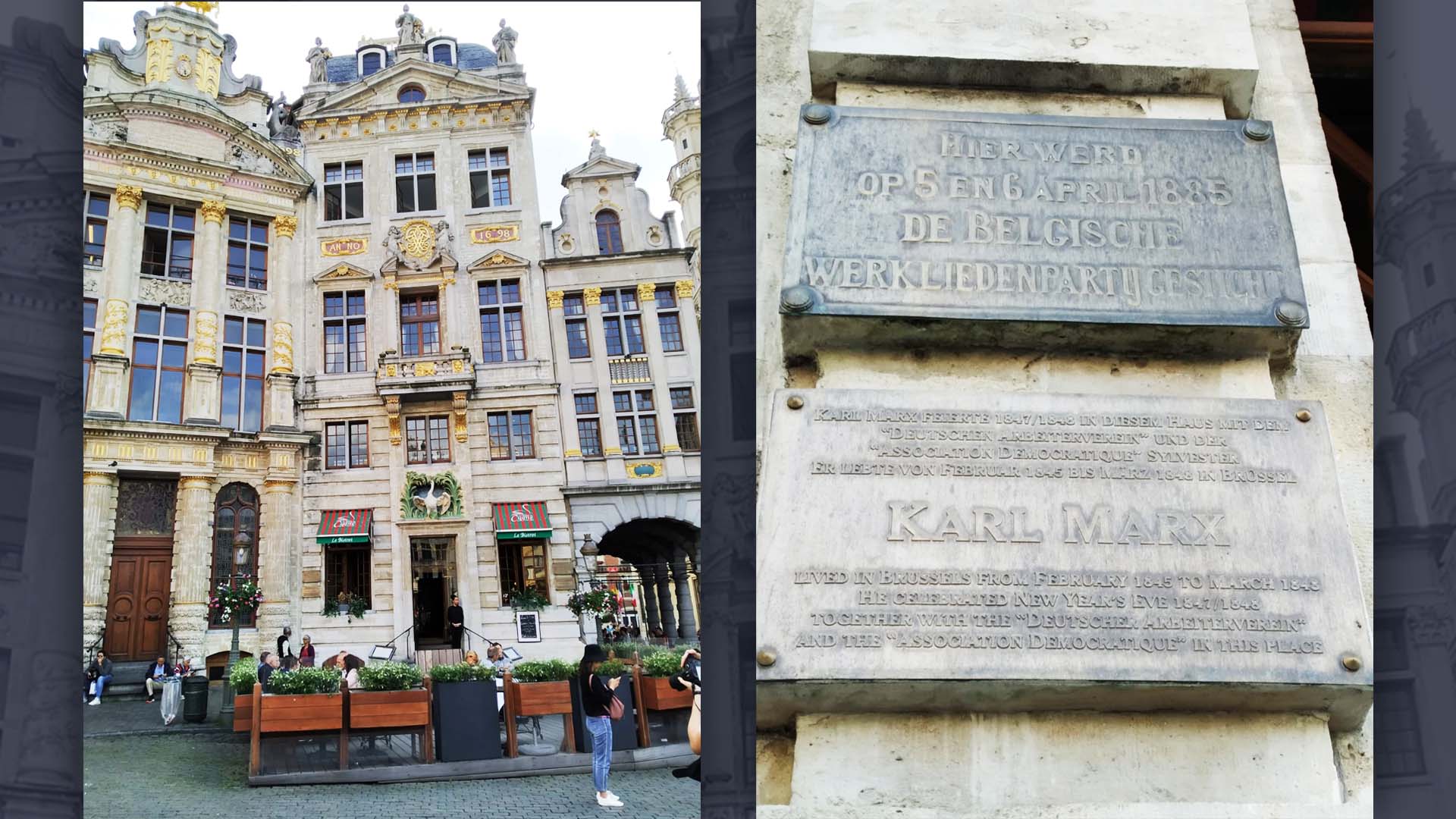
Karl Marx
Lived in Brussels from February 1845 to March 1848
He celebrated New Year’s Eve 1947/48 together with the “Deutscher Arbeiterverein” and the “Association Democratique” in this place
The plaque put on a building which housed a restaurant ‘Le Cygne, The Swan’ now is the only memory left of the days when history was ‘made’ here. According to legend, it is the same place ‘[w]here the First International had convened’ and Marx and his lifelong friend and comrade Engels ‘[h]ad written the Communist Manifesto’.
No doubt it was the same place when Marx, Engels, Mozes Hess – who was another early luminary of socialism and who supposedly had influenced Engels about communism – and other associates of the surging workers movement pondered over many of those ideas which have been memorialised in the opening sentences of the Manifesto, “A spectre is haunting Europe — the spectre of communism….”
May be the historic slogan ‘Workers of the World Unite, You have nothing to lose but your chains’ which later reverberated throughout the world – whose echoes are still heard – had its ‘humble’ beginning in one of those very rooms, where Marx and his close associates used to educate workers about their exploitation.
Scores of people sitting in this particular restaurant which was serving them sumptuous food and choicest drinks were completely oblivious of all those details. Few of them rather looked at us with a sense of disbelief and dismay, when they witnessed us taking photos of the nondescript wall which had the plaque put on it. Perhaps they looked more satisfied that they are enjoying food at a place which is situated on the Grand Place or Grote Markt, which is the central square of Brussels and is considered one of the most beautiful squares in Europe and is also part of UN Heritage.
( Read the full article here : https://www.newsclick.in/karl-marx-in-brussels)
विचार ही अब द्रोह !

(‘चार्वाक के वारिस : समाज, संस्कृति एवं सियासत पर प्रश्नवाचक ‘ की प्रस्तावना से)
कार्ल मार्क्स की दूसरी जन्मशती दुनिया भर में मनायी जा रही है।
दिलचस्प है कि विगत लगभग एक सौ पैंतीस सालों में जबसे उनका इन्तक़ाल हुआ, कई कई बार ऐसे मौके आए जब पूंजीवादी मीडिया में यह ऐलान कर दिया कि ‘मार्क्स इज डेड’ अर्थात ‘मार्क्स मर गया’; अलबत्ता, यह मार्क्स की प्रत्यक्ष मौत की बात नहीं थी बल्कि मानवमुक्ति के उस फलसफे के अप्रासंगिक होने की उनकी दिली ख्वाहिश को जुबां दिया जाना था, जो उनके नाम के साथ जाना जाता है। याद किया जा सकता है कि सोवियत रूस का विघटन होने के बाद और जिन दिनों पूंजीवाद की ‘अंतिम जीत’ के दावे कुछ अधिक जोर से उठने लगे थे, पूर्व सोवियत रूस के एक गणराज्य में बाकायदा एक पोस्टर मार्क्स की तस्वीर के साथ ‘‘मोस्ट वाटेंड’’ के नारे के साथ छपा था।
यह अलग बात है कि हर बार इस भविष्यवाणी को झुठला कर अग्निपक्षी/फिनिक्स की तरह मार्क्स राख से बार बार ‘नया जीवन’ लेकर उपस्थित होते रहे हैं। आलम तो यहां तक आ पहुंचा है कि 1999 में- अर्थात सोवियत रूस के विघटन के लगभग नौ साल बाद- बीबीसी के आनलाइन सर्वेक्षण में मार्क्स को सहस्त्राब्दी का सबसे बड़ा विचारक कहा गया था। Continue reading विचार ही अब द्रोह !
Clinical Establishment Act Kerala: A Historic Initiative — B Ekbal
This is a guest post by Dr B EKBAL
The Kerala Clinical Establishments (Registration and Regulation) Act 2017 is being implemented with effect from Jan 2019. The rules pertaining to the Act have already been framed. In the first phase, establishments under modern medicine including hospitals, clinics and laboratories will come under its purview.
<!–more Continue reading Clinical Establishment Act Kerala: A Historic Initiative — B Ekbal
Thejus – The Death of a Daily Newspaper
[This is a GUEST POST by N P CHEKKUTTY]
It is rarely that a journalist writes about himself or herself, because they are supposed to be detached observers of history-in-the-making. But this time I cannot help it because one of the things that happened in the Sabarimala-obsessed state of Kerala this week happens to be the demise of Thejas, a daily newspaper that I was associated with for almost 14 years. It was a death foretold over two and half months ago, but no one took notice and no one raised any serious concerns about the passing of a newspaper that existed in our civil society for over a decade. It is sad that the newspaper which was known for its fierce anti-Sangh Parivar positions leave the scene just a few months ahead of a general election that will decide the future course of this country. Continue reading Thejus – The Death of a Daily Newspaper
Hindutva Terror and Left Hegemony: After Women’s Entry into Sabarimala
Hours after the two women entered Sabarimala, the Hindu terrorists began their handiwork. Mad mobs, including women, began to roam the streets and attack by-passers, in their desperation to foment violence and provoke riots. In Karunagappally, Muslim establishments and shops were singled out for vandalism. The Sangh-backed Sabarimala Action Council called for a hartal today and they have spared no effort to make sure that people are terrorized. Continue reading Hindutva Terror and Left Hegemony: After Women’s Entry into Sabarimala
The Triumph of Streevaashi! Women break the wall of caste at Sabarimala
Out of the dark, seemingly never-ending night, a streak of light! Two women of menstruating ages, Bindu and Kanakdurga, finally entered Sabarimala, breaking the concerted walls built against them by brahmanical-Hindutva male authorities on the right and left. Continue reading The Triumph of Streevaashi! Women break the wall of caste at Sabarimala
50 Years Later, Shadow of Keezhvenmani Continues to Hover Over our Republic
December 25, 1968, termed as ‘Black Thursday’, saw the first mass crime against Dalits in independent India, who were fighting for respectable wages under the leadership of the Communist Party.
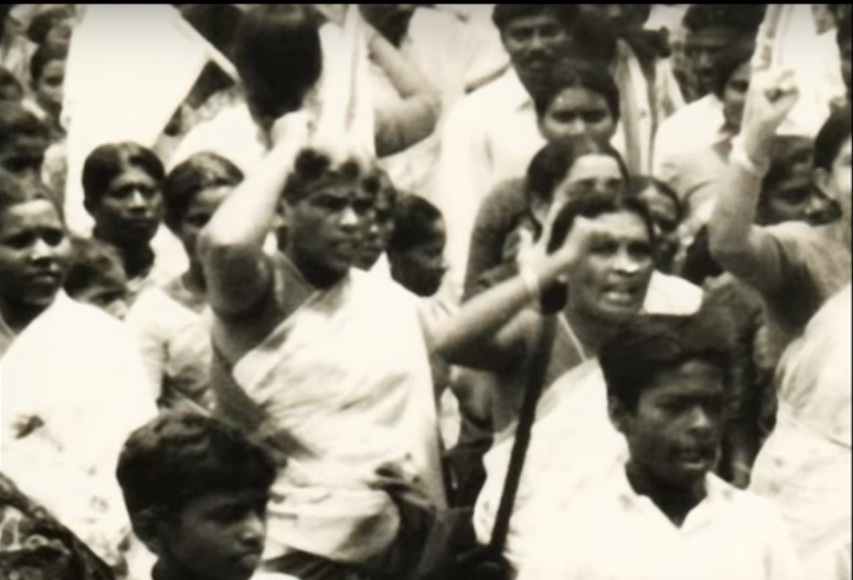
Image for representational use only; Image Courtesy : Socialist India
P Srinivasan, a veteran village functionary who cremates the dead had, in an interview done few years ago, described the darkening early morning on December 26, 1968, when the bodies began arriving from Keezhvenmani, a non-descript village in Thanjavur district of Tamil Nadu.
The village functionary, called Vettiyan, who is nearing 60 now, still remembered the number: “There were 42 corpses in all, horribly burnt and mangled. The stench was awful,” Pointing towards the plot of land where they were cremated, he said “All of them were Dalits, burnt to death in a caste clash. I cremated them on these very grounds.”
Srinivasan, then 23-year-old, shared vivid details of that ‘Black Thursday’ in 1968, a day that has remained etched in his mind.
December 25, 2018, completes 50 years of that ‘Black Thursday in 1968’, which is remembered as the first massacre of Dalits in independent India. The Dalits were martyred while fighting for respectable wages under the leadership of the Communist Party. All of these landless peasants had started to organise themselves into a campaign for higher wages following the increase in agricultural production in the area.
(https://www.newsclick.in/50-years-later-shadow-keezhvenmani-continues-hover-over-our-republic)
വിട, IFFK! വിട, ബീനാ!
പ്രിയ ബീനാ
IFFK എന്ന പ്രസ്ഥാനത്തിനോട് വിട പറയാൻ സമയമായിയെന്ന് തോന്നുന്നു. ബീനയ്ക്ക് വേണം ഈ വിടവാങ്ങൽ കത്തെഴുതാനെന്നും തോന്നി. കാരണം ഇതിനെ ഒരു ജനകീയ പ്രസ്ഥാനമാക്കിയത് നിങ്ങളാണ്. ഇന്ന് അത് മറ്റൊന്നായി മാറിയിരിക്കുന്നു. ഇടങ്ങളെല്ലാം മാറിക്കൊണ്ടിരിക്കുന്ന ഈ കാലത്ത് ഇതു പ്രതീക്ഷിതമാണ്, അതുകൊണ്ട് ഇതു വ്യക്തിപരമായ കുറ്റപ്പെടുത്തലല്ല. Continue reading വിട, IFFK! വിട, ബീനാ!
An Open Letter to Brinda Karat about Rehana Fathima: Why are we being hunted in Kerala?
Dear Comrade
Last year, around this time, I wrote you an open letter about the plight of Hadiya Asokan who was being hunted down by the Hindutva groups for her choice of faith and partner while the CPM and its cyber force was either actively abetting the violence or watching passively. I wrote in joy, because you had taken a firm stand and despite angry howls of protest against you from your own party. However, this time, I write in sheer despair at your silence; not just yours, but of the AIDWA in Kerala in general, in the wake of the twisted machinations of the Hindutva forces around the Supreme Court’s order permitting the entry of women of menstruating ages to the Sabarimala temple. Continue reading An Open Letter to Brinda Karat about Rehana Fathima: Why are we being hunted in Kerala?
Now What? After the Betrayal of Women at Sabarimala
At the end of the five-day worship in the month of Tulam, it is clear that women have been betrayed. The right wing which promised not to violently stop women devotees did precisely that; their leader also hurled vicious insults are trans people. The dominant left which foamed Ayyankali and Sree Narayana Guru at the mouth ended up reinforcing the ‘good woman’/bad woman’ division, saying first that only the former would be allowed to proceed, made the term ‘activist’ into a code word for ‘bad woman’, and then finally threw up its hands saying that it was impossible to implement the court order. The government and the CPM had obviously not done enough to make sure that women would indeed enter the shrine. Clearly, they are reluctant to touch the savarna moral majority. Continue reading Now What? After the Betrayal of Women at Sabarimala
Keep Calm and Carry On: Dealing with Patriarchal Carpet Bombing in Kerala
For all women in India, what is happening in Kerala should be an eye-opener. This is how Indian society rewards you for reaching the top, aspiring seriously to be on top, and actually asking questions to authorities about why they keep drawing on women’s energies and resources while simultaneously undermining the very ground on which they survive. In Kerala, two things are going on: there is on the one hand, a vicious gang led by Rahul Easwar which is openly threatening women who would dare to enter Sabarimala with the worst kinds of violence, on the other, the horrid misogyny of the press was revealed at the press conference held by the Women in Cinema Collective who expressed their deep disquiet at the way in which the organization of cinema actors, AMMA, and its president Mohanlal, were eager to protect oppressors and ignore survivors. Also, even male intellectuals who have been very supportive of feminist and gender justices causes have been named in the MeToo campaign among journalists in Kerala.
Kerala is a society where, in the past twenty years, we have seen women come up everywhere — in journalism, literature, academics, cinema, architecture, engineering, art, management, sports, trade unionism, activism. Women in Kerala have been the force of social democratizing as evident from the struggles ranging from the Munnar tea garden workers’ struggle to the brave nuns protesting against sexual violence. For sure, a very large number of women in Kerala are ultra-conservative, and that is apparent both in their presence in the muck that Easwar and his gang are raking up in Kerala, as well as in the shameless way in which some of them were emboldened to hurl caste insults at the Chief Minister of Kerala. This is therefore reminiscent not so much of the Battle of Britain in World War II, but for the Battle of Stalingrad — which was heavily bombed by the Luftwaffe, even as there was hand-to-hand combat on the ground for control of the tiniest slices of the city, and where the city residents were often subject to the terrors of both the Nazi and the Soviet sides alike.
If you want to see male hubris overflowing, please take a look at this video, of https://www.facebook.com/plugins/video.php?href=https%3A%2F%2Fwww.facebook.com%2FWomeninCinemaCollectiveOfficial%2Fvideos%2F249328929064857%2F&show_text=0&width=267“>the press conference held by the Women in Cinema collective. All I can tell us all is, Keep Calm and Carry on. After all, unlike in the World War II, the ammunition of these creeps need not hurt us at all; it can make it only more powerful.
Restore Our Vision of the Future: A Letter to the Kerala Chief Minister
Dear Comrade
I write to you as a citizen, so unlike the many eulogies and appeals you have received recently, this will not be sugar-coated. You have received much praise, which is indeed well-deserved. But most of us have done, and are still doing, our duty well, but there is no need to indulge in any more self-praise.
Continue reading Restore Our Vision of the Future: A Letter to the Kerala Chief Minister
Brackish Reflections on the Great Deluge of 2018: Roby Rajan
This is a guest post by ROBY RAJAN
Epic. Biblical. Apocalyptic. These are some of the words that have been used to describe the floods and landslides that have wreaked havoc in Kerala over the last few weeks. Entire towns and cities were submerged, and entire rivers altered their courses overnight. Continue reading Brackish Reflections on the Great Deluge of 2018: Roby Rajan
A National Pledge for Kerala after the Great Deluge of 2018
- Kerala is the land of my birth, and my life is intertwined closely and inseparably with the lives of all fellow-Malayalis. I will respect and remember this truth and will never think of my life as totally unrelated to nature, my neighbours, and the government that we elect to rule us.
Continue reading A National Pledge for Kerala after the Great Deluge of 2018
അഭിമന്യുവധം ഉയർത്തുന്ന കാതലായ പ്രശ്നം
സത്യം പറഞ്ഞാൽ അഭിമന്യു എന്ന വിദ്യാർത്ഥിയുടെ ഞെട്ടിക്കുന്ന കൊലപാതകത്തിനു ശേഷം ആ ചെറുപ്പക്കാരൻറെ മാതാവിൻറെ വിലാപം മാത്രമാണ് ഇപ്പോഴും മുഴങ്ങിക്കേൾക്കുന്നത്. ആ ശബ്ദം മനസ്സിൽ നിന്ന് മായുന്നതേയില്ല.
To Gain a View of the Elephant – India, History, Modernity, and Marx : Ravi Sinha
Guest Post by Ravi Sinha
(Marx Bicentennial lecture – Acharya Nagarjuna University, Guntur, March 16, 2018)
etaddhastidarshana iva jatyandhah
That is like people blind by birth viewing an elephant.
- (Shankaracharya’s bhasya on Chandogya-Upanisad 18.1)[1]
It was six blind men of Indostan,
To learning much inclined,
Who went to see the Elephant
(Though all of them were blind),
That each by observation
Might satisfy his mind.
- John Godfrey Saxe[2]
The ancient Indian parable of blind men and the elephant, popularized in modern times by John Godfrey Saxe’s nineteenth century poem, has often been deployed in philosophical discourses about the nature of reality and its relationship to sense perception. It has served as a useful metaphor in many an argument about empiricist epistemology, moral relativism, cultural plurality, even religious tolerance. No such usage is intended here. My purpose in starting out with the parable is mostly methodological – how does one put together a vision of the beast based on necessarily partial observations of it. Continue reading To Gain a View of the Elephant – India, History, Modernity, and Marx : Ravi Sinha
 KAFILA - COLLECTIVE EXPLORATIONS SINCE 2006