Category Archives: Metropolis

Media Landscape and the Making of an Unconventional Journalist: Monobina Gupta

Guest post by MONOBINA GUPTA

A profile of Ravish Kumar, this post tells the story of the media from a uniquely interesting vantage point – even as it presents before us a slice of contemporary social conflicts. 

I

Five days a week at 9 PM, Ravish Kumar begins his news programme, Prime Time, on NDTV India with “namashkaar, main Ravish Kumar…” At the same time when English news channel anchors scramble over each other for ratings, putting on display wild (often unsubstantial) discussions on the day’s events, Prime Time – in style and news content – strikes a very different note.
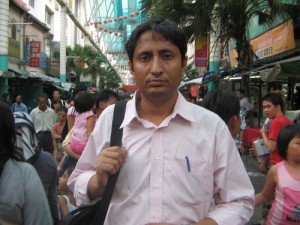
A journalist on the move
Journalist on the move

Ravish starts his programme with a 5-minute introduction, which is its unique selling point and also one of the highlights of the show. Packaging the topic of debate with a well-researched perspective, Ravish speaks in lucid, eloquent Hindi, interspersed with subtle and witty asides. Meticulously, he references the news reports, analyses, blog posts and opinion pieces he has swotted over during the day. In his mindful reference to every author whose work he has accessed through both mainstream and social media, Ravish has created a new media morality. The cutthroat universe of corporate media is more dedicated to grabbing information first rather than acknowledging sources or granting space to insights generated by others.

“Firstpost.com is our rival but whenever I take any news or analysis from the website, I acknowledge it. You could say this is NDTV India’s inherent culture. English channels don’t have that system. But they can have it if they want to. I do that consciously. I want viewers (a lot of them are students) to follow up these references,” Ravish told me. Continue reading Media Landscape and the Making of an Unconventional Journalist: Monobina Gupta

From Jadavpur to Everywhere #Hokkolorob – Let There be Clamour

#HOKKOLOROB
#HOKKOLOROB

More then one hundred thousand students and their friends (according to Kolkata Police estimates) defied the rain to walk in protest yesterday against the assault on Jadavpur University by Kolkata Police, backed by an insensitive University Vice Chancellor and a cynical State Government. There were students, ex students, professors, students from Presidency University, and many other colleges in Kolkata and the neighborhood, there were many ordinary citizens, some who had never been university students, and many who had stopped being university students a long time ago.

Continue reading From Jadavpur to Everywhere #Hokkolorob – Let There be Clamour

Notes from Jadavpur: Ahona Panda

Guest Post by Ahona Panda

About eight years ago, while lounging about doing nothing much in the campus of Jadavpur University where I was a student of the English department, I came across some callously etched graffiti:

Jodi prem na dile praane
Tobe Jadavpure pathanor ki mane?
(If you haven’t given this life some love–
What is the point of sending one to Jadavpur?)

Eight years on I cannot imagine the luxury of lounging about doing nothing much. One moves on in life after graduating from Jadavpur University. Meanwhile, in home and the world, the complete freedom (some will persist in calling this anarchy) of the JU campus has made it a legend somewhat like Dirty Harry: either worship and put it in on a pedestal, or condemn it thoroughly. The reputation of JU since the infamous 1970s has been as a hub of constantly bubbling anarchism, where Naxalites are hatching their next program of action, where ignorant armies like SFI and other anti-SFI groups clash by night.

Continue reading Notes from Jadavpur: Ahona Panda

From Jadavpur University, Kolkata – ‘I am, one of those survivors, who has experienced a nightmare last night’: Tanumay Naskar 


Guest Post by TANUMAY NASKAR

[ This is an account of the events of last night in Jadavpur University, Kolkata, were students sitting in on a peaceful protest against university authorities inaction on a recent complaint of sexual harrassment. What followed (an attack from two fronts, by police and goons affiliated to the Trinamool Congress) brought back memories of the many times that students have been attacked mercilessly in JU. Currently, around 40 students have had to receive medical attention, and 38 are in police detention. Protests against this event are being organized today in Kolkata (at 4:00 in the afternoon, at Jadavpur University, and at 6:00 PM at JNU in Delhi, by the JNU Students Union]

Follow this link to read a detailed time-line of the events as they unfolded.

Follow this hashtag – ‪#‎hokkolorob‬ for details of how people are responding to the situation.


I am one of those survivors who has experienced a nightmare last night.
We were singing. We were dancing. We were peacefully protesting. 
When someone yelled, “Let’s make the barricades, the police is coming”. 
After that, we saw police (READ GOONS) of grade A, barred all the entrances and charged us with Lathis.

Continue reading From Jadavpur University, Kolkata – ‘I am, one of those survivors, who has experienced a nightmare last night’: Tanumay Naskar 


Demolitions in Aya Nagar, Delhi: Thomas Crowley

Guest Post (and photographs) by THOMAS CROWLEY

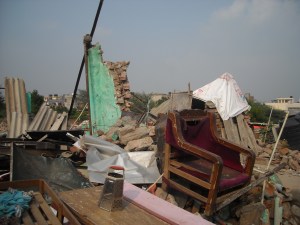
The media is all praise for the central government’s rescue efforts in Kashmir, despite the evident hollowness of the government’s claims to heroism. But the press has little to say about the brutal destruction authored by the government in its capital city. Thursday, September 11, saw another demolition drive in a city that has seen far too many of them, from the Emergency to the Commonwealth Games. The demolition took place in the South Delhi neighborhood of Aya Nagar, where residents say about 250 houses were destroyed.

Aya Nagar 1

Continue reading Demolitions in Aya Nagar, Delhi: Thomas Crowley

Eta Kolkata (This is Kolkata): Kaveri Gill

Guest post by KAVERI GILL

Today comes the surreal news that anyone painting their house or apartment white or sky blue in Kolkata can claim a waiver on property tax for a full year, a horror conjuring up a city that looks like a crumpled weave of Mother Teresa’s saree. Now, towns of Regency England and the Cornwall coast have uniform building and color restrictions to maintain historical continuity, but this idea is more in the perverse vein of babus suggesting that the burning ghats at Varanasi be “white-washed” for “freshness”.

The Chief Minister's radio and music in public places scheme
The Chief Minister’s radio and music in public places scheme

Thankfully, another Humphrey shot that idea down, yet the decimation of the architectural integrity of the façade of these famous ghats continues apace, with sealed air-conditioned buildings overlooking the burning bodies at Manikaran. Bengal’s Chief Minister has been known to remark that the colours “promote happiness” and accordingly, the Trinamool Congress (TMC) Mayor has incentivised citizens to embrace the “theme colours of the city”[1]. Coming on the heels of a general election, where the TMC won 34 seats out of 42, up from 19 in 2009, and compared to only 2 each for the Communist Party of India (Marxist) and the Bharatiya Janata Party (with 18% of the vote share, not to mention an almost win in the city), even discounting for dirty tricks appropriated by their cadres from the Left of old, the scorn must be tempered by what this result says about the contemporary citizen of this state and city. Continue reading Eta Kolkata (This is Kolkata): Kaveri Gill

Ruins of the Living: the Rohingya Refugees: Akshita Nagpal

This is a guest post by Akshita Nagpal

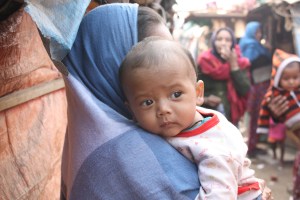
A tree with deep roots, if uprooted and planted in alien soil, might live but often sans its vigour. The same can be said for refugees. A couple of weeks ago, along with a bunch of my classmates, I visited the refugee camp of Burmese Rohingya Muslims at Kalindi Kunj in the vicinity of our university campus. The visit was part of an initiative to help them with old winter clothing after hearing about the unliveable conditions of the camp.

IMG_3912

The Rohingyas, an ethnic group hailing from Myanmar (Burma), chiefly from its Rakhine (Arakan) State, happen to be one of the most oppressed people in the Asian sub-continent.

Continue reading Ruins of the Living: the Rohingya Refugees: Akshita Nagpal

We The People, Reclaim the Republic: Various Citizens Groups

Call given by VARIOUS CITIZENS GROUPS

As we commemorate another Republic Day, We The People proclaim that the parade of the powerful at Rajpath does not represent us. We The People, Reclaim our Republic.

As members of the LGBT community, women, workers, sex workers, students, teachers, activists, persons with disabilities, health rights activists, Dalits, indigenous people, farmers, those affected by unconstitutional military rule, we are united not as “minorities” or “others,” but as the people. We invoke the promises of the Constitution of India in our name. Our struggle will continue until all arms of the state are unwavering in their constitutional promises towards the marginalized in our society, rather than only representing the powerful.

Continue reading We The People, Reclaim the Republic: Various Citizens Groups

Why AAP’s Stance on Somnath Bharti Is Disturbing, Whether He is Eventually Sacked or Not: Kavita Krishnan

Guest Post by KAVITA KRISHNAN

AAP’s official position is: we’ll sack Bharti IF judicial probe finds him guilty. But what AAP leaders are saying about Bharti’s ‘version’ on TV is as disturbing as Bharti’s own actions and words.

Continue reading Why AAP’s Stance on Somnath Bharti Is Disturbing, Whether He is Eventually Sacked or Not: Kavita Krishnan

Open Letter to Delhi CM Demanding Action Against Racist Minister: Concerned Citizens

Guest Post by a group of Concerned Citizens

Open Letter by Citizens to Delhi CM Demanding Action Against Racist Minister

To 
Shri Arvind Kejriwal, 
Founder, Aam Aadmi Party and 
Chief Minister, Delhi


CC: Shri Yogendra Yadav, Shri Prashant Bhushan 


Our Demands


1. Remove Somnath Bharti from his position as Law Minister immediately


2. Punish all those, including Somnath Bharti, guilty of instigating and perpetrating racist and sexual violence on African women


3. Delhi Police must come under Delhi Government, but Delhi Police must be accountable to Constitution and not to the bidding of Ministers and mobs 


4. Meet and apologise to the Ugandan women who have complained of racist, sexual violence Continue reading Open Letter to Delhi CM Demanding Action Against Racist Minister: Concerned Citizens

The Savage Greed of The Civilized – AAP, Moral Posturing and Ordinary Racism

The savage greed of the civilized stripped naked its own unashamed inhumanity’

Africa, Rabindranath Tagore

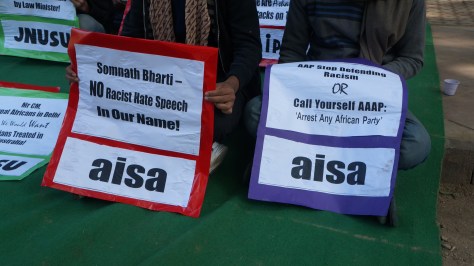
SIGNS AT ANTI RACISM PROTEST IN JANTAR MANTAR

Delhi Law Minister and Aam Aadmi Party leader Somnath Bharti’s midnight raid in Khirki village, during which he ordered policemen to search and enter houses, arrest people without warrants, and allegedly said that “black people, who are not like you and me, break laws” –  strips naked the unashamed inhumanity of the Aam Aadmi Party regime’s moral posturing. Underneath the holier-than-thou mask of that moral posture lies the unmistakably horrible sneer of the ordinary racist thug. This is the real face of Somnath Bharti. I hope it is a face that the Aam Aadmi Party can turn itself away from.

Continue reading The Savage Greed of The Civilized – AAP, Moral Posturing and Ordinary Racism

Protest Against Delhi Law Minister Somnath Bharti’s Racist Vigilantism in Delhi: Kavita Krishnan

Guest Post by KAVITA KRISHNAN

Many of us have felt disturbed by the implications of the incident involving the Delhi Law Minister’s attempted raid on African nationals in Khidki village.

The Minister, Somnath Bharti, (a member of the Aam Aadmii Party) insisted that the police conduct a raid minus a search warrant. Two African women have said, on record, that they were subjected to racist abuse (‘black people break laws’) and beaten by a mob of people (the Minister’s supporters), and that it was the Delhi police who protected them from the mob violence.

[ See Aditya Nigam’s post on the same issue in Kafila earlier ]

There are also reports that one of the women was forced to give a urine sample in public. The women were also subjected to cavity searches and tests – none of which yielded any sign of drugs. The violence against the women was defended in the name of anger against ‘prostitution’ and ‘drug peddling’, while no proof of the same has been presented as yet. In any case, the treatment meted out to the women cannot be justified even if they were indeed prostitutes! Continue reading Protest Against Delhi Law Minister Somnath Bharti’s Racist Vigilantism in Delhi: Kavita Krishnan

The Aam Aadmi Party and Animal Farm

The plot of George Orwell’s ‘Animal Farm’ can be summarized in a single sentence – “This novel demonstrates the consequences of the addition of four important words -‘but’,  ‘some’, ‘more’, and ‘others’ to the phrase – <all animals are equal>”.

In other words, it describes the transition from the axiomatic statement <all animals are equal> to the qualified formula <all animals are equal, but some animals are more equal than others>.

Aam Aadmi Party founder and Delhi’s new chief minister Arvind Kejriwal’s ruling out the possibility of referendums in Kashmir about the presence of the armed forces in Jammu & Kashmir (in response to his party colleague Prashant Bhushan’s endorsement of the idea of such a referendum during a recent television appearance) could signify a shift within the Aam Aadmi Party’s evolving political doctrine that parallels the transition that the pigs in Animal Farm made while turning their revolution into a counter-revolution. Continue reading The Aam Aadmi Party and Animal Farm

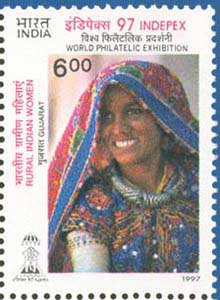
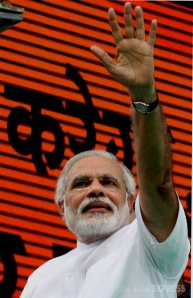
Can Narendra Modi Apologize to Four Hundred and Five Million Rural Women in India?

1744_Rural_Women_Keral 1742_Rural_Women_Gujar B_Id_424710_Narendra_Modi_

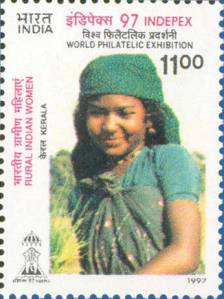
Rural Indian Women (Courtesy India Post) and An Urban Indian Man (Narendra Modi)

I watched the television broadcast of BJP’s Prime Ministerial candidate Narendra Modi’s speech at the Japanese Park in Rohini in Delhi on Sunday morning with breathless anticipation and some trepidation. With the restless anxiety that he would spin at least half a new idea, that could induce some naive fence-sitters in Delhi, my city, to sign up behind his juggernaut along with the rest of his zombie horde.

Would his spin doctors have worked hard and tirelessly overnight to give their client a new teflon coating? Would his savvy advisers have given him a sharp new statistic to play with, an incontrovertible fact, a compelling argument that would persuade my fellow citizens? Continue reading Can Narendra Modi Apologize to Four Hundred and Five Million Rural Women in India?

In Delhi’s defence

Reuters photo
Reuters photo

By SHIVAM VIJ: The census counts ’urban agglomerations’, and the Census of India says that Mumbai is India’s largest urban agglomeration. This includes Mumbai’s suburbs. In counting Delhi, the suburbs are not added because They are separated by state boundaries. If you were to add suburbs of the ’National Capital Region’, Delhi’s population would be not 16 million but over 22 million, making it the world’s largest urban agglomeration after Tokyo. This bustling urban centre is made of its people. Today’s Delhi cannot be stereotyped as just the seat of power. There is more to Delhi than the endless roundabouts of Lutyens’ capital.

Delhi’s core – the Partition refugee Punjabi – is not xenophobic like the Marathi ’manoos’ of Mumbai. In fact Delhi today is what Bombay once was, India’s foremost cosmopolitan metropolis. It is the city of choice for people from across India to migrate to with dreams of riches.

A lot has been written about “the Delhi gang-rape”. 16 December 2012 started a conversation that doesn’t seem to end. This conversation has largely been about rape, not about Delhi.
Continue reading In Delhi’s defence

सार्वजनिक जगहों पर सामूहिक कब्ज़े की संस्कृति : किशोर

Guest post by Kishore

दिल्ली के उत्तर-पश्चिम में स्थित रोहिणी का इलाका लाखों मध्यम और निम्न मध्यम वर्ग परिवारों का बसेरा है. कुछ समय पहले यहाँ मेहनतकश मज़दूर वर्ग के नुमाइंदे भी झुग्गी-झोपडियों में रहा करते थे जिन्होने  रोहिणी  नाम के इस उपनगर को बसाया था. पर पिछले कुछ सालों में इन झुग्गियों को उजाड़ कर दिल्ली के बाहरी हिस्सों में पुनर्वासित किया गया है. ठीक गोरख पाण्डेय की कविता “स्वर्ग से  विदाई” की तरह.

रोहिणी एक नियोजित उपनगर है जिसे दिल्ली विकास प्राधिकरण ने बसाया है. एक शहरी बस्ती की जरूरतों के हिसाब से हर एक चीज़ का ध्यान रखा गया है. थोड़ी थोड़ी दूर पर “सार्वजनिक” पार्कों की व्यवस्था की गयी है और हर एक-दो किलोमीटर पर एक बड़े “सार्वजनिक” पार्क की भी व्यवस्था है जिसे डिस्ट्रिक्ट पार्क कहते हैं. Continue reading सार्वजनिक जगहों पर सामूहिक कब्ज़े की संस्कृति : किशोर

Deceit at the Hospital of Truth: Surendra Panchal

Guest Post by Surendra Panchal

Sanitation Hospital Workers Strike at a Delhi Hospital over Non-Payment of Minimum Wages

Sanitation workers of the Satyavadi Raja Harishchandra Hospital (The Truthful King Harishchandra Hospital), Narela in Outer Delhi have started an indefinite dharna today, to protest their unjust dismissal when they asked to be paid the statutory minimum wage for unskilled work declared by the Delhi Government, Rs 7254 per month.

Continue reading Deceit at the Hospital of Truth: Surendra Panchal

São Paulo: The City and its Protests: Teresa Caldeira

Guest post by TERESA CALDEIRA

In June 2013, a series of large demonstrations throughout Brazil have shaken up its main cities and political landscape.  They have also perplexed politicians and analysts alike, many of whom found themselves without solid references to interpret the novelty and oscillated between silence and old discourses.  It is always risky to interpret emerging processes. Minimally, we risk following secondary paths or, even worst, framing new events with the vocabulary made available by old interpretative models, exactly the ones that the new events are trying to displace. However, in order to reveal what is emerging it is necessary to risk, search for new hints, and follow signs already available.  Several references that can guide us to interpret the June events have been around for quite a while; others are new, but we can trace their lineage and contextualize them.

SP Batata 17 june
17th June, 2013

Continue reading São Paulo: The City and its Protests: Teresa Caldeira

Aap Kare toh Renovation, Hum Kare toh Gentrification

It appears that a Delhi bookstore has relocated. This, in itself, isn’t news in a city of relocation,dislocation, demolition, destruction; a city built, looted and sacked at least seven times. Yet, the emotional coverage of Yodakin’s move – from one part of Hauz Khaas village to another – assures us that Delhi has lost a vital cultural hub, a “safe space”, an “indie book store with the ambience of a salon“. In a city of “aggression, pollution and anxiety”, Yodakin apparently offers us “reassurance”.

The problem, familiar to any intellectual in search of reassurance, is skyrocketing rents. As one particularly maudlin tribute explains: (emphasis in original):

I remember sitting with Arpita and Smita (of 11.11 Celldsgn/ The Grey Garden/ Elma’s/ Edward’s & TLR) at Elma’s across the street from Yodakin (the bakery was still only open for tastings) and vociferously advocating a shopkeeper’s union of sorts back in 2011.We were concerned about the escalating rates, discussing the impending gentrification (and doom) of our little alternative urban village. Everything popular gets subsumed into consumer culture eventually, we argued. The alternative is always being wiggled out of the spaces it fosters. The little guys make the place and then the big rich guns swoop in to ruin it, commercialize it.

But, don’t panic just yet, the bookstore is now sharing space with an organic food and art cafe called Tattva, where a  Tattvaamrita “Fruit Yogurt with Honey and Nuts” costs Rs 245, and a “cooling fennel juice” costs Rs. 175.  If the little guys are charging Rs 625 plus tax for a couscous salad, one genuinely fears what the “big rich guns” will charge. This of course brings us to a much needed conversation about all the things that you talk about in when you live in Delhi: Gentrification, alternative publishing, independent bookstores, and the all things that New York has and Delhi shall soon acquire.

Continue reading Aap Kare toh Renovation, Hum Kare toh Gentrification

Welcome the Two-Year Under Undergraduate Programme at Delhi University

Harish Kumar Trivedi’s article on the proposed four-year undergraduate programme at Delhi University, “Is Delhi University Dying?” (TOI May 29th 2013), for all its rhetorical flourishes, makes in fact a single point – the need for change. He is not alone in this belief; who could possibly be against reform? Who would want to stick their necks out in these breathless times and say, “Stop, why so fast?”

Many, many right-thinking people, actually, as the absolute barrage of criticism against the FYUP has shown. From the ordinary undergraduate teacher to academic and executive councils, committees of courses, and internationally renowned scholars, writers and academics. Now, there can be two responses to the range and variety of criticism that has been expressed. One would be to engage with it, based on the reasonable assumption that so many people involved with a profession cannot be entirely wrong. The other response is of the kind Professor Trivedi makes – to make an a priori argument for “change”. I say a priori because in fact there is only one, short paragraph in the article that discusses the possible advantages of the new system. One, that the new system ends the distinction between pass and honours courses. Two, that even if students exit after two years, they will still earn a “university qualification”. Three, it allows college teachers to frame a course in the fourth year.

Continue reading Welcome the Two-Year Under Undergraduate Programme at Delhi University

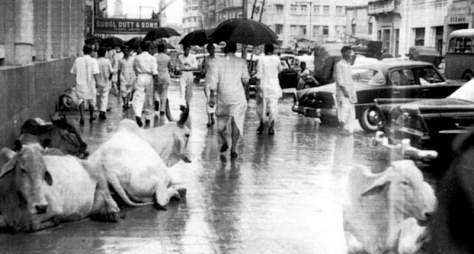
Photographs of Calcutta by Che Guevara, 1959

These three photographs were taken by CHE GUEVARA in Calcutta (now Kolkata) in 1959. The photos are taken from the book Self Portrait by Che Guevara, published by the Centre for Che Studies, Havana, in collaboration with Ocean Books, Australia. They were obtained by Jansatta editor Om Thanvi from the Centre for Che Studies in 2007, and come to us courtesy Thanvi.

1-che-gu-18

Continue reading Photographs of Calcutta by Che Guevara, 1959