Category Archives: Scams

The story of the Indian budget: Where the camera failed? Muhammed Shafeeque CM

Despite the controversies of demonetization, the central government has again succeeded in deftly hijacking the minds of Indian citizens through a riveting speech made by Finance Minister Arun Jaitley. The budget seemed to be especially important given third quarter statistics which are filled with drawbacks of the demonetization policy. Thus we had a budget speech completely focused on digitalization of a country where the ‘digital divide’ stubbornly persists. As the budget theme (Transform, Energize, and Clean) attempted to glorify existing conditions, there were unsurprisingly no transformations in the overall economic framework except the expected tax reduction. In the zeal for “energizing”, the budget had clean forgotten the needs of the informal sector including agricultural sector. Even though the government provocatively claimed that it had cleaned up black money, it revealed no data regarding the amount of black money actually mopped up from the market.

Continue reading The story of the Indian budget: Where the camera failed? Muhammed Shafeeque CM

University Administration Trying to Precipitate Crisis: JNUTA

We are reproducing a statement issued by JNUTA on 19 February 2017, on the situation in the university and the administration’s attempts to create a crisis where there is none.

The Jawaharlal Nehru University Teachers Association is deeply distressed at the continuing impasse in the University. Pursuant to its appeal on 13 February to the Vice-Chancellor to initiate a dialogue with the students, JNUTA has through the last week requested a meeting with him to discuss the situation on campus, but has not even received the courtesy of a reply. It has also spoken daily to the students worried about their future and that of the university about the concerns that the teachers, staff, and officers have at restoring the smooth functioning of the University administration building. Continue reading University Administration Trying to Precipitate Crisis: JNUTA

Demonetization, ‘Financial Inclusion’ and the Great ‘Unbanked’

A Prologue

There is a lot of talk these days about ‘exclusion’ – which is almost unquestioningly assumed to be a bad thing. The corollary to this understanding of exclusion is that all inclusion is necessarily good. One hears a lot about ‘financial inclusion’ these days,  which truth be told, makes me shudder. There is thus a lot of angst expressed these days, especially by the rich and powerful, over the ‘financial exclusion’ of the masses. Here is the basic argument (read the full article, disowned by the edit department, here):

Inclusive growth would mean that all sections of society benefit from economic prosperity. A key metric for inclusion is ‘financial inclusion’ i.e. the access to banking services and affordable financial products such as bank accounts, loans, and deposits for all individuals and businesses. When the poorest of the poor have access to credit and savings facilities, this translates to their financial security. They can grow larger businesses, manage consumption and household expenses better and plan for shocks. The standard of living improves and poverty falls, allowing people to contribute more to the economy as well.

Remember, however, before we proceed:

(i) That in 1997, the Asian financial crisis that wiped out the hard earned life-savings of millions of people, in one fell swoop, was an instance of financial inclusion.

(ii) That it was the banks that were fully responsible for the crises across the USA and Europe, 2008 onward. That the Occupy Wall Street movement was basically a movement against the  robbery of ordinary people’s money saved in banks by the banks, who on top of everything wanted to be bailed out with tax payers’ money.

(iii) That very recently Iceland has had to jail 26 bankers responsible for the 2008 financial crisis, “for crimes ranging from insider trading to fraud, money laundering, misleading markets, breach of duties and lying to the authorities”.

(iv) That one of the major reasons India escaped the worst effects of that crisis was because effectively 70 percent of its population still lies outside the banking and financial sector. Of course, the other important difference with the Western capitalist economies was that India’s banks were still largely in the public sector. In other words, banks do not only do what they and the economists say they do. Banks play with the hard-earned savings of the relatively poor, often simply handing handing them over to predator corporations and then writing off!

The Demonetization Gamble

A lot has already been said by now on the Modi government’s decision to demonetize Rs 500 and Rs 1000 notes. Economists and economic analysts from the Left-wing Prabhat Patnaik to others like  World Bank Chief Economist and former advisor to the Indian government, Kaushik Basu and journalist Swaminathan Aiyar have expressed serious doubts about both the rationale and feasibility of the move.  The point has been effectively made by them and others like Arvind Kejriwal (who have been centrally concerned with the issue of corruption and ‘black money’ for a long time now), that this measure does not touch the real big players in the game of black and unaccounted money. Big corporate sharks don’t need to go the ‘black money’ route because government policy itself is written by them and everything they do is made ‘legal’ either in advance, or retrospectively, because the government is in their pockets. Of course illegal activities even at those high levels often go on nevertheless, because the power-corporate elite has become so used to the idea that nothing really matters in this country – that everything they want is theirs. And in any case, the real big money lies deposited in Swiss banks or in circulation elsewhere, in other forms. Continue reading Demonetization, ‘Financial Inclusion’ and the Great ‘Unbanked’

Modi’s Demonetization, Black Money and Surveillance: Baidurya Chakrabarti

Guest post by BAIDURYA CHAKRABARTI

  • The demonetization drive of Modi is neither new in content nor in form. In India, it has been done earlier by Morarji Desai; the initial conversion to Euro in the European Union happened within a month’s span. Currency is routinely taken out of circulation. What is significant about Modi’s demonetization is the amount of sensation he has generated out of an otherwise insignificant move. What is routinely done through phasing out denominations is being done in an extremely abrupt manner. He is dressing up a withdrawal and issuing of currency notes as a revolutionary move, and it is being executed in the manner more suited to currency change. What we need to thus ask ourselves is this: why is a routine monetary policy being enacted in this—which I shall later call ‘terroristic’—manner? Clearly, the answer is not economic; even the government does not pretend it to be a strictly economic issue (when they harp on the ‘terror’ factor).

(But before we move on, an aside. This demonetization exposes how the nostalgia for socialist development has fuelled the rise of Modi. Disenchantment with neoliberalism has produced an obscene amount of nostalgia for the pre-liberalization days among the Indian middle class, especially among the left-leaning ones. However, now that a gesture right out of those hoary days have returned to our world, it turns out to be a nightmare.)

  • Let us state the obvious things first: demonetization will do next to nothing to the so-called ‘black money’, which are routinely converted into fixed assets or foreign currency. This move dis-incentivizes hoarding of cash, but not speculation, all sorts of accounting practices that can produce the so-called ‘black money’ while bypassing the level of cash transaction altogether. Demonetization is simply an old-school, brute-force monetary policy to curb hyperinflation. The Head of European Central Bank in Europe and Larry Summers, US treasury secretary, has proposed demonetization of their high-currency notes this year. But none of them dream of doing it within a notice of 4 hours!

Continue reading Modi’s Demonetization, Black Money and Surveillance: Baidurya Chakrabarti

The Cult of the Angry Pointed Finger, or How I learned to Stop Worrying and Love the Father

The recent order by the I&B Ministery to NDTV India to suspend broadcast for 24 hours drew a range of reactions from outrage to bewilderment. The supporters of the ruling party were of course triumphant – Subhash Chandra of Zoo, er sorry Zee News was so excited he wrote a whole article on this. But even outside the partisan responses, many well-meaning self-declared neutral janta declared that national security is not a matter to be trifled with, and that it was right for the government to admonish NDTV. Wait, ADMONISH?! Never mind that the government’s allegation of NDTV having compromised national security simply doesn’t survive a fact-check. Here is how the largest section of (English-speaking, online) popular opinion sees it.

This token punishment was good and important to show that someone is there who is monitoring the media who always thinks behind the mask of freedom of expression that they can do anything in the world. So it is important that the Government of the Day makes its presence felt otherwise there will more chaos and issues like the UPA government where everyone was going around like headless chicken and no one is bothered or cared if a Govt of Man Mohan Singh existed or NO. Even small timers like the Delhi CM AK and his Guru Anna were threatening and taking morcha in Ram leela Maidan every second day and doing expose every third day putting the Govt. of India on the back foot and in defensive mode running for shelter. Now Arvind Kejriwala and his team is running for shelter as every day a Delhi MLA is shown the door of the JAIL and Anna Hazare has been locked in a shell in his hometown watching the sunrise and the sunset. This means business, It is important that Govt of the India should show it exist otherwise human mentality is that then everyone shows that everyone exist and everyone is the BOSS. Cannot allow to happen like this MESS. PM Modi please keep it up and keep the heat on this reckless media, on AK and his gang, on others who are trying to show unnecessary activism and also the Judiciary, keep all the appointments on hold and let them slog day and night. Show who is the BOSS ! Show who is the BOSS !

Yes, Modi ji, show who is the BOSS!

joffrey_nskwqom3fi1tcgpa7o1_500-1

Continue reading The Cult of the Angry Pointed Finger, or How I learned to Stop Worrying and Love the Father

Aam Aadmi Mohalla Clinics Set to Shut Thanks to L-G and BJP Controlled Municipal Bodies: Jyoti Punwani

[The Superintendent of Tihar Jail, went a joke recently circulating on WhatsApp, had staked his claim for the Chief Ministership of Delhi, because he had the requisite number of MLAs! The mainstream (Big) media has had a field day, reporting with great ‘earnestness’, what even the ordinary person on the street can see is an orchestrated move to harass and discredit the AAP. A leading paper even did a status report on all the cases against AAP MLAs a couple of days ago, as if it was simply ‘reporting’ (with a straight face). Some day, hopefully we will be able to come out with a more detailed analysis of the ways in which sections of the big media have – even in the person/s of their most benign representatives and columnists – played footsie with the regime at the Centre. This dispensation and its utterly unprincipled and unethical ways are truly unprecedented and this phase of our history has emerged as the dirtiest chapter of parliamentary democracy in India. In the meantime, online news forums have kept the tradition of actual reportage and fairness alive. Here are some extracts from a report by JYOTI PUNWANI, courtesy The Hoot (linked below), on the mohalla clinics and the strange politics of the media that surrounds reportage around such measures undertaken by the Delhi government.]

The AAP’s mohalla clinic experiment drew the attention of The Washington Post. Its article (`What New Delhi’s free clinics can teach America’, March 11, 2016) was also carried by the Chicago Tribune. A University of Southern California delegation came to study mohalla clinics  in July.

But our print media didn’t think this important experiment was anything special. Not all covered it; of those that did, some didn’t carry the report in all their editions….

The Indian Express carried a long report in April, after the second batch of clinics opened, in its Delhi edition (“In rented rooms across Delhi, part 2 of ‘mohalla’ clinic project takes off’’).  Livemint hada detailed report last month, after more than 100 clinics had opened (`Mohalla clinic: AAP offers affordable healthcare model at doorstep’); and earlier this week, The Hindu evaluated their performance in its Delhi edition (`A thousand promises of prompt health care’).

Among news websites, Newslaundry did a lively report immediately after the first clinic opened (`Mohalla clinics come to town’). In January, Catch News did a report  (`#MohallaClinics: AAP has diagnosed Delhi’s health problem. Can it cure it?’), and a follow-up in April after the second batch opened (`AAP Mohalla clinics: rented homes turn clinics, private docs appointed’).

A two-part article appeared in Scroll.in in May (`The clinic at your doorstep: How the Delhi government is rethinking primary healthcare…) Indeed, news websites, rather than newspapers, seem to have given the new experiment the space it deserves.

Going through the reports on mohalla clinics, it became clear that the possible removal of some of them was only the latest move against them. A few days before the NDMC issued this order, the Lieutenant General (LG) of Delhi had got into the act. Consider the sequence of events:

On August 5, the Delhi High Court ruled that the LG was the administrative head of the capital. After the judgment, Deputy CM Manish Sisodia specially requested Najeeb Jung not to transfer the Health and Education secretaries as these two bureaucrats were essential for the AAP’s new initiatives in these sectors. Continue reading Aam Aadmi Mohalla Clinics Set to Shut Thanks to L-G and BJP Controlled Municipal Bodies: Jyoti Punwani

An Example of the Liberal Media Defending Powerful Neoliberal Elites: Aditya Velivelli

Guest post by ADITYA VELIVELLI

A wife’s career taking a backseat due to her husband’s work is no trivial issue. However, Outlook magazine used this issue to defend a powerful couple who had giant conflicts of interest among them.

In the recent cabinet reshuffle, Minister of State for Finance, Jayant Sinha, was shifted out of the finance ministry. A few news articles came out speculating that Sinha’s transfer was due to his wife Punita Sinha’s conflicts of interest and because a Tea party organised by Jayant Sinha involved schmoozing between Corporates and bank officers. Jayant Sinha was in the process of organising a bailout fund for the bad corporate loans at that time. This bailout fund would be paid for by the tax payers.  Continue reading An Example of the Liberal Media Defending Powerful Neoliberal Elites: Aditya Velivelli

Three Photographs, Six Bodies: The Politics of Lynching in Twos: Megha Anwer

This is a guest post by MEGHA ANWER


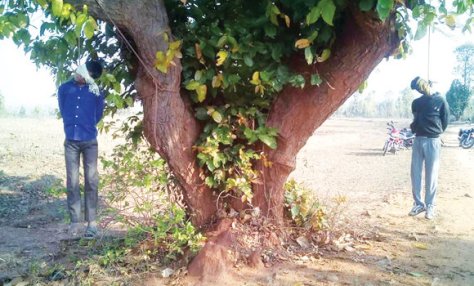
file-19-1458409803749044900
Mazlum Ansari and Imteyaz Khan, Jharkhand 2016.


The recent spate of vigilante attacks in India has lent a new, nearly domestic familiarity to the word “lynching”. This, though, is more than just a shift in language: the nation’s visual archive itself seems be shifting, towards instatement of a new normal. Inside just a year the “lynching photograph” has moved center-stage, filling mainstream news reportage and social media newsfeeds. The imagistic vocabulary of lynching has thus taken on a touch of mundane inevitability in caste and communal violence.

It began in March 2015, with the lynching of Syed Arif Khan in Dimapur, Nagaland. A couple of months later two teenage Dalit girls were raped, strangled and left hanging from a mango tree in Katra village in Uttar Pradesh. Then, on 28 September 2015, Mohammad Akhlaq was bludgeoned to death by a mob in his home near Dadri in what went on to gain spurious notoriety as a “beef-eating incident”. The following March, continuing with the logical rhythm of a scheduled sequel, the cattle herder Mazlum Ansari and his 14-year-old nephew Imteyaz Khan were lynched and hanged from a tree in Jharkhand. Most recently (on May 22) M. T. Oliva, a Congolese citizen, was beaten to death in the national capital of Delhi. This is an incomplete list: it includes only those incidents that resulted in fatalities. In the same timeframe there have been at least a dozen other cases in which the victims somehow survived the end-stage public shaming, torment and lurid physical violence, in short the ordeal of a completed lynching.

There is no lynching without its spectators. Continue reading Three Photographs, Six Bodies: The Politics of Lynching in Twos: Megha Anwer

What the UGC Gazette Notification 2016 Portends for the State of Higher Education in India: Rina Ramdev and Debaditya Bhattacharya

This is a guest post by RINA RAMDEV AND DEBADITYA BHATTACHARYA

The much-debated API (Academic Performance Indicator) system, linking promotions of faculty members in Indian universities/colleges to a quantifiable assessment of their performance, was introduced by the University Grants Commission (UGC) in its 2010 Regulations. Since then, there has been mounting resistance and discontent among massive sections of the teaching community – forcing the UGC to withdraw the said assessment framework for a while in 2013, before reintroducing it across institutions of higher education. However, over the years, the ire of protesting teachers has translated into a sustained critique of the API system and its failure to account for the infrastructural inadequacies of public institutions as adversely impacting the promotion prospects of thousands of teachers across the country.

It was rightly argued that a point-based appraisal pattern reduces teaching as an adventure of ideas into a standardised set of visible-verifiable outcomes and deliverables, expending in this, the necessary surplus of every academic encounter. The clock-timed hours of classroom-teaching – convertible into digits and decimals – were not only incommensurate to the disaggregation of thought beyond workdays and work-hours, but also insisted on a corporate-model professionalism limiting the exact interface between the teacher[-as-service-provider] and the student[-as-client].

The perils of quantification notwithstanding, the API system practically sought to make teaching a redundant exercise in terms of ‘necessary qualifications’ for faculty promotions. With a lucrative price-tagging of the ‘value’ of research activities conducted by individual teachers outside of teaching-schedules and the consequent structures of waging intellectual productivity through the numbers of projects and publications, the API contributed to a voiding of the classroom in undergraduate colleges in many parts of the country. Forced to prove her/his levels of productivity as the most essential claim to survival and growth within the field, the teacher needed but little to do by way of engaging students. And yet, on the contrary, the government persisted with its policy of withdrawing research grants and forcing research organisations to look for alternative sources of funding to sustain their work. Consequently, teachers have been infrastructurally forced into producing dubious research in the cause of ‘career advancement’, self-funding their way into business-rackets parading as scholarly platforms.

Continue reading What the UGC Gazette Notification 2016 Portends for the State of Higher Education in India: Rina Ramdev and Debaditya Bhattacharya

Niyamgiri – An Unending Struggle for Livelihoods and Habitat: Kamal Nayan Choubey

Guest post by KAMAL NAYAN CHOUBEY

On the 6th of May, 2016 the Supreme Court rejected Odisha government’s petition for conducting Gram Sabha meetings for a second time in villages near Niyamgiri hills for the extraction of bauxite. Earlier, in August 2013, following Supreme Court directions, the Dongria Kondh tribals of Niyamgiri clearly decided in 12 Gram Sabha meetings that they would not give any permission for mining in their place of worship. The Odisha government filed an interlocutory application in February 2016 and argued that situation had changed in that area because mining was now proposed to be done by Odisha Mining Corporation (OMC) instead of a joint venture project between OMC and Vedanta. The Odisha government filed the petition to help the Anil Agrawal-owned Sterlite (formerly Vedanta Alumina) company, which wants to extract bauxite from Niyamgiri hill in Kalahandi for its Lanjigarh refinery. The Supreme Court, however, rejected the arguments of Odisha government and accepted the validity of August 2013 Gram Sabha meetings. Now, the Odisha government can claim that it wants to ensure the development of all groups of the state and create more alternatives for marginalized groups like Dongria-Kondhs. The question, however, is whether the Odisha government can claim, on moral grounds, that it has not been working as an agent of corporate capital? What can a marginalized group do when it finds that a democratically elected government is relentlessly working against its interest and violating constitutional provisions? Indeed the Niyamgiri experience has raised many questions not just about the violence caused by dominant ‘development’ model against marginalized adivasi groups, but also about the crisis of constitutionalism and the role of democratically elected government in using/misusing state apparatus for the benefit of capitalists.

Continue reading Niyamgiri – An Unending Struggle for Livelihoods and Habitat: Kamal Nayan Choubey

How We Destroy our Future by Proxy – On The Ruination of Ruins: Rahul Sharma

This is a guest post by RAHUL SHARMA

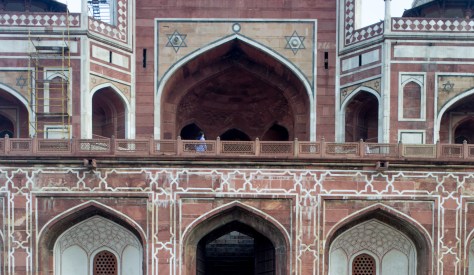
humayun-1-2

Why do we, if at all we do, really care about our material cultural heritage? Is it because it reminds us of what was, and is, good and great in humanity? Or is it the case that we look at a cultural objet and recognise that it is the Ozymandias complex materialized, that even the great and the mighty fail? Or is it that we may never attain the great heights in purity, simplicity, or other qualities we idolize and project on the remnants of the times past?

Or maybe we just want the tourism dollars and euros. Be that as it may, only someone obtuse, or with exaggerated tendency towards the behavior philistine, would say that our cultural heritage, our miniature paintings, our ruins, our tombs, forts, wall paintings, temples, mosques , books, manuscripts, and other things this essay is too short to quantify, are not worth preserving. Also note here that I said we, because we might be a bunch of separate kingdoms and separate principalities earlier, but deep down, we were one people, separated by religion and language, but united (willingly or unwillingly), by the plain and simple fact that you can’t chose your neighbor.

Continue reading How We Destroy our Future by Proxy – On The Ruination of Ruins: Rahul Sharma

The HLEC and the Aporias of ‘Committeed’ Enquiries: Rina Ramdev and Debaditya Bhattacharya

This is a guest post by Rina Ramdev and Debaditya Bhattacharya

Students of JNU have been on an indefinite hunger-strike for over 15 days now, and the administration’s only official response so far had been the Vice Chancellor’s May 4 statement invoking the vocabulary of the ‘lawful’ and the ‘constitutional’ — in ambivalences closer to threat than appeal. The subsequent May 10 Academic Council meeting has been historic, both for its 53 members’ overwhelming denunciation of the HLEC report, as also for the indelible image of a fleeing VC now forever etched in campus folklore. Further, the Delhi High Court’s stay on the fine imposed upon one of the students lends hope for similar stays with the remaining beleaguered students’ cases. The VC has consequently been referring to the enquiry mandate as being sub-judice, only to grant it an interim legitimacy that may symbolically defeat the stridency of student resistance. Letters have been sent out to the parents of striking students, in an attempt to re-route intimidation and pressure through other non-official means of paternalism. Given the conditions of duress being thus created, until the HLEC’s report is revoked in entirety, there is every reason to believe that the administration’s vindictive punitive designs will leech into the future of university freedoms and campus democracy irreversibly.

Continue reading The HLEC and the Aporias of ‘Committeed’ Enquiries: Rina Ramdev and Debaditya Bhattacharya

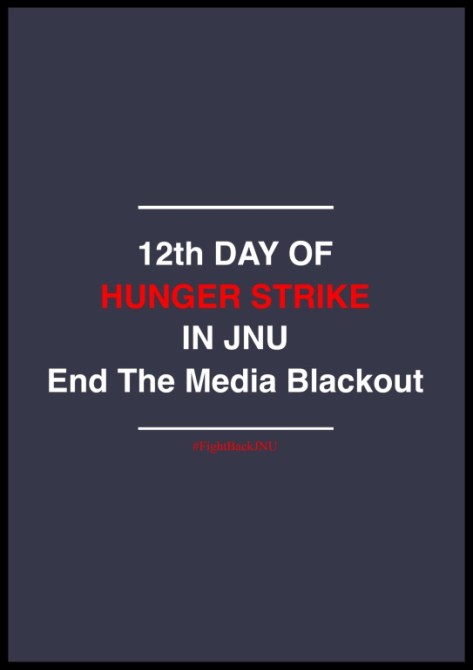
JNU Hunger Strike Day 12 : Game On – Students 1, Media, Authorities 0

The JNU Students’ Hunger Strike Enters Day 12. Ketone counts go up, Weight goes down, Morale stays miles high. Media fatigue shows that crusading news anchors are no match to hunger striking students when it comes to stamina, and, may we say, courage. The university authorities, the JNU VC and his gang, the government, the RSS-ABVP, remain what they are – losers.

(Images taken, with thanks, from the ‘We are JNU‘ Facebook Page, and the ‘Mothers Stand with JNU‘ Facebook Page.)

This slideshow requires JavaScript.

MEANWHILE, RADIOSILENCE CONTINUES (BESIDES RAVISH KUMAR’S SHOW) ON MAINSTREAM MEDIA

13177661_10153973732855546_8091436192653453340_n

This slideshow requires JavaScript.

Statement of Solidarity with Hyderabad Central University from Columbia University, New York

This is a statement of March 29, 2016 from students, faculty and affiliates of Columbia University. We publish it below with apologies for the delay.

We, students, faculty and affiliates of Columbia University, strongly condemn the violation and atrocities brought upon the students and faculty of the Hyderabad Central University (HCU) on March 22, 2016. Since Professor Appa Rao Podile was on leave and under investigation for the institutional murder of Rohith Vemula, his return to the campus to resume duties as the Vice Chancellor was unacceptable. The students justifiably organized a peaceful protest in the campus that day. The institutional responses to that, by the University authorities, the Andhra and Telangana police force, Rapid Action Force personnel, the media, and the members of the Akhil Bharatiya Vidyarthi Parishad (ABVP) on campus, were outrageous, inhuman, and fascist. The University authorities, instructed by Prof Podile, shut down the Internet connection, dining hall and drinking water facilities in retaliation to the peaceful student protest. The Andhra and Telangana police force lathi-charged students and faculty, violently beat up and severely injured them, molested and threatened to rape female students, targeted Muslims and Dalits, abused them verbally, and eventually arrested 24 students and 3 faculty. The ABVP members resorted to violence and aggressive sloganeering from the very beginning of the students’ peaceful protest and also attacked and injured them. The mainstream media has been ignoring these atrocious events at a Central university campus and has decidedly turned away from its responsibility and its accountability to the public. This is ironic, at the very least, when some of the news anchors just last month were so focused on fabricating stories of “terrorist” and “anti-national” activities at the Jawaharlal Nehru University, Delhi. The media ultimately failed to demonize the students then. Now, yet again, the media is unabashedly siding with the authoritarian regime of corporate and state power; this time by ignoring the brutality of the police and the HCU authorities.

We strongly condemn

–       the fascist abuse of power by the University authorities, who decided to deprive the students of basic facilities as ‘revenge’ for the peaceful demonstration

–      the violence, the targeting and the brutality of the police force

–   the irresponsibility of the media for not reporting this on prime time and for effectively siding with the tyrannical regime in power

–       the atrocities unleashed by the casteist, capitalist, Hindu fundamentalist government and its affiliates, especially ABVP.

Continue reading Statement of Solidarity with Hyderabad Central University from Columbia University, New York

JNUTA Statement on Suspension of Dr Shreya Bhattacharji in Jharkhand Central University

The Following is a statement from JNUTA

30 March 2016

On actions of the VC of Central University of Jharkhand

The JNUTA condemns in the strongest possible terms the suspension of Dr. Shreya Bhattacharji and her removal from administrative positions by the Vice Chancellor of Central University of Jharkand. What is simply outrageous is the action on her part that has been deemed as ‘misconduct’ – namely, inviting an eminent academic to be a Guest of Honour at a function in the University. She was assigned the responsibility to organize the event. The presumption underlying the accusation – that the credentials of the invited scholar, Professor M.N. Panini, were questionable as he is considered to be “mentor of the group of students of JNU, who were involved in anti-national activities in JNU campus recently” – would be laughable if it were not a scandal.

Clearly, the maligning of Professor Panini is simply on account of his association with JNU, where he served on the faculty with distinction for many years before his retirement, and has absolutely no relation with recent incidents in JNU.

Continue reading JNUTA Statement on Suspension of Dr Shreya Bhattacharji in Jharkhand Central University

When Crime Becomes Ordinary, Ordinary Life Will be Criminalised

  1. Zee News Anchor Sudhir Chaudhary whose heart beats for India tried to extort 100 crores from the Jindals, remember? No, no, please, kindly, take a few minutes to watch this, at least until 3.55.


  1. This is a photo comparing Chaudhary with that the whistleblower in the Vyapam scam, who exposed a long-running case of serious corruption by the state and political parties which has involved the murders of over 45 individuals! The current government is providing Chaudhary X category security while with this cycle-borne ‘security’ the Vyapam whistleblower has survived 14 attacks on his life.
main-qimg-ce1f1542701c71d0da51f68ad43ecab8
Courtesy: Quora.com

Continue reading When Crime Becomes Ordinary, Ordinary Life Will be Criminalised

जेनयू की सफाई पर स्मृति ईरानी की सफाई: नियति शर्मा

Guest post by NIYATI SHARMA

लोकसभा में स्मृति ईरानी जी की सफाई उर्फ़ भाषण बहुत भावुक, मनोरंजक और प्रभावशाली था। लोग उन्हें ‘आयरन लेडी’ का खिताब दे रहे हैं- यह उनके तर्क के लिए या उनके तेवर के लिए, या फिर उनके यह कहने के लिए की वो अपना सर काट के मायावती जी के चरणों में रख देंगी, पता लगाना थोड़ा मुश्किल है । सोचा था स्मृति जी कुछ सवालों का जवाब देंगी पर असल में मिली एक लम्बी, मेलोड्रामाटिक सफाई जिससे उन्होंने अपनी सरकार की सारी गलतियों पे पर्दा डाल दिया।ऐसी स्तिथि में हम मजबूर हो गए हैं की स्मृति जी से जो सवाल पूछे जाएँ वो तथ्य-सम्बंधित होने के साथ साथ अति भावनात्मक भी हों।

स्मृति जी के अभिनय के सारे सालों का अनुभव उनके भाषण में साफ़ दिखाए दिया। लोकसभा में स्मृति जी के हाव भाव से आक्रोश टपक रहा था पर क्या उन्हें इतना क्रोधित होने का हक़ है? स्मृति जी का यह मानना है की उनके ऊपर काफी बेबुनियादी आरोप लगे हैं, पर यह मामला स्मृति ईरानी जी के बारे में नहीं है, यह मामला उन मासूम छात्रों के बारे में है जिनकी ज़िन्दगी को उन्होंने दांव पर लगा दिया है। आखिर उन ‘बच्चों’ का क्या जिनके ऊपर उन्होंने और उनकी सरकार ने पिछले कुछ दिनों में अनगिनत आरोप लगाये हैं? स्मृति ईरानी जी तो मंत्री हैं, अगर आरोप लगे भी, तो उनकी ज़िन्दगी बर्बाद नहीं होगी, पर जिस क्रूरता से सरकार और मीडिया ने छात्रों का चरित्र-हनन किया, वह कभी भी इससे उभर नहीं पाएंगे। कन्हैया, उमर और अनिर्बान न ही मंत्री हैं जिनके पास कोई राजनैतिक सहारा है और न ही उनके परिवार इतने धनी हैं की वह अपना जीवन, अपनी इज़्ज़त पुननिर्मित कर पाएं। स्मृति जी, आप तो सिर्फ अपने बारे में सोच रही थीं की आप पर और आपकी परफॉरमेंस पर क्या क्या सवाल उठाये गए, क्या आपने एक बार भी सोचा की इन छात्रों के पास आगे ज़िन्दगी में सफाई देने का कोई मौका नहीं होगा? क्या आपने, माँ होने के नाते, यह सोचा की यह छात्र अब कभी भी साधारण जीवन नहीं जी पाएंगे?

Continue reading जेनयू की सफाई पर स्मृति ईरानी की सफाई: नियति शर्मा

Come on man, be clear, what comes first—Nation, or Democracy? Bodhisattva Kar translated by Ahona Panda

Guest Post by Bodhisattva Kar and Ahona Panda

(Written by Bodhisattva Kar in Bengali, First published in on 18 February 2016 by the Ei Samay newspaper.Translated into English by Ahona Panda)

“To you I confess today—what you all call a patriot, I am not of that kind.” After this confession of sparkling clarity, should we not catch hold of that man as an anti-national? So what if he is dead? If the dead can be rewarded with the Bharat Ratna, why can’t we frame the dead with a few charges of sedition? For God’s sake, all you good people, how did you make a song written by this man the national anthem? The man who—without any obfuscation—speaks through the mouth of the protagonist of Char Adhyaya—“They who do not take cognizance of that which is greater than patriotism, their patriotism is like crossing on a crocodile’s back.” Where did he get the audacity to dream of something greater than patriotism? And, he did not even study at JNU. “By killing the very soul of the country, the country’s life can be resuscitated: this terrible untruth is being announced in beastly roars by nationalists around the world and it makes my heart revolt with intolerable intensity.” How can you not burn the books produced by such a treacherous son of Mother India, who said such terribly instigatory things? Why do you worship him instead? Can anyone put their hand on their hearts and say that he wasn’t a Pakistani spy, just because of the niggling detail that Pakistan did not exist at the time he was writing? Did we not shoot Dabholkar or Pansare for agonizing quite a bit less than he did? Continue reading Come on man, be clear, what comes first—Nation, or Democracy? Bodhisattva Kar translated by Ahona Panda

Apologise to the Nation, All of You.

You, who shout your nationalism from the rooftops; you whose blood runs hot for “Mother India”; you who turn red with rage when contradicted; you who set agendas like patriarchs drunk on father-right; you who refuse to let another speak, you! who don a suit every night on television to disguise your cheap tricks; you who abuse your guests if they happen to be young, powerless and honest; you who bloat on adrenaline while your viewers turn to idiotic jelly; you who abuse the highest offices of this land; you who give a bad name to khaki; you who wear lawyers’ robes to beat students and teachers; you who are protected by your political masters; you who strike deals in the privacy of your offices, chambers and boardrooms; you who live by ratings and upvotes; you who tell lies so long you forget the truth; you who form bands of cowards hiding in plain sight; you who roam the streets showing your fist to all; you for whom a martyred soldier is more valuable than a living citizen; you who abuse the power that history gave you; you who mistake that accident of history for a moral right; you whose imagination of revenge always involves rape; you who have brought this country to the brink of civil war; you who speak in the name of the mythical motherland while the actual children of that land are hungry, thirsty and unemployed; you who claim this moment, this nation, this public, this history, this land. Apologise.

Apologise to those who work everyday to make this country decent; who work for too little, and for too long; those whose deaths become statistics in the great churning pots of state economists; those whose parents taught them to keep their heads down and quit an ugly fight; those who argue, debate, disagree without the urge to kill or maim their opponents; those who understand when an argument becomes too heated; those who pull back from the brink every time because they know that to be alive is not always to be right; those who reclaim the streets to protest when it’s hard, when it’s inconvenient, and when it’s dangerous, because it’s the only way to disagree; those who see that an eye for an eye makes the whole world blind; those who understand and accept this land in all its confounding conflict; those who risk death to expose the powerful and corrupt; those who have no choice but to join the army to feed their families; those who laugh when there is nothing left; those who write, think and reason, and take time over all three; those who appreciate the beauty of the stars on a still night; those who make love like it’s a gift and not a right; those whose parents live after they died because they were on the wrong side at the wrong time.

Above all, you deranged “nationalists”, apologise to three fellow citizens – one born in a caste that could only speak from the protection of death; another who is languishing in jail for no crime at all; and perhaps most of all, a third who is on the run from a police none of us ever trusted. Apologise. These young people are the future of this country, not you with your bloodlust. WE are the nation, and we demand an apology from you.

5 Colleges Faculty and Student Statement in Solidarity with JNU

This is a statement sent by scholars at five universities in the U.S

We, the undersigned at the University of Massachusetts – Amherst, Smith College, Hampshire College, Mount Holyoke College, and Amherst College wish to express our solidarity with the students, faculty, staff and wider community of Jawaharlal Nehru University (JNU), India’s premier academic institution. We demand that all charges against all students being targeted as ‘anti-national,’ including JNU Student Union president Kanhaiya Kumar, be dropped immediately. We understand the arrest of Mr. Kumar, and the intention to arrest or interrogate another 50 students on some unspecified list of the Delhi Police, to be associated with a wider campaign to quell dissent in India’s universities, a campaign which includes the harassment faced by Hyderabad Central University student Rohit Vemula, resulting in Mr. Vemula’s suicide. We are concerned about the well-being of the students who continue to be debarred from all academic activities at JNU, without any due process or proof of wrong doing, and we condemn the scapegoating and media trial of Umar Khalid, based largely upon his identity as a minority. We demand that the Delhi police should withdraw from the JNU campus. We believe that the ultimate responsibility for the campaign of harassment against universities throughout the country lies with the present Indian Government and we demand that the government desist.

We are aware and are in agreement with the fact that the case against Mr. Kumar is false in every way. We are also in agreement with eminent economist Professor Prabhat Patnaik, that the government’s actions are nothing less than the beginning of a campaign to undermine the Indian Constitution itself. The events in Hyderabad, JNU, and most recently, Jadavpur University, all point to a pattern of harassment, wherein the central government has deployed campus-based student groups to silence dissent. We take the use of the state’s machinery to physically attack vocal and articulate students speaking against the government extremely seriously. We are particularly concerned by this government’s tacit approval of the violence exhibited by lawyers at Patiala house this week. As scholars and students based in the US, we have already witnessed efforts by representatives of the Hindu right to undermine academic debate and scholarship in the context of South Asian Studies in the US and in India. We collectively represent years of scholarly and activist experience in addressing threats to academic freedom, and see that these threats are part of a larger project to undermine democracy and to rationalize a fundamentally unequal society. Continue reading 5 Colleges Faculty and Student Statement in Solidarity with JNU

Statement of Solidarity with Students in JNU, India – by students in KU Leuven, Belgium

We, the undersigned, students in the social sciences and humanities programs at KU Leuven, strongly condemn the Indian state’s heavy handed and politically motivated action against the students at the Jawaharlal Nehru University (JNU), Delhi.

We condemn the brutal police action against students, especially the arrest of JNU Students’ Union (JNUSU) president, Kanhaiya Kumar on 12 February 2016 – who has been charged under colonial-era sedition laws. We equally condemn the witch-hunt against and media trials against JNU, its faculty, and its students – especially Umar Khalid, an atheist-Leftist activist, who is wrongfully being called an ‘Islamist’ by some in the media.

Over the last few months, Indian universities have become a crucial site to contest and resist the arbitrary and concerted efforts of the Indian state to quash academic autonomy and dissent – from the scrapping of non-NET fellowships in 2015, to the death of Dalit PhD scholar Rohith Vemula at the Hyderabad Central University, earlier in January.

We underscore the fact that universities have historically been sites of critical thinking and politics, and need to remain the same. Furthermore, as the recent cases in India have shown, it is often students from under-privileged backgrounds who raise critical questions against the workings of the state, and also question structures of privilege within universities, in peaceful and non-violent ways.

The government and police action against the students at JNU seriously undermines and threatens these values. These (re)actions are based on questionable facts and charges of anti-nationalism and sedition. Indeed, no is within the space of the university that ideas of the ‘nation’ – who is included within it, and who is excluded – can be questioned and debated.

Continue reading Statement of Solidarity with Students in JNU, India – by students in KU Leuven, Belgium