Category Archives: Violence/Conflict

Harassment or Domestic Violence? The Case of Preity Zinta and Ness Wadia: Amrita Mukhopadhyay

Guest Post by AMRITA MUKHOPADHYAY

On Friday, 13 June 2014, a well known Bollywood actress Preity Zinta lodged a criminal complaint against her former boyfriend and business associate Ness Wadia, with the Marine Drive Police Station, Mumbai. In this case, the actress brought about criminal charges against a powerful businessman under different sections of the Indian Penal Code (IPC). The criminal complaint, which forms the basis of the First Information Report (FIR), alleges a range of behaviour that amounts to different crimes under the IPC falling under specific sections categorised as ‘offences affecting the human body’ and offences dealing with ‘criminal intimidation, insult and annoyance’. The first offence of ‘assault or criminal force to woman with intent to outrage her modesty’ under Section 354 of the IPC is a cognizable non-bailable offence liable with imprisonment ranging from one to five years with or without fine. Section 504 of the IPC forms the basis of another offence dealing with breaching ‘public peace’ on account of intentional insult or provocation, is a bailable non-cognizable offence with a maximum punishment of two years in imprisonment with or without fine. Under Section 506 of the IPC, the businessman is accused of criminal intimidation with ‘threat’ that may deal with intention to cause ‘death or grievous hurt’ or ‘destruction of property’ or to ‘impute, unchastity to a woman’. This offence is liable with imprisonment for seven years and is non cognizable and bailable. Finally under Section 509 of the IPC, the businessman stands accused of a cognizable and bailable crime of insulting the ‘modesty’ of a woman based on ‘any word, sound or gesture’ and carries a term of imprisonment for three years with or without a fine.

Ness Wadia dismissed the allegations as ‘false’.

In this maze of criminal charges, the glaring anomaly is the absence of a focus on nature of the relationship between the person who lodged the complaint and against whom the complaint is alleged. Continue reading Harassment or Domestic Violence? The Case of Preity Zinta and Ness Wadia: Amrita Mukhopadhyay

Aluthgama – Thinking about Co-existence and Resistance in a Time of Crisis: Mahendran Thiruvarangan

Guest post by MAHENDRAN THIRUVARANGAN

I come from a community that was both a victim and a villain in the thirty-year civil war that unsettled all of us. We were victims because the Sri Lankan state killed thousands of us, grabbed our lands and made us homeless; we were villains as we could not question the LTTE strongly when the movement massacred members of the Sinhala and Muslim communities and members of our own community who refused to conform to the movement’s ideology. We witnessed how the narrow nationalist politics that we romanticized, alienated us from the other communities on the island. We witnessed how our failure to criticize the decisions made by our leaders contributed in part to the death of thousands of Tamils in Mullivaikal in May 2009. We witnessed how our obsession with the particular—our language, our culture, our religion and our homeland—incarcerated us within the walls of purism and political decadence. It is true that there was no space for dissent when the LTTE ruled us. But we need to accept as a community that because the LTTE fought against a state that dominated us and persecuted us, many of us often, in our everyday conversations, justified its violence against other communities. Any community that clings to a narrow-minded nationalism has many a lesson to learn from the painful experiences that the Tamils in Sri Lanka went through during the war. When I read about the recent attacks on Muslims in Aluthgama, I remembered the Eviction of Muslims from the Northern Province by the LTTE and the violence that the LTTE directed at the Muslim community in the East in the name of Tamils. Continue reading Aluthgama – Thinking about Co-existence and Resistance in a Time of Crisis: Mahendran Thiruvarangan

A Renegade’s People: Rupam Sindhu Kalita

This is a guest post by Rupam Sindhu Kalita

What unites anti-homophobia campaigners, defenders of the poor’s right to clean water, university student collectives, women rights’ groups and academics under a premature summer sun in New Delhi on the 30th of March earlier this year? It is the unacceptable means employed by the Indian state in response to armed rebellions in North east India and the threat to civilian life that it has precipitated. The contagion of a military approach to a largely political problem was promulgated as an ordinance in 1958 under the presidency of Dr Rajendra Prasad to help quell the Naga movement and was developed into the Armed Forces Special Powers Act (Assam and Nagaland) later in the same year. The Armed Forces Special Powers Act (from here on AFSPA) persists in violating human rights in Kashmir and North east India despite its incompatibility with national and international human rights declarations. Over the years this Act has been sanctified in the inner sanctum of India’s centralised quasi-military administration. The government has been extremely guarded in its approach to growing popular demands for annulling this Act. The civil leadership’s reluctance to temper with the ritualized provisions of this Act has raised the disquieting question of who runs the country.

On 30th March central Delhi woke up to a motley group of protestors unified by a concern for violation of human rights under AFSPA. [Photo credit: V Arun Kumar].

Continue reading A Renegade’s People: Rupam Sindhu Kalita

PUCL Petition to NHRC Urges Inquiry in the Case of Human Rights Defenders Teesta Setalvad and Javed Anand

The following is the text of the PUCL petition to NHRC in the case of Teesta Setalvad, Javed Anand and the Citizens for Justice and Peace

PEOPLE’S UNION FOR CIVIL LIBERTIES

270-A, Patpar Ganj, Opposite Anand Lok Apartments, Mayur Vihar I, Delhi 110 091 Phone 2275 0014 PP FAX 4215 1459 Founder: Jayaprakash Narayan; Founding President: V M Tarkunde President: Prof. Prabhakar Sinha; General Secretary: Dr. V. Suresh

E.mail: puclnat@gmail.com; pucl.natgensec@gmail.com

7th June, 2014

TO: THE HON‟BLE CHAIRPERSON AND HON‟BLE MEMBERS,

NATIONAL HUMAN RIGHTS COMMISSION,

Manav Adhikar Bhawan Block-C, GPO Complex,

INA, New Delhi – 110023

SUB.: SEEKING AN INDEPENDENT REVIEW AND INTERVENTION IN RESPECT OF CONTINUING PERSECUTION AND PROSECUTION OF HUMAN RIGHTS DEFENDERS, TEESTA SETALVAD AND JAVED ANAND OF CITIZENS FOR JUSTICE AND PEACE AND OTHERS

Continue reading PUCL Petition to NHRC Urges Inquiry in the Case of Human Rights Defenders Teesta Setalvad and Javed Anand

Airing the unheard from Polavaram: Mohammed Omais Shayan

Guest post by MOHAMMED OMAIS SHAYAN 

As the Nation is welcoming its 29th state, Telangana is upbeat with hope of starting a new chapter of progress. Amongst the jubilations in Telangana, voices of people affected by the Polavaram dam are being lost. “Dam’ned”, a film by Saraswati Kavula is an attempt to air the unheard voices. It’s a must watch for all concerned as the movie touches the links of people, land, livelihood and development. The film aims to bring ground realities through interviewing the people of the affected region, technical and environmental experts. Before getting into content of the film, a very brief introduction of the project.

Polavaram project is going to be the largest dam in terms of number of people being displaced. The dam will be constructed at Polavaram village in West Godavari district of Andhra Pradesh. The dam aims to irrigate 2910 km2 of area in Andhra Pradesh [1]. It will also provide drinking water to Vishakapatnam City and many villages besides water for industries in Vizag. The project aims to transfer 80 TMC water from Godavari to Krishna basin. The dam will submerge 300 villages of Andhra Pradesh, Chattisgarh and Orissa. This submergence area will cover 3,500 acres of biodiversity rich forest and also partially submerge the Papikundulum wildlife sanctuary [2]. The people living in these areas are predominantly ‘adivasis’ belonging to Koya and Konda Reddy tribes.

Continue reading Airing the unheard from Polavaram: Mohammed Omais Shayan

Enough is enough: Anand Teltumbde

ANAND TELTUMBDE in The Hindu today

http%3A%2F%2Fmedia.npr.org%2Fassets%2Fimg%2F2014%2F05%2F31%2F494819135_custom-58300287d01c3c0d94b0654967811781d07b8f74

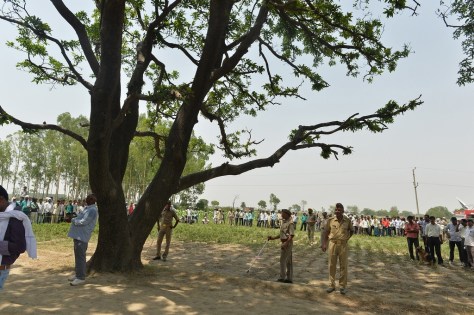
The tree in Katra Shahadatganj village (Badaun district) from which two young Dalit women, sisters, were found hanging after being gang-raped on May 27, 2014. Their bodies were found on May 28th.

The images of two innocent Dalit girls hanging from a tree in Katra village in Badaun district of Uttar Pradesh and a crowd of spectators looking bewildered at them best describes our national character. We can endure any amount of ignominy, can stand any level of injustice, and tolerate any kind of nonsense around us with equanimity. It is no use saying if those girls were our own daughters or our own sisters, we would still stare at them, bewildered and resigned like anyone in that crowd did. In just the past two months, while we as a country were busy playing fiddle to Narendra Modi and his promise of acche din, there have been a series of gory rapes and murders of Dalit teens across the country.

But beyond the residual anger, there is hardly any real concern for these atrocities. The rulers are not concerned, the media is hardly interested, and then there is indifference of the progressive lot and Dalits’ own frigidity towards them. It is shameful that we take the rape and murder of innocent Dalits as an adjunct of our social environment and forget about them.

Waiting on Biafra and Lanka

As May turns into June the quiet loneliness of war-torn Jaffna lies before me. For how much longer, years or decades into the future, will I look back into the past? And who will help me reflect on that past?

Some, fifty years ago, the tragedy of Biafra unfolded. I grew up hearing about the legacy of Biafra. During the early years of Tamil militancy, my father and a few other Tamil intellectuals of his generation warned that we may end up like Biafra. That many intellectuals perished in the struggle for Biafra I knew, but what they did I did not know back then.

It is over the last year, that I returned to Biafra, through the powerful novel of Chimamanda Adichie, Half of a Yellow Sun. A novel sometimes helps us think about questions we find difficult to ask. Adichie made me think about how long it takes for us to grasp the suffering that comes with a devastating war. Indeed, Adichie writes about Biafra some forty years after. From Adichie, I moved to Chinua Achebe’s There Was a Country: A Personal History of Biafra. What struck me most about Achebe’s memoir, is that almost fifty years later, he is still struggling to come to terms with what Biafra meant to him, shackled by lingering nationalist sentiment. It takes a life time or even more to deal with the past in places like Biafra and Lanka.

Mid-May marked the fifth year since the end of the war in Sri Lanka. Continue reading Waiting on Biafra and Lanka

The Modi Mandate – A Belated Response to S Varadarajan: Pradip Datta

Guest post by PRADIP KUMAR DATTA

Siddharth Varadarajan’s article raises some very important dilemmas before Modi which is really a rehearsal of the development versus welfare debate now bound to be exacerbated with the runaway capitalism that Modi promises to unleash.

But it raises another important question. Can we simply forget the past and get on with the future? Can we join the futurist chorus of Modi and his Thatcherite – Reaganite followers? Can an electoral mandate, even one as powerful as this, remove permanently the memory of 2002?

The immediate analogy comes with the anti Sikh riots followed by the 1984 verdict. 1984 returns every election to haunt the Congress even after they have made a Sikh prime minister for 10 years. Some historical memories are very stubborn and refuse to leave off the haunting of the future. It is not as if there have not been many riots. But only some riots achieve a historically emblematic status that remove them from the realms of simple memory alone. Some events become symbolic rallying points and they invite an excess of documentation, of witness testimonies, of cultural representations, all of which memorialize and fix them in chronology as a rupture in time that can never quite be bridged by the stitchings or blurrings of popular oral memory alone. In such events the archive becomes memory. Continue reading The Modi Mandate – A Belated Response to S Varadarajan: Pradip Datta

क्या निराश हुआ जाए?

क्या निराश हुआ जाए? कल सुबह से हजारी प्रसाद द्विवेदी  का एक अन्य  प्रसंग में किया गया यह प्रश्न मन में घूम रहा है. चुनाव नतीजों के पहले ही चरण में पिता ने फोन पर कहा: “यह तुम्हारा पहला कड़ा इम्तहान है.”पिता ने, जो अब जीवन की सांध्य वेला में हैं, कहा, “हम तो किनारे पर खड़े लोग हैं, तुम सब अभी इस जिंदगी के रेले के ठीक बीचो-बीच हो, भागने का न तो कोई उपाय है और ऐसी कोई भी इच्छा कायरता होगी. इसका सामना करो और इसे समझो.” हजारीप्रसाद जी और अपने पिता को कहना चाहता हूँ, वह जो रवींद्रीय ब्रह्मांडीय उदारहृदयता का स्वप्न आप सबने दिखाया था, कामकाजी रोजमर्रापन की तेज रौशनी में खो गया जान पड़ता है. शायद हम सब अब तक सो रहे थे,अचानक जगा दिए गए हैं. निराश या हताश होने की सुविधा नहीं है. समझने की कोशिश ही शायद इस यथार्थ का सामना करने के साधन देगी! Continue reading क्या निराश हुआ जाए?

The UAPA in Madhya Pradesh – The JTSA Report in Perspective, and Beyond: Sharib Ali

Guest Post by SHARIB ALI

REPEAL UAPA: JTSA REPORT IN PERSPECTIVE, AND BEYOND

The state fabricates terror. There is enough evidence to take it to court on that count. Yet, how does one construe ‘fabrication’- what is implied by it? First, that the state has orchestrated elaborate attacks- violence to terrorize its people for certain legal, electoral and political ends. Second, that it has, through the use of laws like Unlawful Activities Prevention Act (UAPA)  against specific segments of its population has consciously manufactured a state of terror- a collectively imagined perception of threat that the nation faces from a particular people. The ends, always remain the same.

Though there is evidence of the agencies of the state, or actors within them, expressly participating in orchestrating large scale terror attacks (think col. Purohit), it is the latter- where terror within specific communities is manufactured in the eyes of the law and the people- that I deal with here, today. ‘Guilt by Association’The JTSA (Jamia Teachers Solidarity Association) report on UAPA cases in Madhya Pradesh, is a crucial case in point.

Continue reading The UAPA in Madhya Pradesh – The JTSA Report in Perspective, and Beyond: Sharib Ali

A Matter of Honour ? A Response to B. G Verghese’s views on the Kunan Poshpora Mass Rape: Shrimoyee Nandini Ghosh

Guest post by Shrimoyee Nandini Ghosh

 I have thought hard about why I want to write this piece at all, since so many others before me, have made robust critiques of Mr B.G Verghese’s well-known views on the Kunan Poshpora mass rape. Past criticism has focussed on questions of his obvious biases– both personal and professional, his misogyny and profound lack of empathy for the victims, his blinding nationalism, the tenor and language of his reportage. Most however accept his version of the facts, given his (often self proclaimed) claims to veracity bolstered by official hospitality, access to documents, and his reputation as an eminent journalist. ‘There was a delay in making an official complaint’ ‘medical evidence shows that the mass rapes did not take place’, ‘villager’s and early official accounts of that night are full of gaps and contradictions’, these have become the pervasive truths about the events of February 23-24, 1991, to the point where his decriers can often only counter him by explaining away the inconvenient and the inexplicable, within the narrative and factual scaffolding that he provides. Mr Verghese points to this when he writes, ‘Sadly, it [the Press Council of India Report] was and is widely criticised to this day, without critics having read it or controverted its substantive findings’. Mr Verghese fails to disclose that until recently no one has had access to the ‘substantive’ material that could allow such a critique, because the state had never disclosed that any other investigative material existed simply replying to RTIs seeking information on the status of the case, with the inscrutable ‘closed as untraced’. The unwieldy length of this piece (8000 words) will, I hope, serve to finally pursuade him that not only is his work read, it is read in painstaking detail.

Continue reading A Matter of Honour ? A Response to B. G Verghese’s views on the Kunan Poshpora Mass Rape: Shrimoyee Nandini Ghosh

भगाणा कांड के पीड़ितों ने इंसाफ की मांग की: भगाणा कांड संघर्ष समिति

Press statement issued by the BHAGANA KAAND SANGHARSH SAMITI in New Delhi, 11 May 2014


Latthmar Mahila Sena
A call for direct action – an armed women’s squad – Latthmar Mahila Sena

हरियाणा के भगाणा गांव में सामूहिक बलात्कार की शिकार हुई चार नाबालिगों के हक में न्याय की मांग के समर्थन में आज पीड़ितोंके साथ भारी संख्या में दिल्ली के सामाजिक कार्यकता, बुद्धिजीवी और विद्यार्थी भी जुटे। यहां दिल्ली में पंत मार्ग पर स्थित हरियाणा के मुख्यमंत्रीआवास पर धरना देते हुए आंदोलनकारियों ने पीड़ितों के प्रति हरियाणा सरकार के रवैए की तीखी आलोचना की और कहा कि ऐसा लगता है कि हरियाणा सरकार सामंती उत्पीड़नकर्ताओं के पक्ष में खड़ी हो गई है और दलितों-पीड़ितों की आवाज को जानबूझ कर दफन किया जा रहा है।

बड़े पैमाने पर जुटेलोगों ने यहां दिल्ली में सरकार और प्रशासन से यह मांग की कि पीड़ितों पर जुल्म ढाने वाले दोषियों को  सख्त सजा दी जाए और फास्ट ट्रैक अदालतों का गठन कर पीड़ितों को जल्द से जल्द इंसाफ दिलाई जाए। Continue reading भगाणा कांड के पीड़ितों ने इंसाफ की मांग की: भगाणा कांड संघर्ष समिति

Bittersweet Gujarat: Reena Patel

This is a guest post by REENA PATEL

I looked around the room and my gaze was met with the kohl lined eyes and stares of bewilderment and distrust. My heart pounded as I listened to three Muslim women describe their latest attempt to find their father and brother after they disappeared in the riots. They were speaking to Rahidbhai* from a local NGO who was accompanying me into the Ahmedabad relief colonies for the first time. Why was I so scared? Why was my heart pounding? The eldest woman of the home disrupted my thoughts, she asked me for my name. I looked around and looked at Rahidbhai, who looked back uneasily. “Mera naam Reena hai.” I said, almost choking on the words, knowing what the next question would be. “Aap ka surname kya hai?” The room grew thick with silence. “Patel.”

As far back as I could remember, I was taught to regard Muslims differently from the rest of the general population. My parents, both from Surat, Gujarat moved and met in the United States in their twenties. They both lived in England and spent time in Gujarat, and had families that were deeply involved in the Gujarati community. My brother and I were born in Long Beach California. I went to Gujarati school on Sundays, went to every function, picnic, and cultural show put on by the Leuva Patidar Samaj in Southern California. Many of my family members were apart of the organization. In fact, my great grandfather Vallabhai Patel was one of the first Patels to land upon the shores of the United States, now estimated at a population of over 140,000. We went to religious camps that were meant to teach us about Hindu ideology, handed out saffron prayer books and modeled how to become ideal Hindu men and women for our communities.

Continue reading Bittersweet Gujarat: Reena Patel

There’s a G on my Neck (again): Simran Kaur

Guest post by SIMRAN KAUR

Shekhar Gupta is at it again: lacing an insidious agenda with just enough actual facts that even the targets of his vitriol become eager to swallow. Aspiring Indian Journos, this is how a good Sardar Joke—and while you are at it, jibe at the poor, the rural, the unemployed, the mourning—is done, while earning your paycheck yet again as an esteemed Editor-in-Chief, at best with head-in-clouds, at worst, a stake-in-oppression.

Shekhar G’s latest thesis: The rest of the country has moved on but Punjab has become a prisoner of its boisterous old stereotype. It has forgotten its entrepreneurial energy, its competitive spirit and slipped into a complacent, decadent trance of perpetual balle-balle.

His first argument for the thesis of Punjab’s decline: “the Punjabification”…of Punjab. He bemoans that signs and posts are in Punjabi, in Punjab.

The 50s and 60s saw Punjabi Hindus becoming the unique community to denounce their own mother-tongue. Upping the ante, G. ridicules Punjabis who use Gurmukhi, the script developed in the time of the Sikh Gurus. He finds tell-tale signs over Punjab (he notes his fieldwork of actually travelling on the Grand Trunk Road and flying over Punjab by helicopter recently) of the people being un-couth:  signage on Punjabi establishments, in poor English.

You will take a minute figuring out what the “burgars” and “nudles” painted on so many fast-food shops mean, or why Lily is always spelt “Lilly”, whether it be the name of a restaurant in Phagwara or a beauty parlour in Bathinda…If you haven’t figured out already that this, indeed, is Singh’s English.

Brilliant two-birds strike, Shekhar G. Continue reading There’s a G on my Neck (again): Simran Kaur

BJP’s Campaign of Intimidation – A Report from Banaras: Monobina Gupta

Guest post by MONOBINA GUPTA

The narrow streets of Goduliya Chowk were bursting at the seams yesterday. It was the time of the famous Varanasi aarti at the ghats of the Ganga, a time when the crowd multiplies by several hundreds of people. Narendra Modi was preparing to head out on his triumphant road show through this area, choc-a-bloc full. The BJP’s activists were in a frenzied trance – waving saffron flags, flaunting Modi caps (a tawdry imitation of the original AAP trademark), dancing and chanting: Modi, Modi. As a person with no love lost for Modi, I responded to the exultant mood with some apprehension. My thoughts were straying to the nukkad sabha of the AAP that I attended last evening when a group of 20 young and old AAP volunteers had gone around campaigning for Medha Patkar’s meeting. I found myself thinking about the evening a couple of days ago when I stood with Anand Patwardhan and some activists who were distributing leaflets right there at Goduliya Chowk, and a group of BJP men came surrounded us. I thought about another night spent at Kabir Math Chowk after watching the Dastangoi performance – when a group of young men from Bangalore and Maharashtra were confronted by BJP supporters. I was worried about their safety standing amidst a crowd which appeared dangerous in its swaggering triumph. Yesterday, with Modi’s cavalcade approaching, frictions were reaching fever pitch – encounters one could not possibly see on the images on TV at home.

Standing there amidst the crowd, I spotted an elderly Sikh gentleman walking through the throng of people wearing his AAP topi. Suddenly a roar went up, as Modi sympathisers lunged after him shouting ‘pagal, pagal’ (mad/mad). A little distance ahead I saw another man wearing the AAP cap. The crowd spotted him too, and ran after them both, gesticulating, heckling. As I start walking quickly towards the men I saw them, seemingly unperturbed, walk right through the charging hoard, not a sign of nervousness about their gait. They were walking the confident walk of men who know no fear. Continue reading BJP’s Campaign of Intimidation – A Report from Banaras: Monobina Gupta

Why the Law may still Catch Up with Amit Shah: Warisha Farasat

Guest Post by WARISHA FARASAT 

Amit Shah seems to be on a roll this election season. First, he escaped any punishment after delivering one of the most disturbing hate speeches made during the 2014 election campaign. After the Muzaffarnagar riots, attempts were made by political parties to capitalize on the suffering of the locals, and provoke certain communities to vote for them. And when Amit Shah was censured by the Election Commission for indulging in objectionable speeches during the election campaign in Uttar Pradesh, BJP Primeminsterial candidate Narendra Modi came to the defence of his most loyal lieutenant. Clearly, Amit Shah’s statement was made with the intention of polarizing the voters in a politically surcharged environment in Uttar Pradesh and amounted to hate speech. However, the Election Commission soon did a u-turn, diluted its own stand, withdrew the ban against Shah and allowed him to go ahead with his campaign. The withdrawal of ban against Amit Shah ignoring the drastic implications of his hate speech during the campaign was alarming.

And now, the CBI has not named Shah as an accused in the Ishrat Jehan fake encounter case stating that there is no ‘prosecutable evidence’ available against him. But Shah and his supporters should not think that this so-called ‘clean chit’ absolves him of all criminal responsibility for indulging in fake encounters in Gujarat. If we believe the CBI in the Ishrat Jehan case when they claim that there is no prosecutable evidence against Shah, consequently, we also need to trust their investigations in atleast two other fake encounters, namely the Sohrabuddin Shiekh and the Tulsiram Prajapati cases where the CBI have named Shah as an accused. Shah is presently being tried in these cases and is able to campaign during these elections only because he is out on bail.

Continue reading Why the Law may still Catch Up with Amit Shah: Warisha Farasat

Condemn the Massacre in Assam: A Statement by Civil Society Groups, Activists and Concerned Citizens

Text of a statement issued by Civil Society Groups and Concerned Citizens

5th May 2014

Condemn the Massacre in Assam, Demand immediate arrest of Pramila Rani Brahma; Ensure safety of Muslims in BTAD: A Statement by Civil Society Groups, Activists and Concerned Citizens

We, the undersigned, express our profound sense of grief and alarm over the gruesome massacre of Bengali-speaking Muslims on 2nd May. This most recent round of killings — in which 32 people, mostly women and children have lost their lives – is another link in the long and… bloody sequence of ethnic cleansing being carried out by tribal Bodo militant groups with impunity.

For years, Hindutva politics has successfully created the bogey of the ‘Bangladeshi’, rendering Muslims as suspects and targets, locked in a perpetual battle with the tribal Bodos. In his rally at Silchar, the BJP’s Prime Ministerial candidate reiterated precisely this. He said: “There are two kinds of people who came from Bangladesh to Assam: those brought as part of a political conspiracy for vote bank politics of a particular party (Muslims) and others who were harassed in the neighbouring country (Hindus). Those brought for vote bank politics and smugglers must be pushed back, while the second category must be accommodated.” (Silchar, 22nd February). Continue reading Condemn the Massacre in Assam: A Statement by Civil Society Groups, Activists and Concerned Citizens

The Carnage in Kokrajhar: Saba Sharma

Guest post by SABA SHARMA

Since the evening of the 1st of May, it has been reported that at least 23 people have been killed in Kokrajhar and Baksa districts in Assam, administered under the Bodoland Territorial Council. All the victims were from the Muslim community, and were allegedly shot by the militant Bodo group, the National Democratic Front of Bodoland (Songbijit), named after its ruthless leader Songbijit, from the Karbi Anglong area in Assam. Indefinite curfew has been imposed here and in neighbouring districts as well, as rumours of other killings and beatings filter in, impossible to separate from facts in the atmosphere of panic that currently prevails.

Polling ended in the Kokrajhar constituency in Assam on the 24th of April, ending a temporary sense of calm and normalcy. Ethnic violence between Bodos and Bengali Muslims took place in July 2012, majorly affecting Kokrajhar, Chirang and Dhubri district. Nearly 5 lakh people were displaced from their homes, and most did not return until January 2013, staying in relief camps, too afraid to return. Once the camps were formally shut down and people returned to their homes, normalcy was still a distant reality. An economic boycott imposed by Bodo leaders on the Bengali Muslim community meant that agricultural labour, a primary occupation for Bengali Muslims, was all but non-existent. In the last year, this economic boycott has slowly been relaxed in some areas, while in other areas, it prevails as strongly as ever. In most areas, markets were among the first spaces to become mixed again, an almost neutral zone where people began to interact with one another again. But in other markets, like Koila Moila bazaar in Chirang, Muslims are still ‘banned’. Continue reading The Carnage in Kokrajhar: Saba Sharma

Anatomy of a Rape and Its Immediate Aftermath – A Report from Kolkata: Kasturi

Guest post by KASTURI

Time flew fast. Over the last two days and sleepless nights. A girl I knew, a cheerful bubbly college first-year, eyes wide open with dreams, has been subjected to sexual violence. We had walked together in many marches against injustice, oppression, gender violence. I remember the day I first met her, several months back. It was opposite the Indian Coffee House on College Street. She had become an activist of the radical left students’ organization AISA by then. After that I met and chatted with her on many occasions. On the very day she was raped, she had participated in a students’ demonstration against the corporate-communal onslaught personified by Narendra Modi. She was slated to participate in another program the very next day. When night struck.

The night that rolled on to dawn
Continue reading Anatomy of a Rape and Its Immediate Aftermath – A Report from Kolkata: Kasturi

Modi Thugs on the Rampage – Where is the EC?

UPDATE on yesterday’s news

BJP's lie exposed

Reports of Modi Thugs on the rampage in Benaras: Over the last few days, as the days of the election appraoch, Modi supporters have become more and more desperate and violent. This is just one in a long series of disruptions of meetings and attacks that has been meted out by the goon squad to AAP volunteers.

जिन्हें नाज़ है हिन्द पर वो कहाँ हैं? उन्हें  ये गलियाँ, ये कूचे, ये मंज़र दिखाओ…

AAp activists attacked by Modi Thugs

Continue reading Modi Thugs on the Rampage – Where is the EC?

Two Tendencies in Industrial Areas: From Faridabad Majdoor Samachar

Even as news of elections seemingly eclipses everything else in India.  life, in the industrial suburbs of the National Capital Region, continues as usual. A report from Faridabad Majdoor Samachar. New Series 310, April, 2014.

Continue reading Two Tendencies in Industrial Areas: From Faridabad Majdoor Samachar