I don’t have to offer any details of what happened at Wayanad. It is the worst disaster of its kind, or perhaps of any kind, that has ever happened in Kerala. But how could it have been so unexpected to the Malayali mainstream? This is what galls me.
Interview with SARWAR TUSHER, writer and activist in Dhaka. Sarwar is one of the leading critical intellectuals associated with the important journal of political thought in Bangladesh, Rashtrochinta Journal and is also member of its editorial panel.In this detailed interview Sarwar explains not just the movement but also the larger politics of Bangladesh.The interview was taken by Aditya Nigam over email.
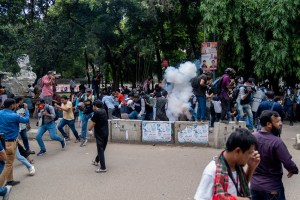
Turbulent July, Photo courtesy Rahat Karim
[After a round of massive repression and killings, the details of which the reader will find below, the movement is now back with renewed strength. This time it is not just the students and youth demanding an end to quotas but rather huge popular movement that is demanding nothing less than resignation of the Sheikh Hasina government and radical reform of the state. The conception behind this demand for “radical reform of the state” has been spelt out by Sarwar Tusher in detail below and the reader can see how it has grown in conjunction with mass movements of the past. Critical political thinking in tandem with the experience of mass movements has now led to the demand also of a new Constituent Assembly and the drafting of a fresh Constitution. It is also significant that “July” is no longer the name of a month but the name of the struggle itself as it reappears with greater vigour. I should add one more point here, which as to do with some misgivings in India about the quota and reservation question. Though Sarwar deals with it at greater length in different part of the interview, my own sense on reading his responses as well as following the discussions over the past one month, is that the situation is more akin to what might have been (and still is) in countries of state-socialism where the communist party certification was crucial in getting jobs and rising in the bureaucracy and other state institutions. The party certified whether you were “revolutionary” (muktijoddha) or “counter-revolutionary” (razakar) and it is not difficult to see why those regimes became so seriously unpopular (to put it mildly) in their own countries. AN]
This is a guest post by the well known Bangladesh photographer, SHAHIDUL ALAM. The article was earlier published in NEW AGE BANGLADESH and sent to us by SIMONE RUDOLPHI. The photographs are courtesy DRIK.Shahidul’s article actually answers many question that have been on Indian readers’ minds, including, not the least, the question of “quotas.”Interested readers may also find this article by academic Naveeda Khan useful, written as it is from within Dhaka, though she herself is based in the USA.
It would be a mistake to see this as simply a demand for more jobs. The quota movement, justified as it is, is simply the tip of the iceberg. A rampant government running roughshod over its people for so very long has led to extreme discontent. The quota issue has merely lit the fuse to this tinderbox. As citizens counted the dead and the injured, the prime minister fiddled, advising attendees at an aquaculture and sea food conference on tourism prospects in Cox’s Bazaar.
The original quota had been designed, shortly after independence in 1972 to be an interim arrangement to acknowledge the contribution of freedom fighters who constituted less than 0.25% of the population. Since a government known to be incredibly corrupt is responsible for creating the list of freedom fighters, over 50 years later the 120 fold allocation through a 30% quota has become an easy back door for party cadres to much sought after government employment. Confirmation came through senior Awami Leaguers saying, ‘just get through the initial screening and we’ll get you through in the viva’ and more tellingly, ‘government jobs will only go to party people.’
[भारत में 1 जुलाई से लागू हुई नई न्याय संहिताओं के साथ-साथ महाराष्ट्र में एक नया जनसुरक्षा कानून भी आया है। यह कानून उस ‘शहरी नक्सल’ के खतरे पर अंकुश के लिए बनाया गया है, जिसके बारे में इस देश का गृह राज्यमंत्री संसद में कह चुका है कि गृह मंत्रालय और सरकार की आधिकारिक शब्दावली में यह शब्द है ही नहीं। ऐसे अनधिकारिक और अपरिभाषित शब्दों के नाम पर बनाए जा रहे कानून और की जा रही कार्रवाइयों के मकसद और मंशा पर नजर ..]
ऐसे अवसर बहुत कम आते हैं जब कोई साधारण सा ट्वीट सामने आ रही वास्तविकता को स्पष्ट शब्दों में रेखांकित कर दे। जानी-मानी वकील और मानवाधिकार कार्यकर्ता इंदिरा जयसिंह का 30 जून को किया ट्वीट ऐसा ही था, जिसमें उन्होंने अगली सुबह से लागू होने वाले तीन नए फौजदारी कानूनों पर चिंता जाहिर की थी।
इंदिरा जयसिंह के ट्वीट में ‘पुलिस राज’ का रूपक इस बात का संकेत था कि सत्ताधारी केवल ताकत की भाषा समझते हैं। वे न तो संवाद में विश्वास करते हैं और न ही किसी के साथ संवाद करने को तैयार हैं- सिवाय अपने मित्रों के एक चुनिंदा गिरोह के।
इस चिंता में वे अकेली नहीं थीं। अन्य प्रमुख वकील और मानवाधिकार कार्यकर्ता भी इस बारे में समान रूप से चिंतित हैं।
ऐसे खतरों को समझते हुए भी उस वक्त शायद किसी को इस बात का जरा सा भी अंदाजा नहीं था कि इसके आगे भी कुछ और होने वाला है, जिसके संकेत आम चुनाव के बाद महाराष्ट्र के मुख्यमंत्री एकनाथ शिंदे ने अपने एक भाषण में दे दिए थे। ..उस समय किसी को भी यह अनुमान नहीं था कि इस भाषण के एक महीने के भीतर ही राज्य सरकार अर्बन नक्सल के ‘खतरे’ को रोकने के लिए एकविधेयक लेकर आ जाएगी। [ Read the full article here :https://followupstories.com/politics/a-police-state-in-the-becoming-the-maharashtra-special-psa-2024/]
One of the innumerable anti-quota protests across Bangladesh, image courtesy Pressenza – International Press Agency
This post is dedicated to the innumerable young students of Bangladesh who have lost their lives in the last few days of struggle. This wasn’t supposed to be our first post on the Bangladesh students’ struggle because our friend Sarwar Tusher, one among the group of dynamic young critical intellectuals associated with the journal Rashtrochinta, was supposed to write a first hand analytical account. Meanwhile, from Thursday night (18 July) the Sheikh Hasina government enforced a total internet shutdown as the Army moved in to quell the protests. Tanks had already been seen moving in some streets and the protesters were expecting an exponential increase in state violence. Another Tienanmen Square seemed to be in the offing.
““I am reminded of Pandit Nehru ‘s speech “ At the stroke of midnight India will awake to freedom” . At the stroke of midnight night 1st July 2024 India will awake to police raj,” (1)
There are rare occasions when a simple tweet underlines the unfolding reality in stark terms.
Noted lawyer and human rights activist Indira Jaising’s tweet a fortnight back created similar ripples. Her concern was over the three new criminal laws coming into operation the next morning.
And she was not alone, other leading lawyers and human rights activists seemed equally concerned about it …
But perhaps nobody had a faint idea that more was in the offing.
Post elections, Eknath Shinde, Chief Minister of Maharashtra in one of speeches had talked of Urban Naxals ‘penetrating NGOs and help creating ‘..false narratives against the government’ A speech made during a rally for BJP Konkan Graduates Constituency in the MLC polls was considered out of tune with the ambiance.
The Establishment’s desperation is becoming clearer by the day. And by ‘Establishment’ here, I do not mean simply the ruling duo in power today but a constellation of forces, many of whom congregated at a mega-wedding event in Mumbai recently. The embryonic New Congress thankfully stayed out of it – though the Old Congress is pretty much part of the Establishment, as we will see below.
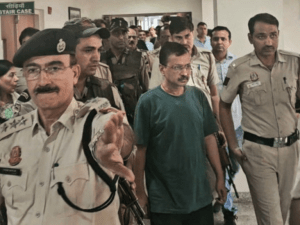
Popular Delhi chief minister, Arvind Kejriwal has finally got bail from the Supreme Court – both interim and regular – in the totally fictitious Enforcement Directorate (ED) case in which he has been framed. Yet he must remain in jail because on the eve of his release by a Delhi court and Additional Sessions Judge Nyay Bindu, the Central Bureau of Investigation (CBI) went and arrested him while he was still in jail!
Image courtesy The Economic Times
This arrest-within-arrest shows a desperation of the Establishment that has rarely ever been seen before. The desperation was even more evident in the fact that the High court judge, Justice Sudhir Kumar Jain went ahead to uphold the ED plea against the bail order by Judge Nyay Bindu, even before the order had been uploaded to their website. 157 lawyers wrote to the CJI alleging that the brother of the Judge, Anurag Jain is one of the counsels for the ED, which showed a clear conflict of interest. More importantly, referring to the urgent listing, hearing and stay of the trial court’s bail order by the high court, the lawyers’ letter said,
Bhakti Era as the Plebeian Plateau in the Civilizational Landscape of India
Guest Post by Ravi Sinha on a possible framework for looking at the millennial trajectory of Indian civilization
We have by now devoted several sessions to mapping the millennial trajectory of the Bhakti Movement across the history and the cultural geography of the subcontinent. Starting with the Tamil lands in the 7th century we followed Bhakti performing the pradakshina of the cultural landmass of the subcontinent, crossing the Vindhyas in its northward journey sometime in the 13-14th century. Our endeavour has been to understand the role of Bhakti in shaping the cultural and the civilizational mind of India. This, in turn, has been motivated by task of making sense of the role this mind plays in contemporary politics and in the rise of fascistic Hindutva in recent decades.
As we stated in the proposal to a previous session, we seek to understand the impact of Bhakti at two different time-scales. On the shorter time-scale of contemporary politics one looks at the phenomenon of communalism. The mainstream of the anti-colonial national movement considered Bhakti Movement as the harbinger of religious tolerance and syncretism that would help evolve the Indian brand of secularism. The subsequent history, however, paints a mixed picture. A social fabric and a cultural mind weaved by the Bhakti ideologies do not offer the kind of resistance to communalism and sectarianism as was expected of them. In our previous sessions we mainly stayed with evaluating the impact of Bhakti at the political-historical time-scale characterized by the problem of communalism and the rise of Hindutva.
On a longer – millennial – time-scale, however, one can evaluate the Bhakti phenomenon in the civilizational context. One can ask something like the Needham Question – why did the Indian civilization, despite its glory and accomplishments in the ancient and the medieval periods, fail to realize its cultural and scientific potentials? Why was it defeated often and why was it eventually colonized? Why did the West forge ahead, why has India lagged behind? Did the cultural mind and social ethos prepared by the Bhakti Movement play a role in the civilizational decline of India? These are very large questions not amenable to easy answers. But one must prepare to wrestle with them as they are of crucial importance for imagining and fashioning a desirable future for India. In this session, we finally arrive at the task of outlining a framework for asking and answering these questions.
For this purpose, we propose to take help of two large concepts – one of Axiality and the other of Modernity. The idea of axial revolutions was proposed for the civilizational breakthroughs that happened in the middle centuries of the first millennium BC in several different and unconnected societies – Judea (land of the Old Testament in the era of prophets), Greece (of pre-Socratic philosophers as well as of Socrates, Plato and Aristotle), China (of Confucius, Mencius and others) and India (of Upanishads, six systems of philosophies, and of Buddha) being the prime examples. We will briefly go through the idea of Axiality and see how we can understand it in the sequence of human cultural and cognitive evolution progressively from the mimetic (pre-linguistic, primarily based on gestures, rituals and body-language) to the mythic (linguistic but largely oral and narrative-based) to the theoretic (rational, abstract, normative and self-reflective). We will try to locate the Indian antiquity in the sequence of cultural evolution.
We will then make a millennial jump and outline the idea of Modernity, which can, in this context, be seen as a new kind of axial transition. The first axial transition did take the civilizations concerned from the mythic era to the theoretic era, but it still depended on the idea of the transcendental to reorder life in the realm of the mundane. The transition to Modernity, for the first time in human history, brings human autonomy to the centre-stage of history and civilization. Elimination of human dependence on the super-natural and on the transcendental is brought explicitly on the agenda and an objective and scientific knowledge of the cosmos is deployed into the service of human emancipation and freedom.
While the Indian civilization was a key example of the axial breakthrough two and a half millennia ago, its transition to Modernity has been faltering and patchy. While this may be true for many civilizations, it is especially disconcerting in the case of India which has had such a glorious antiquity at least in the domains of the mythic and of the theoretic. Of course, entire history of the intervening two millennia culminating in the colonial subjugation at the hands of the modernist imperialists is implicated in the complex and faltering progress of Modernity on the subcontinent and it cannot be explained on the basis of one cause or developments in any single arena. But one can be reasonably certain that the developments in the cultural-religious-civilizational arena play an important role in the civilizational transitions and transformations. The role of the millennial march of Bhakti must be assessed and evaluated in this context.
We will also engage with the theoretical issues that arise in this context of the materialist explanation of historical progress. There is no doubt that the historicalbreakthroughs and the transitions from one stage of history to the next happen through the push of advancing forces of production and, in this respect, the cultural-civilizational transformations are correlated with the developments in the material conditions of life. But there is a significant difference between the respective dynamics of systems and civilizations. While history progresses through replacement of one system by the next, in case of civilizations the older ones never entirely go out of existence. The older ones merely become the subterranean layers on which new layers arise or get deposited. The mimetic-ritualistic and the mythic, for example, have not disappeared from human civilization even after the axial-theoretic and the modernist-scientific stages have become increasingly entrenched.
Once again, I am not sure whether all this can be covered in one session even at the level of very sketchy outline of the argument. But the idea is to start thinking about these issues which, abstract and theoretical as they may sound, are of critical importance in making sense of contemporary politics and history.
Select Bibliography
Johann P Arnason, “The Labyrinth of Modernity: Horizons, Pathways and Mutations”, Rowman and Littlefield, 2020
Robert N Bellah, “Religion in Human Evolution: From the Paleolithic to the Axial Age”, Harvard University Press, 2011
S N Eisenstadt, “The Great Revolutions and the Civilizations of Modernity”, Brill, 2006
Neville Morley, “Antiquity and Modernity”, Wiley-Blackwell, 2009
Sheldon Pollock, “The Language of the Gods in the World of Men: Sanskrit, Culture, and Power in Pre-modern India”, University of California Press, 2006
Report prepared by Association for Protection of Civil Rights
Although the BJP came back with a much reduced majority (or perhaps because of that) the agenda of anti Muslim violence has been ramped up. We, the people of India, who restored the dignity of the Constitution, must continue to bear witness, continue to fight against the hate filled politics of Hindu Rashtra, continue to assert – Not in My Name.
We will remember these names, and the names of thousands of Muslims killed by lynch mobs, who have had their livelihoods destroyed, whose faith has been insulted, who suffer imprisonment without any basis till today.
Sab yaad rakha jayega.
There has been total of eight lynching incidents after the results of the General Elections were announced on June 4, 2024.
Twenty-three-year-old Salman Vohra, who had gone to watch a cricket tournament match in Chikhodra, Gujarat on 22 June, was mercilessly beaten to death by a group of men.
Three Muslim men, residents of Uttar Pradesh, were brutally attacked by a Hindutva mob in Chattisgarh’s Raipur on 7 June. Saddam Qureshi and his cousin Chand Miya Khan (23), both from Saharanpur district, and Guddu Khan (35) from Shamli district, were transporting cattle when they were allegedly chased by a mob in Raipur; two died on the spot, while one died after 10 days.
Israel’s unending war against Palestine – with due support from the Western World – is widely known.
Less known is the fact that representatives of extreme patriarchal Judaism have unleashed a war of a different kind against women. (1)
With their growing ascent in social life their emphasis has been increasingly on segregation of women in public domain….including their being bundled to the back side of public transport buses. (2)
Much has already been written about situation of women in Muslim majority countries.
Right from they being denied right to education, one can cite numerous examples about the laws and customs which prohibit or restrict their participation in education, job or other professions or they being prohibited from mixed gatherings. (3)
What does it portend for the unfolding struggle to save the Constitution and reinvigorate democracy?
Despotic kings or autocratic leaders share one thing in common. They have an uncanny ability to live in their bubbles or not learning from the immediate or past history at their own peril.
Narendra Damodardas Modi, the Rashtriya Swayamsevak Sangh (RSS) Pracharak (propagandist), who famously declared during elections held for the 18th Lok Sabha that he was ‘non-biological’, looks no different. He has returned as the Prime Minister of India – for the third time, albeit with a reduced majority and with support from mercurial allies. Yet, he still wants to believe that nothing has changed. The oath taking ceremony, where (barring Pakistan) leaders of other neighbouring countries were invited, looked like a coronation of sorts.
Much on the lines of a king from a literary fairy tale written by a legendary Danish author, he is going about his business with usual élan.
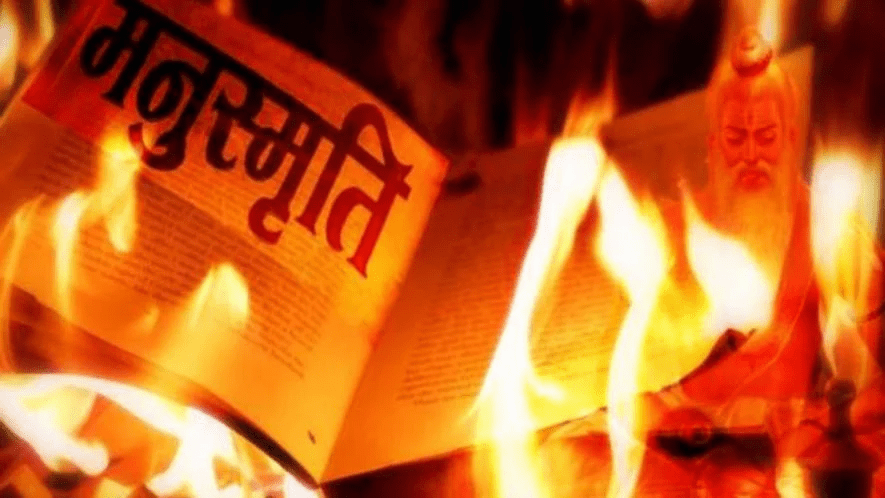
The trend of legitimising hierarchy and sanctifying caste oppression has been rising in the past decade.
It is the firm opinion of this conference that Manusmruti, taking into consideration its verses (statements) which undermined the shudra caste, thwarted their progress, and made their social, political, and economic slavery permanent, and by comparing them with the principles enunciated in the above part of the manifesto of birthrights of the Hindus, is not worthy of becoming a religious or a sacred book. And in order to give expression to this opinion this conference is performing the cremation rites of such a religious book which has been divisive of people and destroyer of humanity…
(Resolution at Mahad Conference, December 25, 1927, Page 351, Mahad: The Making of the First Dalit Revolt’ – Anand Teltumbde, Aakar Books, 2015)
Below we share a compilation of two Facebook posts by AYESHA KIDWAI. With the latest educational scandal of the UGC NET exam being cancelled because the National Testing Agency admitted to gross violations of confidentiality, we see everything come to pass, that teachers all over the country foretold regarding the drastic changes made in the education system over the past ten years. Reasonably robust public universities have been brought to their knees – drastic fund cuts to libraries and student scholarships, corresponding rise in funds to security agencies, university admissions delayed by months in some years, anomalies in admissions that are impossible to confirm because full admission lists with breakups are no longer made available to faculty or students. The system has become utterly opaque. And all this is excluding the academic changes that are still being brought about in an endless stream by the head of the UGC – a range of fantastical policies such as twice a year admissions, PhD admission immediately after a BA in subjects the students may not have studied, along with the ending of the MPhil degree. It’s like Mamidala Jagadhesh Kumar, who began the process of destroying JNU as its Vice Chancellor (a task ably taken up now by the current Vice Chancellor) asks himself every morning – what can I do today that’s fun, will create utter confusion and block the process of critical thinking and serious scholarship some more?
Teachers watch enraged, as our committed and hardworking students face hurdle after hurdle in their goal of pursuing knowledge and dignified livelihoods. As they protested this latest blow to their educational hopes outside the office of the Minister for Education they were manhandled by the police, picked up and detained.
Image courtesy The Telegraph
Along with Ayesha, we say to them –
Do not be disheartened or depressed. Do not believe that just because the BJP-RSS has smashed the entire country’s education system to smithereens, that education or honesty is worthless. It is in fact the only way out of this morass— that’s why these fascists do not want you to have it. Because if you do, you will also find your way out of them. So instead of turning your disappointment inward and causing yourself harm or distress, express your anger please.
Centralization and exclusion have been the hall marks of the transformations. Faculty inputs in admissions have been obliterated with the gigantic and bloated National Testing Agency (NTA) emerging as the chief control centre of all entrance examinations. What is this beast?
Ayesha Kidwai tells us more.
In January this year, the autonomy of universities to conduct their own entrance examinations at the research level was snatched away by the UGC by an arbitrary diktat that the UGC NET examination conducted by the National Testing Agency (NTA) will serve as the sole examination by which admission to PhD programmes will be determined. All the Central University Vice Chancellors immediately complied with this directive, riding roughshod over the internal protests by students and teachers alike. The end result of going with this corrupt, disorganised organisation called the NTA is therefore this: THERE WILL BE NO ADMISSIONS TO THE PHD PROGRAMMES OF MOST UNIVERSITIES AT THE BEGINNING OF THE ACADEMIC YEAR IN JULY-AUGUST THIS YEAR. Continue reading The National Testing Agency is a scam – shut it down now! Ayesha Kidwai→
Representational image. Women voters in queue, image courtesy Hindustan Times
A Turning Point
We have all been justly euphoric since 4 June 2024 as results started pouring in, especially since the non-biological being himself was trailing behind the Congress candidate Ajay Rai for quite some time. If the claim made in a video of a hardcore BJP worker Ujjwal Kumar from Banaras is to be believed, they – the unsung workers – had to arrange for ‘extra votes’ to ensure that ‘he’ wins. Regardless of whether his claim is correct, we kept up our euphoria even as the ECI website stopped updating counting figures and reports kept coming in from different constituencies in UP and some other places that INDIA alliance candidates were being forcibly declared lost after having won.
The debacle faced by BJP at Ayodhya-Faizabad is a big loss of face for the party and the broader Sangh Parivar.
“Those who cannot remember the past are condemned to repeat it.”
– George Santayana, The Life of Reason, 1905.
‘Zor ka Jhataka Dheere Se Lage‘ (roughly translated ‘powerful jolt felt lightly’)
The catch line of a song – or perhaps a famous ad campaign – very well describes the reverses faced by the Bharatiya Janata Party (BJP) in the recently held Lok Sabha elections.
So Suresh Gopi, persistent in his effort to ‘take Thrissur’ (his own words), has finally managed to win the Thrissur seat in the 2024 Lok Sabha elections. I have been deluged with messages and queries from friends outside expressing shock and surprise.
Towards 75 years of adopting the Constitution, it is time for a new beginning.
‘Secularism is the religion of humanity …. It is a protest against theological oppression, against ecclesiastical tyranny, against being the serf, the subject or slave of any phantom, or of the priest of any phantom. “
– Robert Green Ingersoll
Simple ideas are perhaps the most difficult to implement.
For a country of around 1.4 billion, which has witnessed internecine violence on religious lines at the time of Independence, and which has turned a new leaf by adopting a Constitution based on secularism, which abhorred even mentioning the word God, why it is still difficult to avoid religious rituals in public domain, at least in the precincts of the courts?
The model of vigilante justice, i.e, bulldozer politics, by the State itself is a phenomenon that has gained fresh legitimacy during the past decade under Modi.
“Under what law can they demolish a house for an offence that hasn’t been proved?”
Former SC Justice Madan Lokur.
..police cannot, “under the guise of investigation”, bulldoze anyone’s house without permission, and if such practices continue then “nobody is safe in this country” ..: “Show me from any criminal jurisprudence that for investigating the crime, the police, without any order, can uproot a person, apply a bulldozer. .”
There are interventions of courts which are considered to be ‘breaking new grounds’.
The Gauhati High Court’s judgement in the ‘illegal demolitions’ at Salonabari (May 2022) was one such occasion.
The two-judge bench of the high court led by Chief Justice RM Chhaya and Justice Soumitra Saikia had come down heavily on the demolitions executed without following any procedure and declared such actions ‘illegal’ and compared the police actions akin to a ‘gang war’ and ordered compensation to the victims as well as actions against guilty officials.
Two years later, this issue was again before high courts recently, as the affected families had approached it for the government’s dilly dallying on compensation and actions against officials.
How Ten Years of Modi Regime Has Undermined Constitutional Rights to Dalits
Image courtesy: Wikimedia commons
“If the fundamental rights are opposed by the community, no Law, no Parliament, no Judiciary can guarantee them in the real sense of the word”,..“What is the use of fundamental rights to the Negro in America, to the Jews in Germany and to the untouchables in India. As Burke said there is no method found for punishing the multitude’
– Ambedkar
Introduction
Within less than a fortnight we will have a new government in power.
Indian people normally make a judicious choice while electing their representatives, their government and this year won’t be different.
One can recall their wisdom when their united resistance helped unseat Indira Gandhi regime after the emergency (1977) or their concerted action could overthrow the Vajpayi government ( 2004) despite the much hyped ‘India Shining’ rhetoric pushed by it.
Today also ground currents definitely suggest change is in the air.
People’s desire to defeat the Republic of Hate which is pushed before them and regain their Republic of Hope seems overwhelming.
As already expressed by scholars, political activists, concerned citizens, if the elections remain free and fair, if the various guardrails of democracy can remain true to their mandate , we will have real ‘Acche Din‘ waiting for us.
It is an opportune time to look back and see how this much trumpeted regime fared in the last decade in various aspects of India’s society and state.
It is opportune to see how the ‘New India’ – which we have supposedly ushered in – has fared via-v-vis Dalits. What follows is not an exhaustive picture of the last decade of Modi rule but a cursory glance at the issue at hand.
The Right-wing party has been justifying and legitimising Mir Jafar, Mir Sadiq and associates, while demonising Siraj-ud-Daulah and Tipu Sultan.
The tomb of Nawab Siraj-ud-Daulah. Image credit: Wikimedia Commons
Elections to the 18th Lok Sabha have broken records in many ways.
Right from the arrests of Opposition leaders on the eve of elections, the spinelessness shown by the Election Commission (EC) to the open mouthing of hateful speeches targeting a community by top members of the ruling dispensation, to complete metamorphosis of the mainstream media into a cheerleader of the government, all such signs are ominous for the future of democracy in the country.
May be one should add to it the open justification by ruling Bharatiya Janata Party (BJP) leaders of the betrayal by the likes of Mir Jafar and his associates like Raja Krishnachandra Roy, Jagat Seth, Omi Chand — which lead to defeat of the Siraj-ud-Daulah (1733-July 2,1757), the last independent Nawab of Bengal in the Battle of Plassey, which ultimately opened the gates of conquest of the rest of India by the Britishers.
If 2019 elections are still remembered because BJP had fielded candidates who were accused of involved in terrorist acts, the 2024 elections would also be remembered how they helped betrayals covered in glory. ( Read the full article here : https://www.newsclick.in/how-bjp-covers-betrayals-glory)







 KAFILA - COLLECTIVE EXPLORATIONS SINCE 2006