Given below is the text of a letter written by research scholars and student volunteers to the Prime Minister of India. Given below the letter is a table listing the findings of the survey that the letter speaks about.
Imagine there had been a rape in Delhi. Imagine the headlines in the papers. They would have been loud and angry. As they are, and as they must be. Do you think any of the papers would have said that the woman in question has ‘accused’ or ‘alleged’ who the perpetrator was? But there has been a rape in Kashmir and your media wants you to know that a woman has ‘accused’ an army jawan of having done so. Journalistic restrain and caution are good things when they are useful. After all, let an inquiry establish this is the truth.
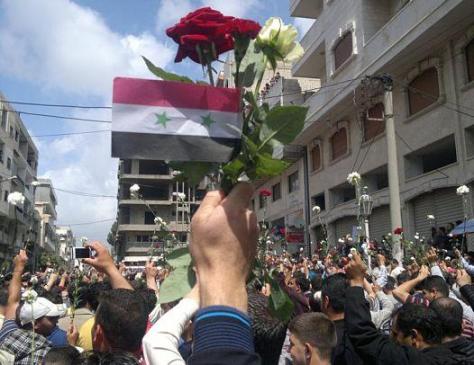
Civil society, including human rights groups, in Bengal are now divided on Mamata Banerjee government’s ‘open and hidden’ conditions regarding the release of political prisoners who have been jailed during the Left front rule as well as talks with Maoists and Maoist-backed Peoples Committee against Police Atrocities in Bengal’s tribal hinterland, known as Junglemahal.
Mamata and her ministers have rejected the demands for unconditional release of all political prisoners, immediate withdrawal of joint forces from Junglemahal and public announcement on non-enforcement of the draconian central law, the Unlawful Activities Prevention Act. Maoists and PCPA have accused Mamata of eating up her pre-poll words on those demands. A large section in the human rights movement including the intellectuals and activists who actively joined the Mamata-led campaign for regime-change now supported these demands. But some of their fellow travellers have differed on political and legal grounds.
The differences revealed contradictions between the pre-poll and post-poll positions of Mamata as well as chinks in the armour of human rights groups on the attitude to the new government, Maoists and PCPA. Tension among all the stakeholders in the process— Mamata, Maoists, human rights groups and individuals— was well-known within the concerned circles for quite some time. But none of the stakeholders dwelt on it in public before the assembly polls when they had made common cause against the CPM, particularly, the atrocities by CPM-joint forces combine.
I would like to dwell on post-poll dilemmas and fissures in the pro-Paribartan civil society in Bengal later. But this piece is primarily aimed at reporting the increasing manifestations of the hitherto latent tension.
The Times of India reported today that Delhi Police intercepted a call immediately after the Mumbai blasts on Wednesday, which has given them crucial clues to solving this case.
Basically, immediately after the blasts, the ever alert Delhi police intercepted a call from Mumbai to the NCR to ask the person in the NCR if ‘the work had been done’ and whether ‘Sharif” had been informed. On getting the answer ‘yes’, the caller hung up, and not just hung up, but ‘immediately’ hung up. The call lasted for about a minute.
This brief call was not too brief for the Delhi Police’s keen forensic skills.
I have long been a fan of your column, tweets and have admired The New Indian Express and DNA under your editorship. I am, however, saddened to se that you chose to publish Subramanian Swamy’s column that is Islamophobic in the extreme, presumes the people behind the Mumbai blasts were Muslims without evidence, and in hardly veiled terms calls for violence against Muslims. Continue reading A note of protest to Aditya Sinha, editor, DNA→
The recently announced Rajiv Awaas Yojana (RAY) has brought back an old ghost to debates on how to allow the urban poor a foothold into the city and the possibility of upward mobility. The central policy initiative of the Ministry of Housing and Urban Poverty Alleviation is the most significant contemporary attempt to address urban poverty through providing housing to the urban poor. The “slum-free city” is back. Now more than ever, then, it is time to ask: what is a “slum-free city”?
Statement by COALITION OF MUSLIMS AND TAMILS FOR PEACE AND COEXISTENCE
The coalition of Muslims and Tamils is a Sri Lanka based organization-comprising Muslim and Tamil identified persons who as a general principle are committed to pluralism and social justice in all its forms. Specifically, we are committed to the peaceful coexistence of Muslims and Tamils in the country, particularly in the north and east, and to a just and equitable solution to the ethnic conflict.
Two Years On: No War but no peace for women still facing the consequences of the war
Women in the north and the east of Sri Lanka have undergone severe hardships during the war, including the loss of loved ones, family’s support structures, livelihoods, houses and also a loss of life and dignity. While there have been numerous changes announced by the Government the situation for women on ground, however, has continued to be challenging. It is sad since the end of the brutal war women’s lives have not seen a dramatic transformation over the last two years and they have continued to face the basic challenges of safety, shelter and basic facilities. It in this light that we wish to put forward a few issues that these women have been facing within the broader context of life in the north and east for the communities living there. We have chosen to highlight these issues because of their gravity, the State’s involvement in the same and the inability of women to seek justice in such cases owing to the lack of an effective civilian administration, security threats and the lack of a concrete remedy within the local legal system. While we write of the issues relating to women, they raise broader concerns impacting the families and communities. The incidents and the report cover only the Northern and Eastern Province of Sri Lanka. Continue reading Two Years On: No War but No Peace for Women still facing the Consequences of the War – CMTPC→
Madhumita Dutta has sent us this powerful letter in solidarity with the people of Jagatsinghpur opposing the POSCO project, written by a South Korean activistSUNG-HEE CHOI, in prison for opposing a naval base.
Dear residents in Jagatsinghpur,
I am a woman and activist living in South Korea, the country of the POSCO you oppose. I am currently being jailed in the Jeju prison, under the charge of ‘interruption of business’, because of my resistance against the enforcement of the naval base construction in the Jeju Island located in the south of South Korea. As of today, July 3, I met 46th day since my arrest and 44th day since my being restrained.
I accidently happened to see two of your struggle photos and a photo in the Korean Times, June 13, 2011 had a caption underneath it:
‘Anti POSCO action in India: A village sprays water to relieve children lying with other villages along the entry point to prevent policemen and officials from entering their area at Jagatsinghpur district, about 140 kilometers(87 miles) east of eastern Bhubareshwary India, Saturday. The villagers have been protesting against turning their farmland into an industrial developed area for a $12 billion steal plant of South Korean conglomerate POSCO (AP-Yonhap).’
Statement by Jamia Teachers’ Solidarity Association
JTSA offers its heartfelt sympathies to the bereaved and the injured in the Mumbai serial blasts. We sincerely hope that the perpetrators of this mindless violence will be brought to justice swiftly. There are early indicators though that this investigation will be marred by prejudiced investigating agencies. There are news items appearing in various media outlets which cite the interrogation report of Md. Salman, a supposed operative of the Indian Mujahideen (IM) to establish that Mumbai was on IM’s sights.
Already we see that, though the Home Ministry has restrained from holding any group culpable, the investigation is being gently pushed in one direction. But even if one leaves aside for a moment the criticism that investigators react in stereotypical ways, their compass needle invariably pointing towards Azamgarh, there are serious issues arising out of this reliance on Salman’s interrogation report for getting to the bottom of the Mumbai serial blasts conspiracy.
We the citizens of India and Pakistan strongly condemn the inhuman and dastardly serial blasts in Mumbai on 13 July 2011 in which 21 innocent people were killed and over 140 injured. We offer our heartfelt condolences and sympathies to the bereaved families and pray for quick and complete recovery of all those injured. It is clear that these blasts are a well orchestrated heinous conspiracy to derail the resumption of the dialogue and peace process between India and Pakistan that was stalled following the terrorist attack in Mumbai in 2008. Continue reading Indian and Pakistani Citizens Condemn Serial Blasts in Mumbai→
It is widely believed that the Kashmir conflict has its roots in the Partition of India in August 1947. This view perpetuates the understanding of the conflict as one between India and Pakistan. However, recognising that the roots of the conflict lie in an earlier history – indeed, that there was a history before August 1947 – changes our understanding of the ‘intractable’ conflict in Kashmir. This guest post by MRIDU RAI, author of the book, Hindu Rulers, Muslim Subjects: Islam, Rights and the History of Kashmir (2004), discusses the salience of the events in Srinagar on this day, exactly 80 years ago.
While "separatists" were placed under house arrest to prevent commemorative mass gatherings, policemen took part in Kashmir Martyrs' Day ceremonies at the Martyrs' graveyard in Srinagar, July 13, 2011. Photo credit: Reuters
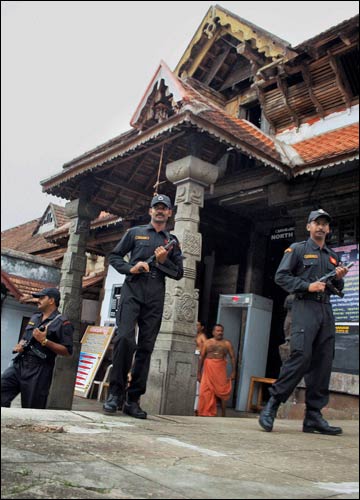
Our fair but humble town of Thiruvananthapuram has been in a tizzy since it was discovered that our benign presiding deity, Lord Sree Padmanabha, had been resting on a huge treasure-trove, so fantastic that no one has been able to stop talking of it since then. This seems to have changed drastically the way we have perceived our past — or rather, the historical amnesia which we have been suffering from has been drastically accelerated. In the decades after independence, very few people, except the upper caste retainers of the Travancore royal family and the accolytes of the regime, thought that rajabharanam was a good thing. There were stories about the days immediately following the accession of Travancore to India, of how people gathered outside the Padmanabhaswamy temple, and when the Travancore Maharajah, Chithira Tirunal Balarama Varma arrived there for his daily visit, reminded him of their equality with him as citizens of India, addressing him personally and intimately … ‘Hey, Balaa’! That seems to have gone for a toss and we are back to His Golden Majesty, Ponnutampuran, though such a tampuran has no place in our political system. Continue reading Can Kingly Mortals Donate to the Gods?→
Giving a historical background of why the Sree Ananta Padmanabha Swamy temple in Thiruvananthapuram came to have these riches, Malavika Velayanikal writes in DNA:
True, the bags of gold coins, diamonds, precious stones, 18-feet-long gold necklaces, jewellery weighing many kilograms, and solid-gold statues of gods and goddesses landed in the vault via the king. But in reality, the temple treasury was nourished by the sweat and blood of the masses as well.
One of the main sources of the royal income was taxes. They were incredibly high for the lower castes, with marriages, childbirth and even death being taxed. Country boats, ploughs, carts, umbrellas, headscarves, why, even a moustache, were taxed. Mothers were allowed to breastfeed their newborns only after they paid the ‘mulakaram’ (breast-tax) to the local lord, who would then grant permission. [Must read]
But you won’t hear this said too often because, as Appu Esthose Suresh reports in Mint:
“If the government makes any move, then the believers will protest and BJP will support the people,” he (a temple staff member) was quoted as saying by news agency PTI.
It is precisely the fear of antagonizing a section of the Hindus that is forcing the state government to be cautious.
“This government does not have the courage to go against Hindu sentiments,” said P.R.P. Bhaskar, a political observer. “It will move in a direction which will accommodate the royal palace.”
“The Left Front gained Hindu votes for two reasons. Firstly, its traditional vote base consists of Hindus and a perception that Christian and Muslim votes are moving towards the Congress and its allies had led to a consolidation of Hindu votes. This might help the government change that perception a bit,” he added. [Link]
Hindu appeasement. That’s what will come in the way of a just, fair, pro-people decision about what should be done wit the temple wealth.
A press release from the JAMMU AND KASHMIR COALITION OF CIVIL SOCIETY
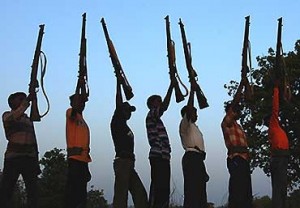
8 JULY 2011: Jammu and Kashmir Coalition of Civil Society (JKCCS), welcomes the recent judgment delivered by the Supreme Court of India in which it has struck down as ‘unconstitutional’ the practice of arming local tribal youth of Chattisgarh as Special Police Officers (SPOs) in order to fight the Maoists. It has asked the Chattisgarh state government to:
· immediately stop using SPOs,
· recall all firearms distributed to them,
· desist from funding the recruitment of any other vigilante groups,
· ensure the filing of FIRs into criminal activities committed by them, and
Recently a whole lot of noise was made and reams of paper were covered in fine print to make us realize how unique this July 2011 has been. We have been told that this phenomenon of a month having 5 Fridays, 5 Saturdays and 5 Sundays is a rare occurrence. Someone said that this has happened after 823 years and then someone else came along and disputed this figure. Newspapers not normally inclined to accept their mistakes did so with alacrity, and they had good reason to do so it was someone else’s mistake that they were foregrounding.
The 24X7 purveyors of nonsense have as usual gone to town, breaking all kinds of news and inviting all manner of soothsayers, numerologists, tarot-card readers, palmists, astrologists and other purveyors of superstition to respond to the breathless inanities of the perpetually excited anchors about the cataclysmic significance of these five long weekends coalescing at the peak of the Monsoon Season. Continue reading Five Long Weekends→
The Supreme Court has held that the use of extra-legal armed forces in Chhattisgarh is unconstitutional. Responding to a PIL filed by Nandini Sundar, Ramachandra Guha and E.A.S. Sharma, the court’s decision turns on the nature of the Salwa Judum and the appointment of special police officers under the Chhattisgarh Police Act. But if it were a judgment that had merely ruled on the technicalities, it would have been a welcome and competent order, but would have missed its moment of constitutional greatness. This judgment attains such greatness by virtue of its deft combination of insightful legal analysis, the articulation of a moral vision of constitutionalism and development and its sharp invocation of rhetoric (in the best sense of the term) and fiction to buttress its arguments.
Fiction, William Gass reminds us is the figure of truth. Law has always produced and promoted legal fictions and the substantive interpretation of law often rests upon on a body of rhetorical figures and scenarios. The imaginative and moral character of legal fiction can often be found wanting, but there are times when the courts produce inspired moral visions that outdo even literature. Although fiction in the manner of its making, is pure philosophy, Gass says that no novelist has created a more dashing hero than the handsome absolute, or conceived more dramatic extrications- the soul’s escape from the body, for instance, or the will’s from cause. Nandini Sundar v. State of Chattisgarh is an excellent example of the ways in which the law can productively use metaphor as legal argument (‘our constitution is not a pact for national suicide’)
PRESS STATEMENT: MENTAL HEALTH PROFESSIONALS CRITICISE UNION HEALTH MINISTER’S STATEMENT ON HOMOSEXUALITY
6 July 2011: We are a group of highly qualified mental health professionals who are practicing as psychiatrists, clinical psychologists and behavioural psychologists from across the country. We regret the statement made by Union Health Minister Ghulam Nabi Azad on Monday where he called homosexuality a “disease”, as being “unnatural”, and a having “come from western shores”. Scientific evidence shows that homosexuality is a natural variant of human sexuality and is not a mental disorder or disease. Homosexuality as a specific diagnostic category was removed from the World Health Organisation’s ICD-10 Classification of Mental and Behavioural Disorders published in 1992, and from the American Psychiatric Association’s DSM-IV Guidelines in 1973. Continue reading Mental Health Professionals Criticise Union Health Minister’s Statement on Homosexuality→
In a Q&A session with five newspaper editors recently, India’s Prime Minister Manmohan Singh had this to say about the Indo-Bangladesh relations:
With Bangladesh, we have good relations. Bangladesh government has gone out of its way to help us in apprehending the anti-Indian insurgent groups which were operating from Bangladesh for a long time. And that is why we have been generous in dealing with Bangladesh. We are not a rich country. But we offered it a line of credit of one billion dollars, when Sheikh Hasina came here. We are also looking at ways and means of some further unilateral concessions. We are also looking at ways and means of finding a practical and pragmatic solution to the sharing of Teesta waters. I plan to go there myself. The external affairs minister is planning to go later this week. So, Bangladesh, our relations are quite good. So with Bangladesh, our relations are quite good. But we must reckon that at least 25 per cent of the population of Bangladesh swears by the Jamiat-ul-Islami and they are very anti-Indian, and they are in the clutches, many times, of the ISI. So, a political landscape in Bangladesh can change at any time. We do not know what these terrorist elements, who have a hold on the jamiat-e-islami elements in Bangladesh, can be upto.


 Recently a whole lot of noise was made and reams of paper were covered in fine print to make us realize how unique this July 2011 has been. We have been told that this phenomenon of a month having 5 Fridays, 5 Saturdays and 5 Sundays is a
  The Supreme Court has held that the use of extra-legal armed forces in Chhattisgarh is unconstitutional. Responding to a PIL filed by Nandini Sundar, Ramachandra Guha and E.A.S. Sharma, the court’s decision turns on the nature of the Salwa Judum and the appointment of special police officers under the Chhattisgarh Police Act. But if it were a judgment that had merely ruled on the technicalities, it would have been a welcome and competent order, but would have missed its moment of constitutional greatness. This judgment attains such greatness by virtue of its deft combination of insightful legal analysis, the articulation of a moral vision of constitutionalism and development and its sharp invocation of rhetoric (in the best sense of the term) and fiction to buttress its arguments.
