Goodbye UN, Hello Sarpanch: Jahangir Rana

Guest post by JAHANGIR RANA

It has now become an established trend for the Indian political establishment to beat the drums of ‘victory’ after every electoral process in Kashmir. Almost invariably, prior to an election, this establishment maintains that the issue of resolution is not linked to elections in the disputed state. However, as soon as the electoral process is over, the same establishment is out to cash the participation in elections as an implicit approval for the status quo.

In an interview last week, senior Congress politician Mani Shanker Aiyer went as far as claiming that Azadi can be attained through Panchayat, pointing at the recent participation in Panchayat elections. These bombastic claims are now bordering on the absurd. To assume that the twenty-year resistance in Kashmir has been about devolution of power and development at grass roots, Aiyar and his colleagues within the establishment continue to live in denial. Continue reading Goodbye UN, Hello Sarpanch: Jahangir Rana

Arindam Chaudhuri, Silchar

When I read The Caravan‘s cover story on Arindam Chaudhuri some months ago, I wondered when he was suing them. And he’s done it! While a court injunction has made The Caravan remove the story from theire wesbite, you can read it thanks to Google cache. No wonder Chaudhuri’s sued Google India as well! Given below is the full text of the press release put out by The Caravan. Unlike when Chaudhuri took on bloggers in 2005, I’m glad it is an organisation with the resources to fight the case and take him head on – not to say that requires some spine as well. After you’re done reading the release below, entertain yourself with all the Arindam jokes on Twitter.  
IIPM’s Rs500-million lawsuit against The Caravan
In response to our February profile of Arindam Chaudhuri, the IIPM has sued The Caravan. Here’s why we’re fighting the suit. Continue reading Arindam Chaudhuri, Silchar

“Report the news. It is not news that there are poor people in India.”

In the morning today The Independent‘s Asia correspondent, Andrew Buncombe, blogged his disagreement with Arundhati Roy’s statement that foreign journalists in India have been asked not to report bad news. As a foreign journalist in Delhi he had faced no such censorship from his editors or the government here.

Buncombe made his case strongly: Continue reading “Report the news. It is not news that there are poor people in India.”

Coke Studio India – the first six songs

So the unanimous verdict is that Coke Studio India (first aired on the Friday that went by) is no match for Coke Studio Pakistan [Wikipedia]. For some it’s been like an India-Pakistan match – I’ve seen Indian congratulate Pakistanis on Twitter for the ‘Coke Studio victory’ and others ask Indian musicians and singers to listen to Pakistani singers and hang themselves. For most, this was not surprising – Coke Studio Pakistan has showcased some of the best music you’ve heard in recent times and it raised the bar too high for Coke Studio India. There’s also the problem of Bollywoodisation of music in India, of dumbing down, producing music aimed at the marriage market and livening up the moods of those stuck in traffic. A celebrity culture has taken the passion out of music in India – it does not seem to come from deep within. New popular music in India leaves you with the kind of feeling that a mall does. Loud and empty.

Continue reading Coke Studio India – the first six songs

लखनऊ और फैज़: अतुल तिवारी

Guest posy by ATUL TIWARI

(प्रगतिशील लेखन के आंदोलन से जुडे हुए प्रसिद्ध पटकथा लेखक
अतुल तिवारी ने यह लेख लाहौर में आयोजित फैज़ शताबदी समारोह में प्रस्तुत किया था और फिर दिल्ली में थिंक इंडिया मैगज़ीन के फैज़ नम्बर की रिलीज के समय होने वाले कार्यक्रम में भी उन्होंने यह लेख प्रस्तुत किया । काफिला के लिए लेखक की अनुमति से प्रकाशितThe English translation is given below the Urdu original. – SH)

“हज़रात!

ये जलसा हमारी अदब की तारीख़ में एक यादगार वाक़या है।  हमारे सम्मेलनों,अंजुमनों में – अब तक, आम तौर पर – ज़ुबान और उसकी अशात अत से बहस की जाती रही है। यहाँ तक कि उर्दू और हिंदी का इब्तेदाई लिटरेचर – जो मौजूद है – उसका मंशा ख़यालात और जज़्बात पर असर डालना नहीं, बल्कि बाज़ ज़ुबान की तामीर था।…लेकिन ज़ुबान ज़रिया है मंजिल नहीं ।

…अदब की बहुत सी तारीफें की गयीं हैं।  लेकिन मेरे ख़याल से इसकी बेहतरीन तारीफ़ “तनक़ीद-ए-हयात” है – चाहे वो मकालों की शक्ल में हो। या अफसानों की। या शेर की। इससे हमारी हयात का तब्सिरा कहना चाहिए। Continue reading लखनऊ और फैज़: अतुल तिवारी

Channel 4 documentary on war crimes in Sri Lanka

The Ice-Cream Flavour Mint’s Editors Don’t Like

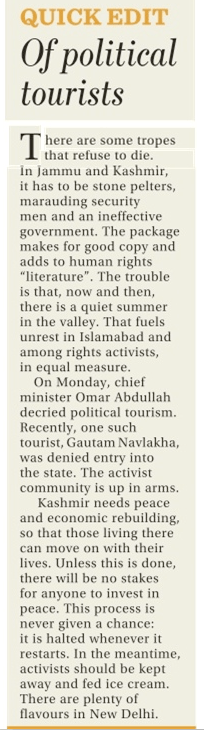
“There are some tropes that refuse to die,” said a “Quick Edit” titled “Of Political Tourists” in Mint on Tuesday, 14 June, “In Jammu and Kashmir, it has to be stone pelters, marauding security men and an ineffective government.” The edit forgot another trope there: the lies and obfuscation that the Delhi media indulges in when it comes to Kashmir. A good example of this is the “Quick Edit” itself, even if it was just 157 words long.

The “Quick Edit” derided human rights work as if it ‘human rights’ is an anti-national and unconstitutional ideology. It supported the Jammu and Kashmir government’s decision to disallow the journalist and human rights activist Gautam Navlakha into the Kashmir Valley. In doing so, it echoed the views of the Jammu and Kashmir chief minister, Omar Abdullah, that activists should be kept away from Kashmir in the summer as they cause political unrest. No wonder that Mr Abdullah recommended the “Quick Edit” on Twitter with a brief comment: “LOL. Short but says it all :-)”.

The edit derisively called activists like Navlakha “political tourists”; would the editors describe the security forces stationed in Kashmir as ‘military tourists’? The edit argued that allowing Navlkaha and activists like him into Kashmir would affect “peace and economic rebuilding,” and said that such people “should be kept away and fed ice cream. There are plenty of flavours in New Delhi.” This suggests that last year’s bloody summer in Kashmir was caused or at least aided by Mr Navlakha and other human rights activists. Perhaps Mint‘s editors were enjoying ice-cream in Delhi and did not want to indulge in conflict tourism. Ignorance, however, should not lead to lies. It is thus pertinent to recall what happened in Kashmir last year.

On 8 January 2010, Inayath Khan, 16, was returning from a computer coaching in Srinagar and was killed by CRPF personnel who were chasing away protestors. After the bullet hit his thigh, he was hit by a CRPF vehicle and eyewitnesses say, CRPF personnel trampled upon him with their boots and beat him with their gun butts.

On 31 January, a 13-year-old, Wamiq Farooq, was shot in his head by the J&K police with a tear gas shell. He was playing carrom in a room when this happened.

Continue reading The Ice-Cream Flavour Mint’s Editors Don’t Like

निनाद: कुलदीप कुमार

Guest post by KULDEEP KUMAR

जिन लोगों को यह ग़लतफ़हमी थी कि भारतीय जनता पार्टी हिन्दू धर्म और हिन्दुओं की बहुत बड़ी हितैषी है और व्यक्तिगत एवं सार्वजनिक जीवन में शुचिता की हिमायती है, उनकी यह ग़लतफ़हमी अब तो दूर हो जानी चाहिए. उसके शासन वाले राज्य उत्तराखंड में एक संन्यासी गंगा को स्वच्छ किये जाने और अवैध खनन को रोके जाने की मांग को लेकर अनशन करता रहा लेकिन पार्टी और सरकार के कान पर जूँ तक न रेंगी. गंगा का सभी भारतवासियों, विशेष रूप से हिन्दुओं, के लिए भावनात्मक महत्व है. अनशन भी शासन के विरोध में नहीं बल्कि एक सकारात्मक मांग को उठाने के लिए किया गया था. लेकिन स्वामी निगमानंद न तो राज्य सरकार का ध्यान अपनी ओर खींच पाए और न ही मीडिया का. जब उनकी ओर ध्यान गया तब तक बहुत देर हो चुकी थी.पंजाबी सूबे की मांग को लेकर अनशन करने वाले दर्शन सिंह फेरुमान की मृत्यु के बाद शायद यह पहला अवसर है जब किसी ने अनशन के कारण प्राण त्यागे हैं. Continue reading निनाद: कुलदीप कुमार

Dr Khaleel Chishty will finally be free

This note comes from KAVITA SRIVASTAVA of the People’s Union for Civil Liberties

An ailing Dr Chishty will soon be with his family

Dr. Khaleel Chishty, the 78 year old a renowned Virologist from Pakistan, will now go home very soon. A process that began on the 20th of April, 2011 will finally conclude at the Rajasthan end two months later precisely on the 20th of June, with the Governor signing the mercy petition that will let him go, once the MEA give their stamp.  Continue reading Dr Khaleel Chishty will finally be free

Of Fakes, Duplicates and Originals – the Tale of Ration Cards and the Trail of Transparency in Governance

On 2nd May 2011, the front page of the Times of India (TOI) beamed and screamed: “Don’t pay a bribe, file an RTI application – Equally Effective in Ensuring Service”. Two doctoral candidates at Yale University’s political science department had conducted field experiments in the bastis in Delhi in the year 2007 regarding poor people’s experiences in making applications for ration cards. The researchers – Leonid V Peisakhin and Paul Pinto – found that persons who paid bribes had their ration cards processed faster. However, those who filed an RTI request to know about the status of their ration card application, were “almost as successful”, the TOI report claimed. (The details of the study and the outcomes can be accessed through Peisakhin and Pinto’s paper “Is transparency an effective anti-corruption strategy? Evidence from a field experiment in India.” The paper was published in 2010 in Regulation and Governance Journal, volume 4, pp 261-280.) The researchers had also put people in two other control groups – one which neither paid a bribe nor followed-up and a second group which had filed their applications along with a letter of recommendation from the local NGO. Both these groups were not as successful as the former two groups in obtaining their ration cards. The researchers’ analyses veered towards two conclusions: first, that the RTI Act serves the poor who are usually denied/deprived of information. Secondly, reforms/laws which give more ‘voice’ to citizens and allow them to scrutinize the functioning of officials and elected representatives are more effective in ensuring transparency and gaining access to public services. Continue reading Of Fakes, Duplicates and Originals – the Tale of Ration Cards and the Trail of Transparency in Governance

‘Locking up gods within caste’

This note comes via Malarvizhi Jayanth. Those in support can leave a comment saying so, and add their designations to their names, if they wish.

We call for all those who support democracy and free speech to express solidarity with Thirumavalavan, Meena Kandasamy and Samya.Kathavarayan and Madurai Veeran are among the gods who are acknowledged to be Dalit and are worshipped by many castes. Clearly, in the oral history of the people, the gods have castes and these castes are not determined by who worships them. The twin brothers Ponnar Shankar inhabit the realm between hero and deity. They have been fictionalised, recreated for the silver screen, and are worshipped across communities. Their origin myth remains contested territory – it is variously read as symbolic of the conflict between agriculturists/warriors and hunters, as part of founding tale of the land-owning agriculturist Kongu Vellala Gounder sub-caste and, in a textbook example of how Hindutva functions, have recently been claimed as reincarnations of the Pandavas. Like other deities of the people, they are firmly located in a historical imagination among a society of human beings, and not in a mythos of gods.

In a footnote in Uproot Hindutva: The Fiery Voice of the Liberation Panthers by Thirmavalavan, MeenaKandasamy describes Ponnar Shankar as dalit. M Loganathan, an advocate from Nanje Goundanpudur and Students Wing Convenor of the Kongu Nadu Munnetra Kazhagam (KMK), has been quoted in news reports as saying that there is evidence proving that Ponnar and Shankar are Kongu Vellala Gounders and claiming that depicting them as Dalits will lead to caste tension. Continue reading ‘Locking up gods within caste’

Of Mosques and Minars

The Jama Masjid at Mandu. Photo credit: Himanshu Joshi

I can’t really say when I first heard the Aazan  (the call for prayers given by the Muezzin, five times a day) it must have been in the early 50s when I was a little child and lived in Chabi Ganj, next to the Faseel (City wall) near Kashmiri Gate.

The sound of the Azan would have drifted in from one of the nearby Mosques, there were a few not too far away. The practice of using loudspeakers was not in vogue those days and yet the muezzin’s call for prayers travelled quite some distance, primarily because the horrible ambient sounds that assail our auditory nerves were almost non-existent at the time, in place of this cacophony there used to be other ambient sounds, the rustling of leaves, the chirping of birds and others, that have, it would seem, now been lost forever.  Continue reading Of Mosques and Minars

Birds, tea, ghosts and the Indian National Congress: Sumana Roy

Guest post by SUMANA ROY

A few years ago, I took my students to the cemetery in Darjeeling. I lived in an apartment just above the Happy Valley Tea Estate, from where I saw the prettiest of sunsets, had a colleague point out the ranges of Sandakphu to me quite often, and from whose long narrow balcony I imagined shadows of, as the lingo among Bengalis in Darjeeling went, “Sahib Ghosts”. Apart from the weather, perfect and monstrous in turns, what kept Darjeeling alive to “professors from the plains”, as we were called, was the mythology of “biliti” (“foreign”) ghosts waiting for the appropriate moment to reclaim what they had created – tea-gardens, the schools and colleges, the architecture, the cookies and cakes, the “style”, a word in which we tried to condense the British legacy. We spoke about planchettes, about ghosts we wanted to invite for tea, while history professors debated with political science researchers whether that meeting would be a post-postcolonial one or an anti-postcolonial moment. Continue reading Birds, tea, ghosts and the Indian National Congress: Sumana Roy

The Mountains Are Coming Closer

(This article by me has appeared in the Sunday Guardian, Delhi, and the Friday Times, Lahore.)

The voices that reverberate in your head after a visit to Kashmir leave you numb, making you sadder the more you think about them. You know that it is going to be worse when you visit next year. The mountains that you see faintly from over the bridges on the Jhelum river in downtown Srinagar, a thousand-year-old settlement, you know they are coming closer.

An old man you see on the road wants your attention. No, not here. Let’s get inside a parked car. You wonder what secrets are to be passed on. From inside his pheran he takes out a bundle of papers. Both his sons were picked up from Kathmandu in Nepal in 2000, where they were eking out a living. Had they been militants why would they have … look, look, this paper, certificate of registration of Indian nationals in Nepal? The last he heard of his sons some years ago was that Indian intelligence had detained him in Delhi. He is coming to Delhi next month. Could you help? All he wants to know is what happened to his sons, which prison are they in, could he see them once? Read more…

Caste in Urdu Prose Literature: Ajmal Kamal

Cover of "The Adventures of Amir Hamza (M...
A cover of 'The Adventures of Amir Hamza'

Guest post by AJMAL KAMAL

The historical division of society in South Asia on caste lines is now an acknowledged sociological, political and economic fact. However, caste as a literary or social discourse does not, for several reasons, form a part of the predominantly Muslim culture of Urdu. Nor has there been much academic exploration of the role caste plays in the life of South Asian Muslim communities as against others. As far as the Urdu literary writing is concerned, it has traditionally focused exclusively on the lives and concerns of conquerors, their cohorts and their descendants, who typically prided themselves on their real or perceived foreign origins. Even after modern, socially committed writing began in Urdu around the 1930s, caste as a variable for social exploration was largely ignored in favour of economic class. Continue reading Caste in Urdu Prose Literature: Ajmal Kamal

These rapes aren’t rapes? Amrita Nandy

Guest post by AMRITA NANDY

Like the French, Mona, a 30-year old sex worker in Delhi, is intrigued and amazed over the hullabaloo around the DSK sexual assault case.  From her one-room shed, she has been keenly following television channels for the latest on the scandal. She asked me if I had any updates, adding: “That man may be in jail for 25 years! Really? Unbelievable. For us, being assaulted at work is a regular part of it. I tolerate some of it and ignore the rest. But you see… I cannot complain if I am harassed. A sex worker is a doll in the hands of her customer. No one will play with the doll if she complains!”

While Mona’s fatalism may have helped her cope, the risks at work are especially dire for non-brothel sex workers.  Some have nearly been killed.

Continue reading These rapes aren’t rapes? Amrita Nandy

Corruption, the New Caste: Thomas Crowley

Guest post by THOMAS CROWLEY

In the mainstream coverage of the Ramdev hullabaloo, there has been, unsurprisingly, little substantive discussion about corruption itself: its fundamental causes; its widespread effects; the viability of different plans to combat it. Who would want a dry, intellectual discussion of the root causes of corruption when we can stare uneasily at pictures of Baba Ramdev holding a sword and wait with bated breath for his holy army to congregate?

But let’s – for the moment – take seriously Ramdev’s proposal that the death sentence be meted out to India’s corrupt. If the press is to be believed – especially the foreign press – this may just mean killing every Indian. For, implicit in many media reports is the assertion that corruption is part of the Indian psyche, an essential component of what it means to be Indian. In this sense, corruption serves the same conceptual role as caste: it essentializes an ever-changing historical phenomenon, freezing it in time and obscuring its economic and political roots. Much as the British taught Indians and foreigners alike to understand India predominantly in terms of caste, modern commentators are encouraging both desis and firangis to conceptualize India as the land of unending corruption. (Of course corruption has not replaced caste as a mode of understanding India; the fascination with caste still runs deep.)

Continue reading Corruption, the New Caste: Thomas Crowley

Six Dead Villagers and a Lost Road: This did not happen at Baba Ramdev’s ‘Yoga Camp’ at Ramlila Ground in Delhi

Sometimes, thankfully, one does not need to write an over-long post to make a point.

Everybody knows how the entire television media has been giving enormous airtime to BJP and its allies giving vent to their outrage on the condemnable police action on Baba Ramdev’s ‘Yoga Camp’ in the Ramlila Maidan in New Delhi. One woman, named, Rajbala is still seriously injured. No casualties have been reported so far.

Though it must be said that Acharya Balkrishna, Baba Ramdev’s right hand man, seems to have had the pitch of his voice transposed a few octaves higher, giving his heartfelt statements at press-conferences the timbre of a dulcet castrati. I suppose, depending on how you look at the fate of Acharya Balkrishna’s vocal cords and other organs, that is a casualty. Continue reading Six Dead Villagers and a Lost Road: This did not happen at Baba Ramdev’s ‘Yoga Camp’ at Ramlila Ground in Delhi

On Lathicharging a Satyagraha: Dilip D’Souza

Guest post by DILIP D’SOUZA

So what do you think happened when the police assaulted a gathering of satyagrahis with lathis? Here’s what happened to some people I met from such a gathering.

  • Tulsibai, 45+, was hit on her stomach and wrist.
  • Manglubai, about 40, was hit on her buttocks.
  • Rajkumaribai, who didn’t know her age, had a deep wound on the upper part of her thigh that she showed us shyly.
  • Jiggelal, 60, was hit so hard on his arms and legs that he blacked out. Continue reading On Lathicharging a Satyagraha: Dilip D’Souza

POSCO: Lies, Crimes and Atrocities

This statement about today’s events in Jagatsinghpur, Odisha, comes from the CAMPAIGN FOR SURVIVAL AND DIGNITY

Today, more than a thousand armed police besieged the gram panchayat of Dhinkia in Jagatsinghpur District of Orissa to crush the resistance to the POSCO steel plant. For the entire day thousands of people sat in the heat, where several people (including children) and even two policemen fainted. At noon the Collector declared their protest “unlawful” and subsequently loudspeakers blared threats about use of tear gas, lathi charges, “those engaging in unlawful protests being dispersed” continuously for four hours. Efforts were made to divide the protesters as well. The protesters remained firm. Eventually, perhaps afraid of the heavy media presence and unable to break the will of the people, the police withdrew. The people have left some of their number on guard, fearful of the police’s return at any time.  Continue reading POSCO: Lies, Crimes and Atrocities

Alvida, Maqbool Fida: M.F. Husain, Free at Last

M. F. Husain at the Serpentine Gallery during the Installation of 'Indian HIghway', December 2008

Like possibly several other children growing up in the kind of lower-middle class metropolitan households that attempted to reconcile their aspirations towards culture with their frugal habits in the 1970s and1980s in Delhi, my first introduction to the art of our time was the framed print of a Husain painting. We had no television. And my parents had no gods. The only icons in our modest house were two framed pictures – an inexpensive N.S. Bendre, (Lalit Kala Akademi) print of a few women at a well and the reproduction of a Husain painting, possibly detached lovingly and carefully from an Air India calendar, possibly featuring the kind of goddess image that incensed the zealots who made it impossible for M. F. Husain to live out his final years in India. Continue reading Alvida, Maqbool Fida: M.F. Husain, Free at Last

DISSENT, DEBATE, CREATE