Arif Lohar sining a Jugni with multiple beat instruments – dholak, dhol and bongo and chimta. Even the alghoza – two short and narrow reed flute like instruments – used to keep fast rhythm between three to four notes. *
Prasenjit Bose, chief of research cell, central committee of CPI(M) deserves kudos for his article Corruption and Forbearance under Neoliberalism, published in the journal of The Centre for Policy Analysis, and reproduced in pragoti.org. However, corruption is not an exclusive phenomenon under the capitalist system. Socialist countries – I mean the social orders encouraged by the Third International – were also afflicted by corruption, not to speak of People’s Republic of China (both in Mao and post-Mao years). Even the CPI(M)-led governments in Kerala and West Bengal never waged a principled war against corruption. Hence Bose’s inference that “the state under the neoliberal regime has increasingly become a vehicle for capital accumulation and also a site for primitive accumulation, by the established corporate players as well as new entrants to the big business club” – is only half the truth. Continue reading Corruption, CPI(M) and Neoliberalism: Sankar Ray→
In the video above, Niyamat Ansari, NREGA/RTI activist in Jharkhand, speaks of the threats to his life. Ansari was murdered on 2 March 2011. You can watch more videos of him here.
Given below are facts of how and why Niyamat Ansari was killed, and the follow-up threafter. You can follow the campaign to get justice for Niyamat Ansari on this Facebook page set up in his memory and in pursuit of justice for him. Please share these links widely, because Your Channel will not organise a candle-light vigil at India Gate. See this statement calling for justice.
The struggle of the NREGA is regularly chronicled at Nrega.net.in. NREGA, the world’s largest rural employment guarantee scheme, recently completed five years.
A couple of months ago, I was given two books which I was asked to review. Published in India, both were compilations of abridged versions of popular children’s fairy tales and fables. One book, however, had a pink cover; the other was bound in blue. The former said clearly, on the cover, that it was meant for ‘little girls’, the latter was for ‘little boys’.
Having grown up surrounded by books, I wondered, when I saw these two copies, as to how one could tell which stories were meant for girls and which were meant for boys. As a child, I never saw the difference. Lo and behold, the tables of content in both books gave me my answer (and destroyed my peace of mind): the volume with the pink cover was full of stories about lost princesses and damsels in distress seeking saviours; the one with the blue cover had stories such as ‘the boy who cried wolf’. Continue reading Stop gendering children: Urooj Zia→
The Telegraph's "File picture of suspected illegal migrants detained by police"
I think that should be the title of a poem, but since I can’t write poetry, I want to bring to your attention in pithy prose the Congress party’s time-worn ‘soft Hindutva’ election strategy is back in Assam. Which means that while the Congress, BJP and others in Assam want to welcome Hindus from Bangladesh, the Muslims from there are as ever the “illegal” immigrants, the terrorists, the jehadis, the infiltrators.
They want citizenship for Bangladeshi Hindus and the Bangladeshi Muslims kicked out.
As per India’s non-existent refugee policy, Hindus from Pakistan and Sikhs from Afghanistan have been getting citizenship, but so many other persecuted peoples from all over the world come to India and find it very difficult to get by and soon seek resettlement in a developed country.
This, then, is how I want to introduce Indian secularism to you.
[An earlier version of this note was presented as keynote lecture for the Arts Faculty Seminar on Interdisciplinary Research in Humanities,Benaras Hindu University, 9-10 September 2010]
It cannot be emphasized enough how critically important the theme of the Seminar is – especially for us in India today but more generally in the world at large. We need to think of the idea of interdisciplinarity in much more fundamental and radical ways today if we are to even begin to meet the intellectual challenges posed by ‘our contemporary’.
Before I proceed, let me also clarify that the term ‘indisciplinarity’ in the title of my talk, is not simply there for its shock-value. I believe that we are today at the threshold of a fundamentally new condition where there is a serious question mark over old knowledges and disciplines as they emerged in the course of the last few centuries. Continue reading Thinking about ‘the Contemporary’: Between Interdisciplinarity and Indisciplinarity→
In recent years, we have seen a number of filmic representations of Delhi, (Love Aaj Kal, Delhi 6, Band Baaja Baraat, to name a few.) Amit Trivedi has even given Dilli a new anthem. All of these artist representations have been trying to capture or at least showcase the contemporary social, political and economic layers of India’s Powerpolis. Implicit within these depictions is that Delhi is actually Dilli, a place mired in contradictions and tensions, but still dil wali, a city with heart.
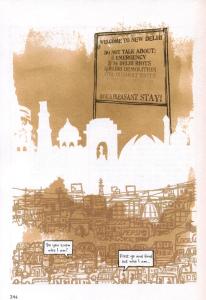
Vishwajyoti Ghosh’s graphic novel Delhi Calm (Harper Collins Press, 2010) recounts the 21-month period from 25 June 1975 – 21 March 1977 that is known in this country as the Emergency. This book shows another side of the city, one that does not talk about or acknowledge the atrocities committed in the name of the nation. In fact, Ghosh’s Delhi functions on the principle that silence or “self-censorship” is the key to survival in this city and by extension the mythical nation. Continue reading Think Freely, but Obey: Indu Vashist→
In these times of celebrating ‘small’ films, ‘new’ unheard-of young directors, little India, and non-filmi characterizations, it seems to have become mandatory for critics to praise every film claiming to build its narrative around a so-called non-mainstream idea. If this were not so, two ‘small’, ‘different’ films which created a lot of hype recently, would not have gathered as much post-release steam. I am talking about No One Killed Jessica and Manu weds Tanu. Both have been promoted and described in reviews as bold films, with star heroines showing a no-holds-barred temperament and verbal acumen, and this being the central focal point of their ‘different-ness’, both have made that oft-repeated Bollywood claim, ‘pikchar hatke hai’. If the films are to be believed, this new Indian woman can be instantly recognized by one or more of the following traits: smoking nicotine or other substances, mouthing expletives both in Hindi and English with ease, being sexually promiscuous or even vaguely ambivalent, manipulating people close to them without giving a thought to causing hurt, and a sound lack of any sense of ethics in the professional sphere or personal turf.
The character of Jugni has been featuring in Punjabi popular and folk music for well over a century. The most recent references of this rebellious, fiery female character have appeared in diverse productions like Pakistan’s Coke Studio (above), Punjab’s sensicore rocker Rabbi Shergill, and of course Bollywood in films like Tanu Weds Manu and Oye Lucky! Lucky Oye!Continue reading Who is Jugni?: Indu Vashist→
Sanchar Bhawan, office of the Ministry of Communications and Information Technology in New Delhi
The Internet in India is regulated by the Information Technology Act (2000) to which amendments were passed in 2008 and in 2009 the IT (Amendment) Act 2008 was passed. The Ministry of IT has now gotten down to notifying additional rules for the Act. Amongst the set of rules is one specifically for cyber cafes, about which I’ll write another post, and there’s one on ‘due diligence on intermediaries’. Intermediaries in the context of internet means that if you post any comment on this blog, I am legally responsible for your comments too. Intermediary liability is a favourite tool of internet censorship by repressive regimes the world over.
To those familiar with Indian laws, this will appear to be routine stuff, the sort of laws that regulate newspapers, for instance, or freedom of expression in India in general. However, three main problems here: one, the over-emphasis on blogs and bloggers, indicating the government’s anxiety over controlling blogs; two, the vagueness and vast scope of the reasons for which the government can block websites; and three, the utterly regressive move of introducing ‘intermediary due-diligence’, a favourite tool of repressive regimes against bloggers.
It is interesting that while “Blogs” and “Blogger” are defined in the Definitions section of this rule, the words aren’t used in the rules per se. In other words, they had blogs in mind while making the rules. These rules, if notified, will basically be India’s Blogger Control Act.
Update: Please see bottom of the post for several updates.
*
“Shivam!” Nikhil Pahwa of Medianama called this morning. “It’s 2006 all over again. They’ve blocked Typepad.” I instantly knew what this meant. They’ve done this at least twice before, the fellas at CERT-IN. In 2003, 2006 and now 2011.
Typepad.com is a blogging service, much like Google Blogger (Blogspot.com) or WordPress.com that this site, Kafila.org runs on. Now. Airtel users who go to Typepad.com find this:
[The following is a revised version of some comments made during a discussion with Sudipta Kaviraj at the Centre for the Study of Developing Socoeties, Delhi on 21 October 2010. Kaviraj made a presentation based on a recent essay of his ‘Marxism in Translation: Critical Reflections on Indian Political Thought’ (published in Political Judgement: Essays in Honour of John Dunn, Eds Raymond Geuss and Richard Bourke) to which some of us responded. AN]
It is interesting to revisit, with Sudipta Kaviraj, the field of ‘Indian Marxism’. It is an abandoned field, a piece of haunted land where no living beings go – at least not in their senses. What is more, it is a field that ‘Indian Marxists’ themselves are afraid of revisiting. It is their past – the land of the dead, of unfulfilled ancestral spirits, where the ghosts of yesteryears hang like betaal from every tree. The terror of this forbidden territory has redoubled, after the collapse of socialism. It is as if some deep secrets of the past lie buried there which they would rather not bring back to life, for fear of what might be revealed to them of their own selves. It is strange but true that Marxists who swear by history are perhaps as afraid of it as anybody else.
…quipped my brother Dilip in response to the following mail from my sister Pramada:
So the bell rings this afternoon. desperate clanging. i open the door and there is a man with forms in his hand and a general irritated demeanor. figured that this was the census man. he comes in and settles down. starts by wanting to know who the head of the household is. i say there is no one. he insists. i continue to say no one.
Census of India 2011 mascot
He proceeds to explain that if the parents live in the house, then they are the head of the household, if married then the husband is. I proceed to ask for definition and say that all three of us who live in the house are head of the household since we all earn and take decisions. he promises to erase what he has written since he was sure my mother was head of household.
He seemed to find my gender a bit dubious so questioned my mother if i was a boy or a girl and then repeatedly said “ladki” to me. having established that i indeed was a woman, he wanted to know date of birth, which was not difficult, but place of birth he found extremely challenging. he could not get his spellings right, or did not know districts or states in the country so tattamangalam in palghat district in kerala was as baffling as mysore in karnataka. calcutta was easy to deal with and he said calcutta was in calcutta!!! mother tongue caused him more angst because he had to write malayalam and again the spelling eluded him.
DB Power is a subsidiary of DB Corp Ltd, a media conglomerate that owns four newspapers, including the Hindi Dainik Bhaskar and English DNA, that have a combined readership of 17.5 million readers, and the My FM radio station.
The company’s most recent project in Dharamjaigarh shall displace 524 families from six settlements to extract 2 million tonnes of coal every year to fuel a 1320 MW thermal power plant that shall be built in the adjoining district of Janjgir.
No prizes for guessing what the Dainik Bhaskar’s coverage was like:
Black diamond to give sparkle to Dharamjaigarh's destiny
Here’s a crime: February 27 2002, 59 people killed when a train is set on fire in Godhra. 90+ people are arrested and accused of the slaughter. Bail is denied to them all. The trial takes nine years, the trial verdict acquits 63 of them, finds the other 31 guilty. The judge sentences 11 of those 31 to death, the other 20 to life in prison.
Here’s another crime: February 28 2002 (the next day), 69 people killed when a building called Gulberg Society is set on fire and its residents attacked in Ahmedabad.
In the May of 2006, Praveen “Five Police Station” Swami wrote in Frontline: ““Long live Pakistan,” chanted the hundreds of young men who, armed with axes and crowbars, had gathered to demolish Sabina Hamid Bulla’s home in downtown Srinagar on May 5. “We want freedom!” … Last month, residents of Srinagar complained to the police about two 30-second pornographic video clips that had been circulating through mobile phones. A 16-year old girl was then detained, who said she had been recruited by a prostitution ring run by Bulla. In an unsigned statement to the police, the girl said Bulla, to whom she is related, supplied her with drugs and cash for having sex with two State Ministers, a Border Security Force officer, 10 policemen and several well-known businessmen. … As thing stand, though, the Central Bureau of Investigation – which was, notably, given charge of the case before the protests began – has an enormous mission before it. First, it will have to persuade the girl, who was married off in April with some financial assistance from Bulla, to make a formal statement before a magistrate. Then, corroboration will have to be found to back the charges she has made – no small task, given the influence of the men who now face charges of rape.” [Frontline, May 20 – June 2, 2006.] Continue reading Sopore sisters, in death and life: Nawaz Gul Qanungo→
Recently the Supreme Court of India upheld the constitutional validity of extending subsidy on air fare to the Hajj Pilgrims. This year Rs.280 Crores were reportedly spent by the Government of India to subsidise the air fare of one lakh pilgrims. This amounts to a subsidy of Rs.28000/- per pilgrim. The subsidy provided to the pilgrims has understandably generated a lot of debate within political and social circles in India. While the right wing political parties, when not in power, consider it as an unnecessary appeasement of Indian Muslims, the governments formed by any party have always seen it as a necessary expenditure to help Muslims perform their religious obligation of Hajj.
Since I have also performed my Hajj this year, I decided to do some quick calculations to check the veracity of the tall claims made by the GoI and the Hajj Committee regarding the subsidy amount (see box). The results were quite shocking. I checked with one of the service providers —‘makemytrip.com’— and it showed up the Saudi Airline’s fare of a little over Rs.26000/- for a return Delhi-Jeddah ticket with a gap of around forty days. It was amazing to find that the total airfare of Rs.26,000 for a hajj pilgrimage is even lower than the subsidy amount of Rs.28,000 thousand which is allegedly paid by GoI to airlines to subsidise the “high cost” of the air tickets. Continue reading The myth of India’s Hajj subsidy: Muhammad Farooq→
Last week, when an eight member delegation of the outlawed United Liberation Front of Asom (ULFA) returned to Guwahati after the first round of peace-talks with the central government in New Delhi, the response in Assam is a mixed bag of emotions. Arabinda Rajkhowa, the ULFA chairman who led the delegation, while addressing the press, said that they had been assured of an honourable solution to the three decade long Assam conflict by the Prime Minister. Earlier, on 10th February the ULFA made history by coming to the talks table in New Delhi for the first time with no firm pre set conditions on its agenda. It is understood as of now, that no substantial talks would begin before the Assam assembly elections which are expected to be held in April-May this year. However this ‘familiarisation exercise’ of the centre with one of India’s most influential and violent separatist outfits at such a crucial time is a hugely significant move in contemporary history of the insurgency-hit election bound Assam. Continue reading Talking to ULFA: Assam’s Peace Myths and Reality: Tanmoy Sharma→
Sankar Ray is a veteran journalist based in Kolkata
[This article presents the sordid tale of land acquisitions for the New Rajarhat Township and the involvement of important CPI(M) personnel in this game. One of them, the key protagonist of the story below, was mentioned by Pranab Mukherjee in parliament yesterday, taunting the CPI(M) over its claims to be a crusader against corruption, arousing the ire of its MPs. – AN]
Calling it a ‘shocking experience”, after a visiting a segment of oustees in the Narmada Valley in mid- August 2002, Sarla Maheswari, then CPI(M) member of Rajya Sabha member told the media – as if her heart bled, and with revolutionary conscience ablaze: “How can a development project create a disaster in the lives of the most downtrodden tribal people and also thousands of farmers of a huge area? How can it ravage their lives without any protest by mainstream political parties? Truth indeed is stranger than fiction as the same fire-eating ‘communist MP’s demagoguery is now in a hot soup as I-T sleuths raided at her residence, as a sequel to detection of an unaccounted sum of Rs 31 crores and 26 benami companies, belonging to the Canopy Group whose chairman is her husband Arun Maheswari. And the CPI (M) brass at the Muzaffar Ahmed Bhavan, Bengal CPI(M)’s state headquarters keep up their recalcitrance, not even demanding a ‘show cause’ of the cash-rich ‘comrade’ . Former MP and CPI(M) CC member Mohd Selim, a spokesman of state party leadership too, ruled out any punitive step until specific indictment by the I-T department, leave alone criticizing the shady land transactions in the controversial New Town project at Rajarhat fully with the knowledge of ‘comrade Sarla Maheswari’ and her family.
The Oxford Anthology of Writings From North-East India : Poetry and Essays
Edited by Tilottoma Misra
Oxford University Press
New Delhi, 2011, 332 Pages / Rs. 595 ISBN 0-19-806749-6
If you are on the marginalisation trip, and India’s North East is your illicit high, you should be worried. In the last ten years, trying to make up for the dark fifty years of Indian ignorance, anthologies of literature from the region have begun to appear almost annually.
But before I get accused of an inside job, a disclosure that I am loathe to make:
I know many of the poets (some of whose biographies smell of Shillong) who feature in The Oxford Anthology of Writings From North-East India : Poetry and Essays. We share little magazines, anthologies, dark bye-lanes of love, anger, feuds, booze, and journeys to find our next fix. So, I promise to dull my taste and leash my judgment. And only occasionally lapse into pointless gossip. Continue reading 10% Anthology: Tarun Bhartiya→



 …quipped my brother Dilip in response to the following mail from my sister Pramada:

