Jignesh Mevani, The Meltdown of Modi-Men and Dadhichi’s Bones

[ This post is based on updates posted by me on my Facebook wall ]

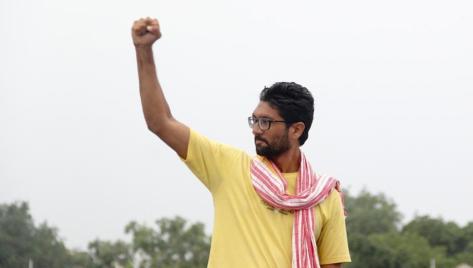
Jignesh Mevani. Photograph by Siddharaj Solanki, HT (Hindustan Times) File Photo, accessed from the HT website

A great kerfuffle has ensued ever since the recently elected independent MLA from Vadgam, Gujarat and Rashtriya Dalit Adhikar Manch activist Jignesh Mevani gave an interview in which he had some choice things to say about the Prime Minister and BJP leader Narendra Modi. Mr. Mevani made some positive and gentle suggestions, to the effect that because Mr. Modi has stopped being relevant, has not delivered on even one of the promises made by him, he should retire, proceed towards the Himalayas, and in the phrase that has caused the greatest commotion, ‘melt his bones’.

Predictably, Mr. Modi’s personal broadcasting service, known as Republic TV has kicked up the greatest fuss. Arnab Goswami has been especially indignant, and he was joined in his rage by BJP spokesperson, the orotund television commentator and historical photo-shop scam artist, Mr. Sambit Patra. Mr. Mevani offered a robust and dignified  refusal to apologize for what he said about Mr. Modi, when Republic TV demanded that he do so. Continue reading Jignesh Mevani, The Meltdown of Modi-Men and Dadhichi’s Bones

Development Outcomes And Politics in Gujarat: Atul Sood

Guest Post by ATUL SOOD

Development is back in focus after the endless noise about cow protection, nationalism, Hindu-Muslim, janeus, Shiv Bhakti, Gorakhpur governance, casteism, love jihad, enemy nation and the rest. Why this talk about development now? Perhaps the dissent and protests on the ground by various sections in Gujarat in the last few years have compelled even the diehards to acknowledge (Mr. Amit Shah recently said ‘It is not my point that the issues raised in those agitations are not an issue’), that something is deeply problematic about the “Gujarat Model of Development”. The ASHA workers have taken to the streets demanding a living wage, regularized working hours and social security; dalits are no longer silent about the violence, indignity and intimidation heaped upon them; displaced families from Sardar Sarovar Dams have occupied streets seeking rehabilitation; farmers are demanding reprieve from a crisis to which they have had no hand in creating; tribals and evicted farmers are protesting against showpiece infrastructure projects which have meant their displacement and destruction of human habitations; and the youth from cultivating castes are seeking guarantee for jobs.  The list is continuing.  

Continue reading Development Outcomes And Politics in Gujarat: Atul Sood

The Indian Constitution too was Demolished Along With Babri Masjid 25 Years Ago

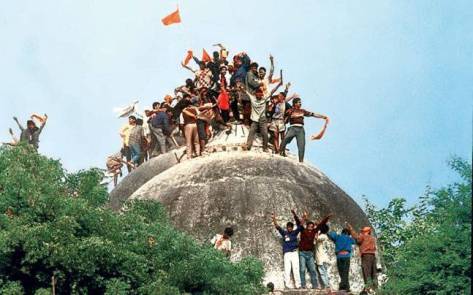
Twenty five years ago, on 6 December 1992, the structure of Babri Masjid was brought down by a mob of vandals, presided over by the top leadership of the BJP/RSS/VHP, as the Congress government led by prime minister Narasimha Rao looked on benignly. As did the Supreme Court before which a commitment was made by the Kalyan Singh (BJP) government in Uttar Pradesh – to the effect that nothing would be allowed to happen to the structure of the mosque.

Journalist Sajeda Momin, covering the demolition, recalls the scene thus,

I can still see the thousands of saffron-clad ‘kar sevaks’ clambering atop the 16th century mosque and pounding it with shovels, iron rods, pickaxes and anything they could lay their hands on. I can hear the screeching of Sadhvi Uma Bharti egging them on shouting “ek dhakka aur do, Babri Masjid tod do” through the microphones from atop the specially-built watchtower for the BJP/RSS/VHP leadership. I can visualize the three domes of the mosque collapsing inwards one by one at intervals of roughly an hour on that cold, wintery Sunday afternoon.

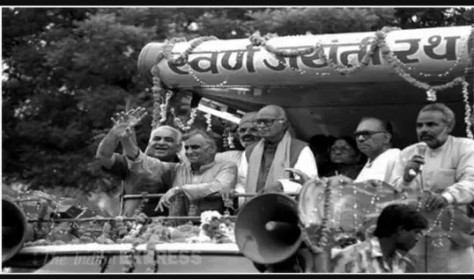
Everyone knew who were the dramatis personae at each level – and practically every bit of evidence that would ever have been required exists, captured in videos and photographs. Our present prime minister was said to be  one of the key organizers of the of the Rath Yatra that led up to the demolition and can be seen holding the microphone in his  hands in the photograph below.

Rath Yatra – precursor to the demolition, image courtesy Quora.com

Worse was to follow the demolition. The  demolition of the structure of the mosque was over that day but the process of the demolition of the Indian Constitution that had begun with what was called the ‘Ram janmabhoomi movement’ continued. By ‘Constitution’ I do not simply mean the book that embodies the law of the land but rather the very weave that came to constitute Indian society as a result of the new contract that the document called the Constitution embodied. Constitution, therefore in a triple sense. The document called the Constitution too was not merely a book of laws; it was rather, the only existing, largely agreed upon, vision of a modern India. It was a vision which was put in place through the long process of struggles, debates and contestations over the long decades of the anticolonial movement and finally given shape in, in the Constituent Assembly. There was nothing benign or innocuous about it – every bit of it had to be achieved through a fight. And yet, in the end, that was the document that embodied the vision of modern India. The only political current that stood far away from both the anticolonial struggle and had no role in the creation of this vision is the political force that rules India today.

The RSS and its numerous offshoots were neither fighting the British nor joining in the anti-caste and anti-untouchability struggles through the period since they came into existence in the mid-1920s. No wonder leaders of the Sangh combine think the anti-colonial/ national struggle was about cow-protection. That they neither subscribed to the anti-British agenda nor to the anti-caste agenda around which struggles of that period took shape, is not just a matter of historical record but is also visible in the way its leaders and ranks conduct their politics today. Every single step taken by the Sangh leaders is a step out of sync with the vision of the future spelt out by the social contract of modern India. That the Sangh attributes this vision to the Congress is an expression of its own illiteracy about the diverse forces in struggle throughout that period.

Even though it is conducted in the name of Hindus, there is nothing ‘Hindu’ about its agenda. Sangh and Sanghism is the name of a malignant political machine that seeks to destroy the very body of society in the name of an ancient past. That is the political machine we confront today. That is the political machine that we must fight today with all our vigour.

What’s in a Name? The Demolition of ‘Babri Masjid’, the Name and the Mosque: Hilal Ahmed

Babri-Masjid – Before the Demolition, image courtesy Tehelka.com

The gradual erasure of the words ‘Babri Masjid’ from our everyday memory actually began in 1986, when the Hindu community was granted the exclusive right to worship there. This happened without any regard ownership disputes the and illegal conversion of this mosque into a temple in 1949.

This story of the dispute itself is disputable. It is imperative to revisit three interesting moments, which no one talks of these days.

The 1949 moment

On the night of 23 December 1949, a group of local Hindus entered the mosque and installed the idols of Lord Ram inside it. Although the police filed an FIR in which the building is clearly defined as a functional mosque, the local administration took charge of the building, and without removing the idols from the mosque space, declared it a legally “disputed site”. Read the full article here


An open letter to Brinda Karat: why do female supporters of the Kerala CPIM spew such venom at Hadiya?

Dear Comrade

I can hardly describe the joy and relief I felt reading your piece on the Hadiya case in the Hindu yesterday. By now I am nearly deaf from the cacophony of misogyny, islamophobia, and sheer short-sighted rage that CPM supporters on Facebook are unleashing against this young woman.

Your voice of sanity, Comrade, is therefore a great restorative. If not for your writing, one could have well thought that the CPM was nothing more than a bunch of short sighted, power hungry, strategisers, whose total lack of ethics and values is covered up by a vapid, outdated rationalism and an equally problematic liberalism. You refuse to condemn Hadiya for choosing Islam. You acknowledge that she is brave. You unequivocally reject the father and other minions of patriarchy. You rightly criticise state patriarchy evident in the Supreme Court. Unlike many CPM supporters here, you have no illusions about the times we live in; you are clearly aware that the NIA is not something which will spare us if we stay good. Importantly, you put paid to the idea that the High Court judgement that sanctioned her illegal custody was justified — an idea assiduously nurtured by certain public figures allied with the CPM against religious Muslims. Comrade, thank you again for being so forthright and in the face of snarling islamophobes in your own ranks actually gunning for the voice you raised against her illegal custody long back.

Continue reading An open letter to Brinda Karat: why do female supporters of the Kerala CPIM spew such venom at Hadiya?

The Gates of Vaikuntam?

When Hadiya Shafin shouted to the crowd that she converted voluntarily, that Shafin was her chosen husband, and that she wished to spend her life with him, some leading rationalist liberal feminists in Kerala sniggered at her: be grateful for the Indian Constitution which allows you to make a choice. This statement hid a despicable insult to her choice of Islam, slyly implying that it would not permit her any choices.

Goodness knows where these puerile, vain, indurate minds live their everyday lives.  Maybe they are either still able to insulate themselves somehow from the onslaught of Hindutva violence, or find it useful to use the arms of this Hindutva hegemonised thuggish state to their narrow, shamefully narrow, ends.

Whatever, I could see no trace of the protective presence of the Indian Constitution when the Supreme Court heard Hadiya. I could see not the highest court of Justice of a vibrant democracy but I got a sense of how the Gates of Celestial Vaikuntam may look like:

Read more at : https://thewire.in/200701/hadiya-supreme-court-nia/


[Statement]: Women Against Sexual Violence and State Repression (WSS) on the on-going conversation on “The List”

The following is a statement by WSS on the lists of sexual harassers being circulated on social media. We reproduce it here as part of the ongoing dialogue on the issue.

Women Against Sexual Violence and State Repression (WSS) stands
firmly with the survivors who have faced sexual harassment at the hands of the
perpetrators on and off the list and, most importantly, extends solidarity in this
moment of unravelling narratives, disjointed arguments and personal struggles of
individuals voicing their experiences.

The last few weeks have seen lists of sexual harassers in academia and civil society published and circulated on social media, statements issued by groups of persons and individuals reflecting on the lists, and questions raised on the ways of dealing with such lists, perpetrators of harassment, and the mechanisms in place to address it.

Alongside the lists and statements, there has been a marked silence from some of the avenues that normally engage with sexual violence and harassment, both within and outside academia. While social media was abuzz with discussions and debates, now, once again, there is silence. As a collective standing against sexual violence and state repression, we recognise that institutional spaces can be fraught with sexual violence of varying kinds and, sometimes, despite systems and processes in place, the journey of seeking justice for each individual can be a long and lonely one. Continue reading [Statement]: Women Against Sexual Violence and State Repression (WSS) on the on-going conversation on “The List”

Hadiya’s Safety is the Kerala Government’s Responsibility: Rajathi Salma writes to the Chief Minister of Kerala

[This is the text of the open letter to the Chief Minister of Kerala from the celebrated Tamil poet Rajathi Salma, a leading literary and activist voice from South India whose writing has often revealed the pain and poignancy of women’s unfreedoms and the denial of a creative life of choice to them. This is about the never-ending agony that the confinement of a young woman, Hadiya, by her father, has become. Hadiya is to be heard by the Supreme Court of India on 27 November 2017, but the Kerala government refuses to take responsibility for her safe travel to Delhi, after many many pleas from civil society] Continue reading Hadiya’s Safety is the Kerala Government’s Responsibility: Rajathi Salma writes to the Chief Minister of Kerala

महाड़ सत्याग्रह के नब्बे साल

‘‘जब पानी में आग लगी थी’’
Inline image 1
प्रस्तावना
‘क्या पानी में आग लग सकती है ?’’
किसी भी संतुलित मस्तिष्क व्यक्ति के लिए यह सवाल विचित्र मालूम पड़ सकता है। अलबत्ता सामाजिक-राजनीतिक आंदोलनों पर निगाह रखनेवाला व्यक्ति बता सकता है कि जब लोग सदियों से जकड़ी गुलामी की बेड़ियों को तोड़ कर आगे बढ़ते हैं तो न केवल /बकौल शायर/ ‘आसमां में भी सुराख हो सकता है’ बल्कि ‘ पानी में भी आग लग सकती है।’
2017 का यह वर्ष पश्चिमी भारत की सरजमीं पर हुए एक ऐसे ही मौके की नब्बेवी सालगिरह है, जब सार्वजनिक स्थानों से छूआछूत समाप्त करने को लेकर महाड नामक जगह पर सार्वजनिक तालाब से पानी पीने के लिए डा अंबेडकर की अगुआई में हजारों की तादाद में लोग पहुंचे थे। /19-20 मार्च 2017/ कहने के लिए यह एक मामूली घटना थी, लेकिन जिस तरह नमक सत्याग्रह ने आज़ादी के आन्दोलन में एक नयी रवानी पैदा की थी, उसी तर्ज पर इस अनोखे सत्याग्रह ने देश के सामाजिक सांस्कृतिक पटल पर बग़ावत के नए सुरों को अभिव्यक्ति दी थी।

Continue reading महाड़ सत्याग्रह के नब्बे साल

Was the ‘Dancing Girl’ of Mohenjodaro actually a warrior?

NAMAN AHUJA, art historian, asks an exciting question that reminds us that the interpretation of artefacts, indeed, interpretation as such, is inevitably framed by the context of the viewer, and therefore always open to rethinking.

The image below is one that we are all familiar with, the exquisite sculpture of the ‘Dancing Girl’ found at Mohenjodaro.

Naman Ahuja, speaking to Anindita Ghose, suggests that the reading of this image as a dancing girl can be attributed to a perspective arising from the normalizing of patriarchal values prevalent in contemporary society. Ahuja offers an alternative reading that is much more persuasive:

The figure has bangles all the way up her left arm but her right arm is bare, as any working person would have it. A decorated left arm and a bare right arm free for labour…or for war? If she was a dancing girl by profession, surely it would have been relevant to keep both arms decorated? Look at the way she is standing. Look at her confidence. One arm on hip. Head thrown back. The way her hand is sculpted, there might have been a spear in her hand. Is she a warrior figure? Could she be a soldier rather than a dancing girl?

I can’t wait for this exhibition, India And The World: A History In Nine Stories,  to come to Delhi!

Nightmarish Visions – Indian government proposal for ‘Institutions of Eminence’: JNUTA

Statement by JNU Teachers’ Association

In early November, the JNU administration forwarded to all Centres/Special Centres/Schools, the Government of India proposal to establish twenty “Institutions of Eminence” to achieve world class status, from amongst the existing Government/Private institutions and new institutions from the private sector. It conveyed its intentions to submit an application to the UGC under the scheme and has asked Centres/Special Centres/Schools to provide comments on Part-1 – III [Vision for Institute of Eminence], Part-1 – IV [proposed fifteen year strategic plan], and Part-1 – VI [Proposed five years implementation plan] of the attached proforma.

This note from JNUTA is first to direct colleagues’ attention to the serious debate that this GoI plan has occasioned, in a country where higher education has simply failed to deliver in terms of access, quality, and justice — with a Gross Enrolment Ratio of just 20.4, as per the All India Survey of Higher Education (2013), it is the responsibility of educationists to query whether an outlay of Rs. 10,000 crore on ten institutions is warranted in the first place. (Please see the following pieces in favour of the proposal, and against it, in particular). Given that the goal of this whole initiative is a limited one of achieving a breakthrough into the world top 100 rankings, the teaching community must thoroughly discuss what rankings are good for anyway, and what significance the term ‘world class’ truly signifies, if the goals of education are essentially humanist and necessarily inclusive in character.

Continue reading Nightmarish Visions – Indian government proposal for ‘Institutions of Eminence’: JNUTA

Thoughts on the Continuing Assault on Women’s Rights and Progressivist Gaslighting in Kerala

After the atrocious indifference and trivialisation of domestic violence displayed by the sneering alpha-male brigade of the CPM during the discussion of the Hadiya Case, nothing surprises me. However, it appears important to point out how such callousness is indeed becoming normalised here alarmingly. It seems that the gains of women’s movement which made violence against women at home something beyond an intimate private affair, a ‘family quarrel’, are being steadily depleted. Of course, we did see how so many smooth-talking liberal CPM-oriented or purportedly-rationalist young male intellectuals went ballistic at the mere suggestion that they are blind to the domestic violence in Hadiya’s imprisonment. Also intriguing was their persistent defense of the father’s right to keep an adult, mentally fit, educated daughter immobile and imprisoned because he feared for her safety. Continue reading Thoughts on the Continuing Assault on Women’s Rights and Progressivist Gaslighting in Kerala

Objects in the Mirror are Closer than you Think – Beyond the Rhetoric of Otherness: Lata Mani

Guest post by LATA MANI

Political discourse in the contemporary period is by marked an affective intensity. Regardless of the issue an acute depth of feeling is in evidence. Righteousness, betrayal, entitlement, anguish and aggression suffuse arguments across the political spectrum. What seems at stake is not merely the desire to speak but to have the terms of one’s discourse deemed legitimate, to be understood as one understands oneself. The sizzle, crack and snap of rhetoric expresses the heightened temperature. One could credibly interpret it as the sound of an existing order breaking down under multiple pressures. This would however be a partial explanation. The surcharged atmosphere is equally evidence of the ties that bind those passionately disagreeing with each other. And therein lies a clue. Continue reading Objects in the Mirror are Closer than you Think – Beyond the Rhetoric of Otherness: Lata Mani

Statement by concerned citizens on the continued incarceration of Hadiya

We, the undersigned concerned citizens, are greatly disturbed by news reports of the NCW in-charge, Rekha Sharma’s visit to meet Hadiya at the home of her father, Mr. Asokan, where she continues to be incarcerated. These reports raise more fears than they allay.

Ms Hadiya has been reported by Ms Sharma to be ‘healthy and happy’. However, Ms. Sharma goes on to state, without providing any evidence whatsoever, that while there is no ‘love jihad’ in Kerala, there are forced conversions.

It bears reiteration that Ms. Hadiya is a twenty four year old adult woman, who took a decision to convert to Islam, and then to marry a Muslim man. For this exercise of self determination, Ms. Hadiya has been placed under house arrest in her parents’ control, and this shocking violation of Ms. Hadiya’s personal liberty and her right to take decisions about her own life, has been endorsed by the legal system.

Continue reading Statement by concerned citizens on the continued incarceration of Hadiya

‘Revolution against Das Kapital’ and the ‘Lonely Hour of the Economy’

This is a modified version of the article that was published earlier in The Wire

(T)he economic dialectic is never active in the pure state; in History, these instances, the superstructures etc – are never seen to step respectfully aside when their work is done or, when the Time comes, as his pure phenomena, to scatter before His Majesty the Economy as he strides along the royal road of the Dialectic. From the first moment to the last, the lonely hour of the ‘last instance’ never comes. – Louis Althusser, For Marx, London: Verso 1979, p. 113

The event known to the world as the ‘October’ revolution in Russia – or simply as the ‘Russian revolution’ – took place on 7-8 November, a hundred years ago. But then why call it the October revolution? Thereby hangs a tale – the tale of modernity, myth-making and of a new imagination of Time.

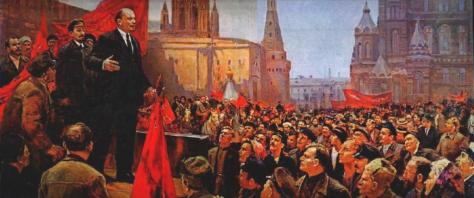
The moment of revolution, image courtesy libcom.org

As a matter of fact, the Revolution occurred on 25-26 October, according to the Julian calendar (so called because it had been promulgated by Julius Caesar), which Russia, along with a large part of the Western world, followed at that time. It was only in January 1918 that the Soviet government decreed the shift to the Gregorian calendar. The reason was that Russia should join ‘all cultured nations in counting time’, as a decree cited by historian Mark Steinberg put it. Accordingly, the first anniversary of the revolution was celebrated on 7 November 1918 throughout the Soviet Union.

What is interesting here is not so much the shift but the reason assigned for it – joining other ‘cultured nations’ of the world, which in the language of the early twentieth century meant only one thing – the modern West, which had long been setting the norm for everything desirable. Ways of ‘counting time’ too had to be aligned with Europe, lest one be considered insufficiently modern. Spatially, the Czarist Russian empire straddled both Europe and Asia, which had already, in the new reckoning of Time, been cast as ‘advanced’ and ‘backward’ respectively. The desire to become modern and join the ‘cultured nations’ was to run through the history of the revolution and its consolidation into the new Stalinist state. This desire was to be manifested in its deep distrust of the peasantry and rural life on the one hand, and in the frenetic drive to ‘catch up’ with Western Europe. As Stalin would say, he wanted to accomplish in a couple of decades what Europe had in a few centuries, compressing time, as it were, into one dizzying experience for entire society. The continuing ‘past’ had to be annihilated.

Continue reading ‘Revolution against Das Kapital’ and the ‘Lonely Hour of the Economy’

Revoke NSA Charges against Chandrashekhar of Bhim Army: Committee for the Defense of Bhim Army

The Committee for the Defense of Bhim Army has released the following statement against framing of Chandrashekhar Azad ‘Ravan’ under NSA

Committee for the Defense of Bhim Army


#StandWithChandrashekharAzad


PRESS RELEASE

4 November 2017

The Committee for the Defense of Bhim Army (CDBA) expresses it shock at the act of the Uttar Pradesh government and the Saharanpur district administration in slapping charges under the National Security Act on Bhim Army founder President Chandrashekhar.

It is telling that the NSA was slapped against Chandrashekhar after the Allahabad High Court gave him bail on 2 November after a long legal battle. The High Court had observed while granting bail to Chandrashekhar and three other Bhim Army activists that the charges were politically motivated.

It appears that the decision of the district administration to book Chandrashekhar under NSA was taken a long time back and the government and local administration were keeping their options open about when exactly to move in this direction. Around 6-7 September, Chandrashekhar had already written about this in a hand-written letter from prison, addressed to his comrades, friends and well wishers of the Bhim Army. He had mentioned that he had learnt from sources in the jail that the administration (and state government) did not want him to fight for his bail, and if he did, they would book him under NSA. This information and Chandrashekhar’s letter was shared by the CDBA in its press conference held in Press Club, in New Delhi on 12 September 2017.

The decision to invoke the NSA now, immediately after Chandrashekhar and others were granted bail by the High Court proves that the information put out by Chandrashekhar in early September was correct and that the decision is mala fide.

We consider that the UP government and the district administration is invoking the NSA to delay, if not actually circumvent the judicial process and thus keep Chandrashekhar in prison as long as possible – even though they know that these charges cannot be sustained in the court of law.

This step by the Yogi Adityanath government, we believe, is in keeping with its consistently anti-Dalit attitude and its attempts to keep its upper caste support intact. The increasing attacks on Dalits with complete impunity has, in fact, now become a hallmark of BJP governments everywhere in the country.

The Committee for the Defense of Bhim Army calls upon all democratic forces to raise their voice against this monstrous decision to frame Chandrashekhar. The attack on Bhim Army and Chandrashekhar and his comrades is an attack on the very principles of democracy and the rule of law and it is of utmost importance that voices across the board join in opposing this act of the UP government and its Saharanpur district administration.


Sanjeev Mathur                                Pradeep Narwal                    Praveen Verma

Coordinators, Committee for the Defense of Bhim Army

Notes on a Feminist Crowdsourced List of Sexual Harassers: Nandita Badami

Guest post by NANDITA BADAMI

In the wake of the extreme disagreements we have witnessed in these past few days, there is perhaps no point (at least, not anymore) in staking a claim about whether or not the list should have been created or circulated to begin with. The list is here, and it will most likely stay. It has, as Rama Lakshmi has pointed out in an extremely insightful Facebook post, inaugurated a new moment in the Indian feminist movement. And despite their many concerns, I doubt that even the most vocal anti-listers will deny the cathartic role it has played for some women.

Perhaps the time has come then, to think seriously about how to engage with the list: not simply declare allegiance, or deny legitimacy, but to start thinking about how to work towards bettering what many (both pro- and anti-listers) find to be problematic with it. To at least try to create genuine feminist dialogue about what a crowdsourced list of sexual harassers could look like – starting not from the content, but from the form and format of the list itself. Continue reading Notes on a Feminist Crowdsourced List of Sexual Harassers: Nandita Badami

#whatnow? Ponni

THIS POST IS WRITTEN BY PONNI

To all the men, women, and all those of named and unnamed genders in my life, intimate, private and public, who have shown me safety, joy, pleasure, comfort and love and who ask of me, gently, the same. I love you all.

I was raped when I was 14, Or maybe 15. Not sure. It took me three years to realise it happened. Another ten to choose to begin to deal with it. And another six to realise the details and extent of what happened. And so, the process continues. Far from over. So yeah, #metoo.

When I moved to Delhi I called home crying everyday, not only because I didn’t know Hindi and everyone chided me by calling me madrasi, but because I got sexually harassed everyday. It wasn’t the ‘far away’ whistling kind I was used to in Chennai. I saw penises from unzipped pants in the crushing closeness of Delhi buses. Again, on the bus, I had men masturbate on my shoulders and am still showering to get it off me. So yeah, #metoo.

Once I was older, I acquired some ‘power’ (by my standards) – people had heard of my name from publications, activist work – I was accused or it was implied that I could have sexually harassed or abused two women at two different times. I was in romantic relationships with them. Neither one made the accusation public. Neither one of them were my equals in age, or cultural capital. One of them got in touch many years later and tried to establish a friendship again while implying that she never meant to make me feel that way. But I was too scared to even respond. The other was much closer to me and so I said more and she said more to me. She was the one I had a physical relationship with. I will never forget that feeling of power, enormous self doubt, and painful reflection. I will always ask myself what my intentions were, how I may have expressed them and why I wasn’t able to negotiate power in a way that was adequately and appropriately dignified, respectful, kind and most importantly equal-ising.

Continue reading #whatnow? Ponni

Statement Condemning BJP Appropriation Of Muslim Women’s Voices: Bebaak Collective

We, as Bebaak Collective (Voices of the Fearless), are writing this statement unequivocally condemning  the comment made by the BJP leader Subramanian Swamy in an event in Mumbai on Friday, 27th October that the party could win in Uttar Pradesh elections because Muslim women believed that it was BJP who could save them from ‘triple talaq’. (See, “Muslim women felt only BJP could save them from triple talaq says Swamy” Indian Express, 28th October) BJP leaders have time and again celebrated the victory of the recent judgement that invalidates the instantaneous practice of triple talaq and the leadership have often claimed the victory to itself, strategically pointing out the silence of the Congress government during the Shah Bano case.

Continue reading Statement Condemning BJP Appropriation Of Muslim Women’s Voices: Bebaak Collective

Say NO to Aadhar – sign the petition

Sign the petition here.

Text of the petition

I’m Saying NO to Aadhaar

We the undersigned wish to place on record our opposition to the Aadhaar scheme which is being aggressively pushed by the government in complete violation of norms, procedures and Supreme Court orders. 

Many of us have resisted enrolment. Many of us are already enrolled. But today, we stand together to say NO To Aadhaar. 

We oppose Aadhaar because it violates our Constitutional rights and freedoms as citizens. 

We oppose Aadhaar because it undermines the foundations of our democracy, disempowering us as citizens while giving government the means to control every aspect of our lives. 

The mess created by Aadhaar is not a matter of poor implementation or “teething troubles” as claimed by the government.  Aadhaar cannot be fixed with some tweaking and tinkering. It is fundamentally flawed and  must be scrapped.      

We say NO to Aadhaar because  Continue reading Say NO to Aadhar – sign the petition

Sexual Harassment in the Academia – What the Hitlist Misses: Debaditya Bhattacharya and Rina Ramdev

This is a GUEST POST by DEBADITYA BHATTACHARYA and  RINA RAMDEV


The past few years have not allowed us the respite to prepare for a fight. We were perpetually donning our war-gear – often forced without necessary ammunition into a battle that raged through parliaments and streets and colleges and colonies and our doorsteps. There was no time to strategise, no time to theorize, no time to bargain and no time to compose ourselves for the next day’s onslaughts. And yet, the onslaughts never abated. The mundane was coupled with the spectacular, the anti-national with the terrorist, the intellectual with the condom-user, the dissenter with the stone-pelter, and the everyday with the genocidal. Continue reading Sexual Harassment in the Academia – What the Hitlist Misses: Debaditya Bhattacharya and Rina Ramdev

DISSENT, DEBATE, CREATE