Elephants in the Room – Who Gets the Autonomy in Autonomous Colleges? : Sanjay Kumar

Guest Post by Sanjay Kumar

In February this year, University of Delhi officials invited chairpersons of the six best known colleges to apply for  autonomy. So far, only the governing body of St Stephen’s College has reacted, authorising its principal to take up the application process. Teachers and staff associations of the university, DUTA (Delhi University Teachers’ Association) and DUCKU (Delhi University Karamchari Union), are against the move. Besides affecting the working conditions of faculty and staff, college autonomy has bearing on the academic content of undergraduate learning. It is surprising that many of the academic red flags are not even noticed in the policy. These obvious blind spots indicate that real motivations are not academic, but lie elsewhere.

The XII plan document of the UGC sets the target to make 10 percent of eligible colleges autonomous by the end of the plan period. It boldly declares, ‘(t)he only safe and better way to improve the quality of undergraduate education is to the link(sic) most of the colleges from the affiliating structure’. The claim is surprising, because world over university education is considered a good undergraduate education. A university with active research, accomplished faculty and diversity of subjects to offer is the best place for a young person to get initiated into the adventure and challenges of higher education. How taking students away from the ambit of a university becomes the way to better education requires a bit of an explanation. Continue reading Elephants in the Room – Who Gets the Autonomy in Autonomous Colleges? : Sanjay Kumar
बिहार क्या सिर्फ बिहार में है ?

बिहार फिर से खबर में है. इंटरमीडिएट परीक्षाओं के परिणाम आए हैं.पैंसठ प्रतिशत छात्र फेल हो गए हैं.बिहार में विरोध प्रदर्शन चल रहे हैं.कॉपियों की दुबारा जाँच कराने की माँग की जा रही है. जन संचार माध्यमों के जरिए वैसे छात्रों की व्यथा और क्रोध का पता चल रहा है जिन्होंने आई आई टी जैसी कठिन प्रवेश परीक्षाओं में सफलता प्राप्त की है लेकिन जो बारहवीं की बोर्ड परीक्षा में फेल हो गए हैं.इसे पर्याप्त माना जा रहा है यह कहने के लिए कि परीक्षा परिणामों में घपला ज़रूर है वरना इतने प्रतिभाशाली युवा, जो आई आई टी की परीक्षा की बाधा दौड़ पार कर गए हैं,बोर्ड के इम्तहान में फेल कैसे हो जाएँगे! Continue reading बिहार क्या सिर्फ बिहार में है ?

अरुंधति का निर्वासन: वैभव सिंह

Guest post by VAIBHAV SINGH

अरुंधति राय के खिलाफ अपशब्दों की, गाली-गलौच की, आरोपों की हिंसा ने हमें एक बार फिर यह प्रश्न पूछने के लिए विवश कर दिया है – क्या हमने सचमुच अपने देश में सभ्यता व सहिष्णुता के महान मूल्यों की रक्षा करने के दायित्व से छुटकारा पा लिया है? कहीं हम पूरे राष्ट्र को ‘डिसोसिएटिव आइडेंटिटी डिसआर्डर’ (खंडित व्यक्तित्व मनोरोग) का शिकार बनते तो नहीं देख रहे हैं जिसमें किसी व्यक्ति नहीं बल्कि पूरे राष्ट्र के चरित्र में परस्पर विरोधी मूल्य इस प्रकार विषैले कांटों की तरह उग आते हैं कि राष्ट्र का पूरा व्यक्तित्व चरमराने या दिग्भ्रमित होने लगता है! एक सभ्य-लोकतांत्रिक देश के रूप में आत्मछवि और हिंसक बाहरी आचरण में जितना गहरा भेद पैदा हो जाता है, वह राष्ट्र की आत्मा मार देता है। जिसने भी स्वयं में अनूठी लेखिका को जीप के बोनट से बांधने की कल्पना की, उसे संभवतः अंदाजा भी नहीं था कि वह केवल एक वक्तव्य नहीं दे रहा है, बल्कि मनुष्यता के सभी संभव परिकल्पनाओं के विरुद्ध अपराध कर रहा है। ऐसी कल्पना में बीमार विचारशून्यता ही नहीं बल्कि भयानक सड़ांध, विकृति और मनोरोग की झलक मिलती है। परेश रावल के अरुंधति के विरोध में लिखे ट्वीट से उल्लसित सोशल मीडिया के एक समूह ने तो अरुंधति राय की सामूहिक ढंग से हत्या कर उनके शव को पाकिस्तान में दफनाने की वकालत भी कर डाली।

Continue reading अरुंधति का निर्वासन: वैभव सिंह

1984 and Punjab’s Transformation to a Hindutva Laboratory: Gurpreet Singh

Guest post by GURPREET SINGH

It was summer of 1985 when we were visiting New Delhi, the national capital of India to attend a wedding in the family. I had a long hair back then and was aged 15. Both me and my uncle who were wearing turbans like other Sikh men were waiting at a bus stand for the next bus to go to our relatives. As soon as the bus arrived and we were about to climb in after other waiting passengers, the door was slammed on us.  When my uncle protested, the conductor shouted that there is no seat inside. Even as we pointed out at some empty seats, the answer was – “we have told you there is no seat.” Before we could argue the bus sped away.

The incident left me shocked but I wasn’t surprised.  Continue reading 1984 and Punjab’s Transformation to a Hindutva Laboratory: Gurpreet Singh

बहुजन राजनीति की नयी करवट की अलामत है भीम आर्मी : प्रवीण वर्मा

Guest post by PRAVEEN VERMA

यूँ तो अम्बेडकर जयंती हर साल आती हैं और दलित-पिछड़े समुदाय का एक बड़ा तबक़ा इसे बड़ी शिद्दत से मनाता आया है। लेकिन इस बार अम्बेडकर का 126वां जन्मदिन कुछ और ही नज़ारा ले कर आया। यू॰पी॰ का सहारनपुर ज़िला जहाँ अच्छी ख़ासी तादाद में दलित समुदाय के लोग रहते हैं और अन्य जिलों की बनिस्बत ज़्यादा संगठित हैं, वहाँ दो आयोजनों और उसकी अनुमति को लेकर दबंग जाति के लोगों ने जम कर उत्पात मचाया, जिसका दलित समुदाय के द्वारा ना केवल डट कर मुक़ाबला किया गया बल्कि एक वाजिब जवाब भी दिया गया। हालाँकि प्रशासनिक कार्यवाही हमेशा की तरह एकतरफ़ा रही जिसमें 40 दलित युवकों को जेल में ठूँस दिया गया और दबंगो को सस्ते में जाने दिया गया। शब्बीरपुर की ये घटना(एँ) कई दिनों तक चलती रही जिसमें दबंग जाति के लोगों के अहम को चोट तो लगी ही, साथ ही साथ एक और संदेश दे गयी : जिस तरह से दबंग जाति के लोगों ने हिंसा को अपनी बपौती समझ लिया था, अब वैसा नहीं हैं, लगभग देश के कुछ हिस्सों में तो। 

Continue reading बहुजन राजनीति की नयी करवट की अलामत है भीम आर्मी : प्रवीण वर्मा

Photo Story on Bhim Army Rally in Delhi: Debalin Roy

Guest post by DEBALIN ROY

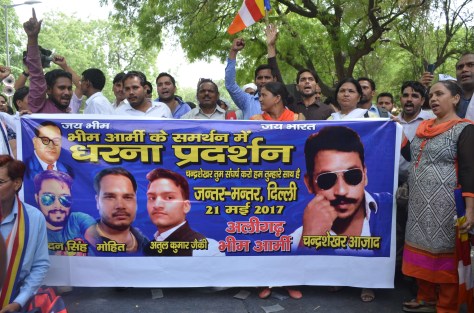
Debalin Roy takes us to some specific moments in the rally, aside from the bird’s eye view of the massive rally that we have already seen.

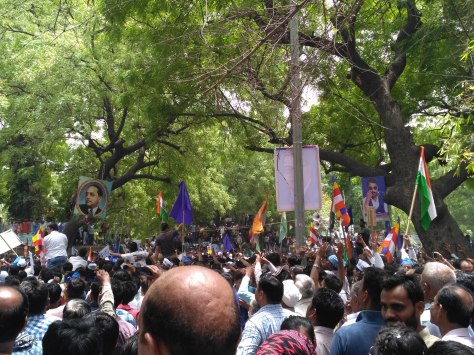
Dalits from all over northern India gathered at Jantar Mantar, Delhi on the 21st of May to protest the Saharanpur violence and increasing atrocities on Dalits across the country.

Although there were representatives from various states, especially from Haryana, U.P. and Rajasthan, Bhim Army took the center stage, with their blue flags waving like a giant dark blue field of tall grass, shaking and waving with every chant of Jai Bhim.

Continue reading Photo Story on Bhim Army Rally in Delhi: Debalin Roy

A Day Against Kalluri at IIMC, Delhi: Bastar Solidarity Network Delhi Chapter

Guest Post by Bastar Solidarity Network Delhi Chapter

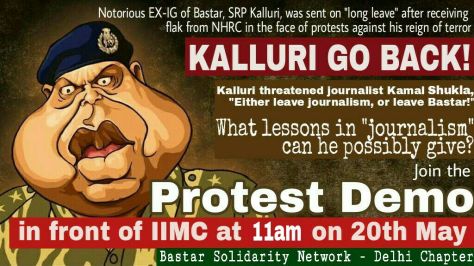
The democratic forces, organizations and the thinking minds of IIMC took part in a spirited protest today against the invitation extended to notorious ex-IG Kalluri by the IIMC administration to take part in a seminar. To start with, since last two days, there were several attempts on the part of the organizers to confuse/conceal Kalluri’s invitation. Immediately after the declaration of the protest, Kalluri’s name was dropped from the poster. There were also threats of counter-mobilisation by the BJP goons. But undeterred, as we reached the gates of IIMC at 11am, the site echoed with slogans of “Killer Kalluri Go Back”!

Continue reading A Day Against Kalluri at IIMC, Delhi: Bastar Solidarity Network Delhi Chapter

Violence against Dalits in Saharanpur, UP : A Report by CPI-ML (Liberation) & AISA Team that Visited Saharanpur

Guest Post by Sucheta De

CPI-ML- AISA Team’s Visit to Saharanpur – A Report

“Sarkar Hamari Hai, Police-Prashashan Bhi Hamara Hai”- Yogi Government Boosts Up Morale of Casteist Feudal Goons Who Burnt Dalit Village in Shabbirpur!

Casteist Goons from Dominant Rajput Community Enjoy Complete Impunity while Bhim Army Activists Continue to Face Witch-Hunt!

CPI-ML-AISA Appeal Everyone to Join Hands with the Dalits of Saharanpur in their Struggle for Justice!

Saharanpur Carnage: Teaching a Lesson to Politically Assertive, Self-Reliant Dalits Who Refuse to be Foot Soldiers of Hindutva’s Hate Politics

When BJP gains electoral majority, Saharanpur happens.

For last several years the belt of western Uttar Pradesh has been made the laboratory of the RSS-BJP’s sinister design of communal polarization and violence against Muslims. The 2013 Muzaffarnagar riots was a planned design by the RSS-BJP to polarize the belt on communal lines and reap electoral benefits. And now, after that design had delivered ‘electoral success’ for the RSS and BJP, upper caste feudal forces have started celebration of their ‘victory’ by unleashing attack on Dalits.

Continue reading Violence against Dalits in Saharanpur, UP : A Report by CPI-ML (Liberation) & AISA Team that Visited Saharanpur

The Anti-Democratic ‘Republic’: Bobby Kunhu

Guest post by BOBBY KUNHU

English language television news in India nowadays is nothing more than exaggerated visual editorials. They pick two or three stories, sensationalize them, run them in a loop through the day, alongside panel discussions where the editorial ideology of the channel is forced down the throat of the panelists and the viewers. In short there is hardly little journalism left in these channels. Though they do have panel discussions, regional language channels – at least Malayalam and Tamil channels that I watch – have a wider and more diverse reportage than self-proclaimed national television.

It wasn’t always like this. When Prannoy Roy pioneered private television content for Murdoch – regardless of the ideological content – there was reportage. Editorial proselytizing and endless panel discussions were limited most often to when psephologists stepped in.

Continue reading The Anti-Democratic ‘Republic’: Bobby Kunhu

और इस बार नंबर आईआईएमसी का था : Rohin Kumar

Guest Post by ROHIN KUMAR

संस्थान के गेट पर सरस्वती की प्रतिमा थी ही. नारद पहले पत्रकार बताए जाते रहे हैं. अब बचा था हवन वो भी होने ही वाला है. आईआईएमसी मीडिया स्कैन नामक संस्था के साथ मिलकर ‘वर्तमान परिदृश्य में राष्ट्रीय पत्रकारिता’ पर सेमिनार आयोजित करने जा रहा है. इसकी शुरुआत हवन से होनी है. उसमें पांचजन्य के संपादक और बस्तर का खूंखार आईजी कल्लूरी आमंत्रित है. चौंकाने वाली बात है कि कल्लूरी जिसने सबसे ज्यादा आदिवासियों, पत्रकारों, सामाजिक कार्यकर्ताओं को तंग किया, उनपर फर्जी केस डाले वो ‘वंचित समाज के सवाल’ पर बोलने आ रहा है.

हमें इसकी सूचना दो दिन पहले मिली. सोशल मीडिया पर इसके पोस्टर रिलीज़ किये गए थे.

सबसे पहले हम छात्रों ने इसका सोशल मीडिया पर विरोध दर्ज किया. इसमें कई पूर्व छात्रों का हमें समर्थन भी प्राप्त हुआ. संस्थान में पढ़़ाने वाले शिक्षकों को फ़ोन किया, उनसे जानना चाहा कि आखिर उनकी इसपर कोई राय है?

जानकर हैरानी हुई कि उन्होंने छात्रों से बिलकुल डरे सहमे अंदाज़ में बात किया. इस बाबत जानकारी से इनकार कर दिया. फिर डिप्लोमेटिक जवाब देने शुरू किये- “चुंकि हमें कोई आधिकारिक सूचना इस कार्यक्रम के बारे में नहीं मिली है इसलिए मैं इसे फेक न्यूज़ मान रहा हूं.” इतना कहकर मीडिया एथिक्स पढ़ाने वाले टीचर ने कन्नी काट लिया.

Continue reading और इस बार नंबर आईआईएमसी का था : Rohin Kumar

कट्टरता के खिलाफ अज्ञेय: वैभव सिंह

Guest post by VAIBHAV SINGH

सच्चिदानंद हीरानंद वात्स्यायन अज्ञेय हिंदी के ही नहीं वरन समूचे भारतीय साहित्य में निरंतर जिज्ञासा और पाठकीय आकर्षण पैदा करने वाले रचनाकार के रूप में देखे जाते हैं। विभिन्न किस्म की दासता-वृत्तियों, परजीवीपन और क्षुद्र खुशामद से भरे मुल्क में उनका स्वाधीनता बोध जितना गरिमावान लगता है, उतना ही चौंकाने वाला भी। इसी स्वाधीनता बोध ने अज्ञेय की दृष्टि को भारत के लोकतांत्रिक मिजाज के अनुसार ज्यादा खुला व अपने रचना संसार को स्वेच्छा से निर्मित करने लायक बनाया। उनके इस स्वाधीनता बोध का प्रभाव व्यापक रूप से सृजन के बहुत सारे आयामों पर पड़ा है।

अज्ञेय के साहित्य पर लिखने वाले कई आलोचकों ने इस प्रभाव के मूल्यांकन का प्रयास किया है। जैसे कि निर्मल वर्मा ने स्वाधीनता बोध से उत्पन्न उनकी इसी खुली, व्यापक दृष्टि को उनके संपादन कर्म से जोड़कर देखा था। अपने द्वारा संपादित पत्र प्रतीक व दिनमान  में उन्होंने मुक्तिबोध, शमशेर बहादुर सिंह व सज्जाद जहीर को जोड़ा तो तार सप्तक के विविध खंडों में अपने से पूर्णतया भिन्न दृष्टिकोण वाले कवियों को। स्वाधीनता के प्रति तीव्र संवेदनशीलता को व्यक्तिवाद के दायरे में रखकर समझने की सरल चिंतन-प्रक्रिया साहित्य में बहुतायत से मौजूद रही है। ऐसा मानने वालों की सीमा प्रकट करते हुए निर्मल वर्मा ने कहा है कि स्वाधीनता के प्रति अत्यंत सचेत अज्ञेय के प्रति लोगों को झुंझलाहट उस समाज में स्वाभाविक थी जहां लोगों को हर समय किसी ‘ऊपर वाले’ का मुंह जोहना पड़ता है। इन ऊपर वालों में परिवार, जाति, रूढ़ि, पार्टी, विचारधारा, संगठन आदि सभी कुछ शामिल रहा है। यहां तक कि गांव में जातिवाद-परिवार की गुलामी करने वाले लोग जब शहर आए तो उन्होंने विभिन्न पार्टियों, संगठनों व विचारधाराओं की गुलामी को बिना किसी आलोचना के स्वीकार कर लिया। जिन्होंने नहीं स्वीकारा उन्हें कुलद्रोही, जनविरोधी, परंपराद्वेषी, धर्मविरोधी, व्यक्तिवादी आदि आरोपों का सामना करना पड़ा।

Continue reading कट्टरता के खिलाफ अज्ञेय: वैभव सिंह

The Elephant in the Room – Silence on Class Issues in Indian Politics : Sanjay Kumar

Guest Post by SANJAY KUMAR

Ramesh has been working as a daily wager in a Government of India office in Delhi for ten years. He is one of the army of peons, office assistants, security guards, gardeners, and cleaning staff which government offices, city municipalities, hospitals, schools and colleges of the metropolis employ regularly. He is a graduate, but gets the wage of an unskilled worker. He is among the fortunate ones who at least get government mandated minimum wage. Most private employers in the city violate the minimum wage act; either they pay less than the mandated amount, or make daily wagers work more than eight hours without any overtime.

Ramesh was pleasantly surprised this April when he noted a more than 30% increase in his wages. His daily wage that stood at Rs 360/ earlier was now Rs 513/. This was due to a Government of Delhi notification issued on 3rd March, 2017. The news was covered in the inner pages of some newspapers. Most TV news channels ignored it. Hence, it is not surprising that employees like Ramesh who are not associated with any organsiation of workers were not aware of this increase. Continue reading The Elephant in the Room – Silence on Class Issues in Indian Politics : Sanjay Kumar

LBJ, Kashmir, and Indian Liberals: Rajive Kumar

Guest Post by RAJIVE KUMAR

Towards the end of his presidency, Lyndon B Johnson, the 36th President of the United States of America, had been reduced to a figure of universal scorn and derision. His escalation of the Vietnam War to a point from which it became impossible to extricate the US ended up  in becoming one of the defining human tragedies of twentieth century. This was war fought on the basis of pretexts that did not actually exist.  The slur “Hey, hey, LBJ, how many kids did you kill today?” which became an anthem of sorts for protestors eventually compelled him to forgo running for a second term in office in 1968.  Those protesting against the war, those who eventually forced Lyndon Johnson to leave the political arena were Americans who were overcome with images of atrocities and the rising count of civilian deaths in a mindless war.

Continue reading LBJ, Kashmir, and Indian Liberals: Rajive Kumar

The Draft Labour Code on Social Security-Workers’ Concerns: Ramapriya Gopalakrishnan

Guest Post by RAMAPRIYA GOPALAKRISHNAN

In March this year, the Ministry for Labour and Employment unveiled the third of its series of Labour Codes aimed at simplifying and rationalizing the labour laws. The Draft Labour Code on Social Security has been placed in the public domain and comments and suggestions have been invited in respect of its provisions. The Draft Code is ambitious in scope and amalgamates the provisions of 15 central labour laws relating to social security. Continue reading The Draft Labour Code on Social Security-Workers’ Concerns: Ramapriya Gopalakrishnan

Linger Like Moisture Within – On Viren Dangwal’s Pitr-Paksh: Prasanta Chakravarty

Guest Post by Prasanta Chakravarty

Pitr-paksh/ पितृ-पक्ष (also pitru-paksh) is the 16 day lunar period in the Hindu diurnal calendar when believers pay homage to their ancestors, through specific food offerings. Most years, the autumnal equinox falls within this period, that is, the Sun transitions from the northern to the southern hemisphere during this time. In Northern and Eastern India and Nepal, among the cultures following the purnimanta or the solar calendar, this period usually corresponds with the waning fortnight of the month Ashwin. The souls of three preceding generations of one’s ancestor reside in Pitr-loka, a realm between heaven and earth. Continue reading Linger Like Moisture Within – On Viren Dangwal’s Pitr-Paksh: Prasanta Chakravarty

We are Baba Saheb’s Followers, We Believe in the Constitution – Vinay Ratan Singh, President of Bhim Army

The vicious and combined attack of the administration and the local media on Bhim Army continues. It is being villainized by them and they are threatened with impending arrests under the National Security Act. The  blatantly partisan attitude of the administration, backing in overt and covert ways, the attempts of the Thakurs and other upper castes, to provoke riots – are laid bare by VINAY RATAN SINGH in the interview below where he speaks to CHALCHITRA ABHIYAAN on what has been going on in Saharanpur and neighbouring areas. We unequivocally support the efforts of the Bhim Army to resist the vicious attacks of the upper castes, who are now emboldened by the presence of their own government in the state.

People’s Movements Demand Revocation of Suspension of Dalit Asst. Jail Superintendent, Varsha Dongre

The  NAPM (National Alliance of People’s Movements) has written the following letter, signed by many movements and orgnizations, to the Governor and the Chief Minister of Chhatisgarh

Date: 11th May, 2017

To,

Shri Balram Das Tandon, The Hon’ble Governor, Raj Bhawan, Raipur, Chhattisgarh,

To,

Shri Raman Singh, The Chief Minister, Civil Lines, Raipur, Chhattisgarh

Sub: Revocation of suspension orders of upright, Dalit woman officer, Ms. Varsha Dongre, Asst. Jail Superintendent, Raipur Central Jail and restoration of peace and good government in the V Schedule adivasis areas of Bastar – Reg.

Respected Balram Das Tandon ji and Shri Raman Singh ji,

We, the undersigned, representing a large number of people’s movements and organizations, across India, as the National Alliance People’s Movements (NAPM), are writing to you with a deep sense of anguish regarding the arbitrary suspension of a young and dynamic dalit woman officer of your state, since she publicly expressed concerns over the serious human rights abuses of young adivasis girls in the jails of Chhattisgarh.

Continue reading People’s Movements Demand Revocation of Suspension of Dalit Asst. Jail Superintendent, Varsha Dongre

‘India is Threatened by Brahminism, Not Muslims’ says Bhim Army Chief

Update: Reports coming in that the UP government plans to use NSA against Chandrashekhar. Should be condemned and opposed by all concerned.

Even as the embers of the recent fires continue to smolder in Saharanpur, ‘Dalit-Thakur’ clashes have been reported just now from Sardana. Ravi Das statues have apparently been desecrated in many places in Western UP, according to preliminary reports from senior journalist Radhika Ramaseshan. In that context, we are Chalchitra Abhiyaan the organization of Dalits that is in the eye of the storm, fighting back – the Bhim Army. Vilified by the local media for fighting back, Nakul Sigh Sawhney and the Abhiyaan have recirculated their video interview of Advocate Chandrashekhar, taken a few weeks back. Chandrashekhar is the founder of Bhim Army. Here is the video:

फर्ज़ी प्रमाण पत्र के सहारे दलित और आदिवासियों के अधिकार पर डाका

सांसद समेत अन्य लोग फर्ज़ी कागज़ातों के ज़रिये दलित और आदिवासियों के अधिकार छीन रहे हैं.

Indian tribal people sit at a relief camp in Dharbaguda, in the central state of Chhattisgarh, March 8, 2006. Violence in Chhattisgarh, one of India's poorest states, has mounted since the state government set up and started funding an anti-Maoist movement. Picture taken March 8, 2006. REUTERS/Kamal Kishore

(फोटो: कमल किशोर/रॉयटर्स)

मध्य प्रदेश के बैतूल से अनुसूचित जनजाति के लिए आरक्षित सीट से दूसरी बार चुनी गईं सांसद ज्योति धुर्वे की सदस्यता फिलवक़्त ख़तरे में पड़ती नज़र आ रही है.

पिछले दिनों मध्य प्रदेश सरकार की उच्चस्तरीय जांच कमेटी ने सघन जांच के बाद उनके द्वारा प्रस्तुत किए जाति प्रमाण पत्र को खारिज़ कर दिया.

ख़बरों के मुताबिक अपने जाति प्रमाण पत्र की कथित संदिग्धता के चलते धुर्वे तभी से विवादों में रही हैं जब 2009 में वह पहली दफ़ा वहां से सांसद चुनी गई थीं. यह आरोप लगाया गया था कि वह गैर आदिवासी समुदाय से संबद्ध हैं और उन्होंने फर्ज़ी जाति प्रमाण पत्र जमा किया है.

इस मसले को लेकर मध्य प्रदेश उच्च न्यायालय के सामने एक केस दायर किया गया है और अदालत के आदेश पर ही उपरोक्त जांच पूरी की गई है.

गौरतलब था कि जांच के दौरान पाया गया कि उनका जाति प्रमाण पत्र वर्ष 1984 में रायपुर से जारी हुआ था, मगर जब कमेटी ने इस बारे में कुछ और प्रमाणों की मांग की तो सांसद महोदया उन्हें कमेटी के सामने प्रस्तुत नहीं कर सकी.

कमेटी ने यह फैसला एकमत से लिया है और इसके बाद सांसद महोदया के ख़िलाफ़ कार्रवाई की मांग उठी है. विपक्ष का कहना है कि यह मसला 2009 से सुर्ख़ियों में रहने के बावजूद राजनीतिक दबाव के चलते इस पर फैसला नहीं लिया गया था.

बहरहाल, ज्योति धुर्वे के बहाने फिर एक बार फर्ज़ी जाति प्रमाण पत्रों का मसला चर्चा में आया है.

(Read the complete text here : http://thewirehindi.com/8059/how-our-leaders-and-other-people-snatching-the-rights-of-dalit-and-adivasi-by-fake-certificates/)

Bilkis Yakub Rasool’s Statement to the Press

All Accused in Bilkis Bano Case, Including Police Officers Finally Convicted

BOMBAY HIGH COURT REJECTS APPEALS OF THE 11 CONVICTED ACCUSED, UPHOLDS LIFE IMPRISONMENT

Sets Aside Acquittals of 7 Gujarat Cops & Doctors Convicts them of Evidence Tampering & Cover Up

 Mumbai, May 4, 2017

 Through all of you, friends in the media, I wish to say to all my fellow Indian citizens, my fellow Gujaratis, my fellow Muslims, and to women everywhere – I am grateful that this verdict delivered by the Honorable Judges, has, yet again, vindicated my truth, and upheld my faith in the judiciary.

 My rights, as a human being, as a citizen, woman, and mother were violated in the most brutal manner,  but I have trusted in the democratic institutions of our country. Now, my family and I feel we can begin to lead our lives again, free of fear.

 I am happy that the State and its officials who emboldened, encouraged, and protected the criminals who destroyed the life of an entire community, are no longer unblemished, but today stand convicted of tampering with evidence and cover up. For officers of the state, whose sworn duty it is to protect citizens and enable justice, this should be their great moral shame, to bear forever. Continue reading Bilkis Yakub Rasool’s Statement to the Press

Karl Marx in the Times of Climate Change

The Communist Manifesto had, as its object, the proclamation of the inevitable impending dissolution of modern bourgeois property. But in Russia we find, face-to-face with the rapidly flowering capitalist swindle and bourgeois property, just beginning to develop, more than half the land owned in common by the peasants. Now the question is: can the Russian obshchina, though greatly undermined, yet a form of primeval common ownership of land, pass directly to the higher form of Communist common ownership? Or, on the contrary, must it first pass through the same process of dissolution such as constitutes the historical evolution of the West?

The only answer to that possible today is this: If the Russian Revolution becomes the signal for a proletarian revolution in the West, so that both complement each other, the present Russian common ownership of land may serve as the starting point for a communist development. [Marx and Engels, ‘Preface’ to the 1882 Russian Edition of The Communist Manifesto; all emphasis added]

The above passage, jointly signed by Marx and Engels, appears at the end of the 1882 ‘Preface’ to the Russian edition of The Communist Manifesto. It also appears, towards the end of a decade-long engagement with the Russian social formation and the social formation of many Eastern societies like India’s. The detailed notes, excerpts and commentaries compiled by Marx, published later as The Ethnological Notebooks of Karl Marx, belong precisely to the end of this period, the years 1880-1882. Marx passed away the following year, in 1983. Continue reading Karl Marx in the Times of Climate Change

DISSENT, DEBATE, CREATE