Kafila was hacked – but we’re back!

For the second time in two years, we were the target of  a malicious cyber attack.

We must be doing something right!

For ten years, since October 2006, Kafila has served as a forum or debate and dissent, and with the support of our readers, contributors and commentators, we hope to keep going.

Thank you to the group of superb experts (in the games people play in the cyber-universe), who were so prompt and generous with their time, enabling us to get back up and running.

Our new domain name is kafila (dot) online.

As Faiz said:

mata-e-lauh-o-qalam chhin gayi to kya gham hai

ki khoon-e-dil men dabo lee hain ungliyan maine

(So what if my slate and pencil have been snatched,

I have dipped my fingers in the blood of my heart)


No Country for Free Speech : Shiv Inder Singh

Guest Post by Shiv Inder Singh

freedom of expression के लिए चित्र परिणाम

(Photo courtesy : humanrightshouse.org)

In an open letter, Mr Shiv Inder Singh, an independent overseas journalist from Punjab, claims that he lost his job owing to his criticism of PM Modi’s government. 

Dear Sir/ Madam,

I am an independent journalist based in Punjab, India. I have been associated with the media industry for the past fifteen years. My work experience includes the time period of five years as an overseas’ contributor for Canada-based radio stations in Ontario, Alberta and British Columbia. In that capacity I have been giving daily news updates and political commentary on India at these radio channels.

I want to bring to your knowledge that the Vancouver-based Radio Red (93.1) FM for which I have been working since October 2014 has arbitrarily suspended my services due to political interference which amounts to trampling of freedom of expression. Continue reading No Country for Free Speech : Shiv Inder Singh

Everybody Loves A Good Riot

This here is a 360 video of Friday namaaz at the Rangrezi masjid in Lisad, a village where 13 Muslims were killed in the Muzaffarnagar Riots of 2013.

Play the video, and tilt your phone left, right, up or down to explore the mosque. If you are watching this on your computer, click on the screen and drag your mouse to look around this space.

I shot this video last week in Muzaffarnagar as part of “Everybody Loves A Good Riot” – an immersive multimedia project detailing western Uttar Pradesh’s “riot economy”. The story features 2 more 360 videos like the one above, as well as a text story to mark the 3rd anniversary of the Muzaffarnagar riots. Experience the full story here

State Violence against Peaceful Assemblies in Kashmir: JKCCS

Guest Post by Jammu & Kashmir Coalition for Civil Society (JKCCS)

Over the last week – August 29 to 5 September, of uninterrupted curfew in Kashmir, the government’s unbridled use of force on peaceful public meetings/rallies, which are either funeral processions of the civilians killed by government forces or peaceful political rallies where people demand their right to self determination, across Kashmir valley has resulted in injuries to 1215+ people, many of whom are injured by pellets shot guns. The violence used by government forces against un-armed peaceful rallies deflates its claims that its forces only resort to violence when they are pelted with stones. Contrary to government claims, the use of force against the peaceful demonstrators acts as a provocation to people and youth in particular who then retaliate by stone throwing on Indian forces. The sheer number of peaceful pro-freedom rallies held in the last week alone symbolizes the nature of the current anti-India uprising which has seen lakhs of Kashmiris on streets to voice their demand for right to self-determination. Such attacks are against the internationally, and domestically, recognized fundamental rights of peoples to peaceful assembly and association, and freedom of opinion and expression, including India’s obligation under the ICCPR. Continue reading State Violence against Peaceful Assemblies in Kashmir: JKCCS

Statement against All India Muslim Personal Law Board’s affidavit claiming triple talaq is Islamic: Bebaak Collective

Statement by Hasina Khan, Roshni Rina, Geeta Thatra, Shirin Dalvi  on behalf of Bebaak Collective (Voices of the Fearless).

Contact details: bebaakcollective@gmail.com/ 9870162113

We, as part of women’s movement and practising feminists working with Muslim community and the women of the community for years in India, take the liberty to write this statement condemning the recent affidavit posed by All India Muslim Personal Law Board (AIMPLB). The claims of this affidavit are:

First, abolition of triple talaq is (un) Quranic;

Second, since women lack decision making abilities, it is only men of the community who should have this right;

Third, polygamy is Islamic, though not promoted by Islam, and this practice ensures marital rights for Muslim women, banning of which will result in promiscuous sexual practices or murder of women at the hands of their husbands;

Fourth, the honorable Supreme Court of India has no right to intervene in the religious law of the community.

This statement has been issued by the AIMPLB in the context of the growing number of Muslim women’s petitions challenging the constitutionality of triple talaq in the apex court.

We strongly condemn this statement based on all the four premises.

Continue reading Statement against All India Muslim Personal Law Board’s affidavit claiming triple talaq is Islamic: Bebaak Collective

Kashmir Scholars Action Group Letter to the UN High Commission for Human Rights on the Situation in Jammu&Kashmir: KSAG

Guest Post by Kashmir Scholars Action Group

To Mr. Zeid Ra’ad Al Hussein

UN High Commissioner for Human Rights

Re: Urgent action needed to end state violence in Indian-controlled Kashmir

We are writing to you to express our concern about the situation in Indian-controlled Kashmir where the already subjected population is currently living in a state of siege due to the massive violence unleashed by the Indian forces. We appreciate your decision to create a fact-finding mission and deplore the refusal of the Indian government to allow access to UN human rights monitors (1). In the absence of such a mission, we feel it incumbent upon civil society groups to provide regular updates on the situation.

We, the Kashmir Scholars Action Group, are an interdisciplinary group of scholars of various nationalities engaged in research on the region of Kashmir. Our research on Kashmir, its history, its consequences for the region and beyond, and its possible resolution, delves into the implications for an internationally mediated political solution, and is of relevance to policy makers. Based on our long and active engagement with civil society groups in Indian-controlled Kashmir, we have undertaken to document and communicate the situation on ground since the Indian state’s violence against civilians has continued to mount from July 7th, 2016 onwards. Each of us has written about Kashmiri history, society and politics; and we are particularly concerned about the present conditions of violence. We write to you now as part of our urgent efforts to check the brutality of the state’s response to Kashmiris, scores of whom have mobilized in support of their demand for azadi (freedom). Even as we will go on to list some of the details of the humanitarian crisis, we wish to make clear that we are calling not only for the resumption of basic civil services, the rule of law, and the restoration of human rights in Kashmir, but, most importantly, for an internationally mediated political solution for this ongoing crisis. Continue reading Kashmir Scholars Action Group Letter to the UN High Commission for Human Rights on the Situation in Jammu&Kashmir: KSAG

The Singur Judgement, End of Neoliberalism and the CPI(M) Comedy Show

The Supreme Court verdict on Singur land acquisition that eventually signaled the beginning of the end of CPI(M)-led Left Front’s 34 year long rule in West Bengal, has come as a breath of fresh air. It is especially so, because the advent of the Modi government at the Centre had succeeded in reinstating the logic of corporate development, brushing aside all concerns regarding environmental clearances to land acquisition, despite its attempts to undo the provisions of the Land Acquisition Act 2013 (LARR 2013), being effectively rebuffed. The implications of the Singur judgement go far beyond West Bengal, for the argument made by Justices V. Gopala Gowda and Arun Mishra underlines one thing starkly: the “brunt of development” should not be borne by the “weakest sections of the society, more so, poor agricultural workers who have no means of raising a voice against the action of the mighty State government.” While the 204 page still waits to be read more closely, it is clear that the break that the Singur-Nandigram moment had already initiated in the neoliberal consensus among the political and state elite in 2006-7, continues to acquire legitimacy. Even the 2013 Act was a consequence of that break. The SC verdict recognizes that ‘growth’ and industrialization’ do not come without costs and who pays for those costs remains a key question at the end of the day.

Continue reading The Singur Judgement, End of Neoliberalism and the CPI(M) Comedy Show

The Surrogacy Debate and the Missing ART Bill: Chayanika Shah

Guest Post by CHAYANIKA SHAH

Altruistic. Meaning: showing a disinterested and selfless concern for the well-being of others; unselfish.

So once again the government is asking women to be unselfish and show selfless concern for the well being of others. The “others”, however, have been clearly marked. It has to be people within the close family. Women dare not feel selfless or altruistic concern for anyone other than those that are connected to them genetically or through marriage (since that is what defines a family by law and dominant customs). This concern should be so selfless that they should also not worry about their health after the pregnancy, they should not care for the loss of employment or any other changes that may happen in their lives as a result of this concern that they show for a family member. After all we are living in the “Indian ethos” where women are supposed to sacrifice for their “families,” and for none other. And in any case, till very lately, until all these new fangled ideas of women being natural guardians etc. came up, women were giving this altruistic services to their husbands. They are used to it and this is merely an extension of their familial labour. Simple!

It is such a waste of women’s reproductive potential that they bear children just for their husband. The family may as well benefit from the labour of the woman, and it be shared with other family members too. Especially for those who have married as per all the caste and community norms and have even stuck together for five years in spite of not having a child. Why should the hard earned money of “the family” be squandered on someone else? Is that not wasting the potential of women? After all why have we have saved the girl child? So that our boys can have the right girls to marry and also so that we can continue with our eugenic marriage and child bearing practices within the right caste and gotra unions.

Continue reading The Surrogacy Debate and the Missing ART Bill: Chayanika Shah

ABVP and Dalit upsurge: Jatin Goraiya

Guest Post by JATIN GORAIYA who recently resigned from the post of Vice President of ABVP JNU unit. 

Read also his interview to The Telegraph here.

Jatin sent this statement to Kafila, which we publish here in full.

The right wing in our country is keen to strengthen the model of Hindutva fascism in India which is jeopardising the secular fabric of this country. This model of Hindutva fascism is based on a narrow, conservative sense of nation which tends to exclude a major population of dalits, adivasis, muslims and women. This imagination necessarily feeds on this idea of exclusion, the propagators of  RSS and Sangh ideology would never be able to sustain their dominance if they render equal status to Dalits, Adivasis, Muslims and women in this country. Hierarchy and inequality is the basic minimum to keep them in power. At the same time they are trying to inculcate and justify a particular kind of idea of nation and nationalism in people around the country. The BJP has not been able to do any good as far as the rhetoric of development is concerned, so the alternative strategy is to sway people in the name of nationalism and religion. Ideologically they are aware of their hollowness and bankruptcy, so the idea now is to mobilise people in the name of sentimental and unreasonable matters. For example they provide an ideological backup to the Manusmiriti, where women are seen as objects of seduction and are to remain under the feet of men all their lives no matter how brutal he is. Dalits are supposed to serve the upper castes and should be given inhuman punishments if they don’t comply. Following this kind of  mindset, they tend to keep the caste and gender hierarchies and divisions intact, while paying lip service to social justice.

Continue reading ABVP and Dalit upsurge: Jatin Goraiya

Reaching for the Universe


“Universal” is a tricky word. It has an enormous appeal, an unquestioned romance of taking every one along. Universal human rights, universal access to basic services, housing for all. It is the barometer of inclusion done right. The dark side of the romance is that it’s one of the hardest things to actually achieve. Often the “universal” is a vanishing horizon and, like all horizons, the mirage is what makes you lose sight of the very real trade-off’s and constraints in your way.

This week the Delhi Jal Board announced a new horizon towards the idea of universal access to a basic urban service and human need: water. The “Jal Adhikar Connection” (a Right to Water Connection) promises to let households within slums in Delhi apply for legal, metered water connections “irrespective of the status of their residence.” This move – following the Government of Delhi’s already given pledge to extend water and sanitation services to unauthorized colonies – implies that legal, public and metered water could (like electricity) actually cover the city as it exists rather than as it is imagined in plans and laws.

Continue reading Reaching for the Universe

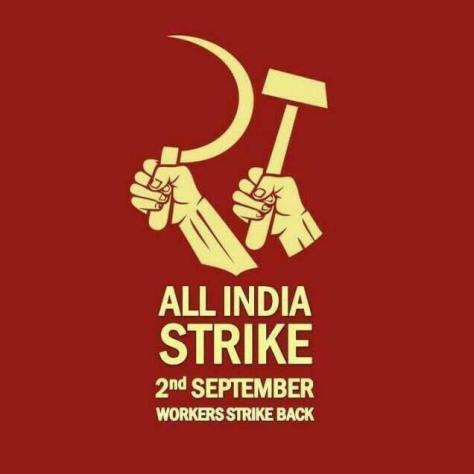
Workers Strike Back : Statement by NSI on the All India Strike

Guest Post by New Socialist Initiative (NSI)

All trade union federations in India, except the BMS affiliated with the RSS, have declared a one day nationwide strike on 2nd September against the price rise and economic policies of Modi government. One of the main demands is a minimum wage of Rs 18,000/ per month. At present the legal minimum wage in most of the Aountry is less than one third of this. The overwhelming majority of workers in India work for even less than the legal minimum wage. The condition of agricultural workers is the worst. In Pudducherry the legal minimum wage for agricultural workers is Rs 1650/ per month. On the other hand, if the minimum wage is calculated to provide consumption needs of three persons for fooAd, clothing, housing, education and medical expenses, then it should be around Rs 26,000/. Clearly, the economic system in the country has failed to provide even essentials of life to the most of its working people. Indian capitalism is a predatory system which feeds on the living labour of Indian people without providing them even the bare minimum needed to survive. Everybody in a working class family has to work. It is no surprise that India has the largest number of child labourers in the world. Working parents can not earn enough to take care of their children. Capitalism in India makes super profits from patriarchy and caste system. As Ambedkar said, caste is division of labourers. It divides workers and forces Dalits to do the least remunerative and dangerous work as agricultural workers, manual scavengers, sanitation workers and in other ‘untouchable’ activities. Women workers are paid a pittance. Without their unpaid extra domestic work, working class families would simply collapse.
All governments in India favour employers over working people. The Modi government however has been specially vicious in attacking workers. It has systematically degraded the National Rural Employment Guarantee scheme by starving it of funds. The proposed GST is likely to stoke the fires of already high food inflation even higher. It has dismantled the existing labour inspection system for the sake of ‘ease of doing business’. Its law on Child labour permits children to work in household units. Make in India programme is premised upon Indian labour being cheaper than global competitors.
The strike call of 2nd September has broken new ground. The trade union movement so far has remained confined to the organised sector which employs only seven percent of the workforce. Workers in the unorganised sector work on contract with no job security. By making the demand for a reasonable minimum wage the main slogan of the strike, trade unions have taken an important first step towards forging the class wide unity of the entire working people.
New Socialist Initiative stands in solidarity with this strike and wishes it a grand success. The road to a society without capitalist exploitation, and which honours and justly rewards the labour of working people is long and arduous. Nationwide strikes which strengthen working class solidarity are its important milestones.



Ambedkar University faculty statement on violence against marginalized communities

Ambedkar University Delhi Faculty Association (AUDFA) expresses serious concern and outrage about the growing spiral of violence against various marginalized communities across the country. In the last one month two states particularly have witnessed violence and protests in an extensive scale.

AUDFA condemns the continued violence against people in the Kashmir valley, where the death toll is continuously rising. The violence in Kashmir this time saw a familiar pattern as before, an (encounter) killing, a funeral where rage is vented through slogans and indiscriminate and abominable violence as a response. Kashmir valley remained under a complete blackout with all modes of communication and transport blocked and curfew imposed for several days. AUDFA urges that immediate efforts towards demilitarization of Kashmir valley must be initiated and steps must be taken towards preventing the killing and injury of civilians.

AUDFA also strongly protests against the brutal beating, flogging stripping and parading of seven dalit men in Una taluka of Gujarat. As protests against this violence, at least twelve dalit men attempted suicide. Massive protests by dalits are evidence towards the failure of the justice system which has not been able to provide redress against the high rates of caste atrocity in Gujarat. AUDFA believes that action needs to be taken against vigilante gauraksha groups (who were the perpetrators of the violence) under the SC/ST (Prevention of Atrocities) Act.

Continuous violence and discrimination against Muslims and the dalits goes against the moral fabric of the Constitution and as a faculty association AUDFA expresses its anxiety over the growing everyday intolerance among and polarisation of the people in this country. We express our solidarity with protests against such ongoing violence.

Gopalji Pradhan                   Rukmini Sen                         Arindam Banerjee

Secretary                                President                               Treasurer


‘गाय की दुम तुम रखो, हमें हमारी जमीन दो’ 

फैलता दलित विद्रोह और बदहवास हिन्दुत्व ..
Image result for una struggle
(Photo Courtesy : indianculturalforum.in, Radhika Vemula addresses Dalit Mahasammelan in Una)
जब मैं पैदा हुआ तब मैं बच्चा नहीं था
मैं एक स्वप्न था, एक विद्रोह का स्वप्न
जिसे मेरी मां, जो हजारों सालों से उत्पीड़ित थी
उसने संजोया था
अब अभी भी मेरी आंखों में अछूता पड़ा है
हजारों सालों की झुर्रियों से ढंका उसका चेहरा
उसकी आंखें, आंसूओं से भरे दो तालाबों ने
मेरे शरीर को नहलाया है ….
– साहिल परमार
/गुजराती के जानेमाने कवि साहिल परमार की  कविता ‘जब मैं पैदा हुआ’ के एक हिस्से का मूल गुजराती से अनुवाद, जीे के वनकर द्वारा,http://roundtableindia.co.in/lit-blogs/?tag=sahil-parmar/
1
गाय से प्रेम, मनुष्य से नफरत ?
 
हर अधिनायकवादी परियोजना की विकासयात्रा में ऐसे मुक़ाम अचानक आ जाते हैं कि उसके द्वारा छिपायी गयी तमाम गोपनीय बातें अचानक जनता के सामने बेपर्द हो जाती हैं और बिगड़ते हालात को संभालना उसके लिए मुश्किल हो जाता है। हिन्दुत्व की ताकतें फिलवक्त़ अपने आप को इसी स्थिति में पा रही हैं। गुजरात में उदघाटित होते दलित विद्रोह ने उसके लिए बेहद असहज स्थिति पैदा कर दी है, जो आज भी विकसित होता दिख रहा है।

Continue reading ‘गाय की दुम तुम रखो, हमें हमारी जमीन दो’ 

A secularism of despondency or a secularism of hope? Vikas Bajpai

Guest post by VIKAS BAJPAI

Mera abai watan, my ancestral home, the place to which I belong, is Lucknow.  Lucknow is ‘my city of joy’; and for me Lucknow’s identity derives from ‘old Lucknow.’ The newer part of the city is a creation of barely thirty to thirty-five years and bears little reflection of what Lucknow otherwise stands for.

There can be little conceptualization of Lucknow’s legendary culture, its tehzeeb, without any imagination of ‘old Lucknow’. As an instance of how deeply this tehzeeb had percolated into society, I still recall, on a few occasions that I happened to accompany my maternal uncle to the Raqabganj sabzi mandi, the hawkers would attract buyers for slender and delicate kakdis (skinny cucumbers) with the poetic call – ‘lijiye – lijiye, laila ki ungliyan, majnu ki pasliyan’ (‘Come, get these delicate fingers of Laila, Majnu’s slender  ribs’, referring to the legendary star-crossed lovers Laila-Majnu).

Old Lucknow’s lanes and by-lanes, its busy bazaars, the Chowk – famous for chikan embroidery and zari work; Prakash ki kulfi in Aminabad (a popular market in old Lucknow); the early morning doodh malai and jalebi stalls; the horse-driven ikkas and the tangas; the masjids and their aazaans; the Siddhanath Mandir next door to our house; burqa clad women and the Muslim men wearing dupalia topis, headgear sometimes worn by Hindu men too, especially on Holi; Chaar Bagh railway station; Hanuman Inter ‘Kalej’ and ‘Quins Kalej’ (colleges from where my mother and father matriculated respectively; in the Awadh area of Uttar Pradesh ‘college’ would typically be pronounced as ‘kalej’); and of course how can one forget the mangoes – all of these shall forever be etched as a part of my childhood memories.

Continue reading A secularism of despondency or a secularism of hope? Vikas Bajpai

Regulating the Surrogacy Industry – A Feminist Perspective: Sarojini Nadimpally, Deepa Venktachalam and Sneha Banerjee

Guest Post by SAROJINI NADIMPALLY, DEEPA VENKTACHALAM and SNEHA BANERJEE of SAMA, a resource group for women and health.

The press briefing on commercial surrogacy by Minister of External Affairs Ms  Sushma Swaraj, on 24th August 2016,  did not come as a surprise to many of us who have been advocating for the rights of surrogate mothers and the regulation of the Assisted Reproductive Technology (ART) industry. Many of the points mentioned in her speech were already in the Draft Assisted Reproductive Technologies (Regulation) Bill 2014. Since 2015, the Ministry of Home Affairs (MHA) had stopped issuing visas to foreigners for commissioning a surrogacy. The Supreme Court of India is currently hearing arguments in a Public Interest Litigation (PIL) demanding a prohibition or ban on commercial surrogacy.  In a recent hearing, the Supreme Court asked the government to develop the framework for the regulation of the  ART and surrogacy industry in India.

The latest regulatory move extends prohibitions in place in the draft ART Bill of 2014, banning commercial surrogacy altogether, and permitting only altruistic surrogacy (without payment), and only for one category of people – heterosexual Indian couples who have been married for five years and do not have any children, specifically excluding NRIs. Only close relatives can be surrogates and there are penalties that are absent in the Draft ART Bill of 2014. The draft ART Regulation Bills (2010, 2014) mentioned marriage as a mandatory clause, with ‘couple’ who could access surrogacy arrangements, defined as a man and woman living in a marital relationship for two years; the current Surrogacy Bill says 5 years.

This approach obviously discriminates against queer couples whose marriage is not legal in India; and as for ‘single’ persons – they are persona non grata. This is highly problematic, moralistic and discriminatory. The briefing was an outpouring of the nation-family-culture rhetoric and patronizing morality. We have not read the current Surrogacy Regulation Bill yet as it is not available in the public domain and hence our concerns are based on the media reports.

Continue reading Regulating the Surrogacy Industry – A Feminist Perspective: Sarojini Nadimpally, Deepa Venktachalam and Sneha Banerjee

Statement Of JNU Faculty On Incident Of Sexual Violence On Campus

We, the undersigned faculty members of JNU, express deep shock and dismay at the news that a complaint of rape has been lodged against a JNU student Anmol Ratan (an activist of a left students organisation but since then expelled from it), by another student of JNU. We express our support and solidarity for the complainant and request the JNU community, the administration, and the GSCASH to ensure that the due process of law is allowed to proceed without any hindrance.

It is of primary importance that the health and safety of the complainant be at the centre of all that the university community and the JNU administration does. This necessitates swift action to ensure that the accused (or those acting on his behalf) do not have any opportunity to intimidate, slander, or harm the complainant or the complainant’s witnesses, tamper with evidence or testimony, or otherwise create a campus environment that indulges in victim blaming or casting aspersions on the motives of the complainant.

We are therefore extremely dismayed to know that more than 48 hours after the complaint has been lodged, the accused has yet to be suspended or declared out of bounds from the university, so that safe conditions of complaint and testimony for the complainant may be maintained. We demand that this be done forthwith. This failure to act has tarnished the image of the JNU administration quite severely.

We also recognize the manner in which over the decades, teachers and students have made JNU a space in which women generally feel safe, and also empowered to report cases of sexual violence when these occur. This atmosphere however, has been caricatured in the recent past by sections of the media and by right-wing individuals as one of irresponsible sexual license, which the JNU administration has done nothing to counter.

We are dismayed also by the instrumental use of this case by some organizations on campus to further their political ambitions.

The JNU administration must undertake to cover all medical and legal costs of the complainant. It must fully cooperate with the investigation. So must all other members of the JNU community, as they are likely to have information relevant to the case and conduct of the accused.

As JNU faculty, we reiterate our commitment to building a campus that is safe, democratic, secular and mindful of the dignity of all sections of our community.

 Signed:

Mohan Rao

Rohit

Ayesha Kidwai

Nivedita Menon

Madhu Sahni

Ranjani Mazumdar

V Sujatha

Ritoo Jerath

Supriya Varma Continue reading Statement Of JNU Faculty On Incident Of Sexual Violence On Campus

The new war on piracy

This is a piece that has come out in today’s Hindu


Recent reports about the change in copyright infringement warnings on various websites have triggered anxiety among many Internet users in India. While the government has maintained a list of banned websites for quite some time, the warning that one earlier saw merely mentioned that the website had been blocked under directions from the Department of Telecommunications, while the new message warns against the viewing, downloading, exhibition and duplication of the contents of the URL as being offences which are punishable under Sections 63, 63-A, 65 and 65-A of the Copyright Act. It further states that these provisions prescribe a punishment of up to three years and a fine of up to Rs.3 lakh.

Internet users in India, many of whom routinely use torrent sites to access a range of entertainment and other content, are understandably worried about the new punitive rhetoric that underlies the warning. It may therefore be useful to unpack what the law actually says on the point and also examine the impulse behind this rhetorical shift within the logic of copyright enforcement.

Conflating various provisions

Sec. 63 of the Copyright Act, which deals with the offence of infringement, provides that any person who ‘knowingly’ infringes copyright or abets in the infringement of the same may be punished with imprisonment (minimum of six months and extendable to three years) and fined up to Rs.2 lakh. The new warning seems to have accounted for inflation and arbitrarily extended the fine amount to Rs.3 lakh, but that is only one part of its disingenuity. What the warning does is to conflate all the provisions and flatten them as though they all deal with a singular thing called infringement. Continue reading The new war on piracy

Dalit Uprising and After …

Why Hindutva Would Not Be The Same Again ?

Image result for una struggle

(Photo Courtesy : newsclick.in)

When I was born I was not a child
I was a dream, a dream of revolt
that my mother, oppressed for thousands of years ,
dreamt.
Still it is untouched in my eyes
Covered with wrinkles of thousand years, her face
her eyes, two lakes overflowing with tears
have watered my body…..

– Sahil Parmar*

Well known Gujarati poet Sahil Parmar’s poem ‘When I Was Born’ perhaps reverberates these days in Gujarat when we are witnessing a Dalit Upsurge- a first of its kind at least in that regions history. It will be a talk of folklore for times to come how flogging of dalits in a village in Saurashtra by Hindutva fanatics suddenly erupted into a mass movement of dalits which could catch imagination of the people cutting across different sections of society. An attempt is being made here to understand the dynamics of the movement and its likely impact on the future trajectory of Hindutva.

Continue reading Dalit Uprising and After …

In Chhattisgarh, a slow and determined CBI cover-up

Statement on Recent Developments in Kashmir: Delhi University Students, Academics and Other Concerned Individuals

Guest Post by Delhi University Students, Faculty and Other Concerned Individuals

The current escalation of violence in Kashmir started on July 8, 2016 after the killing of Hizb ul Mujahideen’s Burhan Wani by the armed forces of the Indian State. As per reports from the local media, Burhan’s funeral was attended by an estimated 4 lakh people, apart from the numerous other assemblies of mourning held in-absentia across the valley.

The essential character of resistance to the Indian state in Kashmir today is not primarily in the form of a guerrilla war between the armed forces and the militants. Since 2008 mass rebellions have broken out against the Indian state, including stone pelting by youth. In the years 2008, 2009, and 2010, the Indian government has responded to the mass movement through the use of brutal violence leading to the killing of over two hundred civilians, and injuring thousands, many of whom have been blinded for life through the use of pellet guns by the Indian armed forces. We have also witnessed how the Indian state has responded to these agitations by imposing continuous curfews, curbing the local press, snapping all forms of communication and by incarcerating the pro-freedom leadership, thus denying the people all avenues to express and demand the fulfillment of their aspirations peacefully. In 2016 the State continues to respond much the same way. As we write this, sixty nine civilians have been killed, including Amir Nazeer, who studied at the University of Delhi. Thousands have been injured and yet again scores have lost their eyesight forever due to the firing of pellet guns. The government has yet again as always, blamed Pakistan for instigating the protests, thus completely refusing to acknowledge the ground reality in Kashmir. Continue reading Statement on Recent Developments in Kashmir: Delhi University Students, Academics and Other Concerned Individuals

Adventures in Creepland: An Open Letter to the District Collector, Calicut, Kerala

This letter is jointly written by the signatories.


Dear Mr Prasanth Nair

We, the undersigned participants of the 7th Queer Pride March held on 12 August 2016 in Calicut, would like to bring to your attention the unforgivably irresponsible attitude of the Kozhikode police towards the rights of young people who identify themselves as queer, and their allies. In what should have been a completely joyous event, their attitude cast a dark shadow, for sure. Continue reading Adventures in Creepland: An Open Letter to the District Collector, Calicut, Kerala

DISSENT, DEBATE, CREATE