Tag Archives: Kerala

Check Hindutva Patriarchy: Prof. Akeel Bilgrami writes to the Chief Minister of Kerala

 (This is the text of the open letter written by the eminent philosopher Prof. Bilgrami, who was honoured by the Government of Kerala a few years back, to Com. Pinarayi Vijayan, on the Hadiya case)
Dear Mr. Vijayan,

You may not remember me from a couple of years ago when you and Prof. Pannikar were kind enough to award me the Social Science Research Prize and attend my lecture on that occasion in Trivandrum. I write out of the blue now —an impertinent liberty— to urge you to intervene in the case of Hadiya where an important constitutional right to choose one’s religion is being violated since, as is well-known, there was absolutely no force exercised upon her in her conversion.   Both Hindutva mischief and patriarchal attitudes are at play in her plight and they need to be strongly resisted.  Moreover it seems to me that the NIA’s being allowed to play a role in this matter is a deplorable interference in the the state of Kerala’s autonomy in the federal system of governance to which our country is committed, and should also be resisted.
  Won’t you please lead the way on this  —your voice, speaking out on all these issues and your support of Hadiya from your position of authority as Chief Minister, will make all the difference.
With my very best wishes,
Akeel Bilgrami
Akeel Bilgrami
Sidney Morgenbesser Professor of Philosophy,
Professor, Committee on Global Thought,
Columbia University,
Tel: 212 316 3458
Fax 212 854 4986

Free Hadiya March on 3 Oct: Citizens for Hadiya

On October 3, students, human rights activists, muslim-dalit-adivasi-bahujan organisations from all over India are converging in Thiruvananthapuram to march for the freedom of the twenty-four-year-old Hadiya, who is under virtual house arrest in the home of her father, Mr Asokan after the shocking annulment of her marriage to her chosen partner by the Kerala HC. The march will begin from the Martyr’s Column, Palayam, at 11 AM and end at the Kerala State Government Secretariat junction. Through this we hope to draw the attention of the public to the grave dangers posed by these decisions of the judiciary and by the shameful silence and criminal inaction of the Kerala government , which claims leftist and secular credentials. We invite all to participate in this march and strengthen the hands of those who are fighting to undo this unspeakable violation of justice to an Indian citizen and the gross attack on the fundamentals of Indian democracy. We also request you to kindly change your Facebook profile pictures to Citizens for Hadiya and/or write supporting posts.

Continue reading Free Hadiya March on 3 Oct: Citizens for Hadiya

A letter to Kummanam-ji, but also to all Pujya/Poojya/Poo Hindutva fanatics from Kerala, in the wake of revolution in the prasad-giving practices in Haryana

Dear Kummanamji

This is to let you know how the events presently unfolding in Dharmakshetra- kurukshetra (or at least its vicinity) are making even me, a lapsed sudrathy from Kerala, more and more creative about convincing your masters in Delhi that Hindutva fanatics in Kerala are no less worthy of kind consideration than their own home-grown fanatics. Actually, is this not the time you should be making a splash? Alas, despite your earnest efforts, these days, the Kerala police (and even your arch-enemies in Kerala, though they seem to be a bit less enthusiastic  these days), take all the credit of minority-bashing and gender-criminalising. And the best you can do is go home to home telling Hindu women to cover up etc. and shout at Muslim groups doing the same, accusing them of nearly the same acts.

My ex-sudra blood boils perhaps when I notice how in the course of post-independence history, Kerala politicians in Delhi with the exception of a few of the likes of AK Gopalan, have performed mostly sudravritti especially after the 1980s even when they were in powerful posts (often clearing the shit your predecessors have made according to the instructions from above and to the extent to which they permit). Now is your chance, I think, to rise, or at least put your head above the ground. Continue reading A letter to Kummanam-ji, but also to all Pujya/Poojya/Poo Hindutva fanatics from Kerala, in the wake of revolution in the prasad-giving practices in Haryana

The Heavy Footsteps of Brahmanical Dandaneethi : The Hadiya Case


It appears that for women in India, the modern judiciary is fading and in its place, the terrifying face of Brahmanical Dandaneethi is emerging. A ten year old rape victim is denied abortion, women fleeing dowry harassment are to submit to the rule of local elders and leaders of ‘family welfare committees’, and now, in the Hadiya case, the judges declared that unmarried daughters should be under their parents according to ‘Indian tradition’.

Read more:   https://thewire.in/169543/hadiya-islam-conversion-supreme-court/


An Anthem for Kerala: Mojitopaattu

In these days in which Indo-Gangetic barbarians seethe with rage against Kerala and unleash all sorts of false propaganda about the state of affairs here, I have been thinking about my own love for and quarrels with this place. My relation to it has been largely critical, as a Malayali woman born and raised here who has endured, and continue to endure, much second-rate treatment. More than anyone else, I realize, it is Malayalis who have criticized Kerala.  Not surprising, then, is the fact that one of the most ardently-discussed themes in public politics here in the past decades has been the critique of the entrenched imagination of Kerala, and its exclusions. Not for nothing, too, have the struggles of marginalized people here demanded not just material gains, but the reimagining of Kerala in more expansive terms. And newer and newer groups of excluded people keep renewing it – most recently, the LGBTIQ+ people.

Our love for Kerala is a cursing, stumbling love – but love above all.

That’s why I think Anitha Thampi’s poem  Mojitopaattu (The Mohito Song) ought to be our anthem. Anitha is undoubtedly one of Kerala’s most perceptive poets of the present, capable of delving into the depths of the present cultural moment and surfacing with inscrutable yet pervasive feelings and moods and weaving these into words. Our crazy love of Kerala which cannot be but critical is brilliantly caught in this poem In it, this love comes alive as moonlight falling on this place which illuminates erratically, sways madly, and disappears without notice; this loving looks as hard and risky as a drunk’s faltering steps along a rough bylane through treacherous yet playful moonlight; this love eddies through the blood of two and a half generations and comes awake even as the whole world sleeps. Long before the Indo-Gangetic barbarians even noticed us have we felt this mad love, and it will take more than vituperative slander to kill it.

Below is my translation of Mojitopaattu – and I take Anitha’s suggestion that it a song, and a drunken one, seriously. I hope someone sets it to music and it becomes the anthem of crazy-lovers of Kerala.


Four-five sprigs fresh mint

Two spoons sugar
Juice of three limes
Vodka, two measures and a half 
Soda
Ice

Hey you, swayin’-shakin’-rollin’
 on night-time alley that’s runnin’
all o’er earth that’s green and shinin’
Banana-leaf-like, straight and gleamin’*
Hey sweet moonlight, 
who you be,
you be man or you be woman?

Hey you, fallin’ easy-loose-y
You for real, or just a feelin’?
Hey you singin’ , spreadin’-creepin’
Who you be to sunshine beamin’?

Hey you lurchin’, fallin’, stumblin’
on each an’ ev’ry greenly leafling  
Hey bright moonshine,  distilled-dried blood, bluish, 
two and a half generations bleedin’
Who be you?

You be me, or you be you?

*Kerala, that lies at the foot of mountains like a bright green banana leaf beside the sea.

( Anitha Thampi , ‘Mojitopattu’)


And here is the original, much more terse and controlled in its use of language, but a paattu all the same:


മൊഹീതോപ്പാട്ട്

നാലഞ്ച് തളിർപ്പുതിന

രണ്ടു സ്പൂൺ പഞ്ചസാര

മൂന്നു നാരങ്ങാ നീര്

രണ്ടര വോഡ്ക

സോഡ

ഐസ്


നാക്കിലമണ്ണിൻ∗

രാവൂടുവഴിയൂടെ


ആടിയാടിപ്പോകുന്ന പൂനിലാവേ നീ

ആണാണോ പെണ്ണാണോ?

അഴിഞ്ഞഴിഞ്ഞു തൂവുന്ന പൂനിലാവേ നീ

നേരാണോ പൊളിയാണോ?

പാടിപ്പാടിപ്പരക്കുന്ന പൂനിലാവേ നീ

വെയിലിൻറെ ആരാണോ?


പച്ചിലകൾ തോറും തപ്പിത്തടഞ്ഞു വീഴും

രണ്ടരത്തലമുറ നീലിച്ച വാറ്റുചോരപ്പൂന്തെളിനിലാവേ നീ

ഞാനാണോ നീയാണോ?


∗കേരളം


Take back the Poison-Rain: Ambikasutan Mangad’s Swarga

Swarga_300_RGBWhen I first encountered Enmakaje, it was already much praised in Kerala as the powerful little book that aroused the Malayali’s moral conscience towards the unspeakable tragedy wrought by the unbelievably-callous aerial spraying of the insecticide Endosulphan in north Kerala, over some of the most lush, verdant areas of the State. It was criticised by some for what I thought was a very interesting experiment with form: it begins as fiction, slowly shades into a historical account of the beginnings of the anti-Endosulphan struggle in north Kerala, and then shades back, in the end, to fiction again. For me, Enmakaje was much more than an activist tale. It was a determined effort to renew the Malayali self, through a prayerful weaving and imaginative retelling of the many stories that have shaped us. Reading of Neelakantan’s and Devayani’s stories, one remembers these stories, but differently. For example, what if Raman and Seetha left Ayodhya forever, renouncing its sickening power games? What if Adam and Eve voluntarily renounced Paradise? What if Vararuchi’s wife had rebelled in the origin-story of Kerala, of the Parayi petta panthirukulam?

Juggernaut has just published my translation of this gem of a book, and the title of the English version is Swarga: A Posthuman Tale . Below is an excerpt from the book.


It was past midnight.

Jayarajan started from his sleep and sharpened his ears for sounds from outside.

He shook Neelakantan, who was fast asleep, awake. Neelakantan woke to darkness assailing his open eyes. He was frightened.

‘What is it?’

In a trembling voice, Jayarajan said, ‘Something is happening outside. I can hear noises.’

Neelakantan’s throat was parched. He asked in a loud voice, ‘Who is there outside?’

Jayarajan noticed his fear in the dim light of the lantern.

‘Not human beings. Something like a storm and strong winds . . . I can’t make out much . . .’

Neelakantan’s breath returned.

‘Oh, that! Must be the wind . . . I’ve been scared ever since you came in . . . it’s just that I didn’t show it. You lie down, I’ll see you off tomorrow morning; put you on the first bus back. It is not at all safe for you to come and stay here again.’

Jayarajan got up.

‘Come, let’s go out for a bit.’

Neelakantan yawned. His voice was lazy. ‘The rain and wind will go their own way. You should lie down.’

Jayarajan took his hand and made him get up.

‘I’ve seen quite a bit of rain and wind too . . . but something extraordinary is happening outside.’

Neelakantan began to listen, alert now. There was a whole symphony of unpleasant sounds rising outside.

Taking care not to wake Devayani, they opened the door and stepped out.

They saw the most unbelievable sights on top of the Jadadhari Hill.

The huge trees were shaking hard, writhing, in the wind. From the clouds above, golden-coloured lightning-snakes descended, falling on the tops of the massive trees and enveloping them. As if from the impact of the lightning, the tall trees bowed as low as the ground, seeking to shake off the golden serpents . . .

In the next moment, the wind came hurtling like a demon’s hand, swooping up the trees. The branches clung and cleaved to each other as if in a paroxysm of desire, and shivered as though in the throes of an orgasm. And then, the lightning-serpents returned, and the whole cycle began again.

Startled, Jayarajan asked, ‘What is happening up there?’

For a few moments, Neelakantan had no words. He kept watching the hill’s frenzied dance and then said, ‘Terrible thunder and lightning. And the wind and rain besides. All of it together, that’s all.’

But even as he said those words, he knew how inadequate they were. Human language was too limited to describe this miraculous phenomenon. It was too vast to be comprehended by puny human consciousness.

‘Look, it is raining on top of the hill,’ Jayarajan pointed out. ‘Some of it is falling here too. But just see – there is not even a sign of rain or wind anywhere near here. Here the trees are still as if they have stopped breathing. It is a miracle . . . let me call chechi.’

‘No, she will be scared.’

Jayarajan remembered Devappa’s words. ‘On the night of the Kozhikkettu in Bhagyathimaarkandam, no one goes out!’

‘Two years ago, on a night like this, I heard the jungle sway like this around midnight. I thought it was a storm and did not go out.’

‘I think,’ Jayarajan said and stopped.

‘What?’

‘Is this really Siva’s dance of destruction, the thandava? Isn’t this the Jadadhari Hill?’

Neelakantan asked, ‘Are you a believer?’

‘No. What about you?’

‘I haven’t been to temples or shrines after I began to see things differently . . . In my view, Siva is Nature itself. Siva exists in every leaf, every flower. The thandava that you mentioned–’

‘The dance of destruction of Siva, who swallowed the divine serpent Vasuki’s deadly venom! This is it! Is this thandava- Jadadhari Hill’s, Nature’s – that means Siva’s – own attempt to shake off the terrible chemical poison, so like Vasuki’s venom, the Kalakoota?’

‘You tie up everything to your consciousness of the environment!’

Jayarajan pointed out: ‘See, the wind’s grasping fist now eases. The lightning retreats. The rain and thunder depart. The trees stand up straight once again.’

Neelakantan nodded, his eyes wide open and filled with the magic in the air. Yes, the dance of destruction was now ebbing.

Excerpted with permission of Juggernaut Books from Swarga by Ambikasutan Mangad, translated by J Devika available in bookstores and on Juggernaut.


Love in the Time of Public Despair: Remembering Kamala Surayya

31 May passed like any day in present-day Kerala – filled with the cacophony of mediocrities and expressions of greed, envy, and hate which have become the new normal. No wonder, then, that most people did not remember that this was the poet Kamala Das/Madhavikkutty/ Kamala Surayya’s death anniversary. I cannot help recollecting that I had predicted that this would happen: that people here would celebrate her death, display sickening sentimentality, and then quickly forget. In life and in death, Surayya never received the critical attention that she deserved as a thinker, nor did those interested in progressive left politics take her forays into politics seriously. In these times of despair, one must, however, turn to her …

Read more on:

http://www.thehindubusinessline.com/blink/know/seeking-rhyme-in-reason/article8737506.ece


Confront the Rupa Subramanyas Within : A Note to a Nair-born Friend

Dear Kaviraj,

Just saw your post condemning The Telegraph’s representation of Smriti Irani as ‘Aunty’. I understand your indignation, though I am curious to know why few people like us stand up and protest when the people who supporte her, the sanghis, throw vile abuse at dissenters and feminists, label them prostitutes, and threaten them regularly with rape and disfigurement. My daughter was recently threatened in Delhi and warned not to behave like a ‘JNU randi’; senior women teachers from JNU were showered with similar abuse, shoved, groped, and hit at the Patiala House, and many of them have received direct and indirect threats. JNU women have been portrayed in the most despicable terms recently, before which Telegraphs’s characterisation of Irani as ‘Aunty’ is tame indeed even if unacceptable.

Continue reading Confront the Rupa Subramanyas Within : A Note to a Nair-born Friend

If You Can’t Beat Them, Join ’em – Or, Ente Dinkeswara!

A new wave, nay, tsunami, of (THE) Faith has risen in Kerala. Soon, it will sweep the Nation.  This is the mighty thrust of Lord Dinkan, now known all over Kerala as Dinkamatam – or Dingoism.

…. Yellow, and black, and pale, and hectic red/ Pestilence-stricken multitudes: O Dinka,/ Who chariotest to their dark wintry bed ... [from ‘Ode to Dinka’ by the early Dinka devotion poet Muroidea Muridae Murinae, later stolen by Shelley and rewritten as ‘Ode to the West Wind’. Note that Dinkan,  superhero airborne rat and Shelley’s West Wind are both powers of the Air]

If you don’t believe me, visit this url:

https://www.dinkoism.com/

Now, like many others, I too was an unbeliever until I went there. One click, and I knew this was truly Faith. Market logic is nowadays the true marker of anything genuine (redefined an anything worth pursuing), and Dinkoism is unmatched in this regard. Even Amritanandamayi who successfully packages and sells all styles of Hinduism (the astrologer-obsessed style, the Saibaba-singing-style, the Sivakasi-print style, the shallow version of the Upanishadic style, the Christian-inflected Hugging-Mother style, the belligerent Hindutvavadi-style) cannot match him. Upon opening this Divine page, my eyes fell upon a notice in Malayalam which said: Mega offer before the world ends in 2012 [that needs updating, I suppose – small error; the spirit is more important] . 100 % guarantee in securing sin-free existence. Many years of service. Ridding of curses undertaken responsibly. We have no branches. Now, what further proof did I need to be convinced that this was the true Faith? Who doubts now that faith in the Logic of the Market precedes faith in faith? The Logos of Dinkan and the Logic of the Market are in perfect harmony!

Continue reading If You Can’t Beat Them, Join ’em – Or, Ente Dinkeswara!

Women in Sabarimala – The Untold Story: Elsa T Oommen

This is a guest post by ELSA T OOMMEN

‘For the last 20 years woman irrespective of their age were allowed to visit the temple when it opens for monthly poojas. They were not permitted to enter the temple during Mandalam, Makaravilakku and Vishu seasons’
– (S. Mahendran vs The Secretary, Travancore Devaswom Board and Ors. (1991) (8) [AIR 1993 Ker 42])

The Supreme Court of India will soon be hearing the final arguments on the question of the restriction imposed on women in the reproductive age from entering the Sabarimala temple in Kerala. The court had earlier questioned the constitutional basis of the restriction at the behest of a the public interest litigation (PIL) placed before the apex court of India by the Indian Young Lawyers Association (IYLA) where it called for allowing women of all ages to be allowed entry to the temple. Continue reading Women in Sabarimala – The Untold Story: Elsa T Oommen

Two Trees Don’t Make a Forest: Leave KOL Alone

The latest assault on the Kiss Of Love movement, the last in the long list of assaults against its activists over the past one year in Kerala, involves the arrest of two former KOL activists, Rahul Pasupalan and Resmi Nair, over sex trafficking charges. While the media has been mixing up this case with that of a pedophilia FB page in a rather unwarranted way , the media has been screaming about the pair’s connection with KOL and some reports almost imply that their actions were because of their associations with KOL. Others, including the arch-conservative newspapers, have asked whether the KOL was a cover for sex work markets! Continue reading Two Trees Don’t Make a Forest: Leave KOL Alone

For a Better FB: WomeninCampaign’s Press Release

August 26, 2015

Digital rights advocates demand a revision of Facebook’s policies that perpetuate violence against women in non-English speaking communities.

On July 28th a social activist, Preetha G, was brutally slut-shamed, harassed and abused in Facebook through a page which was in a native Indian language, Malayalam. The hate pages instigated a huge degree of violence, hurled abuses at her dignity and womanhood. It contained her morphed pictures with sexually explicit abuses, targetting even her autistic son. Preetha hailing from the state of Kerala in India, has around 22K followers on Facebook and uses the platform to to express her political opinions, her ideas on gender and other minority rights.

Many users including Preetha reported the hate pages (a total of 5 pages in a span of 3 weeks) to Facebook and also to the cyber crime wing of Kerala Police. Facebook replied with a generic message stating “The post doesn’t violate community standards”. The hate pages continued to update its content with threats and abuses to the women who publicly supported Preetha. Amidst all this, profiles of several supporters, especially women were suspended by Facebook. All these, including that of Preetha was blocked stating “violation of Real Name Policy” possibly due to reporting by those cyber-criminals who started the hate pages.

As the story of violence aided by Facebook policies spread, stories emerged from other countries as well. A recent incident occurred in Peshwar, Pakistan where a similar hate campaign was unleashed towards several young women through Facebook. When this was reported by users, Facebook responded in a similar fashion with the generic message that “no community standards were violated”. These young women’s lives were put to extreme risk and their own families did not protect them.

The women in countries like India and Pakistan do not get family support and Facebook refuses to understand the cultural complexities. With respect to this context, different individuals and organizations had several conversations with Facebook, but Facebook failed to take any measures until now to rectify these.

From the generic response that Facebook provides while hate pages in non-English language is reported, it is evident that the language experts that Facebook claims to have in place, is a myth. The actions or rather the lack of actions from Facebook, make it easier for several majoritarian forces to unleash violence against women and other marginalized sections. Facebook’s flimsy community policies are putting women’s lives in danger and this platform is used as a tool to silence women and bring forth more oppression.

It is high time we collectively inform Facebook about renegotiating its policies what adhere to majoritarian forces, and initiate a global mass campaign against those policies.

We, Women In Campaign, demand the following to Facebook:

a) Right to Privacy: To get rid of the real name policy and its associated proceedings.

b) Right for protection against hate crimes: A systemized responsive system or a set of language experts for assessing hate pages in non-English languages and a timely response and follow up in such situations.

c) Right to cultural diversity: Facebook needs to understand the complexity of non-English cultures and cannot impose its American corporate colonization into other societies. It urgently needs to appoint linguistic experts who can verify hate pages and understand regional languages and it nuances.

On Tuesday Aug 18th 2015, an online meeting was held with representatives from Facebook (India and US), Maya Leela and Inji Pennu (Women In Campaign) and members of a few other organisations who stand for Facebook policy revisions. We are waiting for a post-meeting response from Facebook. Depending on their response, we will disclose our future strategies.

We stand in solidarity against the invasion of Facebook into our right to privacy and political choices.

A Facebook page is started for the campaign: https://www.facebook.com/womenincampaign

hashtag for solidarity: #forabetterfb 

 Sincerely,

Women In Campaign, India

[Aswathy Senan, Inji Pennu, Jaseela Cheriyavalappil, Jina Dcruz, Kunjila Mascillamani, Maya Leela, Najma Jose, Preetha GP]

Digital Rights Foundation, Pakistan – Nighat Dad

Internet Democracy Project, India

Point of View, Bishakha – India

Phone Contact:Inji Pennu : (USA) +1-3212502484

Jaseela CV: (India) +91-9497550324

Email : forabetterfb@gmail.com 

Nighat

Kavita

chomsky

An Open Letter to Mr Adani on the Occasion of Onam

Dear Mr Adani

Writing to you from Thiruvananthapuram, where you recently signed an agreement with the Kerala government, undertaking the construction of the international container terminal at Vizhinjam off the Thiruvananthapuram coast.

The Malayali press went wild in their delight ; the politicians beamed in triumph (well, most of them. Some of them –guess who — could not, having discovered that they had shot themselves in the foot); the contractors and sundry middlemen in the construction sector rubbed their hands in glee. This is Onam season in Kerala, and Onam, you may know, is our national festival. You are very much in the talk here. To the contractors and our miserably corrupt and craven political class, you are Maveli reborn in flesh and blood. To the poor fisher people on what is arguably Kerala’s poorest coastal stretch, you are a newer version of evil Vamanan himself, threatening to banish them to the nether-world. There was a time when the political left in Kerala reinterpreted the Maveli myth as a vindication of the Welfare State. But since the welfare state has been almost as good as dead in the minds of Kerala’s mainstream political classes, the throne has also been conveniently empty.The mainstream press has set you up on it indirectly but definitely, and that’s pretty much evident. But Malayalees who love this land and are not blinded by hollow –false– national sentiment can see that not only are you the very opposite of Maveli, but also that this Emperor-figure has no clothes at all.

Continue reading An Open Letter to Mr Adani on the Occasion of Onam

Murdering Democracy in Kerala : the Latest

Secularism and socialism can be thrown out, so says the Hindutvavadi. Among those who protested against this suggestion were, of course, the Congress. But then, increasingly, many of us who live in  Congress-ruled Kerala are unable to tell the Congress from the BJP as they have thrown out not just secularism and socialism but even minimal forms of liberalism. For our rulers seem as adamant as the BJP in forcing down our throats at least a softer version of Hindutva, reinforced with protection to shameless plunder of public resources and repressive police measures. Now young people and activists in Kerala, many of who were active in many protests including the Kiss Protests, are being pursued and hounded by the police. Apparently, a few people who participated in the latest edition of the Kiss Protests, the Lovefest, were hounded by the police for having been seen in the vicinity of a police station repeatedly! The most convenient excuse is pursuing the Maoists, a fear that is easily excited in our fattened and lazy middle classes. By the way, I am actively considering saving some money by ending my subscriptions to newspapers. In fact it is not being on FB which makes me feel out of touch with the world these days. Two leading human rights activists, Thushar Sarathy and Jaison Cooper, have been arrested and the papers are busy covering that shameful and utterly criminal waste of our common resources, the opening ceremony of the National games.

I am not surprised at all, having been an observer of local politics. In Kerala, after the Left-Right differences in politics came to an end, what we have seen is the transformation of our politics into a neofeudal space inhabited by powerful male leaders and their craven followers vying for power. Because the discourse of social development still lingers and the oppositional civil society has not yet given up, entry of predatory capital from national or global sources has not been easy. However, a whole generation of NRI — Malayali –capitalists based in the Gulf countries who essentially manage the wealth of the rulers there have been able to enter Kerala unimpeded.It is this group which is increasingly taking over our resources in overt and covert ways, legally and illegally. These capitalists themselves are interesting — their transnational belonging needs to be studied. They have apparently managed to become part of the non-democratic political systems in the Gulf countries, entering the lower levels of the court there, as juniors who help manage the rulers’ wealth. And from that position of strength, they now work to systematically undermine everything that Malayalis hold dear : our welfarist democracy, social development achievements, our rich ecology. Continue reading Murdering Democracy in Kerala : the Latest

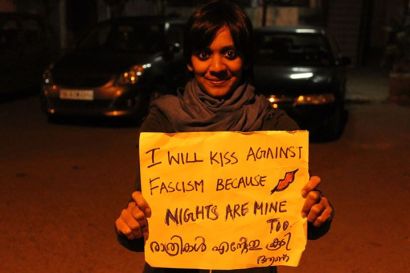
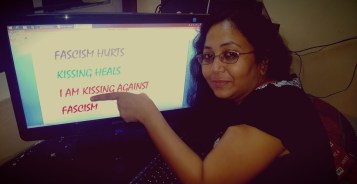
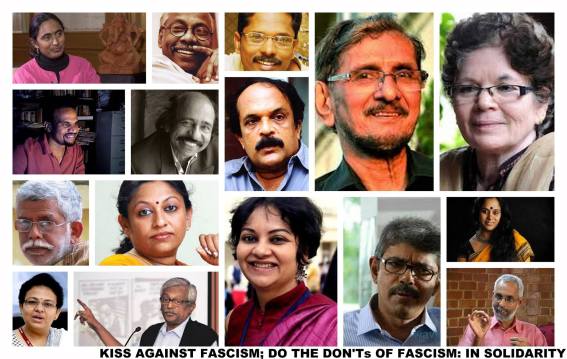
Wave after Wave, We Refuse to Die Down: Kiss Protest Against Fascism at IFFK

If you are in Thiruvananthapuram, please do join us at one o’clock at noon in front of the Kairali-Sree theatre complex at Thampanoor, the main venue of IFFK.

We do believe that the rising tide of fascism in Kerala, the creeping fear of the sheer violence of fascist goons, can be combated only through love, humor, and moral courage. The victory of Hindutva right wing forces in the national scene seems to have emboldened them in Kerala. They are attempting to import here the instruments of terror that they brazenly unleash on people in the states which have become laboratories of their hate-politics. We will not let their evil grow; we will fight it with love.

We will use as an instrument of self-defense precisely all that which fascist forces deny us in this society. We will reclaim that ultimate symbol of tender and intimate human contact, the Kiss; we will kiss against fascism.

And each of us has different, but interconnected reasons, for kissing against fascism.

sunilKissable boymikek edited 3aswatyrenuedited 2nisaaratrikasinghabipshaKAF solidarity


The old Gods haven’t fled: Sankar Radhakrishnan

Guest Post by SANKAR RADHAKRISHNAN

On a morning not long ago, chaya cup in hand, I was getting my regular Kafila fix, when I paused mid-click. What caught my eye was a headline with ‘Gods, Own and Country’ in it. Now that combination of words could only mean one thing — a piece on Kerala. It helped though that right below the headline was a picture of a Kathakali artist in sthree vesham or female makeup.

So I dived right into the essay on Thiruvananthapuram by Professor Mohan Rao. The first couple of lines had me grinning with delight for he wrote of his “four wonderful days” in the city, one that’s been my home for much of the past three decades.

I was so pleased by this that I skimmed the next few lines. Only to be stopped in my tracks, almost spilling some scalding chaya on myself in the process, by the Professor’s declaration that “… Ganesha is not a deity widely worshipped in Kerala.”

Now I’m no expert in Hinduism, but I do know that my extended, and very Malayali, family used to perform a ‘Ganapathy homam’ on a number of specific occasions; before moving into a new house, for instance. And this has been going on for decades. I also remember that both my grandmothers had an image of Ganapathy in their personal pooja spaces. Just to make sure that I hadn’t got my wires crossed, I checked with a couple of Malayali Hindu friends who confirmed that Ganapathy and Ganapathy homams were an integral part of their families’ religious landscape too.  Continue reading The old Gods haven’t fled: Sankar Radhakrishnan

I am a Muslim, an Atheist, an Anarchist: Salmaan Mohammed

Guest Post by Salmaan Mohammed

[ Salmaan Mohammed, a twenty five year old philosophy student was arrested in Thiruvananthapuram on 19 August 2014 for sedition, and for allegedly dishonouring the national flag and national anthem. The complaint against him originated as a response to his refusing to stand while the national anthem was played in a cinema during a screening. Salman is currently out on bail, but still faces the prospect of a life term in prison if he is found guilty of sedition by the judicial process. We at Kafila have been in touch with Salman and he has recently sent us a translation of an audio interview he did after coming out of prison on bail so that the world outside Kerala (and those who do not read or speak Malayalam) can understand what he has been thinking.]

Continue reading I am a Muslim, an Atheist, an Anarchist: Salmaan Mohammed

Have the Gods Fled Their Own Country? Mohan Rao

Guest Post by MOHAN RAO

kathakali-performance-in-stree-vesham-in-mumbai

I returned a few days ago after four wonderful days in Trivandrum – having gone back there after some thirty years. Looking over Trivandrum from my seventh floor hotel room was a wondrous sight for sore eyes, a thick lush greenness everywhere. Hardly any high rises, an occasional mosque, temple or church rising above the green.

Going for a walk the next morning, around the medical college area, it was vastly reassuring to still see some old bungalows, and a number of ugly new ones of course. But not that many apartment blocks. Unlike Bangalore, the ones that have come up are not named Malibu Towers or Sacramento, but Revi Apartments.

Yes, it was wondrous to see Lakshmi still spelt Lekshmi and Ramya, Remya. Continue reading Have the Gods Fled Their Own Country? Mohan Rao

Creeping Dictatorship: Concerns from Kerala

Guest post by THUSHAR NIRMAL SARATHY

 Are we living in a democratic dictatorship? ‘Democratic dictatorship’ is a much debated concept in Kerala.  I am referring not to that here but to the dictatorship of the executive led by democratically-elected politicians. Recent incidents seem to indicate that this is now an ever-growing tendency in our democracy.

A few months back, a notice with the photos of well-known public figures, which identified them as Maoists, appeared in the Mananthavady police station at Wayanad.  These were pictures of senior, very well-known activists who have fought battles for democracy in Kerala.  Following widespread protests, the police was forced to remove the notice. On 28th July this year, Jonathan Baud, a Swiss citizen was arrested by Valappad police for attending a commemoration meeting of a Maoist leader, Sinoj, who died in an accidental explosion at the forested Kerala- Karnataka border. Mr Baud was in India on a tourist visa. His arrest was big news in the media which had happily swallowed policespeak, and so he was also projected as a Maoist. The reports claimed that he had come here with the express purpose of attending the meeting, and that he delivered a solidarity speech there. Later, when the Commemoration Committee made public its own version of events, the police sensationalism was refuted and had to be withdrawn. The charge against Mr Baud are apparently limited to violation of visa conditions and it was admitted that he had no Maoist links. Continue reading Creeping Dictatorship: Concerns from Kerala

Don’t let the Magic Fade: Thoughts on Kudumbashree’s Sixteenth Anniversary

I do not write on Kafila as frequently as I used to because I don’t want to be writing stories of impending doom all the time. These are times in which we appear doomed, but it does not help to get obsessed with it; in fact, the obsession may actually hasten the downfall.

But these days, we also hear stories which may be told either way. For example, I can tell the story of the mining going on at Mookunnimala in Trivandrum as yet another episode in the continuing story of the destruction of our natural environment and its impending collapse. But I can also tell it another way, foregrounding the resistance that has shaped up there despite the formation of a deadly nexus of Kerala’s political parties, bureaucracy, predatory capitalists and other criminals against local people. Or, I can tell the story of the ‘development’ of the government school at Attakkulangara in the heart of Trivandrum city as another incident that proves the unrelenting march of ‘urban development’ which is nothing but shorthand for the steady takeover of prime urban space by corrupt officials and venal politicians. But it is also a David-and-Goliath tale of how a few dedicated members of the school’s old students’ association, and nature-lovers and environmental activists who go by the name Tree Walk  managed to draw the attention of others, alert authorities, and arrest the steady pace of these forces. Continue reading Don’t let the Magic Fade: Thoughts on Kudumbashree’s Sixteenth Anniversary

Ka Tvam Baale? Kaanchana Maatha! Or, the University of Calicut experiments with the Grotesque!

Now let me confess, it is high-time in life that I got an award — I am 46, nearly. It isn’t really a question of whether I desire it or not. If you are in the business of reading and writing in Kerala then you MUST receive some award by mid-career — it’s a bit like experiencing nausea and tiredness in early pregnancy. You MUST have it, it is the surest sign of being pregnant, and sometimes to enjoy people’s kindness towards a pregnant woman, you need to get vomiting soonest possible. You can’t get into a conversation about pregnancy with other women without being able to recount your experience of being nauseous and tired. Continue reading Ka Tvam Baale? Kaanchana Maatha! Or, the University of Calicut experiments with the Grotesque!