
[ Random notes made in the wake of the conviction of Dr. Baba Ram Rahim Singh Ji Insaan of Dera Saccha Sauda for the offense of rape in Panchkula, Haryana, with some attention paid to the testimonials of his close friends. ] Continue reading The True Bargain : How Dr. Ram Rahim Singh Insaan Defined His Time
Tag Archives: Narendra Modi
The Modi regime, its minions in the JNU administration and the brave struggle of whistle blower Prof Rajeev Kumar
The prime minister of India Narendra Modi’s cheap hindutvavaadi jibes in his farewell address to vice president Hamid Ansari were better suited to Republic TV or The Organiser, but under Modi’s regime, parliament is pretty much run like an RSS shakha, and Modi himself seems no different from Arnab Goswami.
Said Modi in parliament to the distinguished out-going vice president:
Aapke karyakaal ka bahut saara hissa West Asia se juda raha hai. Usi dayere mein zindagi ke bahut varsh aapke gaye, usi mahaul mein, usi soch mein, aise logon ke beech mein rahe. Wahan se retire hone ke baad bhi jyadatar kaam wohi raha aapka; Minorities Commission ho yah Aligarh Muslim University ho, zyadatar dayara aapka wohi raha.
Lekin yeh 10 saal puri tarah ek alaga zimma aapka sar mein aaya. Puri tarah ek ek pal samvidhan samvidhan samvidhan ke hi dayere mein chalana. Aur aapne usko bakhubi nibhaane ka bharpur prayaas kiya. Ho sakta hai kuch chatpatahat rahi hogi bhitar aapke andar bhi. Magar aaj ke baad shayad woh sankat bhi nahin rahega. Mukti ka anand bhi rahega aur apni mulbhut jo soch rahi hogi uske anusaar aapko karya karne ka, sochne ka, baat batane ka awsar bhi milega.
प्रधानसेवक का मौन
ऊपर से शांत दिखने वाली भीड़ का हिंसक बन जाना अब हमारे वक्त़ की पहचान बन रहा है. विडंबना यही है कि ऐसी घटनाएं इस क़दर आम हो चली हैं कि किसी को कोई हैरानी नहीं होती.

15 वर्ष का जुनैद ख़ान, जिसकी चाहत थी कि इस बार ईद पर नया कुर्ता पाजामा, नया जूता पहने और इत्र लगा कर चले, लेकिन सभी इरादे धरे के धरे रहे गए. उसे शायद ही गुमान रहा होगा कि ईद की मार्केटिंग के लिए दिल्ली की उसकी यात्रा ज़िंदगी की आख़िरी यात्रा साबित होगी. दिल्ली बल्लभगढ़ लोकल ट्रेन पर जिस तरह जुनैद तथा उसके भाइयों को भीड़ ने बुरी तरह पीटा और फिर ट्रेन के नीचे फेंक दिया, वह ख़बर सुर्ख़ियां बनी है.
दिल्ली के एम्स अस्पताल में भरती उसका भाई शाकिर बताता है कि किस तरह भीड़ ने पहले उन्हें उनके पहनावे पर छेड़ना शुरू किया, बाद में गाली गलौज करने लगे और उन्हें गोमांस भक्षक कहने लगे और बात बात में उनकी पिटाई करने लगे. विडम्बना है कि समूची ट्रेन खचाखच भरी थी, मगर चार निरपराधों के इस तरह पीटे जाने को लेकर किसी ने कुछ नहीं बोला, अपने कान गोया ऐसे बंद किए कि कुछ हुआ ही न हो.
ट्रेन जब बल्लभगढ़ स्टेशन पर पहुंची तो भीड़ में से किसी ने अपने जेब से चाकू निकाल कर उन्हें घोंप दिया और अगले स्टेशन पर उतर कर चले गए. एक चैनल से बात करते हुए हमले का शिकार रहे मोहसिन ने बताया कि उन्होंने ट्रेन की चेन भी खींची थी, मगर उनकी पुकार सुनी नहीं गई. इतना ही नहीं, रेलवे पुलिस ने भी मामले में दखल देने की उनकी गुजारिश की अनदेखी की.
विडंबना ही है कि उधर बल्लभगढ़ की यह ख़बर सुर्ख़ियां बन रही थी, उसी वक़्त कश्मीर की राजधानी श्रीनगर की मस्जिद के बाहर सादी वर्दी में तैनात पुलिस अधिकारी को आक्रामक भीड़ द्वारा मारा जा रहा था. जुनैद अगर नए कपड़ों के लिए मुंतज़िर था तो अयूब पंडित को अपनी बेटी का इंतज़ार था जो बांगलादेश से पहुंचने वाली थी.
( Read the full article here : http://thewirehindi.com/12095/mob-lynching-and-india/)
Why Two Hundred Ordinary Hindus Did Not See A Dead Muslim Child On A Railway Station In North India
 On 22 June 2017 fifteen-year old Hafiz Junaid was stabbed to death on a Mathura-bound train from New Delhi. He was traveling home for Eid with his brothers and two friends. A dispute over seats resulted in a group of men repeatedly assaulting and stabbing Junaid and his companions. The assailants flung their bodies onto the Asoti railway platform. A crowd gathered. At some point an ambulance was called and two bodies were taken away. Junaid is dead. His companions are in critical condition. While one person has been arrested the police investigations are running into a wall of social opacity since they have been unable to find a single eye-witness to the incident. Of the 200 hundred strong crowd that assembled on Asoti railway platform on Thursday evening, the police cannot find one person who can say what they saw. The police cannot find a witness because something very peculiar seems to have happened to those present at Junaid’s death. A report by Kaunain Sherrif M in the Indian Express provides specific details. When asked if he had seen anything that evening, Ram Sharan a corn-vendor whose daily shift coincides with the killing, Sharan said he was not present at the time of the incident. Two staffers who were sent to investigate by the station master were unavailable for comment. Neither the station-master, the post-master or the railway guards saw the event they were present at.
In this startling piece the journalist reports how the public lynching of a Muslim child becomes a social non-event in contemporary India. He shows the reconfiguring, and splitting, of a social field of vision. He reports all the ways in which people – Hindus- did not see the body of a dead – Muslim – child that lay in front of them. The Hindus on the Asoti railway platform managed to collectively not see a 15 year old Muslim boy being stabbed to death. Then they collectively, and without prior agreement, continued to not see what they had seen after the event. This is the uniquely terrifying aspect of this incident on which this report reflects: the totalising force of an unspoken, but collectively binding, agreement between Hindus to not see the dead body of a Muslim child. Hindus on this railway platform in a small station in north India instantly produced a stranger sociality, a common social bond between people who do not otherwise know each other. By mutual recognition between strangers, Hindus at this platform agreed to abide by a code of silence by which the death of a Muslim child can not be seen by 200 people in full public view on a railway platform in today’s India. Continue reading Why Two Hundred Ordinary Hindus Did Not See A Dead Muslim Child On A Railway Station In North India
Revisiting the demonetization survey: Juhi Tyagi
Guest Post by JUHI TYAGI
In light of the recent book, I Am A Troll: Inside the Secret World of the BJP’s Digital Diary authored by journalist Swati Chaturvedi which describes the working of the BJP’s media’s cell to systematically undermine dissenting opinions, we need to revisit other, seemingly innocuous, government media campaigns such as the demonetization survey and its use as a tool in bending into shape public opinion.
The demonetization survey was officially launched on 22nd November 2016 on the NM app by the government. Its purpose was to receive feedback from the people themselves on the validity of withdrawing 86 percent of the currency in circulation to address two problems: that of black money and counterfeit currency. The survey consisted of nine questions, with the tenth providing space for sharing suggestions. The questions dealt with people’s beliefs about the existence of black money in India and on its need to be eliminated. On their opinions of the government’s efforts against corruption, and more particularly, on the effectiveness of demonetization in ridding society of black money, all corruption and terrorism while creating opportunities for higher education, health care and affordable housing for all.
Continue reading Revisiting the demonetization survey: Juhi Tyagi
Maternity Entitlements were Legal Rights 3 years ago, not a New Year Gift: Statement of the Right to Food Campaign
On New Year’s Eve, the Prime Minister in his much-anticipated speech amongst other commitments made a vague announcement of a “nation-wide” scheme for maternity entitlements for pregnant women.
But the PM has not spelled out any specifics – neither the timeframe;budget nor its universal coverage as obligated in the National Food Security Act (NFSA) since2013. Clause 4B of the law already promises all pregnant and lactating women maternity entitlements of atleastRs 6000 for each child. But for three years, the central government didn’t honour this legal obligation. Though better late than never, re-packaging this legal right as the PM’s New Year gift is disingenuous.
Further media reports, from December indicate that the Finance Ministry may hike the budget by a mere 20 percent (instead of the sevenfold increase necessary for universalisation) and that too restrict the benefit to only women Below the Poverty Line (BPL). This would be in complete violation of the NFSA.
But there seems to bearecurring trend to subvert the law. For the last three years, this government continued with the pilot Indira Gandhi MatritvaSahyogYojana (IGMSY) in just 53 districts of the country despite repeated demands by civil society activists and women from across the country. This year, Right to Food Campaign activists from across India even sent postcards to the PM to remind him of the state’s obligation.
In September 2015, even the Supreme Court issued notices to the Centre on the non-implementation of maternity entitlements under the NFSA.
While the government did initially enhance the IGMSY allocations from Rs 4000 to Rs. 6000 to be in tune with the NFSA, neither the coverage nor the budget was enhanced which languishes at Rs. 400 crores. Instead to ensure that all eligible women are covered as per the NFSA, Rs 16,000 crores is necessary. A real test of the Prime Minister’s announcement will be in the fine print of the allocations in next month’s budget.
Indian Muslim women – Caught between misogynists and hypocrites: Sanober Umar
Guest Post by SANOBER UMAR
The ugly patriarchal politics of ‘Triple Talaq’ or unilateral ‘instant divorce’ through which Indian Muslim men (specifically Sunnis who follow the Hanafi school of Islamic jurisprudence), can divorce their wives by pronouncing the word ‘talaq’ thrice in a single sentence, has appeared once again in mainstream politics. In this board game played over Muslim women, you have two main players. On the one hand you have the ever-so-vocal and self-proclaimed representatives of Muslims – The All Indian Muslim Personal Law Board (AIMPLB) – and on the other hand, you have right-wing public figures of Hindutva, including our very own Prime Minister Mr. Modi, shedding tears of concern for Muslim women’s rights.
However Muslim women should not be deemed as agentless victims in this plot, and many are raising their voice against this practice by asserting their Koranic rights. Nonetheless, it is important to emphasize that while AIMPLB and Hindutva politics may seem to be polar opposites, the two have much more in common when it comes to curbing or denying Muslim women their rights. The male dominated AIMPLB is clearly vested in its project of misogyny even at the cost of denying Muslim women their Islamic right of longer procedures of divorce, that allow time and space for reasonable consideration before annulling a marriage. On the other hand, Hindutva men are no saviours of Muslim women either, as many instances both past and present have shown – including the recent spates of rape and murders (such as the Haryana rapes and murders by Gau Rakshaks and not to forget, the horrifying Muzaffarnagar violence not too long ago).
Continue reading Indian Muslim women – Caught between misogynists and hypocrites: Sanober Umar
Not Pakistan, but Modi has pushed Kashmir on the Brink : Ashok Swain
This is a guest post by ASHOK SWAIN
Since the death of a young and charismatic separatist named Burhan Wani, Kashmir has erupted into violence and chaos. Weeks of violent protests in the Valley have resulted in the deaths of at least 50 people and over 5,000 injuries. Kashmir is not new to violent protests and civilian deaths, but this time the intensity of the protest and the passion of the protesters is unprecedented. Continue reading Not Pakistan, but Modi has pushed Kashmir on the Brink : Ashok Swain
Caste, sedition, oppression: JNU round-up
Earlier this week, I tried to join the many dots of violence at universities into a coherent pattern. My central contention is:
Spirited resistance in campuses across the country suggests the politics of India’s youth are more fluid and assertive than expected. The mid-1990s empowerment of historically oppressed castes, narratives of economic aspiration from the 2000s and an instinctive suspicion of authoritarianism have come together to forge a bold poetic new politics of desire that has befuddled even ruthless and astute politicians like the prime minister.
and
Modi’s government uses outdated laws, a pliant police force and Hindu student organizations as a battering ram to crush this awakening, exacerbating the discord between a prime minister determined to stamp his authority on an unruly nation and students enraptured by a thrilling moment of unlikely solidarities that could define their generation.
Statement of Solidarity FromFaculty and Graduate Students at the University of Hawai’i, Manoa Against Police Ation on JNU Campus
To: Prof. M. Jagadesh Kumar
Vice Chancellor
Jawaharlal Nehru University
New Delhi-110 067, India
University of Texas Students and Faculty stand with JNU
We, the undersigned, students, scholars, and faculty of the University of Texas at Austin, stand in solidarity with the students, faculty, and staff at Jawaharlal Nehru University, New Delhi against the illegal and unconscionable crackdown by police. We demand an immediate end to all police action on campus, a withdrawal of all frivolous charges against the President of JNU Students’ Union, Kanhaiya Kumar, and other students, as well as an end to the campaign of harassment and intimidation against students at the university. With them, we affirm the autonomy of the university as a non-militarized space for freedom of thought and expression. Accordingly, we condemn police presence on campus and the harassment of students on the basis of their political beliefs. Continue reading University of Texas Students and Faculty stand with JNU
Bangalore Research Network’s Letter of Solidarity with JNU
We, the undersigned members of the Bangalore Research Network and a consortium of academics and researchers from Bangalore, declare our solidarity with the students and faculty of the Jawaharlal Nehru University, New Delhi protesting the illegal police arrest of JNUSU president Kanhaiya Kumar on charges of sedition. We unequivocally stand by them in affirming that universities are autonomous spaces for the free expression of a plurality of beliefs and cannot become military spaces of thought control that go against the very grain of a democratic society. With them, we condemn the blatantly authoritarian attempt by the police and the central government to witch hunt students on the basis of their political beliefs. We also condemn the unethical media trial of JNU students such as Kanhaiya Kumar and Umar Khalid. Continue reading Bangalore Research Network’s Letter of Solidarity with JNU
The Limits of Efficient Suasion : Rina Ramdev
This is a guest post by RINA RAMDEV
The Prime Minister’s monogrammed suit and the HRD Minister’s fake degree in the early days of the BJP’s 2014 electoral win were embarrassments dotting the uneasy calm that prevailed over the new digital, development avatar of the nation; even as a sense of the slouching beast waiting to break through the controlled, contained quietism was always there in deferred menace. And thus, when majoritarian sentiment fuelled the ‘Ghar waapsi’ campaign and the ban on cow slaughter found a mainstreaming in minority witch hunting, there was an eerie expectedness to these turns. The Swachh Bharat Abhiyan’s minatory address, carrying the subtext of a communal cleansing in sinister remand, visibilized itself in the horrific lynching of Mohammed Akhlaq in Dadri. Mostly civil voices of protest raged against this as well as against the organised killings of questioning rationalists like Pansare and Kalburgi. Sections of the thinking polity mobilised signature campaigns, petitions and an entire event like the‘Award waapsi’ drew attention to this vitiated political climate. Continue reading The Limits of Efficient Suasion : Rina Ramdev
The India I Came Back To: Namrata Sharma
This is a guest post by NAMRATA SHARMA
I will start this piece with a painful but short flashback tirade about myself. I moved back to New Delhi in 2014, after six long years in New York and Singapore. My decision to move back to the motherland was predominantly attributed to issues that a twenty-something grapples with when he or she is away from home and family. However, familial ties and emotional reasons aside, there was one factor which deeply resonated with me and was the driving force behind my decision to move back. This factor was – the liberty to express my thoughts and views on a topic, any topic, in an indulgent and lenient space, which, by virtue of being an Indian citizen, was guaranteed to me in India and not in other places. In India, this liberty transcended predictable spaces like classrooms, newsrooms and sophisticated editorial pages of the morning newspaper and was very organically present in the form of arm-chair political banter amongst friends and political conversations with family over dinner. Continue reading The India I Came Back To: Namrata Sharma
Solidarity Statement of Students from Northeast India, TISS, Mumbai 20th February 2016
We, the undersigned, students and research students from various states of northeastern region of India studying in Tata Institute of Social Sciences, Mumbai would like to highlight on the unprecedented shrinkage of academic spaces across various universities in India. We condemn the politically motivated interferences of the state in Jawaharlal Nehru University and in Hyderabad Central University (HCU), and other universities. We also condemn the mob justice perpetrated by lawyers against students, journalist, activists etc in the Patiala House Courts, New Delhi, and media trial led by prominent journalists from New Delhi. Continue reading Solidarity Statement of Students from Northeast India, TISS, Mumbai 20th February 2016
Mea Culpa, Mea Culpa! : To A Student from CDS
Dear Student from CDS who pasted the posters criticising our collective effort to stand with JNU
I write in response to the views that you expressed on those posters. First of all, let me tell you how much I’d have appreciated if you expressed those views openly right from the beginning, so that we could have had a proper debate. I do wish we stopped scribbling comments on each others’ posters – this is an open campus, and surely, we don’t practice the Sangh Parivar’s intolerance of a contrary opinion. No one, I assure you, will harm you in any way, and I am sure all my fellow teachers, students, and non-teaching staff will join me in assuring you thus.
Continue reading Mea Culpa, Mea Culpa! : To A Student from CDS
A message of Solidarity and a Statutory Warning: Pankaj Mishra
Guest Post by author Pankaj Mishra
One can only welcome the broad coalition that has sprung up against the assault on JNU and in defense of the right–eternally vouchsafed to students–to intellectual freedom. But the imperative of solidarity should not make us forget that this multi-pronged violence—ordered by the government, and assisted by police officers, university officials, lawyers and sections of the media—has been in the making for a while—at least a decade and a half.
The empowerment of a technocratic elite that presumes to know exactly what the ‘New India’ ought to do in order to be wealthy and powerful made much intellectual and artistic endeavour, not to mention political struggle, seem unnecessary. Its cherished epithet ‘jholawallah,’ aimed to scornfully delegitimate a whole spectrum of demands for justice and equality as well as a culture of reflection and debate. Wealth-creators and their lackeys in politics, business and the media have long been united in their contempt for intellectual dissent—roughly interpreted as anything that seems to impede or slow down their own progress towards more wealth and power.
Continue reading A message of Solidarity and a Statutory Warning: Pankaj Mishra
How the Hindutva Propaganda Machine Manufactures Lies
Did you know that the return of awards by writers, film-makers and scientists was a plot hatched jointly by the United States of America, Saudi Arabia and Pakistan? Well, if you did not, you will probably not ever understand why the ‘tolerant’ multitude that turned out at Anupam Kher’s March for India rally today, could so vilely abuse and attack NDTV’s Bhairavi Singh and Aaj Tak’s Mousmi Singh. After all, it is one thing for the netas to simulate their anger and laughter on TV channels and elsewhere, but how do you actually get ordinary people to go crazy? How and why does the ordinary Hindutva footsoldier act the way he or she does? Basically, he (and occasionally, she) is made to believe things that most people would know to be false. So why does as innocuous an act as the returning of awards by writers become such a big threat to India’s position in the world and to the very existence of the government of the day? Well, because, it is not a simple matter of some writers acting out of their conscience but already a part of an international conspiracy plotted by the US-Saudi Arabia-Pakistan nexus!
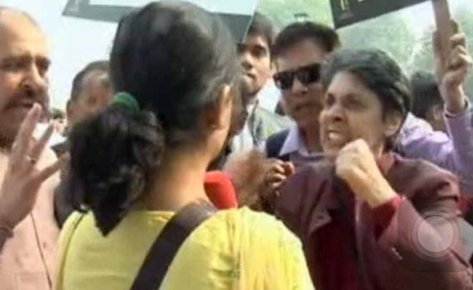
Published below is the text of a note that has been circulating over different social media platforms. We have left the typographical and printing errors as they are in the original. Paranoid in its content, it is also illustrative of the way the RSS ‘rumour-machine’ works to produce lies. In earlier days, it used to start circulating from the morning shakhas via the shakha participants. Nowadays it moves from one social media platform to another, with lightning speed. Continue reading How the Hindutva Propaganda Machine Manufactures Lies
Statement by Academics Against Intolerance
In light of the recent spate of killings of noted writers and intellectuals M M Kalburgi, Govind Pansare, and Narendra Dabholkar, and the Dadri lynching incident followed by forced nation-wide attempts at cultural policing, we feel that the current political dispensation headed by the Prime Minister is mandating an atmosphere of violence and fear. Continue reading Statement by Academics Against Intolerance
A Letter to Modi from a Former Supporter: Bhawni Mehrotra
Guest post by BHAWNI MEHROTRA
Dear Modiji,
I’m glad you spoke. Even though it was devoid of any personal remorse and limited to calling the Dadri lynching an “unfortunate and unwarranted” incident at Sasaram. Even though it was to cash in on ‘communal harmony’ during an election rally in Bihar. Even though it was a mere paraphrasing of the President’s quote once before at Nawada (we know of your limited vocabulary beyond acronyms and your “may-the-force-be-with-you” love for quoting). Still, I’m glad that you managed something! However, the one thing that you have failed miserably to manage (and let’s leave the ambling economy and your familial relations out of this) is the ‘fringe elements’ that come as part of the ‘BJP family pack’ offer. Sadly, under your ‘good governance’, the fringe has been asserting itself as the mainstream. Even sadder is that under ‘you’, the fringe is the mainstream.
The icing on the cake are your own MPs and ministers. Initially, what I thought of as verbal diarrhea on their part is actually proving to be a string of comments that are a part of a larger orchestrated communication message. Each message has a defined audience suited to their language and idioms. They all suffer from a dangerous saffron strain, exactly the kind that has fathered the ISIS, the Taliban and so on. Whether it be Yogi Adityanath’s remark, calling on Hindus to organize themselves; or Sadhvi Niranjan Jyoti’s unparalleled comparison between a “Ramzaada” and a “Haramzada”; or Nitin Gadkari’s reminder of the government being one of “Rambhakts”- all seem to be competing for being the most ridiculous. Did you mean “Hindutva First” and not “India First”? I’m sorry that I was so awestruck by your gazillion rupee election campaign (the one thing that you managed brilliantly) that I didn’t read the fine print. Therefore, it is not your failure, it’s mine. Had I voted sensibly, Mohammad Akhlaq wouldn’t be dead today. Continue reading A Letter to Modi from a Former Supporter: Bhawni Mehrotra
The Man And His Words
Narendra Modi has finally spoken. More than a fortnight after a Muslim man was lynched in Dadri by a Hindu mob over rumours of storing and eating beef, the prime minister summoned his deepest indignation and employed the strongest adjective he thought befitted the murder: “unfortunate”. “The Dadri incident or the opposition to Pakistani ghazal singer Ghulam Ali are sad and undesirable,” he told the Bengali daily Anandabazar Patrika in an interview.
In Modi’s esteemed view clearly, Dadri shouldn’t be given undue importance. It should be treated like another law and order issue – “regrettable” is all it deserves. In the prime minister’s book, the mob lynching of 50-year-old Mohammad Akhlaq can be clubbed with the cancellation of Ghulam Ali’s concerts in Mumbai and Pune after threats of violence by the Shiv Sena. Continue reading The Man And His Words
 KAFILA - COLLECTIVE EXPLORATIONS SINCE 2006