
So, the moral police has struck again. The papers in Kerala have been full of news about how a young IT sector employee, Thasni Banu, was confronted by a group of goons while she was being dropped to work at night by a male friend, insulted, slapped several times, and warned that they will not allow Kerala to “become Bangalore”. She did not take it mildly and complained to the police, who rolled their eyes, hummed, and hawed, and as to be expected, went slower than usual. One of the goons who was apprehended was let off. The papers have indeed taken the issue very seriously — and so have the state government, which suspended the policeman who handled the affair shoddily. Continue reading Seeking the Apadhasanchaarini/ The Malayalee Flâneuse
Category Archives: Culture
Coke Studio India – the first six songs
So the unanimous verdict is that Coke Studio India (first aired on the Friday that went by) is no match for Coke Studio Pakistan [Wikipedia]. For some it’s been like an India-Pakistan match – I’ve seen Indian congratulate Pakistanis on Twitter for the ‘Coke Studio victory’ and others ask Indian musicians and singers to listen to Pakistani singers and hang themselves. For most, this was not surprising – Coke Studio Pakistan has showcased some of the best music you’ve heard in recent times and it raised the bar too high for Coke Studio India. There’s also the problem of Bollywoodisation of music in India, of dumbing down, producing music aimed at the marriage market and livening up the moods of those stuck in traffic. A celebrity culture has taken the passion out of music in India – it does not seem to come from deep within. New popular music in India leaves you with the kind of feeling that a mall does. Loud and empty.
लखनऊ और फैज़: अतुल तिवारी
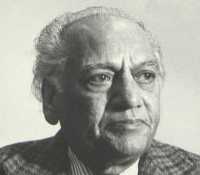 Guest posy by ATUL TIWARI
(प्रगतिशील लेखन के आंदोलन से जुडे हुए प्रसिद्ध पटकथा लेखक अतुल तिवारी ने यह लेख लाहौर में आयोजित फैज़ शताबदी समारोह में प्रस्तुत किया था और फिर दिल्ली में थिंक इंडिया मैगज़ीन के फैज़ नम्बर की रिलीज के समय होने वाले कार्यक्रम में भी उन्होंने यह लेख प्रस्तुत किया । काफिला के लिए लेखक की अनुमति से प्रकाशित। The English translation is given below the Urdu original. – SH)
“हज़रात!
ये जलसा हमारी अदब की तारीख़ में एक यादगार वाक़या है। हमारे सम्मेलनों,अंजुमनों में – अब तक, आम तौर पर – ज़ुबान और उसकी अशात अत से बहस की जाती रही है। यहाँ तक कि उर्दू और हिंदी का इब्तेदाई लिटरेचर – जो मौजूद है – उसका मंशा ख़यालात और जज़्बात पर असर डालना नहीं, बल्कि बाज़ ज़ुबान की तामीर था।…लेकिन ज़ुबान ज़रिया है मंजिल नहीं ।
…अदब की बहुत सी तारीफें की गयीं हैं। लेकिन मेरे ख़याल से इसकी बेहतरीन तारीफ़ “तनक़ीद-ए-हयात” है – चाहे वो मकालों की शक्ल में हो। या अफसानों की। या शेर की। इससे हमारी हयात का तब्सिरा कहना चाहिए। Continue reading लखनऊ और फैज़: अतुल तिवारी
‘Locking up gods within caste’
This note comes via Malarvizhi Jayanth. Those in support can leave a comment saying so, and add their designations to their names, if they wish.
We call for all those who support democracy and free speech to express solidarity with Thirumavalavan, Meena Kandasamy and Samya.Kathavarayan and Madurai Veeran are among the gods who are acknowledged to be Dalit and are worshipped by many castes. Clearly, in the oral history of the people, the gods have castes and these castes are not determined by who worships them. The twin brothers Ponnar Shankar inhabit the realm between hero and deity. They have been fictionalised, recreated for the silver screen, and are worshipped across communities. Their origin myth remains contested territory – it is variously read as symbolic of the conflict between agriculturists/warriors and hunters, as part of founding tale of the land-owning agriculturist Kongu Vellala Gounder sub-caste and, in a textbook example of how Hindutva functions, have recently been claimed as reincarnations of the Pandavas. Like other deities of the people, they are firmly located in a historical imagination among a society of human beings, and not in a mythos of gods.
In a footnote in Uproot Hindutva: The Fiery Voice of the Liberation Panthers by Thirmavalavan, MeenaKandasamy describes Ponnar Shankar as dalit. M Loganathan, an advocate from Nanje Goundanpudur and Students Wing Convenor of the Kongu Nadu Munnetra Kazhagam (KMK), has been quoted in news reports as saying that there is evidence proving that Ponnar and Shankar are Kongu Vellala Gounders and claiming that depicting them as Dalits will lead to caste tension. Continue reading ‘Locking up gods within caste’
Of Mosques and Minars
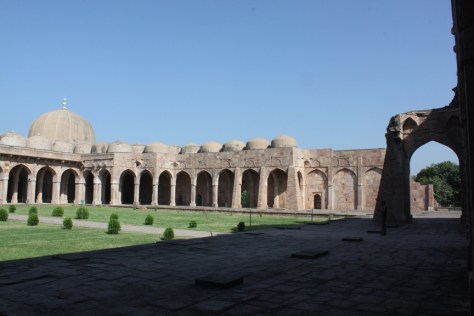
I can’t really say when I first heard the Aazan (the call for prayers given by the Muezzin, five times a day) it must have been in the early 50s when I was a little child and lived in Chabi Ganj, next to the Faseel (City wall) near Kashmiri Gate.
The sound of the Azan would have drifted in from one of the nearby Mosques, there were a few not too far away. The practice of using loudspeakers was not in vogue those days and yet the muezzin’s call for prayers travelled quite some distance, primarily because the horrible ambient sounds that assail our auditory nerves were almost non-existent at the time, in place of this cacophony there used to be other ambient sounds, the rustling of leaves, the chirping of birds and others, that have, it would seem, now been lost forever. Continue reading Of Mosques and Minars
Alvida, Maqbool Fida: M.F. Husain, Free at Last
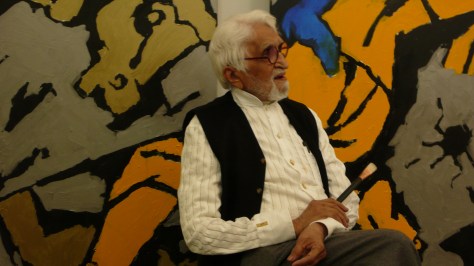
Like possibly several other children growing up in the kind of lower-middle class metropolitan households that attempted to reconcile their aspirations towards culture with their frugal habits in the 1970s and1980s in Delhi, my first introduction to the art of our time was the framed print of a Husain painting. We had no television. And my parents had no gods. The only icons in our modest house were two framed pictures – an inexpensive N.S. Bendre, (Lalit Kala Akademi) print of a few women at a well and the reproduction of a Husain painting, possibly detached lovingly and carefully from an Air India calendar, possibly featuring the kind of goddess image that incensed the zealots who made it impossible for M. F. Husain to live out his final years in India. Continue reading Alvida, Maqbool Fida: M.F. Husain, Free at Last
On the passing away of MF Husain: SAHMAT
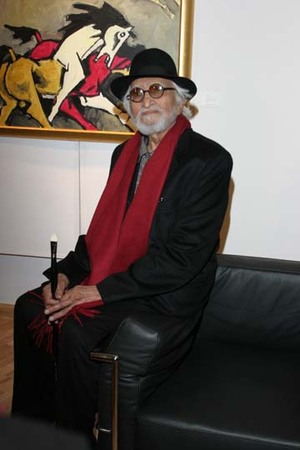
This statement has been put out by the SAFDAR HASHMI MEMORIAL TRUST (SAHMAT)
M. F. Husain
Easily the most iconic artist of modern India, Maqbool Fida Husain passed away in London on 9 June 2011. M. F. Husain was born in 1915 in Pandharpur, the famous temple town in Maharashtra. Bereft of his mother’s presence since childhood, Husain grew up in the multi-cultural milieu of Indore where his father migrated around 1919.
Indian civilization, in all its diversity, had been Husain’s basic inspirational project. Since the year of Independence, through the Nehruvian decades and thereon, cognizant of all the challenges involved in nation-building, Husain had been steadfast in maintaining a most affirmative relationship with the Indian peoples’ consciousness of their national identity. Through him, we have learned to address a whole gamut of issues pertaining to the interactive dynamic of modernity with the country’s many-layered art and culture. Continue reading On the passing away of MF Husain: SAHMAT
Baba Ramdev, Baba Ramdev
Old Left is Dying! Long Live the Left!
[Following the publication of the previous post – the statement on the future of the Left, we have received some important comments that seek to take the debate forward, alongside those predictable, invective laden rants that we know only too well by now. We need to keep the debate on the future of the Left in India going, irrespective of these comments that seek to derail any meaningful discussion. We must continue to assert that ‘the Left’ far exceeds the decadent and decrepit lot that now goes by the name of Left parties in this country. This post is a slightly modified and longer version of an article that appeared in Bengali yesterday in Ekdin.]
In a recent newspaper article, former Left Front finance minister Ashok Mitra, observed: “The Left Front, led by the Communist Party of India (Marxist), has not merely lost the poll in West Bengal, it has been made mincemeat of.” He was underlining the obvious, catastrophic significance of the results – at least from the Left Front’s perspective. The signs are there for everybody to see, especially when all important leaders of the LF government have faced resounding defeat and the overall vote share of the LF has declined by almost 9 percent since the last assembly election. Mitra’s reference is important as much was being made of the fact that he signed in support of the LF in the course of the election campaign.
But such was the state of drunkenness in power, that only a Biman Bose could say, when virtually everyone knew what was coming, that the LF would still gain a comfortable majority and those who were predicting their decline would have to “swallow their own spit.” More incredibly, even after the elections, indeed after the results came in, both Bose and Prakash Karat in Delhi focused on the fact that their votes had increased by 11 lakh votes in absolute terms. Of course, the minor detail they mentioned in passing was that the TMC alliance had increased its votes much more. The even more minor point that there had been as many as 4.8 million more votes polled this time as compared to 2009 was, of course, beside the point.
Putting the “Jan” into the Lokpal Bill: Nikhil Dey and Ruchi Gupta
Guest post by NIKHIL DEY and RUCHI GUPTA
For many who quite rightly guessed that the Lokpal Bill drafted by the Government would be a non-starter, the alternative merited automatic support. However, little was known about the contents of the two Bills, except that the alternative being proposed by ‘India Against Corruption’ had the prefix of being a “peoples” Lokpal. The consequences are too important to leave to the expertise of the drafting committee. The people must comprehend, and play their part in ensuring that there will be an Act that will empower them to fight corruption- not make them surrender their hopes to yet another anti-corruption organization. How people-centric is the Jan Lokpal Bill (JLP)?
While the JLP is going through rapid revisions – 12 so far – the basic framework and some principles have remained constant. Broadly the Bill can be divided into four sections: the mandate and scope of the Lokpal; composition and selection of the Lokpal; powers of the Lokpal; and functioning of the Lokpal. The composition and selection of the Lokpal is substantively one of the least contentious sections – concerned largely with procedural matters and subjective preferences, rather than ideological or legal viewpoints. A discussion of the other three sections follows.
Continue reading Putting the “Jan” into the Lokpal Bill: Nikhil Dey and Ruchi Gupta
Beyond the Bluster-Equity and Justice in West Bengal: Abusaleh Shariff and Tanweer Fazal
Guest post by ABUSALEH SHARIFF AND TANWEER FAZAL
One of the key issues being keenly watched in the recently concluded assembly elections in West Bengal was the direction in which the Muslim vote was going. Muslims constitute 25 per cent of West Bengal’s population. Despite such high concentration, the near absence of Muslims from public arena—art, culture, literature, public service, education—is alarming and should cause consternation in any polity, especially one that claims its legitimacy in the name of the poor and the marginalized. However, any suggestion that the long Left Front rule had rendered Muslims of West Bengal poorer and deprived than other social groups was taken as an affront to the so-called ‘exceptional’ record of the Left Front. Figures were trotted out, statistics read out in support of this track record. However, there is a difference between sops, assurances and promises made in an election year and the actual performance of a regime that has ruled a state for more than 30 years.
An Actor’s Journey from Text to Performance
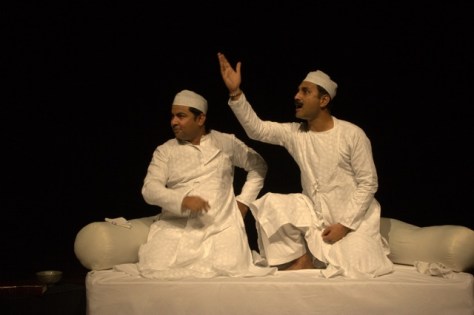
Whenever I begin preparing for a new performance words sit heavy in front of me as boulders. Alien, unknown boulders. I look up and I see them littered till wherever my eyes can see. I do not know these words. I did not create them. I do not know their context. I do not know what all they hide within. But I have to deal with them.
This is one of the fundamental struggles of an actor. To grapple with the text he intends to perform. Every time I encounter a new text for performance this line from Noon Meem Rashed’s iconic poem “Zindagi Se Darte Ho” comes to haunt me: Continue reading An Actor’s Journey from Text to Performance
Young Women in Kerala : Between Empowerment and Death? — Part I
[This was a note titled ‘We Still Need Feminism’ which I wrote on March 31 on my Facebook page; I thought it relevant to re-post it here as it appears that an ‘honour killing’, of a sort — an ‘honour suicide’ — may have actually surfaced in Kerala. More on that in the next post]
In JNU, last week, some of us were noticing how there seemed to be a notable increase in the numbers of students, both women and men, from the Hindi heartland. It is interesting, said one of my friends, that the deterritorialised university spaces in Delhi can no longer back off from directly confronting the tensions through which these societies now live through. “Look at that girl,” she said, pointing to a sprightly young woman, a bright student who I’d briefly met earlier,”she comes from a family that’d kill her if she married out of her gotra. And she is involved with a young man who’d not even of her region. We must fear the worst and prepare to confront evil.” For a brief moment, in my fright, I thought, well, at least we don’t have honour killings in Kerala. Honour kidnappings, yes, but I haven’t heard of too many honour killings. Maybe honour killings are still on their way here (like dowry deaths were, in the 1980s, when I was growing up into a young woman). We have some time to rally against them. Continue reading Young Women in Kerala : Between Empowerment and Death? — Part I
The Poet of Romance and Revolution
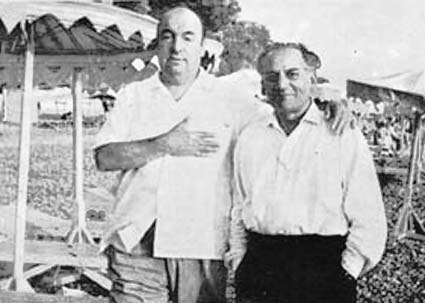
If you met him on the street you would never imagine that he was a poet, and not your run of the mill poet, but among the most important poets of the 20th century, not only in Urdu, not only in the subcontinent but in the entire world of the 20th century. I have always wondered how could someone who invariably dressed in rather unimpressively stitched, unromantic terry-cot Safari suits, someone who could at best pass off as a joint secretary in the ministry of shipping or something similar, be such a wizard with words and not only with words but with content and with form?
पीर पराई जानै कौन?: कुलदीप कुमार
Guest post by KULDEEP KUMAR
अज्ञेय की प्रसिद्द कविता-पंक्तियाँ हैं:
“दुःख सबको मांजता है/
स्वयं चाहे मुक्ति देना वह न जाने/
किन्तु जिनको मांजता है/
उन्हें यह सीख देता है/
कि सबको मुक्त रखें.”
लेकिन दुःख की इस सीख पर क्या कोई अमल भी करता है? पुराना या आज का इतिहास तो इसकी गवाही नहीं देता. बल्कि देखने में तो यह आता है कि दुःख के भी खाने बन जाते हैं. हमें केवल अपना या अपनों का दुःख ही दुःख लगता है. पराई पीर जानने वाले वैष्णव हम नहीं हैं.
जबसे सुना है कि ओसामा बिन लादेन की ह्त्या उसकी दस-बारह साल की बेटी की आँखों के सामने हुई, तभी से विचलित हूँ. मुझे मालूम है कि आज जिस तरह की फिजा बन गयी है, उसमें यह कहना भी जोखिम से खाली नहीं है. मुझे ओसामा बिन लादेन के प्रति सहानुभूति रखने वाला घोषित किया जा सकता है. उसकी बेटी को तो पता भी नहीं होगा कि उसका बाप वाकई में क्या था. क्या उस बच्ची का दुःख इसलिए कम हो जाता है क्योंकि वह ओसामा की बेटी है? हम लोगों ने अपने लिए जिस तरह के तर्क गढ़ लिए हैं, उनके अनुसार तो इस बच्ची के दुःख के बारे में सोचना और बात करना भी आतंकवाद के प्रति सहानुभूति दिखाना होगा.
Punjabi Qissas and the Story of Urdu
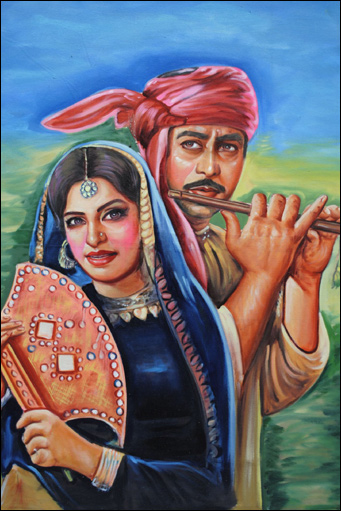
- Heer-Ranjha in a Pakistani film poster, circa 1970s
The Social Space of Language: Vernacular Literature in British Colonial Punjab
by Farina Mir
Permanent Black, Ranikhet, 2010.
ISBN-817824307-5
pp-277, price Rs 695
This book straddles several anomalies that are rather obvious once stated but are rarely formulated as such. How is it that the world of Urdu literature becomes so dominated by people from the Punjab in a span of fifty years, beginning circa 1900s, and in a sense, continues to remain so? Iqbal, Faiz, Meeraji, Rashid, Bedi, Manto, Krishan Chander and down to our times Mushtaq Ahmed and Zafar Iqbal, a top twenty or top fifty list of modern Urdu litterateurs would likely contain eighty percent Pubjabis. And how is it that Punjabi, which produced such a brilliant and varied repertoire of stories, epics and poems until the late medieval era by such extraordinary luminaries as Baba Farid, Bulle Shah, Waris Shah, Haridas Haria seems to drop out of our horizon in the modern era, where all we know of is an Amrita Pritam or, less likely, a Surjit Patar. Where such poverty after such riches, where such preponderance from such invisibility? And yet, how is it that Punjabi still continues to enjoy immediate and even aural connotations that transcend nationality, religion and, even as it defines a community, a specific ethnicity. What then is a Punjabi community and where and how has it existed specifically in the colonial era but, in many resilient ways, down to our times? Continue reading Punjabi Qissas and the Story of Urdu
Who Killed Jugni? Shiraz Hassan
Guest post by SHIRAZ HASSAN
It was many summers ago. I was visiting my village on the banks of the Jhelum. I saw the people of my village go towards the Eidgah, across the chappaD, or the pond. When I asked my grandfather about them, he said. “Ajj mela ay putter!” [Son, today is a fair!] The mela ground was bustling with makeshift shops and people thronging them. At one end of the mela a circus had come up. The mithai stalls were packed with customers and curious on-lookers, some of them were buying and eating. And that’s when I heard the sound of their music. There they were, surrounded by a circle of spectators. A couple of local artists sang a song I had not heard before. I couldn’t understand a word, other than ‘O mereya Jugni, O mereya Jugni’ – which they chorused, over and over again.
That was my introduction to Jugni. I had no idea who Jugni was, and for I long time I didn’t care. Continue reading Who Killed Jugni? Shiraz Hassan
Brilliant Tutorials: Trisha Gupta reviews Siddharth Chowdhury’s “Day Scholar”
 Guest post by TRISHA GUPTA
On the face of it, Siddharth Chowdhury’s Day Scholar, is a coming of age novel. The book’s own inside cover actually describes it as a “crazed and profane coming of age tale”, whose plot is ostensibly about how Patna boy Hriday Thakur (“who hopes to be a writer some day”) is first “trapped… by a series of misjudgements” and later “saved from a terrible end”. But much like Chowdhury’s previous offering, Patna Roughcut (also billed as “a story of love, idealism and sexual awakening” that takes us to “the heart of an aching, throbbing youth”), Day Scholar – despite a self-referential moment when its protagonist is asked by his father about how his Bildugsroman is coming along – is not a book that seems containable within the neat boundaries of the coming-of-age genre. Continue reading Brilliant Tutorials: Trisha Gupta reviews Siddharth Chowdhury’s “Day Scholar”
Music and politics – the power of minimalism: Prasanta Chakravarty
Guest post by Prasanta Chakravarty
I want to tell you about a song. A song and a singer that few will call political. I want to talk about a song called Daya Karo (Have Mercy) sung by Mousumi Bhowmik, which appears originally in her album Ami Ghor Bahir Kori/ In and Out of My Room (2001).
Though she would routinely perform in certain public events and campus fests in Kolkata, Bhowmik has always been a peripheral figure in the popular imagination on Bangla singers who appear in the last couple of decades. She does not qualify as a mainstream modern popular singer. It is an equally barbed proposition to accommodate her within a new group of singers who would tilt the popular musical scenario in Kolkata and its suburbs by some straight talking, angst ridden compositions and solo performances throughout the nineties. Some of these singers have of late plunged into active politics and one of them has even become a Member of Parliament.
Continue reading Music and politics – the power of minimalism: Prasanta Chakravarty
Cultures of Corruption: Kalpana Kannabiran
Guest post by KALPANA KANNABIRAN
We are a country given to idolatry – both the erection and demolition of idols a favourite pastime that buries under the rubble questions of ethics and constitutional morality. While this penchant for idolatry raises larger questions, I will concern myself at this point with the effigy (or the idol upside down) called corruption.
While there has undoubtedly been a marked shift in the languages of corruption in the neo liberal era, calling for new and different strategies to combat it, the fight against corruption is not new. When women’s groups campaigned decades ago against the testing of banned drugs and contraceptives on poor people by the ICMR, the question that was raised was about the nexus between pharmaceutical companies and state actors that involved deals for which poor and vulnerable communities were pushed to the guillotine. With Bhopal, the question came up again on the deals between multinational companies (Union Carbide in this case) and the government that violated every principle of human rights, natural justice, constitutional morality and the ethics of care in governance. Was the derailment of justice effected without corruption at every level? Apart from providing care to the affected, was not the struggle for justice in Bhopal a struggle against corruption? When the People’s War Group (as it was then called) abducted an elected representative two decades ago (who was later released), the reason they gave to the negotiators was that he misused public funds in the district and asserted that theirs was a fight against corrupt representatives.
A Tribute to Moin Akhtar (1950-2011)

For many of us in India he was Amitabh Bachhan and Dilip Kumar combined in one, although he did no action. His action consisted of something else altogether. He could play any character in the world, sometimes animals too. His impersonations of Dilip Kumar were sometimes better than the thespian’s own act. He could speak well, emote well, mimic brilliantly, parody, caricature, satirize and imitate almost anything and anybody. He could do all of this without appearing crude in the slightest way. His understated demeanour, his timing and his ability to retain a straight face through the most ridiculous of situations was more than a gift, through it he brought class to whatever he did. He has often been described as a comedian but if he was a comedian then he redefined the art of comedy and created a genre which could be performed only by himself. He was a one man entertainment industry and unlike film starts from this side of the border he needed nothing other than himself. He was his own writer, performer, director, presenter. Here was a fusion of an artist and his material that is rarely seen in the performance arenas in the subcontinent. Continue reading A Tribute to Moin Akhtar (1950-2011)
 KAFILA - COLLECTIVE EXPLORATIONS SINCE 2006