Category Archives: Culture

महिला पहलवानों का सुबकता चेहरा – राष्ट्र अपने अंतरात्मा के दर्पण में : माया जॉन

Guest post by MAYA JOHN

यह लेख डेक्कन हेरल्ड में लिखे गए लघु लेख का हिन्दी रूपान्तरण है।

रात के अंधेरे में महिला पहलवानों से दिल्ली पुलिस की हालिया हाथापाई के बाद उनका आँसुओं से भरा  चेहरा दिखा। अंतर्राष्ट्रीय ख्याति प्राप्त यह महिला पहलवान सत्तारूढ़ पार्टी के सांसद और भारतीय कुश्ती संघ के अध्यक्ष द्वारा महिला पहलवानों के कथित यौन उत्पीड़न के खिलाफ लगातार विरोध प्रदर्शन कर रही हैं। पिछले कुछ महीनों में आरोपी सांसद के खिलाफ इन विरोध प्रदर्शनों का यह दूसरा दौर है। विडम्बना है कि सुप्रीम कोर्ट में मामला पहुँचने के बाद ही आरोपी के खिलाफ प्राथमिकी दर्ज हो पाई। आरोपी के खिलाफ लैंगिक अपराधों से बालकों का संरक्षण (पोक्सो) अधिनियम के तहत मामला दर्ज होने के बावजूद उसकी अभी तक गिरफ्तारी नहीं हुई है, और यहाँ तक कि वो अभी भी कुश्ती संघ के अध्यक्ष पद पर आसीन है। पहलवानों के यूँ सुबकते चेहरे, उनके अपमान और हताशा हमारे ज़मीर को भी झकझोरते हैं कि आखिर हमारे देश की क्या हालत हो रही है।

Continue reading महिला पहलवानों का सुबकता चेहरा – राष्ट्र अपने अंतरात्मा के दर्पण में : माया जॉन

Decoding Jan Shakti at National Gallery of Modern Art -There is no Schindler’s List! Sandip K Luis

This post originally appeared on social media and refers to the on-going Jan Shakti exhibition at National Gallery of Modern Art (NGMA), Delhi, which according to its description, displayed “works of India’s top artists on themes covered in Mann Ki Baat such as Swachhata, water conservation, agriculture, space, India’s northeast, Nari Shakti, Yoga, and Ayurveda.”

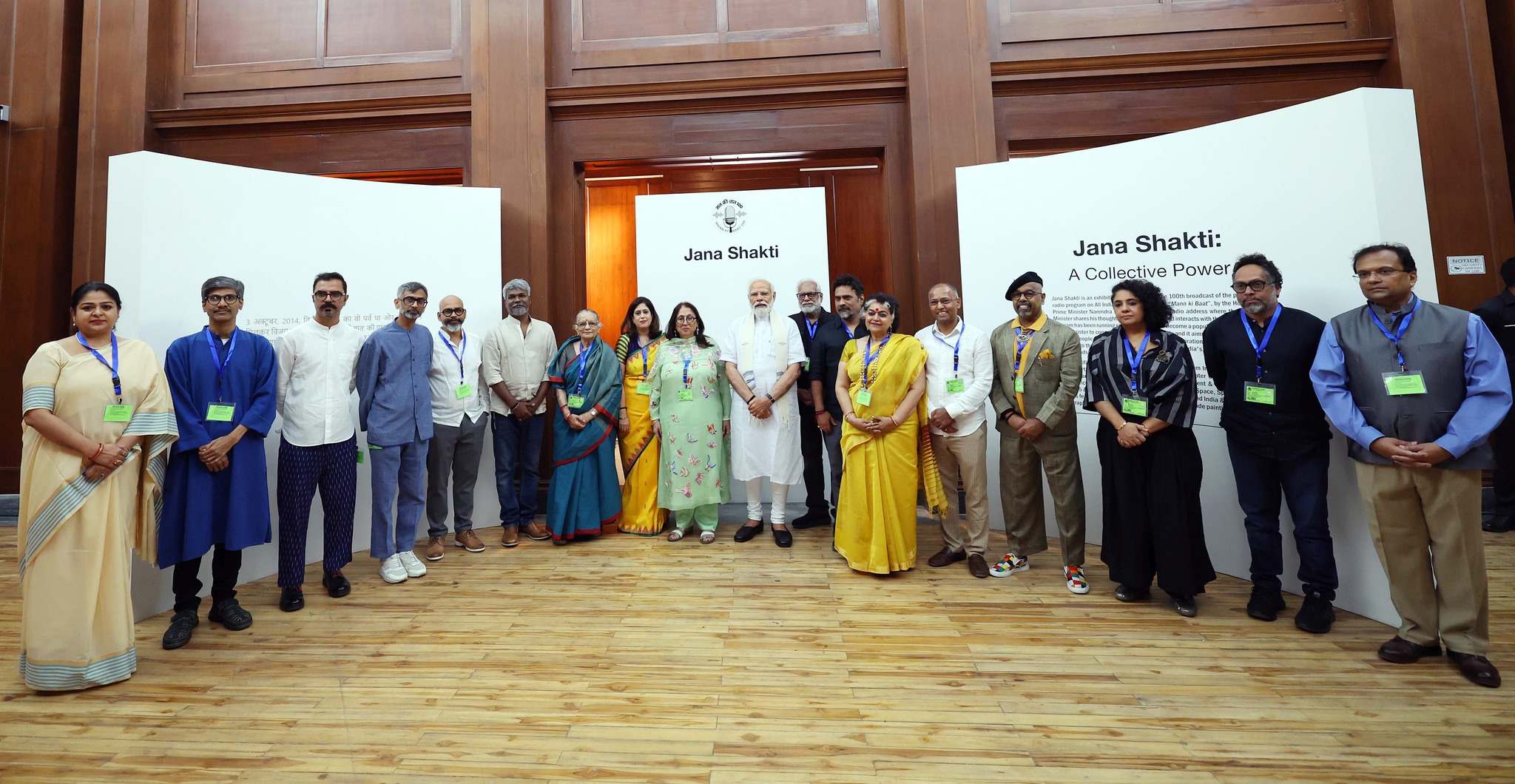
For some days now, certain videos and photos of PM Narendra Modi, the authoritarian Supreme Leader now ruling one-sixth of the world’s population, have been circulating on social media. He is seen visiting the new exhibition ‘Jan Shakti: A Collective Power’ at NGMA dedicated to his propagandist radio programme Mann Ki Baat.

About a week ago, an uproar, however scattered, erupted on social media when this exhibition, guest-curated by Alka Pande, was opened to the public since the occasion also witnessed the presence and participation of some of the celebrated personalities of the Indian artworld. To name some of them, since they would be recorded in history’s hall of shame – Atul Dodiya, Vibha Galhotra, Riyas Komu, Ashim Purkayastha, G.R. Iranna, Thukral and Tagra, Manjunath Kamath, Jagannath Panda and  Kiran Nadar in her role as the “adviser” to the exhibition. Almost all of these luminaries and “top artists” (as it is reported in the media) again appeared when the PM visited the show, proudly posing for a photo with him.

New Delhi, May 14 (ANI): Prime Minister Narendra Modi poses for a photograph with a group while visiting Jana Shakti, an exhibition at the National Gallery of Modern Art in New Delhi on Sunday. (ANI Photo)

Continue reading Decoding Jan Shakti at National Gallery of Modern Art -There is no Schindler’s List! Sandip K Luis

The Kerala Story, Hindutva, and Malayali Women

The movie called The Kerala Story is hate-speech against a whole people, but our courts are great upholders of free speech. Of course, unless people with the surname ‘Modi’ are said to have been defamed. As an observer of how the ‘love jihad’ agenda has unfolded in Kerala since more than over a decade now, I think we need an explanation of why the very idea, discredited by the state machinery itself and thrown out in effect by the Supreme Court in the Hadiya Case, has been used over and over again, like a hammer, to beat Kerala (hopefully into a shape acceptable to Hindutva).

Continue reading The Kerala Story, Hindutva, and Malayali Women

B 32 to 44: Body Politics or No Body/Politics?

B 32 to 44 is the title of a movie — it refers to the bra sizes of the protagonists of director and scriptwriter Sruthi Sharanyam’s debut film, which has been generating highly positive reviews in the Malayalam facebook world. It has also been highly-awaited  after it received funding from the Ministry of Culture and the Kerala State Film Development Corporation.

Continue reading B 32 to 44: Body Politics or No Body/Politics?

Statement by Historians and Concerned Scholars on Recent Changes Made by NCERT in Textbooks

Received via Maya John, the following statement was issued by over 250 historians and concerned scholars, protesting against the blatantly ideologically driven agenda of the present government in deleting chapters and sections of the school textbooks.

The recent decision of the National Council of Educational Research and Training (NCERT) to drop entire chapters from the history textbooks for class 12, as well as from other classes and to delete statements from other textbooks is a matter of deep concern. Using the period of the pandemic-cum-lockdowns to argue that there was a need to lighten the load of the curriculum, the NCERT initiated a contentious process of dropping topics like the history of the Mughal courts, the 2002 communal riots in Gujarat, the Emergency, mention of Dalit writers, the Naxalite movement, and the fight for equality from social science, history, and political science textbooks of classes 6 to 12. The new editions of these NCERT books have simply made the deletions the norm even when we are in a post-pandemic context in which school education has limped back to normalcy and is no longer in the online mode.

Continue reading Statement by Historians and Concerned Scholars on Recent Changes Made by NCERT in Textbooks

Turning a Blind Eye: Power and the Intellectual in Kerala Today

Today someone who is an absolute darling of the post-socialist oligarchy in Kerala and their army of hanger-ons told me, without a tinge of irony, with the most endearing innocence, that they were not celebrated at all in Kerala. That they were excluded from circles that praised and glorified the work of many other authors. It was most intriguing, to say the least. I think it reveals a lot about how the present dispensation manages intellectuals and minimises critical thinking.

You can be a rebel without any serious losses in present-day Kerala if you desist from any serious criticism of the establishment and its acolytes. You can spout feminism, dalit politics, espousals of the solidarity economy, liberal Muslim thought, queer thinking, soft Hindutva– literally anything except Islamism if you keep your mouth shut about the establishment and the post-socialist oligarchy, or at least limit yourself to weak, occasional noises. You can also present yourself in combinations of the above laced with hints of your slant towards the establishment and reap much success in classrooms and academic fora, and much applause on the social media. If you have connections with the Nair deep state and ‘deep intellectual elite’, you can pornify, sell, any kind of abuse of women.

Continue reading Turning a Blind Eye: Power and the Intellectual in Kerala Today

The Goba of Ladakh – Current Relevance of a Traditional Governance System: Shrishtee Bajpai and Ashish Kothari

Guest post by SHRISHTEE BAJPAI and ASHISH KOTHARI

Abstract: Indigenous and other local communities across India have had traditional systems of local governance as unwritten or sometimes written codes of conduct and decision making. Many such systems are still being followed in parallel with the panchayat systems, or getting re-invented by combining the modern forms of governance with the traditional ones, especially in the case of communities still practising traditional occupations and ways of life (forest-based, pastoral, fishing, and/or farming). There are, however, very few studies of these systems interacting with modern state institutions, their current or continuing relevance, and their role in achieving goals of justice, well-being, and ecological sustainability.

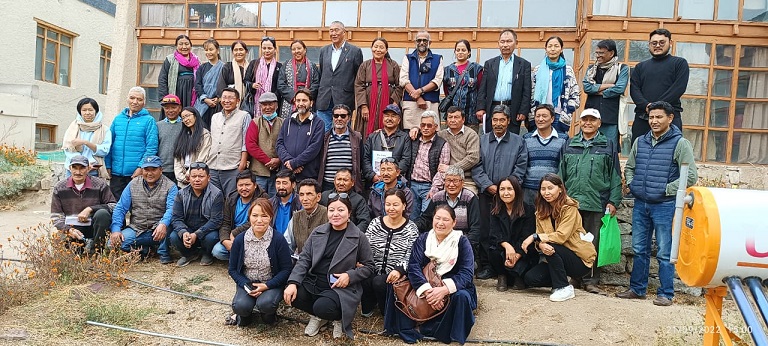
Goba meeting to discuss study results, Leh Aug 2022.

This study focuses on documenting the present status and relevance of the traditional governance system of Ladakhi villages, with a focus on the goba (or lambardar/nambardar). For this, the study also looked at the interface between the local/traditional and new/modern governance systems, viz. the goba with the panchayat, Ladakh Hill Council and UT Administration.

Keywords: traditional governance, goba, democracy, natural resources, indigenous knowledge, environment

Continue reading The Goba of Ladakh – Current Relevance of a Traditional Governance System: Shrishtee Bajpai and Ashish Kothari

Science as a Cultural Ideal – Ravi Sinha

Theme :

Science as a Cultural Ideal

Despite frequent misgivings about universal claims of modern science and despite it being taken often as an accomplice of western imperialism, it is impossible for any culture or civilization to avoid science or to create a culturally distinct version of it. And yet, how does science seep into and reshape a culture would have as many answers as there are cultures. The example of the West is invariably taken as canonical wherein science appears as a key factor in triggering the Great Divergence catapulting Western Europe in pole position ahead of far advanced civilizations such as China or India. It is far more tractable to draw some approximately generalizable lessons from this example than to comprehensively answer the famous Needham Question about why the rest of the world missed out on the Scientific Revolution and the subsequent percolation, even if partial and fragmentary, of the cognitive values promoted by science into the layers of cultural values.

Yet, the fact remains that the cultures and the civilization on the Subcontinent are irreducibly distinct from the West and also from the rest of the world. It is not possible to draw out serviceable prescriptions just from the western example for cultivating science in the cultural soil of the Subcontinent. It will be necessary to cast a bird’s eye-view on the civilizational contours of this vast land to have some idea about what have been the obstacles in the past and what possible pathways to future are available in the present.

While the right-wing of the Hindutva kind seeks glory in ancient India and considers the arrival of Islam as the despoiler of a great civilization, the left-wing, both of the liberal and the leftist kinds, puts all the blame at the doors of colonialism. Both miss out, in their respective ways, a very large fact. The thickest layer of the mass cultural soil on the subcontinent was deposited during the millennium between the 7th and the 17th century and in this the Bhakti Movement played the most important role. If in Europe the theological debates and religious wars led to modern philosophy and modern science, in India the philosophical debates, such as in the Upanishads and between the Buddhists and the Sanatanis, led to devotional movements of mass religions and theologies.

After sketching out these broad contours I will conclude this talk by making some tentative suggestions about how to seek pathways to a future in which science can attain the status of a cultural ideal, which in turn may facilitate emergence of an Indian modernity worthy of a glorious civilization.

About the Speaker :

Ravi Sinha is an activist-scholar who has been associated with progressive movements for nearly four decades. Trained as a theoretical physicist, Dr. Ravi has a doctoral degree from MIT, Cambridge, USA. He worked as a physicist at University of Maryland, College Park, USA, at Physical Research Laboratory, Ahmedabad and at Gujarat University, Ahmedabad before resigning from the job to devote himself full time to organizing and theorizing. He is the principal author of the book, Globalization of Capital, published in 1997, co-founder of the Hindi journal, Sandhan, and one of the founders and a leading member of New Socialist Initiative.

This will be a Zoom meeting which will also be live streamed at Facebook ( facebook.com/newsocialistinitiative.nsi). Please send an email at democracydialogues@gmail.com if you would like to have the zoom link.

When Does Democracy Undermines Itself : Dr Ravi Sinha

Dear Friends

New Socialist Initiative ( NSI) South, recently organised two lectures by one of its senior Comrades Dr Ravi Sinha in Hyderabad. 

First lecture was on ‘Fascism and Democratic Polity : How Did India Land in This Crisis ?‘ and the second lecture was on ‘When Does Democracy Undermines Itself ?

Here is a YouTube Link of the second lecture. We had already shared YouTube link of the first lecture earlier

We will appreciate it very much if you are able to share your views / comments with us

Topic – When Does Democracy Undermines Itself

Speaker – Dr Ravi Sinha

Date : 19 th February 2023

Venue: Sundarayya Vignana Kemdram

Hyderabad

Organised by : New Socialist Initiative (South)

Fascism and Democratic Polity : How Did India Land in This Crisis ? – Dr Ravi Sinha

New Socialist Initiative ( NSI) South, recently organised two lectures by one of its senior Comrades Dr Ravi Sinha in Hyderabad. 

First lecture was on ‘Fascism and Democratic Polity : How Did India Land in This Crisis ?‘ and the second lecture was on ‘How Does Democracy Undermines Itself ?

Here is a YouTube Link of the first lecture.

Topic – Fascism and Democratic Polity : How Did India Land in This Crisis

Speaker : Dr Ravi Sinha

Date : 17 th February 2023

Place : Tarnaka, Hyderabad

Organised by : New Socialist Initiative ( South)

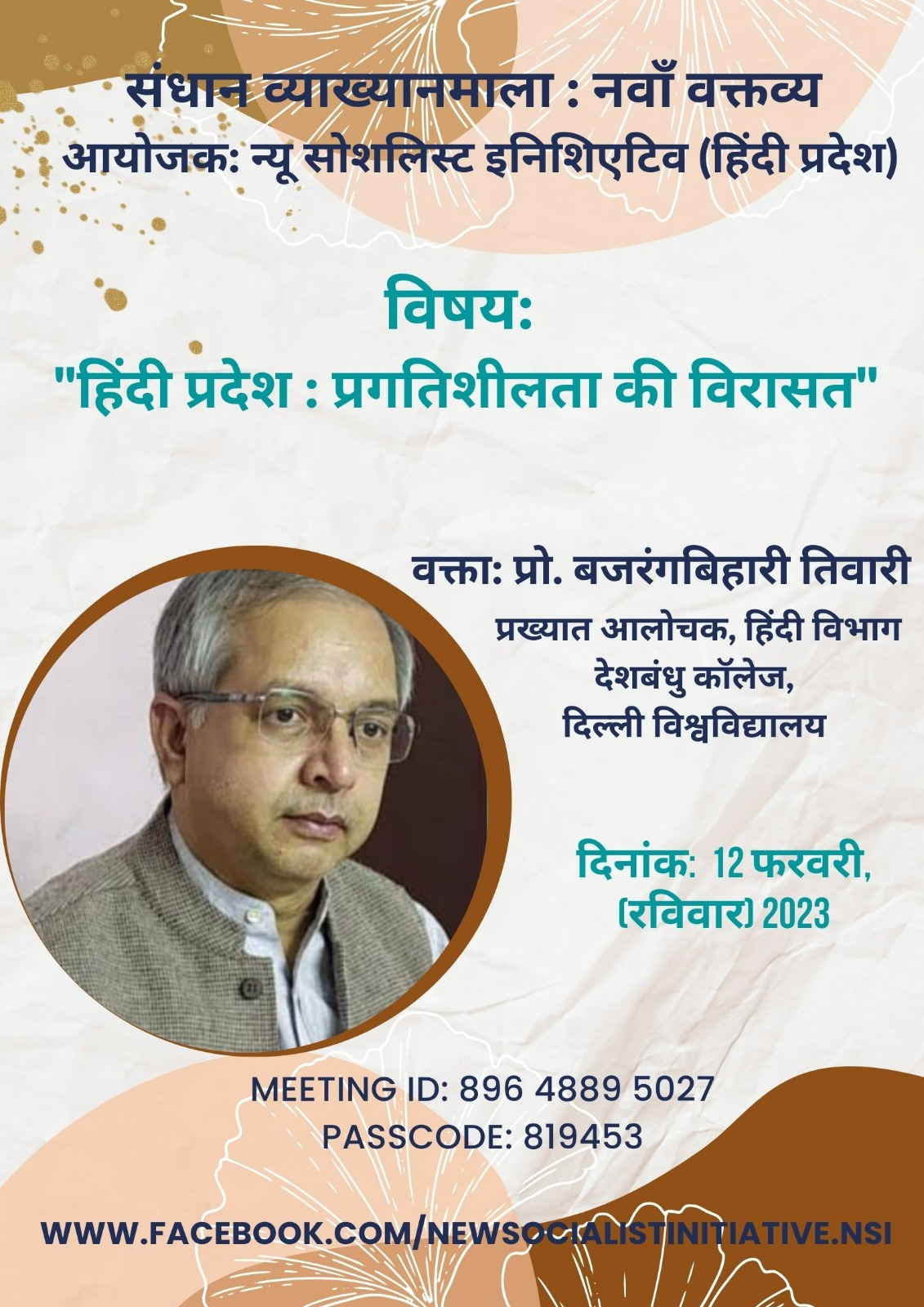
हिंदी प्रदेश : प्रगतिशीलता की विरासत – प्रोफेसर बजरंग तिवारी

विषय : हिंदी प्रदेश : प्रगतिशीलता की विरासत

इस व्याख्यान में निम्न पहलुओं को समेटने की कोशिश रहेगी –

अर्वाचीन बोध क्या है? हिंदी प्रदेश में इसकी बुनियाद को कैसे समझें ? छठी से ग्यारहवीं शताब्दी का दौर।

भक्ति आंदोलन के दौर में क्या बदलाव हुए ? कला और साहित्य में दरबारीपन को कैसे समझें ?

स्वतंत्रता आंदोलन में साहित्य और साहित्यकारों की क्या भूमिका रही? अपने विगत से इस आंदोलन ने क्या ग्रहण किया ?

प्रगतिवाद ने हिंदी-उर्दू-संस्कृत साहित्य को कैसे प्रभावित किया ? प्रगतिवाद के आरंभिक चरण में क्या मुद्दे रहे ?

अस्मितामूलक साहित्य के उभार को कैसे समझें? दलित साहित्य की विकासयात्रा का हाल-मुकाम क्या है ?

The Lady Vanishes – Justice and Law in Our Age: Dilip Simeon

Guest post by DILIP SIMEON

[Names and publications of cited authors are listed at the end of the essay.]

The sophists taught, rather publicly, the view that the summit of happiness is to combine the appearance of justice with actual injustice: Gregory McBrayer (2015), p 44

To speak of justice has always been to plunge into a metaphysical abyss, especially as the issue has been intractable since (at least) Plato’s most famous work, The Republic was written some twenty-five centuries ago. Not least has been the permanently contentious issue – named the theological-political problem by Leo Strauss – of whether we should live according to divine or human guidance. But to speak of justice in India is confront our deeply divided souls; and in the most horrendous cases, to stare evil in the eye.

If Mrs Indira Gandhi dreamt of a ‘committed bureaucracy,’ our current rulers appear to be bent upon the complete domestication of civil society by their ideological enterprise. This requires a committed judiciary too, for which aspiration clues are ample, because they conspire in broad daylight. It was inevitable that some members of the judiciary were and continue to be complicit in this totalitarian project. We should be grateful that there are men and women of courage and conscience within. One of them was named Judge Loya.

Continue reading The Lady Vanishes – Justice and Law in Our Age: Dilip Simeon

The Phantom of Bombay House: Upal Chakraborty

Guest post by UPAL CHAKRABORTY

[Published below is the story of a long fight against harassment and for justice by someone who took his corporate job and the interests of his company seriously, little knowing what it could lead to. It gives a glimpse into the corporate culture even among what are known to be the best corporate entities. ]

There was a gentleman whose name propped up frequently inside the Tata Group headquarters “Bombay House”, but he was more known by his sobriquet – the “Phantom of Bombay House”. He was considered a recluse and shunned social get-togethers as far as possible. Not a soul has ever seen him inside the premises, yet he held an 18.4% stake in the Tata Group. The gentleman was none other than the Late Pallonji Mistry, the father of the previous Group Chairman Cyrus Mistry whose family owned around 18% share of the Group. Tata professionals including Ratanji himself, reportedly, looked up to him for professional support.

It is unfortunate, therefore, that during the stewardship of his son, the episodes described in this article could take place. Mr. Mistry personally may or may not have been aware but for some strange reason the Group chose to turn a blind eye to a series of sordid happenings and preferred to side with an individual whose criminal acts were proved beyond any reasonable shade of doubt.The individual concerned, Mr. Tarun Kumar Samant or Tarun Kumar Sawant, can arguably be described as the new Phantom of Bombay House after the demise of Mr. Pallonji Mistry.

Continue reading The Phantom of Bombay House: Upal Chakraborty

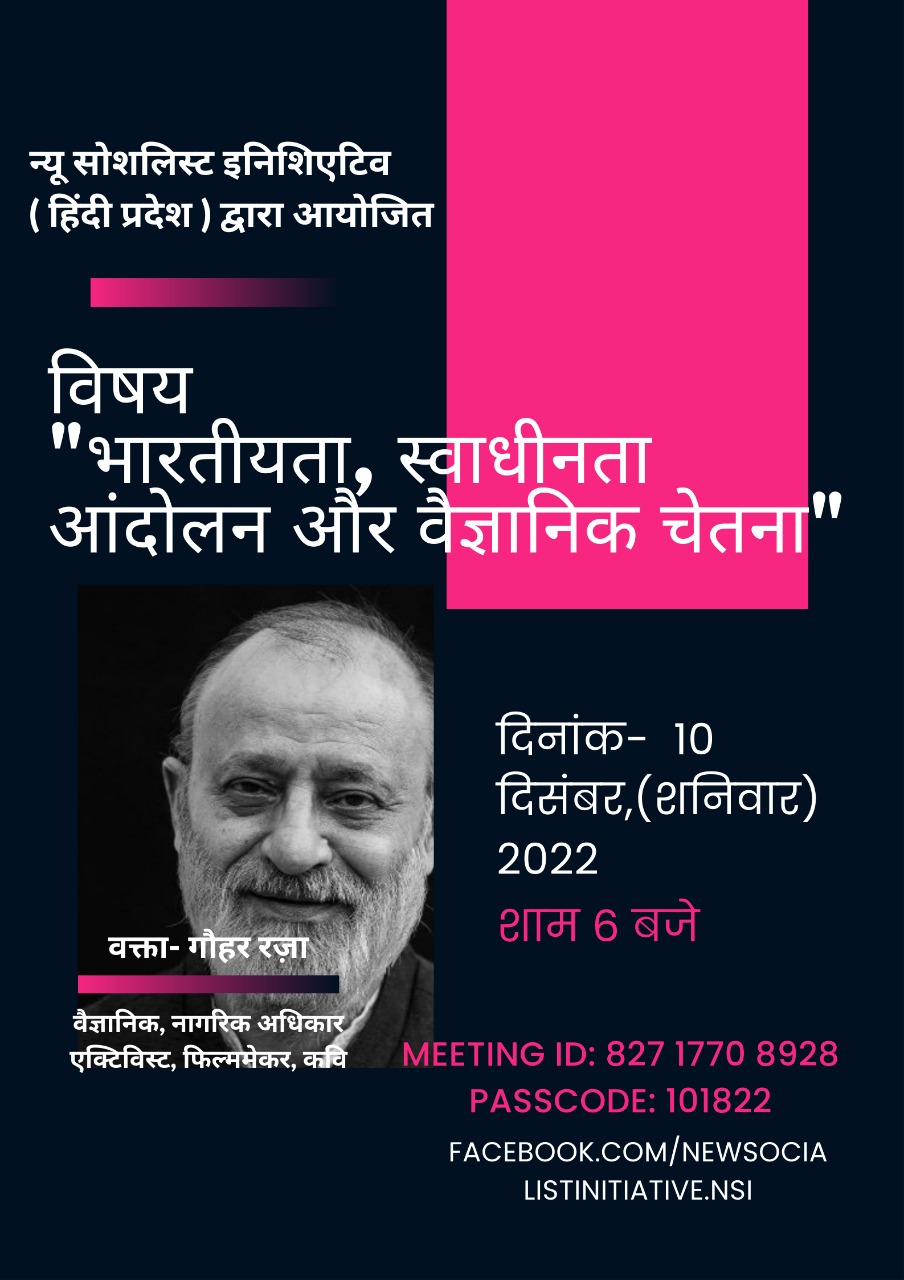
भारतीयता, स्वाधीनता आंदोलन और वैज्ञानिक चेतना : गौहर रज़ा

The next lecture ( 8 th one) in the ‘Sandhan Vyakhyanmala Series initiated by New Socialist Initiative ( Hindi Pradesh) will be delivered by Gauhar Raza, Former Chief Scientist, Council of Scientific and Industrial Research, Documentary Filmmaker on Social Issues, Civil Rights Activist and a  Poet 

He will be speaking on ‘Indian Identity, Freedom Movement and Scientific Temper’ ( भारतीयता, स्वाधीनता आंदोलन और वैज्ञानिक चेतना) on Saturday, 10 th December, 2022  6 PM ( IST). 

Time: Dec 10, 2022 06:00 PM India

Join Zoom Meeting
https://us02web.zoom.us/j/82717708928?pwd=SW1qMnRaVVpWbHVzZjdJb3lZK2dwUT09

Meeting ID: 827 1770 8928
Passcode: 101822

The lecture will also be live streamed on www.facebook.com/newsocialistinitiative.nsi

——————–

संधान व्याख्यानमाला : आठवां वक्तव्य 

विषय :  भारतीयता, स्वाधीनता आंदोलन और वैज्ञानिक चेतना

वक्ता :  गौहर रज़ा , पूर्व मुख्य वैज्ञानिक , कौन्सिल ऑफ़ साइंटिफिक एंड इंडस्ट्रियल रिसर्च , डॉक्युमेंटरी  फिल्म निर्माता , सामाजिक कार्यकर्ता और कवि  

शनिवार , 10  दिसंबर , शाम 6 बजे   
आयोजक :न्यू सोशलिस्ट इनिशिएटिव ( हिंदी प्रदेश )

आयोजक : न्यू सोशलिस्ट इनिशिएटिव ( हिंदी प्रदेश ) 

विषय : ‘ भारतीयता, स्वाधीनता आंदोलन और वैज्ञानिक चेतना

देश के पहले प्रधानमंत्री जवाहरलाल नेहरू ने देश के सामने दो बड़े सवाल रखे थे, पहला था ‘वैज्ञानिक चेतना’ का और दूसरा था ‘भारत माता कौन है’ यानी हमारी भारतीय पहचान का क्या अर्थ है.  इन दोनों सवालों पर आज फिर एक बार नज़र डालने की जरूरत है. आज एक तरफ़ तो  वैज्ञानिक चेतना पर बड़ा हमला है और दूसरी तरफ़ ‘सामूहिक भारतीय पहचान’ को बदलने की व्यापक कोशिश ने सामाजिक ढांचे को छिन्न भिन्न करने का ख़तरा खड़ा कर दिया है. 

ये व्याख्यान जंग-ए-आज़ादी के दौरान ब्रिटिश राज्य के दमन के ख़िलाफ़ गाढ़ी गयी ‘हिंदुस्तानी पहचान’ से जुड़े कुछ सवालों पर नज़र डालने की कोशिश करेगा. इस पहचान का गारा वैज्ञानिक चेतना से तैयार किया गया था, पर ये भी याद रखना चाहिए कि देश में वैज्ञानिक चेतना के खिलाफ़ शक्तियां हमेशा ही सक्रिय रही हैं, खास तौर से हिंदी पट्टी में. 2014 के बाद से इन शक्तियों की ताक़त बढ़ी है और साथ ही वैज्ञानिक चेतना और भारतीय पहचान पर हमले भी. 

Who are these ‘Hindus’? The Tragedy of Vizhinjam and the Despicable Cruelty of the Majority

The struggle against the ecologically-fatal Adani seaport being built at the seaside village of Vizhinjam in south Kerala is probably the first large-scale instance of ‘accumulation by dispossession’ in the history of this state. The state — the ruling government, the police, and judiciary — hold hands now in their effort to dispossess the large population of fisher people whose home this coast has been since centuries, for the convenience of predatory capital. As usual, the port-building commenced after massive ‘opinion-building’ exercises by all the major political parties among their supporters in the port-affected villages, promising them golden futures (now that the resources of the sea, which they had depended on for centuries, were robbed, in the course of some seventy years since the 20th century, through the commercialization of fisheries). Doing fieldwork in those areas around 2013, I remember how hard it was to even broach the topic without provoking massive, sometimes, violent, disagreements — it has divided the people completely and left the major social force there, the Latin Catholic Church, quite confused. Now, after 2018, the ecological destruction wrought by this foolish act of greed is nakedly evident for all with eyes to see; and most residents of the sea coast are convinced that in just a few years, the sea will take everything, including the houses built with sweat and tears, labouring for years abroad, even.

Continue reading Who are these ‘Hindus’? The Tragedy of Vizhinjam and the Despicable Cruelty of the Majority

A Few Remarks On The Absence of Scientific Temper in the Land of Bose, Raman, and Salam

Guest Post by Ravi Sinha

[I must begin with a “thank you” to the Indian Diaspora of Washington DC* and to Razi Saheb for letting me say a few words here. It is an honour for me to share the dais, even if virtually, with Gauhar Raza and Pervez Hoodbhoy. I was stressed about Razi Saheb being a stern time-keeper. So, I decided to jot down what I have to say. But the flip side is that I did not know at the time of preparing these notes what Gauhar and Pervez would say. Please bear with me if what I say turns out to be redundant in the light of what has already been said, or if it appears tangential to the concerns of the organizers or of the other two speakers.]

Let me first get some elementary considerations out of the way. The title refers to the land of Bose, Raman and Salam, which might betray an assumption that a scientist is guaranteed to possess scientific temper and he is influential enough to leave an imprint on the society. In an ideal world, perhaps, that ought to be the case. But even scientists do not live in an ideal world.

Take the example of Sir Isaac Newton, the greatest icon of science, whose genius did put its final and authoritative seal on the Scientific Revolution. Running away from plague in Cambridge to his native village, the young and solitary scholar single-handedly laid the foundation of modern science. He accomplished this during a mere 18 months of his anni mirabiles of 1665-66 when he formulated his laws of motion and his theory of gravitation. In addition, he also invented calculus during the same months. But, after that, he devoted a large part of his long life to the practice of alchemy and to the theological labours of interpreting the Bible. He denounced what he thought were corruptions of Christianity – such as trinitarianism – and adopted a radically puritanical version of Arianism that considered the Bible as an exact Revelation about the future. Nothing in Newton was of normal proportions – neither his scientific genius nor his rigid dogmatism and confident superstitions.

If you think I am being unfair to Newton – after all he could only be a product of his times – you are already conceding part of the point I am driving at. But let me cite a few examples from more recent times before I try to peep into the relationship between Science and Scientific Temper. Pascual Jordan, a pioneer of Quantum Mechanics, was an active Nazi who continued to hold his fascist views even after his rehabilitation in post-war Germany. Physics Nobel laureates Philipp Lenard and Johannes Stark too were active Nazis and confirmed anti-Semites. A little earlier, the great mathematician, Emmy Noether, had been prevented from becoming a faculty in the mathematics department of the University of Gottingen just because she was a woman. An exasperated David Hilbert famously said, “I do not see that the sex of the candidate is an argument against her admission as a privatdozent. After all, we are a university, not a bathhouse.” And a scientist friend of mine reminded me the other day that our own Sir C V Raman, one in the title of this program, was opposed to a woman being admitted as a Ph.D. student, because, in his views, women were unfit to do science.

I am not here to withhold the certificate of scientific temper from being awarded to eminent scientists. My purpose is to examine whether lack of scientific temper comes in the way of doing good science. Pervez Hoodbhoy wrote a book some thirty years ago. The book is called “Islam and Science”, and the subtitle is “Religious Orthodoxy and the Battle for Rationality”. In the book he cites a telling example. Steven Weinberg and Abdus Salam – the same Salam who too is in the title of this program – came up with one of the greatest physical theories of 20th century – the unified quantum theory of electromagnetism and the weak nuclear force. They invented this theory independently of each other and shared the Nobel Prize for it. Weinberg was an avowed atheist; Salam was self-confessedly a believer. Salam wrote the foreword to Pervez’s book in which he concurs with the author that being a believer made no difference, one way or the other, to his coming up with the theory. There you have it from the horse’s mouth. What, then, is the relationship between science and scientific temper?

The scientist does not live by science alone. Even a scientist’s mind is not entirely colonised by Scientific Reason. I do not know if, like the brain, the mind too has two separate but interconnected lobes. But allow me to use a simple-minded metaphor. Scientific temper, it seems to me, has something to do with the rational side of the mind trying to influence the emotional side. This may give rise to a reasonable and cultivated individual, but it can also result in disaster. With the rational side meddling too much with the emotional side, it may give rise to a rather childish adult, if not a veritable Dr Strangelove.

Scientific temper is a tricky business. It involves a very intricate game between Reason and Culture. Neither side of the game we understand very well. There are those who think that Reason is transparent, whereas Culture harbours dark corners. The opposing side points out that this is a false picture. It labours to show that Reason has murky origins – it did not result from an immaculate conception. And, it is not at all self-aware – it does not know that it is inextricably entangled in structures of power.

Which side is more important for a successful and at the same time a meaningful life? Which side should sit in judgement? It is a debate that is hard to settle. There are funny episodes, for example, of scientists sitting in judgment over poetry. Paul Dirac, one of the greatest scientific minds of the 20th century once told J R Oppenheimer, another great scientist and a polymath, “I don’t see how you can work on physics and write poetry at the same time. In science, you want to say something nobody knew before, in words everyone can understand. In poetry, you are bound to say something that everybody knows already, in words that nobody can understand.” The judgements of poets about science, on the other hand, are usually not so funny. They are often much darker – prone to denouncing the supposed soullessness of science or mocking it as one mocks the childishness of a grown-up.

With this much as a background, let me now come to the topic of the day. I do agree with the assertion that scientific temper is largely missing from the societies and cultures that form a distinct civilisation on the subcontinent. But, I am less surprised that it is missing despite scientists likes of Bose, Raman and Salam. I am more surprised that it is missing despite someone like Jawaharlal Nehru. To my mind, Nehru was the best and the wisest proponent of the desirability of scientific temper. Let me quote a passage from The Discovery of India even if it consumes a precious minute,

“Science deals with the domain of positive knowledge but the temper which it should produce goes beyond that domain. The ultimate purposes of man may be said to be to gain knowledge, to realize truth, to appreciate goodness and beauty. The scientific method of objective inquiry is not applicable to all these, and much that is vital in life seems to lie beyond its scope – the sensitiveness to art and poetry, the emotion that beauty produces, the inner recognition of goodness. The botanist and the zoologist may never experience the charm and beauty of nature; the sociologist may be wholly lacking in love for humanity. But even when we visit the mountain tops where philosophy dwells and high emotions fill us, or gaze at the immensity beyond, that approach and temper are still necessary.”

I might also add that the Indian Constitution is the only Constitution in the world which prescribes developing “scientific temper, humanism and the spirit of inquiry and reform” as a fundamental duty of every citizen.

All this, however, may sound too philosophical and too idealistic. How can one be sure that scientific temper really matters to a society or a civilisation? I think history has provided a very real example. Let me dwell on it for a minute.

Pervez’s book that I have already mentioned opens with a parable of “a team of Martian anthropologists visiting Earth sometime between the 9th and 13th centuries”. They find that “the civilization with greatest promise is the Islamic civilization with its Bait-ul-Hikmah, astronomical observatories, hospitals and schools”. Then they visit again towards the end of 20th century and find that “their earlier prediction had turned out to be wrong. The part of humanity which once seemed to offer the greatest promise now appears inescapably trapped in a state of frozen medievalism, rejecting the new and clinging desperately to the old. On the other hand, the former retrogrades have climbed the evolutionary ladder and are now aiming for the stars. Was this stunning reversal of roles, ask the visitors, the mere misfortune of one and the good fortune of the other? Was it due to invasions and military defeats? Or was it the result of a fundamental shift in outlook and attitudes?”

With minor variations the parable may apply equally well to the fate of the subcontinent. If the Martians were to visit here sometime during the 17th century, they would be dazzled by the Navratnas (nine jewels) in Akbar’s court and they would marvel at the fact that the subcontinent accounted for nearly one third of the total world production. However, on their second visit at the turn of the millennium, they would be equally disappointed with this civilisation.

Perhaps the real question to ask is: why and how did the West pull ahead? That may shed easy light on why everyone else got left behind. The answer is obvious, but, like the case of the elephant in the room, there have been reasons for ignoring the obvious. Looking for deeper causalities behind the long trajectories of history may no longer be the intellectual flavour of the day. After all, this is the era of suspicions about grand narratives. We who got left behind can derive satisfaction from the all-round denunciations of colonialism and imperialism and attribute all that we suffer from to their crimes. We may rejoice that those in the high chairs of western academia are raising an intellectual storm against science and modernity which, supposedly, have been nothing but handmaidens of capitalism, colonialism and imperialism. The postcolonial theorist may continue to uncover sinister doings of the long dead colonialism. But someday we will have to ask – what is in it for us on the subcontinent? These critics are definitely making the western societies better, more cultivated, more democratic and more multicultural. But they already had science and modernity; they had already pulled ahead. How should we find our path out of poverty and superstition? What kind of future should we visualize for ourselves?

Explanations about why and how did the West pull ahead fill entire libraries. But, in some ways, the answer is too obvious: West did it with the help of science and modernity. Of course, both were born along with capitalism and colonialism. But one should not throw the baby with the bathwater. It is truly astonishing that there exist high theories declaring that all claims of science about universal truths, objectivity and uniqueness of scientific method are false; that all cultures and communities in all ages had equally valid claims to knowledge and method. In India a simple way has been found to support such theories – all one has to do is to claim that everything that modern science has accomplished, and will ever accomplish, is already there in the Vedas.

In any case, West did not accomplish the miracle of Great Divergence only through capitalism and industrial revolution. Enlightenment and Modernity played an equally important role. I have already referred to the complex interaction between Science and Culture. In 18th century Western Europe this imparted an added acceleration to history. And it took nearly two centuries after the advent of modern science for scientific temper to seep into western culture. Enlightenment was the name given to this process of seeping in.

Enlightenment and Modernity cannot just be imported or imitated. This is because of the fact that science is one but cultures are many. All cultures must find their own ways to imbibe science and animate modernity. Among those who were left behind, there have been a few successful examples of catching up with the West. Soviet Union used to be one such example but it collapsed. Russia, in any case, was too close to the European civilisation to count as a distinctive example. In the East, Japan earlier and China now have been such examples. What has stopped the subcontinent from being another such example?

This too is an enormous subject and an extraordinarily complex one. It is said that fools rush in where angels fear to tread. But let me rush in nevertheless. Among many millennial historical processes that have gone into the making a distinct civilisation on the subcontinent, one is special and unique. Elements of it may be found in other lands but on the subcontinent it has played role like no other place on the planet. This, in my opinion, has been the single largest obstacle to scientific temper seeping into our culture. Let me conclude by pointing a finger at it.

I am alluding to the fact that nearly all religions on the subcontinent took, in varying degrees, a mystical-devotional form, comprising of numerous sects led by gurus, pirs, mahatmas and other god-men – all engaged in the task of paving a plebeian road for a direct access to God without the mediation of priests or books or other intermediaries. On the Hindu side it emerged in the South as the Bhakti Movement and spread to the North in the second millennium. On the Muslim side it made its way through Afghanistan to the north-west of India and spread through sufis, dervishes and pirs. The phenomenon also gave rise to a new religion – Sikhism. It is this phenomenon of Bhakti, Sufism, Sikhism and assorted mystical-devotional movements that is at the heart of a distinct civilisation on the subcontinent.

This phenomenon has been judged favourably by nearly everyone. It has won praises from the religious and the non-religious, from traditionalists and modernists, from the right-wing as well as the left-wing. Nearly everyone prefers heterodoxy to orthodoxy. There is no denying that in many ways it has contributed positively to the culture and civilization on the subcontinent. And yet, there is a very large negative fall-out that has been largely ignored.

This phenomenon triggers processes that obstruct the advance of scientific temper and modernity. It encourages blind faith at the cost of a genuine sense of wonder; prevents religiosity from turning genuinely spiritual and becoming philosophical; prevents the philosophical from becoming reasoned; prevents Reason from seeping into Culture. It has been the principal vehicle of unreason, blind faith and superstition in our part of the world. George Orwell once said, “Saints should always be judged guilty until proven innocent”. An ironical meaning has been added to Orwell by today’s India where god-men do not lose followers even after being convicted as rapists and murderers.

Even Nehru fails to grapple with the civilizational consequences of Bhakti Movement. He harbours contradictions. He admires Vivekanand, Rabindranath Tagore, Gandhi, Bhagat Singh and Einstein – all at the same time. He was a great man – a visionary, a leader, a thinker, a statesman. Like Whitman he could perhaps say, “I am large, I contain multitudes”. He failed because the weight of the past was too heavy. He could not speak bare truths because he had to carry his people along. That is why, sometimes, you need to listen to small men too. They can speak the bare truth as they are spared the onerous task of carrying Nehru’s burden.

This is where I will stop.

——————————————-

Dr Ravi Sinha, Theoretical Physicist, Activist, Scholar, associated with Progressive Movements and Writer

[* The Indian Diaspora Washington DC Metro, USA organised an online panel discussion on the theme ‘Absence of Scientific Temper in the Lands of Scientists Raman, Bose, Abdus Salaam on 19 th November 2022.

Professor Pervez Hoodbhoy, Eminent Physicist, Prominent Public Intellectual, Civil Rights Activist, Author, Columnist from Pakistan ; Dr Ravi Sinha, Theoretical Physicist, Activist, Scholar, associated with Progressive Movements and Writer ; Mr Gauhar Raza, Former Chief Scientist, Council of Scientific and Industrial Research, Civil Rights Activist, Poet, Documentary Filmmaker both from India shared their ideas at the programme which was followed by discussion.

Prof Razi Raziuddin, Scientist, Founder, Indian Diaspora, Washington DC Metro, USA shared welcoming remarks. ]

The Two-Nation Theory, Partition and the Consequences – Prof Ishtiaq Ahmed

 Prof Ishtiaq Ahmed, Professor Emeritus of Political Science, Stockholm University and a leading authority on the Politics of South Asia and an eminent author will deliver next lecture (21 st one) in the Democracy Dialogues Series, organised by New Socialist Initiative

He will be speaking on ‘The Two-Nation Theory, Partition and the Consequences’ on Sunday, 27 th November 6 PM (IST) 

The lecture will also be live streamed at facebook.com/newsocialistinitiative.nsi

Topic : 

The Two-Nation Theory, Partition and the Consequences

1.    The Two-Nation Theory as an Idea and an Argument: The talk will contextualize the origins of the Two-Nation Theory in the background of pre-colonial and British colonial rule and analyse it in relation to competing ideas of a One-Nation Theory as well as the vaguer ideas of multiple nationalities deriving from language, ethnicity and religion. This section will also deal with British policy regarding such competing ideas of group identity and nation and nationalism. This will cover the period 1857 – 1932. However, most attention will be given to the 1928 Motilal Nehru Report (which a section of Muslims including one faction of the Muslim League was willing to accept) and Jinnah’s 14 points.

 2.      The Two-Nation Theory and the demand for Partition: The Government of India Act 1935, the election speeches and manifestos, election results and the Muslim League’s deployment of communalism as political strategy to demand partition on behalf of Muslims. The stands of the Indian National Congress, the Muslim League, the Communist Party of India, the Hindu Mahasabha, the Jamiat Ulema e Hind and other Islamist, regional and working-class parties of Muslims and the Sikhs of Punjab.

 3.      British policy on the future of India: from unwillingness to grant India freedom to retaining influence and control through defence treaty to finally deciding in favour of partition. The Cabinet Mission Plan, Wavell’s schemes to transfer power as an award, The British military’s transformation from opposition to support for partition; 3 June Partition Plan, the partitions of Bengal and Punjab, the 18 July 1947 Indian Independence Act.

 4.      The Partition as a flawed exercise in the transfer of power which claimed at least one million Hindu, Muslim and Sikh lives, caused the biggest migration in history (14 – 15 million) and bequeathed bitter disputes over the sharing of colonial assets, territory and claims to princely states. In this regard, the

 5.      The Partition as a referent for nation-building: while agreeing finally to the partition of India on a religious basis India held steadfastly to nation-building on a secular, liberal-democratic, inclusive and pluralist basis. The Indian constitution came to represent such a view of nation and nation-building. On the other hand, since Pakistan had been won in the name of Islam its nation-building was based on distinguishing Muslims from non-Muslims and generating different formulae of differential rights. More importantly, it brought to light the deep divisions among Muslims based on sect, sub-sect and ethno-linguistic criteria.

 6.      The Partition and settling of disputes between India and Pakistan: The two-nation theory continued to define and determine relations between India and Pakistan resulting in wars, terrorism and zero-sum games in international forums.

 7.      The Partition as a historical, political, ideological and intellectual phenomenon: An Evaluation

About the Speaker :

Prof Ishtiaq Ahmed

Professor Emeritus of Political Science, Stockholm University; Honorary Senior Fellow, Institute of South Asian Studies, National University of Singapore. Published several books with special focus on the politics of South Asia discussed in context of regional and international relations

Latest publications, Jinnah: His Successes, Failures and Role in History,  New Delhi: Penguin Viking, 2020 won the English Non-Fiction Book Award for 2021 at the Valley of Words Literary Festival, Dehradu, India; Jinnah: His Successes, Failures and Role in History, Vanguard Books, Lahore 2021;

Pakistan: The Garrison State, Origins, Evolution, Consequences (1947-2011), Karachi: Oxford University Press, 2013;

The Punjab Bloodied, Partitioned and Cleansed, Karachi: Oxford University Press, 2012- It won the Best Non-Fiction Book Prize at the 2013 Karachi Literature Festival and the 2013 UBL-Jang Groups Best Non-Fiction Book Prize at Lahore and the Best Book on Punjab Award from Punjabi Parchar at the Vaisakhi Mela in Lahore, 2016

He is working on a new book, The Partitions of India, Punjab and Bengal: Who What and Why

He is the Editor-in-Chief of the “Liberal Arts & Social Sciences International Journal (LASSIJ)” and also regularly writes columns in several Pakistani newspapers

The Partition of India: Three Outstanding Questions – Professor Pervez Hoodbhoy

Professor Pervez Hoodbhoy, eminent physicist, author, public intellectual and a forceful voice for reason, science and democracy will be delivering the 19th Democracy Dialogues lecture on Sunday, October 9th, 2022 at 6 PM (IST)

The Partition of India: Three Outstanding Questions 

Seventy five years after the communal storm of 1947 countless important questions still remain. From among them I will concentrate upon three which are particularly important in understanding the past but which, in addition, continue to influence current trajectories.

  1. How, when, and why did the two-nation theory emerge? 
  1. Why is Pakistan a praetorian state but India is not? 
  2. Was Partition preventable and had it not happened what might have been the consequences? 

Speaker: 

Pervez Hoodbhoy is a nuclear physicist, a frequent commentator on Pakistani television channels, founder-director of The Black Hole in Islamabad, and an author. He received his undergraduate and graduate degrees from MIT and taught physics at Quaid-e-Azam University for 47 years.  

The lecture will be held on zoom and for security reasons the link will be shared individually only closer to the event. Please write to us at democracydialogues@gmail.com if you want to join the lecture online.

It will also be live streamed at facebook.com/newsocialistinitiative.nsi

Feminist reflections on the brave women of Iran: Ayesha Kidwai

Guest post by AYESHA KIDWAI

Women in Iran cast off their hijabs and occupy the streets.

Looking at these women in this photo, I think of what feelings they struggle with at this moment.

How many emotions populate this picture? Courage, triumph, feelings of being exposed, fear, the sense of a point of no-return being crossed…

But one knows they have found the one thing that will carry them beyond this moment—the long, deep embrace of sisterhood.

Inquilab Zindabad is not only said with clenched fists, it’s said with interlinked arms and bodies curved into each other. Continue reading Feminist reflections on the brave women of Iran: Ayesha Kidwai

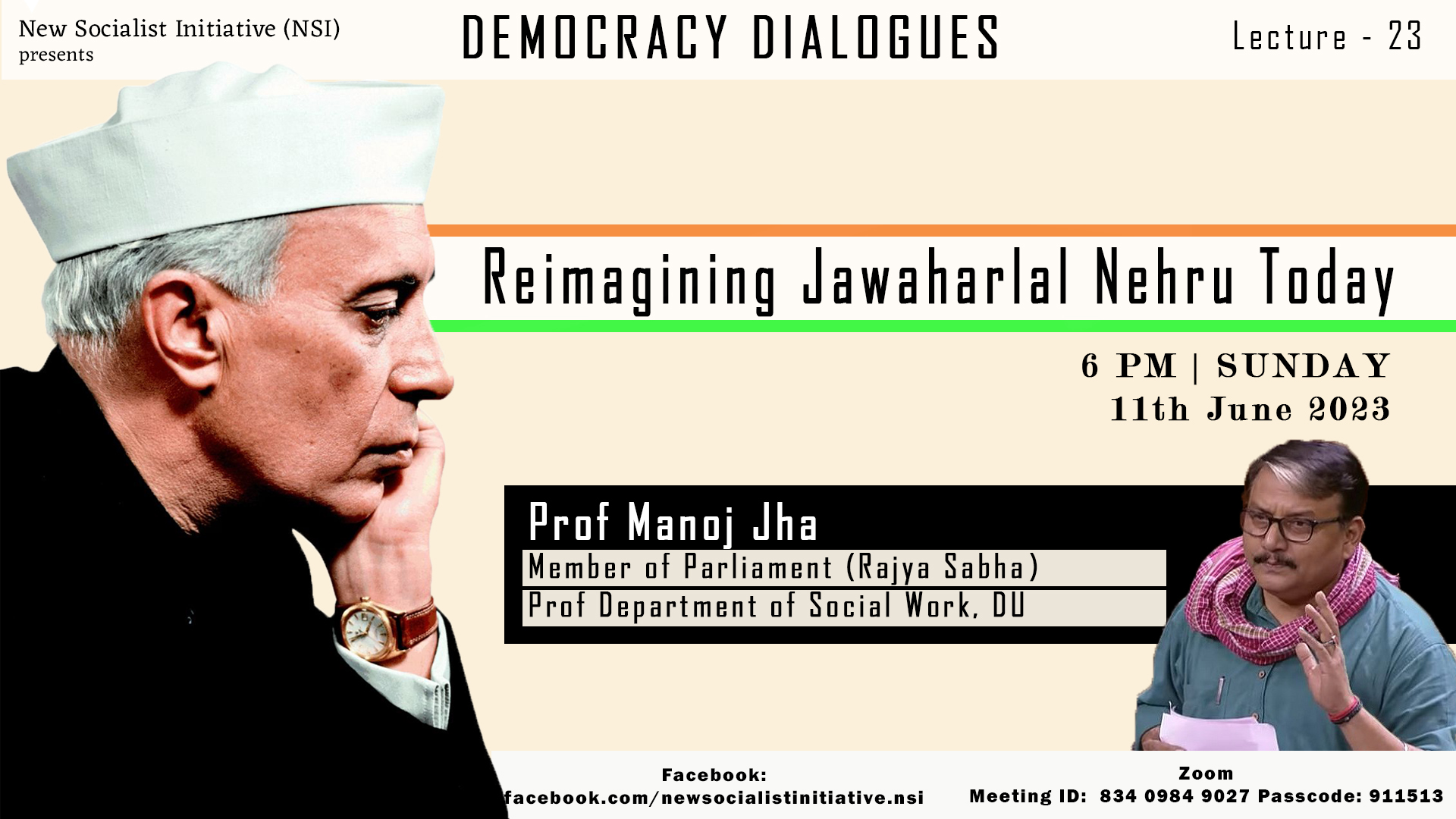
Where Are We – 75 Years after Independence : Prof Aditya Mukherjee

 Eminent scholar of Modern Indian History Prof Aditya Mukherjee, ( Retd.) Centre for Historical Studies, JNU who is also editor of the ‘Sage Series in Modern Indian History’ will deliver the next (18 th) Lecture in the Democracy Dialogues series organised by New Socialist Initiative.

He will be speaking on ‘Where Are We : 75 Years After Independence.’ on Sunday, 28 th August 2022 at 6 PM (IST).

Join Zoom Meeting

https://us02web.zoom.us/j/81606280893?pwd=U3daWGVYSFV6MFIyMzROVDJ0Qm40Zz09

Meeting ID: 816 0628 0893
Passcode: 356973

The programme will also be live streamed at facebook.com/newsocialistinitiative.nsi . 

Theme :

Where Are We : 75 Years after Independence

“As we celebrate 75 Years of India’s independence, it is time to reflect on the extent to which the Indian nation-state has lived up to the vision of the Indian national movement and the spirit of the new Constitution. The core ideas behind this vision envisaged that Independent India would be sovereign, democratic, secular republic that will have a pro-poor orientation and would be based on reason rather than blind faith and obscurantism.

With the recent changes in the governmental power at the Centre and in many states where forces following precepts of the Right – forces which had remained outside the spectrum of the national movement – have become dominant resulting in a grave threat to the core components of the Idea of India. There is a reason why the world is no longer accepting India as a full democracy and is, instead, being variously describing it as a “partially free democracy”, a “flawed democracy” and even as an “electoral autocracy”.

In this lecture we will trace the course of developments that has led India to this predicament and will outline future prospects for overcoming the challenges.”

About the Speaker :

Prof Aditya Mukherjee has been associated with Centre for Historical Studies, JNU for the last more than four decades.
He has been Editor of the Series, ‘Sage Series in Modern Indian  History’ published by SAGE publications, and a member of Scientific Committee, International Review of Sociology, Rome, since 2011 and Regional Editor, International Journal of AsianStudies, Tokyo (Cambridge University Press)
He has been Visiting Professor at  Duke University, USA ; was a Visiting Fellow at Institute of Advanced Study, Lancaster University, UK ; Fellow at Institute of Advanced Study, Nantes, France ; Visiting Fellow , Institute of Advanced Study, Sao Paulo, Brazil ; Visiting Professor, La Sapienza, University of Rome at various periods during his long career.
He is author / co-author of many books : India’s Struggle for Independence, which has gone into 80 reprints ; India After Independence, 1947 – 2000 ; Imperialism, Nationalism and the Making of the Indian Capitalist Class 1927-1947 ; India Since Independence, Penguin, More than 35 reprints till 2016.7 ; RSS, School Texts and The Murder of Mahatma Gandhi: The Hindu Communal  Project , (co-author),

When ‘With the Survivor ‘ Rings Hollow: Observations on the Rage over the Civic Chandran Case

The internet frenzy over the Civic Chandran case has reached a new zenith over the two highly problematic — deeply elitist, sexist, logically and empirically flawed — anticipatory bail orders issued to the accused by the Sessions Court. There was a strange silence about the first one which was stuffed with elitist statements, and an even stranger pause over the blatantly sexist and conservative order before the active condemnation of the latter began to be voiced over the internet. Even stranger, because there is far more tolerance of elitism among the internet woke-folk than of conservative sexist understandings of the appropriate clothing for women’s bodies in Kerala. The three-day break from expressions of outrage did not, and still does not make sense.

Continue reading When ‘With the Survivor ‘ Rings Hollow: Observations on the Rage over the Civic Chandran Case