Writers, scholars, artists have always worried the powers that be.
There was a time when the Parisian police had been given the onerous task of keeping the greatest writers of late 18 th Century who were living in Paris at that time under their watch. Poor fellows, one can imagine their difficulty in maintaining files on writers and artists and scholars ‘beyond criminals and political figures.’
The present dispensation at the centre is no different.
It could be said that it may be a step ahead.
The French Monarchs – who within few decades witnessed a mass upheaval which finally overthrew them – were wise enough to ask their minions to be rather discreet in their activities, not to offend the writers, scholars directly ; the harbingers of today’s ‘New India’ have even abandoned that discreetness for good.
How India is Slowly Emerging as a ‘World Teacher’ albeit of a different kind
( Illustration : coutesy CJP, Citizens for Justice and Peace)
France has moved towards normalcy some time back.
The anger and anguish of the still marginalised in the society, which spilled over into the streets, over the killing of a 17 year old Nahel – son of an Algerian single woman of Muslim origin – by the trigger happy traffic police, recorded on a camera, has long subsided.
No doubt the questions raised by it are not going to go away so easily.1
Experiences of two countries cannot be compared easily but perhaps one could easily see in the uproar shades of the ‘black lives matter moment’ for the French society. Not only in terms of the brutality of the police as witnessed in American society after the killing of George Floyd but the soul searching of sorts which seems to have begun afresh there, a churning has accelerated within the French people after this killing.
Prof Pranab Bardhan, Professor Emeritus, UC Berkeley, delivred the 24th Democracy Dialogues Lecture on August 27, 2023, Sunday at 10 AM India Standard Time.
Theme : The Erosion Of Liberal Democracy in India: An Analysis
Speaker : Prof Pranab Bardhan
Professor Emeritus of Economics at the University of California, Berkeley
Topic : The Erosion Of Liberal Democracy in India: An Analysis
A Brief Outline of the theme shared by Prof Bardhan
I’ll start with the global context of the turn of politics to right-wing extremism in much of the world.
One of the major factors behind this is the weakening of trade unions and of labour movements in general, which in earlier days used to act as a major force of resistance.
I shall then look into the weakening of labour movements in India and the pathetic failure of the Left political organizations. I shall analyze the deficiencies in their economic policies, mobilization strategies and governance failures even in areas where they used to be influential. Just blaming the semi-fascist Right is not good enough.
I shall end with a general discussion of how in prevailing Indian ideologies (including that of the Left) liberal democracy has often been under-valued.
Speaker :
Pranab Bardhan is Distinguished Professor Emeritus of Economics at the Department of Economics at the University of California, Berkeley.
He was educated at Presidency College, Kolkata and Cambridge University, England. He had been at the faculty of MIT, Indian Statistical Institute and Delhi School of Economics before joining Berkeley.
He has done theoretical and field studies research on rural institutions in poor countries, on political economy of development policies, and on international trade.
He was Chief Editor of the Journal of Development Economics for 1985-2003.
He is the author of 17 books and editor of 14 other books, and author of more than 150 journal articles including in leading Economics journals
His latest book titled A World of Insecurity: Democratic Disenchantment in Rich and Poor Countries was published by Harvard University Press in late 2022.
His memoir titled Charaiveti: An Academic’s Global Journey is being published by Harper Collins India in late 2023.
His memoir in Bengali (titled Smriti-kanduyan, ‘Memory-Sratching’) has been serialized in Kolkata’s leading literary magazine, Desh, and the book came out in January 2014.
He has also contributed essays to popular outlets and some of these popular pieces have now been collected in his latest books, Globalization, Democracy and Corruption and Indian Polity and Economy:A Mirror to Difficult Times (Frontpage Publications). A collection of his Bengali essays has been published by Ananda Publishers in Kolkata in 2020.
The “Rome Declaration of the G20 Culture Ministers” (2021) inserted culture in the G20 process, recognising it for its social and economic value, and stating a commitment to the protection of cultural heritage and expressions at risk. This Declaration recognises the need for strengthening and developing effective, sustainable, inclusive and coordinated management models and tools for protecting cultural heritage at risk. The International Federation of Library Associations and Institutions (IFLA) has recognised this as an opportunity for libraries and documentary cultural heritage experts to play a vital role in developing these models and tools, as well as benefiting from them. As a result the upcoming G20 meeting in India will showcase libraries. This statement is by the Free Library Network, a member of IFLA, drawing attention to the imperative need for India to have a free library policy.
The Free Libraries Network (FLN), is a coalition of free libraries and librarians advocating for free library access and the right to read in India and South Asia. FLN believes in universal access to reading materials and information. FLN offers a platform for sharing resources, best practices, and insights about free libraries in India. Although it does not own or operate libraries, FLN plays an integral role in coordinating and acting on policy issues related to access to knowledge resources.
The FLN Statement
The Free Libraries Network (FLN) will participate in the Festival of Libraries by the Ministry of Culture, Government of India at Pragati Maidan, New Delhi on August 5 and 6, 2023. This conference, focused on the library landscape in India, is an opportunity for library advocates across the country to discuss the need for a public library system that offers free access to books and information to all people.
During the conference, FLN members will be contributing to three panels, aimed at sharing insights on free libraries’ potential in promoting reading, thinking and community discussions, as well as in such libraries’ potential to undo the historic exclusion of the vast majority of people from reading and to promote the Constitution’s vision of equality. Additionally, FLN members will engage in various advocacy activities both inside and outside the conference venue, appealing for a policy that guarantees free library access to all. Continue reading Public Libraries Must Be Free! Free Libraries Network (FLN) at the G20→
In response to the LCI ‘s invitation to “stakeholders, including public and recognised religious organisations” to share their views on the Uniform Civil Code, some feminist groups and individuals came together in Delhi on July 4-5 2023 to draft a considered response. The UCC has been debated in feminist circles for decades, and a broad consensus has gradually emerged since the 1990s that gender justice and not uniformity should be the focus of reforms of laws pertaining to family, whether governed by Personal Laws (religious communities) or customary laws (Scheduled Tribes). The following response emerged on the basis of these discussions, which in turn drew on the long history of serious engagement with the issue in feminist circles for decades.
To,
The Hon’ble Chairperson and members,
Law Commission of India
14 July 2023
Sub: Response of feminist, queer and women’s rights groups and individual feministsto Public Notice of the Law Commission of India dated 14/06/2023, soliciting views on the Uniform Civil Code (UCC).
Respected Chairperson and members of the Law Commission of India,
We, the undersigned, write to you as representatives of feminist, queer and women’s rights groups, as well as concerned citizens, who have been working on issues related to gender justice and equality for women from diverse communities across the country. We draw upon our collective experience over many decades, as we respond to the current discussion on the proposed Uniform Civil Code.
Our submission is in three parts:
Concerns related to the procedure adopted to initiate these discussions by the Law Commission of India (LCI).
Comments on substantive issues of uniformity, equality and non-discrimination vis à vis gender justice.
Governing principles for any efforts towards gender justice for all
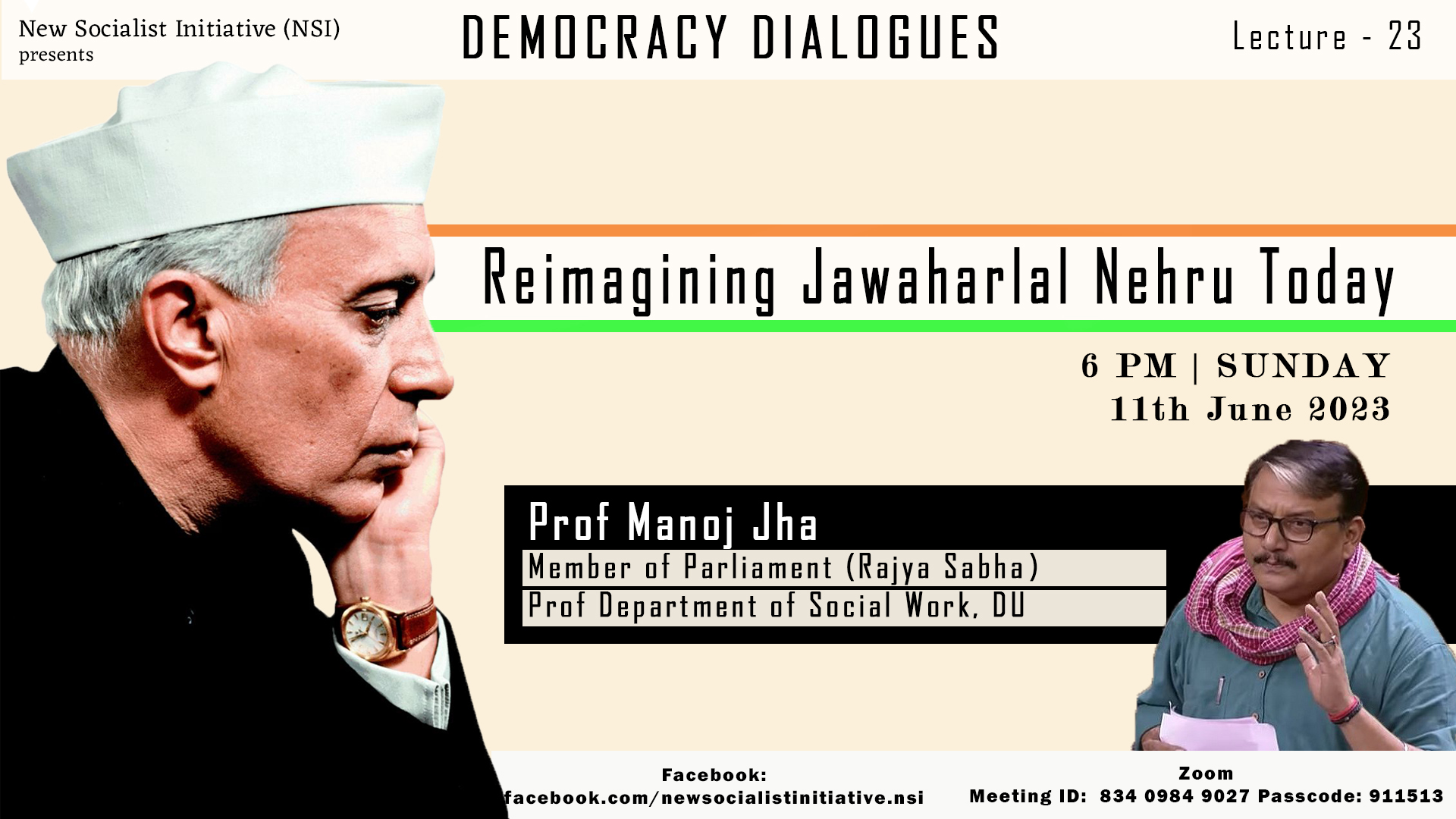
Prof Manoj Kumar Jha, who is a National Spokesperson of the Rashtriya Janata Dal, (RJD), and a Member of Parliament in Rajya Sabha ( upper house of the Parliament) who works as a Professor at the Department of Social Work, Delhi University, Delhi has kindly agreed to deliver the 23 nd lecture in the Democracy Dialogues Series , organised by New Socialist Initiative.
He will be speaking on ‘Reimagining Jawaharlal Nehru Today’ on Sunday, 11 th June, 2023 at 6 PM.
Reimagining Jawaharlal Nehru today would involve examining his legacy and contributions in the context of the present day. Nehru, the first Prime Minister of India, played a crucial role in shaping the country’s political, economic, and social landscape after its independence in 1947. While we reimagine today presuming he was here we shall have to look at our parliamentary democracy and the core policy issues which have undergone so much of change that he would disown. The idea is to speak about some of the critical concerns we face as a nation through the Nehruvian lens.
Speaker:
Prof Manoj K Jha, who is a National Spokesperson of the Rashtriya Janata Dal, (RJD), and a Member of Parliament in Rajya Sabha is a leading voice of the opposition.
A consistent votary of the idea of social justice and a strong opponent of the politics of majoritarian authoritarianism, his debates and interventions in the Upper House of the Parliament are appreciated across the political spectrum and are widely watched.
Prof Jha, is a very popular teacher in the Delhi University, was also head of the Department of Social Work, Delhi University , for a few years.
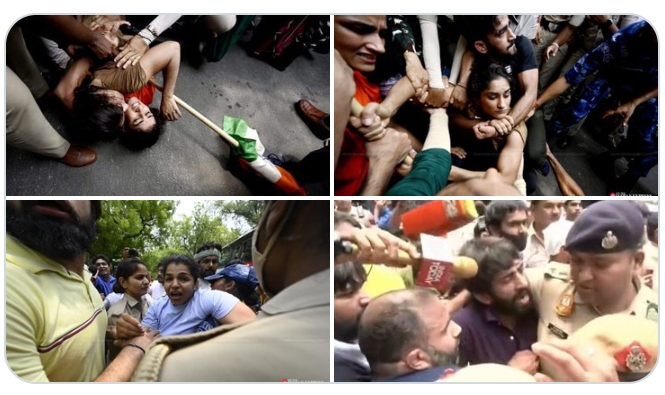
On the day that the Prime Minister was inaugurating a new Parliament house, democratic space was being crushed outside.
More than 1150 people including activists, lawyers, academics, former civil servants, artists and concerned citizens have released a statement condemning the brutal police action against the protesting wrestlers and those who had come out in support of their call from all over Delhi, Haryana and Uttar Pradesh for a Mahila Samman Mahapanchayat today.
We, concerned individuals, are absolutely horrified to see the violence unleashed by the government and police today, to suppress the powerful grassroots support for our brave wrestlers and their struggle against Wrestling Federation of India chief Brij Bhushan Sharan Singh, who stands accused of sexual harassment of women wrestlers stretching back over a decade. The wrestlers have been protesting since 18th of January, 2023. They had given a call to all women’s organisations, activists and all other civil society organisations to join a Mahila Samman Mahapanchayat outside the new parliament building today, i.e 28 May 2023.
Thousands of women from Delhi and nearby states responded to the call. Fearing the collective strength of Indian women – the police pre-emptively blocked all border roads, shut down proximal metro stations, and cordoned off roads. This is how scared a patriarchal State is of the sight of the women of India standing shoulder to shoulder with each other. Despite this crackdown, the government was unable to block the flow of solidarity; activists and concerned citizens found ways of trying to reach the protest site. Continue reading Dismantle the structures of sexual violence, NOT the protesters’ tent! Statement by concerned citizens→
Over 500 concerned citizens, democratic rights’ activists across movements, women’s groups, students and academics condemned the misuse of the Prevention of Money Laundering Act (PMLA) against scholars and activists, raising constitutional issues and asking for the government’s accountability.
We the undersigned women’s organisations and concerned individuals strongly condemn the continuous and repeated harassment of a number of women activists and intellectuals, by the Enforcement Directorate(ED), under the guise of an inquiry, in Delhi. This is a clear abuse of its extraordinary and draconian powers under the Prevention of Money Laundering Act (PMLA). As in the case of the Unlawful Activities Prevention Act (UAPA), there are increasing instances of the misuse of PMLA, especially against persons who are vocal critics of the government and its policies, and those who raise issues of the poor and oppressed sections of society. The ED is being used as an intimidation tool for political vendetta, where the process is the punishment for the detention of dissenters.
In the course of the last few months, several women scholars and activists have been summoned repeatedly, made to wait long hours, often interrogated without any woman officer present throughout, asked to furnish documents over and over again, in an ED investigation. In a clear case of evergreening the inquiry, the process has become endless. It is quickly turning into a fishing expedition, with all kinds of irrelevant documents and personal information being demanded, such as those about other family members, having no relevance to the inquiry whatsoever. Continue reading STOP THIS WITCH HUNT – DON’T MISUSE PMLA AGAINST SCHOLARS AND ACTIVISTS! Statement by concerned citizens→
Bebaak Collective (‘Voices of the Fearless’) was founded in 2013 as an informal association of grassroots activists to advocate for the rights of Muslim women and community. It is a platform for engaging with feminist thought and practice, human rights issues, and the anti-discrimination struggle. It has been working in Uttar Pradesh, Gujarat, Maharashtra, and Rajasthan. With the rising onslaught against marginalised communities, the Collective has evolved into an advocacy group that strongly adheres to constitutional values and believes that the rights and principles enshrined in our constitution are inalienable from every Indian citizen, irrespective of their caste, gender, sexuality or religion.
Relatives of a victim of the Delhi pogrom 2020 in mourning. Source: The Guardian
Foreword
Mental health and its socio-political determinants are beginning to emerge from a shroud of silence and stigma into public discourse. There are several possible reasons for this, the most visible being the pandemic and the many narratives of suffering it brought to the fore from among the most vulnerable sections of society. Even before the pandemic, the relationship between social disadvantage and the mental health of certain communities and groups (some more than others) has been studied in the Indian context. Some examples of these include the mental health of women, homeless persons, Dalit, Bahujan, and Adivasi communities, and queer and trans persons. However, the mental health of Indian Muslims has been severely underrepresented and almost invisible within the mental health or development literature in India. Continue reading Social Suffering in a World without Support – Report on the Mental Health of Indian Muslims: Bebaak Collective→
Yesterday, May 15, 2023 marked the 75th anniversary of Nakba or the dispossession of the people of Palestine by the Zionist state of Israel. This is the text of a talk delivered at an event organized by India Palestine Friendship Forum.
Stamp issued in 1981
In September 2012, I had the incredible good fortune to visit Palestine. We stayed in Ramallah, visited and interacted with colleagues at Birzeit University and spoke at a conference organized by Muwatin, a research institute based in Ramallah. We met a large number of inspiring people who pushed the frontiers of our minds, and we came away humbled and moved by the dignity of a people living through the brutal occupation of their lands by the Zionist state of Israel, with limitless courage and bubbling sense of humour intact. Continue reading 75th year of Nakba – In solidarity with the Palestinian struggle→
[This post is a report on what went on in Jayanagar, a constituency in the southern parts of Bangalore, in the Vidhansabha Elections, May 2023]
Yesterday, 13 May, by 2.30 pm or so, the Jayanagar seat had gone in favour of Sowmya Reddy, Congress. It had been a very closely contested election with her rival CK Ramamurthy, BJP in close pursuit. Sowmya Reddy’s final lead, after 16 rounds, was 160 votes.
Flag 1: The Election Commission website was pretty up to date with all candidate results, but Sowmya Reddy’s results were very slow in coming. Her final result came online by around 6 pm while the counting was over, and she had gained her lead at 2.30 pm.
Another candidate stood from Jayanagar with a slight name variation – Sowmya A Reddy. She got 320 votes.
As Sowmya Reddy was leaving to collect her certificate, Ramamurthy also left the vote counting venue – SSMRV college. However, the Election Commission of India rules mandate that since the victory margin was lower than the number of postal ballots, a recount of postal ballots had become mandatory. When Sowmya Reddy was absent, Ramamurthy came back and requested for a recount of the postal ballot. Postal ballot is the term used for those votes which are cast by outstation voters and the pink form submitted by service personnel – police, officers, ambulance drivers and so on – who would be on duty during elections and can’t vote on election day. Their votes are recorded in advance. These votes are counted between 7.30 and 8 am, before strong rooms are opened and EVM vote count starts.
यह लेख इंडियन एक्सप्रेस में मई दिवस 2023 पर लिखे गए लघु लेख का हिन्दी रूपान्तरण है।
वो दिन ज़रूर आएगा जब हमारी खामोशी उन आवाज़ों से ज्यादा ताकतवर होगी जिनको आज तुम दबा रहे हो।
अमर शहीद अगस्त स्पाइज़ का हेमार्केट शहीद स्मारक पर उद्धृत कथन, अनुवाद हमारा
हर दिन मैं खुद को यह याद दिलाता हूँ कि मेरा अंदरूनी और बाहरी जीवन मृत और जीवित लोगों के श्रम पर आधारित है, और जो मुझे मिला है और मिल रहा है उसको उसी मात्रा में देने के लिए मुझे पुरज़ोर मेहनत करनी होगी।
अल्बर्ट आइंस्टीन, द वर्ल्ड एज़ आई सी इट (दुनिया मेरी नज़र में), अनुवाद हमारा
मई दिवस 2023 के साथ भारत में मई दिवस मनाए जाने के 100 साल पूरे हुए हैं। सिंगारावेलु चेट्टियार, जो कि भारत के स्वतंत्रता आंदोलन की बड़ी शख़्सियतों और जाति-विरोधी आंदोलन से जुड़े शुरुआती कम्युनिस्ट नेताओं में से एक थे, उनको भारत में सबसे पहले मद्रास शहर में 1 मई, 1923 को मई दिवस मनाने का श्रेय दिया जाता है। सिंगारावेलु ने भारत में मई दिवस की शुरुआत कर कोशिश की कि भारतीय मजदूरों के संघर्षों को वैश्विक-स्तर के मज़दूरों के प्रतिरोध के साथ जोड़ा जाए। शिकागो में मई 1886 में मजदूरों की रैली से शुरू हुए मई दिवस की तीव्र तरंगें जो भारतीय तट तक 1923 में पहुँचीं, उस संवेग को आज भी दुनिया के विभिन्न हिस्सों में महसूस किया जा रहा है।
Abstract: Indigenous and other local communities across India have had traditional systems of local governance as unwritten or sometimes written codes of conduct and decision making. Many such systems are still being followed in parallel with the panchayat systems, or getting re-invented by combining the modern forms of governance with the traditional ones, especially in the case of communities still practising traditional occupations and ways of life (forest-based, pastoral, fishing, and/or farming). There are, however, very few studies of these systems interacting with modern state institutions, their current or continuing relevance, and their role in achieving goals of justice, well-being, and ecological sustainability.
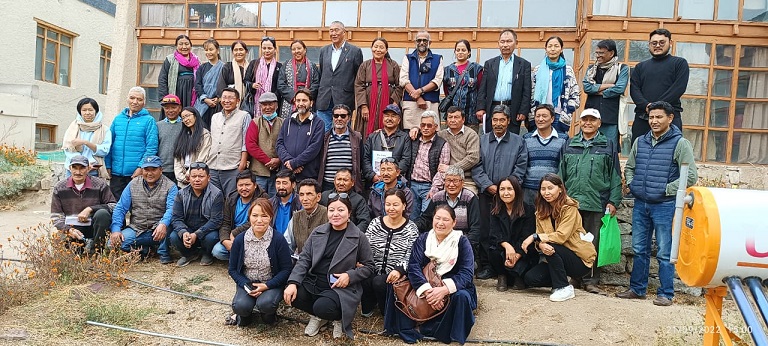
Goba meeting to discuss study results, Leh Aug 2022.
This study focuses on documenting the present status and relevance of the traditional governance system of Ladakhi villages, with a focus on the goba (or lambardar/nambardar). For this, the study also looked at the interface between the local/traditional and new/modern governance systems, viz. the goba with the panchayat, Ladakh Hill Council and UT Administration.
Keywords: traditional governance, goba, democracy, natural resources, indigenous knowledge, environment
If 2018 was a trial by water in Kerala, 2023 seems to be a trial by fire, judging by the horrendous waste-dump fires in the State’s commercial capital, Kochi which have been polluting the air this with the most dangerous mix of toxins (so say the scientific community which has been warning this bunch of callous, stupid, greedy, irresponsible bunch who we have elected to power).
New Socialist Initiative ( NSI) South, recently organised two lectures by one of its senior Comrades Dr Ravi Sinha in Hyderabad.
First lecture was on ‘Fascism and Democratic Polity : How Did India Land in This Crisis ?‘ and the second lecture was on ‘When Does Democracy Undermines Itself ?‘
Here is a YouTube Link of the second lecture. We had already shared YouTube link of the first lecture earlier
We will appreciate it very much if you are able to share your views / comments with us
[This is a response to many who ask me why I chose to be part of the KSSP’s ongoing Kerala Padayatra, which seeks to highlight crucial issues in development and governance in Kerala.]
New Socialist Initiative ( NSI) South, recently organised two lectures by one of its senior Comrades Dr Ravi Sinha in Hyderabad.
First lecture was on ‘Fascism and Democratic Polity : How Did India Land in This Crisis ?‘ and the second lecture was on ‘How Does Democracy Undermines Itself ?‘
Here is a YouTube Link of the first lecture.
Topic – Fascism and Democratic Polity : How Did India Land in This Crisis
[यह लेख The India Forum में अंग्रेज़ी में छपा और उसके हिंदी अनुवाद का एक संक्षिप्त संस्करण सत्य हिंदी में छपा. यहाँ हिंदी में लेख को पूरा (बिना काट-छांट के) पढ़ा जा सकता है. हिंदी अनुवाद के लिए डॉ कविता नंदन सूर्य (सम्पादक, www.debateonline.in) को शुक्रिया.]
बहुध्रुवीयता अंतर्राष्ट्रीय संबंधों की वामपंथी समझ को दिशा देने वाला कम्पास है. भारत और वैश्विक वामपंथ की सभी धाराओं ने लम्बे समय से साम्राज्यवादी अमेरिकी वर्चस्व वाली ‘एकध्रुवीय’ दुनिया की अवधारणा के खिलाफ ‘बहुध्रुवीय’ विश्व की वकालत की है.
दूसरी ओर, ‘बहुध्रुवीयता’ वैश्विक फासीवाद और तानाशाही की साझी भाषा का मूल आधार बन गई है. यह निरंकुश शासकों के लिए एकजुटता का ऐसा आह्वान है, जो लोकतंत्र पर उनके हमले को साम्राज्यवाद के खिलाफ जंग की शक्ल में पेश करती है. अंतर्राष्ट्रीय संबंधों के साम्राज्यवाद-विरोधी लोकतंत्रीकरण के नाम पर बहुध्रुवीयता को वैश्विक वामपंथ के गुंजायमान समर्थन ने, निरंकुशता का भेस बदलने और उसे वैधता दिलाने के लिए ‘बहुध्रुवीयता’ के इस्तेमाल को असीमित शक्ति प्रदान कर दी है.
राष्ट्र राज्यों के आतंरिक अथवा आपसी राजनैतिक टकरावों पर रुख तय करने लिए कितने आधार उपलब्ध हैं? इस प्रश्न के जवाब में वामपन्थ सिर्फ़ दो विकल्पों – या तो “बहुध्रुवीयता” या “एकध्रुवीयता” – को प्रस्तुत करती है. अगर आपने “बहुध्रुवीयता” को अपना मूल आधार नहीं बनाया तो वामपन्थ मानेगी कि आप ज़रूर अमेरिका/नाटो की दादागिरी वाले “एकध्रुवीयता” के पक्ष में हैं. पर “बहुध्रुवीयता” या “एकध्रुवीयता” के बीच यह कल्पित बाईनरी हमेशा भ्रामक थी. लेकिन आज “बहुध्रुवीयता” बनाम “एकध्रुवीयता” के बीच संघर्ष की मनगढ़ंत कहानी भ्रामक ही नहीं, खतरनाक है क्योंकि इस कहानी में फासीवादी और तानाशाह नेताओं को “बहुध्रुवीयता” बनाए रखने वाले नायकों का पात्र दिया गया है.
[Names and publications of cited authors are listed at the end of the essay.]
The sophists taught, rather publicly, the view that the summit of happiness is to combine the appearance of justice with actual injustice: Gregory McBrayer (2015), p 44
To speak of justice has always been to plunge into a metaphysical abyss, especially as the issue has been intractable since (at least) Plato’s most famous work, The Republic was written some twenty-five centuries ago. Not least has been the permanently contentious issue – named the theological-political problem by Leo Strauss – of whether we should live according to divine or human guidance. But to speak of justice in India is confront our deeply divided souls; and in the most horrendous cases, to stare evil in the eye.
If Mrs Indira Gandhi dreamt of a ‘committed bureaucracy,’ our current rulers appear to be bent upon the complete domestication of civil society by their ideological enterprise. This requires a committed judiciary too, for which aspiration clues are ample, because they conspire in broad daylight. It was inevitable that some members of the judiciary were and continue to be complicit in this totalitarian project. We should be grateful that there are men and women of courage and conscience within. One of them was named Judge Loya.
[Published below is the story of a long fight against harassment and for justice by someone who took his corporate job and the interests of his company seriously, little knowing what it could lead to. It gives a glimpse into the corporate culture even among what are known to be the best corporate entities. ]
There was a gentleman whose name propped up frequently inside the Tata Group headquarters “Bombay House”, but he was more known by his sobriquet – the “Phantom of Bombay House”. He was considered a recluse and shunned social get-togethers as far as possible. Not a soul has ever seen him inside the premises, yet he held an 18.4% stake in the Tata Group. The gentleman was none other than the Late Pallonji Mistry, the father of the previous Group Chairman Cyrus Mistry whose family owned around 18% share of the Group. Tata professionals including Ratanji himself, reportedly, looked up to him for professional support.
It is unfortunate, therefore, that during the stewardship of his son, the episodes described in this article could take place. Mr. Mistry personally may or may not have been aware but for some strange reason the Group chose to turn a blind eye to a series of sordid happenings and preferred to side with an individual whose criminal acts were proved beyond any reasonable shade of doubt.The individual concerned, Mr. Tarun Kumar Samant or Tarun Kumar Sawant, can arguably be described as the new Phantom of Bombay House after the demise of Mr. Pallonji Mistry.
We have been living through an unnatural and scary time in India. Those in power today are ideologically responsible for destroying the greatest achievement of India’s freedom struggle. The achievement is stable parliamentary democracy, one of the main conditions for whose existence and development is accommodation of dissent and transparency therein. The symptoms of this destruction are often horrendous.
The Bharatiya Janata Party (BJP) won 156 out of 182 seats in the recently held Gujarat Assembly elections. The pattern of state politics was completely reversed as BJP’s number of seats increased from 99 to 182 from 2017 to 2022 and Congress’s seats decreased from 77 to 17. But BJP’s strength in municipal and panchayat elections in Gujarat was decreasing.




 Stamp issued in 1981
 KAFILA - COLLECTIVE EXPLORATIONS SINCE 2006