Category Archives: Government

In Defense of the ‘Post-Ideological’ Aam Aadmi – Yet Again!

On the morning of 17 January, the very day after Somnath Bharti carried out his vigilante act – and I maintain, despite Arvind Kejriwal and Yogendra Yadav, that it was a vigilante act – I wrote a post relating to the dangers of xenophobia, racism and vigilantism that this act portended. I felt called upon to write that post because one of the valuable political lessons I have learnt over the years is that there can be no unconditional support for any political formation. Every support must be is contextual and conjunctural,  never for all eternity. My criticism was therefore of someone who is invested in the process that AAP and Kejriwal have unleashed and I want it to succeed. In invoking xenophobia and racism, my point, however, was that the leadership of the party has a role to play in relation to political education and cannot simply flow with the local sentiment.

I have always maintained, right from the days of the anti-corruption movement led by the IAC, that the movement and its later avatar, the AAP, had opened out a space of new possibilities. The mass support that the movement and now AAP is drawing is primarily, in my view, a function of the fact that it can mean many things to many people. ‘Clarity’ on every issue concerning the world is not its agenda. This is why some of us have been arguing that the movement/ party is still taking shape. It does not yet have a ready-made, given ideological form. This is why it can be shaped. Its future is radically open. I see no reason to change that position yet. Yes, it is in the design of things that there are Kumar Vishwases and Somnath Bhartis in that formation, and it disturbs our sensibilities no end. But that is precisely the challenge – if we cannot deal with them, we cannot deal with ordinary folk either. Moreover, everybody can change and it is simply arrogant upper class presumptuousness to mock at the ‘uncouthness’ of someone or hold their past against them (in the case of Vishwas). In any case, for anyone seriously interested in changing the existing state of affairs, it should be quite clear that the entire business is about changing ‘common sense’, to put it in Gramscian language. We don’t live in an already transformed universe. Continue reading In Defense of the ‘Post-Ideological’ Aam Aadmi – Yet Again!

Protesting the Indian Republic at Kangla Fort, Manipur

A-police-personnel-tries-toREPEAL ARMED FORCES SPECIAL POWERS ACT

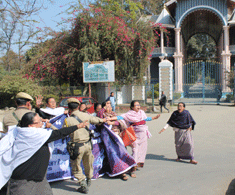
The Sangai Express (Imphal) reported that women from different corners of Manipur staged a demonstration on January 25, 2014 in front of the Western Kangla Gate to denounce Prime Minister Dr Manmohan Singh’s failure to keep his promise to replace Armed Forces Special Powers Act with a humane legislation.

Displaying placards and festoons inscribed ‘Remove AFSPA,’ ‘Save Sharmila,’ the demonstrators also raised slogans demanding the resignation of Prime Minister Manmohan Singh. Pandemonium erupted at the site when police personnel tried to seize the festoons from the agitating women.

Later, RK Radhyasana Devi, one of the protestors speaking to media persons, highlighted that the Prime Minister Dr Manmohan Singh, while handing over the historic Kangla Fort to the people on November 20, 2004, had assured the people of the State that AFSPA would be replaced with a more humane Act .

She pointed out that the promise Dr Manmohan Singh made a decade back has not been translated into action till now.

Strongly demanding that the AFSPA, 1958 should be repealed, Radhyasana further asserted that the movement of Meira Paibi organisations would go on until the Act is scrapped from the State.

In 2004, at the same historic Kangal Fort, Manipuri women had staged a militant nude protest to denounce AFSPA in the aftermath of the extra-judicial killing of Thangjam Manorama Devi by Assam Rifles troopers.

And meanwhile, Irom Sharmila, in the 14th year of her fast against AFSPA, continues to be held in isolation by the Indian state, a prisoner of conscience.


We The People, Reclaim the Republic: Various Citizens Groups

Call given by VARIOUS CITIZENS GROUPS

As we commemorate another Republic Day, We The People proclaim that the parade of the powerful at Rajpath does not represent us. We The People, Reclaim our Republic.

As members of the LGBT community, women, workers, sex workers, students, teachers, activists, persons with disabilities, health rights activists, Dalits, indigenous people, farmers, those affected by unconstitutional military rule, we are united not as “minorities” or “others,” but as the people. We invoke the promises of the Constitution of India in our name. Our struggle will continue until all arms of the state are unwavering in their constitutional promises towards the marginalized in our society, rather than only representing the powerful.

Continue reading We The People, Reclaim the Republic: Various Citizens Groups

For the sake of Form

The Aam Admi Party it seems has now decided to hit back at critics by uploading videos on Youtube to defend the controversial actions of Somnath Bharti, its Law Minister in Delhi done purportedly ‘in public interest’. Bharti has been chastised even by AAP supporters for his vigilantism and for trying to force the Delhi police to raid the house of suspected sex and drug racketeers and who in fact ‘helped’, along with his followers to catch two of the fleeing women.

Eight videos have been uploaded. They, according to the party contain incriminating evidence to prove that sex and drug racketeers were very much active in that area. Reporting the videos The Times of India says “… some of the scenes are not so easy to judge. Two clips show an African national walking around naked in the area. In another, three women in a car are rubbing some substance in their hands. Yet another shows several condoms lying about a car.” .

We do indeed see an African national moving around naked in the video. This is supposed to prove the allegation by the party that drugs are being used as according to one AAP worker “Walking around naked like this is an after-effect of drugs and this is a regular occurrence in the area”. You can also see for yourself condoms lying in the car. Do you need any more evidence to prove that the occupants of the car were indeed prostitutes carrying condoms with them and luring men to indulge in sex? Why are these three women rubbing some substance in their hands or trying to hide something by putting on gloves? Continue reading For the sake of Form

Of AAP, dreams and nightmares: Nityanand Jayaraman

Guest post by NITYANAND JAYARAMAN

I am avowedly anti-police. I am only half-convinced when I say that they are a necessary evil. The “necessary” part is what I get doubtful about. This last Saturday was different. I found myself uncomfortably on the same side as the police as I read the newspapers about Somnath Bharti’s self-righteous and racist escapades. To tell the truth, I did not immediately believe what I read. That was not because I had some personal knowledge of Bharti’s antecedents. But because, AAP was a phenomenon that I wanted to work.

These last few weeks, ever since AAP’s dramatic rise to power, I have been wafting in and out of mental states, between dreams and wakefulness. Dreams are fragile things. For me, AAP’s upsurge was a dream coming true. I come from a generation of Tamils that takes joy no matter whether AIADMK or DMK wins as long as the ruling party loses horribly. Ditto with Congress and BJP.
Now, this AAP thing was an early morning dream. I could see it, feel the joy of seeing disbelief and confusion writ large in the faces of BJP and Congress wallahs. I loved it. I did not know whether I liked AAP or not. But I liked what they did, how they did it. In terms of what they proposed to do, I had questions, suggestions and critical comments. To me, the stated lack of ideology – to begin with – was both an opportunity and a challenge. Continue reading Of AAP, dreams and nightmares: Nityanand Jayaraman

Notes of Dissent on the AAP Dharna

I have no issues with anyone using dharnas as a political strategy, whether or not they are the Chief Minister. The “inconvenience” and “dignity of office” arguments being made by some also hold little truck with me. I write here then to mark my dissent on three specific fronts against the recently concluded AAP dharna from a different vantage point. As with all thoughts on things emergent, they are offered in the making with all their attendant uncertainties.

Continue reading Notes of Dissent on the AAP Dharna

Letter to Arvind Kejriwal: Women against Sexual Violence and State Repression

Women against Sexual Violence and State Repression condemns the racial profiling, sexual violence and vigilantism by AAP against Ugandan women.

Women Against Sexual Violence and State Repression (WSS) is a network of women’s rights, Dalit rights, human rights and civil liberties organizations and individuals across India. It is a non-funded grassroots effort by women to stem the violence being perpetrated upon our bodies and on our societies by the State’s forces, by non-state actors and by the inability of our government to resolve conflict in a meaningful, sustainable and effective manner.

Women against Sexual Violence and State Repression strongly condemns the illegal raid conducted by the AAP cabinet law minister, Somnath Bharti and his mob of supporters, on the premises of the Ugandan women on 17th January 2014 residing in Khidki village, New Delhi.

One media report states that four women who were kept in a taxi for 3 hours were accused of conducting ‘drug rackets’ and ‘sex rackets’; and were terrorized by your cabinet minister and his mob. The women, who were eventually helped by the police, have registered their statements. Two of them have stated that they were physically assaulted by the mob and were also subjected to intense racist abuse – “black people break laws.” Continue reading Letter to Arvind Kejriwal: Women against Sexual Violence and State Repression

Kunan Poshpora – The Other Story : Shrimoyee Nandini Ghosh

This guest post by SHRIMOYEE NANDINI GHOSH is based on two essays about the men and women of Kunan Poshpora, that appeared in the Kashmir Reader dated 1 September 2013, and 13 January 2014

Information and updates about the campaign for justice and truth for the survivors of Mass Rape and Torture in Kunan Poshpora are available at https://www.facebook.com/KunanposhporaCampaign.

Beneath the horrors of the mass rape committed by  Indian troops in the twin villages that night in February 1991, lies the untold story of systematic torture of men, carried out by the same forces with the precision and deliberation of a planned military operation.

In June 2013, a Public Interest Litigation filed in the  Jammu and Kashmir High Court,   by fifty Srinagar based women, supported by human rights group Jammu and Kashmir Coalition of Civil society (JKCCS) had resulted in a Magisterial order for the  further investigations of the mass and gang rape by Indian army personnel of the women of Kunan, and neighbouring hamlet Poshpora, in Kupwara District of North Kashmir on the night of February 23rd-24th 1991. The police, it appears from the lack of any remotely investigative activities in the villages to have done little if anything, by way of following the court order in the last six months. On 14 September, 2013 they asked for and were granted an additional three months time for further investigations, without notice to the survivors who are legally represented in the case.

However, the closure report, which police had failed to file for twenty – two years, and which had been presented before the Magistrate of Kupwara just weeks before the Public Interest Litigation, in March 2013, had yielded several important previously unavailable official documents. Continue reading Kunan Poshpora – The Other Story : Shrimoyee Nandini Ghosh

The Savage Greed of The Civilized – AAP, Moral Posturing and Ordinary Racism

The savage greed of the civilized stripped naked its own unashamed inhumanity’

Africa, Rabindranath Tagore

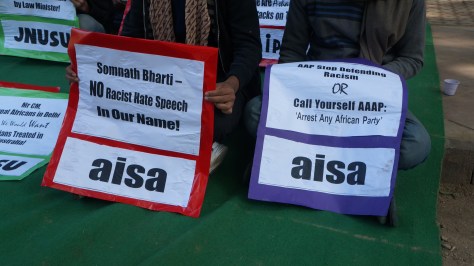
SIGNS AT ANTI RACISM PROTEST IN JANTAR MANTAR

Delhi Law Minister and Aam Aadmi Party leader Somnath Bharti’s midnight raid in Khirki village, during which he ordered policemen to search and enter houses, arrest people without warrants, and allegedly said that “black people, who are not like you and me, break laws” –  strips naked the unashamed inhumanity of the Aam Aadmi Party regime’s moral posturing. Underneath the holier-than-thou mask of that moral posture lies the unmistakably horrible sneer of the ordinary racist thug. This is the real face of Somnath Bharti. I hope it is a face that the Aam Aadmi Party can turn itself away from.

Continue reading The Savage Greed of The Civilized – AAP, Moral Posturing and Ordinary Racism

Protest Against Delhi Law Minister Somnath Bharti’s Racist Vigilantism in Delhi: Kavita Krishnan

Guest Post by KAVITA KRISHNAN

Many of us have felt disturbed by the implications of the incident involving the Delhi Law Minister’s attempted raid on African nationals in Khidki village.

The Minister, Somnath Bharti, (a member of the Aam Aadmii Party) insisted that the police conduct a raid minus a search warrant. Two African women have said, on record, that they were subjected to racist abuse (‘black people break laws’) and beaten by a mob of people (the Minister’s supporters), and that it was the Delhi police who protected them from the mob violence.

[ See Aditya Nigam’s post on the same issue in Kafila earlier ]

There are also reports that one of the women was forced to give a urine sample in public. The women were also subjected to cavity searches and tests – none of which yielded any sign of drugs. The violence against the women was defended in the name of anger against ‘prostitution’ and ‘drug peddling’, while no proof of the same has been presented as yet. In any case, the treatment meted out to the women cannot be justified even if they were indeed prostitutes! Continue reading Protest Against Delhi Law Minister Somnath Bharti’s Racist Vigilantism in Delhi: Kavita Krishnan

The Party Left and Aap: Satya Sagar

GUEST POST by Satya Sagar

“Comrade! There is a man dying of thirst at the door. What is the Party line on giving water to thirsty people?”

There was a moment’s silence at the other end of the telephone and then the Great Ideologue said, “That is reformist activity. Tell him we can give our lives for the Revolution but cannot- as matter of policy- give water to the thirsty”

“But Comrade, he will die at our doorstep if we don’t give him water. Think what the bourgeois media will say then”

“You are right. Positive media coverage is important as that is the only way we reach the masses these days. But before you give him water to drink first ask him whether he believes in public or private supply of water” Continue reading The Party Left and Aap: Satya Sagar

Why I’ll Wait for Aan Allaatha Party in Kerala

The discussions about the concrete shape the AAP will take in Kerala have begun to heat up here. Two suggestions appear to be equally strong at the moment. One, the apparent interest taken by VS Achutanandan and his supporters as well as groups that have broken away from the CPM and possess some electoral clout, like the RMP, have been read as a beginning. The second indication is from news that public intellectuals like Sarah Joseph, who have a long history of struggle in and within Kerala’s largely leftist oppositional civil society, are joining the AAP Kerala. There is also some fear that the fledgling party will be choked by middle-class college lecturers and others who are angry about Kerala being ‘too politicized’ and who would read AAP as essentially politics in the service of anti-politics. A fourth prominent group is of sceptics who ask if the AAP is doing anything more or different from the militant welfarism of the left in Kerala in the mid-20th century decades. Is the AAP even relevant in Kerala, they ask. Continue reading Why I’ll Wait for Aan Allaatha Party in Kerala

Beating AAP with the Kashmir stick

When Prashant Bhushan first made his remarks supporting a referendum in Kashmir to decide whether Kashmir will stay in India, a hooligan had gone to his office and slapped him. The Aam Aadmi Party made it clear that these were Bhushan’s personal views and were not endorsed by the AAP, but the stick was too good to ignore. At a loss of words to see the rise of the AAP, somewhat dimming the euphoria over the rising fortunes of Narendra Modi, the BJP has gone on and on over Bhushan’s views on Kashmir. Even when the AAP was proving its majority on the floor of the house, the leader of the opposition, Harsh Vardhan, made Prashant Bhushan’s personal views out be somewhat of a national security threat to India. Just saying that a people should be allowed to decide their fate is anti-national because we know that making such an allowance would bring results we’d rather not see. Continue reading Beating AAP with the Kashmir stick

Enumerative Practices of the Indian State and the Disabled: Avinash Shahi

Guest post by AVINASH SHAHI

The 2011 Census release on disabled population in India is shocking, exposing the fallacious methodology and technique used by census enumerators while counting the disabled population in the country. According to census figures, the population of disabled people has gone up to 26.8 million in 2011. In the last decade the numbers have increased just below six million from 21.9 million in 2001. Surprisingly, these low numbers follow the collaboration between the Census Commission, NCPEPD and Diversity and Equal Opportunity Centre (DEOC) for sensitizing, and imparting training to census master trainers.

The idea was to frame questions on disability and include these in the Census questionnaire. Nonetheless, millions have yet again been rendered invisible.  In 2001, the Census Commission collected data on five categories of disability among different disabled groups, and found that visual disability emerged as the top category at 48.5%. The other disabilities population enumerated by the census were as follows in descending order: In movement (27.9%), Mental (10.3%), in speech (7.5%), and in hearing (5.8%). In contrast, the 2011 Census initial release percentage among different disabled categories has changed drastically. The persons with blindness now stand at third place.  Continue reading Enumerative Practices of the Indian State and the Disabled: Avinash Shahi

March to Implement the Gadgil Committee Report in Kerala: An Appeal and Some Dilemmas

Tomorrow, Thiruvananthapuram will witness a protest march to the Kerala Legislative Assembly  by those who feel that the recommendations of the report of the Western Ghats Ecology Experts Panel (WGEEP 2011), popularly known as the Gadgil Committee Report, submitted to the Union Ministry of Environment and Forests (MoEF) in August 2011, and published recently following an order from the Central Information Commission, must be implemented. Kerala is one the states affected deeply by the recommendations of the report. Please join the march from the Secretariat Gate in Thiruvananthapuram at 11 AM. Continue reading March to Implement the Gadgil Committee Report in Kerala: An Appeal and Some Dilemmas

National Interest and the Aam Aadmi: Abhijit Dutta

Guest post by ABHIJIT DUTTA

Yesterday, Delhi Chief Minister and Common Man-in-Chief of the AAP, Arvind Kejriwal, declared that “We don’t agree with what Prashant Bhushan said about Kashmir, it’s his personal view. Whatever the Army wants to do regarding the deployment, there is no question of a referendum on it. We do not support Prashant Bhushan’s statement.”

Bhushan’s comments, made on NDTV’s ‘We The People’ show, which, in a matter of happy coincidence happens to be the Constitutional term for Aam Aadmi, was simply this: wishes of the people of Kashmir be taken into account while determining whether the Army was needed for internal security or not. Unreasonably, and with shattering common sense, Bhushan had argued that if the Armed Forces deployed within Kashmir (as opposed to the border areas) were meant to protect the general Kashmiri population, might it not be a good idea to ask that population whether they wanted the protection or not. Continue reading National Interest and the Aam Aadmi: Abhijit Dutta

ऐसा तो गुजरात में भी नहीं हुआ था: अपूर्वानंद

ऐसा तो गुजरात में भी नहीं हुआ था! हाँ! हमें 2002 की गर्मियां ज़रूर याद हैं, मस्जिदों में चल रही पनाहगाह की याद है, याद हैं गम से खामोश और समझदार आँखें जो हमें देख रही थीं जो उनका दुःख बँटाने आए थे वहाँ, कुछ घंटे, कुछ दिन, कुछ वक्त गुजारने, फिर जो अपने घरों को लौट जाने को थे क्योंकि हमारे घर थे जहां हम लौट सकते थे, घर जो आपका इंतज़ार जितना करता है उससे कहीं ज़्यादा दिन-हफ्ते उससे बाहर गुजारते हुए आप उसका करते हैं. वे आँखें जानती थीं कि हमारे घर हैं लौटने को और उनके नहीं हैं. वे अशफाक, सायरा, शकीला होने की वजह से बार-बार घर खोजने को नए, सिरे से उन्हें बसाने को मजबूर हैं, कि उनको  और उनकी आगे की पीढ़ियों को इसका इत्मीनान दिलाने में यह धर्मनिरपेक्ष भारत,यह हिन्दुस्तान लाचार है. जिसकी हस्ती कभी नहीं मिटती, उस हिन्दुस्तान को बनाने वालों में कई को ज़रूर एक ज़िंदगी में कई जिंदगियां गढ़नी पड़ती हैं. एक घर के बाद कई घर बसाने पड़ते हैं. Continue reading ऐसा तो गुजरात में भी नहीं हुआ था: अपूर्वानंद

Corporate Sabotage and AAP’s Chavez Moment

Even as the new AAP government was preparing to take oath of office, the news came of an unprecedented hike in the price of CNG (Compressed Natural Gas) – a hike of Rs 5.15 per kg. In principle, there is nothing wrong with a price-hike that is supposedly necessitated by the need to reduce supplies to metropolitan centres in order to ensure a more equitable distribution to other towns. However, knowing the way the Congress Party functions, the timing of this hike gives rise to legitimate suspicion that the intention is mala fide. At the very least, the decision could have waited till the new government assumed office and some consultation with the new government was carried out. This move shows up the nature of what can be expected from Congress and its ‘outside support’ to the new government.

Expectedly, auto-rickshaw drivers have started making noises about going on strike if fares are not commensurately hiked. If auto fares are raised, it hits the middle class, and if they are not, it alienates the auto-drivers.This clearly throws any new government into a quandary. Continue reading Corporate Sabotage and AAP’s Chavez Moment

Arvind Kejriwal, master-blaster

Arvind Kejriwal is the new Sachin Tendulkar. You throw him the most difficult googly and he sweeps it to add runs for his century. In 2011, he started a national anti-corruption movement with the specific aim of setting up an anti-corruption ombudsman called Lokpal. The movement’s public face and leader was Anna Hazare, a respected social leader, who like Gandhi, believes in fasting for politics. The critics said Anna is just a puppet and it’s Kejriwal’s movement, and that such sophistry showed Kejriwal (who takes oath as chief minister of Delhi tomorrow) had sinister motives.

Kejriwal’s critics said that fasting unto death was a blackmail strategy not suited to a democracy. Kejriwal can’t have a Lokpal just because he wants it. His popular support is just media hype. If he really wants a Lokpal, why doesn’t he form a political party and contest elections?

Kejriwal’s critics said he was supported by the RSS and the BJP, that he is a BJP stooge, that the Lokpal movement was a right-wing conspiracy to remove pristine, super-secular, people-loving, chosen-by-god Congress party from power. Continue reading Arvind Kejriwal, master-blaster

Why AAP is the new Congress

There is nothing novel about new parties upsetting the two-party binary. We have seen that happen through the process of Mandalisation in many states. But all those new parties have come up in the name of one or more identities caste, community, region. The BJP is the Brahmin-Bania party of Hindu nationalism. The BSP is the party of the Dalits, the JD(U) of the Kurmis, the BJD of Odisha. Many of these parties don’t have ambitions to rival the Congress or the BJP on the national stage.

The Aam Aadmi Party (AAP) is an exception in that its central ideology is good governance. This helps it escape identity politics. At the same time, the AAP embraces identity politics like everyone else does: its symbol, the broom, was from day one targeted at the Valmikis. Be it Muslims or Dalits or Brahmins, the AAP quietly takes note of identity politics and gives lip service, even as the party as a whole does not identify itself with any one community. The only other party which handles identity politics this way is the Congress. Continue reading Why AAP is the new Congress

Aam Aadmi, Khaas Politics: Satya Sagar

   Guest Post by SATYA SAGAR                                          

From time to time in the history of every nation there emerges a maverick force that collapses the existing system by taking its logic to the extremes.  Arvind Kejriwal and his Aam Aadmi Party are precisely that, a ‘wild card’ in Indian politics, threatening to turn it upside down in ways no one could have imagined before.

Ever since they were born out of the throes of Anna Hazare’s anti-corruption movement, a couple of years ago, everyone has tried to slot the AAP in the regular political categories of right, left and center. Some have dubbed the Aam Aadmi Party as the ‘new Congress’ and others as the ‘B Team’ of the BJP. Supporters of the party have hailed its leader Arvind Kejriwal as a ‘modern day Gandhi’ while one opponent has intriguingly called his party ‘right wing Maoists’! Continue reading Aam Aadmi, Khaas Politics: Satya Sagar