Category Archives: Identities

17 Faces of Hunger for Justice – Day 6 of the Indefinite Hunger Strike at JNU: ‘We Are JNU’

Guest Post by ‘We Are JNU

At the end of the 6th day of the Indefinite Hunger Strike by JNU Students, the ‘We Are JNU‘ Facebook Page uploaded a gallery of portraits of the 17 students on Hunger Strike, together with details of their medical conditions. We are sharing this post on Kafila in solidarity

This slideshow requires JavaScript.

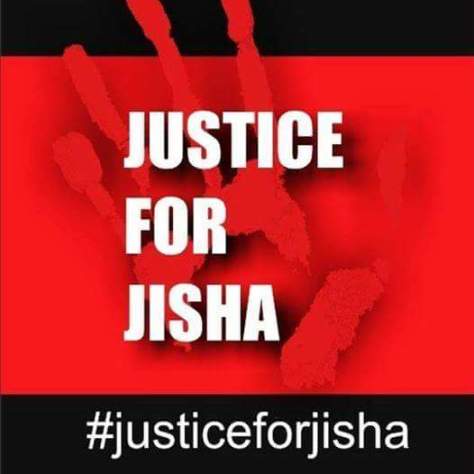
Do Not Rest in Peace, Jisha: Shehla Rashid

Guest Post by Shehla Rashid

(Pictures by Biju Ibrahim)

Dear Jisha, I never knew you, nor did you know me.

You were probably a “usual” student, pursuing your studies, dreaming of a better future for yourself and your country. You were probably someone like Rohith Vemula, who dreamed of stars and skies. I learnt that you were a Law student, but I regret to tell you that the Law of this country fails us miserably.

13133163_10153366003160194_2754795347866060882_n

It is because a Bhanwari Devi does not get justice that Bhagana happens. It’s because no one in Bhagana gets justice that a Delta Meghwal happens. It is because a Delta Meghwal does not get justice that a Jisha happens. And most painfully, I can predict that you may not get justice either.

This is because the Law that you studied is not the law that actually runs this country- this country runs according to a parallel law which is called Manusmriti. It is routinely quoted by judges in their judgments, but perhaps you wouldn’t have studied that in Law school. It is the law of Manusmriti that prescribes limits for women and limits for Dalits.

Continue reading Do Not Rest in Peace, Jisha: Shehla Rashid

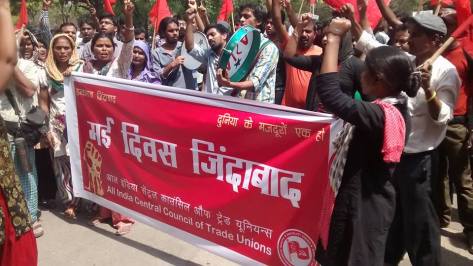
Workers and Students Unite on May Day in JNU: Aswathi Nair & Umar Khalid

Guest Post by Aswathi Nair and Umar Khalid (With Photographs and Videos by K. Fayaz Ahmed, Azhar Amim, Samim Asgor Ali, Reyazul Haque and Agnitra Ghosh)

Exactly nine years back, in 2007, ten students were rusticated (again) in the month of May for their “crime” of agitating along with workers to ensure the legally mandatory minimum wages for the workers here in JNU. It was the peak of summer, the time of holidays, and the administration (like this time, like every time) thought that they could break the unity of the workers and students with crackdown timed to coincide with what was thought to be the ‘weakest’ time for mobilization on campus. The administration’s plans did not bear fruit then, they will not work now either.

Workers and Students Unite in JNU on May 1, 2016, International Labour Day

We are in that strange time again. The summer of 2016 has witnessed a May Day wherein the workers in JNU not only took out their own rally, but also rallied with us students sitting on the 4th Day of their Indefinite Hunger Strike against administrative crackdown on our democratic spaces. Continue reading Workers and Students Unite on May Day in JNU: Aswathi Nair & Umar Khalid

Diary of a JNU Student on Hunger Strike: Pankhuri Zaheer

Guest Post by Pankhuri Zaheer

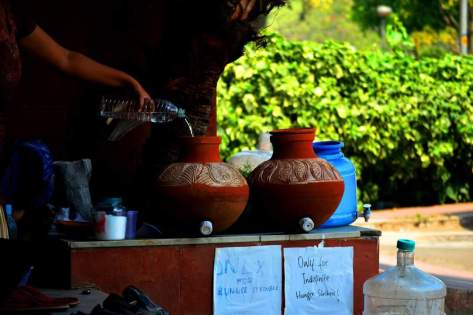
Water - A Gift for Hunger Strikers. Photo Courtesy, Azhar Amim
Water – A Gift for Hunger Strikers. Photo Courtesy, K. Fayaz Ahmed

“I wanted to bring you something but I didn’t know what to get you so I got you a bottle of water,” says a friend who would perhaps never identify herself as a student activist but since 9th February, like many like her, has been an integral part of the stand with JNU movement.

19 of us have decided to sit on an indefinite hunger strike till the time the farcical report of the High Level Enquiry is not rolled backed in its entirety. Today, April 30th, is the third day of our hunger strike.

Continue reading Diary of a JNU Student on Hunger Strike: Pankhuri Zaheer

‘Radical’ Critics and KaBodyscapes

What does it mean to dissent in a world in which everyone claims to be a dissenter? What does it take to build a critical vantage-point, one that is not merely the easy pastime of fault-finding, when we all seem to already know what will be truly critical? Ever since the oppositional energy generated against Hindutva fascism in and through the Kiss of Love campaigns dissipated into the rival folds of the Human and the Anti-Human in Kerala, these questions have troubled me. The prospect of being sucked into one side of such a binary formation is terrifying enough to scare one away from  engaging with either side; but worse is the pain that follows the realization that the unique moment of hope – the hope that the diverse groups that populate the anti-Hindutva civil society may well be able to form a bond of trust, however tentative and fragile, more than merely strategic connections – is well and truly in the past. Both sides have indulged in belligerent and damaging caricaturing of each other’s positions, as if the annihilation of the other was the very condition of the survival of the one. Continue reading ‘Radical’ Critics and KaBodyscapes

Rise Up against the Proxy War on Students by the Modi Regime: Shehla Rashid

Guest Post by Shehla Rashid, (Vice President, Jawaharlal Nehru University Students’ Union)

Rise up against the proxy war on students by the Modi regime.

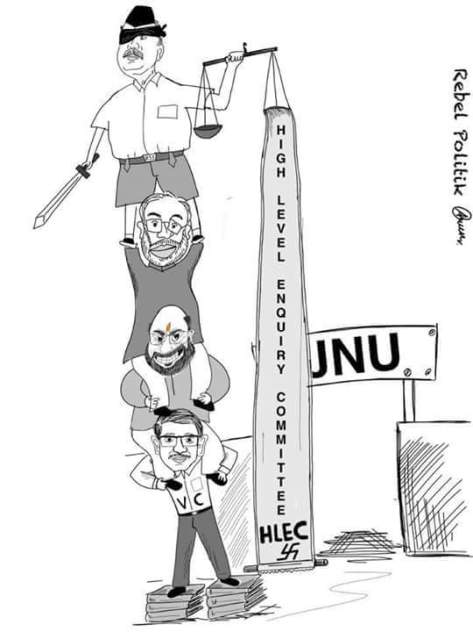
Cartoon by V. Arun Kumar

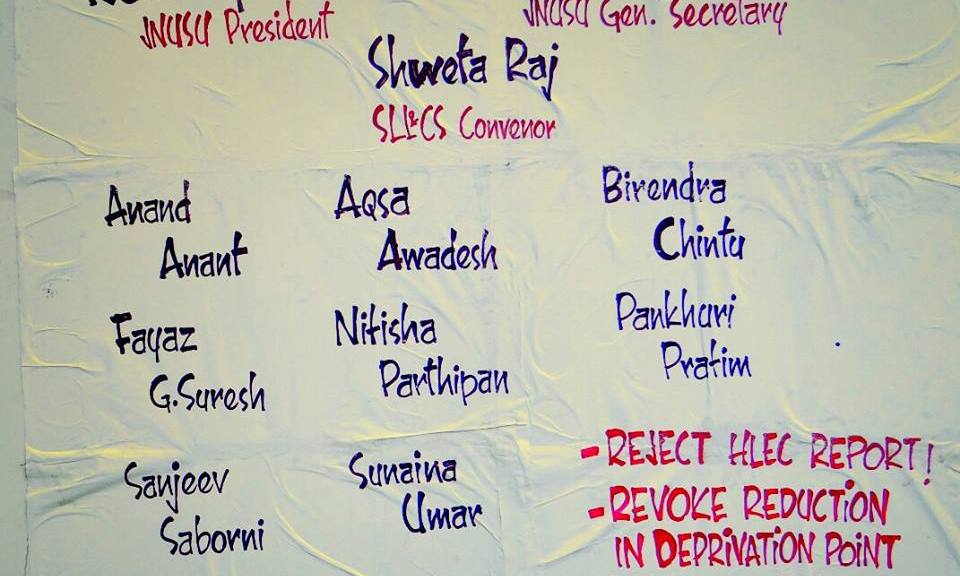
JNUSU rejects the report of the enquiry committee constituted by the Vice-Chancellor to look into the 9th of February incident. JNUSU also rejects its reports and any punishment handed out by it. The JNUSU and JNUTA had repeatedly asked the administration to democratise the enquiry committee, but this was not done.  Now, when the holidays are here, the VC has made public the punishments, after one and a half months of submission of the HLEC (High Level Enquiry Committee) report. Continue reading Rise Up against the Proxy War on Students by the Modi Regime: Shehla Rashid

Jayadeva Uyangoda on Ambedkar’s Legacy

Text of the talk delivered on April 22, 2016 at the Indian Cultural Centre, Colombo on the occasion of B. R. Ambedkar Commemoration.

Ambedkar’s Legacy: Critique of Religion, Quest for Social Justice and the Paradox of Constitutionalism

Jayadeva Uyangoda, Senior professor of Political Science, University of Colombo

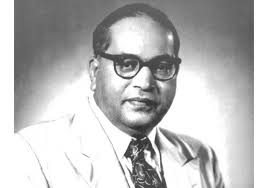
Ambedkar

May I begin my talk this evening by thanking His Excellency Y. K. Sinha the Indian High Commissioner in Colombo for inviting me to deliver this lecture on B. R. Ambedkar? This event is part of a series of celebrations in connection with the 125th birth anniversary of Babasaheb Ambedkar, which fell on the 14th of April. I am afraid my talk may not celebrate great Ambedkar’s memory and legacy as such. It will only present some disjointed and hurriedly constructed thoughts about the life and legacy of this great son of South Asia.

Ambedkar’s name is well known in Sri Lanka. In Sinhalese society, the popular culture of which I am somewhat familiar with, Ambedkar is known as the leader of India’s Harijan communities. The word dalit is not in much use in Sinhalese society. The Gandhian neologism of harijan is better known. Ambedkar is respected as the Harijan leader who embraced Buddhism along with several thousands of his followers. Sinhalese Buddhists are particularly sympathetic to Ambedkar and his social reform movement. For them, Ambedkar’s project constituted a critique and a rejection of Hinduism. This is despite the fact that Buddhism has historically and in terms of elite as well as popular practices been closely interwoven with Hinduism. Quite independent of Ambedkar, Sri Lankan Buddhists have a somewhat ambivalent attitude towards Hinduism and Hindu traditions as well. It is almost like their ambivalence towards India in general, as some of their intellectuals and professionals seem to be inclined to demonstrate these days. Continue reading Jayadeva Uyangoda on Ambedkar’s Legacy

JNU High Level Committee Delivers a Low Blow – Students Unjustly Rusticated, Fined, Declared ‘Out of Bounds’

So, the High Level Enquiry Committee at JNU, set up under the watch of Jagadish Kumar, the recently appointed Vice Chancellor, has just delivered a low blow. A summary of its decisions (taken from the Facebook Wall of JNUSU Vice President, Shehla Rashid) meted out as the consequences of the events of February 9 and after is as follows :

Umar Khalid, rusticated for one semester + 20K fine.

Anirban, rusticated till 15 July & from 25 July, out of bounds for 5 years.

Another Kashmiri student rusticated for two semesters.

Ashutosh, former JNUSU President, removed from hostel for one year + fine.

Chintu, former JNUSU Gen Sec: 20K fine

Rama, current JNUSU Gen Sec: 20K fine

Anant, former JNUSU Vice-President: 20K fine

Aishwarya, current GSCASH representative: 20K fine.

Gargi, current JNUSU councillor: 20 K fine

Shveta Raj, current SL & CS Convener: 20 K fine

Kanhaiyya, current JNUSU President: 10K fine

Other organisers fined from 10K to 20K

Two ex students declared out of bounds from campus.

This is an administration, which, in obedience to its backers in the Ministry of Human Resource Development and the Government of India, that knows only one way of dealing with the students in its charge – and that is a replica of the vindictive path that eventually drove Rohith Vemula to his institutionally mandated death in Hyderabad University.

This is an administration that invited police to intervene in what was essentially a dispute between groups of students, at the instigation of right wing thugs. Continue reading JNU High Level Committee Delivers a Low Blow – Students Unjustly Rusticated, Fined, Declared ‘Out of Bounds’

जी हाँ, हम राजनीति करते हैं : अनन्त प्रकाश नारायण

Guest Post by Anant Prakash Narayan

जे.एन.यू. में 9 फरवरी को एक घटना घटी. घटना क्या थी अब उसके बारे में बहुत सी चीजे स्पष्ट हो चुकी है. सरकार का दमन चला जिसके परिणामस्वरुप एक आन्दोलन चला. कहा ये जा रहा है कि आन्दोलन के कारण सरकार बैकफुट पर है. ये आन्दोलन अभी भी चल रहा है. जब ये मुद्दा पुरे देश में गरमाया जा रहा था  उस समय बहुत सारी चीजे डिबेट का हिस्सा बनी जैसे राष्ट्रवाद क्या है? अभिव्यक्ति की स्वतंत्रता (Right to Freedom of Speech and Expression) को कैसे देखा जाये? आज़ादी की सीमा क्या होगी? क्या टैक्स से पढने वाले स्टूडेंट्स को “इतना बोलना” शोभा देता है? क्या जब सीमा पर जवान मर रहे है तो “ये काम” किया जा सकता है? ये सारे मुद्दे बहुत ही जोर–शोर से सरकार के पक्ष से या फिर इसके उलट लोकतंत्र के पक्ष में बात रखने वालों की तरफ से भी की जा रही थी. लेकिन इसी बीच में एक खतरनाक अवधारणा सरकार के तरफ से बात रखने वाले और जाने अनजाने लोकतंत्र की तरफ से भी बात रखने वाले टी.वी. चैनलो, अखबारों, इंटेलेक्चुअल, राजनीतिज्ञों की तरफ से रखी जा रही थी. वो अवधारणा थी कि राजनीति बहुत बुरी चीज है और छात्र राजनीति तो बदतर. यहाँ तक कि हमारी पैरोकारी करने वाला पक्ष भी यह बार-बार साबित करने का प्रयास कर रहा था कि ये सामान्य से पढने लिखने वाले छात्र है इनका राजनीति से कोई मतलब नही है. ये लोग तो बस कभी कभी कुछ यू हीं करते रहते हैं. क्या अगर हमारे बारे में यह टैग लग जाता कि हम राजनीति करने वाले लोग है तो हमारे पक्ष से बात रखना इतना मुश्किल हो जाता. जबकि यह सर्वविदित है कि जिन कुछ छात्रो के नाम राजद्रोह के तहत लिए जा रहे है वे वामपंथ की सक्रिय राजनीति का हिस्सा है. आने वाले समय में हम आन्दोलन को किस हद तक जीतते है और आगे ले जा करके इसको इस फासिस्ट सरकार के लिए कितना खतरनाक बना पाते है ये अभी तय होना बाकी है लेकिन “मुख्याधारा” की राजनीति करने वाली पार्टियाँ, जिसको प्रोग्रेसिव छात्र-आन्दोलन ने हमेशा उनके जन –विरोधी रवैये के कारण चैलेंज दिया है, एक बार इस मौके को राजनीति, खासतौर से अगर छात्र करे तो, बहुत ही गलत चीज है इसको स्थापित करने में लगी हैं. छात्रों का काम काज सिर्फ पढना-लिखना है और इसके इतर वो अगर कोई और काम करते है तो वो अपनी “सीमा” लांघते है. बड़ी-बड़ी मल्टीनेशनल कंपनियों में छोटे-छोटे उम्र के कमाने वाले लोगों के साथ तुलना करके ये समझाने की कोशिश की गई कि आप जितनी कम उम्र में जितना ज्यादा कमा लेते है आप उतने ही सफल स्टूडेंट है. हम अभी लगभग बीस दिन के एक कैंपेन में थे. इस कैंपेन के तहत देश के विभिन्न हिस्सों खास तौर से उत्तर भारत के गाँवो और छोटे-छोटे कस्बो और कुछ शहरो में मेरा जाना हुआ. जिसमे जे. एन. यू. पर बात होती, भगत सिंह और डॉ. अम्बेडकर के विज़न पर बात होती. जब इन विषयों पर बात होती तो नैचुरली मोदी सरकार के ऊपर बात होती. उन कार्यक्रमों में कुछ ऐसे लोग भी मिलते जिनका कहना होता कि आप लोगों के साथ जो हुआ गलत हुआ लेकिन इस मैटर को लेकर अब आप लोग राजनीति कर रहे है. मोदी के खिलाफ आप लोग जो इतना बोल रहे है उससे अब आप लोग एक्सपोज हो गये है कि आप लोग राजनीति कर रहे है. क्या सच में राजनीति इतनी बुरी चीज है कि उससे स्टूडेंट्स को दूर रहना चाहिए? Continue reading जी हाँ, हम राजनीति करते हैं : अनन्त प्रकाश नारायण

Responding to the Challenges of Blue and Red – Reminiscences of a JNU-HCU Alumna: Shipra Nigam

This is a guest post by SHIPRA NIGAM

That the past few months have been cataclysmic is an understatement. Personal tragedies and political catastrophes have exploded within our most cherished spaces, and brought a churning in them.  What was truly transformative was the experience of both the emergence of broad solidarities against right-wing fascism, and of the reminders of multiple registers and contexts within them. These underline the need for multiple conversations to understand both our common struggles, as well as the contradictions within, and to renew a resolve for introspection through them as we move towards real ‘azaadi’.

There is of course an ongoing debate on this, and here I felt that some binaries being invoked in it are not very convincing, while others brought home stark truths that pose challenges to a patriarchal, majoritarian caste hindu ordering of society, within which we are all located at different levels of hierarchy, complicity, and engagement.

I have been part of both public universities under fire right now, and the present brings home the urgency of the dual task of defending the public university as a space for pushing the boundaries of critical thought, and confronting the very hierarchies and complicities with power that shape it. This is necessary even as processes of democratisation and affirmative action take root in public institutions . So these are some reminiscences from an alumna of both these public universities who has been wrestling with articulations and complexities which lie beyond institutional labels or binaries. Continue reading Responding to the Challenges of Blue and Red – Reminiscences of a JNU-HCU Alumna: Shipra Nigam

‘Swacch Bharat Abhiyan invisibilises the linkage of Caste and Sanitation and glamourises broom among Scavenging Communities’ – Bezwada Wilson

In Conversation with Bezwada Wilson, National Convener of Safai Karmachari Andolan

The 125 day Bhim Yatra which started from Dibrugarh and traveresed 30 states and 500 districts to reach Delhi is now over.  As everybody knows it culminated in a big rally coupled with people’s hearing where families of those victims who died while cleaning sewers and septic tanks shared their plight at the hands of state as well as civil society. The call of this Bhim Yatra raised by Safai Karmacharis – ‘Stop Killing Us’ – would could keep reverberating for quite some time. (https://kafila.org/2016/04/14/bhim-yatra-so-that-there-are-no-more-killings/)

Here follows an interview with Bezwada Wilson, National Convener of Safai Karmachari Andolan

 How do you see the impact of  ‘Bhim Yatra’ ?

As far as those people who are still condemned to do scavenging is concerned, the 125 day Bhim Yatra has made two significant impacts :

– It has made people aware that a new act (2013 act) has come into existence for elimination of manual scavenging and they should make use of it for their liberation.

– Second significant impact is that people are realising that we should not do this work, we should leave this work altogether. Babasaheb’s teachings that depressed classes should leave all such professions which are stigmatised and which further help stigmatise them has reached broader cross sections of people engaged in cleaning and scavenging. The slogan ‘ Leave the Broom, Take the Pen’ is slowly reverberating across people especially the younger ones. Continue reading ‘Swacch Bharat Abhiyan invisibilises the linkage of Caste and Sanitation and glamourises broom among Scavenging Communities’ – Bezwada Wilson

The Difference between What They Tell Us and What We Know: Shehla Rashid

Guest Post by Shehla Rashid. Based on a Status Update on her Facebook Page.

They tell us that the military is meant for fighting the “terrorists”; But most of the time, it is the civilians who are killed.

They tell us that “special powers” for the army are necessary for national unity; But the army only teaches us how to hate India.

They say the University is anti-national because it wants to break India; But it’s the University that teaches us to love Indians.

Then, who is anti-national? Those who teach us how to hate India, or those who teach us how to love Indians?

Yes, we see the difference between India and Indians; India is at war with Indians throughout India.

I wish the Indian state could also see the difference between Kashmir, which it claims as its own, and Kashmiris who belong to no one; They claim to love Kashmir but hate and kill Kashmiris.

Continue reading The Difference between What They Tell Us and What We Know: Shehla Rashid

How to be free of Caste – Guest Post by Suhas Borker

Guest Post by Suhas Borker

This year, India has sponsored the observation of the birth anniversary of Babasaheb Ambedkar at the United Nations for the first time. The Permanent Mission of India to the UN shall commemorate the 125th birth anniversary of the Dalit icon on April 13 at the UN headquarters, a day before his date of birth, with an international seminar on ‘Combating inequalities to achieve Sustainable Development Goals (SDGs)’. A note circulated by the Indian mission says that the “national icon” remains an inspiration for millions of Indians and proponents of equality and social justice across the globe. “Fittingly, although it’s a matter of coincidence, one can see the trace of Babasaheb’s radiant vision in the SDGs adopted by the UN General Assembly to eliminate poverty, hunger and socio-economic inequality by 2030.”

Juxtapose this with a recent report on caste-based discrimination by the United Nations Human Right Council’s Special Rapporteur for minority issues that has stung the Indian government, provoking it to raise questions about the lack of “seriousness of work” in the UN body and the special rapporteur’s mandate. Ambedkar, the architect of the Indian Constitution, would definitely not be pleased. Nor are the Dalit rights activists in India and abroad.

( Read the rest of the piece here : http://www.thehindu.com/opinion/op-ed/how-to-be-free-of-caste-in-india/article8467518.ece?homepage=true)

JKCCS Statement on Extra Judicial Killings by Army (Rashtriya Rifles) and Police in Handwara, Kashmir: Jammu & Kashmir Coalition of Civil Society

Guest Post by Jammu & Kashmir Coalition of Civil Society

On 12 April 2016, armed forces personnel of Indian Army’s 21 RR and Jammu and Kashmir police killed three persons – two young boys and an old woman – in Handwara, Kupwara District, and injured around 24 civilians. Initial reports suggest that the armed forces fired at civilians protesting against sexual violence directed at a minor girl in Handwara town by army personnel.

24 hours after these killings the Chief Minister Mehbooba Mufti, and army spokesperson have only made statements that do not address the steps that must be immediately taken. The army spokesperson while regretting the killing has assured action and stated that it would need to be ascertained if the “standard operating procedures” have been followed. Chief Minister Mehbooba Mufti has sought assurance from the Indian Defence Minister that action would be taken in this case. Meanwhile, it appears that the Jammu and Kashmir Police have recorded and uploaded a video of the victim of sexual violence exonerating the army and both the police and army have circulated this video widely, including to news channels.

First, the army personnel of 21 RR involved in the killings, including those present on the scene of crime and in command of 21 RR, and involved police personnel, must be immediately arrested for purposes of investigations. Arms, ammunition and any other physical evidence connected to the killings must be immediately seized. Arrest of armed forces personnel in Jammu and Kashmir is not barred by any law. No “standard operating procedures” need to be consulted, particularly as it appears from RTI information sought that no such SOP’s even exist for situations such as the instant one of protests. Further, this preliminary step in investigation does not require the intervention of the army, Defence Minister or any other authority. But, the move by the Chief Minister to approach the Indian Defence Minister does explain where political power vis-à-vis even law and order in Kashmir lies. Thus far, media reports suggest that ASI Mohammad Rafiq has been suspended. His suspension is not enough as the amount of violence witnessed by people yesterday is not possible to have been carried out by one police official. Therefore, other officials responsible from army and police should be arrested immediately.

Second, the Jammu and Kashmir Police must immediately suspend the Superintendent of Police, Handwara, Ghulam Jeelani Wani, subject to investigations in this case as his role in the killings would need to be ascertained. Further, it appears that the video of the victim of sexual violence, a minor, has been circulated to distract from the investigation of 21 RR personnel responsible for the killings. Further, the actual circulation of the video, and disclosure of the identity of the victim, would invite prosecution under criminal law and/or other disciplinary action for the Superintendent of Police and other police officials involved. The army circulation of the video must also be examined as on one hand they have regretted the killings but at the same time are deeply invested in prejudicing investigations against their personnel. The circulation of this video has serious ramifications for the security of the victim.

Lastly, but most importantly, due to the role of the police, particularly the Handwara police, over the last 24 hours, the investigation of this case must be immediately, at the very least, handed over to a senior police officer of another district, with no criminal allegations against him.

Past crimes committed by the armed forces have been buried in a manner similar to what we witness today in the case of the Handwara killings. Following initial statements by the army and the State, no action is taken. The army claims to carry out an enquiry which is invariably not made public and is an essentially an attempt to take the case out of the public domain and protect the accused army personnel. It is pertinent to recall that in 2004 in Badra Payeen village, Handwara, when an army office was accused of rape of a mother and daughter, Mehbooba Mufti and then Chief Minister, Mufti Sayeed assured that the guilty officer would be punished. Mehbooba Mufti may have forgotten this case but people of Kashmir remember the case and also know that the accused officer was not tried by the civilian court but by army court-martial that did not convict him for rape and he was subsequently re-instated to the army. It appears the assurances by Mehbooba Mufti and the Indian Defence Minister in Handwara killings are no different from the standard role of the State in numerous cases, including the Badra Payeen case.


Fifty Shades of Grey – Without the Thrills

[This is a response to Shourajenda Nath Mukherjee’s open letter on Kafila by Prof Makarand Paranjape]

Mr. Shourjendra Nath Mukherjee’s “Open Letter” of April 5, 2016 makes only one substantive point, concerning the agency of students, which needs attention. The rest of it, as the Dormouse said to Alice, is “much of a muchness” – confusion, rigmarole, and thumb-twiddling over precious little, which scarcely need be dignified by serious confutation. Continue reading Fifty Shades of Grey – Without the Thrills

NIT and the Never Ending Story of Kashmir: Jagjit Singh

Guest post by JAGJIT SINGH

[The incidents in NIT Srinagar follow those in a number of universities and institutions of higher education and at one level, reflect a similar pattern. Yet, at another level, they – and the forces active behind them – play on a very different template of politics to achieve the same result. The story is similar and yet, radically different. The key dramatis personae are, understandably, the same. How do we make sense of what is happening in NIT Srinagar? Today’s Indian Express story by Nirupama Subramanian gives a sense of one part of the backdrop – life in NIT Srinagar before the incidents. The piece below gives us another sense of the larger history.]

NIT Srinagar non-Kashmiri students demonstrate
NIT Srinagar non-Kashmiri students demonstrate, image courtesy The Hindu

I remember when I was kid and was trying to make sense of a sport which looked very dull and boring but generated passions I had never seen in my hometown. Every time the game ends, the streets would be flooded by countless people with music and firecrackers and slogans in the background. Sometimes we could see fireworks even from our balcony, and some other times we would be locked inside our homes. Only thing we knew was ‘situation is tensed outside’. The game was Cricket and my hometown was Jammu. Jammu has always been RSS’s stronghold, and there are two Muslim-majority areas in Old City, Jammu. The whole tension surrounded these two areas only. Even that time slogan shouting was the test of your love for your country. The more violent and high-pitched your slogan is the more cheers you receive from the crowd. Continue reading NIT and the Never Ending Story of Kashmir: Jagjit Singh

An Open Letter to Prof Makarand Paranjape

Guest post by SHOURJENDRA NATH MUKHERJEE

Please note that this response was first sent to Swarajya Mag, where Prof Paranjpe’s Open letter appeared, but was not published. It was then sent to Kafila.

Dear Prof Paranjape

I am Shourjendra, an MPhil research scholar in the Department of History, DU. I write this letter as a rejoinder to your open letter in response to Maitreyee Shukla. Your open letter was not addressed to me and therefore you can feel free to not reply to my letter.

You sir, seem to reflect a lot of the opinions expressed very strongly by a section of the urban middle classes. Granted, these views are by their very nature not ‘fascist’ but nonetheless they help perpetuate and legitimate the regime in power. You are also one of the most eminent academicians to have sought to engage in these raging debates in the public sphere, and I very strongly appreciate you for this. Your open letter is one such statement and I would like to take this up as an opportunity to critically engage with some of the issues that you have raised. (Since, your statements are mostly uncritical appreciation and endorsement of these ideas, I would regard your statements as statements made by an academician who has paused to think academically.) Continue reading An Open Letter to Prof Makarand Paranjape

Apropos Fetishizing Higher Education and University Politics

This is a guest post by PRATIK ALI.

[This article summarizes quite well the very many criticisms that have been raised from broadly the left of the political spectrum, about the Standwithjnu campaign. We do hope it generates a lively debate that will enlarge our horizons and strengthen the struggle against fascism]

Whether it has been the scrapping or stagnancy of the Non-NET Fellowship, the increased interference of the State in student activity in universities of higher-education, or merely the (routine) introduction of symbols of the ruling party in cultural institutions (of which universities are a part), a dangerous, and even strange trend is seen emerging in the student response: asserting their isolation from other sections of society as valuable uniqueness. Continue reading Apropos Fetishizing Higher Education and University Politics

University of Minnesota Stands in Solidarity with the University of Hyderabad

We, the undersigned at the University of Minnesota, strongly condemn the current onslaught on protesting students and faculty at the University of Hyderabad. Following the tragic death of Dalit scholar Rohith Vemula earlier this year, the UoH community has been questioning the role of the university administration in the circumstances leading to his suicide. Days before he took his life, five Dalit scholars including Vemula were expelled by the university administration. At the behest of the ruling government, they were punished for screening a film which documents the frightening spread of Hindu fundamentalism in India today. In the wake of their expulsion and then Vemula’s suicide, the UoH community spearheaded a nation-wide movement which draws attention to the horrific normalization of caste discrimination and the growing criminalization of dissent in universities in India. Instead of responding to the concerns raised by the movement, the university administration recently reinstated P Appa Rao to the office of the Vice Chancellor. As P Appa Rao has been charged for abetting Vemula’s suicide, this amounts to an utter mockery of the movement and also threatens the integrity of the on-going judicial enquiry about his death. This has rightfully angered the UoH community which registered its protest by peacefully occupying the office of the Vice Chancellor on 22 March 2016.

Continue reading University of Minnesota Stands in Solidarity with the University of Hyderabad

Stand With UoH: Statement by Concerned Members of the IIT Bombay Community


We, the undersigned members of IIT Bombay community, strongly condemn the police repression that has been unleashed on students and faculty of University of Hyderabad who seek justice for Rohith Vemula, with the active connivance of the University administration. The testimonies of the events have been singularly disturbing. We cannot let educational institutions become play fields of state repression. Continue reading Stand With UoH: Statement by Concerned Members of the IIT Bombay Community

University of Hyderabad Alumni Teachers Protest the Brutal Police Acts on Campus


We are deeply pained to see the heinous attack by the state police and paramilitary force on students who are protesting the activities of Appa Rao Podile, the controversial Vice Chancellor of Hyderabad University. As the alumni of one of India’s premier educational institutions, presently teaching in various universities in India, and abroad, we strongly feel that such high handed actions and state sponsored police violence on students – both young men and women – must be condemned. This is crucial in an age of extensive authoritarian silencing. In this open communication with the higher ups in UoH, we would like to reiterate the fact that your dealing with the students has been miscalculated and has provided no reassurance at all. Blinded by a casteist mindset and a resurgent confidence in the wake of a political regime change, the university has failed miserably to instill much needed assurance in the students whose protests have been intensified since the forced suicide of Rohith Vemula.  To our utter dismay, we realise that the failed university administration has begun to work hand in glove with the police in order to silence students’ demands, which should have merited a careful hearing and meaningful resolution. However, the VC and his entourage in the university feel that such sustained efforts have no value in a democracy. The shameful activities of the Police-raj, and the subsequent choreographies of complacency at the university clearly display an abysmal misreading of subaltern issues and concerns about the every day survival of students from marginalised backgrounds. Continue reading University of Hyderabad Alumni Teachers Protest the Brutal Police Acts on Campus