Category Archives: Identities

Making Sense of the Ravi Dasis: Surinder S. Jodhka

The recent attack on the head of Dera Sachkhand Ballan in one of their gurudwaras in Vienna and the ensuing shoot-out between Dalit and non-Dalit Sikhs, spilling over in India into angry street demonstrations in Jalandhar by followers of Dera Sachkhand and other Dalit bodies, forces us to confront the question of caste in contemporary Punjab. We asked SURINDER S. JODHKA, sociologist and Director, Institute of Dalit Studies, who works in this area, to give us a background note.

The Dera Sachkhand Ballan is one of the most important Guru Ravi Das Deras in Punjab today. Ravi Das was a 15th century saint of the Chamar caste whose message is constructed by his contemporary followers in a modern language that foregrounds questions of caste oppression and the  fight against the prevailing structures of authority and the Brahmanical moral order.  In his piece here, Surinder gives us a historical background to the emergence of this movement, and brings us to the point of the 1990s, when the “diasporic energy” of Ravi Dasis who had emigrated to the UK and Europe, gave a boost to the movement both at home as well as in the diaspora, where Ravi Dasis had found things to be no different. In the alien context, with no systemic justification for caste ideology, the Punjabi Dalits did not expect to be reminded of their “low” status in the caste hierarchy, says Surinder, but facing systematic discrimination from wealthy Jat Sikhs, were forced to set up their own autonomous organizations and their own gurudwaras. Continue reading Making Sense of the Ravi Dasis: Surinder S. Jodhka
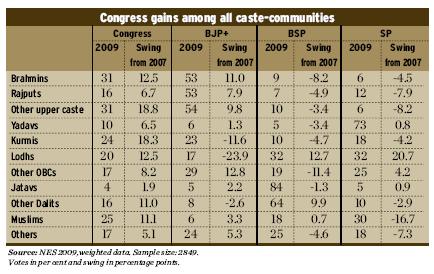
CSDS data on caste voting patterns in UP LS ’09 elections

csdsdataupls09In my post a few days ago I had mentioned a survey who source I could not reveal, except that the BSP is looking at these figures. Truth be told, I don’t know who conducted that survey. But, to back the conclusions, I had a little more than just that survey. Continue reading CSDS data on caste voting patterns in UP LS ’09 elections

UP’s Dalits Remind Mayawati: Democracy is a Beautiful

Party Vote-share Seats
BSP 27.42% 20
SP 23.26% 23
Congress 18.25% 21
BJP 17.5%
10

The higher you fly, the harder you crash. Kumari Mayawati has just learnt this lesson, and is finally giving her ever-expanding fleet of air-crafts some rest. There was clear evidence before the results were out that Dalits were not going to the polling booths to vote; if they did they wouldn’t be able to press any button other than the elephant. Dalit activists in UP had been telling me this for some time now. There were rumours that the UP police has also informed the administration of this trend. Continue reading UP’s Dalits Remind Mayawati: Democracy is a Beautiful

Vaikom Viswan and Little Bo-Peep

If I weren’t aware of Kerala’s more vibrant political past,I’d have died laughing this elections. The election campaign in Kerala was impossibly funny. Just to give you an example  — in Thiruvananthapuram, in the middle of the campaign, we were treated to the spectacle of all the three major contenders — of the CPI, the Congress, and BJP — don the costume of the chivalrous knight — indeed, pushing and shoving each other quite unchivalrously– determined to rescue the damsel in distress. However, there was no damsel waiting to be rescued! Continue reading Vaikom Viswan and Little Bo-Peep

People of the Vaish Community Honouring Shri JP Aggarwal…

"jai prakash aggarwal ko vaish samaj ke logo ne sammanit kiya"
"Jai Prakash Aggarwal ko vaish samaj ke logo ne sammanit kiya."

The photograph above has been sent to me, in my capacity as a journalist, by the PR company hired by Jai Prakash Aggarwal. He was the Congress candidate from the North East Delhi seat, a replacement for Jagdish Tytler. Aggarwal is also the president of the Delhi unit of the Indian National Congress party, that has returned to power with a less encumbering coalition than the one it ran for five years. JP Aggarwal was a reluctant replacement: he was also a Rajya Sabha MP and feared he might lose to the BJP, which would be a great embarrassment for him as the president of the Delhi Pradesh Congress Committee. But the Congress insisted they wanted a ‘baniya’ for the seat. Happily for him, he has won, and this press release is about how the Vaish community has honoured him. Continue reading People of the Vaish Community Honouring Shri JP Aggarwal…

Sri Lanka: A Tragedy Foretold – Rohini Hensman

guest post by ROHINI HENSMAN

Once a forest fire is raging, putting it out is difficult, and an enormous amount of destruction is inevitable. The same is true of the war in Sri Lanka. Even over the past fifteen years, there were several chances to prevent this tragedy, but only a tiny minority of those who are now grieving over the dead and injured were arguing then that a failure to take these chances would lead to a bloodbath. Continue reading Sri Lanka: A Tragedy Foretold – Rohini Hensman

51% = legitimacy

With the elections around the corner, the First-Past-The-Post (FPTP) election system used in India is being blamed for most of the ills in the Indian political system. This post is the outcome of some of the discussions and conversations that Barun Mitra of the Liberty Institute and I have been having regarding the FPTP system.

Briefly, the FPTP system is based on the principle of  “winner-takes-it-all” i.e., the candidate who gets majority of the votes is declared victorious. One of the most common criticisms made against the FPTP system is that candidates win by very narrow margins.  It has been suggested that candidates must get at least 51% of the votes in order for their victory to be deemed as legitimate. It is interesting to note that so far in the history of elections in India, not a single candidate has been dismantled or at least challenged on the grounds that s/he won by 20% of the votes in  the constituency. Therefore, is the criticism misplaced?

Both Barun and I want to suggest that narrow victory margins are in fact the strength of the Indian electoral system. This is because:

Typically, only 50% of the population in the constituency votes in any election. If the victorious candidate has won by 20% of the votes, he has actually received 40% of the votes (given that only 50% of the people are voting).

  1. The narrow victory margins keep the threshold of entry naturally low. This encourages aspirants to enter the electoral fray. If candidates won by 51% of the total votes, it would mean that political parties would have to field heavyweights and stalwarts and it would also discourage novices and independents from contesting the elections.
  2. The narrow victory margins intensifies political competition and keeps candidates and parties on their toes. New aspirants can cut into the vote bases of popular candidates and parties. Moreover, the narrow margins makes it imperative for candidates and parties to attract voters from various backgrounds and widen their appeal instead of confining themselves to gathering votes on the basis of identity and particularistic appeals.

A sham called election reporting

A ‘Kashmiri’ ‘Gurjar’ ‘Muslim’ is contesting the Dausa Lok Sabha seat. As an independent. For the simple reason that after delimitation, Dausa became a reserved constituency. Rerseved for the Scheduled Tribes. Meenas are ST’s. Gurjars wanted to be ST’s. Not only didn’t they not get that, they were deprived of Dausa, where the feudal PIlots had been Gurjar kings.

So someone thought of this simple idea: get a Kashmiri Gurjar. Kashmiri Gurjars are ST’s.

That candidate is campaigning around Dausa, and I gather that even the Brahmins of the area are supporting him! Him! A Kashmiri Muslim Gurjar! Continue reading A sham called election reporting

April 13 a Day of Ignominious Capitulation in Pakistan: HRCP

[The following is the text of a press release issued by Asma Jahangir, Chairperson of the Human Rights Commission of Pakistan on April 14, 2009. The formal adoption of the Nizam-e-Adl is widely perceived in Pakistan as a surrender to the Taliban and a way of imposing the Shariat Laws in the region. And for good reason. As it went up for approval to the National Assembly, the Taliban and the Tanzim Nifaz Shariat-e-Muhammadi (TNSM) warned parliamentarians against opposing the Nizam-e-Adl Regulation. Meanwhile, Jamaat-e-Islami Naib Amir Senator Prof. Khurshid Ahmad has criticized the liberal secular lobby for debunking the introduction of Nizam-e-Adl in Malakand Area.]

Lahore: The way the National Assembly resolved to back the Nizam-e-Adl Regulation for Malakand Division on Monday does no credit to the House, and the day will be remembered for the state’s humiliating submission to blind force, a statement by HRCP said on Tuesday.

Continue reading April 13 a Day of Ignominious Capitulation in Pakistan: HRCP

Swat Flogging and Public Outrage: Beena Sarwar

[This article was first published in Dawn 12 April 2009. It is reproduced here courtesy South Asia Citizens Web. The recent reports of the most spine-chilling instance of flogging of a young woman by Taliban goons unleashed a wave of indignation across Pakistan. This comment by Pakistani journalist Beena Sarwar is self-explanatory. For all the political illiterates and those given to anti-Muslim hate-speech in this country, this report and the innumerable discussions and posts on sites like Chowk, should indicate how much the Taliban and terrorism are hated and resisted by ordinary ‘secular’ people and women’s and human rights groups in Pakistan. They should indicate that ‘Islam’ and ‘being Muslim’ are themselves intensely contested ideas. But of course, we know that nothing can teach these hate-mongers anything, for they are the mirror-image of the Taliban. And as for us, as the old song goes: hum korea mein hum hain hindustan mein/ hum roos mein hain, cheen mein japan mein…And one might add: Pakistan mein bhi hain aur sare jahaan mein

(There we are in korea and in hindustan/in russia we are, in china and in japan/and in pakistan too we are, we’re in the whole wide world…)

It is people like us there who must fight the Taliban, and people like them here who must fight the Hindutva fascists  – always, relentlessly…Even when in the minority and especially when the political parties and leaders desert en masse. – AN]

Demo against womans flogging, courtesy LA Times
Demo against woman's flogging, courtesy LA Times

In the “flogging video’s” undated footage shot with a cellphone in Swat (judging by the language and clothes) a man whips a woman in red, her pinned face down on the ground and encircled by men. The leather strap strikes her back as she cries out in pain.

The video, circulated on the Internet before local television channels broadcast it, caused a furore both in Pakistan and internationally. What caused the outrage? The public punishment meted out to a woman — or the fact that it was broadcast?

Continue reading Swat Flogging and Public Outrage: Beena Sarwar

Why you should Caste your vote

Someone called “Dr Known” has sent Kafila, via our Contact page, this interesting email. I’m posting this here only because I found it interesting; posting does not necessarily constitute agreement. Or disagreement :)

Since Hinduism is based on CASTE hierarchies, it intrinsically breeds HATRED among Indians.

Hence,

* You must VOTE for candidates from your CASTE only.

* Only he can and will UNDERSTAND your culture and IMPROVE your socio-economic status.

* And do not worry if he is CORRUPT.

* You must vote him till 85% of all registered marriages in India are INTER-CASTE or INTER-FAITH.

This is the only way to STOP dis-integration of India.

The Tragedy of Politics in Sri Lanka

I am posting below an article that I wrote with Cenan Pirani.  The shorter version of this article is in Combat Law. The longer version below delves into the history of left politics in Sri Lanka and attempts at a political solution.  Another article by me reflecting some of these concerns and raising questions of solidarity titled ‘The Challenges of Solidarity’ was published in Red Pepper.

The Tragedy of Politics in Sri Lanka

By AHILAN KADIRGAMAR and CENAN PIRANI

In the last few months, the Sri Lankan security forces have managed to ruthlessly push the LTTE into a 40 square km strip of land in the North of the island, and along with the LTTE leadership and its cadres, a sizable civilian population, anywhere from seventy thousand to one hundred and fifty thousand, have also been cordoned off in this area.  As the security forces continue their offensives purporting to rid Sri Lanka of the LTTE, they also claim the lives of these civilians daily. Continue reading The Tragedy of Politics in Sri Lanka

Closed minds

The Constituent Assembly’s ‘Committee to protect and preserve National Interests’ has suggested that a passport regime be introduced at the Nepal-India border. Committee Chair Amik Sherchan has said this is necessary to ‘protect waning Nepali nationalism’ and ‘to treat both China and India equally’. Sherchan claimed that ‘majority of the Nepali people share this view’, an assertion hard to believe.

The clamour to end the open border relationship comes from three different quarters of the Kathmandu (and yes this is confined to the capital) political spectrum. The first is the nationalists who borrow the Westphalian notion of absolutely sovereign nation states. In this version, the Nepali state has never been totally independent because it has not controlled the movement of people across its boundaries. The act of walking across unchallenged is seen as an attack on state authority. Continue reading Closed minds

Who Is Responsible For The Slaughter Of Civilians In The Vanni?: Rohini Hensman

guest post by ROHINI HENSMAN

With the military defeat of the LTTE imminent, the terrible plight of civilians in the Vanni has attracted worldwide concern and sympathy, and rightly so. While the circumstances are completely different, the civilian death toll in the Vanni over the past few months (over 2700) is already triple the number of civilians killed in the Gaza massacre of December-January, and is still mounting. The thousands who suffer serious injuries are further victimised by the delay or lack of medical attention, which means, for example, that injuries to limbs which could have been saved with prompt treatment, instead result in gangrene and amputations. Even those who have not lost lives, limbs or loved ones, have lost their homes and livelihoods, and live in appalling conditions which could well claim more lives through disease or even starvation.

Meanwhile, the LTTE and Government of Sri Lanka (GOSL) trade charges, each accusing the other of being responsible for the slaughter. What truth is there in their respective allegations? Continue reading Who Is Responsible For The Slaughter Of Civilians In The Vanni?: Rohini Hensman

Cultural Policing in Dakshina Kannada: Vigilante Attacks on Women and Minorities

[This summary comes to us from ARVIND NARRAIN (ALF) of a report brought out by the People’s Union for Civil Liberties, Karnataka (PUCL-K) in the wake of the attacks on women in Mangalore by cadres of the Hindu right-wing Sri Ram Sene.]

It was only after the continuous telecast of the images of the women who were subjected to an horrific assault by cadres of the Sri Ram Sene in a pub in Mangalore on January 24, 2009, that public attention gravitated towards what was happening in Mangalore. Self styled vigilante groups in Dakshina Kannada have begun to police social interactions between members of different religious communities such as boys and girls drinking juice together or sitting together on a bus merely because they come from different religious communities. Cultural policing also targets women in particular and lays down norms with respect to public spaces they can occupy and the clothes which they can wear. Cultural policing has as its primary target, young people. From Shefantunde (16) who was attacked for talking to a Hindu girl to a college student Shruti and Shabeeb for talking on a bus to Anishwita (23), Akeel Mohammmad (24) and Pramilla(22) for drinking a juice together, its the young which has come under vicious attack. Perhaps we also need to think of the young not just as victims but indeed as agents of social transformation who through their everyday acts of fraternal living are fulfilling the promise of the Indian Constitution and thereby imperiling the ideological agenda of those who see India differently. Cultural policing aims to punish all those who try to live out the meaning of the Preamble’s promise of ‘fraternity’ and is a fundamental attack on the very Constitutional order. The promise of fraternity held out in the Preamble is what is contested at its very roots by cultural policing. What cultural policing wants to produce are monolithic self-enclosed communities with no form of social interaction between them. It is antithetical to the idea of ‘We, the people of India’ and insists that India is no more one nation, but rather a collection of separate peoples. This Report documents how sixty years after independence, the vision of the framers of the Constitution is sought to be so completely repudiated by organizations which are bent on ripping out the heart of Indian Constitutionalism.

The full report is available on the Alternative Law Forum website and can be accessed here.

The Great House Hunt

A rather fierce debate has been raging at Kafila, the instigator is Zainab, a “Muslim” married to a “Telugu Brahmin” who discovered how deep is the hold of antediluvian ideas and practices in a city that has for sometime been touted as the hub of 21st century India.

She wrote a simple account of her experiences while searching for a house on rent in Bangalore. The piece also touched upon issues like communal profiling, stereotyping entire communities and such like. Some of those commentating on the piece have made ‘clever’ attempts at obfuscation by raising issues like loan quotas for Muslims and such other totally extraneous arguments. Never having studied economics, banking and/or commerce, never having had the resources to apply for a bank loan and not having my life enriched by the immensely educational experience of house hunting in Bombay and Bangalore, I will not try to take on Ipsita or comment on the secular practice of discrimination against all house hunters if they do not belong to the caste, religion, region, gender or economic status of the landlord. Continue reading The Great House Hunt

Fighter for a Great Yesterday

Brand Advani: Perils of Rebranding

[It is for the first time in his nearly five year old tenure as PM that Prime Minister Manmohan Singh made a stinging attack on L. K. Advani – PM in waiting as far as the Sangh Parivar is concerned. Prime Minister was candid enough to remind about the “prominent role” played by Mr Advani in the Babri Masjid demolition, or how he presided over Gujarat riots and failed to prevent terror attacks on Parliament and Red Fort as Home Minister.]

1.

L.K. Advani, the ‘Swayamsevak’ from across the border, the hawk of the nineties or the rediscoverer of Jinnah wants to do a makeover. Not a day passes when we are presented with a new look of the old man who has already crossed eighties. Sudheendra Kulkarni, his speechwriter shared the understanding behind LKA’s rebranding mission. ‘Man of Eighties, Vision of Twenties’. If one day he is presented as an emotional patriarch who has no qualms in shading tears after seeing a movie the next day he is packaged as the man in his energetic twenties and shown raising dumbells at a gymnasium or the next day he is with a family in hospital which tried to committ suicide because of financial problems. Continue reading Fighter for a Great Yesterday

The Discreet Poison of Aamir

Aaamir the film

Aamir, a film about a man on the run, was released in June 2008, it was one of those rare films that was praised by critics and liked by viewers. I did not like the film, I was in fact very upset and disturbed about the film and thought about giving expression to my angst in writing, but this outpouring of powerful emotions never materialised, I would probably have never gotten down to writing this piece had Delhi 6 not arrived on the scene. Continue reading The Discreet Poison of Aamir

Smile Pinki, Pinki Sonkar

If you’ve recovered from your Post-Slumdog Stress Disorder, may I dare to write a short post about Smile Pinki, the short documentary that also won an Oscar and that is also set in India? Continue reading Smile Pinki, Pinki Sonkar

Dalits in ‘Hindu Rashtra’

The Gujarat Earthquake in the year 2001 and the consequent relief and rehabilitation programme was an eyeopener to the outside world regarding the deep seated caste bias in the Gujarati community apart from the much talked about bias against the minorities. There were reports that at places the relief and rehabilitation work bypassed the dalits and the Muslims.

Interestingly Babasaheb Dr Bhim Rao Ambedkar had asked his followers to stop Hindu Raj becoming a reality at all costs. Continue reading Dalits in ‘Hindu Rashtra’

Caste/gender in a poem by Varavara Rao

I’m posting below a poem by Varavara Rao and a response to it by Rochelle Pinto. Comments and debate welcome, but trolls will strictly not be allowed regardless of caste and gender! Comments are regulated here by a disclaimer to maintain sanity. Not repeating your position ad nauseum helps, unless you desperately want to have the last word.

Merit

by VARAVARA RAO

Lucky
You are born rich
To say in your language
“Born with silver spoon in the mouth”

Your agitation sounds creative
Our agony looks violent
Continue reading Caste/gender in a poem by Varavara Rao