We live in strange times. A judge in the country’s Supreme Court believes anyone challenging the government’s decision to impose Aadhar-based surveillance regime is following an “NGO line.” Another judge wonders in the court whether “one nation one identity” is not the necessary path forward. Soon, one wonders, if any opposition to surveillance, and any resistance to being spied upon by the state, will be deemed anti-national not only by the government but also by our top judiciary.
Since the hearings on the various anti-Aadhar pleas are being heard in the Supreme Court, and since such inconsiderate observations are being made regularly, let us look at a few problematic aspects of the biometry-based Aadhar idea itself—not only the technical glitches and possible misuses (of which there are many), but the central philosophy that underlines the state’s eagerness to bring every citizen under one biometric identity.
T T Sreekumar, an important commentator on contemporary politics in Kerala — a public intellectual who now qualifies to be an irritant in the eyes of the Kerala police, now that he has openly declared his allegiance to the dalit people fighting injustice and Vadayambady and inaugurated a protest-event there — writes about the issue and its historical origins:
When I visited Vadayambady the other day to express my solidarity with the cause of the agitation, what I witnessed there was an atmosphere of utmost fear and police terror. A big task force of police was stationed at the location. The team that included the special branch officers, had created a situation of terror at the peaceful site. Activists mentioned that a particular police officer continuously hurled abuses, including caste abuses, at the protesters that included Dalit women and children. When the protest began to draw national attention, the ruling dispensation of CPIM that had hitherto remained unconcerned has started to take up some damage control measures. However, when they finally arrived at the site of the agitation almost after a year since the agitation began, the CPIM leaders allegedly refused to address the caste question involved. Dalit activists, including women activists, surrounded them and raised several objections to this attitude pointing to their sheer hypocrisy and lack of integrity.
The almost insoluble task is to let neither the power of others, not our own powerlessness, stupefy us.
Adorno.
As frightening spectres of untouchability and unseeability hover around the festering sore of the ‘caste-wall’ at Vadayambady in Kerala, as the so-called mainstream left-led government here continues to pour its energy and resources into aiding and abetting caste devils there, as most mainstream media turns a blind eye, as the Kerala police continues its mad-dog-left-loose act, many friends ask me: why have you not yet written about the struggle there of dalit people fighting of the demon of caste now completely, shamelessly ,in the public once more? Continue reading Malayali Feminism 2018: In the Light of Vadayambady and Hadiya’s Struggle→
On 30 January 2018, retired civil servants and veterans of the armed forces jointly organised a conclave on ‘Hinduism and Hindutva’ at the Indian Social Institute, New Delhi. The conclave attended by over hundred participants, emphasized the need to rescue both Hinduism and the Indian Constitution from the clutches of the political project that calls itself Hindutva, and which has nothing to do with religion as such. The participants at the conclave sought to make a plea for saving Hinduism without making any concessions to the monstrosity of caste oppression, which in the spirit of many earlier reformers, they rejected.
This conclave followed an earlier one on ‘A Fractured Polity: The
Relevance of Gandhi Today’ organised on 10 October 2017, which had been
addressed by Justice A P Shah, Mrinal Pande and Ramachandra Guha. The
speeches are available on YouTube (Justice A.P. Shah, Mrinal Pande,
Ramachandra Guha). These civil servants and veterans have also raised severe
concerns about the present situation in a series of open letters over the last few
months: on vigilantism and hyper-nationalism; the suspicious death of Justice
Loya; and violence and discrimination against minorities in India. (See: Retired
Civil Servants open letter – 10 June 2017, Armed Forces Veterans open letter –
30 July 2017, Retired Civil Servants Letter 02 December 2017 – Enquiry into
Judge Loya’s death, Armed Forces Veterans letter to Supreme Court & Bombay
High Court on Judge Loya’s death, Retired Civil Servants open letter – 28 January
2018). Continue reading Defend Constitutional Values, Save Hinduism from Hindtuva: For Civil Servants and Armed Forces Veterans→
पूरे हिंदी क्षेत्र में और विशेषकर उत्तरप्रदेश में ऐसे बडे, छोटे और मंझोले किस्म के नेताओं की बड़ी फौज पैदा हो गई है जिसकी नेतागिरी केवल सांप्रदायिक नारे लगाने और समाज में सांप्रदायिकता फैलाने पर टिकी है। सार्वजनिक जीवन पर इन संकीर्ण सोच वाले हिंदुत्व नेताओं की निरंतर मजबूत होती पकड़ ने सांप्रदायिक हिंसा को ‘न्यू नार्मल’ के रूप में मान्यता दिला दी है। हिंदू धर्म को कलंकित करने में इस नए जमाने के हिंदुत्व की क्या भूमिका है, यह अब किसी से छिपा नहीं है। एक समय था जब समाज पर समाजवादी और गांधीवादी विचारों के प्रभाव के कारण सांप्रदायिकता का सामना करना अपेक्षाकृत कम मुश्किल काम था। पर इन विचारधाराओं का प्रभाव कम हो जाने से सांप्रदायिक नेताओं-समूहों का तेजी से विस्तार हो रहा है। एबीवीपी, विहिप, हिंदू युवावाहिनी और बजरंग दल जैसे संगठन सामाजिक-राजनीतिक जीवन के पूरे परिदृश्य पर हावी हो चुके हैं।अक्सर साधारण परिवारों के युवक इन संगठनों की चपेट में इसलिए आ जाते हैं क्योंकि सांप्रदायिक संगठन समाज सेवा के मुखौटे के भीतर रहकर अपना काम करते हैं। वे दिखावे के तौर पर ब्लड डोनेशन या स्वच्छता मिशन या फिर शहीदों के सम्मान जैसी गतिविधियां करते हैं पर उनका असल मकसद समाज में सांप्रदायिकता का विचारधारा का विस्तार करना होता है। मुस्लिमों में भी सांप्रदायिकता है, पर वे उस प्रकार से संगठित सांप्रदायिकता को व्यक्त नहीं कर रहे हैं। Continue reading कासगंज हिंसा- तिरंगे को हड़प जाएगा भगवा? वैभव सिंह→
रक्स करना है तो पॉंव की ज़ंजीर न देख – मजरूह सुल्तानपुरी
Look – beyond the the prison walls, the brilliance of flowers, the vitality of spring
If you must dance, ignore the chains that bind your feet – Majrooh Sultanpuri
Today, the scared Republic that has imprisoned its young idealistic fighter son, Chandrashekhar, is on trial. The Republic, scared of its own offspring, stands in the dock. This Republic Day, we must all answer how it came to pass that a gang of adventurers and marauders simply took it over, submitted it to their command, while all the elderly, wise men and women, watched. Today, when the Republic bondage we must seek answers from all those who watched helplessly – or self-righteously – as marauders took it over.
It is official now. A radiogram from the Deputy Secretary, Home, Govt of Uttar Pradesh to the Superintendent, Saharanpur District Jail, dated 23 January 2018, confirms the slapping of charges under the National Security Act, on Bhim Army founder, Chandrashekhar Azad ‘Ravan’. Pradeep Narwal, Coordinator, Committee for the Defence of Bhim Army, who met Chandrashekhar in jail yesterday, underlined how the Karni Sena activists attacking school buses and vandalizing schools were being allowed the freedom to do so while Chandrashekhar, responsible for setting up and running of schools (see the video below), is being held in jail for months and has now been slapped with charges under NSA. “Karni Sena are apparently deshbhakts and Shekher bhai and Bhim Army are ‘terrorists’ in the perverted logic of this government,” he said.
In conversations with friends and sympathizers who have been meeting him over the past months, including Pradeep Narwal, Chandrashekhar ‘Ravan’ has been expressing a fear that many of us have also had, independently, for some time now: that the government wants to actually get rid of him – just as judge Loya was, it now transpires. Continue reading A Revolution Called Chandrashekhar Azad ‘Ravan’ – the Republic on Trial→
The recent reference to how the distribution of food in Malayali homes is often skewed against women by the actor Rima Kallingal in a recent talk has sparked off yet another round of attacks against feminists in Kerala. It is interesting to see how this seems to have brought together men of all political stripes and colours (may I say, from pro- and anti-Hadiya camps!). The attacks range from mild smirking to outright abuse, but are equally revealing of the fear of women’s feminist self-assertion. So even those men who supported Hadiya’s decision to choose her faith and community find it hard to swallow when women start laying bare the injustices of the ubiquitous patriarchal family, fearing that there may be an implicit choice in this criticism, to move away from the patriarchal family, and indeed, craft other non-patriarchal forms of intimate connection and commitment. After all, whatever be the community, the patriarchal family is acknowledged by patriarchal authorities everywhere as the foundation Continue reading From Nangeli to Rima Kallingal: Who are fit to claim Nangeli’s Legacy?→
I went to Maharashtra as I along with other activists and intellectuals were invited to come there. I along with others was a guest there. And I would remember fondly the love and support that I received in Pune and Mumbai. I would remember the resilience and enthusiasm of the people I met and their resoluteness to fight Manuvaad and centuries old casteist tyranny. I would remember the immense inspiration that I felt, when we paid homage to Jyotiba Phule and Savitribai Phule in Phule-wada, Pune. And, No I will not let two days of media trials by a few TV anchors, who are more of professional howlers, spoil these wonderful memories. I will not let their criminal cacophony and mindless vilification of me, Jignesh & others shadow my beautiful memories of Maharashtra.
The state of Maharashtra as well as the rest of the country is at a critical juncture today. On the one hand are forces in power who want to push our country back to many centuries and on the other are people who are resisting this Neo-Peshwahi, the casteist-communal-fascist regime of BJP-RSS. In my speech at Elgar Parishaad on 31st December 2017, I had said that the year 2018 is going to be a very challenging one. The last 3 and half years of the Modi Sarkar has exposed the BJP’s jumlas of Ache Din and Vikas as hollow, bitter and brutal lies.
As the General Elections of 2019 approach, BJP/RSS will now resort to creating civil strife amongst the people, polarising them on the basis of caste and religion and unleashing attacks on muslims and Dalits. The developments over the last few days vindicate me, a little too soon. Several regions of Maharashtra are in the midst of an acute agrarian distress. Both Marathas and Dalits are victims of this agrarian crisis that has been precipitated by the policies of both Modi and Fadnavis. The BJP/RSS regime has no resolution to offer to the farmers of Maharashtra. Therefore, unleashing attacks on Dalits through their hoodlums and portraying it as a caste clash between Dalits & Marathas will remain their only strategy. Continue reading Statement about the attacks on Dalits in Bhima Koregaon & the Subsequent developments in Maharashtra : Umar Khalid→
[A shorter version of this article was published in The Wire on 18 December. I thank K. Satyanarayana, P. Sanal Mohan and Jangam Chinnaiah for their very helpful comments on it, which have helped me to clarify and elaborate on certain points.]
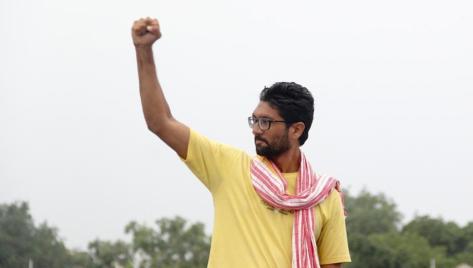
Jignesh Mevani, image courtesy New Indian Express
The rise of Jignesh Mevani constitutes a significant landmark in the political configuration in which the Congress has risen, despite itself, from a state of utter disarray to become the point of articulation for a possible political realignment in the near future. The process of political reconfiguration had already begun as a very significant section of the powerful patidar community, long understood to be the bedrock of the BJP’s social base in the state, had broken away from it. But alongside this, the rise of the young leaders Hardik Patel, Alpesh Thakore and Jignesh Mevani together produced the new young face of emergent Gujarat.
There is no doubt that the vacuum that characterized the space where the opposition should have been, no longer exists. The masthead of a new opposition formation is evident on the horizon. This turnaround in the fortunes of the Congress would not have been possible without the re-alignments in the non-electoral arena, facilitated in no small measure by the rise of this young leadership.
[ This post is based on updates posted by me on my Facebook wall ]
Jignesh Mevani. Photograph by Siddharaj Solanki, HT (Hindustan Times) File Photo, accessed from the HT website
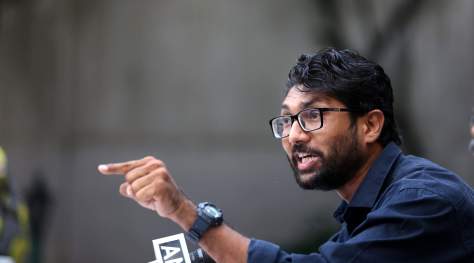
A great kerfuffle has ensued ever since the recently elected independent MLA from Vadgam, Gujarat and Rashtriya Dalit Adhikar Manch activist Jignesh Mevani gave an interview in which he had some choice things to say about the Prime Minister and BJP leader Narendra Modi. Mr. Mevani made some positive and gentle suggestions, to the effect that because Mr. Modi has stopped being relevant, has not delivered on even one of the promises made by him, he should retire, proceed towards the Himalayas, and in the phrase that has caused the greatest commotion, ‘melt his bones’.
#JigneshInsultsPM | Series of abuses after winning his debut poll, is this Jignesh's arrogance or immaturity? Fire in your views using the hashtag and let us know! pic.twitter.com/N6H6yr8oTA
Predictably, Mr. Modi’s personal broadcasting service, known as Republic TV has kicked up the greatest fuss. Arnab Goswami has been especially indignant, and he was joined in his rage by BJP spokesperson, the orotund television commentator and historical photo-shop scam artist, Mr. Sambit Patra. Mr. Mevani offered a robust and dignified refusal to apologize for what he said about Mr. Modi, when Republic TV demanded that he do so. Continue reading Jignesh Mevani, The Meltdown of Modi-Men and Dadhichi’s Bones→
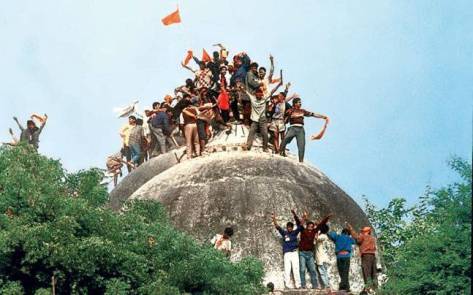
Babri-Masjid – Before the Demolition, image courtesy Tehelka.com
The gradual erasure of the words ‘Babri Masjid’ from our everyday memory actually began in 1986, when the Hindu community was granted the exclusive right to worship there. This happened without any regard ownership disputes the and illegal conversion of this mosque into a temple in 1949.
This story of the dispute itself is disputable. It is imperative to revisit three interesting moments, which no one talks of these days.
The 1949 moment
On the night of 23 December 1949, a group of local Hindus entered the mosque and installed the idols of Lord Ram inside it. Although the police filed an FIR in which the building is clearly defined as a functional mosque, the local administration took charge of the building, and without removing the idols from the mosque space, declared it a legally “disputed site”. Read the full article here
I can hardly describe the joy and relief I felt reading your piece on the Hadiya case in the Hindu yesterday. By now I am nearly deaf from the cacophony of misogyny, islamophobia, and sheer short-sighted rage that CPM supporters on Facebook are unleashing against this young woman.
Your voice of sanity, Comrade, is therefore a great restorative. If not for your writing, one could have well thought that the CPM was nothing more than a bunch of short sighted, power hungry, strategisers, whose total lack of ethics and values is covered up by a vapid, outdated rationalism and an equally problematic liberalism. You refuse to condemn Hadiya for choosing Islam. You acknowledge that she is brave. You unequivocally reject the father and other minions of patriarchy. You rightly criticise state patriarchy evident in the Supreme Court. Unlike many CPM supporters here, you have no illusions about the times we live in; you are clearly aware that the NIA is not something which will spare us if we stay good. Importantly, you put paid to the idea that the High Court judgement that sanctioned her illegal custody was justified — an idea assiduously nurtured by certain public figures allied with the CPM against religious Muslims. Comrade, thank you again for being so forthright and in the face of snarling islamophobes in your own ranks actually gunning for the voice you raised against her illegal custody long back.
When Hadiya Shafin shouted to the crowd that she converted voluntarily, that Shafin was her chosen husband, and that she wished to spend her life with him, some leading rationalist liberal feminists in Kerala sniggered at her: be grateful for the Indian Constitution which allows you to make a choice. This statement hid a despicable insult to her choice of Islam, slyly implying that it would not permit her any choices.
Goodness knows where these puerile, vain, indurate minds live their everyday lives. Maybe they are either still able to insulate themselves somehow from the onslaught of Hindutva violence, or find it useful to use the arms of this Hindutva hegemonised thuggish state to their narrow, shamefully narrow, ends.
Whatever, I could see no trace of the protective presence of the Indian Constitution when the Supreme Court heard Hadiya. I could see not the highest court of Justice of a vibrant democracy but I got a sense of how the Gates of Celestial Vaikuntam may look like:
Read more at : https://thewire.in/200701/hadiya-supreme-court-nia/
[This is the text of the open letter to the Chief Minister of Kerala from the celebrated Tamil poet Rajathi Salma, a leading literary and activist voice from South India whose writing has often revealed the pain and poignancy of women’s unfreedoms and the denial of a creative life of choice to them. This is about the never-ending agony that the confinement of a young woman, Hadiya, by her father, has become. Hadiya is to be heard by the Supreme Court of India on 27 November 2017, but the Kerala government refuses to take responsibility for her safe travel to Delhi, after many many pleas from civil society] Continue reading Hadiya’s Safety is the Kerala Government’s Responsibility: Rajathi Salma writes to the Chief Minister of Kerala→
किसी भी संतुलित मस्तिष्क व्यक्ति के लिए यह सवाल विचित्र मालूम पड़ सकता है। अलबत्ता सामाजिक-राजनीतिक आंदोलनों पर निगाह रखनेवाला व्यक्ति बता सकता है कि जब लोग सदियों से जकड़ी गुलामी की बेड़ियों को तोड़ कर आगे बढ़ते हैं तो न केवल /बकौल शायर/ ‘आसमां में भी सुराख हो सकता है’ बल्कि ‘ पानी में भी आग लग सकती है।’
2017 का यह वर्ष पश्चिमी भारत की सरजमीं पर हुए एक ऐसे ही मौके की नब्बेवी सालगिरह है, जब सार्वजनिक स्थानों से छूआछूत समाप्त करने को लेकर महाड नामक जगह पर सार्वजनिक तालाब से पानी पीने के लिए डा अंबेडकर की अगुआई में हजारों की तादाद में लोग पहुंचे थे। /19-20 मार्च 2017/ कहने के लिए यह एक मामूली घटना थी, लेकिन जिस तरह नमक सत्याग्रह ने आज़ादी के आन्दोलन में एक नयी रवानी पैदा की थी, उसी तर्ज पर इस अनोखे सत्याग्रह ने देश के सामाजिक सांस्कृतिक पटल पर बग़ावत के नए सुरों को अभिव्यक्ति दी थी।
This is a GUEST POST by DEBADITYA BHATTACHARYA and RINA RAMDEV
The past few years have not allowed us the respite to prepare for a fight. We were perpetually donning our war-gear – often forced without necessary ammunition into a battle that raged through parliaments and streets and colleges and colonies and our doorsteps. There was no time to strategise, no time to theorize, no time to bargain and no time to compose ourselves for the next day’s onslaughts. And yet, the onslaughts never abated. The mundane was coupled with the spectacular, the anti-national with the terrorist, the intellectual with the condom-user, the dissenter with the stone-pelter, and the everyday with the genocidal. Continue reading Sexual Harassment in the Academia – What the Hitlist Misses: Debaditya Bhattacharya and Rina Ramdev→
(This is the text of the open letter from Prof. Satish Deshpande to the Chief Minister of Kerala on the Hadiya issue. Satish’s work ContemporaryIndia, translated as SamakalikaIndia, has been hugely influential in shaping the progressive understanding of Hindutva nationalism and communal hatred in Kerala.)
<!–more–>
The Honourable Chief Minister of Kerala
Shri Pinarayi Vijayan
6thOctober, 2017
Respected Sir,
Ever since I first came to Kerala in 1981 to study at the Centre for Development Studies (CDS) at Thiruvanathapuram, I have been a committed supporter of everything that the left tradition of your great state has achieved by way of democratic innovations in governance and social practice. Even today, I believe that Kerala continues to be a shining example in many spheres where the rest of India lags far behind.
I was therefore shocked to read about the Hadiya case and the tacit and explicit state support that underwrite her virtual house arrest today. I am told that the man that Hadiya has chosen to marry and the organisation with which he is associated may have a questionable past. Whatever be the truth of this matter, the fact is that an adult citizen’s personal choices in matters like marriage cannot be undone by the state no matter how ill-considered that choice may appear to others. Moreover, in the current climate, it is surely not irrelevant that the religion in question is Islam – it is highly unlikely that this case would have attracted any attention if Hadiya had chosen to convert to some other religion.
It is highly embarrassing – to the say the least – that a government led by a party that can claim to have played a major role in transforming Kerala society for the better is today seen to be siding with the reactionary forces.
I appeal to you to use the power vested in you by the people of Kerala to end this travesty of justice and ensure that Hadiya is left free to live her life as she chooses.
Amit V Masurkar’s recently-released film Newton explores facets of Indian democracy at its most vulnerable. For these times of ‘nationalist’ bravado, this is a courageous topic. The film is so named because it adopts for the most part, the point of view of its protagonist, Newton (Nutan) Kumar (Rajkummar Rao, thank you once again!) who resists corruption and hypocrisy at home and work. Continue reading The Gravity of Newton : Rituparna Sengupta→

 KAFILA - COLLECTIVE EXPLORATIONS SINCE 2006