A preliminary walk through the unreason of the Supreme Court in the 377 judgment by SIDDHARTH NARRAIN
We hope to see many more pieces which exposes the judgment for what it is- an example of judicial non application of mind. I have also written a short piece looking at the judgment in the context of the Mandela moment
The Supreme Court’s decision in Suresh Kumar Kaushal & Another v. Naz Foundation & Others is an unprecedented ruling, deciding to turn the clock back to pre-July 2009, when LGBT persons were criminalized by section 377 of the Indian Penal Code. On close reading, the judgment is based on a narrow and blindfolded interpretation of the law, ignoring the momentous changes in society and notions of morality that India is witnessing. Further, the judgment, in many parts, relies on shaky precedent, does not explain the logic of its conclusions, and is surprisingly dismissive of substantial evidence that was placed before it. Continue reading We Dissent: Siddharth Narrain→
The Supreme Court has struck down the Delhi High Court decision decriminalizing gay sex in what might go down as the most retrograde judgement in India’s history. While the details of the Court’s reasoning are still not available, we can perhaps easily imagine what they might be. This is time of civil disobedience. Time for protest.
Assemble at Jantar Mantar at 4.30 pm, today 11 December to announce to the world that ‘We Are All Queer’. To announce that this is not a struggle of just the ‘gay-lesbian community’ but a struggle for our most fundamental rights and cherished values.
[We are publishing below the full text of the statement issued by the People’s Union for Civil Liberties, on the Tehelka case, which raises some important issues that have not received public attention yet.]
Press Statement on the Tehelka Sexual Assault Case
Dated: 2 December 2013
The PUCL
Expresses Solidarity with the struggle of the Tehelka Journalist who raised her voice against Rape and Intimidation by the Ex-Editor Tarun Tejpal.
Demands fair investigation and early charge sheet into the matter, from the Goa Police.
Considers Six Day of Custodial interrogation of Tarun Tejpal granted by the Goa Judicial Magistrate Court unnecessary and invidious.
Appeals that police custody and the case not become a tool in the hands of BJP administered Goa police to settle scores with Tejpal.
The People’s Union for Civil Liberties from the very beginning has supported the complaint of the woman journalist of Tehelka magazine who accused the editor of Tehelka, Tarun Tejpal, of rape and sexual assault. PUCL salutes her courage for breaking the silence on rape and sexual intimidation carried out by her senior colleague and editor. We have also admired the consistent and principled manner in which the young girl stated her case, initially via internal emails within Tehelka, and later on to the media, neither allowing vituperation or anger at the blatant violation of her body to sensationalise her case or to prevaricate about the fact of the offence having been committed. Through her dignified stand she stands as a model to all women who suffer similar sexual violence, that the dignity of a woman’s body cannot be a plaything for anybody howsoever influential and powerful they be. By the same token, we also denounce the vilification campaign carried out by Tarun Tejpal and his lawyers against the complainant by seeking to impute that the entire crime was actually a `consensual’ act or at trying to trivialise the crime by calling it “light hearted banter”.
By now the details are well known: a young journalist describes a harrowing encounter with Tarun Tejpal, owner and editor of Tehelka, in an elevator during Tehelka’s Think fest in Goa. The description of the incident alleges gross sexual misconduct and bodily violation of an aggravated nature. Her description does not make for easy reading: it clearly demonstrates the incredibly vulnerable position in which young women are placed when confronted with the sexual misdemeanors of powerful men in positions of managerial authority. Indeed Mr. Tejpal says as much, that to cooperate with him is the best way for her to keep her job. She writes to Ms. Shoma Chaudhury the managing editor describing the incident and asks that she be tendered an official apology, and that Tehelka’s senior management constitute an enquiry and anti-sexual harassment committee as per the Vishaka guidelines. Instead what she is offered is a pathos-laden tale of fall and redemption: directed by and starring Mr. Tejpal, producer Ms. Shoma Chaudhury. There has been near continuous discussion across the web and the news and it can get difficult to keep track of all the various versions being produced on an hourly basis by Tehelka’s bullshit factories. So at this stage it might be useful to simply collate and compare various accounts. Continue reading The Tangled “Tonalities” of Mr. Tejpal→
Notwithstanding the opposition of many Adivasi organizations and progressive forces, the government of Kerala appears bent on moving forward with its project of recruiting Adivasis as home guards, paying them Rs.500 per day, to take on the Maoist guerrillas allegedly active in the Western Ghats. It is obvious that the state government is not learning lessons from the Salwa Judum experience in Central India and is bent on making Adivasis scapegoats in its impending showdown with the Maoists. Continue reading Adivasis of Kerala: Citizens or Cannon fodder?→
What follows is a ‘status update’ from EFL University, Hyderabad, with special reference to the recent regulation of free speech on social networking sites in the university. It follows the polemical structure of a facebook status update as it tries to bring in a new dimension to the nature and scope of the idea of public and public sphere. At the very outset, let me make this point very clear. We are not fighting for some anarchic and absolutist idea of free speech. We know very well that freedom of expression also means a lot of responsible thinking.
First, some detail about the facts of the matter before we reflect on the philosophical and theoretical problems that they posit in the face of the ‘here and now’ of student politics in Indian universities in general and EFLU in particular.Two students, Kt Hafis (the author) and Thahir Jamal were handed show-cause notices, issued by the Proctor’s office signed by Deputy Proctor Sujata Mukhri, for having expressed our opinion on Facebook regarding the anti-reservation remarks made by Mr. Tariq Sheik, a member of the administration and Deputy Dean of Student welfare, at a students’ general body meeting organized by the Dean of Students welfare to select the electoral committee for the upcoming students’ union election at EFL university. In that meeting, students sensitive towards the problems of representation raised genuine concerns about the absence of reservation in the central panel (President, Vice-President, General Secretary, Joint Secretary, Cultural Secretary, Sports Secretary) and against the denial of the posts of SC/ST, OBC, women, disabled and foreign representatives in the new constitution of the Students’ Union. These had been approved by the Vice Chancellor of EFLU and in response to a students’ struggle conducted the last year. Continue reading Chanting Sacred Election-Ritual Mantras by Regulating Free Speech: ‘A Status Update’ from EFLU, Hyderabad:Kt Hafis→
पड़ोसी कब पड़ोसी न रह कर अजनबी बन जाता है ? या वह हमेशा ही एक अजनबी रहता है जिस पर मौक़ा मिलते ही हमला करने में ज़रा हिचक नहीं होती ? हम अपना पड़ोस चुनते कैसे हैं? क्या पड़ोस मात्र एक भौगोलिक अवधारणा है? क्या जो भौगोलिक दृष्टि से हमारे करीब है, वही हमारा पड़ोसी होगा? पड़ोस चुनना क्या हमारे बस में नहीं? क्या पड़ोस कुछ–कुछ धर्म या भारतीय जाति की तरह है जिसके साथ जीवन भर जीने को हम बाध्य हैं? क्या पड़ोस का अर्थ हमेशा आत्मीयता ही है? क्या पड़ोस का मतलब एक दूसरे का ख़याल रखना,आड़े वक्त एक दूसरे के काम आना ही है? या यह रिश्ता अक्सर उदासीनता का होता है , जिसमें हमें दरअसल अपने पड़ोसी में दिलचस्पी नहीं होती? क्या इस उदासीनता के हिंसा में बदल जाने के लिए कोई भी कारण काफी हो सकता है? यह प्रश्न जितना शहर के सन्दर्भ में प्रासंगिक है उतना ही भारतीय गाँव के सन्दर्भ में भी पूछे जाने योग्य है. एक बार फिर, मुज़फ्फरनगर के गाँव में हुई हिंसा के बाद, पड़ोस के मायने पर बात करना ज़रूरी हो उठा है. Continue reading पड़ोसी और अजनबी→
I remember a chill running down my spine that early afternoon in 1998. I was standing at Laxmanpur Bathe – the site of a cold-blooded massacre a year ago. Then a reporter with The Telegraph, I was touring Bihar, reporting on the 1998 general elections, less than two years after the United Front government came to power. Bihar was then firmly under the thumb of the redoubtable Lalu Prasad. Tensions between the Maoist Coordination Committee (MCC) and the Ranvir Sena, a private army of upper caste landlords, were running high. Every reporter visiting the area had been advised by the district magistrates concerned not to travel after sundown. Newspapers in Delhi were full of stories about Bihar’s lawlessness, extortions and abductions even in broad daylight.
I had read details of that deadly night in the newspapers; and then of the sudden trips made by VIP cavalcades to the village in the aftermath of the bloodbath. The massacre had pitched the forgotten hamlet of Dalits into the glaring spotlight. Crowds of politicians and media descended on the spot, even as the grief stricken survivors were struggling with the shock of the attack and the terrible loss of their loved ones. Continue reading Laxmanpur Bathe, Then and Now: Monobina Gupta→
Predictably enough, the Patna High Court has acquitted all the 26 persons convicted by the trial court in the Laxmanpur-Bathe massacre case. This is the fourth successive instance of wholesale acquittal of convicts by the Patna High Court in cases of massacre of the oppressed rural poor in Bihar. Once again eye witness accounts have been dismissed as being not fully credible and convicts granted acquittal on ‘benefit of doubt’. The judges could not however disprove the fact that 58 people had been killed and post-mortems done, and hence they asked the trial court to calculate the compensation payable to the nearest kin of the victims as per relevant provisions the Motor Vehicles Act on the basis of the minimum wage prevalent in the area at the time of the massacre. They of course did not forget to add that any ex gratia paid after the massacre should be deducted from the amount of compensation!
The events preceding the recent death sentence awarded to the rapists of December 16th Delhi gang rape case from 2012 have certainly broadened the canvas of discourse on sexualized violence in India. Not only was the institutional sexism that pervades India’s criminal justice system been challenged, but also patriarchal values and norms that sanction and reinforce gender biases were openly questioned. It was remarkable to watch the unprecedented outpouring from the Indian citizenry from all across which resulted in the decision of the government to constitute a committee which had the mandate for recommending amendments to the Criminal Law. Recommendations by the Justice Verma Committee in early 2013, undoubtedly paved a way for much needed reform of laws and criminal justice practices relating to crimes of sexual violence. However, this was not true for all the survivors of sexual violence, particularly from the “disturbed” peripheral states of India. For the victims and survivors of sexualized violence from the conflict zones of India – Jammu and Kashmir and Northeast, the discourse ended uneventfully with a reserved/muted submission of the Committee’s report to the government. Continue reading Securing Justice for Rape Survivors from Kashmir and Northeast is An International Human Rights Crisis: Ayesha Pervez→
‘No Results Found’ on Searching for Laxmanpur Bathe in Times Now on the night of Oct 12-13, 2013
In a country where the bloodthirsty rhetoric of ‘hang them, shoot them’, an ‘eye for an eye’ and ‘their heads for our heads’ is heard so regularly, and so loudly on prime time television, we were greeted by an odd and chilling silence in the course of this week. It wasn’t for a lack of noise, vendetta laced sound-bytes, storms in tea-cups, or of talking heads.
In normal circumstances, journalists are not people in the limelight– they are supposed to be the first witnesses to history in the making. Their role is as observers of incidents and purveyors of what goes on in the public sphere. And they discharge their duties as representatives of the citizens, generally enjoying the public confidence. That explains the key role of media in a democratic polity, as representatives of the various segments of people and as a forum where a dispassionate debate of public issues can take place. Like the Red Cross personnel on a war front, media-persons are expected to do their job without hindrance of harassment, keeping away from the sound and fury of public life. Continue reading Thejas Daily: A Newspaper’s Encounters with the Ruling Powers : N P Chekkutty→
24th September, 2013
STOP THE WITCHHUNT!
PUCL STATEMENT CONDEMNING THE POLICE RAID OF PROF. GN SAIBABA’S RESIDENCE
The People’s Union for Civil Liberties (PUCL) condemns the illegal raid and search of the residence Professor GN Saibaba of Delhi University on 12th September, 2013. Professor Saibaba is a differently abled person and is wheel chair bound. Ironically, over 50 police persons and intelligence officers raided his house! Prof Saibaba and his entire family including his minor daughter and the driver were all locked in different rooms, during the three-and-half-hour search. It is believed that the raid is pre-cursor to the imminent arrest of Prof Saibaba.
The anger that I felt when a young woman was brutally raped and killed by a group of men on the night of December 16 last year is not something that will ever go away. It marked not just me, but millions of people in Delhi, and elsewhere. That anger has no closure. Nor do I seek the convenience of such a closure. I do not seek the convenience of closure for the rape and murder of dalit women in Haryana, or of women in Kunan-Poshpora and elsewhere in Jammu & Kashmir or in Manipur who were raped and killed by the soldiers of the Indian army and who are still unpunished. I would like such men to be punished, but I will never demand the penalty of death for them. Not because I have any affection for rapists, but because I have a greater regard and respect for human life, which I do not think that we should allow the state to take away, in cold pre-meditation, whatever the circumstances.
RAHAT is a collaboration between Women and Child Development and Majlis Legal Centre, Mumbai, to provide Socio-Legal Support to Victims of Sexual Assault. One of the initiatives taken by RAHAT was the drafting of guidelines for Police while recording and investigating cases of Sexual Assault. A circular with these guidelines has been issued by the Police Commissioner of Mumbai to all police stations in Mumbai.
This is the English translation of the circular.
Special Police Circular No. 27/2013, Dated 12.8.2013
Sexual offences against:
• a person (boy or girl) under 18 years of age shall be registered under POCSO ( Protection of Children from Sexual Offences)Act, 2012
“This wreath/ with no name attached /is for you/who has no grave/ As the place of earth/ which embraced you/ could not be found/this wreath was placed by the wayside/Forgive me/ for placing a memorial for you/ by the roadside.”
…writes Basil Fernando about the memorial constructed by families of disappeared at Radoluwa Junction in Seeduwa, a town near the city of Negombo, Srilanka. When I visited the memorial with lingering faces of the disappeared, it signified an important attempt to keep the memories alive, a yearning to prevent recurrence of mass disappearances and seek justice on behalf of the victims of disappearances and their families. Srilanka which has a deep and complex history of political violence is struggling to redeem the past with a frozen present and a black hole future. Communal riots, political assassinations and ethnic conflict have been an element of the socio-political landscape of this tear nation for more than a century. Two heads of State, dozen national political leaders and numerous regional and local politicians, journalists, activists and artists have been assassinated by groups representing virtually every shade of political spectrum. The Srilankan state deploys disappearances and extra judicial killings as an instrument of public policy in the name of State Emergencies, Prevention of Terrorism Act, dubbing of persons as terrorists, unpatriotic, enemies of state. Brutal suppression of two armed insurrections in the Sinhala South in 1971-72, 1987-89 led by Peoples Liberation Front (JVP) and an armed Tamil Separatist Movement since 1970s led by the Liberation Tigers of Tamil Eelam (LTTE) in the Tamil North and East of the island had spotted Srilankan state guilty of horrific human rights abuses. Now the nation is the world leader in number of disappeared crossing millions who have no date of death, no place of death, no body, and no grave or funeral rites. Obviously there is no shelling, no bombing in the island since 2009 and the State wants the world to believe that war is over but who will bring peace to the families who continue to lose their members to State Terror and also been denied their basic right to even open their mouth about the injustice. Continue reading The Unknown Fate of Thousands in Sri Lanka: Leena Manimekalai→
As Kishtwar continues to be under curfew, this public statement put out on 15 August 2013 by the Srinagar-based JAMMU AND KASHMIR COALITION OF CIVIL SOCIETY is pertinent.
On 29 July 2013, Village Defence Committee [VDC] members were alleged to have killed 16 year old Shamim Ahmed Lone, resident of Noutaas, Thatri, Doda. Further, a few days prior to the murder of Shamim Ahmed, a 16 year old girl, resident of Kuntwara, Kishtwar, was kidnapped and raped by persons backed and protected by the VDC. According to newspaper reports from last over a month at many places in Doda-Kistwar region masked men have terrorized people. Over the last week, several places in the Jammu region, particularly Kishtwar, have been subjected to violence at the hands of VDC members, supported by Hindu communal groups, which resulted into loss of three lives, numerous injuries and loss of public property. The unabated support and encouragement to VDCs by Government of India, has ensured deepening communal strife. Continue reading Communalisation in the name of Security and Sovereignt: JKCCS→
In May 2013, makers of the erotic comic strip came out with the Savita Bhabhi movie, where apart from Savita Bhabhi doing what she is best at, she also helps the two nerds, who mistakenly teleport her into their Orwellian India of 2070, take their revenge upon the notorious I&B Minister who bans all online porn but engages in all offline porn. With this, Savita Bhabhi was back in our ever-so-fickle public memory after 4 years of ban, but yet not quite. Her resurfacing was not as resounding as her going away. One could ascribe this to the spoken language of the movie being Hindi instead of English, which is the original language of the strip and also the official language of all modern day revolutions of the middle class on social media. Perhaps they misjudged the ‘maximum reach’ bit, which rendered her an orphan. Nevertheless, that aside, why isn’t Savita Bhabhi missed enough anyway?
The watchdog metaphor obliges the media to step up their role, that of an opinion maker, and stir public opinion on hunger and food security in India
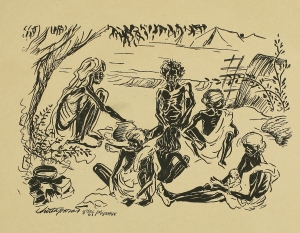
A priest turned beggar, his body starved thin; a family of destitute potters picking up grains soiled in mud; emaciated women forced into sex work; and a man scavenged by dogs and vultures. These were just a few of the scores of starving people journalist Chittaprosad Bhattacharya drew in black and white sketches in his travels through Bengal’s Midnapore district during the Great Bengal Famine of 1943, the last of a spate of famines that plagued colonial India during British rule. Bhattacharya’s portraits of the destitute ’showed’ stories of mass starvation, making visible through withering human flesh a nearly immeasurable tragedy of more than 3 million hunger deaths. Brutal yet compassionate, his graphic chronicles provoked the ire of colonial administrators, prompting officials to burn every copy of his book, Hungry Bengal (1943).
Drawing by Chittaprosad on the 1943 Bengal famine
Despite the censorship of his book, Bhattacharya continued to report on the famine for the Communist Party of India’s weekly newspaper, The People’s War.His sustained efforts to bring the realities of mass hunger to bear on the public conscience in colonial, famine-struck Bengal set a precedent for journalists to use the press as a watchdog that can impel the government to act. Today, his reportage is instructive for those in the profession who particularly cover hunger, poverty and inequality.
In today’s India, home to over 200 million chronically hungry and malnourished people, a significant but small number of dedicated editors, publishers, journalists, photographers and broadcasters are taking strides to highlight the complex nature of inequality in this country. A sporadic renewal of interest on the part of the media to report on hunger and starvation often only occurs in moments of crisis: starvation deaths, children’s deaths, or spoilage of grains in warehouses. Continue reading Reporting Hunger from the Margins: Agrima Bhasin and Ashwin Parulkar→
Sanitation Hospital Workers Strike at a Delhi Hospital over Non-Payment of Minimum Wages
Sanitation workers of the Satyavadi Raja Harishchandra Hospital (The Truthful King Harishchandra Hospital), Narela in Outer Delhi have started an indefinite dharna today, to protest their unjust dismissal when they asked to be paid the statutory minimum wage for unskilled work declared by the Delhi Government, Rs 7254 per month.