Category Archives: Left watch

The ‘Congress Question’ in the CPI(M) and the Problem of Historical Relevance

The CPI(M) is currently being rocked by an internal ‘debate’ over what has emerged, to put it in somewhat old-style communist speak, the ‘Congress Question’. I put the word ‘debate’ in quotation marks because, there is a touch of innocence to the way positions in support of a possible alliance with the Congress are being expounded by respected, senior intellectuals like Irfan and Sayera Habib in their letter to the party politbureau or Badri Raina in his article in a leading newspaper. These statements follow the dramatic exit of another widely respected Central Committee (CC) member, Jagmati Sangwan, from the party for precisely the opposite reason – of the CC going soft on the Bengal CPM for having gone against the commonly arrived at understanding in allying with the Congress. There is undoubtedly a potential debate here but since the common reference point in both – the Habibs’ letter as well as in Raina’s article – happens to be the recent election in West Bengal, one cannot help feeling that it is either a  ‘debate’ over a non-problem or is, at best, a question badly posed.

I say this for two reasons. First, the West Bengal CPI(M) [henceforth CPM-WB] is not really fighting any principled battle – all its exertions in West Bengal, contra Irfan and Sayera Habib, are directed, not against the proto-fascist Modi regime but against the Trinamool Congress whose local party apparatus is substantially what it has inherited from the CPM-WB itself. In the present context of West Bengal, what is urgently required is a different Left platform (with different faces that speak a different language) that can take the place vacated by the CPM-WB. In the absence of any such alternative, nothing can prevent the BJP from emerging as the main opposition party – and if that happens, that will be the end of any kind of Left politics for a very long time to come. A ramshackle CPM-Congress alliance as the opposition to the TMC is the surest way of making the Left (even in name) irrelevant in the state’s politics. The CPM-WB’s desire for an alliance with the Congress is motivated not by the need to defeat the Modi regime’s incursions but rather to return to power any which way. This seemed such a distant dream before the elections that the latter was prepared to go into an alliance with the Congress and entertain the possibility of a joint Congress-CPM-WB ministry, even as junior partner, were electoral fortunes to be reversed by the coming into being of the alliance. Thankfully, this possibility seems ever so remote now, following the election results, despite the alliance that we need not worry about it anymore. Continue reading The ‘Congress Question’ in the CPI(M) and the Problem of Historical Relevance

सी पी एम के भीतर जनतांत्रिक विरोध के अधिकार का प्रश्न – जगमती सांगवान के बहाने

सी पी एम या भारतीय कम्युनिस्ट पार्टी (मार्क्सवादी) पिछले दिनों अपनी एक सदस्य की वजह से खबर में रही. अनुशासनहीनता के कारण जगमती सांगवान को पार्टी से निकालने का निर्णय किया गया,ऐसी सूचना उसके वक्तव्य में दी गई है. जगमती पार्टी की केन्द्रीय समिति की सदस्य थीं.

जगमती सांगवान को पार्टी से निकाला बाद में गया, केन्द्रीय समिति की बैठक के दौरान ही पहले वे बाहर निकल आई थीं और प्रेसवालों के सामने पार्टी छोड़ने का ऐलान कर दिया था.लेकिन कम्युनिस्ट पार्टी में ही नहीं,किसी भी पार्टी में शायद ही किसी सदस्य को खुद पार्टी से अलग होने का गौरव लेने दिया जाता रहा हो! यह फैसला पार्टी ही कर सकती है कि सदस्य का रिश्ता पार्टी से कैसा और कितना लंबा होगा.इसलिए कम से कम इस आधार पर सी पी एम की आलोचना करने के पहले पार्टियों के तंत्र की आलोचना करने की आवश्यकता होगी. Continue reading सी पी एम के भीतर जनतांत्रिक विरोध के अधिकार का प्रश्न – जगमती सांगवान के बहाने

Saffronization, Yoga and the Kerala Left: CP Geevan

Guest post by CP GEEVAN

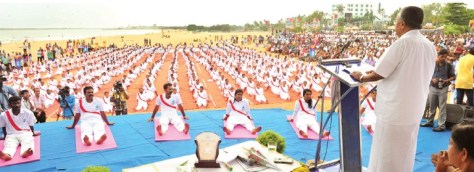
There are many ways in which ‘saffronization’ is being carried out at various levels. It takes the form of virulent battles at one extreme and persistent soft-campaigns at the other. It really does not require deep skills in socio-political analysis to see this entire spectrum of insidious divisive politics – all of that are in the clearly visible band. Surprisingly, the CPI(M) seems to have taken the attitude of a friendly match when it comes to certain variants of soft-saffronization, pretending not to see what is going on behind often innocuous-sounding things like Yoga – the latest weapon being deployed in the saffronization campaign. Instead of questioning the premises of this misplaced ‘national celebration’ and its belligerent imposition that defines the Modi government move, the party has chosen to play a friendly match by wholeheartedly joining the soft-saffronization race.

Pinarayi Vijayan at CPI-MK's Yoga event
Pinarayi Vijayan at CPI-MK’s Yoga event

The CPI(M, Kerala syndicate) has, in many ways, outperformed the RSS in Kerala so much so that the hyper-active media in Kerala had very little to report on how BJP and RSS celebrated yoga day in God’s Own Country. It seemed the Sanghis were pleasantly surprised at the saffronization of the CPI(M) itself! May be, the CPI(M) is gloating over how it out-smarted the Sanghis at their own game but that is not how it works in the world of everyday politics. For their part, the Sanghis could find nothing to object to in the way the new government in Kerala celebrated yoga. It seemed the Gods came to the CPI(M) party headquarters to pay obeisance to the newly enthroned in their glorious new clothes, new language, new style, new gait, new approach, and, of course, some inklings of a new, disquieting politics.

Continue reading Saffronization, Yoga and the Kerala Left: CP Geevan

Stop Trying to Portray Us as Extremists: Dalit Human Rights Movement

The police investigation about the bomb blast at the Kollam Collectorate on 15 June 2016 has now turned against us. Neither the organization nor its activists have any involvement in this incident. The accusation against us is just a ploy to use draconian laws such as the UAPA to destroy dalit-adivasi resistance.

The demeaning and enslaving social norms in Kerala have, since centuries, denied dalit people the most basic human rights such as the right to education, the right to decently clothe one’s body, the right to travel on public roads, and express one’s views. But India became a democracy that aimed for social democratisation, and Dr B R Ambedkar raised the possibility of social equality and reservations for the underprivileged groups through the Indian Constitution. Yet, sixty-five years later, the classes fundamental to this society have made no social, economic, or cultural progress and they continue to endure caste slavery and and exploitation in all areas of public life. The mainstream political parties who surfaced as the protectors of these classes have never offered them complete protection at any time. Though they have been faithful followers and workers of these parties, members of the disadvantaged groups have had little economic security; they have lacked social education; they have had to cry out for tiny parcels of land. Continue reading Stop Trying to Portray Us as Extremists: Dalit Human Rights Movement

Crushing Dignity, Force-feeding Honour: The CPM is Back in Form Again!

The hunt, it seems, is on again. The CPM in power has begun to show its fangs again, and shamefully, they seem to threaten only dalit people who refuse and criticise their disciplinary/welfarist embrace.  In north Kerala, two dalit women were arrested for having allegedly attacked a DYFI leader who abused them in casteist terms. In the south, the persecution of the Buddhist Dalit Human Rights Movement (DHRM)seems to have begun afresh, with the police and the press foisting on them responsibility for the recent bomb blast at the premises of the Kollam Collectorate. The two women mentioned belong to the Congress party; as for the DHRM, the CPM has had a long-standing grouse against them, carried forward now from their last term in power. I am not sure, but the recent ouster of Laha Gopalan, the leader of the Chengara land struggle in the wake of the CPM’s return to power, could be part of this story too. I have no love lost for that man, who evoked the name of Ambedkar but ran the village set up by the landless in Chengara like a crude caste headman. But the timing of his expulsion and the way the village seems to be under the thumb of the police arouses discomfort. Continue reading Crushing Dignity, Force-feeding Honour: The CPM is Back in Form Again!

In the Name of Fidel – The Left Reads the Mandate: Vipin Kumar Chirakkara

This is a guest post by VIPIN KUMAR CHIRAKKARA

Party has two faces: V.S. Achuthanandan (centre) with Pinarayi Vijayan (left)
Party has two faces: V.S. Achuthanandan (centre) with Pinarayi Vijayan (left) Photo and Caption Courtesy – Indian Express.

In his address to the media in Thiruvananthapuram after the Left won the mandate in Kerala, Sitaram Yechury announced two positions to be given to two leaders of his own party who had successfully contested the elections from there.  One is that of the leader of the legislative party of the CPI-M, or effectively the chief ministership of Kerala.  That went to Pinarayi Vijayan.  The other one went to V.S. Achuthanandan.  He is made the Fidel Castro of Kerala.  Yechury, the embattled general secretary of the party who is also known to be closer to VS than to Vijayan, elaborated on the function of the second position since, seemingly, he felt that people could develop doubts about the implication of this honour, if not an anxiety whether the left victory in a single assembly election is turning Kerala into Cuba.  He clarified that VS will be an inspirational symbol providing advice and direction to the new government, and added that the veteran leader could not head the government due to his advanced age and poor health.  Yechury was, of course, flanked by the state secretary of the party Kodiyeri Balakrishnan and VS himself.  The suspense thriller of this election thus had the curtain fall, with an anti-climactic scene of unity.

It would deprive us of a unique opportunity to know another meaning of the mandate if we ignore how Yechury has read it.  He interpreted the mandate in the same address to the media that was held in Kerala’s capital.  He had a special reading to offer us, indeed different from what we all would ordinarily imagine.  His reading is distinguished from ours by its methodology itself.  He does not look at the assembly elections with reference to states where elections have taken place now. According to him, elections took place in 820 seats.  He took out his cell phone and provided the statistics of the results.  The BJP could win only in 64 assembly seats, the Congress in 115 whereas the Left has been victorious in 124.  He said that this was “the absolute ground reality”.  He assured us, the anxious beings, further that this reality implied no such threat as the return of the saffron.  When a journalist mentioned to him the victory of the Trinamool Congress that had won above 210 seats in West Bengal, he said he had in mind only the national parties.  So, we are expected to understand if we haven’t yet, that the Left’s is indeed an impressive performance as a national party!

Continue reading In the Name of Fidel – The Left Reads the Mandate: Vipin Kumar Chirakkara

Choice, Agency and the Naming of Names – The Trap of ‘Immediate Identities’ and the Vision of a Democratic Revolution: Chintu Kumari & Umar Khalid

Paired Guest Posts by CHINTU KUMARI and UMAR KHALID

[ Every struggle goes through highs and lows. The students who are part of the  movements that are spreading out of universities in India – Hyderabad Central University, Jawaharlal Nehru University and Jadavpur University have had their share of internal debates and disagreements, even as they have found moments of significant victory. and solidarity

Students at JNU who have recently concluded their hunger strike to give time to the university authorities to respond reasonably to the High Court directives on the HLEC punishments are now being criticized for having ‘abandoned the struggle’ by some sections who claim to play a role within the broader students movement, when, in fact, nothing of that sort has actually happened.

The majority of the students who were on hunger strike (including several JNUSU office bearers, and others) have said that they have given up the hunger strike against the HLEC recommendations in keeping with the court order.  In doing so, they have never said that they are suspending the agitation against the attempts by the JNU administration to weaken OBC reservation in admissions, hostel seats and deprivation points for women and oppressed sections of society.

In fact it is not as if the HLEC punishments issue has taken precedence over the other issues. It is actually the other way round. The students have decided to give priority to the struggle for ’social justice’ within the campus, while simultaneously giving time to the university authorities to respond adequately to the court directive on the HLEC punishment question.The call for a demonstration against the University Authorities by the JNUSU to continue the struggle on the social justice issues on the 16th of May is indicative of this fact.

13237814_1106943902682435_4288761213192298400_n

The attacks and insinuations against the majority of the students at JNU who were on hunger strike have also featured a deliberate attempt to create divisions within the unified ‘Red-Blue’ / ‘Jai Bhim-Lal Salaam’ dynamics of the movement on the grounds of identity. Activists, such as Umar Khalid, on the left have been singled out for being ‘Savarna-Syed’, if they happen to bear a Muslim name, and for being ‘sold out to the Savarna left’ if they are Dalit, as happened with Chintu Kumari and Rama Naga. This attack has come primarily from individuals representing organizations like BAPSA that claim to speak from a ‘Dalit’ position, and it is given traction by several other individuals eager to flaunt their disdain for the ‘left’ students on Facebook and social media.  Continue reading Choice, Agency and the Naming of Names – The Trap of ‘Immediate Identities’ and the Vision of a Democratic Revolution: Chintu Kumari & Umar Khalid

The HLEC and the Aporias of ‘Committeed’ Enquiries: Rina Ramdev and Debaditya Bhattacharya

This is a guest post by Rina Ramdev and Debaditya Bhattacharya

Students of JNU have been on an indefinite hunger-strike for over 15 days now, and the administration’s only official response so far had been the Vice Chancellor’s May 4 statement invoking the vocabulary of the ‘lawful’ and the ‘constitutional’ — in ambivalences closer to threat than appeal. The subsequent May 10 Academic Council meeting has been historic, both for its 53 members’ overwhelming denunciation of the HLEC report, as also for the indelible image of a fleeing VC now forever etched in campus folklore. Further, the Delhi High Court’s stay on the fine imposed upon one of the students lends hope for similar stays with the remaining beleaguered students’ cases. The VC has consequently been referring to the enquiry mandate as being sub-judice, only to grant it an interim legitimacy that may symbolically defeat the stridency of student resistance. Letters have been sent out to the parents of striking students, in an attempt to re-route intimidation and pressure through other non-official means of paternalism. Given the conditions of duress being thus created, until the HLEC’s report is revoked in entirety, there is every reason to believe that the administration’s vindictive punitive designs will leech into the future of university freedoms and campus democracy irreversibly.

Continue reading The HLEC and the Aporias of ‘Committeed’ Enquiries: Rina Ramdev and Debaditya Bhattacharya

But She was a Law Student …


In a way that is perhaps unprecedented, today, a very large number of Malayalis feel connected to each other by a veritable tsunami of pain. No wonder perhaps, because the veils of our complacency have been ripped off too thoroughly. The immediate context is the gruesome murder of a young Dalit student in central Kerala, in the tiny, rickety squatter-shack that was her home, in full daylight.

At a single stroke, the incident fully exposed the dimensions of social exclusion in contemporary Kerala. Hers was an all-woman family among families deemed ‘properly gendered’, they were lower caste people trapped and isolated among upper and middle caste families, they were the working-class poor without property in an area full of propertied domestic-oriented bourgeois and petty-bourgeois families. Oppressed in all these ways, they were invisible to the state and the political parties. They possessed no form of capital that would have allowed them upward mobility. Yet, the young woman struggled on and reached the law college.

‘But she went to college’, some ask, ‘how could she have been so helpless?’

Read the rest of the article here 


Responding to the Challenges of Blue and Red – Reminiscences of a JNU-HCU Alumna: Shipra Nigam

This is a guest post by SHIPRA NIGAM

That the past few months have been cataclysmic is an understatement. Personal tragedies and political catastrophes have exploded within our most cherished spaces, and brought a churning in them.  What was truly transformative was the experience of both the emergence of broad solidarities against right-wing fascism, and of the reminders of multiple registers and contexts within them. These underline the need for multiple conversations to understand both our common struggles, as well as the contradictions within, and to renew a resolve for introspection through them as we move towards real ‘azaadi’.

There is of course an ongoing debate on this, and here I felt that some binaries being invoked in it are not very convincing, while others brought home stark truths that pose challenges to a patriarchal, majoritarian caste hindu ordering of society, within which we are all located at different levels of hierarchy, complicity, and engagement.

I have been part of both public universities under fire right now, and the present brings home the urgency of the dual task of defending the public university as a space for pushing the boundaries of critical thought, and confronting the very hierarchies and complicities with power that shape it. This is necessary even as processes of democratisation and affirmative action take root in public institutions . So these are some reminiscences from an alumna of both these public universities who has been wrestling with articulations and complexities which lie beyond institutional labels or binaries. Continue reading Responding to the Challenges of Blue and Red – Reminiscences of a JNU-HCU Alumna: Shipra Nigam

Statement of Solidarity with Hyderabad Central University from Columbia University, New York

This is a statement of March 29, 2016 from students, faculty and affiliates of Columbia University. We publish it below with apologies for the delay.

We, students, faculty and affiliates of Columbia University, strongly condemn the violation and atrocities brought upon the students and faculty of the Hyderabad Central University (HCU) on March 22, 2016. Since Professor Appa Rao Podile was on leave and under investigation for the institutional murder of Rohith Vemula, his return to the campus to resume duties as the Vice Chancellor was unacceptable. The students justifiably organized a peaceful protest in the campus that day. The institutional responses to that, by the University authorities, the Andhra and Telangana police force, Rapid Action Force personnel, the media, and the members of the Akhil Bharatiya Vidyarthi Parishad (ABVP) on campus, were outrageous, inhuman, and fascist. The University authorities, instructed by Prof Podile, shut down the Internet connection, dining hall and drinking water facilities in retaliation to the peaceful student protest. The Andhra and Telangana police force lathi-charged students and faculty, violently beat up and severely injured them, molested and threatened to rape female students, targeted Muslims and Dalits, abused them verbally, and eventually arrested 24 students and 3 faculty. The ABVP members resorted to violence and aggressive sloganeering from the very beginning of the students’ peaceful protest and also attacked and injured them. The mainstream media has been ignoring these atrocious events at a Central university campus and has decidedly turned away from its responsibility and its accountability to the public. This is ironic, at the very least, when some of the news anchors just last month were so focused on fabricating stories of “terrorist” and “anti-national” activities at the Jawaharlal Nehru University, Delhi. The media ultimately failed to demonize the students then. Now, yet again, the media is unabashedly siding with the authoritarian regime of corporate and state power; this time by ignoring the brutality of the police and the HCU authorities.

We strongly condemn

–       the fascist abuse of power by the University authorities, who decided to deprive the students of basic facilities as ‘revenge’ for the peaceful demonstration

–      the violence, the targeting and the brutality of the police force

–   the irresponsibility of the media for not reporting this on prime time and for effectively siding with the tyrannical regime in power

–       the atrocities unleashed by the casteist, capitalist, Hindu fundamentalist government and its affiliates, especially ABVP.

Continue reading Statement of Solidarity with Hyderabad Central University from Columbia University, New York

Fifty Shades of Grey – Without the Thrills

[This is a response to Shourajenda Nath Mukherjee’s open letter on Kafila by Prof Makarand Paranjape]

Mr. Shourjendra Nath Mukherjee’s “Open Letter” of April 5, 2016 makes only one substantive point, concerning the agency of students, which needs attention. The rest of it, as the Dormouse said to Alice, is “much of a muchness” – confusion, rigmarole, and thumb-twiddling over precious little, which scarcely need be dignified by serious confutation. Continue reading Fifty Shades of Grey – Without the Thrills

An Open Letter to Prof Makarand Paranjape

Guest post by SHOURJENDRA NATH MUKHERJEE

Please note that this response was first sent to Swarajya Mag, where Prof Paranjpe’s Open letter appeared, but was not published. It was then sent to Kafila.

Dear Prof Paranjape

I am Shourjendra, an MPhil research scholar in the Department of History, DU. I write this letter as a rejoinder to your open letter in response to Maitreyee Shukla. Your open letter was not addressed to me and therefore you can feel free to not reply to my letter.

You sir, seem to reflect a lot of the opinions expressed very strongly by a section of the urban middle classes. Granted, these views are by their very nature not ‘fascist’ but nonetheless they help perpetuate and legitimate the regime in power. You are also one of the most eminent academicians to have sought to engage in these raging debates in the public sphere, and I very strongly appreciate you for this. Your open letter is one such statement and I would like to take this up as an opportunity to critically engage with some of the issues that you have raised. (Since, your statements are mostly uncritical appreciation and endorsement of these ideas, I would regard your statements as statements made by an academician who has paused to think academically.) Continue reading An Open Letter to Prof Makarand Paranjape

Apropos Fetishizing Higher Education and University Politics

This is a guest post by PRATIK ALI.

[This article summarizes quite well the very many criticisms that have been raised from broadly the left of the political spectrum, about the Standwithjnu campaign. We do hope it generates a lively debate that will enlarge our horizons and strengthen the struggle against fascism]

Whether it has been the scrapping or stagnancy of the Non-NET Fellowship, the increased interference of the State in student activity in universities of higher-education, or merely the (routine) introduction of symbols of the ruling party in cultural institutions (of which universities are a part), a dangerous, and even strange trend is seen emerging in the student response: asserting their isolation from other sections of society as valuable uniqueness. Continue reading Apropos Fetishizing Higher Education and University Politics

University of Minnesota Stands in Solidarity with the University of Hyderabad

We, the undersigned at the University of Minnesota, strongly condemn the current onslaught on protesting students and faculty at the University of Hyderabad. Following the tragic death of Dalit scholar Rohith Vemula earlier this year, the UoH community has been questioning the role of the university administration in the circumstances leading to his suicide. Days before he took his life, five Dalit scholars including Vemula were expelled by the university administration. At the behest of the ruling government, they were punished for screening a film which documents the frightening spread of Hindu fundamentalism in India today. In the wake of their expulsion and then Vemula’s suicide, the UoH community spearheaded a nation-wide movement which draws attention to the horrific normalization of caste discrimination and the growing criminalization of dissent in universities in India. Instead of responding to the concerns raised by the movement, the university administration recently reinstated P Appa Rao to the office of the Vice Chancellor. As P Appa Rao has been charged for abetting Vemula’s suicide, this amounts to an utter mockery of the movement and also threatens the integrity of the on-going judicial enquiry about his death. This has rightfully angered the UoH community which registered its protest by peacefully occupying the office of the Vice Chancellor on 22 March 2016.

Continue reading University of Minnesota Stands in Solidarity with the University of Hyderabad

Stand With UoH: Statement by Concerned Members of the IIT Bombay Community


We, the undersigned members of IIT Bombay community, strongly condemn the police repression that has been unleashed on students and faculty of University of Hyderabad who seek justice for Rohith Vemula, with the active connivance of the University administration. The testimonies of the events have been singularly disturbing. We cannot let educational institutions become play fields of state repression. Continue reading Stand With UoH: Statement by Concerned Members of the IIT Bombay Community

Break the Blockade: A Message from a Faculty Member at UoH

[I just got this message from a friend who teaches at UoH and has been trying to support students there. The situation sounds so serious, I asked her permission to post part of the email on Kafila]

 … It has been a very crazy time for us here. However, at this point, in my personal opinion the highest priority is to remove the blockade of entry into the campus. Let me document for you what is still happening in the campus.


1. Parents of students arrested and sister of Thathagata, the arrested faculty member are also not being allowed into campus.

2. Bhim Rao who is the currently acting lawyer of the Velivada students was also not allowed into the campus yesterday. Two of us faculty went and fought with the security officer and told him to give in writing that following the orders of the registrar, he is refusing entry of the lawyer into the campus. Then, he talked to the Registrar, went and got approval and allowed the lawyer in.

3. Rohith’s mother has attempted entry into the campus alone and with the help of civil society multiple times and has been refused entry always. On March 26th morning she was coming to the univ. and fell ill due to her high BP and her right hand going numb. She needed immediate medical attention. When a faculty member attempted to bring her into the campus so she can be looked at by the doctors in the health centre, she was not allowed. Then, doctors went out of the main gate and measured her vital parameters and got her shifted to a hospital. She was under observation for 24hrs.

4. There is still police patrolling on campus.

5. We hear now that new names have been added to an existing FIR in which students are named but not yet arrested.

So, the harassment continues. Students are standing strong despite the extreme intimidation by the administration.

I am sorry to say this and I may be accused of overstating it. However, I feel we are in Chattisgarh when I see the mainstream newspapers. We are in a war without witnesses too, it seems. No reporter is even attempting entry into the campus. There is no media outrage at what is happening on campus. There are no opinion pieces on what is happening on campus from any of the intelligentia of this country in the newspapers. I remember seeing a piece every day about JNU and we were with them. But, we now feel utterly abandoned by all. Is there no way to pressure at least the print media to cover what is happening? Maybe we do not know how to be publicity savvy?! We are stretched so thin trying to protect students – whenever there is any demo by students and so on, at least two of us faculty are around to be at least a witness if not to stop any attacks.

Appreciate any help/advice from you people on this. But, our appeal is that civil society with political parties HAS TO BREAK THE BLOCKADE OF ENTRY. The Registrar’s order states: political parties, politicians, external student organisations and media ONLY. How come lawyers are not being allowed inside? How come parents and families of affected students and faculty are not being allowed inside? What is happening in this country?

Continue reading Break the Blockade: A Message from a Faculty Member at UoH

Rise in Rage – Message of Solidarity for HCU Students: Anirban Bhattacharya and Umar Khalid

Guest Post by Anirban Bhattacharya & Umar Khalid

“We dissent, therefore we are”
The times we are living in are audacious. As the brahmanical Hindutva fascist forces in collaboration with big corporates are attempting to browbeat (or even just beat) us into silence, what better time than today to be audacious, to show our audacity. And that is precisely what Rohith Vemula did, both in his life as well as in his death. He dared to dissent against the brahmanical and communal structures of discrimination and oppression. He posed a graver “national security threat” because he was not just speaking up against the oppression against the Dalits, but also tried to build solidarities with other oppressed communities – the Muslims and other minorities. 
Of course, this invited the wrath of the powers that be – of Manu-Smriti Irani, of Bandaru Dattatreya, of the puppet VC Appa Rao and the puppeteer – the RSS. This earned him the epithet of “anti-national” as he was murdered institutionally by the communal-casteist apparatus of the state. The motive of the state was to “teach him a lesson” and “teach a lesson” to all those voices who dared to be audacious. But in vain. Rohith’s murder sparked a fire that spread across the country – across universities – demanding justice for Rohith. The need was felt by the RSS/BJP to “teach a lesson” yet again. In JNU the attack came in the form of the facile “national/anti-national” debate. When this was thwarted, in HCU it came in the form of the re-installation of the puppet VC Appa Rao.

This, of course, was an insult to the cause of justice for Rohith. It was an affront to the very idea of social justice. And it was a direct challenge to all democratic voices in the country. This outrage, this indignation could not have been taken lying low. The students in HCU yet again showed their audacity as they rose in rage against the re-installation of a killer VC. And this was met with a brutal lathi-charge by the Telangana Police, a fascist witch-hunt of student activists and teachers, their arrest on bogus charges, suspension of mess-water-electricity-internet and other facilities. The university has been turned into a war-zone.

Today universities and educational institutions across the country are being turned into war-zones and prison houses. It’s a shame today that heads of institutions and VCs – whether in FTII or HCU – are being escorted into their own campuses under police protection. On the one hand the institutionalized discrimination against Dalits and other oppressed castes is either forcing students to drop-out or hang themselves thereby necessitating the incessant demand for a Rohith Act. While on the other hand, through a concerted effort the state is imposing the brahmanical Hindutva fascist agenda of the RSS in course-curriculum. On the one hand, the state is pursuing a policy of massive fund cuts, fee-hikes or privatization so as to make higher education unaffordable for a large section – particularly the oppressed caste/class. On the other hand, to achieve the same, the ruling classes have been preparing to quell all possible resistance to the above through depoliticizing campus-spaces and curbing any and every voices of dissent. Such are the diktats, the exigencies of the insatiable thirst of global capital for profit in its bid to overcome the inherent crisis. While such anti-student pro-privatization policies were set in motion by the erstwhile Congress governments with all earnest, under the present regime, further velocity and teeth has been added to the same. The tightening tentacles of fascism in the country with RSS at its helm has only meant further witch-hunt, increasing militarization, casteist targeting, and shrinking of democratic space for debate and dissent in campuses.  

But, much to the irritation of those in Nagpur, the more vicious has been the assault, the more spectacular has been the resistance. From being against the bogey of Love Jihad to being for Kiss of Love, from being against Ghar Wapsi to calling the bluff on Swacch Bharat, from being against Dadri killing to exposing the farce of Make in India, from Hokkolorob to Pinjatod, from FTII to IIT-Madras, from Allahabad to Calicut, from Occupy UGC to Justice for Rohith, from Stand with JNU to Stand with HCU – there is a students’ spring today that swells across the country. We the students, today, are the opposition. And it is this strength that was exhibited in the streets of Delhi when Justice for Rohith and Stand with JNU merged into a sea of resistance.

If we look back in history, at times when the ruling classes has intensified its assault upon the people across the world, it is the students who have taken up a vital share of responsibility to speak up, to dissent. And more often than not we have seen various such youth and student movements talking to each other, drawing from each other, inspiring each other and thereby strengthening each other. The Black Panther movement influenced the Dalit Panthers. The struggle in Vietnam triggered massive anti-war demonstrations across the universities in America. The students of France 68 inspired millions of students across Europe and the world. The Cultural Revolution led by students in Maoist China inspired millions including the students during the Naxalbari movement which in turn inspired thousands across the subcontinent. Similarly it is important today that the movements whether of the Dalits, the women, the minorities, the LGBTIQ community, the workers, the peasants – should all speak to each other and gain strength from each other. At a time of ascendant fascism, it is imperative that we build solidarities forged in struggles. Because, even today if we remain divided into red, blue and green and so on, even if today we remain divided in HCU and JNU – fascism will ensure that tomorrow none survives. Maintaining our ideological differences – our colours, sharpening our tools of criticism and self-criticism, we must shun the path of sectarianism and build genuine unity of the oppressed against the combined assault of the brahmanical Hindutva fascist forces and the forces of big capital. 

The attack today is relentless. So has to be the resistance. The bail orders for a few individuals in a campus can be a small battle won, but the war is far from over and there can be no respite today. We are confronting fascism today; it is a difficult fight, and no one ever said it would be easy. Let us fight for the release of the students and teachers put behind bars in Hyderabad and in the process let us intensify the struggle to oust Appa Rao, to seek justice for Rohith, to challenge the brahmanical fascist forces and their tightening noose.

Rise in Rage against the reinstallation of Appa Rao, the killer of Rohith Vemula as VC in HCU.

Condemn the brutal crackdown and arrests of students and teachers by Telangana Police.
Anirban Bhattacharya & Umar Khalid are both students of Jawaharlal Nehru University (JNU) Delhi

Statement by Concerned Faculty from The English and Foreign Languages University on the Police Crackdown at HCU

We, the concerned faculty from The English and Foreign Languages University, Hyderabad, strongly condemn the police brutality at the University of Hyderabad on 22nd March 2016, after the return of Prof. Appa Rao Podile, the Vice-Chancellor accused of abetting the suicide of the Dalit Research Scholar Rohith Vemula. As an academic community, we are extremely disturbed by the excessive interference of the state machinery, administrative conspiracies, the abuse of power and systemic oppression that prevail in many of the universities in India of late. A university should be a just and egalitarian space. But the suicides of Dalit students with the recent case of Rohith Vemula lay bare systemic structures of oppression and institutional legitimization of caste violence existing within Indian universities. Our university spaces need serious re-vamping to ensure equal opportunity, social justice and critical discourses. Continue reading Statement by Concerned Faculty from The English and Foreign Languages University on the Police Crackdown at HCU

Am I Doing Enough? Crisis, Activism and the Search for Meaning: Lata Mani

This is a guest post by LATA MANI

In the past fifteen years I have been developing what I describe as “contemplative cultural critique.” Such an effort at transcoding between secular and meditative understandings is not without difficulty and not without its limits. But it has led me to pose questions I might not otherwise have asked, and to think through them in ways that I would not have previously considered.

How might this approach contribute to reflecting on the political turmoil of the past eight weeks in India? This period has been marked by national focus on the penalization and criminalization of student dissent at Hyderabad Central University and Jawaharlal Nehru University. In the former case prolonged institutional harassment drove Rohith Vemula to take his life and in the latter it has led to the imprisonment of Kanhaiya Kumar, Umar Khalid and Anirbhan Bhattacharya on charges of sedition. In both instances a witch-hunt led by the media and the right-wing BJP government has created a hostile environment conducive neither to dialogue nor to a calm consideration of facts. These events, as P. Sainath has argued, extend to university campuses ideological, legal and political tactics long used against communities resisting “development” in rural India.[1] Continue reading Am I Doing Enough? Crisis, Activism and the Search for Meaning: Lata Mani

Of False Binaries and ‘Dirty’ Politics: Divya Kannan

This is a guest post by DIVYA KANNAN

Manu Joseph’s latest commentary regarding the ongoing crisis in Jawaharlal Nehru University (JNU) and the larger debate on Indian ‘nationalism’ smacks of crass elitism, as a journalist pithily pointed out online. If one were to use a ‘different term’, as Joseph himself keeps venturing to do in his writing, it is simply nauseating. This is for several reasons. To begin with, he harbours a convoluted understanding of what research in higher educational institutes entails, the nature of student politics, the lasting dangers of right wing assaults, and the pathetic misrepresentation carried out by the media, including himself, of the pressing issues in this country. Continue reading Of False Binaries and ‘Dirty’ Politics: Divya Kannan