
If there is one thing, besides the pervasive Islamophobia in Kerala in both the Left and Right, that the Hadiya case reveals, it is the deeply entrenched commitment to patriarchy everywhere — on the Right, Left, the radical civil society, wherever. Continue reading Judicial Ghar Wapsi : Update on the Hadiya Case
Category Archives: Left watch
Poo’, poo’ Dilip and his Valiant Knights
Poo’ poo’ Dilip is an effect of the discourse on the Malayalam cine actor Dilip , who is facing trial for his alleged involvement in the conspiracy behind the despicable attack on a young woman actor in Kochi in February 2017. Now, as his next bail plea (thrice refused) draws near, there seems to be a concerted effort to produce public sympathy for the jailed actor – which has produced its own discourse, much to the distaste of those who feel that the wronged actor, and not the one accused of wrong-doing, needs to be supported. Poo'(r) Poo'(r) Dilip is a direct (and feminist) translation of the funny distortion of the piece of sentimental shit going around social media on his behalf – Dilip paavamaa, eda (Dilip is a nice guy, bro). Continue reading Poo’, poo’ Dilip and his Valiant Knights
Losing the Soul’s Acid Tongue … Terrorist State, Unbowed Children at Kerala’s Puthvype
[The title is inspired by Balachandran Chullikkad’s searing poetry]
I have recently been asked about why I didn’t write anything about the anniversary of the CPM-led government of Kerala. Have also been asked why I don’t write about politics in Kerala anymore. The answer to the first is easy and painless: governments are not organic things. You measure your kid’s height and weight and other things and think about how they have grown in their minds and hearts on their birthdays. There is nothing that proves that anniversaries are the best occasions to reflect on how governments have grown and thrived. The answer to the second question is more conflicted and excruciatingly painful: it is because we have no politics in Kerala, but plenty of anti-politics. therefore, what one needs to do is invest in the silent, unglamorous, unpopular, long-haul intellectual and political labour that may preserve the possibilities of politics in the future, and that may even create internalities capable of courage and responsibility necessary for being political. Continue reading Losing the Soul’s Acid Tongue … Terrorist State, Unbowed Children at Kerala’s Puthvype
Thinking Labour in Contemporary India – For a Different May Day Agenda
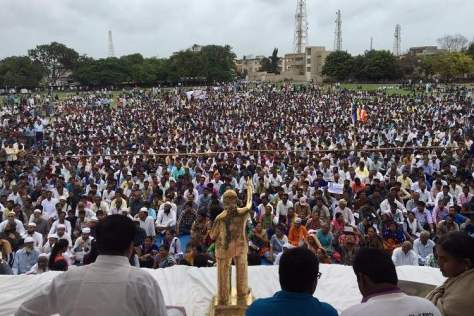
This May Day comes at a very crucial juncture in our history. Crucial, not simply because there is a belligerent Hindu Right government in power but also because it comes in the wake of the most unprecedented belligerence of the upper castes and their all-round violence, especially on the Dalit communities across the land. Last year we had witnessed the most shameful incident of violence in the flogging of four Dalit youth by the cow gangs of Hindutva, which was followed by massive protests by Dalits and joined in by other sections of people, including some of the Left forces, as well. The attack had to do with the very specific form/s of labour that Dalit communities have been made to traditionally perform in Hindu society, in this case, the work of disposing of carcasses of dead animals, skinning them and so on. Continue reading Thinking Labour in Contemporary India – For a Different May Day Agenda
New Politics of Our Times and Post-Capitalist Futures
An earlier version of this essay was published in Outlook magazine
“The young students are not interested in establishing that neoliberalism works – they’re trying to understand where markets fail and what to do about it, with an understanding that the failures are pervasive. That’s true of both micro and macroeconomics. I wouldn’t say it’s everywhere, but I’d say that it’s dominant.
“In policymaking circles I think it’s the same thing. Of course, there are people, say on the right in the United States who don’t recognise this. But even many of the people on the right would say markets don’t work very well, but their problem is governments are unable to correct it.”
Stiglitz went on to argue that one of the central tenets of the neoliberal ideology – the idea that markets function best when left alone and that an unregulated market is the best way to increase economic growth – has now been pretty much disproved. Read the full report by Will Martin here
One often hears over-zealous warriors of neoliberalism say of Leftists that they live in a time- warp; that the world has long changed and that the disappearance of state-socialism has finally proved that all their beliefs were little more than pipe-dreams. They talk as though history came to an end with the collapse of actually existing socialisms and the global ascendance of neoliberalism in the early 1990s. As though all thought came to an end; as if the distilled essence of everything that could ever be thought, or need be thought, was already encapsulated in the neoliberal dogma.
Continue reading New Politics of Our Times and Post-Capitalist Futures
Who will get the hot roti in the Delhi assembly elections?
My friend Guddi has a great story about a Gujjar wedding she attended recently in Ghaziabad. It was a typically chaotic event, marked accurately by the swirling crowds around the dinner stalls. If Gujjar weddings are chaotic and the dinner doubly so, the scene around the tandoor is triply compounded chaos. Barely concealed competition amongst overmuscled Gujjar men in overtight pants for that precious hot roti ensures that none but the most Hobbesian men remain, circling the tandoor like hungry wolves, periodically thrusting their plate forward like fencing champions and shouting obscenities at the harried servers. In such a heart-stopping scenario, a young server had as Guddi recounts, figured out the formula to keep everybody from killing each other (or him). As soon as the roti would be pulled out of the tandoor, seductively golden brown and sizzling, this man would hold it high up with his tongs so everybody could see, then in an elaborate dance-like ritual, touch each of the empty extended plates in front of him with the roti, and finally, in a mysterious but authoritative decision, place it respectfully on a randomly selected plate. Repeat with every single roti that emerged from the tandoor. A hushed silence followed by nervous laughter followed every such flourish.
Continue reading Who will get the hot roti in the Delhi assembly elections?
Thinking Past the BJP Victory in UP – Response to Biju Mathew: C.P. Geevan
Guest post by CP GEEVAN
The following is a response to the piece by Biju Mathew on Kafila, underlining the need for single-minded focus and keep the feet firmly on political realities
Given the exuberant optimism that Biju Mathew evokes in these dark days, many of us afflicted by malignant pessimism should not have many reasons to complain or pick holes in this view of looking back and foreseeing the way forward. On the face of it, this article does gladden one’s heart and spirit! However, imagining larger than life attributes to struggles and spells of resistance can be very misleading. In a way, with a rather benevolent interpretation, one cannot quarrel with Biju’s contention that nobody needs to wait for some political party to lead the resistances against the far-right takeover or start the process of breaking the ‘wave’. There is no hesitation in agreeing with the proposition that instead of waiting, which carries the risk of waiting indefinitely, it is imperative that each individual who is appalled at the turn of events must contribute urgently to building ‘innovative and locally responsive actions’. Well, inaction is certainly not an option. Act we must – in the face of the frightening likelihood of the saffron brigade unleashing a horrific civil war and engineering mass killings. There are no quarrels as to the primary intent of the article – that it is a call to shed excessive pessimism, end despondency, and take steps towards politically meaningful actions. Nevertheless, it will be a big mistake to imply that the process of banishing the gloom need not extend to the political rivals of the Hindutva nationalist parties. Continue reading Thinking Past the BJP Victory in UP – Response to Biju Mathew: C.P. Geevan
Remembering M. Rasheed – A Grandchild’s Political Farewell: Bobby Kunhu
Guest post by BOBBY KUNHU
Rasheed, a political activist, award winning journalist and activist was one of the founders of the Trotskyite movement in India and the RSP in Kerala. He passed away on the 6th of January, 2017

It is very unusual for a grandchild to write public obituaries for grandparents – but Comrade M. Rasheed was a person of unusual politics and his death definitely warrants an unusual response requiring the obituary also to be unusual. Given that the significance of Comrade Rasheed’s life was his unwavering integrity to ideals that he fell into the bad books of his father and walked out of the political party he co-founded, given that he never shied from expressing his opinion on anyone – it would only be right in writing this as a critique of the human being he was – and I am sure he would not have expected anything less from me. Continue reading Remembering M. Rasheed – A Grandchild’s Political Farewell: Bobby Kunhu
Canada’s intervention sought for the release of Saibaba : Radical Desi
Guest Post by Radical Desi
A letter asking Canada’s Minister of Sports and Persons with Disabilities Carla Qualtrough to intervene for the release of disabled social justice activist who has been convicted for life in India was submitted at her constituency office on Tuesday, March 28.
Signed by 100 people, the letter asks Canada, which claims to be a human rights leader in the world, to press upon the Government of India to free G.N. Saibaba, a wheelchair bound Delhi University professor who is 90 percent disabled below waist.
Saibaba was sentenced to life imprisonment early this month under draconian Unlawful Activities Prevention Act for standing up for the rights of the oppressed communities, including Adivasis (Indigenous peoples) and religious minorities.
Saibaba was first arrested in 2014 and incarcerated under inhuman conditions sparking protests across the world. Demonstrations were also held in Greater Vancouver, including one outside the Indian Consulate. Though Saibaba got bail on medical grounds, he has now been convicted after being branded as Maoist supporter. His only fault is that he has been raising voice against repression of the Adivasis, who are being evicted from their traditional lands by the extraction industry in connivance with the state authorities. Often the security forces and the state sponsored vigilantes target Adivasis in the areas under the influence of Maoist insurgents in the name of war on terror. By punishing Saibaba the Indian state is clearly trying to suppress a voice of dissent.
The representatives of Radical Desi submitted a letter asking for Canada’s intervention into the case at the constituency office of the Honorable Carla Qualtrough in Delta.
Continue reading Canada’s intervention sought for the release of Saibaba : Radical Desi
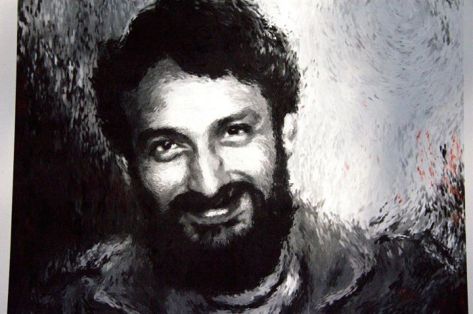
Remembering Chandu, Friend and Comrade: Kavita Krishnan
Guest Post by Kavita Krishnan
It’s been twenty years since the assassin’s bullets took Chandu away from us, at 4 pm on 31 March 1997.
I still recall my sheer disbelief when a phone call from my party office at my hostel that evening informed me ‘Chandu has been killed.’ Chandrashekhar as well as youth leader Shyam Narayan Yadav had been shot dead while addressing a street corner meeting in Siwan – ironically at a Chowk named after JP – Jaiprakash Narayan, icon of the movement for democracy against the Emergency. A rickshaw puller Bhuteli Mian also fell to a stray bullet fired by the assassins – all known to be henchmen of the RJD MP and mafia don Mohd. Shahabuddin.
In the spring of 1997, as JNU began to burst into the riotous colours of amaltas and bougainvillea, Chandu bid us goodbye. He had served two terms as JNUSU President (I was Joint Secretary during his second stint) and had decided to return to his hometown Siwan, as a whole-time activist of the CPI(ML) Liberation. He had made the decision to be a whole-time activist a long time ago. Chandu’s friends know that for him, the decision to be an activist rather than pursue a salaried career was no ‘sacrifice.’ It was a decision to do what he loved doing and felt he owed to society.
Continue reading Remembering Chandu, Friend and Comrade: Kavita Krishnan
A Small Matter of Security – Holding the Guilty Accountable for What Happened in Ramjas College on the 22nd of February: Shafey Danish
This is a guest post by SHAFEY DANISH
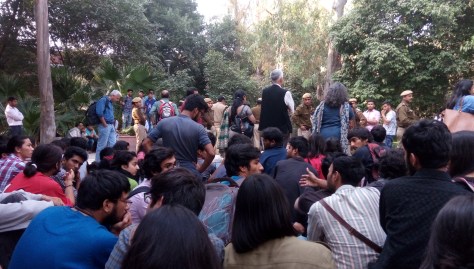
The violence that gripped Ramjas College on the 21st and 22nd of this month is now national news. We heard belligerent slogans by ABVP members of ‘chappal maro saalon ko’ (beat them with slippers), we saw students being chased on the campus, and we saw students being beaten up. All this culminated in a situation where students and teachers were held captive for over five hours within the campus premises. Let me emphasize that this violence was completely unprovoked.
On the 22nd of February, some of the students who were simply sitting with their friends were attacked. The police came and formed a cordon around them. Others joined the students in a gesture of solidarity. Teachers joined them to ensure that the students were not assaulted. The police cordon became their prison for the next five hours. And even then they were not safe.
They were repeatedly assaulted, threatened, and abused. All of this happened in front of their teachers and, more importantly, in front of the police, who, as is well known by now, did not do anything substantial. They could have maintained the cordon around the protesters, arrested those who were repeatedly carrying out the assaults, or – at the very least – prevented the attackers from coming back in (they had left for some time to attack the protest going on outside). But they did not. Whether this was because they were under pressure or because they were complicit is besides the point. The point is that students and teachers remained at the mercy of their attackers for over five hours.
But on the same day something far more ominous was also going on.
An Appeal to the Education Minister of Kerala and the Teachers of the University College, Thiruvananthapuram
We, the undersigned, wish to express our dismay and deep concern about the recent violent events at University College, Thiruvananthapuram, which seem to indicate that the rights of college students, especially women students, are seriously compromised in this venerable institution. As women researchers, academics and teachers of Malayali origin, we are deeply disappointed by the responses of the police, the concerned college authorities, and the teachers there. Continue reading An Appeal to the Education Minister of Kerala and the Teachers of the University College, Thiruvananthapuram
After a Nuit Debout (night standing up), We Wake Up with a Political Strike: Charles Reeve
Guest post by CHARLES REEVE
[Note from Livia Bocadacce: During 2016, social movements in France and in India have been huge and tough. In both countries, youth, workers, students, oppressed people fought against governments who disregarded their desires of freedom and decent life, and have faced violent repression. But in France, we don’t hear about Indian struggles such as Una Dalits’ movement or Hyderabad and JNU students’ protests. In India, the very strong French movement of last spring, called “Nuits Debout”, has aroused very poor coverage. Because we believe we have to learn from the crossed experiences of fighting, because we refuse a globalization only based on trade and forced migrations, because we hope a globalization that could encourage the circulation of critical thinking and collective–action repertoire, we proposed this article on the Nuits debout to Kafila. Hoping it will generate debates and further interests. ]

After a Nuit debout (night standing up), we wake up with a political strike (1)
Living in a moment is always pleasanter than writing about it— it’s always risky to draw conclusions about situations still evolving or to speculate about what they will become. Going on for now over three months [when this post was written – AN], Nuit debout is a new kind of spontaneous, social movement along the lines of « Occupy » and Spain’s « M15 » movement. It has taken on an unanticipated size and importance, all the while developing characteristic features of French society. I won’t go back over its development or its collective spirit. The two texts already published in the May and June issues of the Brooklyn Rail, the first by Anouk Colombani and the second by Ferdinand Cazalis et Emilien Bernard (CQFD, n°143, mai 2016) have provided sufficient detail and clarity to let us grasp the essence and dynamism of these mobilizations.
CPM in Kerala = Caste-Gender Elitism Minus Cow
This is my Malayalam opinion piece for iemalayalam, on something despite the outcry against the CPM in the mess around Kerala Law Academy. The public discussion has been, not unexpectedly, on the line of Kerala’s well-entrenched scandal journalism, which has a history of a hundred years, at least. This is a form of journalism that highlights the sexual lives – proper or improper – of powerful male politicians which accompanies the attack on their public failings directly or indirectly- a very highly successful tactic, hitherto, to undermine even the seemingly unassailable. When women began to figure in this kind of journalism as something more than just passive sexual objects, as active agents of corruption and manipulation – most markedly, in the controversy over the businesswoman Sarita Nair – scandal journalism worked by highlighting the huge contrast between their ‘feminine-respectable’ names, sartorial styles, behaviour, and so on, and the despicable manipulations they indulged in. This is the case also with much media discussion of the principal of the Kerala Law Academy, Lekshmi Nair.
However, this tactic is not only misogynist, it also lets the elite-femininity that she represents escape critique. This is a very contemporary form of respectable femininity that presents itself as essentially domestic, but wields delegated masculine power to vicious ends, and it is almost all-pervasive in disciplinary institutions in Kerala now. Not surprisingly perhaps, the CPM’s mishandling of the issue has not just shown how poorly committed the party is to women’s rights, but also how soft it is on this elite-feminine power.
The full essay, in Malayalam:
https://www.iemalayalam.com/opinion/cpm-j-devika-law-academy-lekshmi-nair-gender-caste-women/
Taming the Brat? Thoughts on the Kerala Law Academy Imbroglio
Reports of exploitation, humiliation, violence, and rampant nepotism are still flowing out of the private-sector law college popularly known as the Law Academy, in Thiruvananthapuram twenty whole days after the commencement of the students’ struggle there. At the centre of the controversy is the principal, Lekshmi Nair, who seems to have ‘inherited’ that position in the institution owned by her family: clearly, the students are determined to teach her a good lesson. Rarely have we seen all student organizations, from the far-right to the far-left, rally against one person with equal determination; but from the complaints of students – subsequently confirmed by the University of Kerala to which this college is affiliated – it appears that there is no reason to be surprised.
But the irony of utter lawlessness and blatantly feudal despotism perpetuated in an institution devoted to legal education in a democratic nation itself seems lost, for the authorities’ commonsense about liberal education in Kerala has been that it should be neither liberal nor education nor anything to do even remotely with the practice of democracy. I have been saying this over and over again, and really, feel utterly breathless at this. Continue reading Taming the Brat? Thoughts on the Kerala Law Academy Imbroglio
A Dog Writes to a Minister: Dear A K Balan …
Dear Mr A K Balan
I am writing to you because I feel that it is my duty to disabuse you of the ideas you seem to harbour of, and in the name of, Indian nationalism (and not just bark at the portentous approach of the peddlers of ‘nationalism’, the Hindutvavaadis). You are a Minister in the CPM-led government of Kerala, which was elected by Malayali citizens to ward off the monstrous Hindtuva-Nazi-Predatory Capitalist combine that has taken over India nearly, and so my barking should have been enough. But you seem to be totally wrapped up in your ignorance. Continue reading A Dog Writes to a Minister: Dear A K Balan …
Requiem for the Undead: On Kerala’s Sixtieth Birthday
[The title is a tribute to Johnny Miranda’s exquisite Malayalam novel, Requiem for the Living (Jeevichirikkunnavarkku Vendiyulla Opees in Malayalam)
As Kerala’s sixtieth birthday – a year which was inevitably one of celebration for many Malayalis as the culmination of life, until the increasing life expectancy here rendered it redundant – approaches, evaluations on the health and well-being of the region (and not just the people, or individual Malayalis) are being offered. They do not bode well. There is a sense in which we feel that the magic that has somehow protected the region, placed a shining cloak around its shoulders once, has departed. This magic is none other than that which is captured by the term ‘Kerala Model’ – which, in our popular imagination, always exceeded being just social science shorthand for the complex array of historical factors that led to high social indicators in a society characterized by low economic growth once associated with us. The idea of the Kerala Model somehow represented the fairy godmother who had transformed Kerala from being the Cinderella in India, to a shining princess fit to be raised to the heights of the UN’s international development-circles in the 1970s. Continue reading Requiem for the Undead: On Kerala’s Sixtieth Birthday
Press Club of India Elections 2016 – Prescription for a better soup: The Dissenters
[As the Press Club of India, Delhi, goes for its election today, with two left panels on offer, here is a note from THE DISSENTERS. We publish this as we think it raises some very important issues of larger importance.]
How to vote amidst false claims from Left, Right and Others
Journalism means expressing dissent and speaking truth to power. Alas! The Press Club Of India has lost this very essence. In the lust for power, all ethics and morality, even professional wisdom is being negotiated with in the current elections for PCI, New Delhi.
The recent move by one brave journalist to dissociate himself from his panel at the last moment exposes grave corruption embedded in the the moral sphere of scribes who have formed convenient rainbow coalitions, convenienty called panels, to grab the small power centre that operates from 1, Raisina Road, New Delhi. This election however was a farce from the very beginning. Let us take some time to read this before we go to vote on October 1st, 2016.
The outgoing panel was supposed to go out of office after completion of its one-year term and remain as a caretaker till the current elections. This never happened. There are many arguments for and against this immoral act but what has conspired in the meantime needs to be recalled.
The defining moment for this panel, named Nadeem panel after PCI outgoing Secretary-General, came in the Ali Javed episode. Let’s not forget that Ali Javed only booked the PCI hall in his capacity as a member where the Kashmir-centric program was held and allegedly “anti-national” slogans were raised. Despite, this management committee involved Delhi Police instead of initiating a preliminary internal inquiry. A complaint was lodged in the midnight by PCI against Javed and others that led to prolonged harassment of this senior member who teaches in DU and is himself the General Secretary of Progressive Writers Association, the oldest organisation of writers in this country associated with the Communist Party of India (CPI).
A signature campaign was initiated against PCI’s move the very next day in favour of Javed that immediately tested the waters. The “official” panel (Gautam-Vinay panel) supported by outgoing GS Nadeem Kazmi is backed by so-called CPI-CPM affiliated journalists. These scribes not only refused to sign the petition rather disapproved of running any such campaign because “right-wing will benefit” from it. Later Javed was reinstated but when he arrived one fine evening in the club, he was forced to leave and even abused as “Pakistani agent” by some management committee members as well as others. Continue reading Press Club of India Elections 2016 – Prescription for a better soup: The Dissenters
On the Ongoing Debate in CPI(M): Dheeresh Saini
Guest Post by DHEERESH SAINI
“In India today, neither has fascism been established, nor are the conditions present — in political, economic and class terms — for a fascist regime to be established. There is no crisis that threatens a collapse of the capitalist system; the ruling classes of India face no threat to their class rule. No section of the ruling class is currently working for the overthrow of the bourgeois parliamentary system. What the ruling classes seek to do is to use forms of authoritarianism to serve their class interests,”
-Prakash Karat
When CPI(M) was under the stewardship of now deceased, voluntarily or forcefully retired leaders, young leaders-workers would say that when young leaders (who were actually middle aged then) like Prakash Karat and Sitaram Yechury take over, the party would zoom on to its real revolutionary track. Karat was always considered more principled and genuine between the two. Yechury has now succeeded Karat as the topmost leader. Meanwhile, the situation of the party that prided itself in waging nationwide struggle against the fascist forces went from bad to worse in West Bengal considered as its fort. In the present scenario, any party considered as progressive or secular, would be bound to face such situation. But it is disappointing to see CPI(M) hog the headlines, in such tough times, on account of constant tussle between its two stars considered most resplendent. Continue reading On the Ongoing Debate in CPI(M): Dheeresh Saini
The Left Non-debate on Fascism or How Not to Fight the Hindu Right
History never repeats itself. Neither as tragedy, nor as farce. Every historical situation is a singularity, a product of its conjuncture and the opening out of different possibilities – thus irreducible to any other. What becomes farcical is the attempt of historical actors to borrow their slogans, icons and ideas from specific pasts and their attempt to reenact them in conjunctures that are radically different. Indian communists, of course, have long had a penchant for re-enacting (or believing they are re-enacting) other histories and other revolutions. And yet, more often than not, they have simply operated on the margins, engaging in violent and heated debates, as if the course of history depended on how these debates were resolved – while other historical actors took centre-stage, actually steering the course of history.
For decades Indian communists debated the ‘class character of the Indian state’ and even though their descriptions of its effects often differed little (except for an emphasis here or an emphasis there), they themselves split many times over in trying to name the beast. They became one another’s bitterest enemies, throwing about labels like “revisionist”, “neo-revisionist”, “sectarian”, “adventurist” and so on. Ask the CPI, CPI(M) or CPI(ML) Liberation, who fought the 2015 Bihar elections together and are trying to come together on issues of common concern today, how invested they are in those characterizations and how relevant they find them for their joint activity today? The really honest answer would have to be that it is of no relevance, whatsoever, whether the state is described as that of the national bourgeoisie, the bourgeois-landlord alliance or as a semi-feudal and semi-colonial one – especially where it concerns joint or common struggles. Indeed, many communists might cringe today if reminded of these characterizations over which not just barrels of ink but precious blood has been spilt in the past. And so it happened, that while communists occupied themselves with all this bloodletting, history passed them by. Not once or twice but repeatedly.
There is a sense of deja vu therefore, when the official Left (at least the CPI(M) and CPI) and many left intellectuals suddenly seem bent upon tearing each other to bits in simply trying to name the Modi/RSS/BJP phenomenon (hereafter referred to as Sanghism – a term I have explained elsewhere). It seems it is necessary to first “correctly” characterize the phenomenon before any fight can even be conceived – even though, I suspect, there will be little difference in the way the different protagonists actually describe it.
Kick-starting this great non-debate, former CPI(M) general secretary Prakash Karat wrote in The Indian Express, a piece so befuddling that it left many people gasping: The Sanghist/ Modi dispensation, according to him, is “right -wing authoritarian” but not “fascist” and hence there is no need for broader resistance against it (my paraphrase of what is in fact a simple question of whether or not to have an electoral alliance with the Congress!) What was worse, he referred to what he called the “classic definition” (yes, definition!) of fascism, in order to make his point. What was simply a formulation made by Georgi Dimitrov and the Comintern in a specific context, is turned into a definition. Here is Karat’s “definition”: Fascism in power is “the open terrorist dictatorship of the most reactionary, most chauvinistic and most imperialist elements of finance capital.” From this definition, he then proceeds to make his deductions about present day India:
In India today, neither has fascism been established, nor are the conditions present — in political, economic and class terms — for a fascist regime to be established. There is no crisis that threatens a collapse of the capitalist system; the ruling classes of India face no threat to their class rule.
Every bit of this statement is an instance of formulaic thinking. As Jairus Banaji pointed out in a sharp riposte, calling Dimitrov’s formulation a “classic definition” is merely a way of suggesting that it was a code graven in stone, and therefore, not open to any critical scrutiny or examination. After all, how can you debate a definition? Banaji, in fact, made an important point in his response: fascism is not merely a conspiracy of finance capital but as later Marxists like Arthur Rosenberg and Wilhelm Reich repeatedly insisted, it was, above all, a mass movement. If one seriously ponders the implications of this claim, fascism’s relationship to capital – finance or otherwise – can hardly be seen as simple and straightforward any more. We will return to this point later. Continue reading The Left Non-debate on Fascism or How Not to Fight the Hindu Right
The Singur Judgement, End of Neoliberalism and the CPI(M) Comedy Show
The Supreme Court verdict on Singur land acquisition that eventually signaled the beginning of the end of CPI(M)-led Left Front’s 34 year long rule in West Bengal, has come as a breath of fresh air. It is especially so, because the advent of the Modi government at the Centre had succeeded in reinstating the logic of corporate development, brushing aside all concerns regarding environmental clearances to land acquisition, despite its attempts to undo the provisions of the Land Acquisition Act 2013 (LARR 2013), being effectively rebuffed. The implications of the Singur judgement go far beyond West Bengal, for the argument made by Justices V. Gopala Gowda and Arun Mishra underlines one thing starkly: the “brunt of development” should not be borne by the “weakest sections of the society, more so, poor agricultural workers who have no means of raising a voice against the action of the mighty State government.” While the 204 page still waits to be read more closely, it is clear that the break that the Singur-Nandigram moment had already initiated in the neoliberal consensus among the political and state elite in 2006-7, continues to acquire legitimacy. Even the 2013 Act was a consequence of that break. The SC verdict recognizes that ‘growth’ and industrialization’ do not come without costs and who pays for those costs remains a key question at the end of the day.
Continue reading The Singur Judgement, End of Neoliberalism and the CPI(M) Comedy Show
 KAFILA - COLLECTIVE EXPLORATIONS SINCE 2006