Category Archives: Politics

Response to Law Commission of India on UCC: Feminist Working Group on Law Commission Submission on the UCC

In response to the LCI ‘s invitation to “stakeholders, including public and recognised religious organisations” to share their views on the Uniform Civil Code, some feminist groups and individuals came together in Delhi on July 4-5 2023 to draft a considered response. The UCC has been debated in feminist circles for decades, and a broad consensus has gradually emerged since the 1990s that gender justice and not uniformity should be the focus of reforms of laws pertaining to family, whether governed by Personal Laws (religious communities) or customary laws (Scheduled Tribes). The following response emerged on the basis of these discussions, which in turn drew on the long history of serious engagement with the issue in feminist circles for decades.

To,

The Hon’ble Chairperson and members,

Law Commission of India

14 July 2023

Sub: Response of feminist, queer and women’s rights groups and individual feminists to Public Notice of the Law Commission of India dated 14/06/2023, soliciting views on the Uniform Civil Code (UCC).

Respected Chairperson and members of the Law Commission of India,

We, the undersigned, write to you as representatives of feminist, queer and women’s rights groups, as well as concerned citizens, who have been working on issues related to gender justice and equality for women from diverse communities across the country. We draw upon our collective experience over many decades, as we respond to the current discussion on the proposed Uniform Civil Code.

Our submission is in three parts:

  1. Concerns related to the procedure adopted to initiate these discussions by the Law Commission of India (LCI).
  2. Comments on substantive issues of uniformity, equality and non-discrimination vis à vis gender justice.
  3. Governing principles for any efforts towards gender justice for all

Continue reading Response to Law Commission of India on UCC: Feminist Working Group on Law Commission Submission on the UCC

Statement against the arbitrary termination of KNMA employee Dr Sandip K. Luis

UPDATE

This statement has been issued by concerned individuals in support of Sandip K Luis. We are publishing it here on Kafila in solidarity and to amplify the call, as we routinely do with many such statements. Those who issued the statement have nothing to do with Kafila, although some individuals associated with Kafila have also endorsed the statement. We feel this clarification is necessary as some reports say that the group that issued this statement runs Kafila. This is incorrect.

Link to endorse this statement at the end.

We the undersigned, artists,  academics and other concerned individuals,  have come to know that Dr Sandip K. Luis, Manager, Curatorial Research & Publications at the Kiran Nadar Museum of Art (KNMA),  has arbitrarily been terminated from work. The action was taken  for a Facebook post he made on 15th May 2023 which was critical of the chairperson of the museum Ms. Kiran Nadar in her individual capacity, for supporting and publicly endorsing a series of propaganda events of the current  government of India being showcased at the National Gallery of Modern Art (NGMA) in Delhi.

The Facebook post was also published here:

Decoding Jan Shakti at National Gallery of Modern Art -there is no Schindler’s List! 

We strongly condemn Sandip’s termination from employment and demand his immediate reinstatement by KNMA.

Subsequent to the inauguration of an exhibition in May 2023, titled Jana Shakti (a celebration of the Prime Minister’s monthly radio propaganda Mann ki baat) curated by Alka Pande, supported by Ms. Nadar as the Advisor,  a number of articles appeared in the press and on social media that called out art world luminaries, for participating in what was obviously a self-aggrandizing  exercise of the government of India. Continue reading Statement against the arbitrary termination of KNMA employee Dr Sandip K. Luis

How to Draw a Line on the Ground : Ravi Sinha

Comments for the Washington DC Diaspora Program on “Karnataka Election Outcome and the Two Contesting Ideologies”

Guest Post by Dr Ravi Sinha

I must begin with a disclaimer. I am no expert on how elections are won or lost. Nor can I claim any competence in deciphering an electionresultfor what has worked and what has not. I will not be offering, therefore, any fresh insights into the results of recently concluded Assembly elections in Karnataka beyond what is already well-known from the media reports and analyses. I plan to focus primarily on the latter half of the title of the discussion today – the Two Contesting Ideologies.

The question of ideologies too is not easy to pose, let alone answer, especially when it comes to the muddy fields of politics on the ground. It is one thing to draw a clear ideological line on paper; it is quite another to do so on the actual ground of politics. In the normal course of politics – at least in a polity that has managed to settle into a normal course – ideological lines are seldom clearly drawn. Those whoinsist ondrawing a clear ideological line in all circumstances are invariably pushed to the margins of thenormal mode of politics.

There are times, however, when politics must undergo a paradigm shift. Ideological battle lines are,more or less,clearly drawn under such conditions, and sometimes, even if rarely, revolutionary transformations ensue from such shifts. The ideological lines may or may not be clearly visible during the actual political turbulence, but one can decipher them in hindsight after the polity and the society settle into a new normal.

One cannot say that India today sits on the brink of a political paradigm shift that promises a revolution. In fact, a shift of decidedly regressive kind has taken place with the rise of Hindutva. Nearly a decade after 2014, it is clear now, at least to those who would care to see, what a disaster India has brought upon itself. The damage done to the economy, to the social fabric, to theinstitutions of governance, and to the democratic process itself,is being felt in the bones of the country. India has been pushed back by decades in what has been at best a slow advance to a reasonably enlightened democratic republic with a moderately prosperous and not too uncaring economy. It will take many decades to recover what has been lost in just one decade. And yet, there is no guarantee that we will stop hurtling towards an even greater disaster in 2024.

Under these circumstances,one should not be considered naïve or conservative if one were to wish fora restorative kind of paradigm shift. One realises now that merelyturning the political clock back by a decade would bring a huge sigh of relief to the country. In times of disasters like this one, it is not a crime to hope for a kind of restoration, especially when revolutions are nowhere on the horizon. It is for this reason that the success of Rahul Gandhi’s Bharat Jodo Yatra followed by the resounding victory of Congress Party in the Karnataka Assembly elections have come as a big sigh of relief and a desperately needed ray of hope in the aware citizenry and, to a significant extent, even among the suffering masses and oppressed communities across the country.

One must, however, ask the question: has the Karnataka outcome resulted from clearly drawing an ideological line at the ground level? Disappointing as it may sound, the answer is largely in the negative. Actually, it should not be as disappointing as it sounds. As I said,drawing such a line in the muddy fields of electoral politics is not a simple or at times even a desirable thing to do. Insisting on this in all circumstances may in fact be counter-productive. One can however ask the converse question: do these results shed some useful light on how to draw an ideological dividing line on the ground? The answer to this question is clearly affirmative. I will be dwelling mostly on this apparently paradoxical situation.

First thing to be noted in the Karnataka outcome is that Congress, which confronted the BJP and the saffron brigade directly, did score a decisive victory, but it is far from the case that Hindutva has suffered a fatal blow. The BJP maintained its vote percentage of roughly 36 percent it had garnered in 2018. At this aggregate level of electoral analysis, the gains of Congress appear to have come at the cost of Janata Dal Secular (JDS),a regional party whose vote percentage has declined by the same 5 percentage points.Despite its name, this party has clearly moved closer to the BJP in the aftermath of the elections.

But one should not rush to conclusions just on the basis of aggregate numbers. Congress has not won only because of its gains in the Mysore region where JDS has been strong. It has won most of the seats in northern Karnataka adjacent both to the Telugu states and to Maharashtra. It has made gains in the rural areas all over the state. The point to note, however, is that not only has the BJP maintained its aggregate vote percentage, it has also made gains in many areas. It has gained ground wherever communal divide has been pronounced and Hindutva is entrenched. In the coastal region of Udupi-Mangalore it has stood its ground and even improved its vote percentage. Same is the case with the urban conglomerate of Bengaluru where it has won 15 out of 28 seats. Spectacular is the case of Srirangapatna where its vote share skyrocketed from 6.4 percent in 2018 to 22.8 percent in 2023. This is the place where an intense communal campaign has been around claims of yet another mosque being a temple. It will be foolhardy to think that Hindutva has lost its ground in Karnataka.

A tell-tale sign of the hold of Hindutva was in the episode of Bajrang Dal and Bajrang Bali. When none other than the Prime Minister himself equated the hooligans with the monkey god, and sought help from the muscle power of one and the blessings of the other, many across the country laughed at this mockery. And yet, it was not a laughing matter. Many leaders of Congress bent over backwards to put on display their religious credentials – even D K Shivakumar, a key architect of Karnataka victory, made well-publicized visits to temples and Congress campaigners began to count how many Hanuman temples Mallikarjun Kharge, the Congress President, had built in his native Hyderabad region of Karnataka. Those who knew the situation on ground, and those who knew a thing or two about how elections are won and lost in India, did not take this matter lightly.

In the electoral analyses splattered across the media, the victory of Congress has been attributed to multiple factors, but three among them stand out – the so-called anti-incumbency of an exceptionally corrupt government, the economic hardships of the poor who area vast majority of the population, and a relatively strong organizational presence of the Congress Party in Karnataka. Such analyses also factor-in the role ofvote bankssupposedly based on castes and communities – Lingayats, Vokkaligas, Kurubas, Dalits, Muslims and so on. But, managing such vote banks is a necessary detail of any electoral strategy – often expressed in the euphemistic phrase of social engineering. It does not define an ideological dividing line. If one tries hard to extract some such line from the enormous complexity of Indian politics, two large conglomerates of factors stand out – Hindutva, cultural nationalism, religious and other traditional identities form one such conglomerate and the issues of poverty, class, basic security of life and material well-being form the other.

Given the history of the 20th century, class has been the centre-piece of the canonical definition of ideological dividing line. Many who swear by this definition and reject the possibility of any other definition would underline the fact that the Karnataka election was won because the poor, especially in the rural hinterlands, supported Congress. While this underlines the fact that the class factor hasn’t gone away anywhere, it does not explaina far more effective presence of the other factors. As I have already mentioned, the victory of Congress does not mean that Hindutva has been defeated in Karnataka and it is not the case that the poor have voted for Congress because they detest Hindutva.

Fact of the matter is that there seem to exist two different axes along which ideological dividing lines can be drawn in today’s politics. The class axis has been the canonical one, but there seems to be another axis.For want of a well-thought-out nomenclature let us call it the cultural axis.It includes identities based on religion, caste, race, ethnicity, community, languages and even civilisations.This axis has become far more operational in the arena of democratic and electoral politics. Actually, part of the question can be posed even more sharply. Why is it that the ever-present class axis almost never gives rise to a politically operational class identity? (The same question can be posed in relation to the gender axis too, even if in a different way.) As many a leftist trade unionist would testify, the class that comes together on the factory floor seldom remembers the class identity and solidarity in the voting booth. Here I would not even try to get into the high theory of relationship between class and culture. For the purpose at hand, I will take a pragmatic tack and treat these two realms as relatively autonomous even if connected at some deep subterranean layer.

The rise of culture in politics is not confined to the so-called Third World. Samuel Huntington, the Harvard don famous for his Clash of Civilizations, can be easily chastised by other dons of the progressive kinds, especially after he showed his true colours by prodding the Americans to ask the question – Who Are We? – and encouraged them to be wary of the Latino immigrants who pose a threat, in his reckoning, to the American national identity. Chastising him is the easy part. But how does one explain the rise of Donald Trump in American politics which has happened more or less along the same lines Huntington theorised? Trumps do not arise just because the likes of Huntington construct their theories. The sources of Trumpism lie in the deeper layers of American society. Similarly, the political traction of Hindutva arises, at least in parts, from the deeper layers of the Indian social mind.

To add to the puzzle and to the tragedy, democracy itself, especially of the fiercely competitive kind, plays a role in bringing the worst out of the hidden layers of the social mind. Who in the world can claim to have a better alternative to democracy? And yet, there are examples galore of democracy landing itself in very strange places. The example of Hitler coming to power through democracy may sound hackneyed except that the phenomenon is far more ubiquitous in the world today. You in the United States had your Trump and I am told that Trumpism hasn’t gone away anywhere. We in India haveNarendra Modi; Turkey just re-elected Erdogan who has been in power since 2003, first as Prime Minister and subsequently as President; Bolsanaro of Brazil was barely defeated; Putin is too well-known an example to forget. One can go on and on and cite examples where democracy finds curious ways to commit suicide. But one thing would be common in all such examples.The cultural axis playsa crucially important political role.

In saying all this I am aware of the fact that the cultural axis does not become operationalon its ownin the political arena. Popular democracy with competitive elections is not exclusively a cultural phenomenon. After all, this whole exercise is for constituting a State and electing a government for running an economic and a political system. This system constitutes itself in the political arena and ostensibly operates in that arena, but competitive electoral processes force it to dig into the cultural unconscious of the social mind. In analogy with depth psychology, I often describe it as depth politics. The cultural unconscious of the Indian social mind, whose layers have been deposited over centuries and millennia, becomes operational in modern politics through competitive electoral democracy.

In the case of the United States,one often hears about the deep state that pulls the wires of democracy while itself remaining beyond the reach of constitutional and democratic powers and procedures. In India the deep state may not be as deep, but it is definitely there and the existence of a cultural unconscious comes very handy to it. In fact, the Indian deep state does not feel the necessity to remain invisible and confined to the depths. There are examples galore of unconstitutional, undemocratic and unscrupulous acts on the part of the political as well as economic forces and agents. All that is being done to the Indian economy, to the public resources, to the constitutional and democratic institutions, is not very hidden. But the point to note is that the state, whether deep or otherwise, finds it handy to manipulate the cultural unconscious and democracy itself becomes an accomplice in this exercise.

Michael Walzer, the Princeton political philosopher, has drawn attention to another curious phenomenon in which, I suspect, the cultural axis is deeply implicated. In his book, The Paradox of Liberation, he points out examples of national liberation movements that led to independence from foreign rule and to establishment of secular, liberal and enlightened democracies, but within a few decades the secular revolutionsmade way forreligious counter-revolutions. The irony is that the counter-revolutions were brought about through the same democratic process which had been instituted by the founding fathers for the purpose of erecting a secular, democratic and enlightened republic. India figures prominently in Walzer’s Paradox, although being a large and complex country the replacement of “revolution” by “counter-revolution” has taken its time. It took half a century after the departure of Jawaharlal Nehru for someone like Narendra Modi to come to power and replace the Nehruvian hegemony with the hegemony of Hindutva.

In saying all this my purpose is to underline the obvious that is often ignored by those who are accustomed to drawing the ideological dividing line only across the class axis. The dividing line on the actual ground of politics cuts across both the axes of class and of culture. In the rough and tumble of competitive electoral politics one is no wiser if one can prove that the latter is a derivative of the former. If class were to be the only operational axis, the Left would have conquered the world rather easily. On the other hand, if culture were to be the only operational axis,it would become impossible to ward off the ascendance of the right-wing. Fortunately, this is not the case on the ground. Even the Sangh Parivar cannot live by Hindutva alone. Even Narendra Modi has to see beyond the Hindu-Muslim divide and talk – at least talk – of Sabka Saath, SabkaVikaas.

It is in this light that the lessons of Karnataka should be read off. By and large the cultural axis was tilted against Congress while the class axis was tilted in its favour. The art of drawing an ideological line on the actual ground requires navigating the political topography along both these axes. Congress managed to do this in Karnataka this time. The BJP lost primarily because the class axis became steeply tilted against it. Hardships faced by the poor had been greatly exacerbated by corruption and misrule.

One should not, however, read too much into the relative importance of class in the Karnataka example. As I have mentioned already, Hindutva has not disappeared from Karnataka. Congress managed to hit the sweet spot because it could take advantage of the class dimension without hurting itself along the culture axis. This situation can be contrasted with a hypothetical situation if the Left were to be the principal opponent of BJP. An equally strong Left would not have fared as well as Congress mainly because it does not know how to navigate itself along the cultural axis which is tilted too steeply against it in most places on the subcontinent.

At the same time, one should not take the eyes off the absolute necessity of drawing a clear ideological line. In the situation that has arisen in India after nearly a decade of Modi Rule, this has become a must even for electoral battles. Given the importance of two axes and the uneven-ness of the political topography, such a line may not be straight, but it must be clear. One can see its importance in the example of the Janata Dal (Secular) debacle. It failed to take up a clear ideological position and planned for winning enough seats through its traditional influence and regular vote-bank politics to be in the position of a king-maker. This tactic has worked in the past but it backfired in the present situation. People were wary of its lack of ideological commitment.

Beyond uplifting the morale of forces opposed to Hindutva and in addition to appearing as a ray of hope in the distressing political atmosphere in India, Karnataka results also have reasonably clear lessons for the all-important battle of 2024. But there are no strong indications that these lessons are being learnt by the entire opposition. In theloud clamours for opposition unity, parties and leaders areadopting negotiating positions as if they are already on the table for seat-sharing. Everyone seems to be angling for the largest piece of the opposition cake. There are talks of putting up one candidate of united opposition against each BJP candidate. There is much advice to Congress to be large-hearted and make sacrifices for the sake of opposition unity.

The obvious necessity of drawing a clear ideological line is getting lost in this noise of opposition unity. There are only two political forces with a relatively unblemished record of fighting against Hindutva – the Congress and the Left. The record of every other force is tainted in varying degrees. Some have been confused or short-sighted while there are many who have been downright opportunists.

There are problems with the two resolute fighters too. Left, as mentioned already, has been especially inept at fighting along the axis of culture. This adds to its handicaps arising out of other ailments such as dogmatism, sectarianism or unthinking populism. Congress, on the other hand, is a much larger political force, but it also has had much bigger problems. Given its long and complicated history, and its more recent omissions and commissions in the political arena, it cannot entirely be absolved from accusations of paving the way for Hindutva. It has often functioned as a half-way-house between secularism and Hindutva and has had leaders and cadres who can cross over to the other side without batting an eye-lid. Congress has never been a shining example of a clear ideology or a cadre-based party. And yet, things have been changing for the better in recent months and years. There has been much internal churning and Congress has emerged as the central force around which all other anti-Hindutva forces could be mobilised for the battle at hand.

Emergence of Rahul Gandhi as an ideological leader and a resolute fighter has been a turning point in the recent history of Congress. Bharat Jodo Yatra has changed the political atmosphere in the country. And yet, Rahul’s Congress is not in a strong enough position to bring about an ideological unity among the disparate political forces of the opposition. The problem is further complicated by the fact that many of the regional parties stand to lose if Congress gains ground in their part of the country. Nearly everyone wants Congress to be strong elsewhere but weak or non-existent in their own areas.

People like us cannot really chart out the course for the opposition in India. We are neither at the drawing board nor at the negotiating table. All we can do is to have a reasonable wish-list.But we have to be receptive to complexity when it comes to larger strategies. One corner of India is so different from another. In Kerala, for example, where Congress and Left are faced with each other, it will be alright if they continue to be at each other’s neck provided they keep the doors shut for BJP. In West Bengal on the other hand, it is not unthinkable that Congress and Left together fight against Mamta Banerjee’s TMC but in such a way that they snatch the ground from BJP and become the main opposition to TMC. In that part of India, this may be the most effective way to fight BJP at the national level. There are other parts of the country where, for example, opposing BJP by putting up one united opposition candidate in each constituency will be tantamount to ensuring that BJP gets more than 50 percent of the votes. One could go on and on about the complexities of India’s political geography.

Ideological line must be drawn but we cannot expect it to be very straight. We should expect Congress to play the lead role in the battle at hand and yet we should not expect it to bind its hand and feet with ideological ropes in such a way that it becomes as ineffective in fighting the real battle against Hindutvaas, for example, Left has become.

In the end, we should also remember that fascists may come to power through elections but they are not very amenable to being dislodged from power through elections. January 6th in the United States had a happy outcome thanks to the relative robustness of American institutions. The Indian analogue of the January 6thwould more likely be a death knell for Indian democracy which is already under a great deal of stress.

On that depressing note, let me stop here.

June 10, 2023

( Ravi Sinha is an activist-scholar who has been associated with progressive movements for nearly four decades. He is one of the founders and a leading member of New Socialist Initiative.)

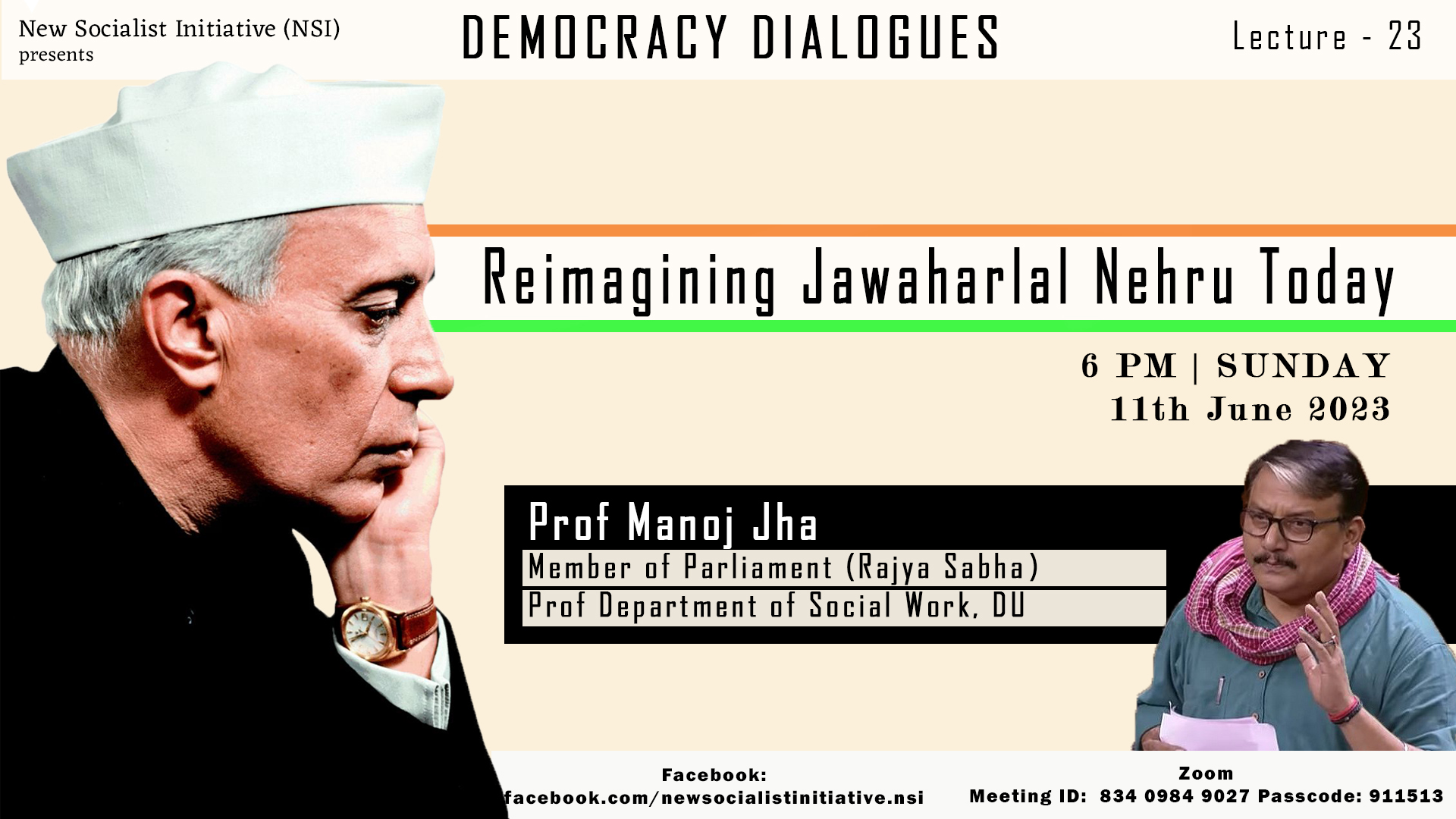
Reimagining Jawaharlal Nehru Today

 https://youtu.be/041eWWvhC1c

Prof Manoj Kumar Jha, who is a National Spokesperson of the Rashtriya Janata Dal, (RJD), and a Member of Parliament in Rajya Sabha ( upper house of the Parliament) who works as a Professor at the Department of Social Work, Delhi University, Delhi has kindly agreed to deliver the 23 nd lecture in the Democracy Dialogues Series , organised by New Socialist Initiative.

He will be speaking on ‘Reimagining Jawaharlal Nehru Today’ on Sunday, 11 th June, 2023 at 6 PM.

The lecture will also be live streamed at facebook.com/newsocialistinitiative.nsi

Topic :

Reimagining Jawaharlal Nehru today would involve examining his legacy and contributions in the context of the present day. Nehru, the first Prime Minister of India, played a crucial role in shaping the country’s political, economic, and social landscape after its independence in 1947. While we reimagine today presuming he was here we shall have to look at our parliamentary democracy and the core policy issues which have undergone so much of change that he would disown. The idea is to speak about some of the critical concerns we face as a nation through the Nehruvian lens. 

Speaker:

Prof Manoj K Jha, who is a National Spokesperson of the Rashtriya Janata Dal, (RJD), and a Member of Parliament in Rajya Sabha is a leading voice of the opposition.

A consistent votary of the idea of social justice and a strong opponent of the politics of majoritarian authoritarianism, his debates and interventions in the Upper House of the Parliament are appreciated across the political spectrum and are widely watched.

Prof Jha, is a very popular teacher in the Delhi University, was also head of the Department of Social Work, Delhi University , for a few years.

Dismantle the structures of sexual violence, NOT the protesters’ tent! Statement by concerned citizens

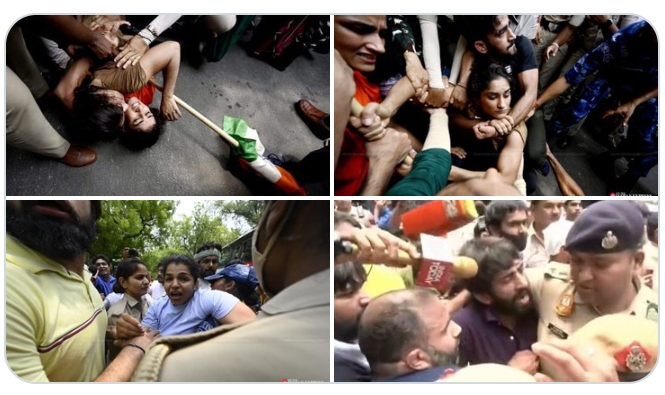
On the day that the Prime Minister was inaugurating a new Parliament house, democratic space was being crushed outside.

More than 1150 people including activists, lawyers, academics, former civil servants, artists and concerned citizens have released a statement condemning the brutal police action against the protesting wrestlers and those who had come out in support of their call from all over Delhi, Haryana and Uttar Pradesh for a Mahila Samman Mahapanchayat today.

We, concerned individuals, are absolutely horrified to see the violence unleashed by the government and police today, to suppress the powerful grassroots support for our brave wrestlers and their struggle against Wrestling Federation of India chief Brij Bhushan Sharan Singh, who stands accused of sexual harassment of women wrestlers stretching back over a decade. The wrestlers have been protesting since 18th of January, 2023. They had given a call to all women’s organisations, activists and all other civil society organisations to join a Mahila Samman Mahapanchayat outside the new parliament building today, i.e 28 May 2023.

Thousands of women from Delhi and nearby states responded to the call.  Fearing the  collective strength of Indian women – the police pre-emptively blocked all border roads, shut down proximal metro stations, and cordoned off roads. This is how scared a patriarchal State is of the sight of the women of India standing shoulder to shoulder with each other. Despite this crackdown, the government was unable to block the flow of solidarity; activists and concerned citizens found ways of trying to reach the protest site. Continue reading Dismantle the structures of sexual violence, NOT the protesters’ tent! Statement by concerned citizens

Aggressors Claim Hurt Sentiments While Victims Face Trial

History is a thin excuse for unrelenting majoritarianism in India and its neighbourhood

Recently, a senior advocate in Karachi was charged with blasphemy after another fellow lawyer complained about his having affixed ‘Syed’ to his name in an affidavit. This, supposedly, hurt the lawyer’s religious sentiments. The case is just one instance of the tremendous persecution the Ahmadiyya minority in Pakistan has faced since the eighties when the Benazir Bhutto regime declared it non-Muslim. Ever since, no Ahmadiyya can use Islamic symbols or names, such as Syed. Their persecution began with the notion that Islam has no space for another prophet, as the followers of Mirza Qadiani, founder of the sect, believed he was. That declaration brought the community into the spotlight of Pakistan’s blasphemy law, and their exclusion has continually expanded—from being denied space in public life, education, and employment, now they are even proceeded against for using certain names or titles.

The situation in India is sometimes no different. ( Read the complete article here)

STOP THIS WITCH HUNT – DON’T MISUSE PMLA AGAINST SCHOLARS AND ACTIVISTS! Statement by concerned citizens

Over 500 concerned citizens, democratic rights’ activists across movements, women’s groups, students and academics condemned the misuse of the Prevention of Money Laundering Act (PMLA) against scholars and activists, raising constitutional issues and asking for the government’s accountability.

We the undersigned women’s organisations and concerned individuals strongly condemn the continuous and repeated harassment of a number of women activists and intellectuals, by the Enforcement Directorate(ED), under the guise of an inquiry, in Delhi. This is a clear abuse of its extraordinary and draconian powers under the Prevention of Money Laundering Act (PMLA). As in the case of the Unlawful Activities Prevention Act (UAPA), there are increasing instances of the misuse of PMLA, especially against persons who are vocal critics of the government and its policies, and those who raise issues of the poor and oppressed sections of society. The ED is being used as an intimidation tool for political vendetta, where the process is the punishment for the detention of dissenters.

In the course of the last few months, several women scholars and activists have been summoned repeatedly, made to wait long hours, often interrogated without any woman officer present throughout, asked to furnish documents over and over again, in an ED investigation. In a clear case of evergreening the inquiry, the process has become endless. It is quickly turning into a fishing expedition, with all kinds of irrelevant documents and personal information being demanded, such as those about other family members, having no relevance to the inquiry whatsoever. Continue reading STOP THIS WITCH HUNT – DON’T MISUSE PMLA AGAINST SCHOLARS AND ACTIVISTS! Statement by concerned citizens

Social Suffering in a World without Support – Report on the Mental Health of Indian Muslims: Bebaak Collective

Report by Bebaak Collective, December 2022

Bebaak Collective (‘Voices of the Fearless’) was founded in 2013 as an informal association of grassroots activists to advocate for the rights of Muslim women and community. It is a platform for engaging with feminist thought and practice, human rights issues, and the anti-discrimination struggle. It has been working in Uttar Pradesh, Gujarat, Maharashtra, and Rajasthan. With the rising onslaught against marginalised communities, the Collective has evolved into an advocacy group that strongly adheres to constitutional values and believes that the rights and principles enshrined in our constitution are inalienable from every Indian citizen, irrespective of their caste, gender, sexuality or religion.

Relatives of a victim of the Delhi pogrom 2020 in mourning. Source: The Guardian

Foreword

Mental health and its socio-political determinants are beginning to emerge from a shroud of silence and stigma into public discourse. There are several possible reasons for this, the most visible being the pandemic and the many narratives of suffering it brought to the fore from among the most vulnerable sections of society. Even before the pandemic, the relationship between social disadvantage and the mental health of certain communities and groups (some more than others) has been studied in the Indian context. Some examples of these include the mental health of women, homeless persons, Dalit, Bahujan, and Adivasi communities, and queer and trans persons. However, the mental health of Indian Muslims has been severely underrepresented and almost invisible within the mental health or development literature in India. Continue reading Social Suffering in a World without Support – Report on the Mental Health of Indian Muslims: Bebaak Collective

75th year of Nakba – In solidarity with the Palestinian struggle

Yesterday, May 15, 2023 marked the 75th anniversary of Nakba or the dispossession of the people of Palestine by the Zionist state of Israel. This is the text of a talk delivered at an event organized by India Palestine Friendship Forum.

Stamp issued in 1981

In September 2012,  I had the incredible good fortune to visit Palestine. We stayed in Ramallah, visited and interacted with colleagues at Birzeit University and spoke at a conference organized by Muwatin, a research institute based in Ramallah. We met  a large number of inspiring people who pushed the frontiers of our minds, and we came away humbled and moved by the dignity of a people living through the brutal occupation of their lands by the  Zionist state of Israel, with limitless courage and bubbling sense of humour intact. Continue reading 75th year of Nakba – In solidarity with the Palestinian struggle

Hindutva Brigade Must Break Silence Over Espionage Allegation

The list of people associated with Hindutva outfits caught in damning revelations keeps growing.

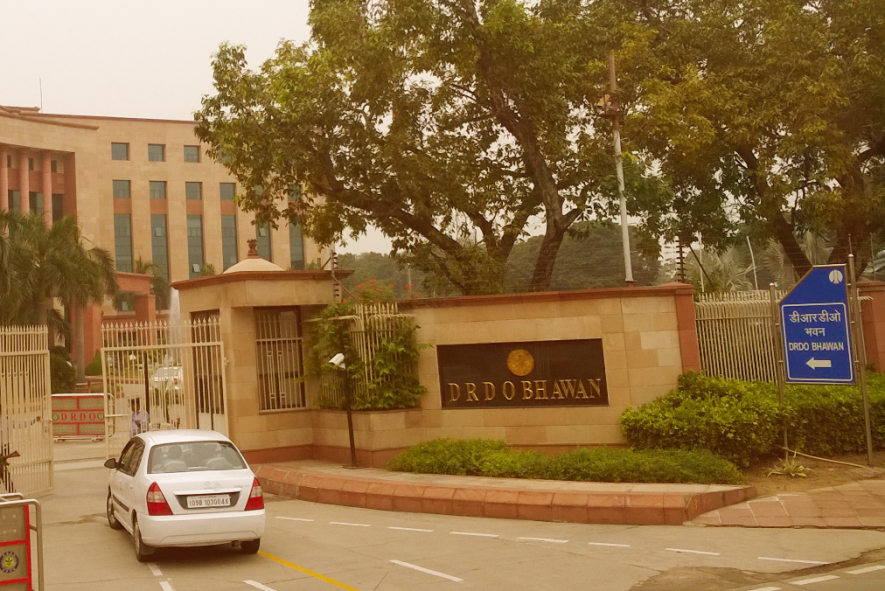
Recent revelations involving alleged espionage involving Prof Pradeep Kurulkar at the Defence Research and Development Organisation should have shaken up the establishment. After all, Kurulkar is said to have handled crucial projects related to India’s defence and reportedly was the lead designer or team leader for projects on missile launchers and subsonic cruise missiles.

Reports say Kurulkar was in contact, over WhatsApp, with a Pakistani Inter-Services Intelligence (ISI) agent late last year. His suspicious activities were reported to the police by DRDO, and in January, his laptop and two mobile phones were seized. The Maharashtra Anti-Terrorism Squad (ATS) is now handling the case. Kurulkar’s foreign trips are also under the scanner.

Such discoveries have long-term implications for India’s national security. Initial reports from ANI, a news agency known for its proximity to the ruling regime, did not mention Kurulkar’s name. The news agency did not initially mention his name in its tweets, though pictures of his face were circulating on social media and news outlets. The sequence of events left many wondering if the tweets deliberately concealed his name to create a doubt over his identity.

No doubt, Indian investigators will examine if the neighbouring country’s sleuths have penetrated India’s defence research sector and the extent to which Kurulkar has compromised India’s secrets. But it’s worth noting this case has not been handed over to the National Investigation Agency. Formed in the immediate aftermath of the 2008 Mumbai terrorist attack and supposedly more equipped and experienced to handle cases with cross-border ramifications, this agency has been busy filing plenty of cases—so, why not this one? ( Read the full article here)

How the Jayanagar Vote was Stolen – What Does Not Add Up: Amandeep Sandhu

Guest post by AMANDEEP SANDHU

[This post is a report on what went on in Jayanagar, a constituency in the southern parts of Bangalore, in the Vidhansabha Elections, May 2023]

Yesterday, 13 May, by 2.30 pm or so, the Jayanagar seat had gone in favour of Sowmya Reddy, Congress. It had been a very closely contested election with her rival CK Ramamurthy, BJP in close pursuit. Sowmya Reddy’s final lead, after 16 rounds, was 160 votes.

Flag 1: The Election Commission website was pretty up to date with all candidate results, but Sowmya Reddy’s results were very slow in coming. Her final result came online by around 6 pm while the counting was over, and she had gained her lead at 2.30 pm.

Another candidate stood from Jayanagar with a slight name variation – Sowmya A Reddy. She got 320 votes.

As Sowmya Reddy was leaving to collect her certificate, Ramamurthy also left the vote counting venue – SSMRV college. However, the Election Commission of India rules mandate that since the victory margin was lower than the number of postal ballots, a recount of postal ballots had become mandatory. When Sowmya Reddy was absent, Ramamurthy came back and requested for a recount of the postal ballot. Postal ballot is the term used for those votes which are cast by outstation voters and the pink form submitted by service personnel – police, officers, ambulance drivers and so on – who would be on duty during elections and can’t vote on election day. Their votes are recorded in advance. These votes are counted between 7.30 and 8 am, before strong rooms are opened and EVM vote count starts.

Continue reading How the Jayanagar Vote was Stolen – What Does Not Add Up: Amandeep Sandhu

Turning a Blind Eye: Power and the Intellectual in Kerala Today

Today someone who is an absolute darling of the post-socialist oligarchy in Kerala and their army of hanger-ons told me, without a tinge of irony, with the most endearing innocence, that they were not celebrated at all in Kerala. That they were excluded from circles that praised and glorified the work of many other authors. It was most intriguing, to say the least. I think it reveals a lot about how the present dispensation manages intellectuals and minimises critical thinking.

You can be a rebel without any serious losses in present-day Kerala if you desist from any serious criticism of the establishment and its acolytes. You can spout feminism, dalit politics, espousals of the solidarity economy, liberal Muslim thought, queer thinking, soft Hindutva– literally anything except Islamism if you keep your mouth shut about the establishment and the post-socialist oligarchy, or at least limit yourself to weak, occasional noises. You can also present yourself in combinations of the above laced with hints of your slant towards the establishment and reap much success in classrooms and academic fora, and much applause on the social media. If you have connections with the Nair deep state and ‘deep intellectual elite’, you can pornify, sell, any kind of abuse of women.

Continue reading Turning a Blind Eye: Power and the Intellectual in Kerala Today

G-20 – A Brutal Beautification of the City:  Glory Rose Roy

GUEST POST by GLORY ROSE ROY

The Delhi Durbar of 1911 has great significance in the history of India in terms of hosting King George V, along with the Queen and other guests. Undoubtedly, the entire occasion was recorded as a grand event and moreover, the decoration used on the way to Coronation Park to make it aesthetically beautiful, was magnificent. However, along with the preparations for the amplified royal visit, another incident that catches attention here is the hiding of an entire village, the ‘Dhakka village’.

People living near Dhakka village, 1911
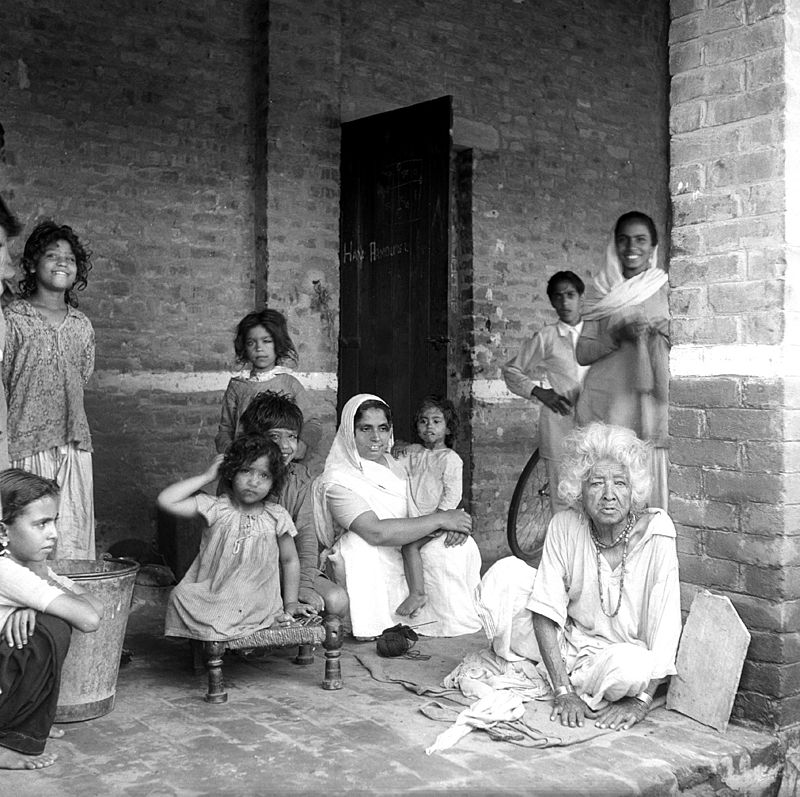
People living near Dhakka village, 1911 (see source below)

The villagers of Dhakka were asked to evacuate the area as their dwellings were not up to the beauty expectations of British officials. The Dhakka village then, represented a strong site of resistance, as the villagers in Dhakka refused to vacate the region for the King’s visit. Thus in response to the recalcitrance of the villagers, the British officials decided to hide the entire village by using huge cloth sheets.. And that is how the village got its name ‘Dhakka’ from the hindi word dhaka which means hidden. The incident portrays to what extent the colonial state could go to welcome its guests. It mulled relocating an entire village and finally covered it out of sight.

Continue reading G-20 – A Brutal Beautification of the City:  Glory Rose Roy

Fascism and Democratic Polity : How Did India Land in This Crisis ? – Dr Ravi Sinha

New Socialist Initiative ( NSI) South, recently organised two lectures by one of its senior Comrades Dr Ravi Sinha in Hyderabad. 

First lecture was on ‘Fascism and Democratic Polity : How Did India Land in This Crisis ?‘ and the second lecture was on ‘How Does Democracy Undermines Itself ?

Here is a YouTube Link of the first lecture.

Topic – Fascism and Democratic Polity : How Did India Land in This Crisis

Speaker : Dr Ravi Sinha

Date : 17 th February 2023

Place : Tarnaka, Hyderabad

Organised by : New Socialist Initiative ( South)

बहुध्रुवीयता – तानाशाही का मूलमंत्र : कविता कृष्णन

Guest post by KAVITA KRISHNAN

[यह लेख The India Forum में अंग्रेज़ी में छपा और उसके हिंदी अनुवाद का एक संक्षिप्त संस्करण सत्य हिंदी में छपा. यहाँ हिंदी में लेख को पूरा (बिना काट-छांट के) पढ़ा जा सकता है. हिंदी अनुवाद के लिए डॉ कविता नंदन सूर्य (सम्पादक, www.debateonline.in) को शुक्रिया.]

बहुध्रुवीयता अंतर्राष्ट्रीय संबंधों की वामपंथी समझ को दिशा देने वाला कम्पास है. भारत और वैश्विक वामपंथ की सभी धाराओं ने लम्बे समय से साम्राज्यवादी अमेरिकी वर्चस्व वाली ‘एकध्रुवीय’ दुनिया की अवधारणा के खिलाफ ‘बहुध्रुवीय’ विश्व की वकालत की है.

दूसरी ओर, ‘बहुध्रुवीयता’ वैश्विक फासीवाद और तानाशाही की साझी भाषा का मूल आधार बन गई है. यह निरंकुश शासकों के लिए एकजुटता का ऐसा आह्वान है, जो लोकतंत्र पर उनके हमले को साम्राज्यवाद के खिलाफ जंग की शक्ल में पेश करती है.  अंतर्राष्ट्रीय संबंधों के साम्राज्यवाद-विरोधी लोकतंत्रीकरण के नाम पर बहुध्रुवीयता को वैश्विक वामपंथ के गुंजायमान समर्थन ने, निरंकुशता का भेस बदलने और उसे वैधता दिलाने के लिए ‘बहुध्रुवीयता’ के इस्तेमाल को असीमित शक्ति प्रदान कर दी है.

राष्ट्र राज्यों के आतंरिक अथवा आपसी राजनैतिक टकरावों पर रुख तय करने लिए कितने आधार उपलब्ध हैं? इस प्रश्न के जवाब में वामपन्थ सिर्फ़ दो विकल्पों – या तो “बहुध्रुवीयता” या “एकध्रुवीयता” – को प्रस्तुत करती है. अगर आपने “बहुध्रुवीयता” को अपना मूल आधार नहीं बनाया तो वामपन्थ मानेगी कि आप ज़रूर अमेरिका/नाटो की दादागिरी वाले “एकध्रुवीयता” के पक्ष में हैं. पर   “बहुध्रुवीयता” या “एकध्रुवीयता” के बीच यह कल्पित बाईनरी हमेशा भ्रामक थी. लेकिन आज “बहुध्रुवीयता” बनाम  “एकध्रुवीयता” के बीच संघर्ष की मनगढ़ंत कहानी भ्रामक ही नहीं, खतरनाक है क्योंकि इस कहानी में फासीवादी और तानाशाह नेताओं को “बहुध्रुवीयता” बनाए रखने वाले नायकों का पात्र दिया गया है.

Continue reading बहुध्रुवीयता – तानाशाही का मूलमंत्र : कविता कृष्णन

No Reason  to Bow Down to So-called Modi Storm, Time for Unity to Strike: Sankar Ray

Guest post by SANKAR RAY

We have been living through an unnatural and scary time in India. Those in power today are ideologically responsible for destroying the greatest achievement of India’s freedom struggle. The achievement is stable parliamentary democracy, one of the main conditions for whose existence and development is accommodation of dissent and transparency therein. The symptoms of this destruction are often horrendous.

The Bharatiya Janata Party (BJP) won 156 out of 182 seats in the recently held Gujarat Assembly elections. The pattern of state politics was completely reversed as BJP’s number of seats increased from 99 to 182 from 2017 to 2022 and Congress’s seats decreased from 77 to 17. But BJP’s strength in municipal and panchayat elections in Gujarat was decreasing.

Continue reading No Reason  to Bow Down to So-called Modi Storm, Time for Unity to Strike: Sankar Ray

Police Violence against the Fisher People on the Kerala Coast: A People’s Account

Below, I share a write-up by Johnson Jament, an academic researcher from the coast of the Thiruvananthapuram district, where an intense struggle against the Adani Port Project has been unfolding. Arrayed on opposing sides are the fisher people who have inhabited the coast since the past 500 years (according to historical record) and more, whose livelihoods are at stake, and the Adani Port Project, supported by the combination of natural resource predators and the CPM-led government of Kerala. The leadership of the CPM (though not the ranks, or at least all of the ranks) can be quite fairly described as a ‘post-socialist oligarchy’, and hence their support of Adani Ports is pretty understandable. The battle has been equally one of wits too, with the Kerala government pulling out all their progressive aces, including the longtime literary-cultural acolytes of the CPM but also some of the (former) stars of Kerala’s oppositional civil society — notably, the poet and critic, K Satchidanandan! Questioned about his stance, this early teacher of Euro-Marxism of a whole generation claimed that the conflict was because of ‘binary thinking’ that supporters and opponents of the Port project both equally indulge in, forgetting notably, that something like ‘structural contradiction’ may be becoming evident in and through this struggle. Perceiving it, of course, is not indulging in binary thinking.

Continue reading Police Violence against the Fisher People on the Kerala Coast: A People’s Account

A Few Remarks On The Absence of Scientific Temper in the Land of Bose, Raman, and Salam

Guest Post by Ravi Sinha

[I must begin with a “thank you” to the Indian Diaspora of Washington DC* and to Razi Saheb for letting me say a few words here. It is an honour for me to share the dais, even if virtually, with Gauhar Raza and Pervez Hoodbhoy. I was stressed about Razi Saheb being a stern time-keeper. So, I decided to jot down what I have to say. But the flip side is that I did not know at the time of preparing these notes what Gauhar and Pervez would say. Please bear with me if what I say turns out to be redundant in the light of what has already been said, or if it appears tangential to the concerns of the organizers or of the other two speakers.]

Let me first get some elementary considerations out of the way. The title refers to the land of Bose, Raman and Salam, which might betray an assumption that a scientist is guaranteed to possess scientific temper and he is influential enough to leave an imprint on the society. In an ideal world, perhaps, that ought to be the case. But even scientists do not live in an ideal world.

Take the example of Sir Isaac Newton, the greatest icon of science, whose genius did put its final and authoritative seal on the Scientific Revolution. Running away from plague in Cambridge to his native village, the young and solitary scholar single-handedly laid the foundation of modern science. He accomplished this during a mere 18 months of his anni mirabiles of 1665-66 when he formulated his laws of motion and his theory of gravitation. In addition, he also invented calculus during the same months. But, after that, he devoted a large part of his long life to the practice of alchemy and to the theological labours of interpreting the Bible. He denounced what he thought were corruptions of Christianity – such as trinitarianism – and adopted a radically puritanical version of Arianism that considered the Bible as an exact Revelation about the future. Nothing in Newton was of normal proportions – neither his scientific genius nor his rigid dogmatism and confident superstitions.

If you think I am being unfair to Newton – after all he could only be a product of his times – you are already conceding part of the point I am driving at. But let me cite a few examples from more recent times before I try to peep into the relationship between Science and Scientific Temper. Pascual Jordan, a pioneer of Quantum Mechanics, was an active Nazi who continued to hold his fascist views even after his rehabilitation in post-war Germany. Physics Nobel laureates Philipp Lenard and Johannes Stark too were active Nazis and confirmed anti-Semites. A little earlier, the great mathematician, Emmy Noether, had been prevented from becoming a faculty in the mathematics department of the University of Gottingen just because she was a woman. An exasperated David Hilbert famously said, “I do not see that the sex of the candidate is an argument against her admission as a privatdozent. After all, we are a university, not a bathhouse.” And a scientist friend of mine reminded me the other day that our own Sir C V Raman, one in the title of this program, was opposed to a woman being admitted as a Ph.D. student, because, in his views, women were unfit to do science.

I am not here to withhold the certificate of scientific temper from being awarded to eminent scientists. My purpose is to examine whether lack of scientific temper comes in the way of doing good science. Pervez Hoodbhoy wrote a book some thirty years ago. The book is called “Islam and Science”, and the subtitle is “Religious Orthodoxy and the Battle for Rationality”. In the book he cites a telling example. Steven Weinberg and Abdus Salam – the same Salam who too is in the title of this program – came up with one of the greatest physical theories of 20th century – the unified quantum theory of electromagnetism and the weak nuclear force. They invented this theory independently of each other and shared the Nobel Prize for it. Weinberg was an avowed atheist; Salam was self-confessedly a believer. Salam wrote the foreword to Pervez’s book in which he concurs with the author that being a believer made no difference, one way or the other, to his coming up with the theory. There you have it from the horse’s mouth. What, then, is the relationship between science and scientific temper?

The scientist does not live by science alone. Even a scientist’s mind is not entirely colonised by Scientific Reason. I do not know if, like the brain, the mind too has two separate but interconnected lobes. But allow me to use a simple-minded metaphor. Scientific temper, it seems to me, has something to do with the rational side of the mind trying to influence the emotional side. This may give rise to a reasonable and cultivated individual, but it can also result in disaster. With the rational side meddling too much with the emotional side, it may give rise to a rather childish adult, if not a veritable Dr Strangelove.

Scientific temper is a tricky business. It involves a very intricate game between Reason and Culture. Neither side of the game we understand very well. There are those who think that Reason is transparent, whereas Culture harbours dark corners. The opposing side points out that this is a false picture. It labours to show that Reason has murky origins – it did not result from an immaculate conception. And, it is not at all self-aware – it does not know that it is inextricably entangled in structures of power.

Which side is more important for a successful and at the same time a meaningful life? Which side should sit in judgement? It is a debate that is hard to settle. There are funny episodes, for example, of scientists sitting in judgment over poetry. Paul Dirac, one of the greatest scientific minds of the 20th century once told J R Oppenheimer, another great scientist and a polymath, “I don’t see how you can work on physics and write poetry at the same time. In science, you want to say something nobody knew before, in words everyone can understand. In poetry, you are bound to say something that everybody knows already, in words that nobody can understand.” The judgements of poets about science, on the other hand, are usually not so funny. They are often much darker – prone to denouncing the supposed soullessness of science or mocking it as one mocks the childishness of a grown-up.

With this much as a background, let me now come to the topic of the day. I do agree with the assertion that scientific temper is largely missing from the societies and cultures that form a distinct civilisation on the subcontinent. But, I am less surprised that it is missing despite scientists likes of Bose, Raman and Salam. I am more surprised that it is missing despite someone like Jawaharlal Nehru. To my mind, Nehru was the best and the wisest proponent of the desirability of scientific temper. Let me quote a passage from The Discovery of India even if it consumes a precious minute,

“Science deals with the domain of positive knowledge but the temper which it should produce goes beyond that domain. The ultimate purposes of man may be said to be to gain knowledge, to realize truth, to appreciate goodness and beauty. The scientific method of objective inquiry is not applicable to all these, and much that is vital in life seems to lie beyond its scope – the sensitiveness to art and poetry, the emotion that beauty produces, the inner recognition of goodness. The botanist and the zoologist may never experience the charm and beauty of nature; the sociologist may be wholly lacking in love for humanity. But even when we visit the mountain tops where philosophy dwells and high emotions fill us, or gaze at the immensity beyond, that approach and temper are still necessary.”

I might also add that the Indian Constitution is the only Constitution in the world which prescribes developing “scientific temper, humanism and the spirit of inquiry and reform” as a fundamental duty of every citizen.

All this, however, may sound too philosophical and too idealistic. How can one be sure that scientific temper really matters to a society or a civilisation? I think history has provided a very real example. Let me dwell on it for a minute.

Pervez’s book that I have already mentioned opens with a parable of “a team of Martian anthropologists visiting Earth sometime between the 9th and 13th centuries”. They find that “the civilization with greatest promise is the Islamic civilization with its Bait-ul-Hikmah, astronomical observatories, hospitals and schools”. Then they visit again towards the end of 20th century and find that “their earlier prediction had turned out to be wrong. The part of humanity which once seemed to offer the greatest promise now appears inescapably trapped in a state of frozen medievalism, rejecting the new and clinging desperately to the old. On the other hand, the former retrogrades have climbed the evolutionary ladder and are now aiming for the stars. Was this stunning reversal of roles, ask the visitors, the mere misfortune of one and the good fortune of the other? Was it due to invasions and military defeats? Or was it the result of a fundamental shift in outlook and attitudes?”

With minor variations the parable may apply equally well to the fate of the subcontinent. If the Martians were to visit here sometime during the 17th century, they would be dazzled by the Navratnas (nine jewels) in Akbar’s court and they would marvel at the fact that the subcontinent accounted for nearly one third of the total world production. However, on their second visit at the turn of the millennium, they would be equally disappointed with this civilisation.

Perhaps the real question to ask is: why and how did the West pull ahead? That may shed easy light on why everyone else got left behind. The answer is obvious, but, like the case of the elephant in the room, there have been reasons for ignoring the obvious. Looking for deeper causalities behind the long trajectories of history may no longer be the intellectual flavour of the day. After all, this is the era of suspicions about grand narratives. We who got left behind can derive satisfaction from the all-round denunciations of colonialism and imperialism and attribute all that we suffer from to their crimes. We may rejoice that those in the high chairs of western academia are raising an intellectual storm against science and modernity which, supposedly, have been nothing but handmaidens of capitalism, colonialism and imperialism. The postcolonial theorist may continue to uncover sinister doings of the long dead colonialism. But someday we will have to ask – what is in it for us on the subcontinent? These critics are definitely making the western societies better, more cultivated, more democratic and more multicultural. But they already had science and modernity; they had already pulled ahead. How should we find our path out of poverty and superstition? What kind of future should we visualize for ourselves?

Explanations about why and how did the West pull ahead fill entire libraries. But, in some ways, the answer is too obvious: West did it with the help of science and modernity. Of course, both were born along with capitalism and colonialism. But one should not throw the baby with the bathwater. It is truly astonishing that there exist high theories declaring that all claims of science about universal truths, objectivity and uniqueness of scientific method are false; that all cultures and communities in all ages had equally valid claims to knowledge and method. In India a simple way has been found to support such theories – all one has to do is to claim that everything that modern science has accomplished, and will ever accomplish, is already there in the Vedas.

In any case, West did not accomplish the miracle of Great Divergence only through capitalism and industrial revolution. Enlightenment and Modernity played an equally important role. I have already referred to the complex interaction between Science and Culture. In 18th century Western Europe this imparted an added acceleration to history. And it took nearly two centuries after the advent of modern science for scientific temper to seep into western culture. Enlightenment was the name given to this process of seeping in.

Enlightenment and Modernity cannot just be imported or imitated. This is because of the fact that science is one but cultures are many. All cultures must find their own ways to imbibe science and animate modernity. Among those who were left behind, there have been a few successful examples of catching up with the West. Soviet Union used to be one such example but it collapsed. Russia, in any case, was too close to the European civilisation to count as a distinctive example. In the East, Japan earlier and China now have been such examples. What has stopped the subcontinent from being another such example?

This too is an enormous subject and an extraordinarily complex one. It is said that fools rush in where angels fear to tread. But let me rush in nevertheless. Among many millennial historical processes that have gone into the making a distinct civilisation on the subcontinent, one is special and unique. Elements of it may be found in other lands but on the subcontinent it has played role like no other place on the planet. This, in my opinion, has been the single largest obstacle to scientific temper seeping into our culture. Let me conclude by pointing a finger at it.

I am alluding to the fact that nearly all religions on the subcontinent took, in varying degrees, a mystical-devotional form, comprising of numerous sects led by gurus, pirs, mahatmas and other god-men – all engaged in the task of paving a plebeian road for a direct access to God without the mediation of priests or books or other intermediaries. On the Hindu side it emerged in the South as the Bhakti Movement and spread to the North in the second millennium. On the Muslim side it made its way through Afghanistan to the north-west of India and spread through sufis, dervishes and pirs. The phenomenon also gave rise to a new religion – Sikhism. It is this phenomenon of Bhakti, Sufism, Sikhism and assorted mystical-devotional movements that is at the heart of a distinct civilisation on the subcontinent.

This phenomenon has been judged favourably by nearly everyone. It has won praises from the religious and the non-religious, from traditionalists and modernists, from the right-wing as well as the left-wing. Nearly everyone prefers heterodoxy to orthodoxy. There is no denying that in many ways it has contributed positively to the culture and civilization on the subcontinent. And yet, there is a very large negative fall-out that has been largely ignored.

This phenomenon triggers processes that obstruct the advance of scientific temper and modernity. It encourages blind faith at the cost of a genuine sense of wonder; prevents religiosity from turning genuinely spiritual and becoming philosophical; prevents the philosophical from becoming reasoned; prevents Reason from seeping into Culture. It has been the principal vehicle of unreason, blind faith and superstition in our part of the world. George Orwell once said, “Saints should always be judged guilty until proven innocent”. An ironical meaning has been added to Orwell by today’s India where god-men do not lose followers even after being convicted as rapists and murderers.

Even Nehru fails to grapple with the civilizational consequences of Bhakti Movement. He harbours contradictions. He admires Vivekanand, Rabindranath Tagore, Gandhi, Bhagat Singh and Einstein – all at the same time. He was a great man – a visionary, a leader, a thinker, a statesman. Like Whitman he could perhaps say, “I am large, I contain multitudes”. He failed because the weight of the past was too heavy. He could not speak bare truths because he had to carry his people along. That is why, sometimes, you need to listen to small men too. They can speak the bare truth as they are spared the onerous task of carrying Nehru’s burden.

This is where I will stop.

——————————————-

Dr Ravi Sinha, Theoretical Physicist, Activist, Scholar, associated with Progressive Movements and Writer

[* The Indian Diaspora Washington DC Metro, USA organised an online panel discussion on the theme ‘Absence of Scientific Temper in the Lands of Scientists Raman, Bose, Abdus Salaam on 19 th November 2022.

Professor Pervez Hoodbhoy, Eminent Physicist, Prominent Public Intellectual, Civil Rights Activist, Author, Columnist from Pakistan ; Dr Ravi Sinha, Theoretical Physicist, Activist, Scholar, associated with Progressive Movements and Writer ; Mr Gauhar Raza, Former Chief Scientist, Council of Scientific and Industrial Research, Civil Rights Activist, Poet, Documentary Filmmaker both from India shared their ideas at the programme which was followed by discussion.

Prof Razi Raziuddin, Scientist, Founder, Indian Diaspora, Washington DC Metro, USA shared welcoming remarks. ]

The Partition of India: Three Outstanding Questions – Professor Pervez Hoodbhoy

Professor Pervez Hoodbhoy, eminent physicist, author, public intellectual and a forceful voice for reason, science and democracy will be delivering the 19th Democracy Dialogues lecture on Sunday, October 9th, 2022 at 6 PM (IST)

The Partition of India: Three Outstanding Questions 

Seventy five years after the communal storm of 1947 countless important questions still remain. From among them I will concentrate upon three which are particularly important in understanding the past but which, in addition, continue to influence current trajectories.

  1. How, when, and why did the two-nation theory emerge? 
  1. Why is Pakistan a praetorian state but India is not? 
  2. Was Partition preventable and had it not happened what might have been the consequences? 

Speaker: 

Pervez Hoodbhoy is a nuclear physicist, a frequent commentator on Pakistani television channels, founder-director of The Black Hole in Islamabad, and an author. He received his undergraduate and graduate degrees from MIT and taught physics at Quaid-e-Azam University for 47 years.  

The lecture will be held on zoom and for security reasons the link will be shared individually only closer to the event. Please write to us at democracydialogues@gmail.com if you want to join the lecture online.

It will also be live streamed at facebook.com/newsocialistinitiative.nsi

In solidarity with the Iranian people fighting for democracy and justice: Ayesha Kidwai & Nivedita Menon

This post is jointly written by AYESHA KIDWAI AND NIVEDITA MENON

On this international day of solidarity with the Iranian people, two feminists from India send you our greetings, in complete awe of your courage, your creativity, your solidarity with one another, your relentless resistance in the face of cruel and brutal repression.

Watching the panel discussion on Jadaliyya on the ongoing struggle of the Iranian people against the authoritarian regime, we were struck by the complexity of the arguments being made. The struggle is not against Islam, and it is not about hijab everywhere and at all times. What we are witnessing in Iran is reflected all over the world wherever there is resistance to the gendered ways in which all states control populations – whether by compulsory conscription in wars the people have no interest in, or by making the hijab central to the reason of state – in Iran by compulsory veiling, in France and in India by compulsory unveiling of the Muslim woman; or in the USA by denying autonomy over their bodies to women by criminalizing abortion. Continue reading In solidarity with the Iranian people fighting for democracy and justice: Ayesha Kidwai & Nivedita Menon

SL Govt – Stop Labeling Student Protestors and Activists as Terrorists! South Asian Feminists

Statement released by feminists from Sri Lanka, Bangladesh, Pakistan, Fiji, Malaysia and India, August 27, 2022

We are a group of feminists writing to call urgent attention to the extra-constitutional attempts of the Government of Sri Lanka (GoSL) to suppress dissent. Lacking a popular mandate, hunting down student protestors and activists, including a LGBTIQ activist has become a central strategy of the political élite to retain power. The latest move by the GoSL is to brand three student leaders and the student union they represent, the Inter University Student Federation (IUSF), as ‘terrorists’.

Wasantha Mudalige, Convenor of IUSF, Galwewa Siridhamma thero, Convenor of the Inter-University Bhikkhu Federation, and Hashan Jeewantha, a student activist, were among the 20 arrested on August 18, 2022, for participating in a peaceful protest led by the student movement. All three of them are prominent student leaders who have been at the forefront of struggles for socio-economic justice in Sri Lanka, particularly against numerous ongoing attempts to dismantle free education. Continue reading SL Govt – Stop Labeling Student Protestors and Activists as Terrorists! South Asian Feminists