Jana Gana Mana and the Danger of Passing Sentiment as Law

This originally appeared in The Wire

This is clearly the winter of Karan Johar’s discontent. Barely had the controversy over the illegal fine imposed on him by the Mahrashtra Navnirman Sena died down when the ghost of a controversy about his earlier film, Kabhi Khushi Kabhi Gham (K3G), has resurfaced in the form of the mind-boggling order from the Supreme Court making it mandatory for the national anthem to played in cinema halls before the screening of a film:

All the cinema halls in India shall play the National Anthem before the feature film starts and all present in the hall are obliged to stand up to show respect to the National Anthem.

Prior to the National Anthem is played or sung in the cinema hall on the screen, the entry and exit doors shall remain closed so that no one can create any kind of disturbance which will amount to disrespect to the National Anthem. After the National Anthem is played or sung, the doors can be opened.

When the National Anthem shall be played in the Cinema Halls, it shall be with the National Flag on the screen.

The national anthem is “the symbol of the Constitutional Patriotism and inherent national quality”, the judgment says. “It does not allow any different notion or the perception of individual rights, that have individually thought of have no space. (sic) The idea is constitutionally impermissible.”

Continue reading Jana Gana Mana and the Danger of Passing Sentiment as Law

Hasta la victoria siempre

UNTIL VICTORY, ALWAYS…

150304151657-01-fidel-castro-0304-restricted-exlarge-169Image courtesy CNN

A Pinjra Tod Winter Afternoon In Jamia Millia Islamia, November 17, 2016

Statement by Pinjra Tod on November 19, 2016

A fiery anonymous open letter by a women resident of Jamia Millia Islamia to the VC on the arbitrary cancellation of late nights in August last year, marks the inception of Pinjra Tod as a movement. It has been an incredible year of reaching out to each other, connecting, discussing and collectivising in Jamia. Overcoming our anxieties of a repressive state machinery intent on criminalising minority voices and institutions, conquering our fear of an administration that has repeatedly targeted students (especially women) for raising their voices, we came together in Jamia last Thursday (17th Nov), drawing confidence from our collective strength, to hold our first ‘public’ event: an exhibition celebrating the struggle of women for education, and a session of poetry, songs and sharing of experiences.

Women students reiterated that the UGC circular issued on 2nd May’16 is being shamelessly flouted by Jamia administration, as in all other Universities and colleges. There are no sexual harassment complaints committee (the program was conducted beneath a huge anti-ragging banner), libraries and other facilities on campus remain inaccessible to women students after 8 PM, random show-cause notices for ‘misconduct’ are a common practice, very little democratic space for women students to organise events/discussions/screenings within hostel spaces and continuous surveillance.

Continue reading A Pinjra Tod Winter Afternoon In Jamia Millia Islamia, November 17, 2016

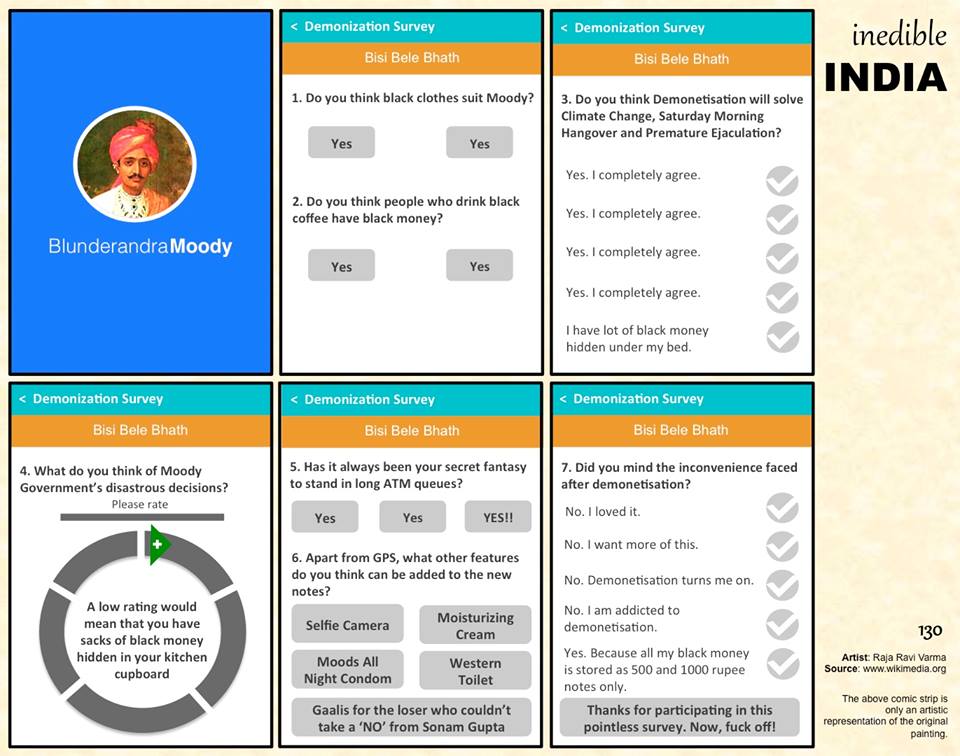
Inedible India on the NaMo App “Survey” on Demonetization

The PMO claimed that more than 93 per cent of the five lakh people who participated in a survey on Narendra Modi App have supported demonetization.

The loaded structure of the survey, the questions to which you can only “agree” or “partially agree”, with no option to “disagree”; all of it is typical of this utterly corrupt and dishonest government which holds the people of India in contempt.

The most powerful response to this government is to mock it.

Take this, Namo!

From Inedible India

15171078_1154465077940674_7199912734542558618_n

Alchemies of Art and Resistance in Kashmir

Bertolt Brecht, was to write

“In the dark times

Will there also be singing?

Yes, there will also be singing.

About the dark times.”

Violence, persistent and unending, creates an alternative reality, a festering, perverted, horrible, surreal reality. Violence, unending and unrelenting erases all memories of times past, Memories of times when another reality existed, It is this alternative reality that begins to redefine imagery, ideas, sensibilities and begins to creates a new grotesque discourse, a discourse in which the ugly face of fear and death becomes the normative. I’ll give you one example of how this works. Continue reading Alchemies of Art and Resistance in Kashmir

Neocaligulaism: Thoughts from Kerala


In these insane times in our country and the world, one searches in the past desperately to make sense of the unfolding madness of the present. No wonder people have recalled Muhammad bin Tughlaq in the face of what has been described (rather misleadingly) by the neutral word ‘demonetisation’ – but as many have already pointed out in considerable detail, what we face is much more than a foolishly, irresponsibly-conceived act of monetary governance gone horribly wrong. Caligula is back, and neocaligulaism is the flavor of the season, across the world, one might say. Continue reading Neocaligulaism: Thoughts from Kerala

बड़े नोटों का रद्दीकरण – छिपकली की पूंछ पकड़ने के लिए विशाल पिंजरा – राजिंदर चौधरी

Guest post by RAJINDER CHUDHARY


1946 और 1978 में भी प्रचलित बड़े नोटों को रद्ध किया गया था। इस लिए 8 नवंबर 2016 को मोदी सरकार द्वारा 500 और 1000 रुपये के प्रचलित नोटों को रद्ध करने का निर्णय आधुनिक काल में तीसरी बार उठाया गया कदम है। तीनों बार मुख्य लक्ष्य कालेधन को खत्म करना रहा है। लेकिन मोदी सरकार ने अपने निर्णय के पीछे एक नया कारण भी जोड़ा हैं। यह है नकली नोटों का बढ़ता चलन और इन के माध्यम से आतंकवाद का फलना-फूलना। रिज़र्व बैंक के नवीनतम आंकड़ों के अनुसार 2015-16 के दौरान 1000 रुपये के नोटों में नकली नोटों का अनुपात 0.002262% था यानी 1000 के एक लाख नोटों में सवा दो नोट नकली पाये गए (इन में पुलिस एवं अन्य द्वारा पकड़े गए नकली नोट शामिल नहीं हैं)। 500 रुपये के नोटों में यह अनुपात 0.00167% था यानी 500 रुपये के 1 लाख नोटों में नकली नोटों की संख्या 2 से कम थी। जाहिर है ये सारे के सारे नकली नोट आंतकवादियों द्वारा जारी नहीं किए गए होंगे। विशुद्ध आर्थिक अपराधियों का भी इस में योगदान होगा। लेकिन अगर यह भी मान लें कि ये सारे के सारे नकली नोट आतंकवादियों द्वारा चलाये गए थे तो भी 2015-16 में रिज़र्व बैंक के आंकड़ों के अनुसार 500 और 1000 के नकली नोटों की कुल कीमत 27.39 करोड़ रुपये बनती है (इन के अलावा 2015 में बीएसएफ़ ने 2.6 करोड़ रुपये के नकली नोट पकड़े थे)। इस से स्पष्ट है कि नकली नोट आतंकवाद की बुनियाद नहीं हो सकते। वैसे भी, इन नकली नोटों पर रोक लगाने के लिए इन नोटों को एकायक रद्ध करना न आवश्यक है और न पर्याप्त। अगर नोटों की छपाई को अधिक सुरक्षित नहीं बनाया गया, तो ‘आतंकवाद के समर्थक’ ताकतों, जो सामान्य अपराधी तो हैं नहीं, द्वारा नए नकली नोट छापना मुश्किल नहीं होगा। इस लिए अधिक सुरक्षित नोट छापना बेहद आवश्यक है।  नए, अधिक सुरक्षित नोट जारी करने के साथ, पुराने ‘असुरक्षित’ नोटों को बदलवाने के लिए एक समय सीमा रखी जा सकती थी। जैसा पहले भी किया गया है। 2005 से पहले के छपे नोटों को, जिन पर छपने का वर्ष अंकित नहीं होता था, उन्हें मई 2013 से पर्याप्त समय दे कर, बैंकों में जमा करा लिया गया है। यही प्रक्रिया दूसरे ‘असुरक्षित’ नोटों के साथ भी दोहराई जा सकती है। इस लिए नकली नोटों पर रोक लगाने के लिए सारे नोटों को रद्ध करना आवश्यक नहीं था। Continue reading बड़े नोटों का रद्दीकरण – छिपकली की पूंछ पकड़ने के लिए विशाल पिंजरा – राजिंदर चौधरी

Death by Demonetisation: Satya Sagar

GUEST POST BY Satya Sagar

The abrupt demonetisation of 500 and 1000 rupee notes by the Narendra Modi regime is a drastic move that is staggering in its scale, ambition and repurcussions. The only other figures in modern history one can think of, devious or stupid enough to attempt something similar, are the likes of Marcos, Suharto, Idi Amin and Pol Pot.

For all its audacity however, the decision could go down also as the grandest of blunders made by anyone in Indian political history. Poorly planned and implemented it is likely to prove disastrous not only for the country’s economy but – ironically enough,– for the BJP’s own electoral fortunes.

The abolition of the two currency notes – that make up 86% of all cash in circulation in the Indian economy –  has affected almost every family in the second most populous nation on the planet.  The harassment of the common citizen – particularly from the ranks of the urban and rural poor- through denial of access to income, savings and livelihood will not be forgotten anytime soon. Continue reading Death by Demonetisation: Satya Sagar

Welfare Shocks are not “Inconveniences”

I want to make one thing clear. There is a difference in between “short-term inconvenience” or pain or difficulty, however you want to call it, and a welfare shock.

Take a very simple empiric: 80% of families in India that are above the poverty line in one year but fall below it in another, do so because of one illness, to one family member, in one year. Let that sink in please: one, one, one. That’s it. (see Aniruddh Krishna’s excellent ‘One Illness Away‘ to read more). This is the reality of the vulnerability of what is so dismissively called the “cash economy.” You can replace illness with wedding or funeral and the story still holds. Welfare shocks, as they are called, break cycles of very tenuous security and small economic gains, pushing families back into cycles of debt and depleted savings. They do it because we don’t have enough public welfare protections to guard against small risks and life events – domestic savings are the only floor.

The thing about demonetisation done in this way, where no planning accounts for the “short-term” contraction of the cash economy in a place where 60-80% of workers work informally, half get paid in cash, and one in every five of them work in cash on daily/weekly wages (see RBI, NSS data, or the NCEUS report on the unorganised sector), then you aren’t pushing a “short-term inconvenience,” you risk causing a welfare shock.

Continue reading Welfare Shocks are not “Inconveniences”

Withdraw false charges lodged by Chhattisgarh police against academics and political activists

PETITION TO THE PRESIDENT, PRIME MINISTER AND HOME MINISTER OF INDIA

We, the undersigned, are outraged by recent charges of murder that have been laid against

Delhi University professor Nandini Sundar, JNU professor Archana Prasad, Vineet Tiwari (of Joshi Adhikar Sansthan, Delhi), Chhattisgarh CPI(M) state secretary, Sanjay Parate, Mangalram Karma, and Manju Kawasi, CPI activist and Sarpanch of Guphidi in Sukma district, by the Chhattisgarh police in the killing of Shamnath Baghel.

The charges are patently fabricated, and follow a pattern of intimidation by the Chhattisgarh police every time evidence is released of their lawless prosecution of the war against the Maoists. Earlier this year, Sundar, Prasad, Tiwari and Parate were part of a fact-finding team that looked at the impact of Maoist violence and state excesses on ordinary villagers in Bastar, finding that they were victims of fake encounters, rapes, arrests, beatings, IED blasts, and killing of informers, implicating Maoists, police, and security forces. The residents of Bastar were also found to be facing the renewal of attacks by civilian militias armed by the state. At that time too, the district administration of Bastar had tried to implicate the fact-finding team on fake charges on the basis of a contrived complaint. More recently, when the police were charge-sheeted on the basis of evidence gathered by Sundar and others for carrying out arson in an operation in 2011, they retaliated by burning effigies of her and other activists and journalists in order to intimidate and incite violence against them.

Sundar and others have put on record their unequivocal condemnation of the killing of Shamnath Baghel. Their writing and interventions on the ongoing war in Bastar have consistently condemned all forms of violence, whether by the state or by the Maoists.

We are saddened by the climate of silencing of dissent that is becoming widespread in India and concerned that the work of researchers, journalists, lawyers and activists is being monitored and controlled to quell critical scrutiny of governmental actions. We believe such silencing of opposing views poses a grave danger to the democratic values of India.

Continue reading Withdraw false charges lodged by Chhattisgarh police against academics and political activists

‘Degrees’ of Democracy – Field Notes from a Central University in Bihar: Debaditya Bhattacharya

Guest post by DEBADITYA BHATTACHARYA

This piece has long been in the coming. Soon after the summer of student protests in India exposed the terror-apparatuses of the state and unleashed a new vocabulary of progressive political resistance, the students of a certain Central University of South Bihar (in Gaya) went on strike against the university administration in the early days of August. They however were not fighting to protect constitutional rights, because their daily encounters with the university had already come to rest on a structural suspension of many such rights. Like those of speech, of rational thought and scientific inquiry, of gender-equality, and of resisting what Vemula called the event of being reduced to one’s “immediate identity”. These students merely decided to fight for their right to a degree.

They had come together to demand statutory recognition for courses that they were enrolled in since 2013, but most sections of the national media at that time deemed the issue ‘sub-national’ enough to be granted space or audience. Reporters from the local print-media were – in what seems like accepted practice across public institutions in the country – barred entry into the university campus, and hearsay reports constituted the stuff of low-key news-briefs with little context or compassion. Those who attempted to organise public opinion by writing on social and alternative media spaces, were – in a classic division of interests that administrative bureaucracies are deft at provoking – urged by students themselves to withdraw. The reason was simple: each social media post or conversation around the issue was declaredly spied on by the university administration in order to ‘detect’ subterranean alliances and “outside support” (as if it were a terrorist conspiracy!), and students were individually targeted and intimidated for passing on internal ‘secrets’ to ‘outsiders’. I know of specific Facebook posts which had been taken print-outs of and convened surreptitious meetings over, where administrative heads and proctorial board members put their heads together to crush the germ of student dissent and ‘outsider’-mobilizations. The agitated students continued in their own ways, despite open threats of disciplinary action and reminders of exam-time tactics of penalisation. The Vice-Chancellor marched off to Delhi to strike bargains for an interim settlement-package with officials in the ministry, and returned to meet the striking protestors with as much of an assurance as threats of expulsion. Continue reading ‘Degrees’ of Democracy – Field Notes from a Central University in Bihar: Debaditya Bhattacharya

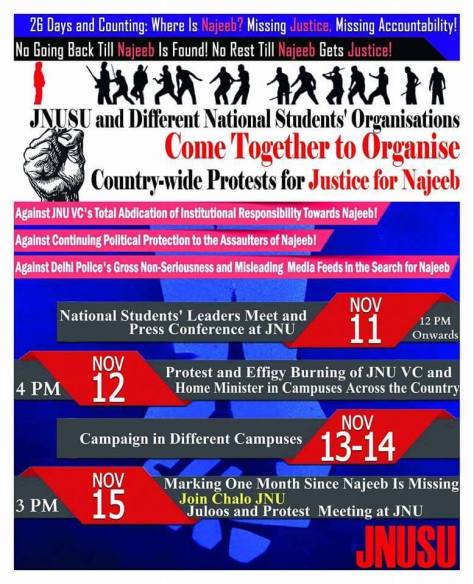
Appeal to Join “JNU Chalo” on 15 Nov Marking One Month of Najeeb’s Disappearance: JNUSU

Guest Post by JNUSU (Jawaharlal Nehru University Students Union)

15036279_10209603262232786_2873516424910911795_n

Friends, on 14th October night, Najeeb Ahmed, a student of M.Sc. Biotechnology, JNU was brutally assaulted and violently threatened by a group of ABVP students. From 15th October morning, Najeeb went missing from the campus. The disappearance of a student from a central university in the national capital after assault and intimidation of right wing lumpens is no doubt an ominous reflection of the dark times we are living in. For past four weeks, students, teachers, staff members of JNU, and citizens of Delhi have been coming out on the streets demanding institutional accountability to bring back Najeeb.

Continue reading Appeal to Join “JNU Chalo” on 15 Nov Marking One Month of Najeeb’s Disappearance: JNUSU

Demonetization, ‘Financial Inclusion’ and the Great ‘Unbanked’

A Prologue

There is a lot of talk these days about ‘exclusion’ – which is almost unquestioningly assumed to be a bad thing. The corollary to this understanding of exclusion is that all inclusion is necessarily good. One hears a lot about ‘financial inclusion’ these days,  which truth be told, makes me shudder. There is thus a lot of angst expressed these days, especially by the rich and powerful, over the ‘financial exclusion’ of the masses. Here is the basic argument (read the full article, disowned by the edit department, here):

Inclusive growth would mean that all sections of society benefit from economic prosperity. A key metric for inclusion is ‘financial inclusion’ i.e. the access to banking services and affordable financial products such as bank accounts, loans, and deposits for all individuals and businesses. When the poorest of the poor have access to credit and savings facilities, this translates to their financial security. They can grow larger businesses, manage consumption and household expenses better and plan for shocks. The standard of living improves and poverty falls, allowing people to contribute more to the economy as well.

Remember, however, before we proceed:

(i) That in 1997, the Asian financial crisis that wiped out the hard earned life-savings of millions of people, in one fell swoop, was an instance of financial inclusion.

(ii) That it was the banks that were fully responsible for the crises across the USA and Europe, 2008 onward. That the Occupy Wall Street movement was basically a movement against the  robbery of ordinary people’s money saved in banks by the banks, who on top of everything wanted to be bailed out with tax payers’ money.

(iii) That very recently Iceland has had to jail 26 bankers responsible for the 2008 financial crisis, “for crimes ranging from insider trading to fraud, money laundering, misleading markets, breach of duties and lying to the authorities”.

(iv) That one of the major reasons India escaped the worst effects of that crisis was because effectively 70 percent of its population still lies outside the banking and financial sector. Of course, the other important difference with the Western capitalist economies was that India’s banks were still largely in the public sector. In other words, banks do not only do what they and the economists say they do. Banks play with the hard-earned savings of the relatively poor, often simply handing handing them over to predator corporations and then writing off!

The Demonetization Gamble

A lot has already been said by now on the Modi government’s decision to demonetize Rs 500 and Rs 1000 notes. Economists and economic analysts from the Left-wing Prabhat Patnaik to others like  World Bank Chief Economist and former advisor to the Indian government, Kaushik Basu and journalist Swaminathan Aiyar have expressed serious doubts about both the rationale and feasibility of the move.  The point has been effectively made by them and others like Arvind Kejriwal (who have been centrally concerned with the issue of corruption and ‘black money’ for a long time now), that this measure does not touch the real big players in the game of black and unaccounted money. Big corporate sharks don’t need to go the ‘black money’ route because government policy itself is written by them and everything they do is made ‘legal’ either in advance, or retrospectively, because the government is in their pockets. Of course illegal activities even at those high levels often go on nevertheless, because the power-corporate elite has become so used to the idea that nothing really matters in this country – that everything they want is theirs. And in any case, the real big money lies deposited in Swiss banks or in circulation elsewhere, in other forms. Continue reading Demonetization, ‘Financial Inclusion’ and the Great ‘Unbanked’

Muktibodh’s Endless Journey


( Muktibodh was born on 13 November, 1917.This article is a tribute to him to mark the beginning of his birth-centenary)

It is a coincidence that November marks the beginning of the centenary of the Bolshevik revolution and also the Hindi poet Muktibodh. The fates of the two however have taken two divergent trajectories.

The life of the revolution turned out to be very short, it could not last out the century it was born. The poet on the other hand, though he died when he was not even 46, has seen his significance growing constantly.

Muktibodh was a Marxist and is considered to be a poet who longed for revolution. But the revolution demanded from its followers  to surrender themselves to the Party, which was absolute. They were expected to be a mere reflection of this absolute self. Muktibodh, on the other hand is interested in the life history of each soul. He seeks to create a community of selves in which each one will  be autonomous.  Continue reading Muktibodh’s Endless Journey

The Meaning of JNU’s Presence : Ankit Kawade

This is a guest post by ANKIT KAWADE

 How does the presence of public universities in general, and JNU in particular, affect the course of Indian politics? What is the sociology of such institutions, since therein cohabit people from diverse and unequal communities and regions? As a sociological phenomenon, what are the potentialities of the interactions which take place in such institutions across class-caste-gender-region categories? Continue reading The Meaning of JNU’s Presence : Ankit Kawade

The Anatomy of a Disappearance: Shehla Rashid

Guest Post by Shehla Rashid. Videos by Haider Saif and Samim Asgor Ali

Students Gathering in a Vigil for Najeeb Ahmed at JNU


Think of the person closest to you, and the place that they hold in your daily life, the bittersweet memories that they create each day in your life, the daily fights and the moments of affection. At times, you fight and simply want to go away from one another, seeking a temporary calm from each other’s absence. You resolve never to call him/her again, or to speak to her/him anymore. However, by the time dusk falls, you realise the emptiness of your time without them, and you make a phone call, speaking reservedly, trying not to sound desperate or sappy. You tell them that you are coming home, and ask whether you need them to get anything- as if that were the reason for the phone call. This person could be you sister, your partner, or your best friend. Continue reading The Anatomy of a Disappearance: Shehla Rashid

Modi’s Demonetization, Black Money and Surveillance: Baidurya Chakrabarti

Guest post by BAIDURYA CHAKRABARTI

  • The demonetization drive of Modi is neither new in content nor in form. In India, it has been done earlier by Morarji Desai; the initial conversion to Euro in the European Union happened within a month’s span. Currency is routinely taken out of circulation. What is significant about Modi’s demonetization is the amount of sensation he has generated out of an otherwise insignificant move. What is routinely done through phasing out denominations is being done in an extremely abrupt manner. He is dressing up a withdrawal and issuing of currency notes as a revolutionary move, and it is being executed in the manner more suited to currency change. What we need to thus ask ourselves is this: why is a routine monetary policy being enacted in this—which I shall later call ‘terroristic’—manner? Clearly, the answer is not economic; even the government does not pretend it to be a strictly economic issue (when they harp on the ‘terror’ factor).

(But before we move on, an aside. This demonetization exposes how the nostalgia for socialist development has fuelled the rise of Modi. Disenchantment with neoliberalism has produced an obscene amount of nostalgia for the pre-liberalization days among the Indian middle class, especially among the left-leaning ones. However, now that a gesture right out of those hoary days have returned to our world, it turns out to be a nightmare.)

  • Let us state the obvious things first: demonetization will do next to nothing to the so-called ‘black money’, which are routinely converted into fixed assets or foreign currency. This move dis-incentivizes hoarding of cash, but not speculation, all sorts of accounting practices that can produce the so-called ‘black money’ while bypassing the level of cash transaction altogether. Demonetization is simply an old-school, brute-force monetary policy to curb hyperinflation. The Head of European Central Bank in Europe and Larry Summers, US treasury secretary, has proposed demonetization of their high-currency notes this year. But none of them dream of doing it within a notice of 4 hours!

Continue reading Modi’s Demonetization, Black Money and Surveillance: Baidurya Chakrabarti

Statement on False Charges by Chhattisgarh Police Against Human Rights Activists

PLEASE ENDORSE IF YOU AGREE

We the Undersigned, strongly condemn the absurd charges of‘criminal conspiracy and murder’ against highly respected academics and social activists by the Chhattisgarh police in the case of murder of Shamnath Baghel by unknown persons on 4th November.

None of the following named in the FIR –  Dr Nandini Sundar, Head of the Department of Sociology, Delhi  University; Dr Archana Prasad, Professor, JNU; Vineet Tiwari of the Joshi Adhikar Sansthan;Sanjay Parate, Secretary, CPM, Chhattisgarh and Manju Kawasi of the CPI– were anywhere near the spot of the killing of Shamnath Baghel. Implicating them for this heinous crime only smacks of sheer vendetta by the police against them for daring to enquire into human rights violations in the state as part of an independent fact finding team.

The Chhattisgarh police’s action is further indication of the undeclared Emergency that has gripped the nation and the harassment of bonafide human rights activists and citizen’s groups trying to protect the fundamental Constitutional rights of ordinary citizens. In particular the Chhattisgarh Inspector General of Police SRP Kalluri seems to have embarked on a mission to prevent the rest of the country from scrutinising the many illegal actions of his forces against innocent tribal populations in the state as part of his war against Maoist extremism.

We have always believed that the use of violence by both the state authorities and those opposed to them are both wrong and any lasting settlement to the conflict in Chhattisgarh can only be brought about through political negotiations between all parties involved. Fact finding teams, like the one the academics and activists were part of, are critical to enabling such dialogue for a peaceful resolution and any assault on them is a threat to both peace and democracy.

We demand that the Chhattisgarh government immediately intervene to drop the arbitrary inclusion of names of completely unrelated persons from the current FIR filed in the Baghel murder case and instead launch a proper criminal investigation to apprehend those really responsible.

Tanika Sarkar

Sumit Sarkar

Zoya Hasan

Achin Vanaik

Pamela Philipose

Rahul Govind

Aruna Roy

Nikhil Dey

Shabnam Hashmi

Apoorvanand

Satya Sagar

Snehsata

Shankar Singh

Dilip Simeon

Kumar Rana

Arshad Ajmal

Manindra Thakur

Radhika Singha

Ravi S. Vasudevan

Chitra Joshi

Sangeetha Dasgupta

P.K.Dutta

Manisha Sethi

Dipak Dholakia

Nivedita Menon

Aditya Nigam


The Cult of the Angry Pointed Finger, or How I learned to Stop Worrying and Love the Father

The recent order by the I&B Ministery to NDTV India to suspend broadcast for 24 hours drew a range of reactions from outrage to bewilderment. The supporters of the ruling party were of course triumphant – Subhash Chandra of Zoo, er sorry Zee News was so excited he wrote a whole article on this. But even outside the partisan responses, many well-meaning self-declared neutral janta declared that national security is not a matter to be trifled with, and that it was right for the government to admonish NDTV. Wait, ADMONISH?! Never mind that the government’s allegation of NDTV having compromised national security simply doesn’t survive a fact-check. Here is how the largest section of (English-speaking, online) popular opinion sees it.

This token punishment was good and important to show that someone is there who is monitoring the media who always thinks behind the mask of freedom of expression that they can do anything in the world. So it is important that the Government of the Day makes its presence felt otherwise there will more chaos and issues like the UPA government where everyone was going around like headless chicken and no one is bothered or cared if a Govt of Man Mohan Singh existed or NO. Even small timers like the Delhi CM AK and his Guru Anna were threatening and taking morcha in Ram leela Maidan every second day and doing expose every third day putting the Govt. of India on the back foot and in defensive mode running for shelter. Now Arvind Kejriwala and his team is running for shelter as every day a Delhi MLA is shown the door of the JAIL and Anna Hazare has been locked in a shell in his hometown watching the sunrise and the sunset. This means business, It is important that Govt of the India should show it exist otherwise human mentality is that then everyone shows that everyone exist and everyone is the BOSS. Cannot allow to happen like this MESS. PM Modi please keep it up and keep the heat on this reckless media, on AK and his gang, on others who are trying to show unnecessary activism and also the Judiciary, keep all the appointments on hold and let them slog day and night. Show who is the BOSS ! Show who is the BOSS !

Yes, Modi ji, show who is the BOSS!

joffrey_nskwqom3fi1tcgpa7o1_500-1

Continue reading The Cult of the Angry Pointed Finger, or How I learned to Stop Worrying and Love the Father

Separatism of Majority against Kashmir : Anil Chamadia

Guest Post by Anil Chamadia

I am an Indian, but a separatist too. I am hostile against Kashmiri people because I only love my fellow countrymen.

The feeling of separatism among the people of a bordering state is easily identified. But there are two types of separatism. In a state or region like Kashmir and North – Eastern states, separatism is identified in such a way that there is a group or more than one group of people who want to secede from Indian nation and they carry out “actions” to fulfill this desire. They try to galvanize public support through their “actions” and harm government machinery as well. But have we ever identified the separatism that is professed by the majority section of the society?

I belong to a Hindu family of north India. Right from the beginning, a separatist feeling against Kashmir has been cultivated within me. A survey can be conducted in entire north India to know how a relationship with Kashmir has been nurtured among the people of this region during their childhood. If I ask 100 children, they all know Kashmir only through the materials available in media. I want to repeat the story how I was introduced to Kashmir. I was born in the early years of 1960s.  While going to school or returning back, I was told that Kashmir has a separate flag which is different from Indian tricolour. Like prime minister of India, it also has a prime minister. There is a separate section in Indian Constitution for it and Muslims are in majority there. Since Pakistan follows Islam, therefore loyalty of Kashmir people is also doubtful. Continue reading Separatism of Majority against Kashmir : Anil Chamadia

Indian Muslim women – Caught between misogynists and hypocrites: Sanober Umar

Guest Post by SANOBER UMAR

The ugly patriarchal politics of ‘Triple Talaq’ or unilateral ‘instant divorce’ through which Indian Muslim men (specifically Sunnis who follow the Hanafi school of Islamic jurisprudence), can divorce their wives by pronouncing the word ‘talaq’ thrice in a single sentence, has appeared once again in mainstream politics. In this board game played over Muslim women, you have two main players. On the one hand you have the ever-so-vocal and self-proclaimed representatives of Muslims –  The All Indian Muslim Personal Law Board (AIMPLB) – and on the other hand, you have right-wing public figures of Hindutva, including our very own Prime Minister Mr. Modi, shedding tears of concern for Muslim women’s rights.

However Muslim women should not be deemed as agentless victims in this plot, and many are raising their voice against this practice by asserting their Koranic rights. Nonetheless, it is important to emphasize that while AIMPLB and Hindutva politics may seem to be polar opposites, the two have much more in common when it comes to curbing or denying Muslim women their rights. The male dominated AIMPLB is clearly vested in its project of misogyny even at the cost of denying Muslim women their Islamic right of longer procedures of divorce, that allow time and space for reasonable consideration before annulling a marriage. On the other hand, Hindutva men are no saviours of Muslim women either, as many instances both past and present have shown – including the recent spates of rape and murders (such as the Haryana rapes and murders by Gau Rakshaks and not to forget, the horrifying Muzaffarnagar violence not too long ago).

Continue reading Indian Muslim women – Caught between misogynists and hypocrites: Sanober Umar

DISSENT, DEBATE, CREATE