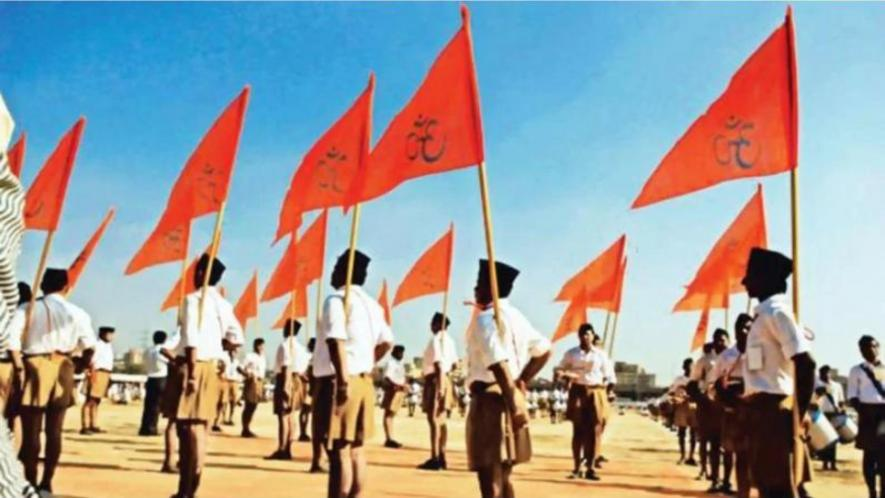
[Centenary celebrations of RSS – the biggest ‘self-proclaimed’ cultural organisation in the world — comprising of Hindus are on.
Much is being said about its longevity etc., and much will be said about it in coming days, it remains to be seen if it is ready to take a fresh look at some discomforting aspects of its own history when it is embarking on a journey towardswhat it calls as ‘new horizons’]
Ram Lila, the dramatic folk re-enactment of the life of Rama is still popular in Northern India.
Anyone who has watched this programme — especially in villages or towns — might have noticed a particular scene where god curses a sage for his misdemeanour that he will get a donkey’s face for his actions and will not even realise that he has got this new face.
One is reminded of this story — which tells us the great hiatus between claims and reality — whenever an individual or a formation starts bragging about its achievements that have no basis in reality.
Leaders of the Hindutva Supremacist movement in this part of South Asia look no different when they declare from the rooftops the “great role their political ancestors have played during the freedom movement”. It is a different matter that any objective student of India’s history — especially of the Independence struggle — is conversant with hundreds or thousands of pages, books, monographs written or documented to underline the contrary, their meek behaviour and compromising role during the very struggle. [https://www.newsclick.in/rss-centenary-search-icon]
Why this latest move by the state government is a worrying development.
“I have seen in Japan the voluntary submission of the whole people to the trimming of their minds and clipping of their freedom by their government, which through various educational agencies regulates their thoughts, manufactures their feelings, becomes suspiciously watchful when they show signs of inclining toward the spiritual, leading them through a narrow path not toward what is true but what is necessary for the complete welding of them into one uniform mass according to its own recipe. The people accept this all-pervading mental slavery with cheerfulness and pride because of their nervous desire to turn themselves into a machine of power, called the Nation, and emulate other machines in their collective worldliness.”
-Rabindranath Tagore, Nationalism
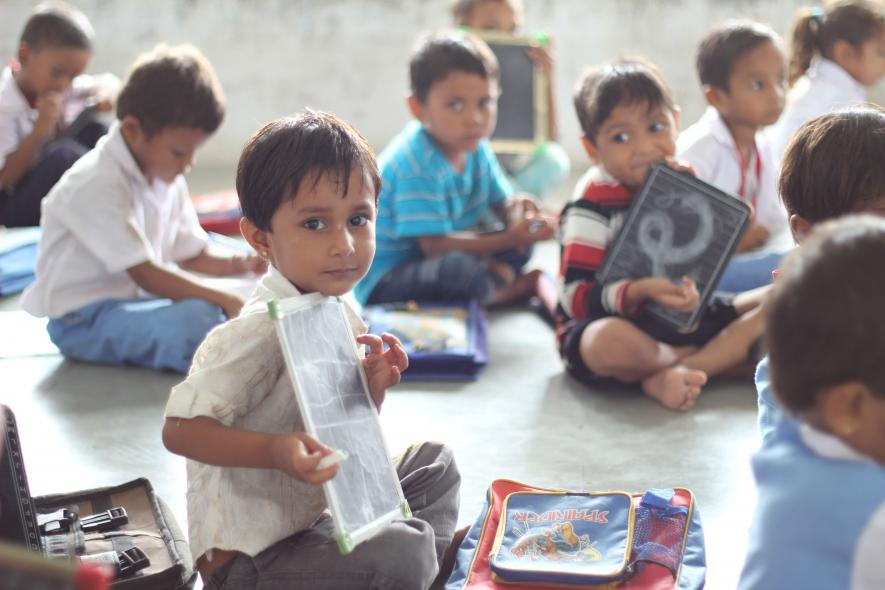
The richest state in the Indian union, Maharashtra, has embarked on a new initiative in the field of school education. It would provide basic military training to school students starting from Class 1, to promote “patriotism, discipline, and physical fitness among young learners from an early age”. Around 2.5 lakh ex-servicemen would be involved to deliver this training which will be introduced in a phased manner.
Undoubtedly, in the aftermath of Operation Sindoor, this proposal will be able to gather enough eyeballs in the rest of the country and it would not be surprise that few other Bharatiya Janata Party-ruled states would implement similar schemes in education.
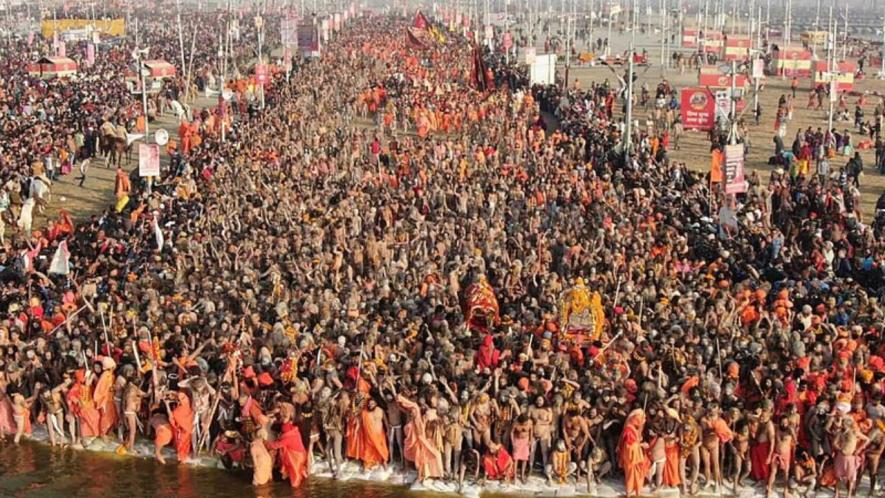
The Mahakumbh has provided Hindu Supremacist forces an opportunity to further marginalise and invisibilise Muslims, and further push for a ‘Hindu Constitution’.
Whether Uttar Pradesh Chief Minister Yogi Adityanath will be able to recover his image after the tragedy at Mahakumbh, which officially killed more than 30 people and wounded many, many more, is a question being raised in hushed voices in the corridors of power in Delhi.
Obviously, questions are also being raised about the great hiatus between the massive propaganda undertaken around the Mahakumbh and the level of preparations for this ‘biggest congregation on earth’….
For Chief Minister Adityanath, who had ‘positioned himself as the ‘host of the biggest congregation on earth’, the path ahead looks challenging, with the tremendous ineptness of the administration led by him on full display. Much has been reported about conscious attempts made allegedly to downplay the tragedy and how it continued for the whole day. A UP minister, supposed to be close to the Chief Minister, even made a controversial statement that “such small events keep happening in large gatherings.” The statement caused so much uproar that he had to issue an apology. The mainstream media added another page of shame to its track record when it continued to publish government handouts, and did not even deem it necessary to report the tragedy. ( Read the full article here : https://www.newsclick.in/road-kumbh-paved-hindu-rashtra-intentions)
Report prepared by Association for Protection of Civil Rights
Although the BJP came back with a much reduced majority (or perhaps because of that) the agenda of anti Muslim violence has been ramped up. We, the people of India, who restored the dignity of the Constitution, must continue to bear witness, continue to fight against the hate filled politics of Hindu Rashtra, continue to assert – Not in My Name.
We will remember these names, and the names of thousands of Muslims killed by lynch mobs, who have had their livelihoods destroyed, whose faith has been insulted, who suffer imprisonment without any basis till today.
Sab yaad rakha jayega.
There has been total of eight lynching incidents after the results of the General Elections were announced on June 4, 2024.
Twenty-three-year-old Salman Vohra, who had gone to watch a cricket tournament match in Chikhodra, Gujarat on 22 June, was mercilessly beaten to death by a group of men.
Three Muslim men, residents of Uttar Pradesh, were brutally attacked by a Hindutva mob in Chattisgarh’s Raipur on 7 June. Saddam Qureshi and his cousin Chand Miya Khan (23), both from Saharanpur district, and Guddu Khan (35) from Shamli district, were transporting cattle when they were allegedly chased by a mob in Raipur; two died on the spot, while one died after 10 days.
Anantkumar Hegde, BJP MP from Uttari Karnataka, is again in the news.
Close on the heels of his controversial statement about demolition of a mosque and his invoking of Hindu community who would not rest ‘until more mosques are reclaimed ‘ (1) he has delivered another explosive statement.
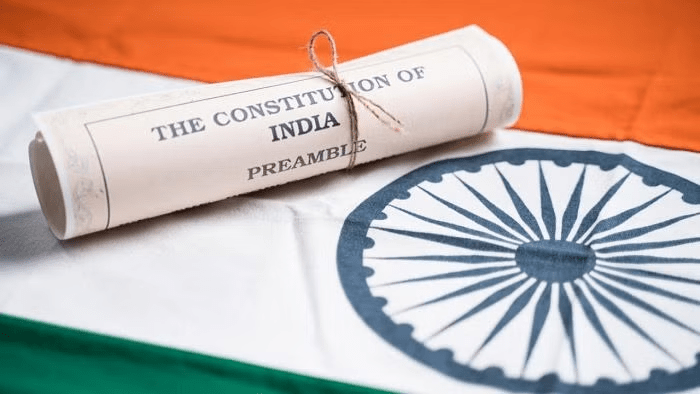
This time the whole edifice of Constitution is under his attack, which according to him has ‘distortions introduced by the Congress to suppress Hindu society’. (2) ..
..Critics have rightly said how this suggestion exhibits real intentions of the saffron regime which wants to usher us into Hindu Rashtra, end reservation for scheduled and backward communities, reinforce caste system and also replace Constitution drafted by Dr Ambedkar with a worldview inspired by Manusmriti. The main opposition party Congress has expressed fear that all such statements, steps just go to vindicate how a ‘cloud of dictatorship’ now hovers over India. (3)
It is a different matter that neither BJP top guns nor PM Modi – who had famously declared way back in 2014 that for him ‘Constitution is the most sacred book’ deemed it important to condemn Hegde’s statements or ordered him to seek apology for his claim.
One learns that it has merely distanced itself from Hegde’s controversial statement to convey an impression that what he said was his ‘Mann ki Baat’ and not BJP’s Dil ki Baat’ .
Prof Romila Thapar, great historian and public intellectual , will be delivering the 28 th Lecture in the Democracy Dialogues Series on Sunday 28 th January 2024 at 6 PM (IST).
Please reserve the time and date for the lecture. Details are given below
Democracy Dialogues – 28 th Lecture
Organised by
New Socialist Initiative (NSI)
Theme : Our History, Their History, Whose History?
The zoom invite will be shared closer to the date.
Abstract: My purpose in this talk would be to examine the link between history and particular kinds of nationalism. I hope to show that nationalism can be a process, bringing together and uniting all the communities that inhabit a particular territory in support of a change in society or opposing a target common to all. This earlier form is what I would like to call a unitary, integrative nationalism that cut across communities and drew them together in a particular country to support a single purpose. This I would differentiate from the latter forms in some countries which identified with units of society or communities according to certain common features, such as a particular religion or language, or caste or ethnicity. I would call it segregated nationalism, where each community is segregated and treated as having a distinctly different identity and its own separate goal. History is brought in when the community that gives an identity to its nationalism insists on tracing its origins to a historical past. This pattern of integrated and segregated nationalisms would seem to apply to India of the twentieth century. There was the all-inclusive national movement whose participants were from every community; its objectives were to maintain the unity of the Indian people and overthrow colonial rule. The other nationalism, segregated nationalism, was seeded in the 1920s and assumed the existence of two nations – the Hindu and the Muslim – which, it was argued, go back to earlier times. Integrated nationalism succeeded in 1947 in bringing about independence, but its foundations needed strengthening, for we are now witnessing the strong presence of religious nationalism in the attempt to inaugurate a Hindu Rashtra in India.
– Romila Thapar
About the Speaker:
Internationally renowned scholar of Ancient History, Prof Thapar was elected General President of the Indian History Congress in 1983 and a Fellow of the British Academy in 1999. In 2008, she was awarded the prestigious Kluge Prize of the US Library of Congress which complements the Nobel, in honouring lifetime achievement in disciplines not covered by the latter. Prof Thapar has been a visiting professor at Cornell University, the University of Pennysylvania, and the College de France in Paris and holds honorary doctorates from the University of Chicago, the Institut National des Langues et Civilisations Orientales in Paris, the University of Oxford, the University of Edinburgh (2004), the University of Calcutta and from the University of Hyderabad
Here is a select list of Prof Thapar’s publications Ashoka and the Decline of the Mauryas, 1961 ( Oxford University Press) ; A History of India : Volume 1, 1966 ( Penguin) ; The Past and Prejudice, NBT ( 1975) ; Ancient Indian Social History : Some Interpretations, 1978 ( Orient Blackswan) ; From Lineages to State 1985 : Social Formations of the Mid-First Millenium B.C. in the Ganges Valley, 1985 ( Oxford University Press) ; Interpreting Early India, 1992 ( Oxford University Press) ; Sakuntala : Text, Reading, Historie, 2002 ( Anthem) . Somanatha : The Many Voices of History, Verso ( 2005) ; The Aryan : Recasting Constructs, Three Essays ( 2008) ; The Past As Present: Forging Contemporary Identities Through History, (2014) ;Voices of Dissent: An Essay, (2020); The Future in the Past: Essay ( 2023)
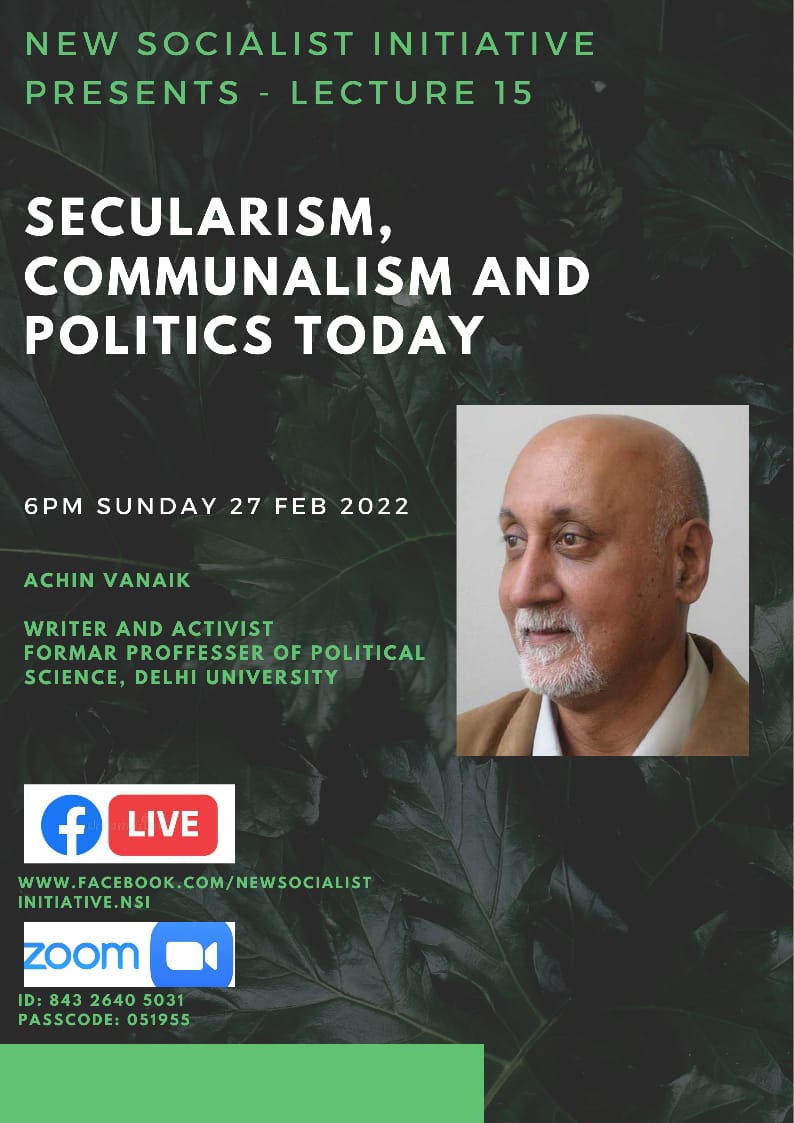
The 15 th lecture in the Democracy Dialogues Series will be delivered by Prof Achin Vanaik on Sunday, 27 th February at 6 PM (IST)
He will be speaking on
‘Secularism, Communalism and Indian Politics Today‘
Speaker
Writer and Social Activist, Former Professor of Political Science at Delhi University Prof Achin Vanaik is a fellow of the Transnational Institute
He is author of numerous books including The Furies of Indian Communalism ( 1997) , The Painful Transition : Bourgeois Democracy in India ( 1990) , Hindutva Rising – Secular Claims, Communal Realities (2017), “Nationalist Dangers, Secular Failings:A Compass for an Indian Left”
Summary :
The presentation will start with a series of definitions of crucial concepts such as secular, secularization, secularism as well as distinguishing between religious fundamentalism, religious nationalism and communalism. This is important to get a handle on how the widespread Indian understanding of secularism as an ancient form of ‘tolerance’ is dangerously mistaken. Of course the rise of the political right and far-right is a global phenomenon in the last few decades giving rise to different forms of what can be called the ‘politics of cultural exclusivism’. So the first principle of explanation for this rise has also to be transnational. After this the question of the rise of the Sangh/BJP in the wider context of developments in India over time will be taken up. It is obvious that the Sangh/BJP is seeking to expand its existing power and influence i.e., to establish and expand its hegemony and this must be understood as well as what are the projects central to its efforts to establish a Hindu Rashtra or Nation. It should be obvious that its particular conception of how to secure a strong Indian nation/nationalism must be exposed and combated. The presentation will end with recognising that this is a long term struggle and how we must go about it.
Is the Indian state turning into a religious dystopia, like some of its neighbours?
Image Courtesy: Free Press Journal
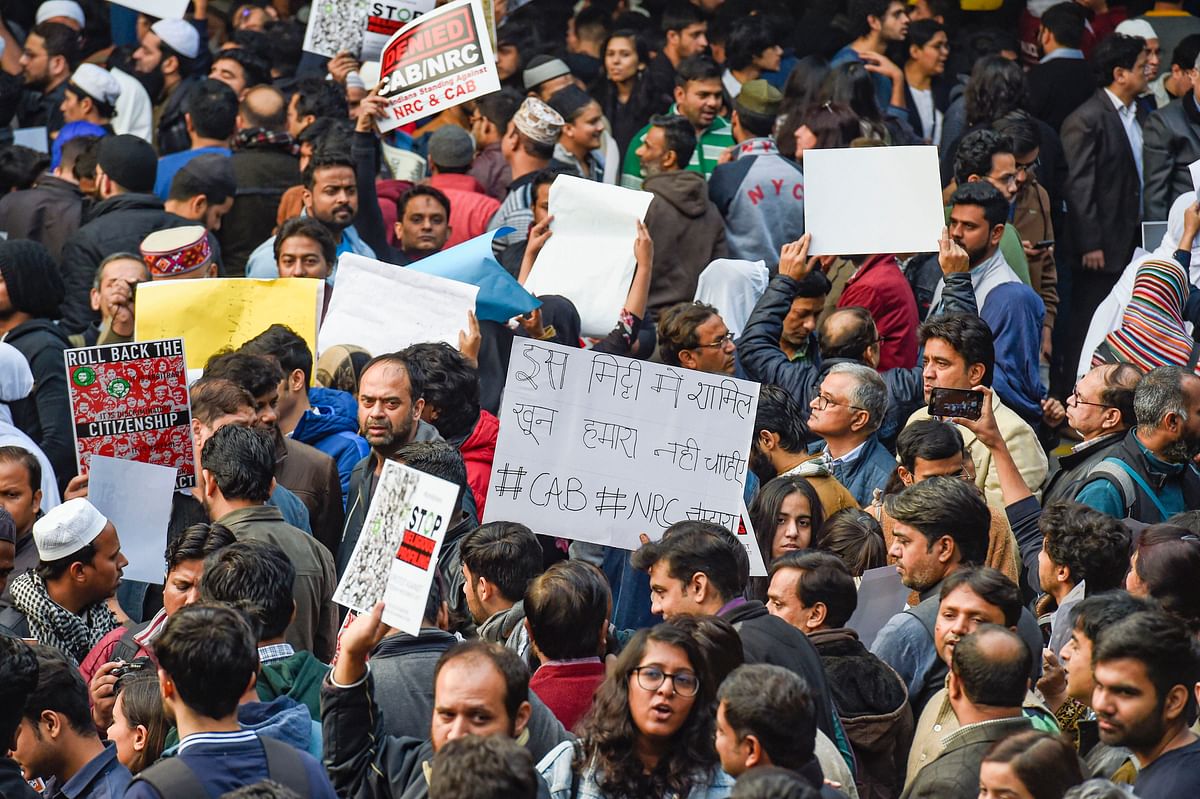
The Bharatiya Janata Party-led central government has pushed the Citizenship Amendment Act through, but it is struggling to manage its fallout and the national outrage that a related proposal to create a National Register of Indian Citizens or NRIC has generated. At first, BJP leaders desperately assured those who were excluded in the NRC, or national register of citizens, that was finalised in October this year for the people of Assam. Its pleas were meant to reassure the Hindus who were excluded in the state’s citizen-count that it would hold a fresh all-India count of citizens, in which they will be included. The reason for the BJP’s desperation was the outcome of the Assam NRC, which turned out to be contrary to its expectations: out of 19 lakh found “illegal” in the state, only about 5 lakh are Muslim, almost all the rest are Hindu.
Yet, the fears of the citizenship law, combined with the resistance to an all-India NRC, have now given rise to tremendous mass resistance across India. There have been massivemarches and rallies in many places, some of them culminating in aggressive confrontations with police and security forces. There is an ongoing massive crackdown on several universities, including in Lucknow, Aligarh, and Delhi where students were agitating against the new citizenship law and the all-India listing of citizens or NRIC.
Hindutva’s Second Coming by Subhash Gatade; published by Media House, Delhi; 2019; pages: 272; Rs 395 (US $ 18).
The return of Modi to power with a huge margin in this 2019 election is a clear verdict for the Hindutva plank. Why and how it happened leave us, the secular billions, to ponder about the reality and its aftermath. And at that juncture Subhas Gatade’s 272-page analysis titled ‘Hindutva’s Second Coming’ gives us something concrete to think over once again. This in-depth study with rich academic perception is a commendable work, bereft of jargons and convoluted expressions, often found in books written from a high pedestal which goes beyond the mental reach of lay readers. Precisely for this reason the author needs to be specially acclaimed for bringing out facts at one place based on notes and references which are so far scattered in divergent historical materials. It serves as a Reader for millions who are combating communalism and distortion of history at the grassroot level.
New Socialist Initiative stands in solidarity with the people of Assam, Tripura and the other North Eastern states in their heroic struggle against the communally motivated Citizenship Amendment Bill (CAB). It was only because of the resistance of the people that the government couldn’t table the Bill for voting in the Rajya Sabha after surreptitiously passing it in the Lok Sabha. This is in fact a victory for all the progressive and democratic forces of the country,who have been fighting to save and expand the secular character of the nation. While the danger still looms large and there is a strong possibility that the government may try to bring back the bill in the upcoming budget session, the mass resistance of the people has demonstrated very clearly that the evil designs of the fascists in power will not go unanswered and that the people will fight back with all their might. Continue reading Statement on the People’s Resistance against the Citizenship Amendment Bill : New Socialist Initiative→
(To be published in the special issue of ‘Janata’)
The spectacle of what is called religion, or at any rate organised religion, in India and elsewhere, has filled me with horror and I have frequently condemned it and wished to make a clean sweep of it. Almost always it seemed to stand for blind belief and reaction, dogma and bigotry, superstition, exploitation and the preservation of vested interests.
– Toward Freedom: The Autobiography of Jawaharlal Nehru (1936), pp. 240–241.
If Hindu Raj does become a fact, it will no doubt, be the greatest calamity for this country. No matter what the Hindus say, Hinduism is a menace to liberty, equality and fraternity. On that account it is incompatible with democracy. Hindu Raj must be prevented at any cost.
– Ambedkar, ‘Pakistan or Partition of India’, p. 358.
Introduction
India’s slow ushering into a majoritarian democracy is a matter of concern for every such individual who still believes in pluralism, democracy, equality and a clear separation of religion and politics. The way people are being hounded for raising dissenting opinions, for eating food of their choice or entering into relationships of their own liking or celebrating festivals according to their own faith is unprecedented. The situation has reached such extremes that one can even be publicly lynched for belonging to one of the minority religions or for engaging in an activity which is considered to be ‘suspicious’ by the majority community.
No doubt there is no direct harm to the basic structure of the Constitution, its formal structure remains intact, de jure India does remain a democracy as well as a republic, but de facto democracy has slowly metamorphosed into majoritarianism and the sine qua non of a republic—that its citizens are supreme—is being watered down fast. It does not need underlining that this process has received tremendous boost with the ascent of Hindutva supremacist forces at the centrestage of Indian politics. Continue reading Nehru, Ambedkar and Challenge of Majoritarianism→
It was probably late sixties or early seventies – when a gentleman called P N Oak started appearing in Marathi magazines peddling his weird theories about well known monuments in and outside India. An article which made lot of news then was centred around Taj Mahal where it was claimed that it was ‘Tejo Maha Aalay’ or hindu god Shiva’s abode. It tried to establish through various ‘explanations’ that a Shiva Temple was destroyed to build Taj Mahal and if we dig deep we can find ‘remnants’ of the earlier structure. Mr Vinay Katiyar’s latest advice to Uttar Pradesh Chief Minister Yogi Adityanath that he “should go into the Taj Mahal and see the Hindu signs inside it” reminded one of P N Oak. Continue reading Taj Mahal as Tej Mahal – Once again “There is a Bee in the Bonnet”→
On 22 June 2017 fifteen-year old Hafiz Junaid was stabbed to death on a Mathura-bound train from New Delhi. He was traveling home for Eid with his brothers and two friends. A dispute over seats resulted in a group of men repeatedly assaulting and stabbing Junaid and his companions. The assailants flung their bodies onto the Asoti railway platform. A crowd gathered. At some point an ambulance was called and two bodies were taken away. Junaid is dead. His companions are in critical condition. While one person has been arrested the police investigations are running into a wall of social opacity since they have been unable to find a single eye-witness to the incident. Of the 200 hundred strong crowd that assembled on Asoti railway platform on Thursday evening, the police cannot find one person who can say what they saw. The police cannot find a witness because something very peculiar seems to have happened to those present at Junaid’s death. A report by Kaunain Sherrif M in the Indian Express provides specific details. When asked if he had seen anything that evening, Ram Sharan a corn-vendor whose daily shift coincides with the killing, Sharan said he was not present at the time of the incident. Two staffers who were sent to investigate by the station master were unavailable for comment. Neither the station-master, the post-master or the railway guards saw the event they were present at.
In this startling piece the journalist reports how the public lynching of a Muslim child becomes a social non-event in contemporary India. He shows the reconfiguring, and splitting, of a social field of vision. He reports all the ways in which people – Hindus- did not see the body of a dead – Muslim – child that lay in front of them. The Hindus on the Asoti railway platform managed to collectively not see a 15 year old Muslim boy being stabbed to death. Then they collectively, and without prior agreement, continued to not see what they had seen after the event. This is the uniquely terrifying aspect of this incident on which this report reflects: the totalising force of an unspoken, but collectively binding, agreement between Hindus to not see the dead body of a Muslim child. Hindus on this railway platform in a small station in north India instantly produced a stranger sociality, a common social bond between people who do not otherwise know each other. By mutual recognition between strangers, Hindus at this platform agreed to abide by a code of silence by which the death of a Muslim child can not be seen by 200 people in full public view on a railway platform in today’s India. Continue reading Why Two Hundred Ordinary Hindus Did Not See A Dead Muslim Child On A Railway Station In North India→
At some point during the Khalistan movement, I came across a brief news item about a constable of the Punjab Police killed by Delhi Police personnel. The two teams had completed their interrogation of a suspected militant. Whose job was it to clean up the blood? Disagreement, a scuffle, a killing.
Legitimized brutality; the stench of blood inflaming the senses; the knowledge of absolute power and absolute impunity.
All of India is that interrogation room now.
Hindu Rashtra is here.
Has there not been violence earlier in this land? Yes of course there has been. A full seven decades of an independent state’s violence against the people of the land declared to be India – against dispossessed peasants and tribal people, against industrial workers, against the people of Kashmir, and of the states of the North East; centuries of violence by savarna Hindu society against the Dalit-bahujan; misogynist, sexist violence against women, up to and including female foetuses in the womb; decades of coldly planned and executed communal violence by institutionalized systems of riot production coordinated by the organizations of the RSS – against Muslims, against Christians, and as a secondary force, against Sikhs in 1984.
Mainstream politics over Rohith Vemula’s suicide is becoming hot and ugly. Although whisper campaigns against Rothith’s dalit identity were on since his suicide, the BJP’s central leadership had been relatively quiet after HRD minister’s rather shrieky ‘appeal’ to not play caste politics over his suicide. However, now it seems daggers are out. The party in power, whose two ministers are accused of creating conditions leading to Rohith’s suicide, has decided that Rohith’s non-dalit status is the dog it is going to beat to counter its anti-dalit image. Rohith’s mother is a Mala, a Scheduled Caste, who lives seperately from his father, a backward caste Vaddera. He got an SC certificate on the basis of showing that he grew up in his mother’s Mala household. BJP’s strategy may look petty, but it is based on the age-old great Hindu tradition which can not contenance any violation of the privileges of the patrilineal system. After all, marital rape does enjoy legal sanction in India to this day. Continue reading Missing the Forest for Trees – Caste System’s Shadow on Rohith’s Suicide : Sanjay Kumar→
( Till 1992, 6 th December was remembered as ‘Parinirvan Divas’ of Dr Ambedkar, legendary son of the oppressed who had clearly recognised the true meaning of Hindutva and warned his followers about the dangers of Hindu Rashtra ; post 1992, 6 th December has an added meaning and it relates to the demolition of Babri Mosque undertaken by these very forces.
Apart from the fact that this event led to the biggest communal conflagaration at the national level post-independence, whose repercussions are still being felt and whose perpetrators are still roaming free, we should not forget that it was the first biggest attack on the principles of secularism and democracy, which has been a core value of the Constitution drafted under the Chairmanship of Dr Ambedkar.
What follows here is an edited version of the presentation made at Dept of Social Work, Delhi University, during their programme centred around 1 st Ambedkar Memorial Lecture)
“If Hindu Raj does become a fact, it will no doubt, be the greatest calamity for this country. No matter what the Hindus say, Hinduism is a menace to liberty, equality and fraternity. On that account it is incompatible with democracy. Hindu Raj must be prevented at any cost.”
– Ambedkar, Pakistan or Partition of India, p. 358
‘Indians today are governed by two ideologies. Their political ideal set in the preamble of the constitution affirms a life of liberty, equality and fraternity whereas their social ideal embedded in their religion denies it to them’
The Gujarat Earthquake in the year 2001 and the consequent relief and rehabilitation programme was an eyeopener to the outside world regarding the deep seated caste bias in the Gujarati community apart from the much talked about bias against the minorities. There were reports that at places the relief and rehabilitation work bypassed the dalits and the Muslims.
There are rare occasions when one is witness to the making of history before our own eyes. The dismantling of the 240 year old Nepalese monarchy and the ushering of Nepal into a Republic has been one such occasion.
As rightly said by a senior Nepali leader “A day comes once in a century. Today is day that Nepali’s long cherished dream has come true.”
But as far as the Sangh Parivar and its affiliated organizations are concerned they have openly expressed their displeasure over these developments. Looking at their sectarian worldview and anti-human understanding of history it does not look surprising. These are the very forces who supported Monarchy till the very end and were enamoured about the ‘model Hindu Rashtra’ in operation here which denied every right to broad cross-section of people. People who still pat themselves on the back for the ‘successful Gujarat Experiment of 2002’ or who celebrate demolition of a five hundred year old mosque as ‘Day of Valour’ can have only such convoluted understanding of things. Continue reading Jaswant Singh ko Gussa Kyon Aata Hai?→




 KAFILA - COLLECTIVE EXPLORATIONS SINCE 2006