Category Archives: Debates

Exploring Possibilities for Critical Alliances Between Animal Rights and Bahujan Politics: Krishnanunni Hari

Guest post by KRISHNANUNNI HARI

This essay emerged as a response to the following question that was raised during a Q&A session that I had run on social media:

“How does one tackle people who amalgamate veganism with upper caste vegetarianism?”

The immediate answer to this is that veganism avoids all animal products and all forms of animal ab/use, and hence cannot be amalgamated with vegetarianism and its caste baggage.

Such an answer, however, ignores crucial cultural issues that determine how Animal Rights (AR) and veganism are perceived, co-opted or taken forward in Indian society.

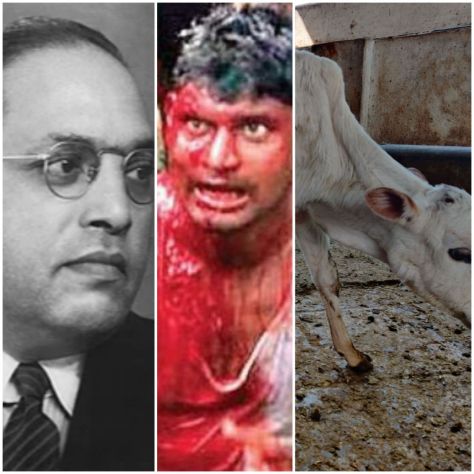
Vegetarians, contrary to what Right wing Hindutva will have us believe, comprise less than 40% of the country’s population.  Jains, most Sikhs and Brahmins and some rich urban forward castes make up the vegetarians in India1. Vegetarianism in India is connected to social power and caste hegemony, unlike its counterpart in the West, where it is an ethical lifestyle and a social justice movement.

Continue reading Exploring Possibilities for Critical Alliances Between Animal Rights and Bahujan Politics: Krishnanunni Hari

Remembering Marx in Lockdown Times – Beyond the “Corona” Paradigm: Maya John

Guest post by MAYA JOHN

On the occasion of the birth anniversary of Karl Marx, the greatest intellectual of the millennium, it is best to steer clear of hero-worshipping. Instead, let us commemorate Marx’s ideas by re-enacting his way of knowing things. Much can be drawn from his writings wherein we can see Marx reinvigorating the revolutionary agenda at a time of deep despair and defeat. Reflecting and writing after the failed revolutions of 1848, Marx provided an introspective critique of unfolding conditions in his essay The Eighteenth Brumaire of Louis Bonaparte (1852). Closely examining the events of the successful coup and assumption of dictatorial powers by Louis-Napoléon Bonaparte in republican France in 1851, Marx was the only contemporaneous political thinker to liken the ascendancy of Louis-Bonaparte to that of his uncle, Napoleon Bonaparte, who seized power in revolutionary France through the coup of 18 Brumaire (7 November 1799).

Continue reading Remembering Marx in Lockdown Times – Beyond the “Corona” Paradigm: Maya John

Why Activists Want Prisons Decongested

The Supreme Court also wants to reduce the Covid-19 risks posed by overcrowded jails, but there is little progress so far.

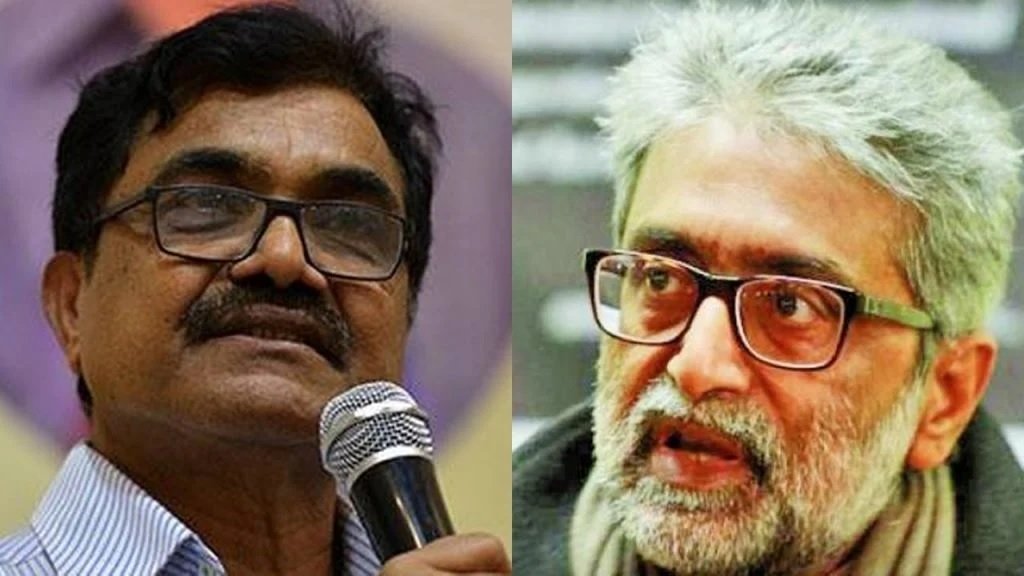
Navlakha and Teltumbde

Late in March, Sirous Asgari, a materials science and engineering professor from Iran, who is at present detained by the United States Immigration and Customs Enforcement (ICE), had warned about the “inhumane” conditions at the ICE facility that could turn it into a hot spot of Covid-19 fatalities.

April has made his worst nightmares come true. Asgari, who has a history of respiratory problems, has been infected by the Novel Coronavirus, which causes the Covid-19 disease. The news created international outrage last month. Not only the Iranian foreign ministry, many United States lawmakers and human rights groups also demanded his release, but it was not to be.

At the facility in which Asgari is still lodged (though he has been exonerated of all the charges he faced in the United States), people are usually detained for no more than 72 hours, but the Coronavirus outbreak has delayed deportations. People like him are simply caught up in the system. Asgari can leave the United States and resume work in Iran—where the viral epidemic has already claimed more than 60,000 lives—because he simply isn’t being taken before a judge.

Asgari’s plight reminds of another incarceration, this one in an Indian jail; that of Anand Teltumbde, who has been arrested in the Bhima-Koregaon case. On 26 April, noted activist-filmmaker Anand Patwardhan had, in a Facebook post, expressed deep concern about the health of 70-year-old Teltumbde, who also suffers from respiratory problems.

( Read the full text here : https://www.newsclick.in/Prisons-during-lockdown-needs-to-be-decongested)

The Many Debts We Owe to Lenin

‘The workers’ and peasants’ government… calls upon all the belligerent peoples and their government to start immediate negotiations for a just, democratic peace.

By a just or democratic peace, for which the overwhelming majority of the working class and other working people of all the belligerent countries, exhausted, tormented and racked by the war are craving [we mean] an immediate peace without annexations – that is, without the seizure of foreign lands, without the forcible incorporation of foreign nations and without indemnities.’

The ‘just and democratic peace’ sought by the workers and peasants government never arrived.

It was on 26 th October 1917 when Lenin, the 47 year old leader of this nascent Government, read out the Bolshevik Decree on Peace. This appeal fell on deaf ears.

The many players and participants in the first World War,  the imperial powers fighting for a re-division of the world, which had already claimed millions of lives, refused to put a halt to their killing machines and the war continued for more than a year, adding menacing figures to the tally of the dead as well as the wounded. Students of history tell us that this ‘War to End Wars’ as it was termed then culminated in the deaths of more than nine million combatants and seven million civilians as a direct result of the War and the resulting genocides and related 1918 influenza pandemic causing another 20-50 million deaths worldwide.

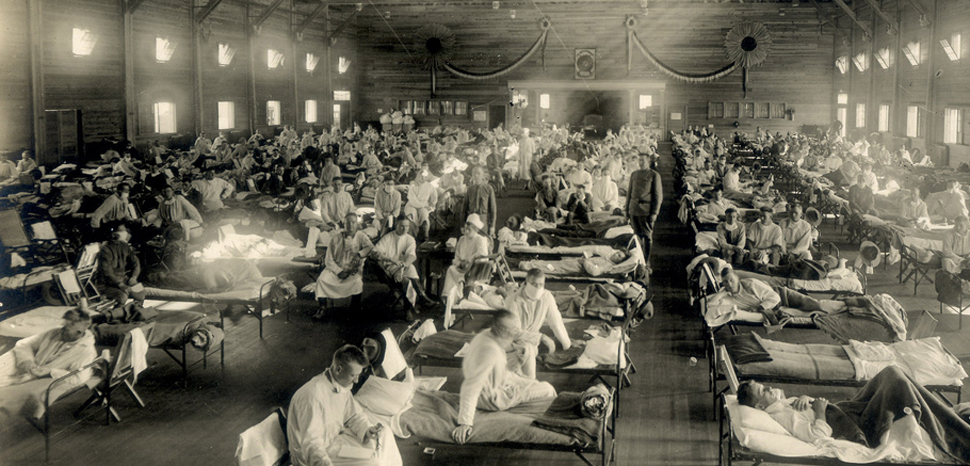
Otis Historical Archives, modified, https://commons.wikimedia.org/wiki/File:Emergency_hospital_during_Influenza_epidemic,_Camp_Funston,_Kansas_-_NCP_1603.jpg, CC 2.0, modified

Looking back one knows that if this decree on peace had been positively responded, few more million deaths in the ongoing war could have been avoided and deaths due to the pandemic of Spanish Flu ( 1918) could have been contained more effectively. Experts can tell you how the trenches of the western front proved ideal for spread of the virus as “[t]renches were flooded much of the time. Blood and bodily remains from people and animals that had been blown to pieces, along with faeces and rotting food, formed the pathways and shelters for troops going to and returning from, the front.”

The World War I which eclipsed all previous wars by its scale of destruction finally came to an end in 1918. Continue reading The Many Debts We Owe to Lenin

Part II – The Virus, the Muslim and the Migrant: Forced labour and data capitalism

THIS IS THE SECOND PART OF A THREE PART POST, THE FIRST PART OF WHICH CAN BE READ HERE.

Forced labour and data capitalism are the low end and high end of Coronacapitalism. Let us examine each of these.

Forced labour

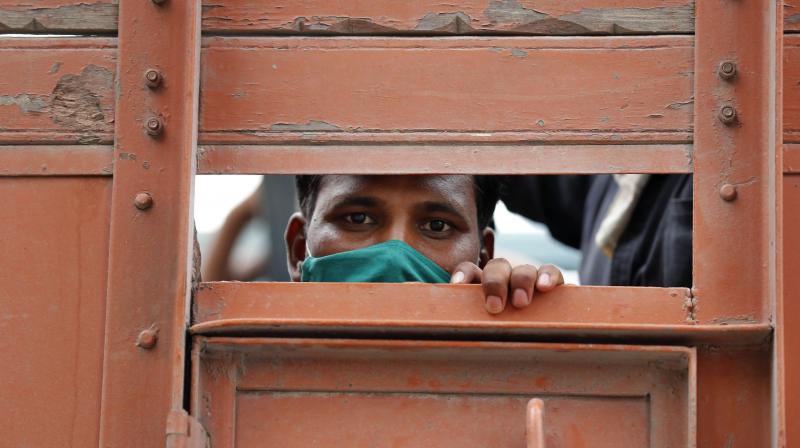
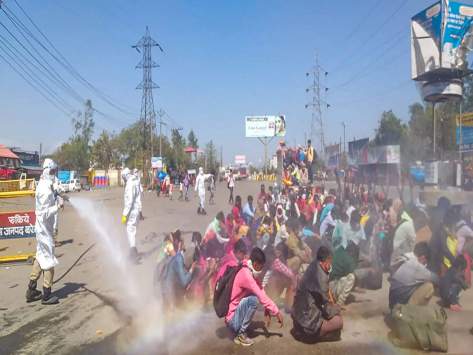
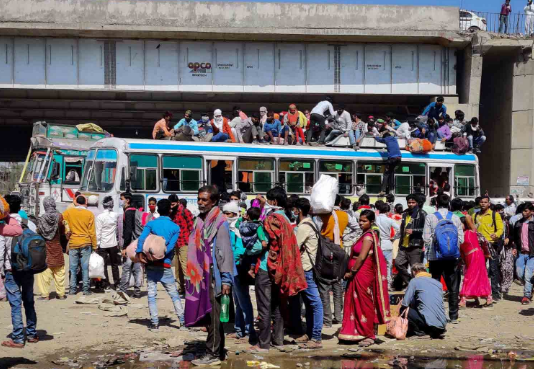
The gut-wrenching picture of migrant workers who managed to reach Bareilly, being sprayed with disinfectant by people protected by hazmat suits themselves, provoked such widespread outrage in India and negative publicity in the foreign media, that the Health Ministry issued a hasty statement that this should not be done.

Spraying of chlorine on individuals can lead to irritation of eyes and skin and potentially gastrointestinal effects such as nausea and vomiting. Inhalation of sodium hypochlorite can lead to irritation of mucous membranes to the nose, throat, respiratory tract and may also cause bronchospasm, the advisory said.

Workers at Bareilly bus terminus being sprayed with chemicals

But this brutality and callousness towards workers and the poor emanates from the very top of this regime – the signal is sent from there, as to who matters and who doesn’t. The difference in treatment is stark and unapologetic.  For example, during the lock-down, on April 18th,  even as thousands of workers walked long distances home because no transport was arranged for them, precisely in order to prevent them from leaving the states in which they were stranded, the Uttar Pradesh government organized 250 buses to bring back students from the state studying in Kota, Rajasthan.  As of April 24th, special flights and hospital beds are being prepared by the government to bring back Indians stranded abroad. Continue reading Part II – The Virus, the Muslim and the Migrant: Forced labour and data capitalism

The Limits of Public Health Management: Time to Rethink Development in Kerala

One of the effects of the pandemic in Kerala, like in most other parts of the world, is that the government’s narrative muffles all other narratives, and this is not just about the containment of the pandemic. Here the government’s narrative about the pandemic enjoys far greater legitimacy than elsewhere, and with good reason. It is true that Kerala’s greater successes in dealing with the pandemic are unique and commendable; however, to think that therefore, the government is right on everything else is probably a huge mistake. Continue reading The Limits of Public Health Management: Time to Rethink Development in Kerala

‘The Man Who Knew Infinity’ : Team Umang Library

Guest Post by Team Umang Library

Remembering Great Mathematician Srinivasa Ramanujan
on his hundredth death anniversary                                                                                                                                                                                                                                                                     (Watch the video on Youtube uploaded by Umang Library:
First Part: https://www.youtube.com/watch?v=Rehg3WtiBKc
Second Part: https://www.youtube.com/watch?v=y1I1NaWoajY

Srinivasa Ramanujan Facts: 40 Facts on Self-Taught Mathematical Genius

Photo Courtesy : https://factslegend.org/

It was the year 1913 when Srinivasa Ramanujan, then an ordinary clerk in Madras Port Trust, drafted letters to Prof G H Hardy, then a leading mathematician at Cambridge University, containing his mathematical theorems.

The rest as we know is history.

Continue reading ‘The Man Who Knew Infinity’ : Team Umang Library

Fascism, the Revolt of the ‘Little Man’ and Life After Capitalism – Manifesto of Hope III

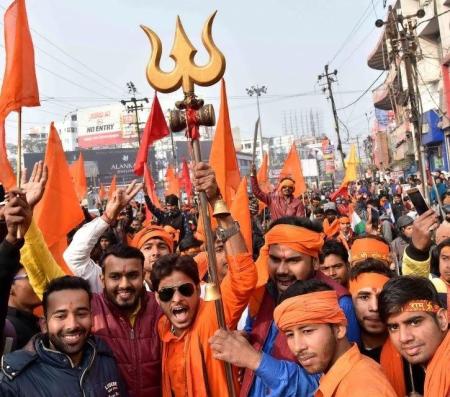
A representational image of a Hindutva demonstration, courtesy Sabrang.

[This the third instalment of a series on ‘Life After Capitalism – A Manifesto of Hope’. Earlier parts can be accessed Part I here and Part II here. Part IV can be accessed here.]

Yesterday was V. I. Lenin’s 150th birth anniversary and just the other day I read a report of a survey that claimed that 75 percent of Russians think the Soviet era was the best time in the country’s history. A great tribute to Lenin on this occasion, one would imagine, whatever may have been the reasons for socialism’s collapse. If you could put this response in Russia to nostalgia for a time gone by, it comes as an even bigger surprise that a recent poll in the United States of America, conducted by an outfit called YouGov and funded by the Victims of Communism Memorial Foundation (a clearly anti-communist outfit) found that 70 percent of the millennials (between the age of 23 and 38 years in 2019) favoured socialism. Earlier in February 2019, Jochen Bittner, political editor of the German weekly Die Zeit wrote in the New York Times on ‘Why Socialism is Coming Back in Germany?’

Continue reading Fascism, the Revolt of the ‘Little Man’ and Life After Capitalism – Manifesto of Hope III

The Virus, the Muslim and the Migrant: Part I – Comvid 14

PART I OF A THREE PART POST

The term Comvid 14 is gratefully borrowed from Tony Joseph who defined it in a Facebook post as Communalvirus (Comvid 2014), the incubation period for which could be as long as six to seven years. Over fifty percent of infected people remain asymptomatic carriers, the rest going into paroxysms of hate and violence, many also gravitating towards TV newsrooms, according to him.

Suffocating mythologies produced by Hindu supremacism blanket India today.

So first of all, a loud, ringing zindabad to all the courageous journalists, citizen reporters and social media activists whose determined work relentlessly exposes fake news, and counters genocidal journalism in India.

Suchitra Vijayan explains the term “journalism as genocide”:

Rwandan cultural anthropologist Charles Mironko analyzed confessions of a hundred genocide perpetrators. His work confirms the thesis that hate messages in the media had a direct effect on the dehumanization of the population that was subject to persistent slander. Several months of this behavior, in the absence of credible reporting, conditioned the population to hate, and kill.

It is all the dogged fact-checking and on-the-ground reporting that continues to let in the light, through the crack, the crack in everything –  as Leonard Cohen sang; the words that Gautam Navlakha referred to just before he surrendered to the National Investigating Agency, on the orders of the Supreme Court.

This is India today – the violent Hindu Rashtra of Savarkar and Golwalkar’s dreams, under the direct control of the Rashtriya Swayamsevak Sangh.  And this Hindu Rashtra is built on predatory capitalism – a toxic cocktail, far deadlier than the biological virus that now haunts us.

Just as the pandemic is inflected in its effects differently in different global contexts, the three features of the crisis in India – the virus, the Muslim and the migrant – relate in a way that is specific to ‘here’. The virus has enabled and strengthened predatory capitalism here as it has globally, but it has also reproduced itself through Hindu supremacism, generating two monstrous mutations – Comvid 14 and Coronacapitalism.

And we who will fight and resist both? What of us, how are we to combine, come together, connect to other stories the virus tells us, find our way to other lanes down which it leads us? How will we find and inhabit  those fissures and chinks in which green things can grow, and solidarities, and compassion and hope?

But first, the two monstrous mutations – one in this part, the second in the next. Continue reading The Virus, the Muslim and the Migrant: Part I – Comvid 14

NLU Jodhpur alumni and students protest homophobic teaching materials

Current VI semester undergraduate students of the University pursuing the ‘Sociology – III Law and Society’ course, at the National Law University Jodhpur were sent outright homophobic content purportedly as essential reading (details of the readings are in the letter below). The material presented outdated notions of homosexuality. When the faculty member was challenged via email by a student, she said she had shared it to encourage debate and present one side of the prevailing views on homosexuality. However, the material was sent without providing any such context. The faculty committed that she would be sending updated material presenting sociological developments on the subject in the coming few days. However, instead of doing so, she delegated her responsibility to the student who had written to her, a move that can only be interpreted as reprisal.

The interim student body wrote to the Vice Chancellor on the issue. 150 alumni members also wrote to the Chancellor, Vice Chancellor and General Council of NLU-J asking for disciplinary action against the faculty member, an external resource person to teach the subject, and review of the course curriculum.

This is the letter

Dear Dr. Saxena and Members of the General Council,

We, the undersigned alumni of National Law University, Jodhpur, much to our consternation, have learnt that current VI semester undergraduate students of the University pursuing the ‘Sociology – III Law and Society’ course were sent outright homophobic content purportedly as essential reading by Dr. Asha Bhandari, Assistant Professor, Faculty of Humanities and Social Sciences, and Member, Academic Council, on April 11, 2020. On a perusal of the content, it is evident that the material sent by Dr. Bhandari is unscientific, uncritical, based on outdated notions of homosexuality, perpetuates dangerous stereotypes, and legitimizes prejudice against the LGBTIQ community. As you would all agree, this is unacceptable in any institute of learning, much less in one that prides itself on being a premier national law school.

Continue reading NLU Jodhpur alumni and students protest homophobic teaching materials

Agony of COVID-19 and the Lockdown – Who is Afraid of ‘Class’? Maya John

Guest post by MAYA JOHN

This essay is the second part of a two-part series on Society in the Time of Covid 19. The first part appeared in Kafila on 5 April and can be read here.

The ideas of the ruling class are in every epoch the ruling ideas…Karl Marx, The German Ideology (1845)

The Bolshevik slogans and ideas on the whole have been confirmed by history; but concretely things have worked out differently; they are more original, more peculiar, more variated than anyone could have expected. – V.I. Lenin, Letters on Tactics (1918)

रहिमन विपदा हू भली, जो थोरे दिन होय हित अनहित या जगत में, जान परत सब कोय

Crisis of a few days is better/ For it reveals who is friend and who is foe. – Khanzada Mirza Khan Abdul Rahim Khan-e-Khana, ‘Rahim’      (1556 – 1627)

Looking at what transpires each day of this epidemic coupled with lock-down, people appear to be plucked out of heterogeneous circumstances and placed in the homogenous time of “Corona”, putting all things in abeyance. The battered housewife whose alcoholic husband grows restless with every day; mourning relatives who’ve lost a loved one and struggle to make it to the last rites; the live-in ‘maids’ whose workday begins at the crack of dawn; the municipal worker who continues to de-clog our sewer lines to prevent the chance of reverse flow in our commodes; the young, newly-wed construction worker who’s anxious about his wife in the village; the tired nurse who fears she’s contracted the wretched infection; among many other circumstances of life are part of this moment, the epidemic-cum-lock-down. The coupling of epidemic and lock-down has created confusion for some people in terms of which of the two is deadlier. For many this is an unprecedented, exceptional time. But for others this moment is not new but rather a repetition of the similar course of life, with the addition of just another fear. Many are puzzled by how, among all the life-threatening contagious diseases and illnesses in circulation, “Corona” gained prominence.

Continue reading Agony of COVID-19 and the Lockdown – Who is Afraid of ‘Class’? Maya John

Brutalising Labourers, Jailing Dissidents

A medical emergency is no pretext to impose a political emergency.

A medical emergency

How many policemen in civil clothes are required to deliver a mere summons to an editor of a web journal 700-k away in an age of email and WhatsApp? The recent action of the Uttar Pradesh police, where it sent a posse of 7-8 policemen, in civil clothes, in a black SUV with no number plates, to Siddharth Varadarajan’s residence in Delhi to deliver a summons has prompted this question.

Definitely the police did not bother to ponder over how Varadarajan, editor of The Wire, will present himself to the authorities during a lockdown which has brought trains, flights and even private transport to a standstill.

The manner in which the issue has unfolded has caused an international uproar with 3,500 jurists, scholars, actors, artists and writers condemning Uttar Pradesh Police’s actions against The Wire, and saying that a “medical emergency should not serve as the pretext for the imposition of a de facto political emergency.”

How Chief Minister Yogi Adityanath’s government will respond remains to be seen, but the story in The Wire on the Tablighi Jamaat, which also noted that “Indian believers” responded late to the viral epidemic obviously provoked the powers-that-be into action. The episode has brought into sharp focus the priorities of the government during the epidemic, which it is supposedly fighting a “war” against.

( Read the full article here : https://www.newsclick.in/Brutalising-Labourers-Jailing-dissidents)

करोना से ग़लत सबक़ लेना घातक हो सकता है : राजेन्द्र चौधरी

Guest post by RAJINDER CHAUDHARY

पिछले दिनों हम ने ‘करोना के कुछ ज़रूरी सबक़’ पर चर्चा की थी. पर बड़ी संभावना यह है कि करोना के आधे अधूरे या गलत सबक निकाले जाएँ.  इस के लिए भी हमें तैयार रहना चाहिए.

बिलकुल गलत सबकों पर आने से पहले, कुछ संभावित आधे अधूरे सबकों की चर्चा कर लें. निश्चित तौर पर करोना के बाद की दुनिया में वैश्वीकरण ढलान पर होगा; अब आर्थिक वैश्वीकरण बढ़ने के स्थान पर घटेगा. विशेष तौर पर दवाइयों और स्वास्थ्य सेवाओं से जुड़ी वस्तुओं के मामले में राष्ट्र आत्मनिर्भर होने की कोशिश करेंगे; करनी भी चाहिए पर यह अधूरा निष्कर्ष होगा. केवल स्वास्थ्य सम्बन्धी मामलों में ही नहीं, बल्कि जहाँ तक संभव हो हर मामले में आत्मनिर्भर होने की कोशिश होनी चाहिए. इस से भी आगे बढ़ कर यह आत्मनिर्भरता केवल राष्ट्रीय स्तर पर न हो कर स्थानीय स्तर पर भी होनी चाहिए.

Continue reading करोना से ग़लत सबक़ लेना घातक हो सकता है : राजेन्द्र चौधरी

Mainstream Myths Versus Scientific Collaboration

The rediscovery of scientific collaboration across borders is a welcome development.

Fake News on COVID

Nothing in life is to be feared, it is only to be understood. Now is the time to understand more, so that we may fear less.

– Marie Curie.

Does the 5G network have any link to the novel corona-virus outbreak?”

Well, any sane person on this part of Earth would readily laugh at this outrageous claim. But this claim has “gone mainstream” leading even to bomb attacks on phone masts. So one has to sit up and analyse.

No doubt, when “psychological states peak and people’s anxiety levels are high,” as one expert puts it, one can easily become prey to such conspiracy theories. And as right-wing or conservative ideas have growing legitimacy in society, things can get even worse. Remember how for a long time Iran’s theocracy was in denial about the Corona-virus threat?

India is no exception to such false claims. All sorts of home remedies are being offered as a definite cure to the disease. We saw Gomutra parties where cow urine was drunk, supposedly as protection from this highly-contagious disease which has taken more than 100,000 lives and infected more than 1.7 million. No doubt it is an arduous task for progressives to counter all the rubbish being peddled around the pandemic and prepare people to take proper care while pressurising the powers-that-be to make public health a priority.

Such struggles can be better fought if individual scientists or groups of scientists join hands to sensitise and educate people.

The recent launch of a pan-institutional CovidGyan website (https://covid-gyan.in/) which is a brainchild of the Tata Institute of Fundamental Research (TIFR), the Indian Institute of Science (IISc), and the Tata Memorial Centre (TMC) is a welcome step in this direction. Other key members of this initiative include Vigyan Prasar, IndiaBioscience, and the Bangalore Life Science Cluster (BLiSC, which comprises InStem and C-CAMP, in addition to NCBS-TIFR).

( Read the full article here : https://www.newsclick.in/Mainstream-Myths-Versus-Scientific-Collaboration)

Life After Capitalism and the New ‘al Shatir-Copernicus’ Revolution – Manifesto of Hope II

[This is the second of a four-part series. Other parts can be accessed Part I here, Part III here and Part IV here]

In the previous instalment of this series in Parapolitics, I had discussed the situation arising out of the Covid 19 pandemic in terms of the possible implications of the global lockdown and ‘quarantine of consumption’, for post-capitalist futures. In this part, I will discuss (a) the conditions that make such futures not just imaginable but possible and (b) indicate certain directions that such futures are already taking – for the paths that we tread now are the ones that lead to the future.

Sorrento Abandoned Mill near Naples, Italy Source: Mentnafunangann/Wikimedia Commons

Theory/ Concept/ Discourse

Since all talk of post-capitalist futures only sounds outlandishly utopian and out of sync with what we see around us with the ‘naked eye’ as it were, it is necessary to first clear our field of vision a little. And, let us be very clear here that this ‘clearing of the field of vision’ is not, in the first instance, about practices on the ground but about the field of knowledge – and theory in general. And before any hard-boiled hysterical-materialist tries to tell us that all this is idealism and that the ‘real’ stuff is materiality and things only happen in practice, I want to make three general points here. First, for the more theologically oriented: it was Lenin who said repeatedly that ‘without revolutionary theory, there cannot be any revolutionary movement.’ (What is to be Done?) Not only that, he also insisted (after Kautsky) that left to its own, the working class movement could only produce ‘trade union consciousness’ and that ‘socialist theory’ had to be imported from outside (basically bourgeois intellectuals) into the working class movement. This understanding was to lead to all kinds of problems including vanguardism but we will let that be for now.

Continue reading Life After Capitalism and the New ‘al Shatir-Copernicus’ Revolution – Manifesto of Hope II

Corona, Capitalism and Civilisation : Ravi Sinha

Guest Post by Ravi Sinha

“Who do you blame it on? For a while it was China, until the most favourite target for the Indians appeared on the scene – you know who. When it comes to the business of blaming, Indians (a large percentage of them) would have loved it if the virus had originated somewhere in the Middle East or in Pakistan.

But new viruses have always appeared in human history, some more deadly than others. This one is the newest such calamity. Sure enough, humanity will be found standing on the other side of this crisis. But, how shall we count the losses after this mayhem is over?

Continue reading Corona, Capitalism and Civilisation : Ravi Sinha

An Open Letter to the Kerala Governor Sri Arif Mohammad Khan About Our Fight Against the Virus, But Also About Our Resistance to CAA-NRC

Dear Sir

First of all, thank you for acknowledging, even praising,the efforts of the government of Kerala and the people to protect ourselves and humanity against the threat of the corona virus. It is true that Kerala’s efforts and achievements are being lauded the world over, but those voices are never going to make any impact on the supporters of the Sangh parivar in Kerala. But your views cannot be dismissed so easily as ‘Western’ or ‘leftist’ (though they may still murmur about your Muslim name). What has really riled me in the recent past is their systematic effort at downplaying Kerala’s achievements, heaping abuse on our effort to help migrant workers, and raising baseless allegations against those who are working to mitigate the crisis. So as a historian of modern Kerala, I am writing this to offer some insights into why we have been able to do this, in the hope that you may be able to see what they will never tell you — simply because they are so sadly blinded by hate. Continue reading An Open Letter to the Kerala Governor Sri Arif Mohammad Khan About Our Fight Against the Virus, But Also About Our Resistance to CAA-NRC

Knowability and Unknowabiility of COVID-19 – Is There ‘Class’ in the Coronavirus Panic? Maya John

Guest post by MAYA JOHN

[This is the first part of a two-part series on ‘society at the time of Covid-19’]

‘An elephant was attacked by a house cat. Frustrated and trying to avoid the cat, the elephant accidentally jumps off a cliff in panic and dies.’ – Anonymous

‘The idea of the self-sufficient character of science (“science for science’s sake”) is naive: it confuses the subjective passions of the professional scientist, working in a system of profound division of labour, in conditions of a disjointed society, in which individual social functions are crystallised in a diversity of types, psychologies, passions …. The fetishising of science, as of other phenomena of social life, and the deification of the corresponding categories is a perverted ideological reflex of a society in which the division of labour has destroyed the visible connection between social function, separating them out in the consciousness of their agents as absolute and sovereign values.’ – Nikolai Bukharin, 1931

The specter of Covid-19 is haunting India and many other countries in the world. As the fear of the novel Coronavirus (SARS-CoV-2) grips India, and draconian state measures unleash havoc on the poor, it is imperative to trace back the clock so as to fully comprehend the underlying thrust of the current paranoia. Who have been carriers of the disease into India and what was done to identify and contain them? Whose paranoia is determining state policy? And are we possibly witnessing an ‘over-reaction’ shaped by the anxiety of upper classes? These questions imply the need, in class terms, for a closer scrutiny of the reasons behind the declaration of the pandemic.

Continue reading Knowability and Unknowabiility of COVID-19 – Is There ‘Class’ in the Coronavirus Panic? Maya John

Corona Biopolitics and Life After Capitalism – A Manifesto of Hope I

[This essay eventually became the first of a four-part series. The subsequent parts can be accessed Part II here, Part III here and Part IV here]

‘It seems we are massively entering a quarantine of consumption where we will learn how to be happy just with a simple dress, rediscovering old favourites we own, reading a forgotten book and cooking up a storm to make life beautiful. The impact of the virus will be cultural and crucial to building an alternative and profoundly different world.’ – Li Edelkoort, trend forecaster and fashion advisor

As large parts of the world reel under the impact of a lockdown that has prompted several people to recall the great lockdowns during the early twentieth century Spanisht flu and even the 14th centry plague, my thoughts in fact strayed in another direction. With international and national air traffic down to the barest minimum, with arenas of conspicuous consumption shut down, zillions of cars of the roads and construction activity to a halt, I was suddenly struck by a not-so-crazy thought: with all the suffering that a lockdown necessarily entails for the poorer sections of the population in particular, there might still be a silver lining here. Perhaps the temperature of the earth will have come down a few notches by the time we are done with this crisis and what is more, it might initiate a different mode of being in the world. It might give the world an opportunity to see what is continuously being denied by climate-deniers (as Naomi Klein recorded, backed by huge funds from right-wing US based foundations and  corporations). It might – it just might – reconnect us with what we have long left behind and have been longing for – a different pace of life where slow is beautiful, as it were.

Continue reading Corona Biopolitics and Life After Capitalism – A Manifesto of Hope I

Weaponising Idiocy: Milk-Drinking Ganesha to Taali Bajao

Then and now, a conservative Hindutva organisation had a role in spreading rumours.

coronavirus and cow urine

Representational image. | Image Courtesy: Deccan Herald


Yad ihasti tad anyatra, yan nehasti na tat kavcit. ‘Whatever is here might be elsewhere, but what is not here could ever be found’.—The Mahabharata, 1.56.33, from Meera Nanda’s The God Market: How Globalisation is Making India More Hindu, Random House 2009.

It was the fag end of the 1st decade of the 21st century when the historian Rink Shenkman wrote his marvellous book, Just how stupid Are We? Facing the Truth about the American Voter. In an interview, he said that Americans are “ill-prepared” to guide the world’s “most powerful” democracy. The book points out the astounding inability of even “two of five voters” to name three branches of the federal government, the fact that half of Americans think that their president can suspend the Constitution, and a large section’s ignorance of the 9/11 attack and the Iraq war that followed.

His concern was the mass of people who could easily, repeatedly and systematically be misled and manipulated by politicians and further “dumb down” American politics.

This “stupidity” was on full display in images of rowdy college crowds hitting California’s beaches during spring break, prompting the governor to close them down. New York governor Andrew Cuomo warned that “young people are not Superman/woman” when it turned out that people, especially the young, are not socially distancing themselves. But only Americans are not to blame. Media tells us that “virus rebels” are displaying their stupidity virtually all over the Western world, prompting crackdowns by authorities.

There’s perhaps no similar study for South Asia, especially India, probing our “stupidity” in this crisis-time, though there’s immense fodder for it.

( Read the full text here : https://www.newsclick.in/Hindutva-Coronavirus-COVID-19-WhatsApp-Fake-News)

Desirable Deaths, Malignant Neglect

Coronavirus reveals that in the capitalist world there is still no such thing as society.

Coronavirus

Bella Ciao! Bella Ciao! A song which traces its origins to the struggles of working women (rice-weeders) in 19th-century Northern Italy, and which later became an anthem of anti-fascist struggles there, recently made a comeback on the streets of Rome.

Well, there was no mass gathering, obviously, but you could hear people’s voices sing not only Bella Ciao from windows and balconies but many other patriotic numbers, some newly-composed.

With the world’s eighth-largest economy under lockdown, people restricted to their homes and fatalities due to novel coronavirus already over 1,400, this collective singing was the Italian people’s way of finding a moment of joy in this time of anxiety. It “lifted their spirits” and became a unique way for them to declare solidarity with each other.

( Read the full story here : https://www.newsclick.in/Coronavirus-Crisis-Capitalist-Society-Public-Funded-Health-System)