
Category Archives: Debates

People’s Participation in Planning Mumbai?: Hussain Indorewala and Shweta Wagh

This is a guest post by Hussain Indorewala and Shweta Wagh

Since the past six months in Mumbai, there has been an unusual convergence between urban activists, community groups, rights groups, unions, Non-Governmental Organizations and academics, who have come together to provide a theoretical critique of the city’s neoliberal development model, to formulate a more diverse and hopeful vision for the city than the one proclaimed by its power elite, and to present practical alternatives to plans and projects promulgated by faceless state bureaucracies and unaccountable private consultants.

On 22nd October 2013, more than 1500 people gathered at Azad Maidan to formally present “The People’s Vision Document for Mumbai’s Development Plan (2014-2034)” to the Municipal Corporation of Greater Mumbai (MCGM).[1] The People’s Vision Document (PVD)[2] is a remarkable collective vision statement, an outcome of discussions focused around specific issues in the city with more than a hundred grassroots and community groups, along with activists, experts and academics who participated in them. With this movement, the less advantaged residents of the city have announced and forced themselves into an exclusionary and secretive Development Plan process; refusing to be silent spectators, in a striking example of initiative, organizational ability and creative agency, they have asserted their right to the city’s future, whose owners and managers have done much to keep them out. To use the language of other social urban movements around the world, some of the most marginalized groups of the city are fighting for spatial justice, urban democracy, and have claimed their ‘right to be equal in diversity.’[3] Continue reading People’s Participation in Planning Mumbai?: Hussain Indorewala and Shweta Wagh
As a religious minority, I empathize with sexual minorities: M Reyaz

This is a guest post by M. REYAZ

The Apex Court judgment of December 11, putting aside the Delhi High Court order on decriminalisation of homosexuality, pertaining to Section 377 of the IPC has clearly divided into two ‘queer’ camps, where on one side besides LGBTS are those liberals extending their support to the LGBT cause, and on the other side, there are religious leaders and groups, who otherwise would not even see eye to eye with each other (what is ‘queer’ about this second camp is not so much its sexual orientation, as the strangeness of its banding together against queer people despite their antagonism toward each other).

Continue reading As a religious minority, I empathize with sexual minorities: M Reyaz

JTSA extends support to the LGBT community, calls for committed judicial activism: JTSA

Guest Post by JAMIA TEACHERS’ SOLIDARITY ASSOCIATION

On 11 December, 2013 a two judge bench of the Supreme Court of India (SC) ruled that section 377 of the Indian Penal Code (IPC), which considers homosexuality a criminal offence, does not ‘suffer from the vice of unconstitutionality’ and hence, legally valid.  By this highly regrettable ruling the apex court astounded and disappointed not only the LGBT community but the wider public at large.

Continue reading JTSA extends support to the LGBT community, calls for committed judicial activism: JTSA

Suresh Koushal v. Naz Foundation: Pratiksha Baxi

Suresh Koushal v. Naz Foundation directs law’s violence on the body of the Constitution of India. Proclaiming colonial law as constitutional, the Supreme Court negates its role in the making of postcolonial constitutionalism. It departs from the theatres of comparative constitutionalism in the post–colonies, which used Naz to strengthen their battles against Macaulay’s legacies. Today the Supreme Court is cited amongst the infamous precedents of injustice that mark Indian legal history. Dubbed as ADM Jabalpur 2, the judgment declares sexual emergency on LGBT communities. By breathing life into s. 377, the Supreme Court attaches a badge of stigma on the body of Constitution.

Taking a jurispathic turn, the Supreme Court asserts that equality is subservient to scale by claiming that the LGBT community is a “miniscule fraction of the country’s population”. Inventing the category of a miniscule minority, the Supreme Court implies that equality provisions will apply only to numerically preponderant body populations. Thereby, overwriting equality jurisprudence by the insidious politics of numbers.  Continue reading Suresh Koushal v. Naz Foundation: Pratiksha Baxi

The Anti-Rape Movement -The Political Vision of ‘Naari Mukti/Sabki Mukti’: Kavita Krishnan

Guest Post by KAVITA KRISHNAN

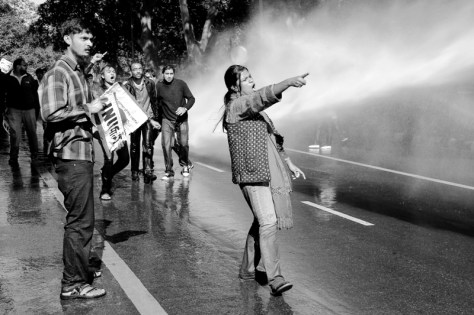
Anti Rape Protest at CM Shiela Dixit's House, Photo by Vijay Kumar
Anti Rape Protest at CM Shiela Dixit’s House, Photo by Vijay Kumar

A year ago, a massive movement erupted on the streets of Delhi and the country – against the brutal gangrape of a young woman on a bus, leading to her death. Looking back at that movement a year later, it is clear that the questions, concerns and above all the tensions and debates embedded in that movement are with us still – and are quite crucial to the political discourse around us.

Continue reading The Anti-Rape Movement -The Political Vision of ‘Naari Mukti/Sabki Mukti’: Kavita Krishnan

AAP’s Rise and Congress Rout – Some Obvious but Unconventional Questions: Sanjay Kumar

Guest post by SANJAY KUMAR

A Congress rout and the AAP success are the most obvious results of recent polls. Both are spectacular, in their own ways. Even BJP’s landslide victory in Rajasthan and Madhya Pradesh pales in comparison, for these two open up new possibilities.

Why a party whose legacy of anti-colonial struggle had lost sheen generations ago, whose top leadership is in the grip of a seemingly disinterested and incompetent dynasty, that lacks any organised cadre, coherent ideology, social base, and whose average leader appears more of a wheeler-dealer, and scamster, should continue to get close to thirty percent of votes from Indians even in worst of times, is a genuine mystery. That the Indian social analyses, barring a few exceptions, have tried little to unravel this mystery, is not only an indication of their intellectual limitations, but also of their ideological biases. The enduring success of Congress indicates seamier side of liberal democracy in general, which bourgeois social sciences try more to paper over than explore.

From voters’ perspective elections under liberal democracy are an exercise in choice, but not in freedom. When people vote, they are not acting as citizens shaping their social world, but as little men and women facing pre-existing structures of social power. The magic of elections under liberal democracy is precisely this. They offer a choice, the choice is not fake, its collective outcome is uncertain, yet the choice is already pre-determined in ways that by and large reproduce pre-existing power structures. That is why, exercising franchise is not necessarily a marker of democratic exercise, and leaders of fascist persuasion are often the loudest votaries of compulsory voting.  But that is not all. If elections were mere gears in a machine that simply revolved on and on, they would be quickly become a ritual, like those under state socialism in which the Party and leaders always got more than 95% approvals. Elections under liberal democracy in contrast provide flexible adjustment of state political functionaries to changing social conditions. They allow reflection of changes in public opinion, demography, gender politics, caste equations and balance of class forces, whose origins lie somewhere else, onto state politics. Punctuated adjustment with a time lag produces a sense of drama. Personae on stage appear as victors and losers, for voters there is enough stage space to allow their hope, vengeance or gratitude to play their part. For a time, and only for a time, the impersonal structure of state power becomes humanly palpable. Continue reading AAP’s Rise and Congress Rout – Some Obvious but Unconventional Questions: Sanjay Kumar

An anti-constitutional judgement: Johannes Manjrekar

Guest Post by JOHANNES MANJREKAR

The ruling by a two-member bench of the Supreme Court, striking down the judgement of the Delhi high Court which had held that Article 377 – a pre-Constitution, 19th century colonial-era law – violated the spirit and directive principles of the Indian Constitution, seems to break new ground in jurisprudence. In an era where governments worldwide have been engaged in systematically rolling back hard-won civil liberties and individual rights and violating constitutionally guaranteed freedoms and principles, one might be excused for believing that the most urgent duty of an independent judiciary endowed with a reasonable degree of conviction and courage, would be to curb the transgressions of governments against the principles laid down in their own constitutions. The recent ruling of the SC does little to encourage such a belief. Continue reading An anti-constitutional judgement: Johannes Manjrekar

On the SC judgement on Sec 377: Statement from TISS teachers

It is with deep shock and disappointment that we received the regressive judgment of the Supreme Court dated 11-12-13, on the reading down of Section 377 of the IPC related to the rights of queer (lesbian bisexual gay and transgender…) people in this country, which reverted the decriminalisation of non-normative sexualities following the Delhi High Court judgement in 2009.

The Delhi High Court had based its expansive judgement on the eloquent discussion of constitutional morality by the framers of our Constitution, especially Dr. Ambedkar. Constitutional morality, they argued is the basis for equality of citizens since public morality which is largely the morality of the dominant forces in society can never guarantee democracy, and perhaps even more importantly equality and dignity to its citizens, especially its most marginal citizens. Additionally, The Delhi High Court judgement evoked the spirit of dignity, inclusiveness and non-discrimination, thereby emphasizing equality of all citizens that Nehru spoke of during the Constituent Assembly debates, so necessary for the deeply hierarchical social fabric that our country represents. Continue reading On the SC judgement on Sec 377: Statement from TISS teachers

The State Manufactures Terrorism: KP Sasi

An Interview with activist-film-maker, K.P. SASI by Md. EisaBadre Alam Khan and Abhay Kumar.

KP Sasi
KP Sasi

K.P. Sasi is a well-known social activist and filmmaker.  In his several decades of activism, he has been associated with a number of social movements ranging from anti-globalisation and anti-nuclear movement to anti-death penalty struggles and the movements led by environmentalists and marginalised social groups such as Dalits, Adivasis, and Muslims etc. He has expressed his activism through making more than two dozen documentaries and a few feature films. But his two music videos —America, America and Gaon Chhodab Nahin, watched by lakhs of people, continue to motivate social and political activists standing against injustice and inequality. The lean and thin Sasi, who spots thick grey beard, is again in controversies for his latest spell of activism. Early in this year he screened a 94-minute long documentary Fabricated based on the life of Muslim leader from Kerala Abdul Nasar Madani, accused in Coimbatore and Bangalore serial bomb blasts. Fabricated has been the fruit of Sasi’s two years of hard work during which he did an extensive research, met a number of people and travelled thousands of miles and received threats as well. Why did he take so much pain and risk his life? Fabricated, in Sasi’s words, is an attempt to bring a ray of hope to thousands of innocent people, mostly Muslims, Dalits, Adivasis, oppressed nationalities, workers and others languishing in jails for years and decades under draconian laws such as Unlawful Activities Prevention Act (UAPA). Fabricated is mostly woven around the story of Madani, making a strong case that the Muslim leader of Kerala is innocent and has been jailed for years simply because has been framed. He has a charisma, a great skill of oratory and above all a vision of the uplift of the marginalised sections. In the early week of November, Sasi was in Delhi where Fabricated was screened at many places. After watching the documentary at Jawaharlal Nehru University, Md. Eisa, Badre Alam Khan and Abhay Kumar had a detailed interview with K.P. Sasi during which he went on a great length about a host of issues from state terror, human rights, Hindu right, caste, and class to the Muslim politics. The excerpts of the interview are as follows: Continue reading The State Manufactures Terrorism: KP Sasi

AAP Halts BJP Advance in Delhi

Over a year ago, I had written on Kafila about the (Ir)resistible rise of Arvind Kejriwal,  a phenomenon thoroughly misread from the beginning to this moment, by free radicals and Left devotees of Congress-style politics. Taking the risk of saying ‘I-told-you-so’, some lessons need to be underlined, learnt from the political developments of the last three years. That post said – referring back to the days of the Anna Hazare movement (itself dubbed reactionary, casteist, even RSS-sponsored and fascist, by pundits of all hues) –

But here was the political class  and the intelligentsia from Left to Right taking the protestors to task – asking them to tame their dissent and channel it through ‘proper channels’. Contest elections and let us see how much support you have, they challenged. Anna Hazare stuck to his guns, refusing the bait. Kejriwal however, seems to have decided to call their bluff. And much before the last hunger strike failed, his political mobilization started moving away from the single point agenda of the Lokpal Bill. Apparently taking up the challenge and moving towards the constitution of a political party, Kejriwal has entered the field in a manner that might even begin to pose an electoral challenge to ruling as well as opposition parties. How much of a challenge it will be we cannot say. However, one thing is quite clear: It will probably introduce an element of serious uncertainty in the coming elections, whenever they are held. Old formulas will cease to work. Equations are bound to change with new imponderables entering the scene.

Continue reading AAP Halts BJP Advance in Delhi

A hunt, the aftermath, angry Indian men and a tragedy: Rahul Roy

Guest Post by RAHUL ROY

Nivedita Menon ends her commentary on the unfolding Tehelka sexual assault case in Kafila by asserting – “the time has come. It is now”. It should be, but is it? Are we witnessing the end game of an old Indian patriarchal sport called sexual assault? The sport is akin to another old game called the royal hunt that was an important part of elite political culture of South Asia. The rules of the sport were then as now heavily loaded in favour of the royal huntsman – weapons, support teams, timing, everything required for the thrill of a kill were with powerful men out to conquer. The expeditions however were not just about the kill. The sport was also a means of asserting authority over tracts of the wild and those that lived there and were by some misfortune not aware of prevailing authority structures. The royal hunt was an event to showcase to subjects the might, prowess and authority of the elite rulers. It was the stamping of power over human as well as animal kingdom. The royal huntsman could not but win. He could not but kill.
Continue reading A hunt, the aftermath, angry Indian men and a tragedy: Rahul Roy

Tehelka, Jhatka and now Tamasha:Satya Sagar

Guest post by Satya Sagar

Eight years ago I remember listening to Tarun Tejpal in Bangalore as he held forth on how the news media could change the world for the better. It was a gathering of journalism students from Catholic institutions around the country and Tejpal was impressive in his defense of media freedoms.

He was passionate, charismatic, extremely articulate and as Chief Editor of Tehelka- with some of the best stories of Indian journalism behind them- very credible too. After his speech Tejpal left in a hurry, like a star priest dashing off to his next flaming sermon and fawning audience. Continue reading Tehelka, Jhatka and now Tamasha:Satya Sagar

Protect the Privacy of the Tehelka Journalist: Report Responsibly

GUEST POST BY ‘REPORT RESPONSIBLY’
To all editors, journalists, bloggers, users of social media, and the public:

Some websites and blogs are posting the Tehelka journalist’s complaint to the magazine’s management or reproducing parts of it, perhaps with intent to expose a grave act of sexual assault by a man occupying a powerful position. However, in doing so, they are violating basic ethical and legal injunctions on the way cases of sexual assault must be reported.

The journalist’s complaint to her company is a private document and not a public one. While private documents can be leaked in the ‘public interest’, this principle is applicable to the emails of Tarun Tejpal and Shoma Chaudhury sent to Tehelka staffers, not to the journalist’s emailed complaint. In cases of sexual assault, it is a well established principle that the media can name the perpetrator, but not the victim. The identity and privacy of a victim must be protected at all costs.We are distressed that many people are circulating the journalist’s emails, and other journalists, bloggers and users of social media are publishing it in parts or whole.

Continue reading Protect the Privacy of the Tehelka Journalist: Report Responsibly

श्रीलंका और हम

श्रीलंका अभी खबरों में है. लेकिन ज़्यादातर हिंदी अखबारों को पढ़ने से आपको अंदाज़ नहीं मिलेगा कि सुदूर दक्षिण में स्थित इस नन्हें-से मुल्क में क्या कुछ हो रहा है जिससे हमारा भी रिश्ता है.वहाँ अभी‘कॉमनवेल्थ’ देशों का सम्मलेन हो रहा है और हमारे प्रधानमंत्री उसमें शामिल नहीं हो पा रहे हैं.श्रीलंका ने कहा है कि वह उनकी मजबूरी समझता है. तमिल राजनेताओं के हंगामे की वजह से प्रधानमंत्री ने अपनी जगह विदेश मंत्री को इस सम्मलेन में भारत का प्रतिनिधित्व करने को कहा है. इस सम्मलेन में श्रीलंका को अगले दो साल के लिए ‘कॉमनवेल्थ’ का नेतृत्व करने को कहा जाएगा. इस पर भारत को ऐतराज नहीं है और अब तक किसी और मुल्क ने भी अपनी आपत्ति दर्ज नहीं कराई है. Continue reading श्रीलंका और हम

Manmohan to go to CHOGM in disguise! Satya Sagar

 Guest post by Satya Sagar

We have in our possession a letter from Indian Prime Minister Manmohan Singh to Sri Lankan President Mahinda Rajapakse explaining why he is not going to attend the upcoming Commonwealth Heads of Government Meeting (CHOGM).

Dear President Mahindar Singh Rajapakse,

I hope you don’t mind me calling you Mahindar in an endearing manner like a good Punjabi instead of calling you Mahinda! I know you are pissed off with me for not coming to your CHOGM coronation bash next week. But yaar, what to do, these Dravidian fellows got together and spiked my trip.

I mean all the Dravidians, from my own Congress Party too and not just that poet with dark glasses or that Iron Lady in Steel Saree. Even my IMF colleague Chidambaram, a fellow who really admires the way you guys killed so many civilians to get so few terrorists, turned against my visit. Continue reading Manmohan to go to CHOGM in disguise! Satya Sagar

Manmohan Singh says ‘No’ to CHOGM 2013, with a whimper: Anonymous

An Anonymous Guest Post

So, Prime Minister Manmohan Singh will not be attending CHOGM 2013 in Colombo after all. Many sections of Indian political and civil society, in Tamil Nadu in particular, will no doubt welcome this. But in reality, far from packing a punch this decision comes more as a whimper. If media reports are to be believed the PM’s letter to Rajapakse “does not talk about the reasons for Dr. Singh skipping the meet”. Muddled and last minute as it has been, far from demonstrating intent the decision actually betrays a singular lack of it, leaving India with little by way of leverage while doing its credibility no good. The PM’s absence will not be comfortable for Rajapakse but in the manner it has come it will in fact cost him little or at least much less than it would have if Delhi had made this decision count politically. But then the United Progressive Alliance is too busy dealing with its own rising electoral insecurities to care for India’s strategic interests let alone the human rights of Tamils in Sri Lanka. Continue reading Manmohan Singh says ‘No’ to CHOGM 2013, with a whimper: Anonymous

उन्नाव का सोना और विश्वास के आगे समर्पण

अभी ज्यादा समय नहीं बीता जब एक दिन यह ज्ञात हुआ के नई दिल्ली में स्थित तथाकथित अग्रसेन की बावली को अगरवाल समाज के हवाले कर दिया गया है क्योंकि उन्होंने ए एस आई से यह कहा था के इस बावली का निर्माण महाराजा अग्रसेन ने किया था जो अगरवाल समाज के संस्थापक थे. उनका कहना था कि इसलिए अगरवाल समाज बावली की देखभाल करना चाहता है – आखिर बावली उनके संस्थापक की यादगार जो है. ए एस आई ने विधिवत ढंग से एक एम ओ यू (इकरारनामा) तैयार किया दोनों पक्षों ने उस पर हस्ताक्षर किये और बावली अग्रवाल समाज के हवाले कर दी गयी.

अग्रवाल समाज को शायद उस शिलालेख से भी ऐतराज़ था जो बावली के बाहर ए एस आई ने लगाया हुआ था और ऐतराज़ वाजिब भी था अग्रवाल समाज का “विश्वास” है के बावली महाराज अग्रसेन की बनवाई हुई थी और शिलालेख पर, जहाँ तक हमें याद है, यह लिखा हुआ था के ‘उग्रसेन की बावली के नाम से मशहूर इस बावली का निर्माण सल्तनत काल की वास्तुकला का एक सुन्दर नमूना है’. इस तरह की बात ज़ाहिर है अस्वीकार्य थी और फ़ौरी तौर पर भूल सुधार की आवश्यकता थी. लिहाज़ा भूल सुधार दी गयी. अब जो नया शिलालेख वहां लगाया गया है उस पर साफ़ साफ़ लिखा है के “इस बावली का निर्माण अग्रवाल समुदाय के पूर्वज, राजा उग्रसेन, द्वारा किया गया था.” यह अलग बात है के शिलालेख पर अंग्रेजी में इस बात को ज़रा अलग ढंग से इस तरह कहा गया है “ कहा जाता है के इस बावली का निर्माण अग्रवाल समुदाय के पूर्वज, राजा उग्रसेन, द्वारा किया गया था.” (यह भी दिलचस्प बात है कि राजा का नाम कहीं ‘उग्रसेन’ तो कहीं ‘अग्रसेन’ लिखा जाता आया है.) Continue reading उन्नाव का सोना और विश्वास के आगे समर्पण

सामूहिक अपराध और जवाबदेही

मुज्ज़फरनगर की सांप्रदायिक हिंसा की जिम्मेदारी तय करने का मसला पेचीदा होता जा रहा है.क़त्ल हुए हैं,बलात्कार की रिपोर्ट है, घर लूटे और बर्बाद किए गए हैं.हजारों मुसलमान अपने घरों और गावों से बेदखल कर दिए गए हैं.यह सब कुछ अपने आप तो नहीं हुआ होगा.किसी भी अपराध के मामले में इंसाफ की प्रक्रिया की शुरुआत अभियुक्तों की पहचान और उनकी नामजदगी से होती है.मुज्ज़फरनगर के हिंदू ग्रामीणों को इस पर ऐतराज है.उनका दावा है कि शिकायतें, जो मुस्लिम उत्पीड़ितों ने दर्ज कराई हैं और जिनके आधार पर अभियुक्तों को चिह्नित किया गया है,गलत हैं.वे और उनके लोग निर्दोष हैं और इसलिए पुलिस को धर पकड़ की अपनी कार्रवाई से बाज आना चाहिए.

अभियुक्तों को गिरफ्तार करने गई पुलिस पर हमले किए जा रहे हैं और पकड़े गए लोगों को छुड़ा लिया जा रहा है.हथियारों के साथ औरतें सड़क पर हैं,कहते हुए कि वे अपने बच्चों और मर्दों के साथ नाइंसाफी नहीं होने देंगी.किसी तुलना के लिए नहीं,लेकिन ऐसे सामूहिक प्रतिरोध के बारे में राय कायम करने एक लिए क्या हम किसी दहशतगर्द हमले में शक की बिना पर किसी मुस्लिम बस्ती में की जा गिरफ्तारी के इसी तरह के सामूहिक विरोध की कल्पना कर सकते हैं?उस समय हम उसे उस समूह की  अविचारित सामूहिक प्रतिक्रिया ही मानेंगे. Continue reading सामूहिक अपराध और जवाबदेही

1984 and the Spectre of Narendra Modi: Ravinder Kaur

Guest Post by Ravinder Kaur 

As India begins the countdown to the 2014 general elections, a new discourse has started taking shape around its minority populations. It is called the ‘what about 1984’ argument. The supporters of Narendra Modi in a bid to deflect attention from his role in 2002 pogrom usually throw 1984 at his critics. The critics have lately begun responding by placing 1984 pogrom in  a less grave category in comparison to 2002. The difference we are told is the political ideology – Congress is inherently secular and 1984 an aberration whereas BJP is communal and 2002 symptomatic. This unfortunate comparison means that the ‘what about 1984’ argument has unintentionally turned 1984 pogrom into an exclusive Congress problem even when it sets out to call out Modi’s anti-minority stance. The role of Hindutava ideology has been airbrushed out of the history that led to 1984 pogrom as a consequence.

Continue reading 1984 and the Spectre of Narendra Modi: Ravinder Kaur

Courage is silent and Stoic – Tortured in Kashmir: Aditya Prakash

Guest post by ADITYA PRAKASH

The following is a narrative of a torture victim I gathered during my time in Kashmir as a researcher. The person interviewed was tortured by the 2nd Dogra regiment of the Indian Army.

Where is your gun?

On the night of 28th October 1991, the 2nd Dogra Regiment of the Indian Army was conducting interrogations in Palhallan. Palhallan is a large village in the Baramulla district of Jammu and Kashmir.

People suspected of having links with terrorists were interrogated. The women and men were asked to come out of their homes. The women were asked to gather at the local dargah (shrine) and the men were lined up in the village school.

A major from the 2nd Dogra handpicked Manzoor Ahmad Naikoo to step forward. Others were also short listed for interrogation. Manzoor was taken inside the school and forced to strip. He was made to sit on a chair. His hands were fastened to his back.

‘Taaki main kuch na kar sakoon’

He was completely immobilized. The army personnel then asked him for his gun. Manzoor Ahmad said he had no gun. He tried to convince them that he was a shopkeeper and never owned a gun. Continue reading Courage is silent and Stoic – Tortured in Kashmir: Aditya Prakash

Securing Justice for Rape Survivors from Kashmir and Northeast is An International Human Rights Crisis: Ayesha Pervez

Guest Post by AYESHA PERVEZ

The events preceding the recent death sentence awarded to the rapists of December 16th  Delhi gang rape case from 2012 have certainly broadened  the canvas of discourse on sexualized violence in India. Not only was the institutional sexism that pervades India’s criminal justice system been challenged, but also patriarchal values and norms that sanction and reinforce gender biases were openly questioned.  It was remarkable to watch the unprecedented outpouring from the Indian citizenry from all across  which resulted in the decision of the government to constitute a committee which had the mandate for recommending amendments to the Criminal Law. Recommendations by the Justice Verma Committee in early 2013, undoubtedly paved a way for much needed reform of laws and criminal justice practices relating to crimes of sexual violence. However, this was not true for all the survivors of sexual violence, particularly from the “disturbed” peripheral states of India. For the victims and survivors of sexualized violence from the conflict zones of India – Jammu and Kashmir and Northeast, the discourse ended uneventfully with a reserved/muted  submission of the Committee’s report to the government. Continue reading Securing Justice for Rape Survivors from Kashmir and Northeast is An International Human Rights Crisis: Ayesha Pervez