Category Archives: Education

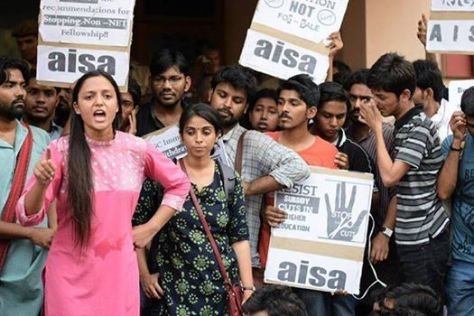
Students Protest in JNU Over Rising Civilian Casualties in Kashmir

The number of unarmed civilians killed in instances of firing by the armed forces, police and paramilitaries enforcing the occupation of Kashmir by the Indian state in the latest wave of violence has crossed fifty. Many more have been blinded by pellet guns. Hundreds have been injured and hospitalized. Reports of protests are coming not only from the Kashmir valley, Kargil, Drass and Jammu, but also from many cities in India. From Delhi (where there has been a public protest at Jantar Mantar, a press conference at Gandhi Peace Foundation and a student protest at Jawaharlal Nehru University), from Kolkata, which saw a massive turn out in a public march, from Chennai, from Patna, and from Kochi and Tricky in Kerala.

On Friday 22nd July, I went to a night protest march and public gathering by students at Jawaharlal Nehru University, Delhi. The march was called by Shehla Rashid, Vice President, JNUSU and Rama Naga, General Secretary, JNUSU (Both AISA activists) There were perhaps two hundred students gathered peacefully. The march began around 10:00 pm, made its way around the university campus and the protest continued well past midnight. Several student organizations, AISA, BASO, Hundred Flowers, Collective, DSU and individual students participated in the march. Shehla Rashid, Vice President, JNUSU and an AISA student activist, addressed the gathering before the march began, stating clearly, that this was going to be a peaceful expression of the democratic right to protest against the atrocities being enacted by the Indian state on the people of the part of Kashmir that is under Indian occupation. She asked the students to be vigilant in case any disruptive slogans were raised by planted agent-provocateurs. The entire march, and the protest meeting was documented by the students, so as to ensure that no ‘doctored videos’ would raise their ugly digital heads in the days to come. The students raised the demand for freedom for the people of Kashmir, and for people in all parts of South Asia. The slogans connected the realties of the people of Kashmir, the North East, Bastar, Jharkhand, with the experiences of Dalits, Workers, Peasants, Women, Students and Minorities. Slogans were raised against the killings and blindings by pellet guns in Kashmir. against torture, again rape, against draconian acts like AFSPA and PSA. The march made its way through the entire campus and culminated outside Chandrabhaga Hostel, where a meeting was held on the steps. The meeting lasted over two hours, was completely peaceful,and more than two hundred students listened to the speakers with close attention.

Police officers and campus security guards were present, and recorded everything. The students also recorded everything. And the indefatigable Shamim Asghor Ali made video recordings of several speeches, and uploaded them on to youtube, which we are lucky to be able to share here. We are also grateful for the still images uploaded by V. Arun, several others also took pictures and videos, which are now being shared on Facebook. Continue reading Students Protest in JNU Over Rising Civilian Casualties in Kashmir

Hindu Nationalists and California’s History Curriculum: Pepper Chongh

Guest Post by PEPPER CHONGH

Gayatri Chakravorty Spivak once asked us to consider that the histories of people at the margins are constantly in competition with dominant histories– that when a marginal woman speaks in dissent, the narratives of more powerful social groups can silence or supplant others.[1] This concept is at the heart of controversies around the revision of history textbooks throughout the world. It’s at the heart of the current debates on South Asian history in the California public school curriculum, up for revision this year.

In 2005-6, U.S. wings of Hindu nationalist groups named together as the Sangh Parivar[2] (the Sangh) attempted to insert changes into California’s 6th grade history textbooks. Rewriting history is one of the Sangh’s political projects toward the realization of a Hindu nation, where upper-caste Hindus dominate and benefit from all aspects of society to the exclusion and subordination of all other groups. The 2005-6 effort follows another in India in 2002-2003, when the successful insertion of Hindu nationalist histories into Indian textbooks resulted in a protest walkout by education ministers from 16 states and a scholar-led suit filed before India’s Supreme Court to block the new textbooks. In 2006, South Asian scholars and minority and other progressive activists defeated the U.S. Sangh in a public clash.[3] The California State Board of Education (SBE) rejected most of the Sangh’s edits, leading the Sangh to file two lawsuits against the SBE, both of which lost on claims of discrimination against Hindus. Continue reading Hindu Nationalists and California’s History Curriculum: Pepper Chongh

How Background Works – Reflections on NLS Socio-Economic ‘Census’ 2015-16: Chirayu Jain

Guest post by CHIRAYU JAIN

Last year I carried out a study to record background and performance data of all students at NLS. Managing to get 97.9% compliance, the data helped in preparing the report “The Elusive Island of Excellence”, which provides a microanalysis of the institution touted as the country’s best law school, and answers two broad questions: who is likely to get admitted to NLS, and how much does background influence one’s performance within NLS? This article details why this year-long study was conducted, reflections on certain key findings and insights received from academics and scholars hypothesizing probable reasons for the outcomes of the report.

When the final figures of the Census were tabulated, the dearth of Muslims or the financial affluence of the under-graduate students at NLS came as no surprise. But what was shocking was the magnitude. Muslims form not even 1% of the student body and with average family incomes being higher than Rs. 20 lakhs per annum- majority of the NLS students come from top one percentile of the country! Not a single student who declared their caste as scheduled caste/tribe was admitted through general category, and Brahmins continue to be disproportionately dominate the numbers by forming more than a quarter of the student body. Likewise, 77.8% of the students came from families where even their grandparents had gone to college, while 26% are those with even longer history of graduates in their families.

Continue reading How Background Works – Reflections on NLS Socio-Economic ‘Census’ 2015-16: Chirayu Jain

Teacher Killings Ignite Calls for Revolution in Mexico

The violent police crackdown on teachers’ union protests recently have spurred widespread condemnation of the government’s privatization drive, backed by repression. The following is extracted from two reports by Lauren McCauley, staff writer, Common Dreams (commondreams.org)

Oaxaca protests, Mexico
Oaxaca protests- teachers block highway, Mexico, (Photo: Luis Alberto Hernandez/ AP)

An initial report in Common Dreams, on 20 June 2016 reported: ‘A Mexican teacher protest against neoliberal education policies turned deadly on Sunday, with nine people killed, after police unleashed gunfire on the demonstrators’ road blockade.

According to TeleSUR, teachers from the dissident union, Coordinadora Nacional de Trabajadores de la Educación (CNTE), “had set up the blockade as part of protests over an education reform implemented by President Enrique Peña Nieto and the arrest of several of the unions’ leaders over the past week,” which they said, were politically motivated.


Continue reading Teacher Killings Ignite Calls for Revolution in Mexico

Resist the Modi Regime’s Assault on Students, Reject the Subramaniam Panel Report on Student Politics: Shehla Rashid

Guest Post by Shehla Rashid

When politics decides your future, decide what your politics should be !

Shehla Rashid (AISA), Vice President JNUSU, speaks at a student protest, during the 'Occupy UGC' Movement
Shehla Rashid (AISA), Vice President JNUSU, speaks at a student protest, during the ‘Occupy UGC’ Movement

The recent government constituted panel‘s (headed by former cabinet secretary T.S.R. Subramaniam) report on student politics is unconstitutional, highly regressive and politically motivated, and signals the upcoming onslaught of total commercialisation of education and imposition of Hindutva ideology in universities. The TSR Subramaniam Panel’s report is the logical follow up to the Birla Ambani report (which was submitted in 2000), following which student unions across the country were banned. The Birla Ambani report had lamented that student unions are not allowing commercialisation of education: we accept the charge and take pride in it! We believe that education should be a right of everyone, not a privilege of a handful of people.

Continue reading Resist the Modi Regime’s Assault on Students, Reject the Subramaniam Panel Report on Student Politics: Shehla Rashid

An Open Letter to the DU Teachers from a DU Student – I Stand with You: Fatma M. Khan

Guest post by FATMA M. KHAN

Dear teachers,

After three years at the Delhi University, I have been disillusioned with a lot of things. But one thing which never ceases to surprise me is the tireless effort put in by a lot of you to create something better. It is often against the system, against the apathy of the students, against the examinations which reduce texts to regressive questions. This is for you.

This is for the teachers who hated the FYUP programme, but still tried hard to create meaningful project topics for the foundational courses out of the juvenile textbooks we had, not caring about the extra correction this created for themselves. This is for the teachers who went out of their way to conduct thought-provoking discussions on “Integrating Mind, Body and Heart”, a course which had no marking. Continue reading An Open Letter to the DU Teachers from a DU Student – I Stand with You: Fatma M. Khan

An Open Letter to Students from DUTA

Dear Students,

I have received letters from some of you, especially final year students, expressing your anxiety about the likely delay in results caused by the evaluation boycott protest of teachers, and appealing to teachers to withdraw this particular form of protest.

Let me assure you that we are equally keen to get back to evaluation and to work overtime to bring out your results at the earliest. In fact, this is not a form of protest we would have embarked on had the situation not been so devastating. You would have seen in the last three years, we observed a one-day strike only once when services of two teachers were terminated, preferring alternative forms of struggle even during the grimmest of battles such as those over theSemesterisation, FYUP, CBCS, debilitating administrative corruption, no permanent appointments, violation of Constitutional provisions of reservation, denial of promotions, a draconian Code of Conduct to suppress dissent and extreme forms of victimization. Continue reading An Open Letter to Students from DUTA

This Is Not Just About Kanhaiya Kumar & Delhi University Teachers: Mukul Mangalik

MUKUL MANGALIK in raiot.in

The Delhi University Teachers’ Association (DUTA) General Body Meeting (GBM) held on May 28, 2016 issued an appeal ‘to all students to support our struggle’ against the University Grants Commission (UGC) Notification 2016. The resolution passed by the DUTA GBM of June 2, 2016 ‘extends thanks to Jawaharlal Nehru University Students’ Union (JNUSU) for its support’ and to many other students’ organisations ‘which have expressed support for the ongoing struggle’. The DUTA Executive, in keeping with the letter and spirit of the sentiments expressed by successive GBMs invited representatives of teachers and students’ unions and organisations, including the JNUSU, to extend solidarity with the ‘khaali thaali’ (empty plates) dharna (sit-in) organized by the DUTA on 6th June outside the UGC compound. A section of Delhi University (DU) teachers did their best to prevent Kanhaiya Kumar, elected President of the JNUSU, from speaking on this occasion…

In trying to deny a student even a chance to speak, they have gone against everything that teaching should mean; in seeking to throttle words, speech and ideasinstead of countering them with other words, speech and ideas they, as university teachers have struck a blow against the freedom of expression that is the lifeblood of universities. They have gone against the idea of universities as potentially life-altering sites for students, places that encourage them to ask questions and speak freely; to read, write and think critically, analytically and with academic rigour, together and independently, in the endless pursuit of understanding and truth; to debate, disagree with, and discuss everything of consequence without fear of any forms of authority or power, but with respect for universal rights, ‘in the hope of creating a future in which liberty and human freedoms might be grounded in citizenship based on substantive equality’…

Let no one imagine that this moment of contestation in our history will spell political doom for the DU teachers’ movement. It shall not. If anything, we are likely to come out of this with an even stronger resolve, holding up a brighter flame of hope to all teachers and posing a more invulnerable front to Capital and State than has been the case thus far.

Read the whole article here.

शिक्षक: पेशेवर पहचान का संघर्ष

अपना  कार्यभार  बढ़ाने के खिलाफ शिक्षक आन्दोलन कर रहे हैं . बहुत दिनों के बाद शिक्षकों में इस तरह की एकजुटता और उत्तेजना देखी जा रही है. दिल्ली विश्वविद्यालय शिक्षक संघ को पिछले दिनों अक्सर ऐसे सवालों पर भी, जो शिक्षकों के हित से सीधे जुड़े थे, आन्दोलन में संख्या की कमी से निराशा होती रही थी. इस बार शिक्षक पूरी तादाद में सड़क पर हैं. संघ की सभाओं में हाल खचाखच भरे हुए होते हैं. क्षोभजन्य उत्साह से आन्दोलन में नई ऊर्जा दीख रही है.

अपने पेशे के अवमूल्यन से शिक्षक आहत और क्रुद्ध हैं. काम के घंटे बढ़ाने के निर्णय ने अध्यापक के काम की विलक्षणता को ख़त्म कर दिया है, यह अहसास उनमें है. अलावा इसके, एक शिक्षक का काम बढ़ जाने के बाद  यह कहा जा सकेगा कि अब चूँकि एक शिक्षक ही दो का काम करेगा, और पदों की आवश्यकता ही नहीं है.इसका असर उन शोधार्थियों पर पड़ेगा जो अध्यापन के पेशे में आने की तयारी कर रहे हैं. इसीलिए इस बार सड़क पर वे सब दिखलाई पड़ रहे हैं, जिन्हें दिल्ली विश्वविद्यालय में  एड्हॉक  कहा जाता है और जिससे  कई जगह बंधुआ मजदूर की तरह बर्ताव किया जाता है.

साधारण जनता को शिक्षक के पेशे की खासियत  के बारे में शायद ही मालूम हो! इसी कारण संभव है, वह यह सोचे कि हफ्ते में सोलह घंटे  पढ़ाने की जिद पर अड़े लोग कामचोर ही तो हैं. लेकिन ऐसी  समझ कुछ तब जाहिर हुई जब दिल्ली विश्वविद्यालय के पूर्व कुलपति प्रोफेसर दिनेश सिंह ने एक अखबार को कहा कि कार्यभार बढ़ने की शिकायत फिजूल है, शिक्षक चाहें तो रात में शोध का काम कर सकते हैं.उन्होंने अपना उदाहरण दिया कि वे भी रात को ही शोध का काम करते रहे हैं!  Continue reading शिक्षक: पेशेवर पहचान का संघर्ष

Open Letter to JNU VC from a JNU Professor: Rajat Datta

Guest Post by RAJAT DATTA

Dear Professor Jagadesh Kumar,

I read your long interview in the Pioneer of 6th June 2016 with great interest, particularly because of the way in which you’ve outlined your vision for JNU over the next five years. We’d been hearing a lot of whispers about your `vision’ all these months, and I’m happy that I’ve finally got to see it in print. Unfortunately, some of the issues you’ve raised have made me somewhat uncomfortable, and thus I feel constrained to write this open letter to you to share some of these concerns. Please don’t take it amiss, for what I have to say emerges from being a very senior faculty member of the university and from your assurance that you work in `consultation’ with senior faculty members.

My first area of unease is precisely this proclamation. I don’t recall a single instance where you tried to consult me, or any of the senior faculty members that I know (and believe me, I know most of them). You’ve not bothered to visit my Centre, the largest in the University in terms of the faculty and student numbers, to interact and `consult’ with us. If by `consultation’ you mean your meetings with Deans over policy issues, there is nothing new in what you’re doing. All Vice-Chancellors in JNU have done that, and more. Indeed, you have omitted Chairpersons entirely from these processes. If your consultation process is so pervasive, why did so many `senior’ and not so senior members of the JNU faculty sit on a relay hunger strike against your administration over eight days in May? I regret to say that the consultation process that you talk about so proudly is seen by many as a very closed coterie of people (whom you proudly refer to as your `team’). Is it because you haven’t been able to win the trust of the larger academic community of this university? On their own initiative, different groups of teachers have met you (when permitted to) and other members of your “team” when you have been unavailable to meet them, over various issues, and emerged from these meetings feeling that you do not listen to us. Continue reading Open Letter to JNU VC from a JNU Professor: Rajat Datta

Statement against the Attack on the ‘Velivada’ in Hyderabad Central University: SC/ST Faculty Forum and Concerned Teachers of Hyderabad University

Guest Post by SC/ST Faculty Forum and Concerned Teachers of Hyderabad University

In the early hours 28th May 2016, at around 2 P.M., the authorities at the University of Hyderabad removed the tents erected in North Shopcom around the Velivada and the venue of protest following the death of Rohith Vemula. This happened in the darkness of night, shrouded in secrecy and utterly insensitive towards the turmoil it was bound generate within the student community. Such an act reaffirms the dictatorial stance of the present administration as well as its intolerance to dissent.

The removal of the tent is a clear act of provocation against students since it is well known that they are emotionally attached to the Velivada and consider it as a place of mourning and memorial for Rohith. Especially for the Dalit students, it remains the site of challenge against caste discrimination. Further, bringing down the posters of Dr.Babasaheb Ambedkar’s quotes that surrounded the tent is a grave insult to the Father of the Constitution of this country and an atrocity in itself. It is indeed ironic that the university administration that overtly pronounces its intent  to celebrate Dr.Ambedkar’s 125th birth anniversary for a year has no qualms about removing his posters, or barring his grandson, Prakash Ambedkar, from entering the university. Such actions unmask the true character of the administration; revealing its deeply discriminatory, apathetic and disrespectful attitude towards Dalits and their leaders.

Perhaps the University officials have long forgotten that a University is not to be ruled and subjugated through the military doctrine of “shock and awe” (who can forget George Bush’s now ill famous use of the term during the military invasion of Iraq by the US in 2003!). Instead, patience, maturity and genuine dialogue with the students alone can help us through these difficult times. Unfortunately, the authorities have acted in an extremely unbefitting manner, without the slightest concern for the feelings of their own students. Further, this act of destruction appears doubly mindless and vindictive because the presence of a tent in the Shopcom area does not harm anyone. In fact, through the scorching summer, many people take shelter under it beating the intense heat—be it the students having their food there or other workers who need to be around the Shopcom area. Therefore, we see absolutely no justification for its removal, that too in such a stealthy and unceremonious manner, taking advantage of the the anonymity of the night during vacation. Clearly the authorities are well aware how heartless and unethical such an action is and the serious opposition that it is sure to encounter if carried out during daytime.

The thoughtless desecration of the Velivada compels us to ask a few critical questions. Is it necessary to instigate confrontations in a campus that is already struggling to come to terms with the tragic death of Rohith Vemula, the brutal lathicharge and imposition of false cases against students and faculty and the continuous harassment of students that takes many different forms? Is it not the urgent responsibility of the administration be a little more receptive to the concerns and feelings of the students, keeping in mind the larger interests of the University? It is a cruel irony that while the administration proclaims to the world that it wants “normalcy” to return to the campus, its actions remain blatantly aggressive, anti-student and discriminatory.

More than four months have passed by since that fateful night when a brilliant young man with immense potential and a strong sense of social justice gave up his life, hounded by the administration on the basis of a fictitious charge and non-existent evidence.  We may recall that the cruel and unusual punishment of suspension from hostels and all common spaces was handed out to the five Dalit students during another vacation—the winter of December 2015. Is it  just serendipity? Or, perhaps vacation is time of total impunity, when all natural and moral laws are suspended and humanity is forgotten? While the Rohith and his friends were forced to spend the cold winter nights out in the open, distraught students protesting the removal of the tent spent the day under the unforgiving Hyderabad sun near the main gate of the University on 28th May until they were pushed away by  the security guards.

Prof. Appa Rao Podile resumed office with the knowledge of a hand-picked teaching and non-teaching staff (after abandoning the University in a state of despair following the death of Rohith) on 22nd March, 2016, without so much as giving prior notice to the interim VC, Prof. Periasamy, fully aware how this would affect the protesting students and friends of Rohith. Now, once again, the Velivada has been desecrated when the world was asleep. We quote what a leading jurist Amita Dhanda had said recently with respect to the events at HCU: “A VC must not only be fair but be seen to be fair.” We leave it to our readers to decide whether the VC has ever acted or appeared to act as fair!

Evidently, the loss of Rohith’s life has not meant nor taught anything to the the University of Hyderabad authorities. Those who had closed their eyes to the evidence that screamed out that  Rohith and his friends were “Not Guilty”, have moved on. They now head important committees and speak on behalf of the University to the rest of the world. As ranks are bestowed upon the University, they brim over with pride and claim credit. It is well beyond their comprehension as to why large groups of students and faculty should hang on to a make-shift Velivada—with walls made up of flex-board images of Babasaheb Ambedkar, Jotiba and Savitribai Phule and Kanshi Ram. For them, it is time to “cleanse” and “sanitize” the Shopcom of those disturbing reminders that tell us that “Something is rotten in the state of the University of Hyderabad.”

But the memory of injustice is a powerful tool. The very same structure that has been an eyesore to the administration is our history—poignant, gut-wrenching and yet imbuing our present with direction and the strength to struggle. To recall a stirring line that has emerged through the Rohith Vemula movement: “A spectre is haunting the brahminical academia—the spectre of caste.” We welcome and embrace this history. The Velivada is the place where Rohith spent his final destitute days, anxious that his years of hard work and aspiration to give a better life to his family may come to nought. This is where we come to pay our respects and to remind ourselves that there should be no more Rohiths. Around this very place, a community has gathered—of those who may not have known each other  earlier but who understood how critical it was to work towards a world where “a man is not reduced to his immediate identity”. People thronged to this place from different Universities and from all walks of life to pay homage, and in solidarity. Those who could not come still became part of this imagined community—those from Uttar Pradesh, Bihar, Kerala, the North East, in fact, from every part of this country—threaded together by empathy and experience. Rohith became an icon and a rallying cry because his life struck a chord with the large majority of Dalit  and other minoritized and underprivileged groups in India for whom education is still a humungous struggle. More important, breaking into the bastions of higher education remain acts of transgression and trespassing. Perhaps that is why the august body that passed the fatal judgement on Rohith Vemula did not even bother to maintain a facade of impartiality. Unfortunately for them, the masses of India—the Dalit and the underprivileged, those who are the “wretched of the earth” in the immortal and evocative words of Frantz Fanon, recognized this judgement for what it is, even as it came cloaked in the language of discipline and bureaucracy.

The socially marginalized, struggling parents who dream of a better life for their children instinctively know what happened—they completely and empathetically identify with Radhika Vemula who sent her son to the big University only to lose him forever. Similarly, all those students and teachers who have relentlessly and often silently faced discrimination in the hallowed portals of premier institutions of learning also know. We, the concerned faculty and students at the University of Hyderabad know. We shall not forget. We cannot forget. The administration is bent upon erasing the Velivada. Can they erase our memory? Can they erase the memory of that fateful night of January 17th? Rohith has travelled from the shadows to the stars. We ask Mr. Appa Rao Podile and his believers, “Can you destroy the stars? Because every time, on each dark night, when we look up we will see Rohith Vemula and we will remember what he lived and died for.”

Perhaps the University Administration presumes that a Velivada rightfully and customarily belongs to the margins of the village—far far away from the modern, secular/brahminical, high-ranking spaces of the University. However, through an extraordinary and imaginative act of symbolism, Rohith and his four friends have re-installed the Velivada in the midst of the University, in our hearts and in our consciousness. We need not skirt past it or bemoan the loss of the Shopcom (as the administration has been doing). For us it is a living history of sacrifice and struggle, forcing us to continually work towards a more pluralistic and egalitarian idea of the University.

There is a writing on the wall that that the administration cannot whitewash! The Velivada can no longer be cast out into the margins; it is here to stay. The University must take note and be attentive to this momentous turn of history.

SC/ST Teachers’ Forum and Concerned Teachers, University of Hyderabad


लाइब्रेरी २४ घंटे खोलने की मांग पर बीएचयू छात्रों को मिला निलम्बन और जेल: अमरदीप सिंह

अतिथि पोस्ट: अमरदीप सिंह 

एक ओर जहाँ हमारे प्रधानमंत्री माननीय नरेन्द्र मोदी जी डिजिटल इंडिया की बात करते हुए देश के गाँव गाँव मे WI-FI लगाने की बात कर रहे है और साथ ही वाराणसी के  घाटो  का भी WiFi करण हो रहा है वही उनके  संसदीय क्षेत्र  के इतने बड़े सेंट्रल यूनिवर्सिटी  “काशी  हिन्दू  विश्वविद्यालय” के छात्र  इंटरनेट ,लाइब्रेरी और अन्य पढ़ाई के मूलभूत सुविधाओं  से वंचित है  । वर्तमान समय मे उच्च स्तरीय शिक्षा के लिए  इंटरनेट की उपलब्धता को नकारा नहीं जा सकता।

मामला साइबर लाइब्रेरी का है जो पहले 24 घंटे खुलती थी लेकिन नए वाईस चांसलर गिरीश चन्द्र त्रिपाठी के आने के बाद यह मात्र 15 घंटे के लिए खोला  जाने लगा (सुबह 8 से रात्रि 11बजे तक ) । आपको बता दे की BHU के 60 प्रतिशत  से अधिक छात्र विश्वविद्यालय के बाहर  रहते है जहां बिजली की एक बड़ी समस्या रहती है । बाहरी छात्रों के इस समस्या के समाधान के लिए साइबर लाइब्रेरी खोली गई थी जिसमे छात्र वातानुकूलित स्थान पर  इंटरनेट व कंप्यूटर की सुविधा के साथ अपना पठन पाठन का कार्य कर सकते है । परीक्षा के दिनो में इसकी जरुरत और बढ़ जाती है|

13262321_713126608789808_531771798_o

वाईस चांसलर का सम्बधित मामले में  कहना है की जब वे पढ़ा करते थे तो सब  सुविधाएं नहीं थी ,उनके क्लासरूम में AC  नहीं था न ही कंप्यूटर की सुविधा थी, फिर भी वे पढ़े । उन्होंने जोड़ते हुए यह भी कहा की स्नातक के छात्रों को लाइब्रेरी की क्या जरूरत  और आउट ऑफ सिलेबस पढ़ने  की क्या जरुरत है ।यहाँ जानकारी के लिए बता दे की आउट ऑफ सिलेबस न पढ़ने  की सलाह देने वाले कुलपति महोदय इकोनॉमिक्स के अध्यापक रहते हुए “शिव तेरे कितने रूप ” और ” मृत्यु के बाद क्या ?” के लेखक रह चुके है ।छात्र प्रतिनिधिमंडल 500 से अधिक छात्रों द्वारा हस्ताक्षर किये गए पत्र को लेकर कुलपति महोदय से मिले लेकिन कुलपति महोदय के बातचीत का लहजा एक गुरु-शिष्य की बातचीत से कोसों दूर था, साथ ही उन्होंने स्ट्रीट लाइट में पढ़ने की सलाह दी तथा आंदोलन करने पर विश्वविद्यालय से बाहर  फेंकने की धमकी भी दी ।

विश्वविद्यालय द्वारा लाठी ,डंडे  के  दम  पर लाइब्रेरी  से जबरदस्ती निकाले जाने के कारण  छात्र स्ट्रीट लाइट के नीचे पढ़ अपना विरोध दर्ज़ करा रहे थे।  छात्र रोज रात को लाइब्रेरी के मैदान अथवा स्ट्रीट लाइट पर पढाई कर रहे थे परन्तु रात को प्रॉक्टोरियल बोर्ड द्वारा छात्रों को बेवजह परेशान किया गया और छात्रों के आईकार्ड छीने गए एवं पीटा गया। यहाँ तक की साइबर लाइब्रेरी 24 घंटे कराने  के लिए  गाँधीवादी तरीके से रात कैंपस में पढाई कर अपने हक़ की आवाज़ को उठा रहे छात्रों में से २ छात्रों शांतनु सिंह गौर (सोशल साइंस द्वितीय वर्ष  छात्र) और विकास सिंह ( पोलिटिकल साइंस शोध छात्र  ) को कारण  बताओ नोटिस जारी  कर दिया ।

इसी क्रम में छात्रों ने  प्रधानमंत्री कार्यालय के स्ट्रीट लाइट के नीचे बैठ कर प्रतिनात्मक पढ़ाई की साथ ही  दिनांक 16.05.2016 को प्रधानमंत्री, राष्ट्रपति, एमएचआरडी, इत्यादि मंत्रालयों को इस सम्बन्ध में सूचना दी गयी लेकिन प्रशासन के कान पर ज़ू तक नहीं रेंगी । पिछले 17 दिनों से स्ट्रीट लाइट में पढ़ने  को विवश  BHU छात्र  विश्वविद्यालय प्रशासन के उदासीन तथा तानाशाहीपूर्ण रवैये के कारण निराश और हताश  होकर  दिनांक 18.05. 2016 से छात्र अनिश्चितकालीन भूख हड़ताल में बैठने को मज़बूर हुए ।

विद्यार्थी सत्याग्रह के नाम से शुरू इस आंदोलन के दूसरे दिन चीफ प्रॉक्टर समेत आला अधिकारियो का एक दल अपील समेत मिला जिसमे अनशन जारी  रखने पर अनुशासनात्मक करवाई की धमकी और एक कमेटी गठन की बात थी ।

कमेटी के रिपोर्ट आने  और कौन से प्रोफेसर को कमेटी मेंबर बनाया गया है सम्बंधित कोई भी सुचना छात्रों को नहीं दिया  गया यहाँ तक की कमेटी  में छात्रों को शामिल करना तो दूर उन्होंने छात्रों का सुझाव , सलाह तक नहीं लिया |

BHU प्रशासन ने  क्रूर आमनवीय व्यव्हार प्रदर्शित करते हुए आंदोलन स्थल पर उपलब्ध पानी ,बिजली,और शौचालय की सुविधा बंद कर दी । BHU  प्रशासन आंदोलन को कमज़ोर करने के लिए अनशनरत छात्रों के घर पर फ़ोन कर परिवारजनों को डरा धमकाने का काम भी शुरू कर दिया । छात्रों को निष्काषित करने , करियर बर्बाद करने , जेल भिजवाने , उठा लेने आदि  की  धमकियां दिया जाने लगा ।

“आपका लड़का भूख हड़ताल पर है और मरने वाला है “। “आप हमारे बिरादरी के है इसलिए चेता रहे है नहीं तो अब तक आपका लड़का जेल में होता“  आदि ये प्रॉक्टोरियल बोर्ड के शब्द परिवारजनों के साथ  फ़ोन वार्ता पर थे  |

यहाँ तक की मेरे  परिवार को बुलाया गया और तमाम मानसिक दबाव बना आंदोलन छोड़ने और आगे से किसी आंदोलन में भागी न होने का मुझसे लिखित लेने में वे सफल भी रहे । मुझे मेरे परिवार के सामने जलील किया गया । दाड़ी की तरफ इशारा करते हुए वाईस चांसलर ने कहा की ये लड़कियों के दुप्पटा खींचने और छेड़ने वालो की तरह दिख रहा है । आप का लड़का रात में पोर्न देखता है और इसे आंदोलन करने के लिए पैसे भी मिल रहे है ।  मेरे कहने पर की  आरोप साबित होने पर में खुद निष्कासन लिखने कर देने को तैयार हुँ , वाईस चांसलर ने कुतर्की और बहुत बोलने वाला कह बात दूसरी ओर मोड़ दी । मेरे परिवार ने दबाव में यह कहा की अगर वाईस चांसलर को लगता  है की तुम्हारे हटने से आंदोलन टूट जायेगा तो लिख कर दे दो क्योकिं यह आंदोलन एक छात्र का नहीं है न ही समस्या किसी व्यक्ति विशेष की है ,  इसमें सभी छात्रों की भागीदारी होने चाहिए , सिर्फ एक की नहीं ।

मेरे आन्दोलन छोड़ने की सुचना पर 10 भूख हड़ताली छात्रों की संख्या 22 हो गयी । यहाँ छात्र एकता की अनूठी मिशल दिखी । कमेटी ने अपनी रिपोर्ट में लाइब्रेरी की मांग को मनोरंजन और आराम का हवाला देते हुए प्रतिबंधित साइट देखने की भी बात कही । कमाल  की बात है की जब साइट प्रतिबंधित है तो छात्रों खोल कैसे लेते  है ??? और अगर छात्र खोल भी लेते है तो यह एक प्रशासनिक विफलता है  जिस पर प्रशासन को अपने सुरक्षा कर्मियों पर करवाई करनी चाहिए । मंदिर के बाहर से चप्पल चोरी होने पर चोर को दण्डित किया जाता है न की मंदिर बंद किया जाता है । कमेटी ने रात्रि में  छात्राओं का पढ़ना अव्यवहारिक बताया है । उसी दिन देर रात वाईस चांसलर ने अपने स्पेशल पावर का इस्तेमाल करते हुए 9 छात्रों को निलम्बित कर दिया । इससे ज्यादा दमनात्मक रवैया और क्या हो सकता है की पढ़ाई की मांग और शांति तरीके से खुद को पीड़ा देने वाले अनशनरत छात्रों को आगमी वर्ष समेत वर्तमान परीक्षा, हॉस्टल आदि सभी सुविधाओं से वंचित कर दिया ।

2 दिन बाद अनशन के 10वे दिन रात 12 :30  पर BHU की स्ट्रीट लाइट बंद कर दी गई । BHU  के आसपास के सारे मार्केट बंद करा दिए गए और वाराणसी के16 थानों की पुलिस की मदद से अनशनरत  12 भूखे छात्रों को गिरफ़्तार कर लिया गया वह भी उस समय जब छात्र सो रहे थे । शायद  भारतीय इतिहास में यह पहली बार हुआ होगा की पढाई के लिए लाइब्रेरी की मांग पर छात्रों को 10दिन अनशन करना पड़ा और इतने क्रूर तरीके से गिरफ्तार कर लिया गया हो । गिरफ़्तारी के समय पुलिस की संख्या हज़ारो में थी जैसे किसी आतंकवादी को पकड़ने आये हो । मेने अपने जीवनकाल में पुलिस को इतनी सतर्कता बरतते पहले कभी नहीं देखा ।

पुलिस ने रात भर अलग अलग तरीको से मानसिक दबाव बना कर अनशन तुड़वाने  की भी कोशिश की । अगले दिन दिनाक 26 को दोपहर में छात्रों को 5000रु  के निजी मुचलके पर छोड़ा गया । तबियत ख़राब होने पर छात्रों को BHU अस्पताल में भर्ती कराया गया । आंदोलनरत  छात्रों ने आपसी सहमति से गिरते  स्वास्थ को देखते हुए अनशन 72  घंटे के लिए स्थगित  करने का फैसला किया । छात्रों का कहना है की यह आंदोलन खत्म नहीं हुआ बल्कि यहाँ से शुरू  हुआ है , हम स्वस्थ हो कर फिर आएंगे और देश भर के सभी छात्र नेताओं,प्रोफेसर ,बुद्धजीवियों ,सामाजिक कार्यकर्ताओ से यह अपील करेंगे की वह पढ़ाई के लिए हमारे इस आंदोलन के समर्थन में खड़े हो । आज का छात्र पढ़ना चाहता है , वह किसी भी प्रकार का शोषण तथा दमन बर्दाश्त नहीं करेगा ।

अमरदीप सिंह बी.एच.यू  के छात्र है

Congratulations on the Completion of Two Years of Government: Reaction of JNU student, Bihu Chamadia

Guest Post by BIHU CHAMADIA

Congratulations on the completion of two years of government. But I just want to ask a simple one line question. Completion of two years but at what cost? At the cost of increase in the number of farmer suicides, at the cost of creating war-like situations in educational institutions, at the cost of acting as a catalyst of widening the gap between hindu-muslim, at the cost of increasing imports and decreasing exports. Celebration on such a large scale because of course it is the first ever government in the history of the world to complete 2 years of governance ! With on-going crisis in the country BJP spends 1000 crores on a programme for this celebration. We would have no problem if this money was yours but sadly it’s not its ours. So now to all the tax payers who had problem with JNU raising its voice I ask you have you people become blind and deaf or are suffering from amnesia and forgot how to read and write.

Well, you speak well Mr Modi but the problem is that you only speak. You and your whole cabinet knows that each and every student of these educational institutes can give you people a befitting reply to all your one liners but we choose not to. People laugh at what your ministers says and say what a fool but I have a completely opposite view. You people are not fool you people are smart, very smart indeed.  Your every policy and every one liner can have a nice reply. Continue reading Congratulations on the Completion of Two Years of Government: Reaction of JNU student, Bihu Chamadia

बीएचयू में लाइब्रेरी को लेकर आंदोलन अभी भी जारी है: अनन्त प्रकाश नारायण

अतिथि पोस्ट: अनन्त प्रकाश नारायण

Guest Post by Anant Prakash Narayan

This is an urgent appeal from Banaras Hindu University (BHU) students to students, youth, intellectuals and journalists everywhere.  Please come to the support of BHU. Speak for BHU students. Students in BHU have been fighting for the right to study 24/7 in the BHU Library. The curtailing of the hours for which the library is open by the university authorities is a direct assault on the right to study. What else are students meant to do in an university? This is what has led students in BHU to agitate. Students even sat on an indefinite hunger strike for nine days in protest. Students have been assaulted and rusticated for their struggle to study in the library.  The hunger strike has been now lifted, because of the intense pressure of the university administration and the failing health of several students, but the struggle continues. BHU students are appealing to everyone to please send post cards in support of their demands to the Vice Chancellor of BHU.

You can also flood the VC with emails to his address  – vc@bhu.ac.in.

Bombard his office and email with messages in support of BHU students, in support of democracy and rights, for right to quality education and freedom of speech.

This slideshow requires JavaScript.

Students on Hunger Strike Were Forcibly Sent to Hospital by the University Authorities

‘बीएचयू में लडाई जारी है’

बीएचयू में लाइब्रेरी समेत 4 मांगो को लेकर 26 दिनों तक चला आंदोलन अभी भी जारी है। 9 दिनों तक चला अनिश्चितकालीन अनशन हमें प्रशासन के दबाव और साथियों की बिगडती तबीयत के कारण तोडना पडा लेकिन अपने सवालों  के साथ हम आज भी संघर्षरत है। इसलिए देश-दुनिया के सभी छात्रों, विश्वविद्यालयों और बुद्धिजीवियों से हम अपील करते हैं कि हमारे निम्न सवालों के समर्थन में आकर हमारे संघर्ष को मजबूत बनाएं और बीएचयू कैम्पस मे अभिव्यक्ति की लडाई में हमारी मदद करें
Continue reading बीएचयू में लाइब्रेरी को लेकर आंदोलन अभी भी जारी है: अनन्त प्रकाश नारायण

What the UGC Gazette Notification 2016 Portends for the State of Higher Education in India: Rina Ramdev and Debaditya Bhattacharya

This is a guest post by RINA RAMDEV AND DEBADITYA BHATTACHARYA

The much-debated API (Academic Performance Indicator) system, linking promotions of faculty members in Indian universities/colleges to a quantifiable assessment of their performance, was introduced by the University Grants Commission (UGC) in its 2010 Regulations. Since then, there has been mounting resistance and discontent among massive sections of the teaching community – forcing the UGC to withdraw the said assessment framework for a while in 2013, before reintroducing it across institutions of higher education. However, over the years, the ire of protesting teachers has translated into a sustained critique of the API system and its failure to account for the infrastructural inadequacies of public institutions as adversely impacting the promotion prospects of thousands of teachers across the country.

It was rightly argued that a point-based appraisal pattern reduces teaching as an adventure of ideas into a standardised set of visible-verifiable outcomes and deliverables, expending in this, the necessary surplus of every academic encounter. The clock-timed hours of classroom-teaching – convertible into digits and decimals – were not only incommensurate to the disaggregation of thought beyond workdays and work-hours, but also insisted on a corporate-model professionalism limiting the exact interface between the teacher[-as-service-provider] and the student[-as-client].

The perils of quantification notwithstanding, the API system practically sought to make teaching a redundant exercise in terms of ‘necessary qualifications’ for faculty promotions. With a lucrative price-tagging of the ‘value’ of research activities conducted by individual teachers outside of teaching-schedules and the consequent structures of waging intellectual productivity through the numbers of projects and publications, the API contributed to a voiding of the classroom in undergraduate colleges in many parts of the country. Forced to prove her/his levels of productivity as the most essential claim to survival and growth within the field, the teacher needed but little to do by way of engaging students. And yet, on the contrary, the government persisted with its policy of withdrawing research grants and forcing research organisations to look for alternative sources of funding to sustain their work. Consequently, teachers have been infrastructurally forced into producing dubious research in the cause of ‘career advancement’, self-funding their way into business-rackets parading as scholarly platforms.

Continue reading What the UGC Gazette Notification 2016 Portends for the State of Higher Education in India: Rina Ramdev and Debaditya Bhattacharya

सामाजिक न्याय ही इस दौर की स्टूडेंट पॉलिटिक्स का मुख्य एजेंडा होगा: अनन्त प्रकाश नारायण

अतिथि पोस्ट: अनन्त प्रकाश नारायण

दिल्ली हाईकोर्ट के आदेश के बाद जे.एन.यू. में 16 दिन की एक भूख हड़ताल खत्म हुई. सभी तरह की सजाओ पर, जो जे.एन.यू. की उच्च स्तरीय जाँच कमिटी (HLEC) ने हम छात्र- छात्राओ पर लगा रखी थी, उन पर रोक लगा दी गई. इस आदेश को ले करके तमाम तरह की व्याख्याए/निर्वचन (Interpretation) है. इस भूख हड़ताल के दौरान कुछ ऐसी घटनाये घटी जिसे यह कैंपस हमेशा याद रखेगा जैसे एकेडेमिक कौंसिल को छोड़कर वाईस चांसलर द्वारा भाग जाना. एकेडेमिक कौंसिल में हमारी मांगे एकदम स्पष्ट थी. उच्च स्तरीय जाँच कमिटी को ख़ारिज करना, ओ.बी.सी. रिजर्वेशन को दोनों स्तर पर लागू करवाना, हॉस्टल में ओ.बी.सी. रिजर्वेशन और साक्षात्कार/ वाइवा के नंबर को कम करना इत्यादि. जब हम जे.एन.यू. की बात करते है तो हमे बिलकुल स्पष्ट हो जाना है कि जे.एन.यू. प्रशासन देश के किसी भी प्रशासन की ही तरह है और कई बार तो उससे भी बदतर. वह तो यहाँ का स्टूडेंट पॉलिटिक्स है जो कि इस कैंपस को समावेशी /इंक्लूसिव बनाने के लिए लड़ता है.
यह वही जे.एन.यू. प्रशासन है जिसने लगभग दस साल तक (1984-93) इस कैंपस से deprivation/ quartile पॉइंट्स को यह कहते हुए ख़त्म कर दिया था कि इस कैंपस में गाँवो से आने वाले स्टूडेंट्स के कारण यहाँ का अकादमिक स्तर ख़राब हो रहा है और कैंपस रेडिकलाईज़ हो रहा है. यह जे.एन.यू. का स्टूडेंटस मूवमेंट था जो की इसे जीत कर 1994 में वापस लाता है. हमने देखा इसी तर्ज़ पर किस तरह से प्रशासन ने ओ.बी.सी. रिजर्वेशन के मिनिमम ‘कट-ऑफ’/cut-off की गलत व्याख्या करके सैकड़ो पिछड़े वर्ग के छात्र- छात्राओ को 2008-2010 तीन वर्षो तक कैंपस से बाहर रखा. यह जे.एन.यू. स्टूडेंट्स मूवमेंट था जिसने कि एक लम्बे पोलिटिकल और लीगल बैटल के बाद एक सही व्याख्या को इस कैंपस में ही नही पूरे देश में लागू करवाया. मदरसा सर्टिफिकेट की लड़ाई हो या फिर अभी ओ.बी.सी. मिनिमम एलिजिबिलिटी का मामला हो, सारे मामले में प्रशासन हमारे खिलाफ ही खड़ा रहा है. आज जब हम ओ.बी.सी. रिजर्वेशन के उद्देश्य/स्पिरिट को इंश्योर कराने के लिए दोनों स्तर पर रिलैक्सेशन लागू कारवाने की कोशिश कर रहे है तब हम देखते है कि किस तरह से इस प्रशासन ने अपने सारी नैतिकता/ मर्यादा को एक तरफ रखते हुए पिछले वी.सी. के समय हुए स्टैंडिंग कमिटी के फैसले को बदल दिया और हद तो तब हुई जब जे.एन.यू. स्टूडेंट्स यूनियन के अध्यक्ष और महासचिव ने यह दावा किया कि इनविटेसन लेटर पर उनके हस्ताक्षर फर्जी किये गये है.

Continue reading सामाजिक न्याय ही इस दौर की स्टूडेंट पॉलिटिक्स का मुख्य एजेंडा होगा: अनन्त प्रकाश नारायण

Choice, Agency and the Naming of Names – The Trap of ‘Immediate Identities’ and the Vision of a Democratic Revolution: Chintu Kumari & Umar Khalid

Paired Guest Posts by CHINTU KUMARI and UMAR KHALID

[ Every struggle goes through highs and lows. The students who are part of the  movements that are spreading out of universities in India – Hyderabad Central University, Jawaharlal Nehru University and Jadavpur University have had their share of internal debates and disagreements, even as they have found moments of significant victory. and solidarity

Students at JNU who have recently concluded their hunger strike to give time to the university authorities to respond reasonably to the High Court directives on the HLEC punishments are now being criticized for having ‘abandoned the struggle’ by some sections who claim to play a role within the broader students movement, when, in fact, nothing of that sort has actually happened.

The majority of the students who were on hunger strike (including several JNUSU office bearers, and others) have said that they have given up the hunger strike against the HLEC recommendations in keeping with the court order.  In doing so, they have never said that they are suspending the agitation against the attempts by the JNU administration to weaken OBC reservation in admissions, hostel seats and deprivation points for women and oppressed sections of society.

In fact it is not as if the HLEC punishments issue has taken precedence over the other issues. It is actually the other way round. The students have decided to give priority to the struggle for ’social justice’ within the campus, while simultaneously giving time to the university authorities to respond adequately to the court directive on the HLEC punishment question.The call for a demonstration against the University Authorities by the JNUSU to continue the struggle on the social justice issues on the 16th of May is indicative of this fact.

13237814_1106943902682435_4288761213192298400_n

The attacks and insinuations against the majority of the students at JNU who were on hunger strike have also featured a deliberate attempt to create divisions within the unified ‘Red-Blue’ / ‘Jai Bhim-Lal Salaam’ dynamics of the movement on the grounds of identity. Activists, such as Umar Khalid, on the left have been singled out for being ‘Savarna-Syed’, if they happen to bear a Muslim name, and for being ‘sold out to the Savarna left’ if they are Dalit, as happened with Chintu Kumari and Rama Naga. This attack has come primarily from individuals representing organizations like BAPSA that claim to speak from a ‘Dalit’ position, and it is given traction by several other individuals eager to flaunt their disdain for the ‘left’ students on Facebook and social media.  Continue reading Choice, Agency and the Naming of Names – The Trap of ‘Immediate Identities’ and the Vision of a Democratic Revolution: Chintu Kumari & Umar Khalid

Who will Educate the Educators? Reflections on JNU today: Janaki Nair

Guest Post by JANAKI NAIR

 In an interview to the journal Frontline on February 16, 2016, just 11 days before he took over one of India’s most prestigious universities, Prof Jagadesh Kumar had this to say:

I am a defender of free expression of thought in a democratic set-up and students are free to question me or challenge my views. I believe in constructive criticism, and as long as it is done peacefully and within the boundaries of the law, there is no problem.

Declaring his  two top priorities, of which one was the redressal of  infrastructural shortcomings, he desired

to improve the learning environment by making it more student-centric. Some of the faculty are great researchers, but they do not have much understanding of teaching. What I want to do requires cooperation from faculty members.

These words, which Prof Kumar has thus far not refuted or denied, should be recalled today, more than three months after his takeover, the  most tumultous months the University has ever known.  It is too early to judge the VC on his infrastructure  promise, as some of us continue to make  bone rattling journeys on cycles over  the most rutted roads on the campus.  Continue reading Who will Educate the Educators? Reflections on JNU today: Janaki Nair

बेहद पोंगापंथी और जातिवादी हैं प्रवासी भारतीय

आम धारणा है कि एक भारतीय विदेश की सरजमीन पर पैर रखते ही जेंटलमैन बन जाता है। वह सभ्यता के नए मूल्यों से परिचित होता है, अपने देश की तमाम रूढ़ियों से नाता तोड़ लेता है और सही मायने में एक आधुनिक व्यक्ति बन जाता है। यह बात एक हद तक ही सही है। कुछ लोगों में भले ही परिवर्तन आ जाता हो पर एक बड़े हिस्से पर शायद उल्टा ही असर होता है। भारत के बाहर जहां-जहां भारतीय बसे हैं, वहां उन्होंने न केवल जाति आधारित संगठनों, संस्थाओं की स्थापना की है बल्कि वहां भी वे निम्न कही जानेवाली जातियों के साथ खुल्लमखुल्ला भेदभाव करने में संकोच नहीं करते। लेकिन उनके चरित्र के दोहरेपन का आलम यह है कि वे चाहते हैं कि ये बातें ढकी-छुपी रहें। वहां के लोग यह सब न जानें।

आजकल अमेरिका के एक बड़े राज्य कैलिफॉर्निया की पाठ्यपुस्तकों में संशोधन चल रहा है। यह एक रूटीन प्रोसेस है जिसके तहत सिलेबस में नए विषय या तथ्य शामिल किए जाते हैं। इस क्रम में वहां सिलेबस में हिंदुओं के बारे में भी कुछ सूचनाएं शामिल की जा रही हैं। लेकिन इस पर विवाद हो गया है कि जानकारियों को किस रूप में रखा जाए। भारतीयों का एक तबका चाहता है कि प्राचीन तथ्यों को नए सिरे से लिखा जाए और हिंदू समाज में मौजूद वर्ण व्यवस्था या छुआछूत की बात को साफ गोल कर दिया जाए। अमेरिका में रह रही दलित ऐक्टिविस्ट थेनमोझि सुंदरराजन ने पिछले दिनों ‘द हफिंग्टन पोस्ट’ में इस संबंध में एक लेख लिखा है जिसके मुताबिक प्रवासी भारतीयों के एक हिस्से में सक्रिय ‘धर्मा सिविलाइजेशन फाउंडेशन’ की तरफ से दलील दी जा रही है कि हिंदुओं में जाति एवं पुरुष सत्ता का जिक्र किया जाएगा तो इससे हिंदू बच्चे ‘हीन भावना’ से ग्रस्त हो जाएंगे। यह उनकी ‘प्रताड़ना’ का सबब बन सकता है, लिहाजा इस उल्लेख को टाल दिया जाए।

सुंदरराजन बताती हैं कि ऊपरी तौर पर आकर्षक लगने वाली यह दलील सच्चाई पर पर्दा डालने जैसी है क्योंकि वही तर्क नस्लवाद के संदर्भ में भी इस्तेमाल किया जा सकता है और किताबों से उसकी चर्चा भी गायब की जा सकती है। लेकिन इन कोशिशों का विरोध भी हो रहा है। विभिन्न धर्मों व नस्लों से जुड़े संगठनों ने एकजुट होकर पाठ्यपुस्तकों में ऐसे हेरफेर की मुहिम पर आपत्ति जताई है। उनका कहना है कि दक्षिण एशिया के इस हिस्से में जातिगत और धार्मिक असहिष्णुता या संस्थागत भेदभाव के प्रसंग को गायब करना न सिर्फ इतिहास को नकारने जैसा है बल्कि यह गैर लोकतांत्रिक भी है। Continue reading बेहद पोंगापंथी और जातिवादी हैं प्रवासी भारतीय

The HLEC and the Aporias of ‘Committeed’ Enquiries: Rina Ramdev and Debaditya Bhattacharya

This is a guest post by Rina Ramdev and Debaditya Bhattacharya

Students of JNU have been on an indefinite hunger-strike for over 15 days now, and the administration’s only official response so far had been the Vice Chancellor’s May 4 statement invoking the vocabulary of the ‘lawful’ and the ‘constitutional’ — in ambivalences closer to threat than appeal. The subsequent May 10 Academic Council meeting has been historic, both for its 53 members’ overwhelming denunciation of the HLEC report, as also for the indelible image of a fleeing VC now forever etched in campus folklore. Further, the Delhi High Court’s stay on the fine imposed upon one of the students lends hope for similar stays with the remaining beleaguered students’ cases. The VC has consequently been referring to the enquiry mandate as being sub-judice, only to grant it an interim legitimacy that may symbolically defeat the stridency of student resistance. Letters have been sent out to the parents of striking students, in an attempt to re-route intimidation and pressure through other non-official means of paternalism. Given the conditions of duress being thus created, until the HLEC’s report is revoked in entirety, there is every reason to believe that the administration’s vindictive punitive designs will leech into the future of university freedoms and campus democracy irreversibly.

Continue reading The HLEC and the Aporias of ‘Committeed’ Enquiries: Rina Ramdev and Debaditya Bhattacharya

Reading Foucault in Mahendragarh

history_of_sexuality2c_french_edition2c_volume_one

In March this year in a rural hamlet 3 hours by train from New Delhi, the local edition of Hari Bhoomi carried an unusual piece of news: Central University of Haryana (CUH) at Mahendragarh, had filed a police complaint against a Facebook page.

The story was short on specifics, but an email to the university registrar, Ram Dutt, elicited a reply:

“Yes, University has filed a complaint against the CUH Media page (anonymously administered unlawfully using acronym of the University) to trace the identity of the page. As the University is Autonomous Body and has the right to continuous vigil to maintain the reputation of the University on the Internet World …”

What was this page, “anonymously administered”, that had the administration so upset? Who were these students “unlawfully using the acronym of the university” to besmirch the university’s reputation “on the Internet World”?

At first glance, the CUH Media page was just like the millions of pages on Facebook visited by a small band of followers – at last count it had just 174 “Likes” – who trolled each other. But a closer look at the posts, the comments they attracted, and their ripples offline, since the page was started in September 2015, suggested the gradual emergence of a spiky student politics in one of India’s newest central universities. Read More