Category Archives: Language

The Cult of the Angry Pointed Finger, or How I learned to Stop Worrying and Love the Father

The recent order by the I&B Ministery to NDTV India to suspend broadcast for 24 hours drew a range of reactions from outrage to bewilderment. The supporters of the ruling party were of course triumphant – Subhash Chandra of Zoo, er sorry Zee News was so excited he wrote a whole article on this. But even outside the partisan responses, many well-meaning self-declared neutral janta declared that national security is not a matter to be trifled with, and that it was right for the government to admonish NDTV. Wait, ADMONISH?! Never mind that the government’s allegation of NDTV having compromised national security simply doesn’t survive a fact-check. Here is how the largest section of (English-speaking, online) popular opinion sees it.

This token punishment was good and important to show that someone is there who is monitoring the media who always thinks behind the mask of freedom of expression that they can do anything in the world. So it is important that the Government of the Day makes its presence felt otherwise there will more chaos and issues like the UPA government where everyone was going around like headless chicken and no one is bothered or cared if a Govt of Man Mohan Singh existed or NO. Even small timers like the Delhi CM AK and his Guru Anna were threatening and taking morcha in Ram leela Maidan every second day and doing expose every third day putting the Govt. of India on the back foot and in defensive mode running for shelter. Now Arvind Kejriwala and his team is running for shelter as every day a Delhi MLA is shown the door of the JAIL and Anna Hazare has been locked in a shell in his hometown watching the sunrise and the sunset. This means business, It is important that Govt of the India should show it exist otherwise human mentality is that then everyone shows that everyone exist and everyone is the BOSS. Cannot allow to happen like this MESS. PM Modi please keep it up and keep the heat on this reckless media, on AK and his gang, on others who are trying to show unnecessary activism and also the Judiciary, keep all the appointments on hold and let them slog day and night. Show who is the BOSS ! Show who is the BOSS !

Yes, Modi ji, show who is the BOSS!

joffrey_nskwqom3fi1tcgpa7o1_500-1

Continue reading The Cult of the Angry Pointed Finger, or How I learned to Stop Worrying and Love the Father

The Twitter Gherao of Mamidala90 on the 10th Day of Najeeb Ahmed’s Disappearance from JNU: Shehla Rashid

Guest Post by Shehla Rashid

[ Between the 9th and 1oth day of the disappearance of Najeeb Ahmed from the JNU campus, the JNU Vice Chancellor, Mamidala Jagadesh Kumar decided to salvage his reputation on twitter, even as he squandered it on the grounds of the campus of the university he presides over. And so he let forth a volley of tweets, while sitting inside his office and his residence, even as he refused to meet or listen to the JNU students who have grown increasingly concerned and anxious at the university administrations callous laxity about the fate of Najeeb Ahmed, the missing students.

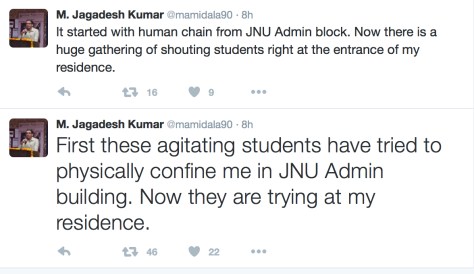
While students marched down the campus, forming a human chain that culminated at the gates of the VC’s residence near the university’s east gate, Mamidala90 (the handle with which the VC distinguishes himself in twitsville) began getting extremely active. While the students were peacefully assembled at the gates of the VC’s residence, very much not in ‘gherao’ or ‘blockade’ mode, Mamidala90 whined about being ‘blockaded’.

A Sample of Mamidala90's tweets while students gathered peacefully outside his residence. Is this what it felt like to hear Nero fiddle while Rome burnt?
A Sample of Mamidala90’s tweets while students gathered peacefully outside his residence. Is this what it felt like to hear Nero fiddle while Rome burnt?

Continue reading The Twitter Gherao of Mamidala90 on the 10th Day of Najeeb Ahmed’s Disappearance from JNU: Shehla Rashid

Ae Shareef Insanon – Sahir Ludhianvi Talks to Those Who Are Still Sane in India and Pakistan

Ae Shareef Insanon

(Sahir Ludhianvi)

khoon apna ho ya paraya ho,
nasl-e-adam ka khoon hai aakhir;

jang mashriq mein ho ya maghrib mein,
aman-e-alam ka khoon hai aakhir.

jang to khud hi ek maslaa hai,
jang kyaa maslon ka hal degi;

aag aur khoon aaj bakhshegi,
bhookh aur ehtiyaaj kal degi.

bartaree ke saboot ki khatir,
khoon bahana hi kya zaroori hai?

ghar ki tareeqiyan mitane ko,
ghar jalana hi kya zaroori hai?

Bomb gharon par giren ke sarhad par,
Rooh-e-taameer zakhm khati hai;

Khet apne jalein ke auron ke,
Zeest faaqon mein tilmilati hai.

Tank aage badhe ke peeche hate,
Kokh dharti ki baanjh hoti hai;

Fateh ka jashn ho ke haar ka soug,
Zindagi maiyaton pe roti hai.

Isliye ae shareef insanon,
jang taltee rahe to behtar hai;

aap aur ham sabhi ke aangan mein,
shama jalti rahe to behtar hai.


اے شريف انسانو !
(ساحر لدھيانوي)

خون اپنا ہو يا پرايا ہو
نسلِ آدم کا خون ہے آخر
جنگ مشرق ميں ہو کہ مغرب ميں
امنِ عالم کا خون ہے آخر
بم گھروں پر گريں کہ سرحد پر
روح تعمير زخم کھاتی ہے
کھيت اپنے جليں کہ اوروں کے
زيست فاقوں سے تلملاتی ہے
ٹينک آگے بڑھيں، کہ پيچھے ہٹيں
کوکھ دھرتی کی بانجھ ہوتی ہے
فتح کا جشن ہو کہ ہار کا سوگ
زندگی ميتوں پر روتی ہے
جنگ تو خود ہی ايک مسئلہ ہے
جنگ کيا مسئلوں کا حل دے گی
آگ اور خون آج بخشے گی
بھوک اور احتياج کل دے گی
اس ليے اے شريف انسانو !
جنگ ٹلتی رہے تو بہتر ہے
آپ اور ہم سبھی کے آنگن ميں
شمع جلتی رہے تو بہتر ہے
برتری کے ثبوت کی خاطر
خوں بہانا ہی کيا ضروری ہے
گھر کی تاريکياں مٹانے کو
گھر جلانا ہی کيا ضروری ہے
جنگ کے اور بھی تو ميدان ہيں
صرف ميدانِ کشت و خوں ہی نہيں
حاصلِ زندگی خِرد بھی ہے
حاصلِ زندگی جنوں ہی نہيں
آؤ اس تيرہ بخت دنيا ميں
فکر کی روشنی کو عام کريں
امن کو جن سے تقويت پہنچے
ايسی جنگوں کا اہتمام کريں
جنگ، وحشت سے، بربريت سے
امن، تہذيب و ارتقاء کے ليے
جنگ، مرگ آفريں سياست سے
امن، انسان کی بقاء کے لیے
جنگ، افلاس اور غلامی سے
امن، بہتر نظام کي خاطر
جنگ بھٹکي ہوئي قيادت سے
امن، بےبس عوام کي خاطر
جنگ، سرمائے کے تسلط سے
امن، جمہور کي خوشي کے ليے
جنگ، جنگوں کے فلسفے کے خلاف
امن، پُرامن زندگي کے ليے‘


A Fast That Ended in Hunger- Thoughts on Irom Sharmila and Hunger Strikes: Anirban Bhattacharya

Guest Post by Anirban Bhattacharya

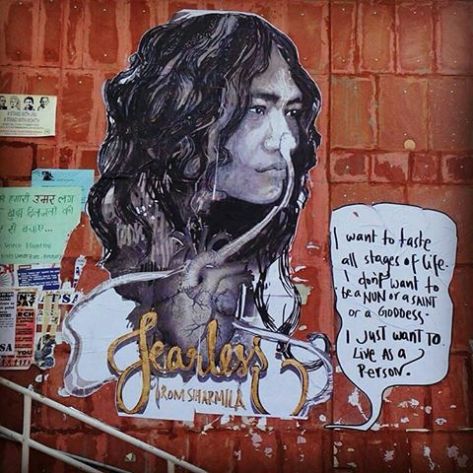
Iram Sharmila Mural at ‘Freedom Square’ JNU. Art by Shijo Suleman and the Fearless Collective. Photograph by Rebecca John. Image, courtesy, ‘The Great Walls of India’ blog on Graffiti and Wall Art

We may have differences in our political approach as to the way and means of the struggle, but what must be stated at the outset is the fact that Irom Sharmila has certainly been an icon of resistance and inspiration in the struggle against AFSPA.

Her 16 year long hunger strike has been a grim reminder of the crimes against the Manipuri people – rape, torture, fake encounters and massacres – committed by the armed forces with impunity under such draconian Acts like AFSPA. But her abrupt decision to end her fast accompanied with her willingness to contest elections in the upcoming assembly elections have met with a mixture of shock, scepticism, disappointment, puzzlement and even anger amongst her people in Manipur and even her close associates. There also seems to be a resentment against her being in a relationship and her plan to marry. Such scrutiny/dragging of her personal life are, however, quite deplorable. But overall, the disappointment with the decision of Irom to quit fasting and contest elections is so strong that, after breaking her fast in the hospital, when she tried to go to a local activist’s shelter, the locals disapproved. She had to seek temporary shelter in an ISKCON temple along with her police guards and then was shifted to a police station and finally she was forced to retreat to the same hospital that housed her for last 16 years. Now, this is telling. But what does it tell? The answer to this question would take us away from criticisms about any particular individual, but to the evaluation of the very method of struggle that she had been a part of, its scope, effectivity and limitations.

Continue reading A Fast That Ended in Hunger- Thoughts on Irom Sharmila and Hunger Strikes: Anirban Bhattacharya

A response to “Kashmir is Feminist Issue” by Sonam Mittal: Tupur Chatterjee

Guest Post by Tupur Chatterjee

Sonam Mittal’s recent piece in Kafila, “Kashmir is Feminist Issue” draws upon an oft-cited gendered analogy to describe the Kashmir’s relationship with India and Pakistan. Though it makes a few pertinent points about the nexus of power and patriarchy and the urgent need for Indian feminist solidarity with the Kashmiri resistance, I found the analogy deeply problematic and strongly feel that it needs further unpacking to underline its worrying implications.

Continue reading A response to “Kashmir is Feminist Issue” by Sonam Mittal: Tupur Chatterjee

Kashmir’s Freedom is India’s Freedom: Hum Kya Chahte? Azadi

I do not think ordinary Indians support the brutality of army occupation in Kashmir. Despite what the Indian state says, and despite what the Indian army and CRPF are doing, I honestly do not believe that any ordinary Indian supports the torture of young men, the blinding of people attending a funeral, the rape of women, the killings and maiming and abuse and humiliation that are now a routinized fact of daily life in the Kashmir valley. To believe that ordinary Indians enjoy watching this spectacle of violence, that ordinary Indians take pleasure in the torture of children, would be to think India is now a country comprised of sadistic psychopaths. I honestly do not think ordinary Indians are psychopaths. I do think, however, that ordinary Indians, and I count myself amongst them, have somehow managed, till now, to keep some distance between what is happening in Kashmir and the idea of India as a whole. After all, India is a large and complex country, a huge and diverse society. Everything that happens in Kashmir, the brutality of the army and the security forces, cannot signify the whole truth of India we tell ourselves. It seems somehow unfair to us ordinary Indians that what happens in Kashmir reflects on us all.

But the time has come now to squarely face some hard truths about ourselves, and the dissimulations, psychological and social, by which we continue to live in this country and call ourselves ‘Indians’. Continue reading Kashmir’s Freedom is India’s Freedom: Hum Kya Chahte? Azadi

Reflections on Dissent -How Is Hannah Arendt Relevant for Contemporary Israel and India? Ira Chadha-Sridhar

This is a guest post by IRA CHADHA-SRIDHAR

In 2016, the age-old conflict between Israel and Palestine has become tougher and more violent at the ground level. The year has come with several disturbing developments in the region- the intensification of the Gaza blockade, the subsequent statement by the Hamas threatening to implement an explosion unless the blockade is lifted and Israel’s rejection of the French peace treaty for the region. Jean-Marc Ayrault, French Foreign Affairs Minister said, in April 2016 that, “The two sides are further apart than ever.” In other news, Ken Livingstone, the former mayor of London, has been criticized for his statements claiming Hitler himself was a Zionist before “he went mad and ended up killing six million Jews”. The merits of Livingstone’s statements and the fallacious reasoning he employs has been rightly criticized by several international commentators. However, he has unknowingly raised larger, more important questions by his statements about how to criticize the Israeli state without being branded as “anti-Semitic” within international discourse- a problem that several commentators critical of the Israeli regime have faced. How can the international community legitimately advance its criticism of the Israeli state? Although critics of Israel are usually non-Jews, there has been a vibrant critique of the oppressive Israeli regime from the Jewish diaspora itself. For historical instruction, in this article, I draw upon the work of one of the earliest and most controversial voices of critique from the Israeli diaspora- the brutally honest voice of 20th century political philosopher, Hannah Arendt. Her book of unparalleled political influence, ‘Eichmann in Jersulelam: A Report on the Banality of Evil’, created what scholars often refer to as a “war” amongst intellectuals across the world that brought to question the validity of her theories and their political and global ramifications. (Elon 2006) Amongst the Jews, and, in particular, in Israel, Arendt’s work was met with anger and severe political backlash. She was labelled “Anti-Jew”, “Nazi” and a “Jew-hater”- labels that were intended to act as violent threats against her distinct, free intellectual voice. (Elon 2006). Continue reading Reflections on Dissent -How Is Hannah Arendt Relevant for Contemporary Israel and India? Ira Chadha-Sridhar

The Paths of Piety: Nandagopal R. Menon

This is a guest post by Nandagopal R. Menon

The recent disappearance of 21 Muslims (men and women) from Kerala – allegedly to join the IS – has created considerable panic in the state. Media and public discourses are rife with speculative reports about their whereabouts, their motives (or pathologies rather), the Islamic networks and scholars with whom they were associated and so on. In this note I want to think about one aspect of this discourse about the disappeared. What is striking is how a specific form of Islamic piety (Salafism) is sought to be, advertently or inadvertently, linked to the IS’ violent extremism. That is, though they are not exactly the same, practicing a certain kind of Salafism could or will lead to embracing the ideology of the IS. To be fair, there is no overt claim made on these lines, but the inordinate focus on Salafism and its practices in the context of IS-related panic creates the impression that there is some kind of organic, straightforward connection between Salafism and IS. Now whatever the precise definition of Salafism given by scholars, what concerns me here is the alleged nature of its “problematic” variant that is at the centre of the controversy in Kerala. This interpretation, sometimes termed “extreme” or “ascetic” Salafism to distinguish it from its “moderate” versions represented by some of Kerala’s major Muslim organisations, apparently stresses a “puritanical” piety that demands a literal interpretation of the Islamic tradition (primarily the Qur’an and hadith, or traditions of what the Prophet said, did or approved). For instance, since there are hadith which say that the Prophet kept goats, Muslims who strive to be pious should also take up herding goats. Similarly, this piety requires one to separate oneself from all kinds of “un-Islamic” ways of life – avoid using products brought with money involving paying or receiving interest, shunning various forms of arts like music and cinema, rejecting certain sartorial styles (trousers that fall below the ankles for men or dress that do not cover the face for women) etc. This form of “puritanical” Salafism thus marks out its practitioners as separate, distinct and even encourages one to (literally) seclude oneself from not only the rest of the society, but also from other Muslims (even family members) who do not adhere to this form of piety. Some “ascetic” Salafis are said to have travelled to Sri Lanka and Yemen, or carved out a separate space in Kerala itself, in their search for the perfect and complete Islamic way of life. Continue reading The Paths of Piety: Nandagopal R. Menon

The Outsiders: Jagjit Pal Singh

This is a guest post by JAGJIT PAL SINGH

It was the year 2013; I took an auto-rickshaw from Dal Gate to Shankaracharya temple. As the auto-rickshaw took a right from the Boulevard towards the road that goes to the temple it was halted by a long queue of vehicles, mostly cars. I could see a security-check post from the distance, men in uniform grilling the drivers and their automobiles with the same thirst. You have to clear it before you pay visit to the deity. In Kashmir, these security-checks posts are just like traffic signals we habitually obey and cross in Delhi or in any other city, every day, every few kilometres. As I got off from the auto to take some fresh air a faujee approached me. He inquired from where I was coming, a very friendly tone in his voice. I was not new to these security-checks. I am half-Kashmiri, half-Punjabi, half-Sikh, half-Indian, half-Pakistani, half- refugee, and many others halves I could never put together to give a name to. He was visibly happy to see an ‘Indian’ in the land of ‘terrorists’, probably mistaken by my Punjabi/Sikh appearance. I’m more Kashmiri than a Punjabi though. If it were 1980’s or 1990’s the approach would have been different. Punjabis, mostly Sikhs, were terrorists those days. There are few other adjectives he used for Kashmiris I would like to skip. I instantly gathered all my Indian-ness and replied in an equally friendly-Indian tone to his friendly-Indian questions. It was a casual chat. Then, he went to the auto-driver in his role as a uniformed Indian in a ‘conflict-zone’; spoke to him in a dialect ‘only Kashmiris understand’, gave a green signal and in few minutes our middle-class auto-rickshaw bypassed all the expensive cars with JK number at the rear. Continue reading The Outsiders: Jagjit Pal Singh

The ‘Congress Question’ in the CPI(M) and the Problem of Historical Relevance

The CPI(M) is currently being rocked by an internal ‘debate’ over what has emerged, to put it in somewhat old-style communist speak, the ‘Congress Question’. I put the word ‘debate’ in quotation marks because, there is a touch of innocence to the way positions in support of a possible alliance with the Congress are being expounded by respected, senior intellectuals like Irfan and Sayera Habib in their letter to the party politbureau or Badri Raina in his article in a leading newspaper. These statements follow the dramatic exit of another widely respected Central Committee (CC) member, Jagmati Sangwan, from the party for precisely the opposite reason – of the CC going soft on the Bengal CPM for having gone against the commonly arrived at understanding in allying with the Congress. There is undoubtedly a potential debate here but since the common reference point in both – the Habibs’ letter as well as in Raina’s article – happens to be the recent election in West Bengal, one cannot help feeling that it is either a  ‘debate’ over a non-problem or is, at best, a question badly posed.

I say this for two reasons. First, the West Bengal CPI(M) [henceforth CPM-WB] is not really fighting any principled battle – all its exertions in West Bengal, contra Irfan and Sayera Habib, are directed, not against the proto-fascist Modi regime but against the Trinamool Congress whose local party apparatus is substantially what it has inherited from the CPM-WB itself. In the present context of West Bengal, what is urgently required is a different Left platform (with different faces that speak a different language) that can take the place vacated by the CPM-WB. In the absence of any such alternative, nothing can prevent the BJP from emerging as the main opposition party – and if that happens, that will be the end of any kind of Left politics for a very long time to come. A ramshackle CPM-Congress alliance as the opposition to the TMC is the surest way of making the Left (even in name) irrelevant in the state’s politics. The CPM-WB’s desire for an alliance with the Congress is motivated not by the need to defeat the Modi regime’s incursions but rather to return to power any which way. This seemed such a distant dream before the elections that the latter was prepared to go into an alliance with the Congress and entertain the possibility of a joint Congress-CPM-WB ministry, even as junior partner, were electoral fortunes to be reversed by the coming into being of the alliance. Thankfully, this possibility seems ever so remote now, following the election results, despite the alliance that we need not worry about it anymore. Continue reading The ‘Congress Question’ in the CPI(M) and the Problem of Historical Relevance

Ashley Tellis ko Gussa Kyun Aata Hai? What makes Ashley Tellis so Angry: Pallavi Paul

Guest Post by Pallavi Paul.

[ This is a response by Pallavi Paul to a post by Ashley Tellis titled ‘Indians are racist, but Africans are not nice either’ that was published recently on the Daily O]

Let me, at the outset state that I feel almost bad taking on such a soft target . I say soft because there is nothing redeemable about Ashley Tellis’ hatred towards ‘dangerous’, ‘morally corrupt’, ‘threatening’ and most importantly ‘unfriendly’ Africans. However, because we are dealing with someone who stakes claim in political-critical thought (or so I am told), this is important to do.

While Tellis cursorily signposts the odd murder and some statements made by a few ministers, he dedicates the rest of the article to creating a portrait of these “Africans” (an all subsuming term that can accommodate an entire continent). By having been a resident of Kishangarh, a colony in Delhi where some ‘Africans’ also happen to live, he takes on the role of the expert in ‘African’ behavior. He produces eye witness accounts of the depravity of these people.

Continue reading Ashley Tellis ko Gussa Kyun Aata Hai? What makes Ashley Tellis so Angry: Pallavi Paul

On the Need for Obscene and Offensive Humour: Rohit Revi

This is a guest post by ROHIT REVI

Tanmay Bhat, popular Stand Up Comic, recently released a video on the popular social networking platform SnapChat, imitating Sachin Tendulkar, the popular cricketer, and Lata Mangeshkar, the popular Musician. He called it ‘Sachin vs Lata Civil War’, where the two figures argue over who the better cricketer is, Tendulkar or Kohli. It was almost immediately picked by right-winged political groups, such as the BJP and the MNS, and over the course of the day, the few seconds long video became about ‘Tanmay vs Indian Culture’, ‘Comedians vs The Nation’ and so on. Mumbai Police consulted legal experts, in the meanwhile asking YouTube and Facebook to take the video down. The mainstream media, held hour long debates in relation to the video, and those who tuned in heard about ‘drawing lines’ and ‘crossing boundaries’, amidst drowning shrieks on, again, what ‘our’ culture is and what it is not. As customary, MNS Leader Ameya Kopkar, issued a quick threat to assault him, if he ever appeared in public. Sunil Pal, the comedian, called the young brand of comedians of which Tanmay is a part, a group “filled with lesbians and gays”. An effigy was burnt.

This article is not about whether the video was funny or not. It is about a certain brand of offensive humour and the need for it. Continue reading On the Need for Obscene and Offensive Humour: Rohit Revi

Three Photographs, Six Bodies: The Politics of Lynching in Twos: Megha Anwer

This is a guest post by MEGHA ANWER


file-19-1458409803749044900
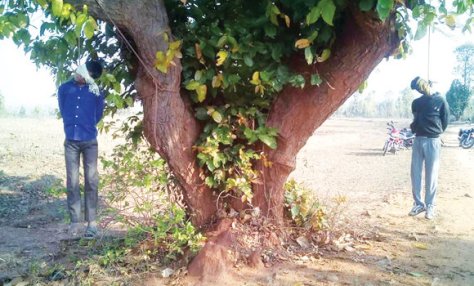
Mazlum Ansari and Imteyaz Khan, Jharkhand 2016.


The recent spate of vigilante attacks in India has lent a new, nearly domestic familiarity to the word “lynching”. This, though, is more than just a shift in language: the nation’s visual archive itself seems be shifting, towards instatement of a new normal. Inside just a year the “lynching photograph” has moved center-stage, filling mainstream news reportage and social media newsfeeds. The imagistic vocabulary of lynching has thus taken on a touch of mundane inevitability in caste and communal violence.

It began in March 2015, with the lynching of Syed Arif Khan in Dimapur, Nagaland. A couple of months later two teenage Dalit girls were raped, strangled and left hanging from a mango tree in Katra village in Uttar Pradesh. Then, on 28 September 2015, Mohammad Akhlaq was bludgeoned to death by a mob in his home near Dadri in what went on to gain spurious notoriety as a “beef-eating incident”. The following March, continuing with the logical rhythm of a scheduled sequel, the cattle herder Mazlum Ansari and his 14-year-old nephew Imteyaz Khan were lynched and hanged from a tree in Jharkhand. Most recently (on May 22) M. T. Oliva, a Congolese citizen, was beaten to death in the national capital of Delhi. This is an incomplete list: it includes only those incidents that resulted in fatalities. In the same timeframe there have been at least a dozen other cases in which the victims somehow survived the end-stage public shaming, torment and lurid physical violence, in short the ordeal of a completed lynching.

There is no lynching without its spectators. Continue reading Three Photographs, Six Bodies: The Politics of Lynching in Twos: Megha Anwer

सामाजिक न्याय ही इस दौर की स्टूडेंट पॉलिटिक्स का मुख्य एजेंडा होगा: अनन्त प्रकाश नारायण

अतिथि पोस्ट: अनन्त प्रकाश नारायण

दिल्ली हाईकोर्ट के आदेश के बाद जे.एन.यू. में 16 दिन की एक भूख हड़ताल खत्म हुई. सभी तरह की सजाओ पर, जो जे.एन.यू. की उच्च स्तरीय जाँच कमिटी (HLEC) ने हम छात्र- छात्राओ पर लगा रखी थी, उन पर रोक लगा दी गई. इस आदेश को ले करके तमाम तरह की व्याख्याए/निर्वचन (Interpretation) है. इस भूख हड़ताल के दौरान कुछ ऐसी घटनाये घटी जिसे यह कैंपस हमेशा याद रखेगा जैसे एकेडेमिक कौंसिल को छोड़कर वाईस चांसलर द्वारा भाग जाना. एकेडेमिक कौंसिल में हमारी मांगे एकदम स्पष्ट थी. उच्च स्तरीय जाँच कमिटी को ख़ारिज करना, ओ.बी.सी. रिजर्वेशन को दोनों स्तर पर लागू करवाना, हॉस्टल में ओ.बी.सी. रिजर्वेशन और साक्षात्कार/ वाइवा के नंबर को कम करना इत्यादि. जब हम जे.एन.यू. की बात करते है तो हमे बिलकुल स्पष्ट हो जाना है कि जे.एन.यू. प्रशासन देश के किसी भी प्रशासन की ही तरह है और कई बार तो उससे भी बदतर. वह तो यहाँ का स्टूडेंट पॉलिटिक्स है जो कि इस कैंपस को समावेशी /इंक्लूसिव बनाने के लिए लड़ता है.
यह वही जे.एन.यू. प्रशासन है जिसने लगभग दस साल तक (1984-93) इस कैंपस से deprivation/ quartile पॉइंट्स को यह कहते हुए ख़त्म कर दिया था कि इस कैंपस में गाँवो से आने वाले स्टूडेंट्स के कारण यहाँ का अकादमिक स्तर ख़राब हो रहा है और कैंपस रेडिकलाईज़ हो रहा है. यह जे.एन.यू. का स्टूडेंटस मूवमेंट था जो की इसे जीत कर 1994 में वापस लाता है. हमने देखा इसी तर्ज़ पर किस तरह से प्रशासन ने ओ.बी.सी. रिजर्वेशन के मिनिमम ‘कट-ऑफ’/cut-off की गलत व्याख्या करके सैकड़ो पिछड़े वर्ग के छात्र- छात्राओ को 2008-2010 तीन वर्षो तक कैंपस से बाहर रखा. यह जे.एन.यू. स्टूडेंट्स मूवमेंट था जिसने कि एक लम्बे पोलिटिकल और लीगल बैटल के बाद एक सही व्याख्या को इस कैंपस में ही नही पूरे देश में लागू करवाया. मदरसा सर्टिफिकेट की लड़ाई हो या फिर अभी ओ.बी.सी. मिनिमम एलिजिबिलिटी का मामला हो, सारे मामले में प्रशासन हमारे खिलाफ ही खड़ा रहा है. आज जब हम ओ.बी.सी. रिजर्वेशन के उद्देश्य/स्पिरिट को इंश्योर कराने के लिए दोनों स्तर पर रिलैक्सेशन लागू कारवाने की कोशिश कर रहे है तब हम देखते है कि किस तरह से इस प्रशासन ने अपने सारी नैतिकता/ मर्यादा को एक तरफ रखते हुए पिछले वी.सी. के समय हुए स्टैंडिंग कमिटी के फैसले को बदल दिया और हद तो तब हुई जब जे.एन.यू. स्टूडेंट्स यूनियन के अध्यक्ष और महासचिव ने यह दावा किया कि इनविटेसन लेटर पर उनके हस्ताक्षर फर्जी किये गये है.

Continue reading सामाजिक न्याय ही इस दौर की स्टूडेंट पॉलिटिक्स का मुख्य एजेंडा होगा: अनन्त प्रकाश नारायण

Choice, Agency and the Naming of Names – The Trap of ‘Immediate Identities’ and the Vision of a Democratic Revolution: Chintu Kumari & Umar Khalid

Paired Guest Posts by CHINTU KUMARI and UMAR KHALID

[ Every struggle goes through highs and lows. The students who are part of the  movements that are spreading out of universities in India – Hyderabad Central University, Jawaharlal Nehru University and Jadavpur University have had their share of internal debates and disagreements, even as they have found moments of significant victory. and solidarity

Students at JNU who have recently concluded their hunger strike to give time to the university authorities to respond reasonably to the High Court directives on the HLEC punishments are now being criticized for having ‘abandoned the struggle’ by some sections who claim to play a role within the broader students movement, when, in fact, nothing of that sort has actually happened.

The majority of the students who were on hunger strike (including several JNUSU office bearers, and others) have said that they have given up the hunger strike against the HLEC recommendations in keeping with the court order.  In doing so, they have never said that they are suspending the agitation against the attempts by the JNU administration to weaken OBC reservation in admissions, hostel seats and deprivation points for women and oppressed sections of society.

In fact it is not as if the HLEC punishments issue has taken precedence over the other issues. It is actually the other way round. The students have decided to give priority to the struggle for ’social justice’ within the campus, while simultaneously giving time to the university authorities to respond adequately to the court directive on the HLEC punishment question.The call for a demonstration against the University Authorities by the JNUSU to continue the struggle on the social justice issues on the 16th of May is indicative of this fact.

13237814_1106943902682435_4288761213192298400_n

The attacks and insinuations against the majority of the students at JNU who were on hunger strike have also featured a deliberate attempt to create divisions within the unified ‘Red-Blue’ / ‘Jai Bhim-Lal Salaam’ dynamics of the movement on the grounds of identity. Activists, such as Umar Khalid, on the left have been singled out for being ‘Savarna-Syed’, if they happen to bear a Muslim name, and for being ‘sold out to the Savarna left’ if they are Dalit, as happened with Chintu Kumari and Rama Naga. This attack has come primarily from individuals representing organizations like BAPSA that claim to speak from a ‘Dalit’ position, and it is given traction by several other individuals eager to flaunt their disdain for the ‘left’ students on Facebook and social media.  Continue reading Choice, Agency and the Naming of Names – The Trap of ‘Immediate Identities’ and the Vision of a Democratic Revolution: Chintu Kumari & Umar Khalid

रोहित वेमुला हम तुम्हारे दिखाए हुए रास्ते पर चल रहे हैं: अनन्त प्रकाश नारायण

अतिथि पोस्ट : अनन्त प्रकाश नारायण

12232699_240984726266767_438392505759428328_o

भूख हड़ताल का बारहवां दिन (12th Days) चल रहा है. प्रशासन कितना दवाब में है कुछ भी कहा नही जा सकता है. हाँ, अगल बगल के हालात देख कर, बात-चीत सुन कर इतना तो जरुर समझ में आ रहा है कि कुछ तो “अन्दर” जरुर चल रहा है. अध्यापक संघ हमारे साथ खड़ा है. उन्होंने हमारे समर्थन में एक दिन का भूख हड़ताल भी किया और अब क्रमिक भूख हड़ताल पर है. हमसे हमारे शुभचिंतको द्वारा बार बार आग्रह किया जा रहा है कि हम भूख हड़ताल को छोड़े. हम जब इस भूख हड़ताल पर बैठ रहे थे तो हमारे सामने की स्थिति ने हमे चेता दिया था कि ये करो या मरो की स्थिति है. इसलिए हमने नारा/स्लोगन भी दिया कि ये भूख हड़ताल हमारी मांगो तक या फिर हमारी मौत तक. हमारी मांग बिलकुल स्पष्ट है कि हम अलोकतांत्रिक, जातिवादी उच्चस्तरीय जांच कमिटी को नहीं मानते है. इसलिए इसके आधार पर हम कुछ छात्र-छात्राओ पर जो आरोप व दंड लगाये गए है उनको ख़ारिज किया जाये और प्रशासन बदले की भावना से इन छात्र-छात्राओ पर कार्यवाही करना बंद करे और जे.एन.यू. के एडमिशन पालिसी को लेकर कुछ मांगे है. सजा क्या है? कुछ का विश्वविद्यालय से निष्कासन, कुछ का हॉस्टल-निष्कासन और कुछ लोगों पर भारी जुर्माने की राशि और कुछ लोगों के उपर यह सब कुछ. अब जब हम आन्दोलन में है तो यह साफ़ साफ़ देख पा रहे है कि यही तो हुआ था हैदराबाद के साथियों के साथ. एक एक चीज हू-ब-हू बिलकुल इसी तरह. इसी तरह से हॉस्टल से निकल कर सड़क पर रहने के लिए विवश किया गया था. इसी तरह तो कोशिश की गई थी रोहित और उसके साथियों को देश और दुनिया के सामने एंटी-नेशनल के तमगे से नवाज देने की. नतीजा क्या हुआ सबके सामने है.

इस भूख हड़ताल के दौरान लोग हमसे मिलने आ रहे है. कुछ लोगों ने जुर्माने की राशि को जुटाने का प्रस्ताव दिया, तो कुछ लोगों ने खुद ही जुर्माने की राशि देने का प्रस्ताव दिया. हम उनके प्रति अपना आभार प्रकट करते हैं. लेकिन क्या यह लड़ाई कुछ दंण्ड/जुर्माने के खिलाफ लड़ाई है? नहीं, यह लड़ाई देश बचने की लड़ाई है. बहुत ही सरल शब्दों में कहा जाये तो इस लड़ाई से यह तय होगा कि इस सत्ता/सरकार के रहते इस देश में विरोध की आवाजो/dissents के लिए कोई जगह होगी की नहीं. जे.एन.यू का प्रोग्रेसिव स्टूडेंट मूवमेंट अपने क्रांतिकारी कलेवर के साथ अपनी पहचान लिए खड़ा रहता है. यह क्रांतिकारी स्टूडेंट मूवमेंट यह तय तो करता ही है कि इस कैंपस  को इतना समावेसित/इंक्लूसिव बना कर रखा जाये कि समाज के सबसे निचले तबके के लिए भी यह विश्वविद्यालय का गेट खुला रहे लेकिन साथ ही साथ इस छात्र-आन्दोलन ने अन्दर और बाहर के मुद्दे का भी भेद मिटा दिया और देश के सामने एक वैकल्पिक राजनीति का मॉडल ले करके सामने आया.

बीते दिनों इस स्टूडेंट-मूवमेंट के साथ साथ पूरे जे.एन.यू को निशाने पर लिया गया और इसे एक संस्थान के रूप में देश-विरोधी ठहरा देने का प्रयास हुआ. आखिर देश है क्या? आखिर हम देशभक्ति माने किसे? अभी कुछ दिनों पहले हम देश की विभिन्न जगहों पर कैम्पेन में थे. उन सभाओ व परिचर्चाओ के दौरान भी देशभक्ति चर्चा का एक गर्म विषय रहा. उन सवालों को करने वाले लोग ही कई बार इन सवालो का जवाब दे देते. वो भारत का नक्शा दिखा कर के और भारत की सीमाओं को दिखाते हुए बोलते इन सीमाओं के भीतर जो कुछ भी है देश है. इसका मतलब पेड़-पौधे, रेलगाड़ी, प्लेटफार्म, पहाड़, जंगल, कारखाने, यहाँ के लोग, खनिज-संपदा, नदियाँ, तालाब, इत्यादि सब कुछ देश है. इस दौरान मुझे अपवादिक रूप से भी कोई ऐसा व्यक्ति नहीं मिला जिसने देश की इस परिभाषा से असहमति जताई. देश के लिए प्रतीक बने, संविधान बना, कानून बने और जैसे-जैसे यह देश बदलता जाता है, आगे बढ़ता जाता है, उसी के आधार पर प्रतीक से ले करके कानून तक सब चीज़ों में परिवर्तन होता जाता  है. देश के लिए प्रतीक होते हैं, प्रतीकों का कोई देश नहीं होता है. देश लगातार चलने वाली एक प्रक्रिया का हिस्सा है. देश रोज़ बनता है और हमेशा नये ढंग में हमारे सामने आता रहता है, जिसे इस देश का गरीब, किसान, मजदूर और बाकी मेहनतकश लोग बनाते है. अब लड़ाई इस बात की है कि यह देश किसका है? और इसका मालिक कौन होगा? इस देश की संपत्ति, संसाधनों पर हक किसका होगा? यही गरीब, मजदूर, किसान और मेहनतकश लोग जो रोज़ इस देश को बनाते है, जब अपने हक के लिए खडे होते है तो इस देश की सत्ता/सरकार चंद पूंजीपतियों के साथ क्यूँ खड़ी हो जाती है? और इस देश को बनाने वालों के हक में जब जे.एन.यू. जैसे संस्थान आवाज़ उठाते हैं तो उसे देशद्रोही करार देने की कोशिश क्यों होती है?

जिस समय जे.एन.यू. का मसला ही पूरे देश में चर्चा का विषय बना रहा उस समय जे.एन.यू. प्रशासन व इस देश की सत्ता ने बड़ी चालाकी से अपने मंसूबों को पूरा करने में इस समय का इस्तेमाल किया. यह सर्वविदित है कि  जे.एन.यू. अपनी एडमिशन पालिसी  के कारण ही अपना एक इनक्लूसिव/समावेशिक कैरेक्टर बना पाया है. लगभग 24 साल से चली आ रही इस पालिसी को प्रशासन ने बदल दिया और स्टूडेंट कम्युनिटी को कुछ खबर तक नहीं हुई. दूसरा, ओबीसी के मिनिमम एलिजिबिलिटी कट ऑफ, जिसको चार साल (4 years) के लम्बे संघर्ष के बाद सुप्रीम कोर्ट तक जा करके इस जे.एन.यू. प्रशासन के खिलाफ जीत कर लाया गया था और इसे सिर्फ जे.एन.यू. नही पूरे देश के संस्थानों के लिए अनिवार्य किया गया था, उसको ख़त्म कर दिया गया और किसी को कानो-कान खबर नहीं हुई. इसी तर्ज पर दूसरी तरफ सत्ता में बैठे लोगों ने इस समय का फायदा विजय माल्या को इस देश के बाहर भेजने के लिए इस्तेमाल किया. ये सत्ता/सरकार की बहुत ही पुरानी तरकीब रही है कि अगर देश की कुछ रियल समस्याएँ हैं तो उसकी तरफ से ध्यान भटकाने के लिए कुछ ऐसा करो कि इस देश के लोगों का ध्यान उधर जाए ही ना. इस सरकार के 2 साल बीत जाने के बाद इनके पास ऐसा कुछ भी नहीं है जो इस देश के लोगों के सामने गिना सके कि हमने क्या किया. ये चुनाव पर चुनाव हारते जा रहे हैं. तब इन्होने इस देश के लोगों का ध्यान उनकी विफलता से हटाने के लिए जे.एन.यू. “काण्ड” को गढ़ा. इस साजिश को साफ़ साफ़ समझा जा सकता है कि जब जे.एन.यू. का आन्दोलन चल रहा था उस समय भाजपा अध्यक्ष ने घोषणा की कि वह इस मामले को लेकर के यू.पी. के घर-घर में जाएंगे. यूपी के घर घर ही क्यूँ? क्यूंकि वहाँ चुनाव आने वाले हैं. धूमिल ने सत्ता/सरकार के इसी साजिश की ओर इशारा करते हुए हमे सावधान किया और लिखा कि

चंद चालाक लोगों ने

जिनकी नरभक्षी जीभ ने

पसीने का स्वाद चख लिया है,

बहस के लिए भूख की जगह भाषा को रख दिया है….

अगर धूमिल की इसी बात को और आगे बढाते हुए कहा जाए तो आज भूख की जगह प्रतीकों/सिम्बल्स/नारों को रखने की कोशिश चल रही है. यानि हमारे जीवन की रियल समस्याओ से ध्यान हटा देने की हर बार की तरह एक कोशिश, एक साजिश .

जे.एन.यू. में जब ये आन्दोलन चल रहा है तब इस आन्दोलन को लेकर तरह तरह की शंकाए/भय, जो कि बहुत  हद तक जायज़ भी है, ज़ाहिर किये जा रहे हैं. हमको यह कहा जा रहा है की इस प्रशासन से हमें कोई उम्मीद नहीं रखनी चाहिए. हम इस बात से पूरी तरह सहमत हैं कि हमें इस प्रशासन से कोई उम्मीद नहीं रखनी चाहिए. तब इस स्थिति में हमें क्या करना चाहिए? हमारे सामने क्या रास्ता है? हमारे ऊपर जो दंडात्मक कार्यवाहियां हुई है, उनको मान लेना चाहिये? हमारा यह साफ़ साफ़ मानना है कि ये दंडात्मक कार्यवाहियां हमारे उपर एक विचारधारात्मक कार्यवाही (ideological punishment) है. भले ही यह कार्यवाही कुछ छात्र-छात्राओं पर की गयी है लेकिन इसका निशाना पूरा जे.एन.यू. ही है. इसका कारण स्पष्ट है कि जे.एन.यू. साम्प्रदायिकता व साम्राज्यवाद विरोधी होने के कारण हमेशा से सत्ता के निशाने पर रहा है. यहाँ पर समाज के हर तबके की आवाज़ के लिए एक जगह है और इतना ही काफी है आरएसएस के लिए कि वह जे.एन.यू. विरोधी हो. जेएनयू के छात्र आन्दोलन की विशेषता है कि यह कैम्पस के मुद्दों को उठाने के साथ साथ देश दुनिया में चल रही प्रत्येक चीज़ पर सजग रहता है, और ज़रूरत पड़ने पर हस्तक्षेप भी करता है और इसी का परिणाम है कि इस सरकार के सत्ता में आने से पहले और बाद में हमेशा से जब भी इन्होने इस देश के लोगों के खिलाफ कदम उठाएं हैं तब-तब इन्हें यहाँ के छात्रों के आन्दोलन/विरोध का सामना करना पडा है.

अब इन सारी चीज़ों को ध्यान में रखकर देखें तो हमें क्या करना चाहिए? नए कुलपति/वाईस-चांसलर साहब की नियुक्ति हुई है, वो अपने संघ के एजेंडे पर बेशर्मी और पूरी इमानदारी के साथ काम कर रहे है. उनको जे.एन.यू. के कैरेक्टर को ख़त्म करना है. ऐसे समय में छात्र-आन्दोलन की ज़िम्मेदारी क्या होगी? क्या हम लोग इस देश के छात्र-आन्दोलन के प्रति जवाबदेह नहीं है जबकि आज एक ऐतिहासिक जवाबदेही हमारे कंधो पर है. जे.एन.यू. के छात्र-आन्दोलन को इस देश में एक सम्मानजनक स्थान हासिल है. कई लोग तो इसे भारतीय छात्र-आन्दोलन का लाइट हाउस तक भी कह देते हैं. यह सही बात है कि हम जब किसी आन्दोलन में होते हैं तो हम यह तय करते है  कि इस आन्दोलन से हमें कम से कम क्या निकाल कर लाना है. लेकिन इस आन्दोलन में क्या कुछ कम-ज्यादा/ मिनिमम-मैक्सिमम जैसा कुछ भी है? यह तो पूरे जे.एन.यू. को बचाने की लड़ाई है. यह देश के लोकतंत्र को बचाने की लड़ाई है. यह आन्दोलन सिर्फ आये हुए संकट को टाल देने के लिए नहीं है, बल्कि आने वाली पीढ़ियों के प्रति जवाबदेही के लिए भी है. अगर इस आन्दोलन को लेकर सोचने का नज़रिया होगा तो यह बिलकुल नहीं होगा कि इस आन्दोलन से कैसे निकला जाए, बल्कि यह होगा कि इस आन्दोलन में कैसे और धंसा जाए और इसे और कैसे धारदार बनाया जाये. अगर “उन्होंने” कुछ तय कर लिया है तो हमें भी कुछ तय करना होगा. हम किसी मुगालते या भावुकता में भूख हड़ताल में नहीं बैठे हैं बल्कि पूरी तरह से सोची समझी गयी राजनीतिक प्रतिबद्धता के साथ हम इस आन्दोलन में गए हैं. हम भी नहीं जानते है कि हमारी लड़ाई का अंजाम क्या होगा. आज हम अपनी लड़ाई को रोहित वेमुला की लड़ाई से अलग करके नहीं देखते हैं. रोहित ने हमें संदेश दिया कि अगर बर्बाद ही होना है तो लड़ते हुए बर्बाद हो. रोहित हम तुम्हारे दिखाए हुए रास्ते पर चल रहे हैं.

अनन्त प्रकाश नारायण

(लेखक जे.एन.यू. के सेंटर फॉर द स्टडी ऑफ़ लॉ एंड गवर्नेंस के शोध-छात्र हैं और जे.एन.यू. छात्र संघ के पूर्व उपाध्यक्ष हैं.)

Do Not Rest in Peace, Jisha: Shehla Rashid

Guest Post by Shehla Rashid

(Pictures by Biju Ibrahim)

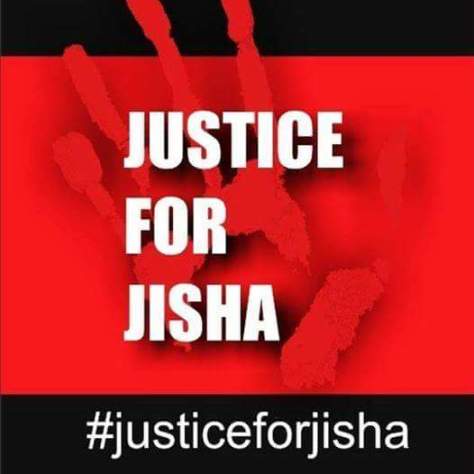
Dear Jisha, I never knew you, nor did you know me.

You were probably a “usual” student, pursuing your studies, dreaming of a better future for yourself and your country. You were probably someone like Rohith Vemula, who dreamed of stars and skies. I learnt that you were a Law student, but I regret to tell you that the Law of this country fails us miserably.

13133163_10153366003160194_2754795347866060882_n

It is because a Bhanwari Devi does not get justice that Bhagana happens. It’s because no one in Bhagana gets justice that a Delta Meghwal happens. It is because a Delta Meghwal does not get justice that a Jisha happens. And most painfully, I can predict that you may not get justice either.

This is because the Law that you studied is not the law that actually runs this country- this country runs according to a parallel law which is called Manusmriti. It is routinely quoted by judges in their judgments, but perhaps you wouldn’t have studied that in Law school. It is the law of Manusmriti that prescribes limits for women and limits for Dalits.

Continue reading Do Not Rest in Peace, Jisha: Shehla Rashid

Diary of a JNU Student on Hunger Strike: Pankhuri Zaheer

Guest Post by Pankhuri Zaheer

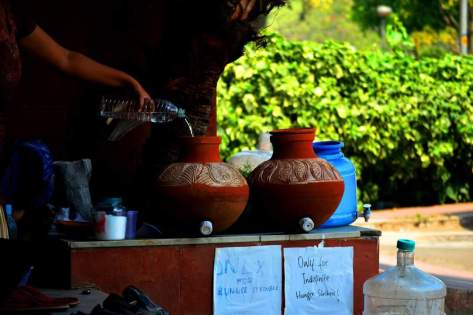
Water - A Gift for Hunger Strikers. Photo Courtesy, Azhar Amim
Water – A Gift for Hunger Strikers. Photo Courtesy, K. Fayaz Ahmed

“I wanted to bring you something but I didn’t know what to get you so I got you a bottle of water,” says a friend who would perhaps never identify herself as a student activist but since 9th February, like many like her, has been an integral part of the stand with JNU movement.

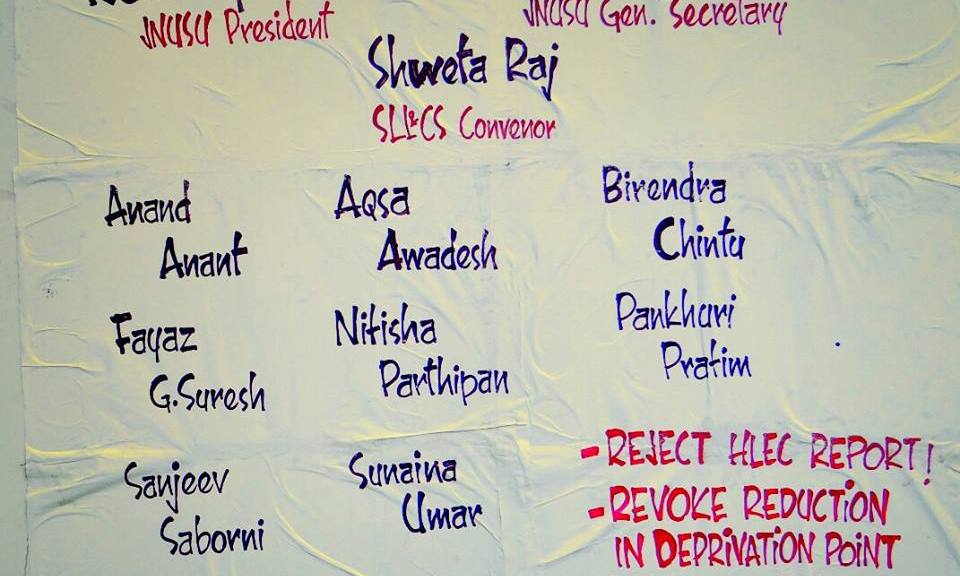
19 of us have decided to sit on an indefinite hunger strike till the time the farcical report of the High Level Enquiry is not rolled backed in its entirety. Today, April 30th, is the third day of our hunger strike.

Continue reading Diary of a JNU Student on Hunger Strike: Pankhuri Zaheer

Summer of Rage: JNU Students Begin Fast Unto Death against HLEC Report

13083178_1763261193905640_250606241251585686_n

Spring has given way to the beginning of a turbulent summer. April, is a cruel month. Temperatures have risen, and so has the level of rage in university campuses. The JNU University Authorities (and their masters – in the Ministry of Human Resources Development, the Prime Minister’s Office and the RSS Citadels in Mahal, Nagpur and Jhandewalan, Delhi) thought that they could break the resolve of the students by enacting a series of harsh measures against them just before exams begin and the university term ends in summer vacations.

Chintu Kumari, Anirban Bhattacharya and other students give the call to protest against the HLEC and call for a Hunger Strike. Photo, Courtesy, Azhar Amim

13055719_10154616732485016_4978357478249045500_o

This is a time, they must have thought, when students will be busy with preparations, and the rising heat will discourage the kind of mass mobilizations that the campus has seen since February. Students in JNU resolved a few hours ago to prove them wrong, and decided to fight back . A massive gathering stood its ground at the Administrative Block, aptly re-christened, ‘Freedom Square’.

Rama Naga, Gen.Sec. JNUSU, (Centre) and JNU Students Calling for Indefinite Hunger Strike on April 27, 2016. Photo, Courtesy, Azhar Amim

They have decided that a batch of students will sit on indefinite hunger strike – a ‘fast unto death’ – until the JNU authorities roll back the draconian measures listed in the HLEC Report.

The 20 students who will be sitting in indefinite hunger strike at JNU.

There’s no looking back now. Whatever happens from now on wards, will be seen as a consequence of the cruel, evil mindset of the current regime, which truly treats the lives of the young as dispensable ballast. Its time to prove them wrong. This is a call that goes out to all students and teachers, and sensible individuals, not just in JNU, not just in Universities and Colleges all across India and all the territories administered by the Indian republic, but to everyone reading this post anywhere in the world, to stand by the courageous students of JNU. It is our responsibility to see that the JNU Authorities see reason and back down. If anything untoward happens to any student, the university authorities, and the regime backing them, will be clearly culpable.

Here is Umar Khalid, speaking just before commencing his Hunger Strike

Here is Chintu, former Gen. Sec. JNUSU, speaking at the Mashaal Juloos, (Torchlight Procession) just before beginning the Hunger Strike.

Listen to Kanhaiya Kumar, President of the JNUSU – restating the reasons for the continuation of the movement.

Thanks to the ‘We are JNU Media Group’ and the AISA Youtube Channel, for the videos.

Sanghis, Sex and University Students – What is it Really All About? Ayesha Kidwai

Guest Post by Ayesha Kidwai

[ The prurient fantasies contained in the ‘JNU Dossier’, produced by some right wing faculty members of JNU in or around October 2015, have been ‘outed’ by an excellent report by Ajoy Ashirwad Mahaprashasta in Wire.org. This comes exactly at the time when the JNU administration has shown its fangs by delivering a low blow by way of the measures outlined in the report of the ‘High Level Enquiry Committee’ appointed by the Vice Chancellor. An impartial examination of the HLEC document and the ‘Dossier’ in will reveal some startlingly resonant patterns. Clearly, the ‘Dossier’, which had been dismissed by the former Vice-Chanceller, Prof. Sopory, has been reincarnated at the express orders of the Nagpuri masters of the present dispensation. We are sharing below an excellent response to the ‘Dossier’ by Ayesha Kidwai, one of the professors – ‘named’ in the dossier. This is taken from Ayesha Kidwai’s status update on her Facebook Page.

For another take down of the ‘Dossier’ – see also – “Sex and sedition: What the JNU dossier tells us about the right-wing imagination” – in Scroll.in by Kavita Krishnan. Meanwhile, JNU Students have commenced on a ‘fast unto death’ in protest against the university administration’s senseless measures. Kafila]

Sanghi smut is in season again! For the authors of the Dirty Dossier, JNU nights are forever scented with musk, with couples draped on every bush, suitably fortified by free alcohol, thoughts of secession, and cash payments supplied by the Awesome Foursome. At its peak, the party can practically involve the whole university, because as per Shri Gyan Dev Ahuja’s estimates, the number of students frolicking this will be 7000 (3000 condom users X 2, plus 500 injectable walas X 2). (Assuming of course that the few hundred left over have gone to fieldwork, have exams, or are abstemious and/or abstinent in nature.)

Laugh as we may (and must) at these feverish imaginings, it’s also important to understand that the very notion of a free university challenges not only misogyny, but also the social apartheid produced by caste and exclusionary religion.

Continue reading Sanghis, Sex and University Students – What is it Really All About? Ayesha Kidwai

Rise Up against the Proxy War on Students by the Modi Regime: Shehla Rashid

Guest Post by Shehla Rashid, (Vice President, Jawaharlal Nehru University Students’ Union)

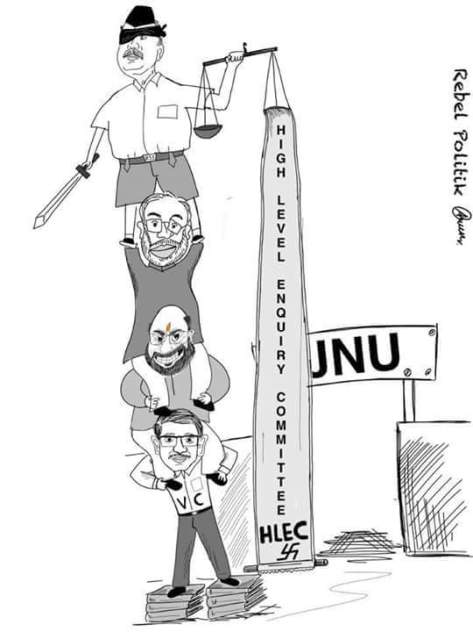
Rise up against the proxy war on students by the Modi regime.

Cartoon by V. Arun Kumar

JNUSU rejects the report of the enquiry committee constituted by the Vice-Chancellor to look into the 9th of February incident. JNUSU also rejects its reports and any punishment handed out by it. The JNUSU and JNUTA had repeatedly asked the administration to democratise the enquiry committee, but this was not done.  Now, when the holidays are here, the VC has made public the punishments, after one and a half months of submission of the HLEC (High Level Enquiry Committee) report. Continue reading Rise Up against the Proxy War on Students by the Modi Regime: Shehla Rashid